Natalie Harp, Bred to Serve the Christian Right
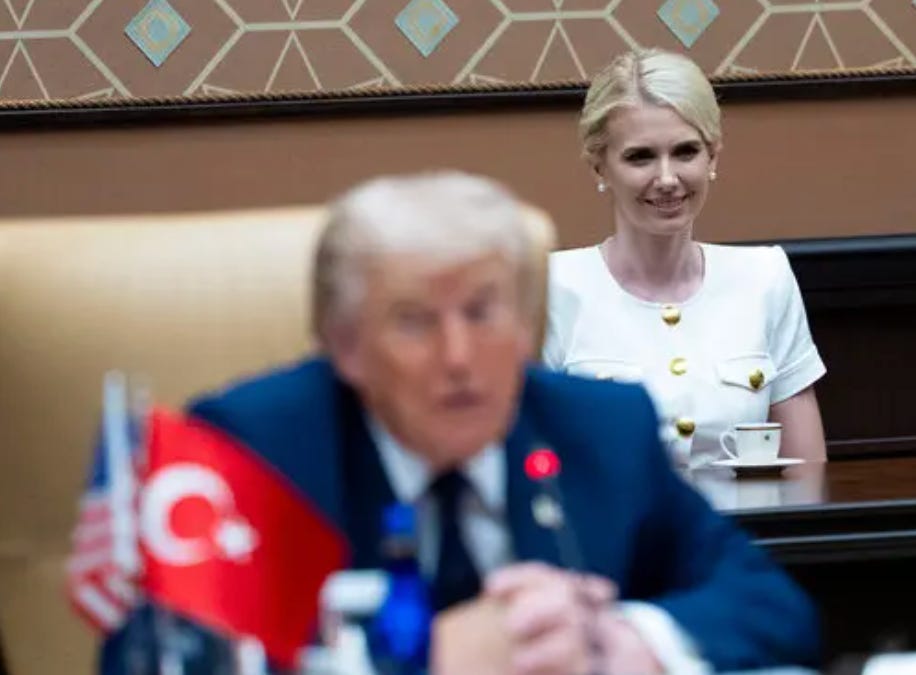
🔗 **Source:** [Natalie Harp, Bred to Serve the Christian Right](https://underthedesknews.substack.com/p/natalie-harp-bred-to-serve-the-christian)
> [!note]+ Document Notes
> tags: [christian-nationalism, nar-research, seven-mountains, marketplace-ministry, source-criticism, epistemic-hygiene]
> author: Unnamed — Under the Desk News (Substack), no byline in capture
> source: https://underthedesknews.substack.com/p/natalie-harp-bred-to-serve-the-christian
> reference: "Natalie Harp, Bred to Serve The Christian Right" — Under the Desk News
> date created: 2026-08-26 17:20
>
> > [!info] Generated analysis — not the author's words. Sections below are machine-written
> > from the captured source. Only text inside `> [!quote]` blocks is verbatim from the author.
> > Do not quote or attribute any other line to the named author.
>
> # 🏷️ Title: Natalie Harp, Bred to Serve The Christian Right
>
> **Attribution.** Reader's `author` field reads `underthedesknews.substack.com` — a domain. **No byline in the capture.** First person, informal register, referencing a "Friday show" and a co-host or colleague ("our girl Monte Mader"), which indicates a video/podcast operation with a Substack companion. Attribute to *the Under the Desk News author*; do not guess a name.
>
> **Register — and this needs to be stated before anything else.** This is **partisan opinion writing in a deliberately casual, profane, snarky register.** It is not reporting, does not present itself as reporting, and mixes three very different kinds of material without marking the boundaries: **sourced investigative journalism** (a *Washington Post* investigation with named academics), **verifiable institutional history** (colleges, a named evangelical committee), and **unverified biographical assertion, speculation, and armchair psychology about living people.**
>
> **⚠️ Handling note — this one is unusually serious.** The piece contains **speculation about a real person's suicide**, **an armchair mental-health characterisation of a living woman**, and **an internal factual contradiction** (detailed below). This analysis separates what is sourced from what is asserted, and **records the source's claims as claims.** Nothing here should be read as my assessment that any unsourced allegation is true.
>
> **Why it matters here.** Two reasons, pulling in opposite directions. **It contains the most useful NAR-research material in this batch** — a specific, traceable Christian Nationalist institutional pipeline, including a named evangelical body and a named missiological programme. And **it is the batch's clearest worked example of how not to handle sources**, which makes it valuable as a contrast case against its Progressive Heretic companion. **Same subject, same core facts, opposite epistemic standards, broadly similar conclusion.**
>
<!-- deep-read:sections start -->
## 🧭 Table of Contents
1. The contradiction, flagged first
2. Summary
3. Main Content and Notes
4. References
5. Paraphrase
6. Newsletter
7. Action Items
8. Hypotheses
9. Methodology
10. Questions
11. Future Research
12. Implications
13. Learning Styles Assessment
14. Accessibility Assessment
15. DEIB Assessment
16. Logical Validity
17. DARVO Analysis
18. Conclusion
19. Refactor Appendix
20. Template Library
## ⚠️ The contradiction, flagged first
The piece states, of the mother:
> *"Which is why when her husband killed himself, she wanted to tell people he 'died in his sleep'."*
**But the antecedent of "her" is ambiguous and the surrounding text makes the sentence incoherent as written.** The paragraph is about Mrs. Harp and the family's homeschooling; the preceding paragraphs establish that **Mr. Harp Jr. — the father — died by suicide.** And the piece states repeatedly and emphatically that **Natalie never married**: *"Graduating without a single proposal"*, *"still unwed!"*, *"In lieu of a husband or a father."*
**So "her husband" can only mean Mrs. Harp's husband — the father.** Read that way the sentence is consistent, but it sits inside a paragraph whose subject drifts between mother and daughter, and the very next sentence returns to Natalie (*"This is important to why Natalie has such a loose grip on reality"*). **A reader can easily take it as a reference to a husband of Natalie's that the piece elsewhere denies exists.**
**Recorded as: a construction ambiguity in a passage making a serious claim about a real death, in a piece with no editor.** It is the kind of error that matters precisely because the surrounding material is unsourced — there is nothing to check it against.
## 📝 Summary
**The thesis**, stated in the title and the third paragraph:
> *"Natalie Harp is what you get when two Jesus freaks find love, dedicate themselves to becoming power players in Christian politics and raise their two children as assets to leverage, tools to use, and tokens to be spent."*
**The author's stated frame is sympathy, not attack** — *"The truth of her life and family history is far more sad than salacious"* — and the piece closes on the same note: *"that's more sad than scandalous."* **Whether the execution honours that framing is the central question about the piece**, and the answer is mixed.
**The institutional pipeline — the genuinely valuable content.** The piece traces a route through named Christian Nationalist institutions:
- **Wheaton College** — founded 1860 by evangelical abolitionists, a stop on the Underground Railroad, graduated one of Illinois' first Black college graduates. The author argues its modern trajectory diverged, citing the **Julie Rodgers** hiring (a gay Christian blogger brought in as a ministry associate on a celibacy-commitment basis) and attributing the ideological shift to **Billy Graham's** influence as a major donor and alumnus.
- **Point Loma Nazarene University** — where **James Dobson** is named as a notable alumnus.
- **Liberty University** — Jerry Falwell's school, with **Will E. Young**, former editor-in-chief of Liberty's *Champion*, quoted from 2019 on a *"culture of fear"*: the school *"founded on principles of fundamental Christianity, is now a place that has zero tolerance for new questions and ideas. Those who harbor them must remain silent, or leave."*
**The family's ideology, as the author characterises it.** Not ordinary churchgoers but *"part of a subculture of Christians who believe the way to have most impact on the United States, and perpetuate 'American Exceptionalism'… is to run very successful businesses."* The father inherited a real-estate business that *"funded evangelical missionary work abroad, and earned him clout with the Christian politicians."*
**The single most research-valuable detail:** in 2019 the father joined the **Lausanne Committee for World Evangelization** — described as *"a global network of leaders in the Faith at Work realm"* — as **"the Catalyst for Marketplace Ministry."** The piece also names the **4/14 Window**, the evangelical focus on children aged 4–14.
**Then the piece's worst moment.** The father died by suicide within a year of joining. The author writes:
> *"NOT SAYING the Lausannes were responsible or anything but like.. ya know.. was something particularly stressful happening over there that would cause this man to abandon hope"*
**That is insinuation with built-in deniability, about a real person's death, with no evidence offered.**
**The sourced core — and this part is genuinely solid.** On Harp's public claim that Trump's **Right to Try** law saved her life from a rare bone cancer, the piece quotes *Washington Post* reporting directly:
> *"the treatment she said she has received — 'an FDA-approved immunotherapy drug for an unapproved use' in her own words — would not have been covered under Right to Try because the drug had already been approved. It is also striking that two months before Trump even signed the law, Harp had already spoken online about receiving her new treatment."*
Plus two named academics: **Alison Bateman-House** (NYU medical ethicist), who tracked the law 2018–2020 and *"estimates that fewer than 10 people have used it to get treatments since it was passed"*; and **Jeremy Snyder** (Simon Fraser public health ethics), who compiled discrepancies for the *Post* and is quoted: *"if this woman who didn't even use the Right to Try law is the best example they can come up with, it just shows the emptiness of the achievements they are trying to claim."*
**The "forgotten woman" detail** is a real and checkable observation: Harp graduated in 2015 and began *"identifying in essays she'd publish on her LinkedIn as a 'forgotten woman' — a term that would become a slogan for Donald Trumps 2016 campaign."*
**Where it goes past the evidence.** *"So did she even have bone cancer? No one knows"* — followed by circumstantial reasons to doubt it (no malpractice suit filed, a *"100% miraculous recovery"*, nobody recalling chemo appointments, two aunts who died of cancer supplying a template). **The piece does not establish this and says so, then argues it anyway.**
**And the psychological claims.** *"This is important to why Natalie has such a loose grip on reality today. She's never lived in reality."* Plus an acceptance of *"Susie Wiles and secret service analysis of her being a mentally unwell woman and potential stalker/danger to the President."* **Unsourced, and about a living named individual.**
**The conclusion**, which is notably restrained given everything before it:
> *"I don't think Natalie Harp is the Presidents lover, I do think she'll allow people to put that on her if it benefits the President… She's a sheep, trained to be loyal to a (white male Christian) Shepard. In lieu of a husband or a father.. I guess that's Trump.. and that's more sad than scandalous."*
**Note that this is the same conclusion the Progressive Heretic piece reaches** — decline the sex-rumour frame — arrived at by a completely different and far looser route.
## 📖 Main Content
### 🗒️ Notes
**Opening.**
- Epigraph attributed to Trump, speaking to staff about Harp: *"All of you will go off and make money, she'll never leave me."* **No source given.**
- Names in circulation: *"the 'human printer'"*, *"the presidents 'special assistant'"*, *"his rumored lover??"*
- **The stated frame:** *"The truth of her life and family history is far more sad than salacious."*
- **The thesis:** *"Natalie Harp is what you get when two Jesus freaks find love, dedicate themselves to becoming power players in Christian politics and raise their two children as assets to leverage, tools to use, and tokens to be spent."*
**Wheaton College.**
- Founded **1860** by evangelical abolitionists; a stop on the **Underground Railroad**; graduated *"one of Illinois' first Black college graduates."* **Verifiable historical claims.**
- The author's characterisation of its present: *"a lot less LIBERAL arts going on"*, and *"noted as the most anti-LGBTQ colleges."*
- The **Julie Rodgers** case: a gay Christian blogger hired *"as a ministry associate who they wanted to reach out to LGBT students about being committed to celibacy."* The author's aside on the mechanism is sharp: *"(who aren't allowed to be out so idk how they were identifying these students…)"* — **a real observation about how a policy of enforced invisibility makes its own outreach incoherent.**
- **The causal claim:** the shift *"can be directly tied to the influence of Billy Graham, an alumni of the school who would go on to have undue influence over their direction thanks to his generous financial contributions."* **Asserted, not evidenced.**
**The family's ideology.**
- Not ordinary churchgoers: *"part of a subculture of Christians who believe the way to have most impact on the United States, and perpetuate 'American Exceptionalism' (something core to their Christian Nationalist identity) is to run very successful businesses."*
- **Mr. Harp Jr.** inherited his father's **real estate empire**, which *"funded evangelical missionary work abroad, and earned him clout with the Christian politicians and as a speaker at evangelical conferences."*
- **2019:** joined the **Lausanne Committee for World Evangelization**, *"a global network of leaders in the Faith at Work realm, as the Catalyst for Marketplace Ministry."*
- The group *"also focuses on what's known as the 4/14 window - evangelizing children ages 4-14."*
- **The author's characterisation of the 4/14 programme:** participants *"often recruited from countries facing massive socioeconomic disaster are rewarded for recruiting friends of other faiths… Basically - children are encouraged to bully other children who did not share their faith."* **This is the author's gloss, not a sourced description**, and "bully" is doing heavy interpretive work on what is elsewhere described as peer evangelism.
- **The suicide passage.** He was on the committee *"for one year before killing himself."* Then: *"NOT SAYING the Lausannes were responsible or anything but like.. ya know.. was something particularly stressful happening over there that would cause this man to abandon hope and commit (in his religious view) the 'moral sin' of self harm? His religion preaches that killing yourself sends you to hell.. what was going on in his world that HELL was the better answer?"*
- **Reviewer note: this is insinuation with deniability.** The disclaimer does not neutralise the implication; it advertises it.
**The household.**
- **Mrs. Harp homeschooled**, *"sticking to a strict interpretation of truths set forth by the bible. So.. no Dinosaurs, but yes a single man built an arc that saved two of every animal."*
- The family — parents plus **Preston** and **Natalie** — kept *"cloistered away in a Christian Nationalist bubble."*
- **The armchair claim:** *"This is important to why Natalie has such a loose grip on reality today. She's never lived in reality. She's lived within the constructs of what reality OUGHT to be."*
- **The ambiguous sentence:** *"Which is why when her husband killed himself, she wanted to tell people he 'died in his sleep'."* **See the contradiction section above.**
**The two children.**
- **Preston** left at 18 *"fucking off to California chasing a more hippie lifestyle"*; *"He currently lives in Nicaragua."*
- **Natalie** at 18 was *"funneled into the first of two Bible colleges, Point Loma Nazarene University - where James Dobson stands as one of their most notable alumni - in the hopes that she'd meet a husband and settle down, following in her mother and grandmothers footsteps, serving at the right hand of a Christian leader, like her father."*
- **The family's stated belief, per the author:** *"Their family openly believe white male Christians are 'superior' and train their women and girls to behave as assets to those white male Christians."* **Asserted with no source.**
- *"Problem is… Natalie failed to launch into her tradwife life. Graduating without a single proposal."*
**Liberty University.**
- Jerry Falwell's school.
- **Will E. Young**, former editor-in-chief of Liberty's *Champion* student newspaper, quoted from **2019** on the *"culture of fear"*: the school *"founded on principles of fundamental Christianity, is now a place that has zero tolerance for new questions and ideas. Those who harbor them must remain silent, or leave."* **A named source with a stated role and date — the piece's second-best sourcing.**
- **The sorting claim**, attributed to *"our girl Monte Mader"* who *"also attended Liberty University and spilled the tea on how their sorting houses work"*:
- Some women are *"used as bait for men - set up to be wives and nothing more."* **Charlie Kirk** quoted: *"You go there to get your MRS. Degree."*
- Others are *"put to work as useful tools for the patriarchy"* — trained as lawyers for firms like the **Alliance Defending Freedom**, described as *"a massive national nonprofit law firm that coordinates high-profile Supreme Court litigation, trains allied attorneys, and works to roll back abortion rights and LGBTQ+ protections."*
- Or trained *"in journalism to make propaganda for the right wing"* — **Fox News, OAN, Breitbart**.
- Or *"in business to build wealth for the Christian Nationalist movement, like Erika Kirk."*
- *"But mostly, they turn out right wing politicians and enablers, like Natalie Harp."*
- **Reviewer note:** this is second-hand from one alumna on a podcast, presented as an institutional mechanism. **The named organisations are real and checkable; the "sorting" system as described is not sourced.**
**The Right to Try story — the sourced core.**
- Graduated **2015**, *"still unwed"*, and began publishing LinkedIn essays identifying as a **"forgotten woman"** — *"a term that would become a slogan for Donald Trumps 2016 campaign."*
- **By 2019** she was receiving right-wing media attention for a claim that she developed **a rare bone cancer from medical malpractice** — that *"a nurse accidentally injected her with sterile water."*
- Her account: two failed chemotherapies, denied clinical trials, providers *"coached her on how to die with dignity, prescribing medical marijuana and offering her Do-Not-Resuscitate orders and instruction on voluntary stopping of eating and drinking (VSED)."*
- Then **Right to Try**, signed **May 2018**, which she credited with saving her life. **Quoted directly:** *"We now have a president who is broadening the pro-life movement to encompass life at conception to natural death. Right to Try empowers the terminally ill to fight with dignity for life-saving experimental treatments and potential cures rather than be forced into pain clinics and 'Death With Dignity.'"*
- **The Washington Post finding, quoted:** the treatment *"would not have been covered under Right to Try because the drug had already been approved. It is also striking that two months before Trump even signed the law, Harp had already spoken online about receiving her new treatment."*
- **Alison Bateman-House**, NYU School of Medicine medical ethicist, tracked the law 2018–2020: *"fewer than 10 people have used it to get treatments since it was passed."*
- **Jeremy Snyder**, Simon Fraser University public health ethics professor, examined her accounts on LinkedIn, Twitter, and in conservative outlets and compiled discrepancies for the *Post*. Quoted: Right to Try *"fits the libertarian and conservative impulses of cutting government restrictions… But it falls apart if you dig even a little bit into it. If this woman who didn't even use the Right to Try law is the best example they can come up with, it just shows the emptiness of the achievements they are trying to claim. They are telling dying people that they have given them some new access to medicine. when that's not true."*
- **The author's aside:** *"Trump has a sort of - Blanche DuBois style relationship with facts"*, with the *Streetcar* line quoted: *"I don't tell the truth, I tell what ought to be truth."*
**The brother's account.**
- Natalie's brother *"told the Daily Beast that he believed she had been looking for a replacement for her father, and found that in Donald Trump. That they bonded over their delusions of American Exceptionalism and her belief that he was the best example of a Christian man using his business and money making skills to build wealth for the Kingdom of God."*
- **Reviewer note: this is the single most important sourced claim in the piece for the NAR thread** — a family member describing her motivation in explicitly Kingdom-of-God-through-business terms. **Attributed to the Daily Beast, not linked.**
- The author's response: *"Baby, Trump's a grifter - not a modern day Biblical Magi."*
**The cancer speculation.**
- *"So did she even have bone cancer? No one knows, but we do know she never filed a medical malpractice lawsuit against the nurse or the healthcare facility."*
- *"We do know she's seemingly made a 100% miraculous recovery while no one around her recalls taking her to chemo appointments, or noting she was visibly ill or unable to function at school."*
- *"We do know that her two aunts died of cancer? That would have given her a front row seat to end of life cancer treatment options."*
- **Reviewer note:** the *"we do know"* construction stacks circumstantial absences into an implication the piece has already conceded it cannot establish. **Not filing a lawsuit is not evidence of anything.**
**The framing shift, which is the piece's most defensible passage.**
- *"Which lie do we actually care about most though? The bone cancer one? Or the lies told about her to improve the Presidents image?"*
- The timing detail: *"It was only a month after her fathers death she took the stage for the 2020 RNC and was awkwardly kissed by Trump as she took the microphone."*
- *"Was that the moment her transference of dedication from her Father the Prophet to Trump the Prophet took place?"*
- *"There's a lot weird with her, but not unexpected. She was bred for this. Trained for it. Good at it."*
**The conclusion.**
- On the proximity: *"He choses her over his own press secretary, secretary of state and the entire press pool to ride in an airline catering cart to a getaway plane… ride along in the golf cart the way Melina and Ivanka used to."*
- *"Just as much as she has a delusional relationship with Trump, he has one right back - allowing her to seat fill where his family used to sit."*
- **On the rumour:** *"I don't think Natalie Harp is the Presidents lover, I do think she'll allow people to put that on her if it benefits the President."*
- **The mental-health claim:** *"I do think that Susie Wiles and secret service analysis of her being a mentally unwell woman and potential stalker/danger to the President is accurate."* **Unsourced.**
- The letters: *"guardian and protector in this life"* and *"you are all that matters to me."* **Presented without the authenticity hedge the companion piece supplies.**
- **The close:** *"She's a sheep, trained to be loyal to a (white male Christian) Shepard. In lieu of a husband or a father.. I guess that's Trump.. and that's more sad than scandalous."*
## 📚 References
**The genuinely valuable, and worth pursuing independently:**
- **The Washington Post's Right to Try investigation** — **the strongest material in the piece and the reason to keep it.** Quoted at length, with two named academics.
- **Jeremy Snyder's essay for the Post** compiling discrepancies in Harp's accounts. Named, dated *"last year"* relative to the Post piece, not linked.
- **Alison Bateman-House's tracking of Right to Try, 2018–2020** — the *"fewer than 10 people"* figure. Checkable.
- **The Daily Beast interview with Natalie's brother** — **the most important unread source for the NAR thread.** A family member describing her motivation in Kingdom-of-God-through-business terms.
- **Will E. Young's 2019 account of Liberty University.** Named source, stated role.
- **The Lausanne Committee for World Evangelization**, its **Faith at Work / Marketplace Ministry** track, and the **4/14 Window**. **All real, documented, and primary-source accessible.** The single most useful research lead here.
**What is asserted with no source at all:** the Trump epigraph · the family's stated belief in white male Christian superiority · Billy Graham's causal influence on Wheaton's direction · the Liberty "sorting" system (second-hand from a podcast) · the Susie Wiles / Secret Service assessment · Preston's current location · the characterisation of 4/14 as encouraging bullying.
**The frame that is described and never named — and this is the finding.** *"Run very successful businesses"* as the route to national influence, a **"Catalyst for Marketplace Ministry"**, *"build wealth for the Kingdom of God"*, *"build wealth for the Christian Nationalist movement"*. **That is the Seven Mountain Mandate's Business/Economy mountain, described in detail across four separate passages without the term appearing once.** The piece has the phenomenon and lacks the vocabulary.
## 🗣️ Paraphrase
**On why this source is worth keeping despite everything wrong with it.** Strip out the speculation and what remains is **a traceable institutional map**: Wheaton → Point Loma Nazarene → Liberty, with Billy Graham, James Dobson, Jerry Falwell, Charlie Kirk, the Alliance Defending Freedom, and the Lausanne Committee as fixed points. **Those institutions are real, their relationships are documented elsewhere, and the pipeline the author sketches is a genuine object of study.** The piece is a bad source and a decent set of leads.
**The single most valuable detail is one the author does not appear to recognise as important.** The father joined the **Lausanne Committee for World Evangelization as "the Catalyst for Marketplace Ministry."** Marketplace Ministry — business as the vehicle of evangelism — is **the Business/Economy mountain of the Seven Mountain Mandate**, the dominionist framework arguing that Christians should occupy the commanding heights of seven spheres of culture. The author describes this ideology four separate times (*"the way to have most impact… is to run very successful businesses"*, *"build wealth for the Kingdom of God"*, *"build wealth for the Christian Nationalist movement"*) **and never names it.**
**Which makes the two Harp pieces in this batch a matched pair in an unexpected way.** The Progressive Heretic piece describes Trump-as-divinely-chosen without naming dominionism. This one describes business-as-dominion without naming Seven Mountains. **Both have the phenomenon; neither has the vocabulary.** Supplying it is precisely what the NAR research thread is for, and the gap is now confirmed across two independent sources.
**On the epistemic failures, which are serious and specific.** Three stand out.
**The suicide passage is the worst.** *"NOT SAYING the Lausannes were responsible or anything but like.. ya know.."* **A disclaimer attached to an insinuation does not retract it — it advertises it while reserving deniability.** This concerns a real person's death, offers no evidence, and the rhetorical construction is designed to plant a causal claim the author will not defend. **It would be objectionable in any register; in a piece whose stated frame is sympathy it is incoherent.**
**The cancer speculation is a close second.** *"So did she even have bone cancer? No one knows"* — and then four sentences of *"we do know"* stacking circumstantial absences. **Not filing a malpractice suit is not evidence.** People decline to sue for many reasons. The construction converts an admitted unknown into an implied answer, and it does so about a person's medical history.
**The armchair psychology runs throughout.** *"Natalie has such a loose grip on reality"*, *"She's never lived in reality"*, and an endorsement of an unsourced assessment that she is *"a mentally unwell woman and potential stalker/danger."* **Diagnosing a named living person from public behaviour is not analysis**, and treating an unverified security assessment as *"accurate"* compounds it.
**On the title, which does the most damage.** *"Bred to Serve"* — and *"She was bred for this"* in the body. **Applied to a human being, "bred" is dehumanising language**, and it sits uneasily against the author's stated position that this is *"more sad than salacious."* The piece wants to hold that Harp is a **product** of a coercive system — which is a sympathetic reading and arguably correct — while using vocabulary that denies her personhood entirely. **You cannot argue someone was denied agency by an ideology and simultaneously write about her as livestock.**
**On what the piece gets genuinely right, which should not be lost.** The *Washington Post* material is handled well — quoted at length, attributed, with two named academics whose credentials and findings are stated. **The "forgotten woman" observation is a real, checkable, and non-obvious detail** connecting Harp's 2015 self-description to a 2016 campaign slogan. And **the Julie Rodgers aside is sharp**: hiring someone to counsel LGBTQ students toward celibacy at an institution where being out is prohibited is a policy that defeats itself, and noticing that takes actual thought.
**On the conclusion, which is more restrained than the 2,000 words preceding it.** *"I don't think Natalie Harp is the Presidents lover."* **The piece declines the sex-rumour frame — the same conclusion its more careful companion reaches.** Two sources, opposite methods, same landing. That is worth noting: **the looser piece did not need its looseness to get there.** Every speculative passage could have been cut without changing the conclusion, which is the clearest possible demonstration that the speculation was not load-bearing.
**On how to use this.** As a **lead generator, not a citation.** The Post investigation, the Daily Beast interview, the Lausanne material, and Will E. Young's account are all worth going to directly. **Nothing unsourced in this piece should be repeated anywhere**, and the paired comparison with the Progressive Heretic piece is a better teaching artifact than either source alone.
## 📰 Newsletter
**Two pieces, one subject, opposite standards — and the same conclusion.**
This week I read two Substack posts about Natalie Harp, Trump's executive assistant. One hedges carefully, attributes its facts to The Guardian, and states plainly that the letters at the centre of the story haven't been authenticated. The other speculates about a suicide, diagnoses a living woman's mental health, and puts *"Bred to Serve"* in the headline.
**They reach the same conclusion.** Both decline the sex-rumour framing. Both land on a father-figure dynamic. **The looser piece did not need its looseness to get there** — and that's the useful observation, because it means every speculative passage was optional.
**What the second piece gets right** is worth separating out, because it's real. It quotes a *Washington Post* investigation at length, with two named academics. Harp built a public profile on the claim that Trump's **Right to Try** law saved her from a rare bone cancer. The Post found the drug she named *"would not have been covered under Right to Try because the drug had already been approved"* — and that she'd described receiving the treatment **two months before Trump signed the law.** An NYU medical ethicist who tracked the law 2018–2020 estimates **fewer than ten people** ever used it. A Simon Fraser ethics professor: *"if this woman who didn't even use the Right to Try law is the best example they can come up with, it just shows the emptiness of the achievements they are trying to claim."*
That's sourced, checkable, and damning. **It's also about 15% of the piece.**
**Where it goes wrong is instructive.** The author notes that Harp's father joined an evangelical committee and died by suicide within a year, then writes: *"NOT SAYING the Lausannes were responsible or anything but like.. ya know.."* **A disclaimer attached to an insinuation doesn't retract it. It advertises it while reserving deniability** — about a real person's death, with no evidence.
Then, on the cancer: *"So did she even have bone cancer? No one knows"* — followed by four sentences of *"we do know"* stacking circumstantial absences, including that she never filed a malpractice suit. **Not suing is not evidence.** The construction converts an admitted unknown into an implied answer.
**But here's why I read it anyway**, and why it's in my notes rather than my bin. Buried in the middle is the most useful research detail I found all week: Harp's father joined the **Lausanne Committee for World Evangelization** as *"the Catalyst for Marketplace Ministry."*
**Marketplace Ministry — business as the vehicle of evangelism — is the Business mountain of the Seven Mountain Mandate**, the dominionist framework arguing Christians should occupy the commanding heights of seven cultural spheres. The author describes this ideology **four separate times** — *"the way to have most impact… is to run very successful businesses"*, *"build wealth for the Kingdom of God"* — **and never once names it.**
The companion piece has the same gap from the other direction: it describes Trump-as-divinely-chosen without naming dominionism. **Two independent sources, both with the phenomenon, neither with the vocabulary.**
**The lesson I'm taking is about source handling**, not politics. This piece is a **lead generator, not a citation**. The Post investigation, the Daily Beast interview with Harp's brother, the Lausanne material — all worth going to directly. Nothing unsourced in it should be repeated.
And one on writing: the title is *"Bred to Serve."* The author's stated frame is sympathy — *"far more sad than salacious"* — and they're arguing Harp is a **product** of a coercive system, which is a defensible and arguably generous reading. **But you cannot argue someone was denied agency and simultaneously write about her as livestock.** The vocabulary undoes the argument.
## ✅ Action Items
**DevRel**
- `#action/h2` **The paired comparison is a teaching artifact.** Two pieces, same subject, opposite standards, same conclusion — the cleanest demonstration I have that speculation is usually not load-bearing.
**OSPO**
- `#action/h3` Only tangentially: *"NOT SAYING X but…"* is a recognisable rhetorical form worth being able to name in any context where claims get made without being defended.
**Community**
- Not applicable to this source.
**WordPress subteams**
- **Not applicable to this source** across all subteams. Political and religious commentary with no WordPress dimension. **Recorded explicitly rather than omitted.**
**The WPOCC**
- Not applicable to this source.
**FAIR**
- Not applicable to this source.
**Personal / vault (NAR research thread)**
- `#action/h1` **THE SEVEN MOUNTAINS FINDING, now confirmed across two independent sources.** This piece describes **Marketplace Ministry** and *"build wealth for the Kingdom of God"* four times without naming the framework; the Progressive Heretic piece describes divine-appointment language without naming dominionism. **Both have the phenomenon, neither has the vocabulary. Supplying it is the research contribution.**
- `#action/h1` **Read the Lausanne Committee material directly** — the **Faith at Work / Marketplace Ministry** track and the **4/14 Window**. **Primary-source accessible, real, and the strongest lead in this batch for the NAR thread.** Note that the author's "children bully other children" gloss is interpretation, not description.
- `#action/h1` **Read the Washington Post's Right to Try investigation** — Snyder's discrepancy essay and Bateman-House's tracking. **The only rigorous material in the piece, and it stands on its own.**
- `#action/h2` **Read the Daily Beast interview with Natalie's brother.** A family member describing her motivation in explicit Kingdom-of-God-through-business terms is **the most directly on-thread sourced claim here.**
- `#action/h2` **Keep the pair permanently.** Progressive Heretic + Under the Desk News is a better artifact than either. **Same landing, opposite routes.**
- `#action/h2` **Institutional pipeline worth mapping properly**: Wheaton (Graham), Point Loma Nazarene (Dobson), Liberty (Falwell), Alliance Defending Freedom, Turning Point. Real, documented, and this piece only sketches it.
- `#action/h3` **Source-handling rule this crystallises:** a piece can be a lead generator and never a citation. **Extract the named sources; discard the frame.**
## 🧪 Hypotheses
1. **The institutional-pipeline hypothesis.** A defined set of Christian Nationalist institutions functions as a recruitment and placement system. **Partly evidenced** (real institutions, named figures, one named alumna account); **the "sorting" mechanism is second-hand from a podcast.**
2. **The Marketplace Ministry hypothesis (reviewer).** The family ideology described — business success as the route to national Christian influence — **is the Seven Mountain Mandate's Business mountain.** *The author supplies four descriptions and no name; the identification is the reviewer's.*
3. **The Right to Try falsification.** Harp's public account is inconsistent with the law's actual coverage and with her own published timeline. **The best-supported claim in the piece**, sourced to the Post and two named academics.
4. **The father-substitution hypothesis.** Attributed to her brother via the Daily Beast, and independently echoed in the companion piece's idolatry framing. **Second-hand but attributed to a family member.**
5. **The cancer-fabrication insinuation.** *"No one knows"*, then argued anyway from circumstantial absences. **Not established, and the piece concedes it isn't.**
6. **The Lausanne-suicide insinuation.** **No evidence offered, and the disclaimer does not retract the implication.** *Recorded as an unsupported and harmful construction.*
7. **The mental-health claim.** An unsourced assessment endorsed as *"accurate."* **Unverifiable and inappropriate as offered.**
8. **The speculation-is-not-load-bearing hypothesis (reviewer).** The piece reaches its companion's conclusion, so every speculative passage could be removed without changing the argument. *Demonstrated by comparison.*
## 📊 Methodology
**Design: partisan commentary with embedded reporting.** **No original investigation.** The sourced material is quoted from the *Washington Post*; the rest is biographical assertion, institutional characterisation, and speculation, **without boundaries marked between them.**
| Claim | Basis | Strength |
|---|---|---|
| Right to Try inconsistencies | **Washington Post, quoted; two named academics with stated credentials** | **Strong. The best material in the piece**, and it stands independently. |
| Fewer than 10 users of the law | **Bateman-House, NYU, tracked 2018–2020** | **Strong** — named expert, stated method, stated period. |
| Liberty's "culture of fear" | **Will E. Young**, named, former *Champion* editor, 2019, quoted | **Moderate-to-strong.** One named insider account. |
| Wheaton's founding history | Historical record | **Verifiable.** |
| "Forgotten woman" self-description | Her LinkedIn essays, 2015 | **Checkable and non-obvious.** Good observation. |
| Brother's account of father-substitution | **Daily Beast**, attributed, not linked | **Moderate** — a family member, second-hand. |
| Lausanne / Marketplace Ministry role | Asserted; the organisation and track are real | **Likely accurate, unlinked.** The most research-valuable item. |
| Liberty "sorting houses" | **Second-hand from one alumna on the author's own show** | **Weak as an institutional claim.** One account, presented as a system. |
| Billy Graham caused Wheaton's shift | Asserted | **Unevidenced causal claim.** |
| Family believes white male Christians superior | Asserted | **Unsourced**, and a serious characterisation. |
| Suicide insinuation | **None** | **Unsupported and harmful.** The disclaimer advertises rather than retracts. |
| Cancer fabrication | Circumstantial absences after conceding *"no one knows"* | **Not established**, argued anyway. |
| Mental-health assessment | Unsourced, endorsed as accurate | **Unverifiable**, about a living named person. |
| Trump epigraph | **No source** | **Unverified**, and used as the opening frame. |
**The one methodological strength.** **The Post material is handled properly** — extended quotation, attribution, named experts with credentials and methods stated. **The author knows how to use a source and does it well once.** That makes the surrounding looseness a choice rather than an inability.
**What is not established** — and the list is long: the epigraph, the family's stated racial-religious hierarchy, Graham's causal role, the sorting system as a system, the 4/14 bullying characterisation, any link between Lausanne and the father's death, whether Harp had cancer, her mental state, and the letters' authenticity (**asserted here, explicitly hedged in the companion piece**).
**Bias checks.** *Political interest* — **explicit and undeclared as such**; the register signals it without a masthead statement. *Financial interest* — a Substack with a companion show; audience-building rewards this tone. *Survivorship* — n/a. *Self-reported metrics* — none. *False precision* — mostly avoided; the numbers used are sourced. *Anecdote generalised* — **pronounced**: one alumna's account becomes an institutional mechanism; one family becomes a category. *Newer-is-better* — n/a. **The dominant failure is unmarked mixing**: sourced journalism, verifiable history, and speculation share a paragraph with no signal to the reader about which is which. **A reader who trusts the Post material has been given no way to distinguish it from the suicide insinuation.**
## ❓ Questions
1. **What does the Daily Beast interview with Natalie's brother actually say?** **The most on-thread sourced claim in the piece**, attributed and unlinked.
2. **What is the Lausanne Committee's Marketplace Ministry track, in its own words?** Primary-source accessible, and the author's characterisation is thin.
3. **Is "Catalyst for Marketplace Ministry" a real title, and did he hold it?** Checkable, and load-bearing for the Seven Mountains connection.
4. **What does the 4/14 Window programme actually describe?** The *"children bully other children"* gloss is the author's, and the underlying missiology is documented.
5. **Who is the source for the Susie Wiles / Secret Service assessment?** Endorsed as accurate with no attribution, about a living person.
6. **Where does the Trump epigraph come from?** Opens the piece, unsourced.
7. **Has Harp responded to the Post's findings?** No indication in either piece.
8. **Is the "her husband" sentence an error or a subject shift?** See the contradiction section. **Unresolvable from the text.**
## 🔮 Future Research
- **Read the Washington Post investigation directly**, plus Snyder's discrepancy essay. **The material that stands on its own.**
- **Read the Lausanne Committee's own material** on Faith at Work, Marketplace Ministry, and the 4/14 Window. **The strongest NAR lead in this batch.**
- **Find the Daily Beast interview.** A family member on her motivation, in Kingdom-of-God-through-business terms.
- **Map the institutional pipeline properly** with sources: Wheaton/Graham, Point Loma Nazarene/Dobson, Liberty/Falwell, ADF, Turning Point.
- **Write the Seven Mountains connection.** Both Harp pieces describe dominionist economics without naming it. **Two independent confirmations of the same vocabulary gap.**
- **Look for a rigorous long-form profile** of Harp, if one exists — something with sourcing and a response from the subject.
## 💡 Implications
**Practice.** One rule, and this piece is the case study: **a source can be a lead generator and never a citation.** Extract the named sources, verify them independently, discard the frame. **The failure mode to avoid is the piece's own** — mixing sourced journalism with speculation in the same paragraph with no marker, which leaves a reader unable to tell which is which.
**Policy.** The Right to Try material has real policy content independent of Harp: **a law credited with saving lives that fewer than ten people appear to have used**, promoted through a spokesperson whose own case the Post found didn't qualify. That is a substantive finding about how legislative achievements get marketed, and it survives the removal of everything else.
**Security.** Not applicable to this source.
**Education.** The Julie Rodgers aside is genuinely instructive: **a policy that forbids students from being out cannot coherently run outreach to those students.** Noticing that a rule defeats its own programme is a transferable analytical move.
**For Courtney's practice.** Three things. **The Seven Mountains gap is now confirmed twice** — both Harp pieces describe dominionist reasoning without the vocabulary, and supplying it is the contribution. **The Lausanne / Marketplace Ministry lead is the strongest NAR item in this batch** and is primary-source accessible. And **the paired comparison is a teaching artifact**: two routes, opposite rigour, same destination — which demonstrates that the speculation bought the author nothing.
## 🧠 Learning Styles Assessment
- **Visual** — Absent from the capture. No images or structural graphics.
- **Aural** — Not applicable to the text, though the register is plainly written by someone who talks for a living, and it references a companion show.
- **Verbal** — **Mixed and deliberately so.** Vivid, funny, and readable in stretches; also profane, elliptical, and reliant on trailing ellipses that stand in for arguments (*"but like.. ya know.."*). **The style is the problem, not a decoration on it** — several of the worst claims are delivered as asides, which is what lets them go undefended.
- **Kinesthetic** — Absent. Nothing to do.
- **Logical** — **Weak.** Chronological rather than argumentative, and the register shifts between sourced reporting and speculation with no signposting. **The one properly built passage is the Right to Try section**, which has a claim, evidence, and named experts.
- **Social** — Moderate. Heavy on named figures and institutions; addresses a presumed in-group who watch the show and share the politics.
- **Solitary** — Weak. Assumes prior familiarity with the show, the co-host, and the political landscape.
- **Naturalistic** — Not applicable to this source.
**Reading level estimate.** Roughly grade 10–11 by sentence structure, but **the required context is much higher**: American evangelical institutional geography, Christian Nationalist vocabulary, and a cast of figures (Dobson, Falwell, Kirk, ADF) introduced without explanation. **Casual prose, specialist assumptions.**
## 📊 Accessibility Assessment
Assessed from the captured text, as a **web article**:
1. **Perceivable — non-text content (1.1.1).** No images in the capture. **Pass by absence**; a Substack header image likely exists and is not assessable here.
2. **Perceivable — info and relationships (1.3.1).** **Weak.** Essentially unstructured — no subheadings across roughly 2,100 words, one long chronological run. **No landmarks for navigation**, which matters for screen reader users skimming by heading.
3. **Perceivable — contrast (1.4.3, 1.4.11).** Not assessable from the scrape. **Not assessed.**
4. **Operable — link purpose (2.4.4).** Few links surfaced in extraction. **Not meaningfully assessable**, and notably the piece quotes sources it does not link.
5. **Operable — timing, seizures (2.2, 2.3.1).** No timed or moving content in the captured text. **Pass.**
6. **Understandable — language and readability (3.1).** **The weakest dimension, and unusually so.** Trailing ellipses substituting for clauses, sentence fragments, inconsistent capitalisation (*"LIBERAL"*, *"HELL"*, *"NOT SAYING"*), an unclosed parenthesis in the Julie Rodgers passage, and **the ambiguous "her husband" sentence.** For a reader using text-to-speech, **ellipsis-heavy fragments and shouted capitals render poorly** — emphasis carried by capitalisation is read as ordinary text or spelled out, so the sarcasm that does the argumentative work simply disappears.
7. **Robust — parsing (4.1).** **Pass.** Extracted cleanly.
**Content-level note.** The piece discusses **suicide** in a speculative register with **no content warning and no support resources.** Editorial guidance on suicide reporting consistently recommends both, and the absence is worth naming in a piece that speculates about motive.
**Highest-value remediation:** subheadings for navigation, a content note on the suicide material, and links to the sources it quotes.
## 🌍 DEIB Assessment
- **The central problem is the framing of a living woman.** *"Bred to Serve"* in the title, *"She was bred for this"* in the body, *"a sheep"* in the closing. **Applied to a person, "bred" is dehumanising**, and it is in direct tension with the author's stated purpose — *"far more sad than salacious."* **The piece wants to argue Harp is a product of a coercive upbringing, which is a sympathetic and defensible reading, while using vocabulary that denies her personhood.** You cannot make an argument about someone's stolen agency in language that treats her as livestock.
- **Mental health.** *"Such a loose grip on reality"*, *"She's never lived in reality"*, and an endorsement of an unsourced characterisation of her as *"a mentally unwell woman and potential stalker/danger."* **Diagnosing a named living person from public behaviour is not analysis**, and it trades on stigma to do rhetorical work.
- **Suicide.** The piece speculates about the cause of a real person's death with a disclaimer that functions as emphasis. **No content warning, no resources, no evidence.** This is the clearest ethical failure in the piece.
- **Where the DEIB content is genuinely good.** The **LGBTQ material is sharp and correctly reasoned.** The Julie Rodgers observation — that an institution forbidding students from being out cannot coherently identify or serve those students — **names a real structural incoherence**, and the aside (*"idk how they were identifying these students"*) is the piece's best analytical moment. The **Alliance Defending Freedom** description is accurate as to its stated activities.
- **Gender analysis has real substance underneath the delivery.** The claim that these institutions train women *"as assets"* — wives, or instruments deployed into law, media, and business — **describes a genuine and documented pattern in complementarian institutions**, and the Charlie Kirk *"MRS. Degree"* quotation is a real artifact of it. **The analysis is sound; the sourcing (one alumna, on the author's own show) does not support the generality claimed.**
- **Race.** The family's alleged belief that *"white male Christians are 'superior'"* is a serious racial claim **presented with no source whatsoever.** The Wheaton abolitionist history is used effectively as contrast.
- **Class and geography.** One genuinely good observation, quickly passed: 4/14 participants *"often recruited from countries facing massive socioeconomic disaster."* **The power asymmetry in evangelising children in crisis contexts is a real ethical question** and gets one clause.
- **Whose dignity is protected.** The piece is careful with Trump's dignity only insofar as it declines the sex rumour, and careless with Harp's throughout — **and Harp is the less powerful person in the story.** That asymmetry runs the wrong way.
## ✅ Logical Validity
**Sound reasoning.**
1. **The Right to Try section is properly constructed.** Claim, quoted source, two named experts with credentials and methods, a direct quotation from Harp for comparison. **This is what the rest of the piece could have looked like.**
2. **The "forgotten woman" observation is a real inference** from a checkable, non-obvious detail: a 2015 self-description matching a 2016 campaign slogan.
3. **The Julie Rodgers point identifies a genuine self-defeating policy** — outreach to students an institution forbids from being identifiable.
4. **The reframing question is the piece's best move:** *"Which lie do we actually care about most though? The bone cancer one? Or the lies told about her to improve the Presidents image?"* **That correctly redirects from personal deception to political instrumentalisation.**
5. **The conclusion declines the available salacious framing**, which the preceding 2,000 words had fully earned the right to indulge.
**Fallacies and weaknesses.**
1. **Insinuation with deniability** — `#fallacy/innuendo`. *"NOT SAYING the Lausannes were responsible or anything but like.. ya know.."* **The disclaimer advertises the claim rather than retracting it.** No evidence, about a real death. **The most serious failure in the piece.**
2. **Argument from absence** — `#fallacy/argument-from-ignorance`. *"she never filed a medical malpractice lawsuit"*, *"no one around her recalls"* — **absences presented as evidence** after conceding *"no one knows."*
3. **Armchair diagnosis** — `#fallacy/psychologist-fallacy`. *"She's never lived in reality"*, plus endorsing an unsourced assessment of mental illness as *"accurate."*
4. **Genetic fallacy, structurally** — `#fallacy/genetic`. The thesis that Harp's beliefs are explained by her upbringing **explains their origin without addressing whether any of them are true or freely held**, which is exactly what the "bred" framing forecloses.
5. **Hasty generalisation** — `#fallacy/hasty-generalization`. One alumna's podcast account becomes Liberty's institutional "sorting" system.
6. **Unsourced causal claim** — Billy Graham *"directly tied"* to Wheaton's ideological direction, asserted.
7. **Serious characterisation with no source** — the family's alleged belief in white male Christian superiority.
8. **Unmarked mixing of evidence tiers** — `#fallacy/suppressed-evidence`, structurally. **Post reporting, verifiable history, and pure speculation share paragraphs with no signal to the reader.** This is the failure that makes all the others harder to catch.
9. **Loaded framing throughout** — *"bred"*, *"sheep"*, *"Jesus freaks"*, *"tokens to be spent"*.
**Tone of voice.** Fast, funny, profane, and conversational — recognisably a broadcaster's voice on the page. **The register is not incidental to the failures; it enables them.** Trailing ellipses (*"but like.. ya know.."*) let an insinuation land without being stated. Shouted capitals substitute for emphasis that would otherwise need argument. Asides carry the worst claims precisely because asides are not expected to be defended. **And the author can clearly write rigorously** — the Right to Try section proves it — **which makes the surrounding looseness a stylistic choice rather than a limitation.** The stated frame is compassion; the vocabulary is contempt, and the gap between them is the piece's defining problem.
## 🛡️ DARVO Analysis
**Not applicable in the strict sense.** DARVO — deny, attack the accuser, reverse victim and offender — describes an **accused party's account of their own alleged wrongdoing.** This is third-party commentary, not a response to an accusation. **The lens does not apply to it.**
**Two adjacent observations.**
**First, the piece makes an unusual move worth recording: it casts its subject as a victim.** *"far more sad than salacious"*, *"raise their two children as assets"*, *"She was bred for this"*, *"that's more sad than scandalous."* **This is victim-framing rather than victim-reversal** — the author is arguing that Harp is harmed by the ideology she serves, not that she is falsely accused. **That is a coherent and arguably generous reading**, and it is undercut by the dehumanising vocabulary used to deliver it. **Recorded as: a sympathetic frame executed in contemptuous language.**
**Second, the piece describes but does not analyse a denial pattern it reports.** The mother allegedly wanting to say her husband *"died in his sleep"* is presented as evidence of a family that substitutes preferred reality for actual reality — and the author connects it to Trump via the *Streetcar* quotation (*"I don't tell the truth, I tell what ought to be truth"*). **That is a genuine observation about denial as a family and political practice**, and the piece has the material to develop it and instead moves on.
**Recorded as: not applicable to the source; a sympathetic-framing structure and one undeveloped observation about denial.**
## 🎯 Conclusion
**Bottom line.** A bad source with one excellent section and the single most valuable research lead in this batch. **Use it to find things; never cite it.**
**What stands on its own.** The **Right to Try** material is properly sourced and genuinely damning: the *Washington Post* found the treatment Harp credited *"would not have been covered under Right to Try because the drug had already been approved"*, and that she had described receiving it **two months before Trump signed the law.** An NYU medical ethicist tracking the law 2018–2020 estimates **fewer than ten people** ever used it. A Simon Fraser ethics professor: *"if this woman who didn't even use the Right to Try law is the best example they can come up with, it just shows the emptiness of the achievements they are trying to claim."* **That section demonstrates the author can source properly, which makes the rest a choice.**
**The research finding, which the author appears not to notice.** Harp's father joined the **Lausanne Committee for World Evangelization as "the Catalyst for Marketplace Ministry."** Marketplace Ministry — business as the instrument of evangelism — **is the Business mountain of the Seven Mountain Mandate.** The piece describes that ideology four separate times (*"the way to have most impact… is to run very successful businesses"*, *"build wealth for the Kingdom of God"*, *"build wealth for the Christian Nationalist movement"*) **and never names the framework once.**
**And its companion has the identical gap from the other side** — describing Trump-as-divinely-chosen without naming dominionism. **Two independent sources, both with the phenomenon, neither with the vocabulary. That confirmation is the batch's contribution to the NAR thread.**
**What disqualifies it as a citation.** **Speculation about a real person's suicide**, delivered as *"NOT SAYING the Lausannes were responsible or anything but like.. ya know.."* — **a disclaimer that advertises the claim rather than retracting it**, with no evidence. **Argument from absence on the cancer question**, conceding *"no one knows"* and then stacking *"we do know"* clauses, including that she never sued — **not suing is not evidence.** **Armchair diagnosis** of a living woman, plus endorsement of an unsourced security assessment as *"accurate."* And an **unsourced claim that the family believes white male Christians are superior**, which is a serious accusation delivered as background.
**The structural failure underneath all of them** is unmarked mixing: **Post reporting, verifiable history, and pure speculation share paragraphs with nothing signalling which is which.** A reader who trusts the sourced material has been given no way to distinguish it from the insinuation.
**And the framing problem.** *"Bred to Serve."* *"She was bred for this."* *"A sheep."* The author's stated purpose is sympathy — *"far more sad than salacious"* — and the argument is that Harp is a **product** of a coercive system, which is defensible and arguably generous. **But you cannot argue that someone was denied agency in vocabulary that treats her as livestock.** The delivery undoes the thesis.
**The comparison is the real artifact.** Paired with the Progressive Heretic piece: same subject, same core facts, opposite epistemic standards — **and the same conclusion.** Both decline the sex-rumour frame; both land on the father-substitution dynamic. **Which means every speculative passage here was optional.** The looseness bought nothing.
**Next steps.**
1. **Read the Lausanne material directly** — Faith at Work, Marketplace Ministry, the 4/14 Window. Strongest lead in the batch.
2. **Read the Post investigation and the Daily Beast interview** — the two sourced items worth having.
3. **Write the Seven Mountains connection** both pieces describe and neither names.
## 🧱 Refactor Appendix
### Literature Split Pad (H3)
> [!quote] `#atom/literature/h1`
> "In 2019, Mr. Harp Jr. joined the Lausanne Committee for World Evangelization, a global network of leaders in the Faith at Work realm, as the Catalyst for Marketplace Ministry."
**The most research-valuable line in the batch for the NAR thread.** Marketplace Ministry is the Business mountain of the Seven Mountain Mandate — **described here and never named.** Primary-source checkable.
> [!quote] `#atom/literature/h1`
> "They are part of a subculture of Christians who believe the way to have most impact on the United States, and perpetuate 'American Exceptionalism' (something core to their Christian Nationalist identity) is to run very successful businesses."
**Dominionist economics, stated plainly, without the vocabulary.** The author has the phenomenon and not the framework.
> [!quote] `#atom/literature/h1`
> "the treatment she said she has received — 'an FDA-approved immunotherapy drug for an unapproved use' in her own words — would not have been covered under Right to Try because the drug had already been approved. It is also striking that two months before Trump even signed the law, Harp had already spoken online about receiving her new treatment."
**Washington Post**, quoted. **The only rigorously sourced material in the piece**, and it stands on its own.
> [!quote] `#atom/literature/h2`
> "If this woman who didn't even use the Right to Try law is the best example they can come up with, it just shows the emptiness of the achievements they are trying to claim. They are telling dying people that they have given them some new access to medicine. when that's not true."
**Jeremy Snyder**, Simon Fraser, via the Post. The policy finding that survives everything else in the piece.
> [!quote] `#atom/literature/h2`
> "founded on principles of fundamental Christianity, is now a place that has zero tolerance for new questions and ideas. Those who harbor them must remain silent, or leave."
**Will E. Young**, former editor-in-chief of Liberty's *Champion*, 2019. Named insider, stated role — the piece's second-best sourcing.
> [!quote] `#atom/literature/h2`
> "Which lie do we actually care about most though? The bone cancer one? Or the lies told about her to improve the Presidents image?"
**The piece's best analytical move** — redirecting from personal deception to political instrumentalisation.
> [!quote] `#atom/literature/h3`
> "NOT SAYING the Lausannes were responsible or anything but like.. ya know.. was something particularly stressful happening over there"
**Recorded as a failure, not a finding.** A disclaimer attached to an insinuation advertises it rather than retracting it. No evidence, about a real death.
> [!quote] `#atom/literature/h3`
> "So did she even have bone cancer? No one knows, but we do know she never filed a medical malpractice lawsuit"
**Argument from absence**, immediately after conceding the unknown. Not suing is not evidence.
> [!quote] `#atom/literature/h3`
> "I don't think Natalie Harp is the Presidents lover, I do think she'll allow people to put that on her if it benefits the President."
**The same conclusion its careful companion reaches** — which demonstrates that none of the speculation was load-bearing.
### Atomic Split Pad (H4)
- `#atom/zettel/z1` **A source can be a lead generator and never a citation** — Extract the named sources, verify independently, discard the frame. Usefulness and reliability are separate axes, and treating them as one throws away real leads or launders bad claims.
- `#atom/zettel/z1` **A disclaimer attached to an insinuation advertises it** — "Not saying X, but…" states the claim while reserving deniability. The retraction is syntactic; the implication is what the reader carries away.
- `#atom/zettel/z1` **Unmarked mixing of evidence tiers disables the reader** — When sourced reporting, verifiable history, and speculation share a paragraph with no signal, a reader who trusts one has no basis to distrust the others. This does more damage than any single bad claim.
- `#atom/zettel/z1` **Absence of an action is not evidence of its premise being false** — Someone declining to sue, complain, or report tells you almost nothing, because the reasons not to act are many and mostly invisible.
- `#atom/zettel/z1` **You cannot argue someone was denied agency in language that denies their personhood** — A sympathetic thesis delivered in contemptuous vocabulary reads as contempt. The delivery is part of the argument, not a wrapper on it.
- `#atom/zettel/z1` **A rule that forbids identification cannot support outreach to the identified** — Any programme targeting a group its own institution requires to remain invisible defeats itself, and noticing that incoherence is a reusable analytical move.
- `#atom/zettel/z1` **Describing a phenomenon is not the same as naming it** — Two independent sources described dominionist economics in detail without the term. Supplying vocabulary to a well-observed phenomenon is a real research contribution.
### Fleeting Queue
- `#atom/fleeting/f1` **SEVEN MOUNTAINS GAP CONFIRMED TWICE.** Both Harp pieces describe dominionist reasoning without naming it — this one via Marketplace Ministry, the other via divine appointment. **Two independent sources, same vocabulary gap. Write it.**
- `#atom/fleeting/f1` **READ THE LAUSANNE MATERIAL** — Faith at Work, Marketplace Ministry, the 4/14 Window. **Strongest NAR lead in this batch**, primary-source accessible. Note the "bullying" gloss is the author's interpretation.
- `#atom/fleeting/f1` **Read the Washington Post Right to Try investigation** plus Snyder's discrepancy essay. The material that stands alone.
- `#atom/fleeting/f1` **Find the Daily Beast interview with Natalie's brother** — a family member on Kingdom-of-God-through-business motivation. Most on-thread sourced claim.
- `#atom/fleeting/f1` **Keep the pair permanently.** Opposite methods, same conclusion — **proof the speculation bought nothing.**
- `#atom/fleeting/f1` **Map the institutional pipeline with sources**: Wheaton/Graham, Point Loma Nazarene/Dobson, Liberty/Falwell, ADF, Turning Point.
- `#atom/fleeting/f1` **The "her husband" ambiguity** — flagged; unresolvable from the text, and it sits on a claim about a real death.
- `#atom/fleeting/f1` **The Julie Rodgers self-defeating-policy observation** is the piece's sharpest moment and transferable well beyond this context.
- `#atom/fleeting/f1` **Suicide content with no warning and no resources** — worth noting as an editorial failure whenever this source comes up.
<!-- deep-read:sections end -->
📄 **Full text:** [[Full Document Contents/Articles/Natalie Harp, Bred to Serve the Christian Right.md|Natalie Harp, Bred to Serve the Christian Right by Under the Desk News (Substack) - no byline in capture]]
## Highlights
- The Harps weren’t your average Christians just sitting nicely in the pews every Sunday. They are part of a subculture of Christians who believe the way to have most impact on the United States, and perpetuate “American Exceptionalism” (something core to their Christian Nationalist identity) is to run very successful businesses. Mr. Harp Jr. inherited his fathers real estate empire which funded evangelical missionary work abroad, and earned him clout with the Christian politicians and as a speaker at evangelical conferences. In 2019, Mr. Harp Jr. joined the Lausanne Committee for World Evangelization, a global network of leaders in the Faith at Work realm, as the Catalyst for Marketplace Ministry. This group also focuses on what’s known as the 4/14 window - evangelizing children ages 4-14. ([View Highlight](https://read.readwise.io/read/01m0z6q7mdmx8phrwfdhd7jrvx))
- Note: THE MOST RESEARCH-VALUABLE PASSAGE IN THIS BATCH FOR THE NAR THREAD — and the author doesn't appear to know it. "Catalyst for Marketplace Ministry" at the Lausanne Committee: Marketplace Ministry (business as the instrument of evangelism) IS the Business/Economy mountain of the Seven Mountain Mandate. The piece describes dominionist economics four separate times ("run very successful businesses," "build wealth for the Kingdom of God," "build wealth for the Christian Nationalist movement") and NEVER NAMES THE FRAMEWORK. The companion Progressive Heretic piece has the identical gap from the other direction. Two independent sources, both with the phenomenon, neither with the vocabulary — supplying it is the research contribution. Lausanne + Faith at Work + 4/14 Window are all primary-source accessible. #atom/zettel/z1
- These young participants often recruited from countries facing massive socioeconomic disaster are rewarded for recruiting friends of other faiths and denominations whose parents have not enrolled them in the program. Basically - children are encouraged to bully other children who did not share their faith. Mr. Harp Jr would only be a part of the Lausanne Committee for one year before killing himself. NOT SAYING the Lausannes were responsible or anything but like.. ya know.. was something particularly stressful happening over there that would cause this man to abandon hope and commit (in his religious view) the “moral sin” of self harm? His religion preaches that killing yourself sends you to hell.. what was going on in his world that HELL was the better answer? ([View Highlight](https://read.readwise.io/read/01m0z6qyb61f4a6tkq8fwp8z21))
- Note: RECORDED AS A FAILURE, NOT A FINDING — and the reason this source is a lead generator and never a citation. "NOT SAYING X but... ya know.." is insinuation with built-in deniability: the disclaimer ADVERTISES the claim rather than retracting it. No evidence offered, about a real person's death, with no content warning or resources. Also note the "children are encouraged to bully" line is the AUTHOR'S GLOSS on the 4/14 Window, not a sourced description — the underlying missiology is documented and worth reading directly. The one genuinely good observation here gets a single clause: participants "recruited from countries facing massive socioeconomic disaster" is a real ethical question about evangelising children in crisis contexts. #fallacy/innuendo
- **From Washington Post:** *Harp has repeatedly credited a “Right to Try” law, pushed by the president and signed into law in May 2018 for saving her life. But the treatment she said she has received — "an FDA-approved immunotherapy drug for an unapproved use” in her own words — would not have been covered under Right to Try because the drug had already been approved. It is also striking that two months before Trump even signed the law, Harp had already spoken online about receiving her new treatment.* ([View Highlight](https://read.readwise.io/read/01m0z6qj12rygj9xcbf01a315w))
- Note: THE ONLY RIGOROUSLY SOURCED MATERIAL IN THE PIECE, and it stands on its own. Washington Post, quoted at length, plus two named academics: Alison Bateman-House (NYU medical ethicist, tracked the law 2018-2020, estimates FEWER THAN 10 PEOPLE ever used it) and Jeremy Snyder (Simon Fraser public health ethics, compiled the discrepancies). The policy finding survives everything else in the article: a law credited with saving lives that almost nobody used, promoted through a spokesperson whose own case didn't qualify. NOTE: this section proves the author CAN source properly — which makes the surrounding looseness a choice, not a limitation. #atom/literature/h1