Next.js on Pantheon Launch Party
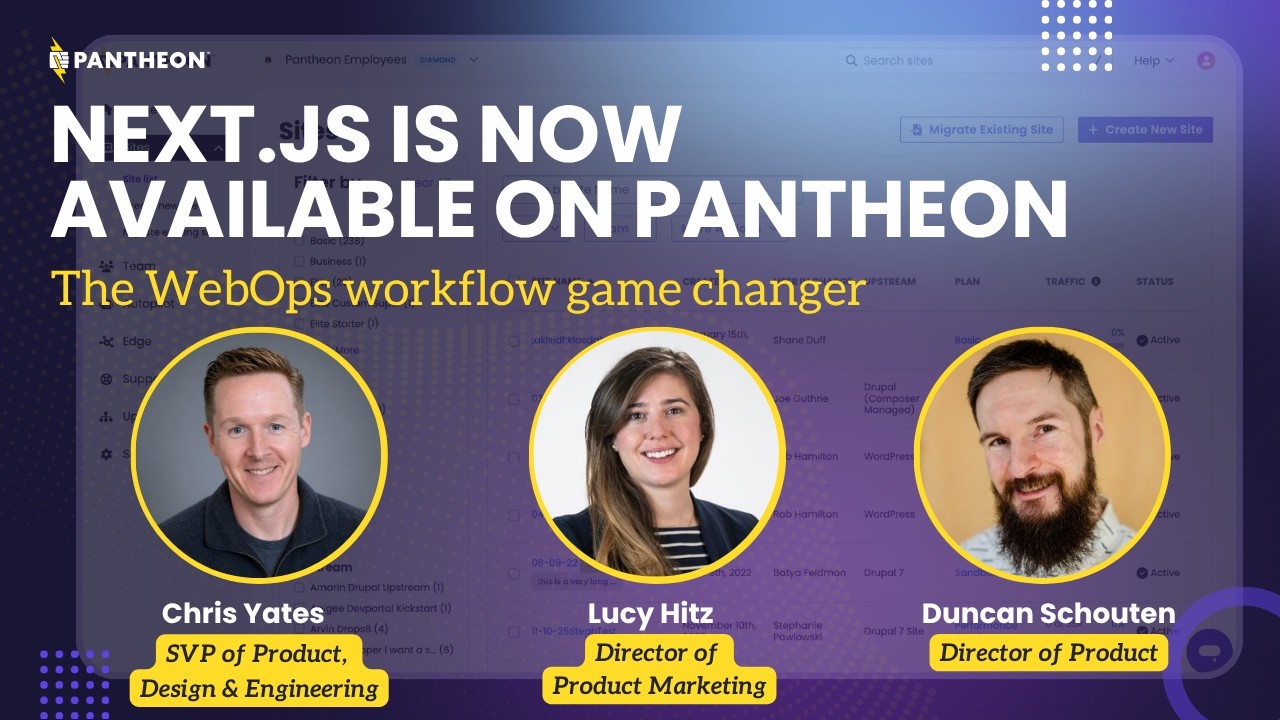
🔗 **Source:** [Next.js on Pantheon Launch Party](https://www.youtube.com/watch?v=5m8L2z2NQXM)
> [!note]+ Document Notes
> tags: #nextjs #pantheon #jamstack #web-hosting #platform-engineering
> author: Pantheon
> source: YouTube
> reference: https://www.youtube.com/watch?v=5m8L2z2NQXM
> date created: 2024-12-28 15:30
>
> # 🏷️ Title: Next.js on Pantheon launch party
>
<!-- deep-read:sections start -->
## 🧰 Action Inbox
- [H1] Try Next.js on Pantheon if you're a Gold Plus customer — immediate availability #nextjs
- [H2] Submit feature requests at roadmap.pantheon.io — ongoing feedback collection #product-feedback
- [H3] Join upcoming webinar with SPS Commerce customer case study — tomorrow's platform tour #learning
## 🧭 Table of Contents
- [[#📝 Summary]]
- [[#📖 Main Content]]
- [[#🗒️ Notes]]
- [[#📚 References]]
- [[#🗣️ Paraphrase]]
- [[#📰 Newsletter]]
- [[#✅ Action Items]]
- [[#🧪 Hypotheses]]
- [[#📊 Methodology]]
- [[#❓ Questions]]
- [[#🔮 Future Research]]
- [[#💡 Implications]]
- [[#🧠 Learning Styles Assessment]]
- [[#📊 Accessibility Assessment]]
- [[#🌍 DEIB Assessment]]
- [[#✅ Logical Validity]]
- [[#🛡️ DARVO Analysis]]
- [[#🎯 Conclusion]]
### 🔗 References
- [Pantheon Next.js Platform](https://pantheon.io)
- [Roadmap Feedback](https://roadmap.pantheon.io)
## 📝 Summary
- **What happened**: Pantheon launched Next.js support on their platform, bringing React-based development to their managed hosting with edge optimization
- **Why it matters**: Unifies WordPress, Drupal, and Next.js sites under one platform, addressing enterprise governance and collaboration needs
- **Key stakeholders**: Enterprise web teams, existing Pantheon customers, JavaScript developers
- **Risks and tradeoffs**: Currently requires WordPress/Drupal for database/filesystem; limited to Next.js framework officially
- **Bottom line**: Pantheon is expanding beyond PHP to capture the JavaScript ecosystem while maintaining their enterprise workflow advantages
## 📖 Main Content
Pantheon has launched Next.js support as part of a new platform foundation that aims to unify website management across WordPress, Drupal, and JavaScript frameworks. The platform provides enterprise-ready features including GitHub integration, secrets management, build/runtime logging, and automated caching with incremental static regeneration.
The new system maintains Pantheon's core value propositions around workflow management, collaboration tools, and enterprise governance while extending into the JavaScript ecosystem where 14% of developers use Next.js compared to 4% using WordPress according to Stack Overflow's 2025 survey.
Key technical features include automatic scaling, edge-optimized delivery, multi-dev environments for each pull request, and Content Publisher integration for Google Docs and Microsoft Word. The platform currently supports any Node.js framework but only officially supports Next.js.
The launch represents Pantheon's strategic shift to serve broader web teams beyond just technologists, with plans for expanded database support and additional framework integrations.
## 🗒️ Notes
#### ⏱️ [00:00](https://youtu.be/5m8L2z2NQXM?t=0) — [H1] Introduction and demo setup
- Key idea: Pantheon launches Next.js with edge optimization and zero infrastructure management
- Evidence: "brings the power of React to a fully managed platform with edge optimized delivery built-in"
#### ⏱️ [02:30](https://youtu.be/5m8L2z2NQXM?t=150) — [H2] Unified dashboard experience
- Key idea: Single interface for WordPress, Drupal, and Node.js sites
- Evidence: "one platform, one dashboard, one interface for managing all of your sites"
#### ⏱️ [04:15](https://youtu.be/5m8L2z2NQXM?t=255) — [H1] GitHub integration and secrets management
- Key idea: Sites connect to existing GitHub repos with built-in secrets manager
- Evidence: "you can now connect WordPress and Drupal sites from GitHub into Pantheon"
#### ⏱️ [06:20](https://youtu.be/5m8L2z2NQXM?t=380) — [H2] Build and runtime logging
- Key idea: Real-time visibility into build processes and application runtime
- Evidence: "cutting edge as we can. So, this is exactly what you would expect from a build log"
#### ⏱️ [08:45](https://youtu.be/5m8L2z2NQXM?t=525) — [H3] Multi-dev environments for PRs
- Key idea: Every pull request automatically gets a preview environment
- Evidence: "Every pull request that you make for the site comes along with a multid-dev"
#### ⏱️ [11:30](https://youtu.be/5m8L2z2NQXM?t=690) — [H1] Content Publisher integration
- Key idea: Direct publishing from Google Docs with live preview
- Evidence: "live preview connected up with the next.js site in real time of the Google Docs"
#### ⏱️ [14:00](https://youtu.be/5m8L2z2NQXM?t=840) — [H2] Instant rollback functionality
- Key idea: 30-second rollbacks without rebuilding or new commits
- Evidence: "That's going to take about 30 seconds to do it rather than triggering a new build"
#### ⏱️ [16:20](https://youtu.be/5m8L2z2NQXM?t=980) — [H1] Incremental static regeneration caching
- Key idea: Automatic cache invalidation when WordPress/Drupal content updates
- Evidence: "incremental static regeneration. The next JS feature that we're really happy to support"
#### ⏱️ [19:45](https://youtu.be/5m8L2z2NQXM?t=1185) — [H2] Why Next.js - market adoption
- Key idea: JavaScript is becoming the web's common language for humans and AI
- Evidence: "Next.js is the framework of choice for I think it was 14% of the developer respondents"
#### ⏱️ [23:10](https://youtu.be/5m8L2z2NQXM?t=1390) — [H1] Governance and upstreams solution
- Key idea: Managing multiple sites from shared templates with coordinated updates
- Evidence: "you can take that parent repo, make a change, and then a pull request is opened on all of the downstream sites"
#### ⏱️ [26:30](https://youtu.be/5m8L2z2NQXM?t=1590) — [H3] Platform features roadmap
- Key idea: Runtime logs, autoscaling, and GitHub integration will extend to all Pantheon sites
- Evidence: "all of this is going to be brought into the Drupal and WordPress side of things"
#### ⏱️ [29:00](https://youtu.be/5m8L2z2NQXM?t=1740) — [H2] Database and filesystem limitations
- Key idea: Currently requires WordPress/Drupal backend for database and file storage
- Evidence: "right now to use a database or file system or deeper caching on that level, you have to go through WordPress or Drupal"
#### ⏱️ [31:20](https://youtu.be/5m8L2z2NQXM?t=1880) — [H3] Open Next ecosystem alignment
- Key idea: Not using Open Next directly but collaborating with ecosystem partners
- Evidence: "working with Versell and Cloudflare and Google and others in the open next ecosystem"
## 📚 References
- [Pantheon Platform](https://pantheon.io)
- [Product Roadmap Feedback](https://roadmap.pantheon.io)
- [Stack Overflow Developer Survey 2025](https://survey.stackoverflow.co)
## 🗣️ Paraphrase
- Pantheon is expanding beyond WordPress and Drupal to support Next.js, creating a unified platform for managing different types of websites with enterprise-grade workflows and governance
- The new platform solves multi-site management challenges that individual hosting providers can't address, particularly around coordinated updates across site portfolios and enterprise procurement processes
- JavaScript frameworks like Next.js are becoming the dominant web development approach, making this expansion necessary for Pantheon to serve where developers are actually working
## 📰 Newsletter
🚀 **Pantheon Launches Next.js Support - Unifying Enterprise Web Management**
Pantheon just launched Next.js hosting that brings together WordPress, Drupal, and JavaScript frameworks under one platform. This is huge for enterprise teams managing multiple sites!
**Key Benefits:**
- Single dashboard for all your sites (no more vendor juggling!)
- GitHub integration with automatic preview environments
- Content Publisher connects Google Docs directly to Next.js sites
- 30-second rollbacks and real-time logging
**Why This Matters:** With 14% of developers now using Next.js vs 4% using WordPress, this positions Pantheon for where web development is heading while maintaining their enterprise governance strengths.
The platform currently requires WordPress/Drupal backends for databases, but standalone database support is coming. Available now for Pantheon Gold Plus customers.
**Resources:** [Try Next.js on Pantheon](https://pantheon.io), [Submit Feature Requests](https://roadmap.pantheon.io), [Developer Docs](https://developer.wordpress.org/)
## ✅ Action Items
#### DevRel
- Developer advocacy: Create Next.js migration guides and best practices documentation
- Education: Develop workshops on headless WordPress/Drupal with Next.js frontends
- Developer experience: Document GitHub integration workflows and secrets management
- Developer marketing: Highlight enterprise governance features vs other Next.js hosts
- Community management: Engage with existing customers trying Next.js, collect feedback
#### OSPO
- Policy & Governance: Review Next.js licensing and dependencies for compliance
- Software Inventory: Document new platform dependencies and Node.js ecosystem components
- Developer Support: Train support teams on Next.js troubleshooting and platform features
- Community Engagement: Participate in Open Next ecosystem discussions and standardization
#### WordPress
- Core: Improve headless/API performance for Next.js frontend consumption
- Documentation: Create headless WordPress guides specifically for Pantheon Next.js integration
- Community: Share learnings about headless implementations at WordCamps
- API: Optimize REST API and GraphQL performance for frontend consumption
#### The WPCC
- Programs: Fund headless WordPress documentation and tutorial development
- Projects: Support headless governance and best practices documentation
## 🧪 Hypotheses
- Enterprise customers prefer unified platform management over best-of-breed solutions when governance complexity increases
- JavaScript framework adoption will continue accelerating, making PHP-only hosting providers less competitive
- Content management workflows that bridge traditional CMSs with modern frontends will become standard
- Multi-site governance features will become a key differentiator in the hosting market
### 📊 Methodology
- Survey enterprise customers on multi-vendor management pain points
- Analyze developer job posting trends for PHP vs JavaScript skills
- Measure adoption rates of headless CMS implementations
- Track feature usage across Pantheon's new platform capabilities
### ❓ Questions
- How will standalone database support change the WordPress/Drupal requirement?
- What additional JavaScript frameworks will Pantheon prioritize after Next.js?
- How does this affect Pantheon's WordPress and Drupal hosting roadmap priorities?
### 🔮 Future Research
- Integration patterns between headless CMSs and JavaScript frameworks
- Enterprise governance models for hybrid technology stacks
- Developer productivity metrics across unified vs distributed hosting platforms
### 💡 Implications
- **Practice**: Web teams can consolidate hosting vendors while adopting modern frameworks
- **Policy**: Multi-site governance becomes possible across different technology stacks
- **Security**: Unified platform reduces attack surface compared to multiple vendors
- **Education**: Developers need training on headless CMS and modern frontend integration
- **Funding**: Enterprise hosting budgets may shift toward platforms supporting multiple technologies
### 🧠 Learning Styles Assessment
Reading level estimate: 12th grade
#### 👀 Visual learners
- **Present**: Live demo screenshots, dashboard interfaces, build logs
- **Improve**: Architecture diagrams showing headless CMS connections, workflow visualizations
#### 🔊 Aural learners
- **Present**: Live demonstration with narration, conversational explanation
- **Improve**: Podcast-style technical deep dive, customer interview audio
#### 🗣️ Verbal learners
- **Present**: Clear definitions of headless, JAMstack, incremental static regeneration
- **Improve**: Glossary of terms, analogies comparing to traditional hosting
#### 🧩 Kinesthetic learners
- **Present**: Live demo with real sites, step-by-step site creation
- **Improve**: Hands-on tutorial, sandbox environment, guided setup checklist
#### 🧠 Logical learners
- **Present**: Feature comparisons, performance metrics, adoption statistics
- **Improve**: Decision trees for technology selection, ROI calculations
#### 🧑🤝🧑 Social learners
- **Present**: Customer community mention, upcoming customer case study
- **Improve**: User forums, peer review sessions, customer advisory groups
#### 🧘♀️ Solitary learners
- **Present**: Documentation references, self-service platform access
- **Improve**: Self-assessment tools, progress tracking, personal learning paths
#### 🌿 Naturalistic learners
- **Present**: Evolution of web development trends, ecosystem thinking
- **Improve**: Technology lifecycle perspectives, sustainability considerations
### 📊 Accessibility Assessment
#### Screen reader semantics
- **Present**: Clear headings in demo, structured presentation
- **Improve**: Alt text for dashboard screenshots, ARIA labels for interface elements
#### Keyboard navigation
- **Present**: Standard video controls, clear focus order
- **Improve**: Keyboard shortcuts documentation, skip navigation options
#### Contrast and readability
- **Present**: High contrast dashboard interface
- **Improve**: Dark mode options, customizable text sizing
#### Text resizing and reflow
- **Present**: Responsive demo interface
- **Improve**: Zoom support verification, mobile optimization
#### Media and captions
- **Present**: Video content available
- **Improve**: Captions, transcript availability, audio descriptions
#### Forms and interactions
- **Present**: Clear form labels in site creation demo
- **Improve**: Error message clarity, input validation feedback
### 🌍 DEIB Assessment
#### Cultural breadth
- **Present**: Global platform perspective, international regions mentioned
- **Improve**: Multi-language examples, diverse use cases
#### Inclusive language
- **Present**: Professional, accessible technical language
- **Improve**: Plain language alternatives for jargon, defined acronyms
#### Neurodiversity support
- **Present**: Structured presentation, clear topic transitions
- **Improve**: Content warnings for rapid demo switching, consistent pacing
#### Representation
- **Present**: Mixed gender presentation team
- **Improve**: Diverse customer examples, varied industry use cases
#### Psychological safety
- **Present**: Encouraging tone, invitation for questions
- **Improve**: Clear feedback channels, multiple support options
### ✅ Logical Validity
#### Strong reasoning
- **Deductive strength**: Market data supports JavaScript framework adoption claims
- **Inductive strength**: Customer feedback patterns justify feature development
- **Causal reasoning**: Clear connection between developer trends and platform strategy
- **Analogical strength**: Effective comparison to existing hosting limitations
#### Fallacies
- **Appeal to popularity**: Using Stack Overflow survey percentages without context of survey methodology or representativeness
- **False dichotomy**: Presenting unified platform vs multiple vendors as only options, missing hybrid approaches
#### Tone of voice
- **Overall tone**: Professional enthusiasm with technical confidence, accessible explanations
### 🛡️ DARVO Analysis
- **Deny**: No denial patterns present
- **Attack**: No attacks on competitors or critics
- **Reverse victim/offender**: No victim/offender dynamics present
- **Emotional cues**: Positive excitement about technology advancement, collaborative language
## 🎯 Conclusion
Pantheon's Next.js launch represents a strategic platform evolution addressing enterprise web team needs for unified technology management. By combining their proven governance and workflow capabilities with modern JavaScript frameworks, they're positioning to capture developer mindshare while maintaining enterprise requirements.
The key innovation isn't just Next.js hosting, but the unified platform approach that solves real enterprise pain points around multi-vendor management, procurement, and coordinated updates across diverse technology stacks. This positions Pantheon competitively as web development continues shifting toward JavaScript frameworks.
For practitioners, this enables experimentation with modern frontend technologies while maintaining enterprise workflow requirements and existing content management investments.
## 🧱 Refactor Appendix
###
---
## Full Transcript
[00:25] Hi everybody and welcome to our LinkedIn<br>[00:28] live where We are celebrating the launch<br>[00:30] of Nex.js on on Pantheon which brings<br>[00:33] the power of React to a fully managed<br>[00:36] platform with edge optimized delivery<br>[00:39] built-in and zero infrastructure to<br>[00:40] babysit. I am Lucy Hitz. I'm the<br>[00:42] director of product marketing at<br>[00:44] Pantheon. And I'm joined here today by<br>[00:46] Chris Yates, our SVP of product design<br>[00:48] and engineering, and Duncan Scoutton,<br>[00:51] our director of product. This is really<br>[00:53] his baby. Um so I'm excited to let you<br>[00:56] um let you see it. Thanks for being<br>[00:59] here, guys.<br>[01:00] >> Thank you, Lizzy.<br>[01:03] >> Um, so I think we're gonna show and and<br>[01:05] not tell and jump right into giving you<br>[01:08] all a peak behind the curtain and what<br>[01:10] this really looks like in practice on a<br>[01:12] real live site. So, we are going to live<br>[01:14] demo here. Pray to the demo gods for us.<br>[01:17] Um, and then we will have a little<br>[01:19] fireside chat where we'll talk about why<br>[01:22] we built this, what's coming next, what<br>[01:24] to expect, um, and all of that. All that<br>[01:26] good stuff. So Duncan, I'll I'll let you<br>[01:28] take it away.<br>[01:29] >> Ideally with minimal fires. We're trying<br>[01:31] to keep the actual fire count down to no<br>[01:34] more than two. So hello everybody. I'm<br>[01:36] Duncan. Uh as Lucy said, I have been<br>[01:39] working on this very intensely for over<br>[01:42] a year now, which is rather distressing<br>[01:44] to say. I'm going to be walking you<br>[01:47] through a whole bunch of things that our<br>[01:48] Next.js system can do because while we<br>[01:51] say it is Nex.js, JS. What that actually<br>[01:54] means is a whole new platform that we're<br>[01:58] building on. This is the foundation of a<br>[02:00] lot of what Pantheon is going to be<br>[02:02] building on top of over the next coming<br>[02:05] years. That doesn't mean our old<br>[02:07] platform is going away, but it means<br>[02:10] that we're building it and improving it.<br>[02:11] And you're going to see some of the<br>[02:12] features that we've applied to Nex.js JS<br>[02:15] as the first framework that we're<br>[02:18] supporting on the new platform that<br>[02:20] eventually, hopefully sooner than later,<br>[02:22] are going to make their way into the<br>[02:25] existing Pantheon platform that you know<br>[02:26] and love. So, I'm going to be walking<br>[02:28] you through creating a new site in<br>[02:30] Nex.js. I'm going to be walking you<br>[02:32] through connecting that with Content<br>[02:34] Publisher, our CMS that we've built<br>[02:36] in-house that connects up with Google<br>[02:38] Docs and Microsoft Word. I'm going to be<br>[02:41] showing you some of the features that<br>[02:44] are inside the new functionality like<br>[02:47] much improved logging, uh, real good<br>[02:51] caching. Caching matters. I care a lot<br>[02:54] about caching. So, it's going to be<br>[02:56] great to show that off and just show you<br>[02:58] a bit of how this system works as<br>[03:01] somebody that's familiar with Pantheon.<br>[03:03] So, as you can see here, this is like<br>[03:07] any other Pantheon dashboard that you<br>[03:09] are familiar with. You see your list of<br>[03:11] sites.<br>[03:13] You have WordPress. You have composer<br>[03:15] manage Drupal. Then you have NodeJS.<br>[03:18] What's that? What we're trying to do<br>[03:20] here is make it so that you've got one<br>[03:23] platform, one dashboard, one interface<br>[03:27] for managing all of your sites,<br>[03:29] WordPress, Drupal, Nex.js. We've heard<br>[03:32] from customers time and again that<br>[03:34] having to manage multiple vendors is a<br>[03:37] real friction point and they would like<br>[03:41] to have one place where all of that work<br>[03:43] comes together and it can be managed on<br>[03:45] one surface. So that's what we've done<br>[03:47] with the new system. Likewise in<br>[03:49] terminus our command line tool it's the<br>[03:52] same functionality. You've got one<br>[03:55] interface for managing all of your front<br>[03:57] end and backend. And to be clear you can<br>[04:00] run Nex.js JS sites that don't have a<br>[04:03] Drupal or WordPress backend on the<br>[04:05] system. You're not tied to that. But<br>[04:07] having them both in one place makes it a<br>[04:10] heck of a lot easier to avoid a lot of<br>[04:13] the pitfalls that come with managing one<br>[04:16] site on AWS, one site here, and one site<br>[04:19] there, and one site there. It's just one<br>[04:21] place really streamlines it. So, let's<br>[04:23] go through creating a site. If you're<br>[04:25] familiar with creating a site on<br>[04:27] Pantheon, this should be plenty familiar<br>[04:29] by design. So, we go into create new<br>[04:31] site. We choose Nex.js alongside<br>[04:34] WordPress and Drupal.<br>[04:36] We're going to create a LinkedIn demo<br>[04:41] site.<br>[04:43] Choose the United States region.<br>[04:47] Continue.<br>[04:49] Here is a new thing for Pantheon. This<br>[04:52] connects up with your GitHub uh<br>[04:54] organization. So unlike the past where<br>[04:58] you handled all of your code management<br>[05:01] inside Pantheon, this connects with your<br>[05:05] existing GitHub repos or you can create<br>[05:08] a new one. So I'm going to connect it up<br>[05:10] with our Pantheon systems.<br>[05:13] And by the way, for those that haven't<br>[05:15] heard this yet, you can now connect<br>[05:17] WordPress and Drupal sites from GitHub<br>[05:20] into Pantheon. I won't focus on that<br>[05:23] here, but as we've been building this<br>[05:25] system, we've been trying to, like I<br>[05:27] said, bring as much as we can into the<br>[05:30] existing experience, and that's one I'm<br>[05:32] really happy with. So, you no longer<br>[05:34] have to go into the Pantheon dashboard<br>[05:36] to do all of your code management. So,<br>[05:38] I'm going to connect it up with Pantheon<br>[05:40] Systems.<br>[05:42] I'm going to create a new repository for<br>[05:44] the LinkedIn demo site.<br>[05:48] Here is where we can add our secrets.<br>[05:51] Another new thing for Pantheon, we as<br>[05:54] part of this work launched a secrets<br>[05:56] manager. So all of your API keys,<br>[05:59] personal access tokens, and anything<br>[06:00] that you need to build your site, which<br>[06:03] is very common in Nex.js now has a real<br>[06:07] sleek, streamlined interface inside<br>[06:10] Pantheon dashboard and available through<br>[06:12] Terminus where you can add these things<br>[06:14] in. So I want to demo a little UX thing,<br>[06:17] just a tiny little UX thing that I was<br>[06:18] really happy to put in there.<br>[06:21] I'm going to copy some demo secrets<br>[06:24] and rather than having to manually write<br>[06:26] them in one by one, I can just paste<br>[06:28] them and they appear. And there we go.<br>[06:32] You can also upload from yourv file of<br>[06:35] choice. But this is the fastest,<br>[06:38] smoothest, sleekst way to do that. At<br>[06:41] this point, I can continue and start<br>[06:43] making the site. I'm going to launch<br>[06:45] that. But using the power of television<br>[06:48] or LinkedIn or something, we're going to<br>[06:50] jump ahead and this is going to be the<br>[06:54] site that we're working with. This is<br>[06:55] the Pantheon web sessions on our uh<br>[06:58] marketing page. This site is connected<br>[07:01] with content publisher which like I said<br>[07:03] is our connection with um Word,<br>[07:08] Microsoft Word and Google Docs. I'm<br>[07:11] going to take this and show you a couple<br>[07:13] of the things that happen inside the<br>[07:14] Pantheon dashboard. Now, the first and<br>[07:17] foremost is that we now have a variety<br>[07:21] of visibility on uh the builds that make<br>[07:25] up your site. So, any one of these<br>[07:28] builds, you can now go in and for<br>[07:31] example, rebuild it. Let's say you've<br>[07:33] added secrets. When you add secrets, you<br>[07:36] have to reinitiate a new build. Well,<br>[07:38] now you can do that without pushing a<br>[07:40] blank commit, which was the way of the<br>[07:42] past. We also have build logs. So, these<br>[07:46] standard practice among companies like<br>[07:49] ours, but we've made them as cutting<br>[07:52] edge as we can. So, this is exactly what<br>[07:55] you would expect from a build log.<br>[07:57] Unlike the Pantheon of the past where<br>[07:59] this was harder to get, now it's just<br>[08:00] built straight in there and you can see<br>[08:02] it while the build is happening. We also<br>[08:05] have runtime logs. runtime logs I'm very<br>[08:08] happy with. So this site whenever it is<br>[08:12] out in the world. If I go here,<br>[08:19] there's going to be one thing. There's<br>[08:20] always going to be one thing that<br>[08:22] glitches out during the live demo. So<br>[08:24] let's let that load now that I've<br>[08:26] acknowledged it. I've made my offering<br>[08:28] and now it's going to show it. So here<br>[08:30] we have logs as of 11:00 a.m. Pacific<br>[08:33] time where I am. I'm going to reload<br>[08:37] this page. Go back over here. And you<br>[08:40] can see that the actual application<br>[08:43] is now pulling in the most recent logs.<br>[08:46] This is the way to determine when<br>[08:48] something goes wrong, why it went wrong.<br>[08:51] Fortunately, there's nothing I can show<br>[08:52] you about it going wrong, but you can<br>[08:54] see that it has all of the up-to-date<br>[08:57] information of what the site is doing at<br>[08:59] the runtime level. This is very very<br>[09:02] handy and I use it a lot in my own<br>[09:04] sites. I also want to show you<br>[09:09] go back here.<br>[09:12] Every pull request that you make for the<br>[09:14] site comes along with a multid-dev.<br>[09:17] Multidevs are our preview environments<br>[09:19] for seeing the changes to your site<br>[09:21] before they go live. Every PR that you<br>[09:24] open now comes with a multid-dev<br>[09:25] associated with it alongside all the<br>[09:28] benefits of a multidev like a dedicated<br>[09:30] preview environment to visit and really<br>[09:35] just the chance to collaborate with your<br>[09:36] team. Again, this is Nex.js for<br>[09:40] enterprise.<br>[09:42] You're not just working on one site with<br>[09:44] a very small team. You might have a big<br>[09:46] web team that all need to collaborate on<br>[09:49] one surface. So, we've taken Nex.js JS<br>[09:52] and brought it in line with Pantheon's<br>[09:54] enterprise readiness and these<br>[09:56] multi-devs for each PR. That's part of<br>[09:59] it.<br>[10:01] Now I'm going to bring you into the<br>[10:02] content publisher side of things.<br>[10:05] So this<br>[10:08] is our web sessions page. This is built<br>[10:13] using content publisher and I want to<br>[10:16] publish a new piece of content. Let's do<br>[10:20] that. So here we have the Google Docs<br>[10:22] version. This is the show notes for a<br>[10:24] new page that we want to publish. I<br>[10:27] click into preview and publish. That<br>[10:30] brings me here. You can see a live<br>[10:34] preview connected up with the next.js<br>[10:37] site in real time of the Google Docs and<br>[10:39] the corresponding page. We can make any<br>[10:42] edits that we want in here.<br>[10:46] Let's say I added an exclamation mark.<br>[10:58] Let's try reloading. Get that in there.<br>[11:05] And there you go. You can see it. So,<br>[11:08] you get a confident preview of exactly<br>[11:10] what's going to happen.<br>[11:13] Now, I'm going to publish. I've made<br>[11:15] sure that our metadata is as we wanted.<br>[11:18] I'm going to publish.<br>[11:25] The content is published successfully.<br>[11:27] Perfect. Let's take a look at that in<br>[11:29] the live site.<br>[11:51] There we are. The newest latest web<br>[11:53] session, Web Curious by Design with Omar<br>[11:55] Actar from user testing.<br>[11:58] Now I want to show you a little bit of<br>[12:00] that roll back functionality that I<br>[12:02] mentioned earlier. So here we have the<br>[12:04] ply list. That's not right. That's not<br>[12:07] right. Somebody made a change. You put a<br>[12:09] put a typo in there. Let's fix that.<br>[12:13] When minutes count, this functionality<br>[12:16] of the roll back makes a big big big<br>[12:19] difference. So, we can just go find the<br>[12:22] most recent deployment, click roll back,<br>[12:26] roll back, and deploy. That's going to<br>[12:28] take about 30 seconds to do it rather<br>[12:30] than triggering a new build and waiting<br>[12:32] for however long it's going to take.<br>[12:34] This is a way to get back to a known<br>[12:36] safe state quickly. This was a much<br>[12:39] requested feature during our beta period<br>[12:42] and the team pushed really hard to make<br>[12:44] sure that we got it into the general<br>[12:46] availability release. So that's going to<br>[12:49] do its thing.<br>[12:53] See if we have anything. And while that<br>[12:55] is happening, I'm going to show you the<br>[12:58] last bit that I wanted to demo, which is<br>[13:01] our caching.<br>[13:03] We've put a lot of work into caching and<br>[13:06] in particular we put a lot of work into<br>[13:08] making it so that when you update<br>[13:09] content in the WordPress or Drupal site<br>[13:12] that is connected to Nex.js<br>[13:15] that shows up quickly on the front end.<br>[13:18] So here we have a demo site. Let me log<br>[13:22] myself back in.<br>[13:24] This is a<br>[13:26] very ugly page, but it does what it<br>[13:29] needs to do just to show you that this<br>[13:32] content is coming from WordPress. It's<br>[13:34] connected to a WordPress site in the<br>[13:36] back end.<br>[13:38] Here you can see, let me just do a quick<br>[13:42] reload of this because this is critical.<br>[13:46] My new post here, my new post here, that<br>[13:49] is going to show you this number age<br>[13:52] zero. That means it's beginning to acrue<br>[13:55] in the cache. Our edge, Pantheon Edge<br>[13:58] has cached this and it's going to<br>[14:01] accumulate time as we go. So we're now<br>[14:04] at age 17. That means the content is<br>[14:07] going to be served from the edge and not<br>[14:09] directly from the WordPress back end.<br>[14:12] Now I'm going to go into WordPress.<br>[14:15] I'm going to update that post.<br>[14:23] It's going to save.<br>[14:26] I'm going to go back here.<br>[14:30] Reload.<br>[14:34] Riveting stuff. I know.<br>[14:37] My new post here now shows you an age of<br>[14:41] zero. And that means that the build has<br>[14:44] kicked off in the background that is<br>[14:45] updating only this content. The rest of<br>[14:48] the content on here is not being<br>[14:49] updated. This is what's called<br>[14:51] incremental static regeneration.<br>[14:54] The next JS feature that we're really<br>[14:56] happy to support now that that build is<br>[14:58] almost certainly finished. There we go.<br>[15:00] And like before,<br>[15:03] it is now acrewing time age zero. And<br>[15:07] that change went live ASAP. We've got to<br>[15:11] close this loop.<br>[15:14] I have done the roll back now.<br>[15:20] It should have been rolled back<br>[15:25] and I reload this. And we're back at the<br>[15:28] playlist. So, I've shown you a bunch of<br>[15:31] different things on here. I've shown you<br>[15:32] creating a new site. I've shown you our<br>[15:34] build and runtime logs. I've shown you<br>[15:36] the connection with content publisher.<br>[15:38] And I've shown you our caching system<br>[15:40] working<br>[15:42] on content that has been published from<br>[15:44] the WordPress site on the back end. and<br>[15:46] reloading the edge cache and clearing<br>[15:48] it. And all of this stuff<br>[15:51] is next to<br>[15:54] oh brain brain slip. All of this stuff<br>[15:57] is brand new to Pantheon. So, we've got<br>[15:59] things in here that I'm really excited<br>[16:01] to be showing off and that we can bring<br>[16:03] into the rest of the platform hopefully<br>[16:05] before too long. So, I'm going to turn<br>[16:07] it back to Lucy to bring us into a<br>[16:10] little bit more conversational times.<br>[16:13] >> Thank you, Duncan. so many times. I<br>[16:15] wanted to throw some heart emojis out<br>[16:17] there, but we're not on a Zoom like we<br>[16:19] usually are all day together every day.<br>[16:21] Um, but I think my first question is<br>[16:24] really to you, Chris, and Duncan, please<br>[16:26] also chime in. But, you know, we are<br>[16:29] known for Drupal, for WordPress, um, for<br>[16:33] our really strong infrastructure and,<br>[16:37] you know, really, uh, platform<br>[16:40] management. But why Next.js Next.js like<br>[16:43] why did we build this? Why did we decide<br>[16:45] to invest here? Why now?<br>[16:48] >> Yeah, that's a great question, Lucy. And<br>[16:50] and thanks for the the great demo. I<br>[16:52] think we uh we we must have done<br>[16:54] something right to uh appease the the<br>[16:57] demo gods. All that worked very well. Uh<br>[17:00] and it's been a tremendous amount of of<br>[17:02] effort by the team and and it's a really<br>[17:04] awesome result. Why Nex.js? Uh I mean<br>[17:08] first for our you know existing<br>[17:09] customers and partners uh this is<br>[17:12] something that uh they have been<br>[17:14] expanding their uh you know their view<br>[17:17] uh from you know building applications<br>[17:19] strictly in WordPress and Drupal to<br>[17:22] injecting uh technologies like React and<br>[17:25] frameworks like Nex.js into their<br>[17:27] workflows. And Pantheon's value, as<br>[17:30] Duncan said earlier, is really not just<br>[17:32] in, you know, the runtime of being able<br>[17:35] to run these things, but also the<br>[17:36] workflow, the collaboration, the tooling<br>[17:39] that makes all of these technologies<br>[17:41] really enterprise ready. So that's<br>[17:44] reason one. The other reason uh is that<br>[17:49] what we've seen over the last couple of<br>[17:51] years and es especially accelerating<br>[17:53] over the last few months is that uh<br>[17:56] JavaScript frameworks and nex next.js in<br>[17:59] particular and other react uh based<br>[18:01] tools have become this kind of common<br>[18:04] language that uh is both incredibly<br>[18:07] accessible to humans. it is kind of the<br>[18:10] default uh kind of way people are<br>[18:12] learning to code that default uh for<br>[18:15] building new types of applications for<br>[18:17] the web and even for mobile. Uh but it's<br>[18:19] also a fantastic place for people to<br>[18:22] collaborate with AI tooling whether<br>[18:24] those are kind of generative tools that<br>[18:27] you interact with or agentic tools that<br>[18:29] are doing work on on our behalf. React<br>[18:32] and Nex.js are a fantastic substrate for<br>[18:35] those tools to to work on. So we see<br>[18:38] this as an an important kind of bedrock<br>[18:41] to add to Pantheon's platform for you<br>[18:45] know reason three the future of you know<br>[18:48] what the web is and what you know<br>[18:50] Pantheon wants to deliver uh of which<br>[18:53] Nex.js is really a centerpiece.<br>[18:57] >> Thank you. Anything you want to add<br>[18:58] there Duncan?<br>[19:02] I think it's important to underline what<br>[19:04] Chris said around JavaScript being where<br>[19:06] the web is is centralizing right now.<br>[19:08] There's uh there's some stats that were<br>[19:10] from the Stack Overflow developer survey<br>[19:12] 2025 that I reference in just about any<br>[19:15] call that I have about Nex.js.<br>[19:18] Over the 2025 survey, Nex.js is the<br>[19:22] framework of choice for I think it was<br>[19:25] 14% of the developer respondents.<br>[19:29] WordPress was somewhere around 4% and<br>[19:33] Drupal was somewhere between 1 and 2%.<br>[19:36] This is where the web is going and more<br>[19:39] and more companies are hiring JavaScript<br>[19:42] native developers.<br>[19:45] PHP not always so much. So we have to<br>[19:48] work where our customers are. And we're<br>[19:50] seeing more and more of our customers<br>[19:52] take interest in Nex.js and JavaScript<br>[19:54] frameworks generally. And to kind of<br>[19:56] pull back the curtain a little bit more,<br>[19:58] Nex.js is the framework that we are<br>[20:01] officially supporting on the new<br>[20:03] platform. But that's not all that it can<br>[20:06] do. So it actually supports any NodeJS<br>[20:09] framework.<br>[20:12] It just doesn't come with the Pantheon<br>[20:14] support of that. So we can't help you if<br>[20:16] the application that you're building<br>[20:18] goes a little bit off the rails. We'll<br>[20:20] try, but we're only officially<br>[20:22] supporting Nex.js. but it's the<br>[20:24] foundation for expanding into more of<br>[20:27] these JavaScript frameworks as time goes<br>[20:29] on and the market needs. So really this<br>[20:32] is like us recalibrating for where the<br>[20:34] web is going and setting us up for a<br>[20:37] whole lot of our next chapter. Mhm.<br>[20:40] >> And do you see um you know a world where<br>[20:45] especially for our existing customers<br>[20:47] who are you know really like like strong<br>[20:51] and skilled in Drupal and in WordPress<br>[20:53] and have a lot of belief there where<br>[20:54] there's a lot of experimentation to be<br>[20:56] done you know while they keep their<br>[20:58] sites running in you know ways that they<br>[21:00] always have. Mhm.<br>[21:02] >> Yeah.<br>[21:03] >> I think that it is a natural extension<br>[21:06] of Drupal and WordPress. There's a lot<br>[21:09] of things that Nex.js can do,<br>[21:11] particularly around the caching side of<br>[21:13] things, that a PHP backend just doesn't<br>[21:16] support quite as well. So, it's there's<br>[21:19] a very straight path now. Some years<br>[21:22] ago, not so much. But now, there's a<br>[21:24] very straight path between I have a<br>[21:26] WordPress backend, I have a Drupal<br>[21:28] backend, and I have a Nex.js front end.<br>[21:30] it's easy to add on that Nex.js front<br>[21:33] end on top of it and gain all of the<br>[21:35] benefits that come along with it like<br>[21:37] some of the things that I demonstrated a<br>[21:39] couple minutes ago. So, it's a natural<br>[21:42] extension of what our existing customers<br>[21:44] are already doing and it gives more<br>[21:48] benefits than WordPress or Drupal can<br>[21:50] offer out of the box. So, we're seeing a<br>[21:54] lot of our customers take interest in<br>[21:57] keeping their existing fleet of sites,<br>[22:01] >> but bringing the front end of them into<br>[22:05] this new JavaScript world. So, it's a<br>[22:07] it's a pretty natural extension of what<br>[22:10] we already offer. So when we think about<br>[22:12] that spectrum of kind of maybe<br>[22:15] experimentation then to scaling across<br>[22:18] 20 sites across a whole portfolio.<br>[22:21] Um and you've touched on this a little<br>[22:23] bit but I'd love you to get both either<br>[22:25] of you both of you to get as specific as<br>[22:27] as you want to or can. What is the one<br>[22:30] kind of unsexy problem that that<br>[22:32] Pantheon solves for for Next.js JS<br>[22:34] developers um or folks experimenting<br>[22:38] with it that they don't realize they<br>[22:40] have until until it's too late.<br>[22:44] >> One word, governance.<br>[22:48] Other hosts are<br>[22:51] really quite amazing at running one site<br>[22:53] at a time. You've got one site that is<br>[22:56] connected to one repo and<br>[23:00] there's a very clear path to how to<br>[23:01] update one and the other one changes.<br>[23:03] It's dead simple. But a lot of our<br>[23:05] customers have more than one site that<br>[23:08] are all drawing from the same source,<br>[23:12] the same code base. Higher ed<br>[23:14] institutions, for example, they're going<br>[23:16] to have one template that maps across<br>[23:19] many, many, many different um faculty<br>[23:23] sites, for example. And it's really<br>[23:26] important that when you change the<br>[23:28] parent site that all of the downstream<br>[23:31] sites can be changed. This is really<br>[23:34] freaking hard whenever you have the<br>[23:36] concept of one repo, one site, and no<br>[23:39] governance across the whole collection<br>[23:42] of them. So with Pantheon, we offer<br>[23:44] something called upstreams. I wanted to<br>[23:46] demo it today, but just didn't have the<br>[23:47] time for that. But you can take that<br>[23:49] parent repo, make a change, and then a<br>[23:53] pull request is opened on all of the<br>[23:55] downstream sites. That is something that<br>[23:58] we really want to hone in on. And that's<br>[24:00] a pain that a lot of people that are<br>[24:04] more used to having that one-to-one<br>[24:05] relationship.<br>[24:07] There's no way around that<br>[24:10] >> unless you're using something like<br>[24:11] upstreams.<br>[24:12] >> So governance is the one that comes to<br>[24:14] mind for me. Anything on your side,<br>[24:16] Chris?<br>[24:17] >> I I mean there's other unsexy things<br>[24:19] like, you know, procurement and<br>[24:20] compliance and security. um even if you<br>[24:23] only have one site that's operating in<br>[24:26] this kind of decoupled model uh whether<br>[24:28] you're you have a next front end with a<br>[24:31] WordPress backend or you want a you know<br>[24:34] purely kind of server uh a decoupled uh<br>[24:37] you know headless backend that means<br>[24:40] going to multiple vendors it means<br>[24:42] having multiple procurement processes it<br>[24:44] means having multiple bills it means<br>[24:46] having multiple pathways that you have<br>[24:48] to work through in order to do the<br>[24:50] development uh different development<br>[24:52] customs, uh, you know, different bills,<br>[24:55] all of those things are separate. Uh,<br>[24:58] the idea with that that we're working<br>[25:00] with here is to bring that all together<br>[25:02] onto one centralized platform uh to be<br>[25:05] able to only have to go through one<br>[25:08] procurement process, one security<br>[25:10] review, one uh, you know, development<br>[25:12] workflow uh, for all of your sites,<br>[25:15] whether they are JavaScript or PHP<br>[25:17] driven. So I I think that's actually<br>[25:20] incredibly important for, you know,<br>[25:22] getting to the point of teams just doing<br>[25:24] the work. Uh there's a lot of things<br>[25:25] that have to go into getting to that<br>[25:27] starting point. Uh and we want to make<br>[25:29] that as easy as possible.<br>[25:32] >> Thank you. Yeah, that's great. I also<br>[25:34] wanted to mention I don't not sure I did<br>[25:36] it earlier, but if anyone watching has a<br>[25:38] question, please please throw it in the<br>[25:39] comments and we'll definitely definitely<br>[25:41] get to it. Um, so tell me, you know,<br>[25:45] when we were prepping for this LinkedIn<br>[25:47] live, um, Duncan said to me, "Hey, we<br>[25:51] should probably mention all of the stuff<br>[25:53] that we built for this next.js release<br>[25:55] that's going to benefit our entire<br>[25:57] platform so that people know about it."<br>[25:59] Um, what are those? What What is that<br>[26:02] stuff? Um, and and why does it matter?<br>[26:05] Why does it matter to our customers,<br>[26:07] Duncan? Well, I showed off some of that<br>[26:09] while I was doing the the core demo.<br>[26:12] Things like runtime logs,<br>[26:14] they're so straightforward, but as a<br>[26:17] company that um didn't have them, I<br>[26:21] mean, that's not a great look. So, we<br>[26:22] fixed it. We heard what the market needs<br>[26:25] and we fixed it. There's things that are<br>[26:29] in the even deeper back end that let a<br>[26:32] site on the new system scale much<br>[26:35] better. we have autoscaling at the<br>[26:38] deeper platform level. That means that<br>[26:41] when you have traffic spikes,<br>[26:43] the system just accommodates that. If<br>[26:46] it's going into a lower period, the<br>[26:48] system is going to be using fewer<br>[26:49] resources.<br>[26:51] There's also things like uh well the<br>[26:54] connection with GitHub and GitHub is<br>[26:56] only one part of our planned broader<br>[26:59] integration with external platforms. So<br>[27:01] we started with GitHub. We wanted to get<br>[27:02] GitHub right.<br>[27:05] We're going to expand it to supporting<br>[27:06] GitLab and Bitbucket and potentially<br>[27:08] some others as time goes on. That's not<br>[27:10] just for Nex.js sites. That's for all of<br>[27:13] the sites on Pantheon. We want to make<br>[27:16] it so that Pantheon fits into the the<br>[27:18] team's existing development workflows<br>[27:21] rather than forcing the development<br>[27:23] workflows on our terms. So, these are<br>[27:26] some things that uh have been brought in<br>[27:27] there.<br>[27:29] Other stuff like the pull request, the<br>[27:32] multi-dev per pull request. I'm actually<br>[27:34] really happy with that one because teams<br>[27:37] aren't necessarily going to want to go<br>[27:40] to the Pantheon dashboard or Terminus<br>[27:42] and spin up a multid-dev and then<br>[27:44] connect a branch to it. You're working<br>[27:46] in GitHub. You create a PR in GitHub and<br>[27:50] you can see that right away. I'm trying<br>[27:53] to think what else is really worth<br>[27:54] highlighting, but those are some of the<br>[27:56] things that jump out at me. And all of<br>[27:57] this is going to be brought into the<br>[28:00] Drupal and WordPress side of things.<br>[28:03] We just want to get Nex.js right first.<br>[28:07] >> And by the way, if you have a request or<br>[28:11] idea for an integration, also please put<br>[28:13] that put that in the comments as well.<br>[28:15] We have a question here. What platform<br>[28:17] services I think you you you basically<br>[28:19] touched on this, but just to underline<br>[28:21] it. What platform services are available<br>[28:24] in Nex.js sites i.e. database, file<br>[28:26] system, caching.<br>[28:31] The short answer is right now<br>[28:35] to use a database or file system or<br>[28:39] deeper caching on that level, you have<br>[28:41] to go through WordPress or Drupal. One<br>[28:44] of the things that's on our road map is<br>[28:45] to bring in freestanding database<br>[28:48] support for Nex.js sites. But right now,<br>[28:51] if you want to use that part of the<br>[28:53] system, you do have to go through<br>[28:55] WordPress or Drupal.<br>[28:58] Which leads me to my next question. Oh<br>[29:00] wait, we have another question in the in<br>[29:01] the in the comments. Is it built on top<br>[29:03] of open next?<br>[29:05] >> So right now we are not using open next.<br>[29:08] We have uh the short answer is we don't<br>[29:11] have a need for it right now. It's built<br>[29:14] using Nex.js vanilla and there's no need<br>[29:17] in what we've currently built for the<br>[29:19] adapter layer that open next offers. We<br>[29:22] are uh now working with Versell and<br>[29:26] Cloudflare and Google and others in the<br>[29:28] open next ecosystem to make sure that<br>[29:31] we're all building on a shared<br>[29:33] foundation. So while we are not<br>[29:36] supporting Open Next directly, we have a<br>[29:39] clear line of sight to anything that's<br>[29:40] happening in that world. And if and when<br>[29:42] we need to build a Pantheon Nex.js JS<br>[29:45] build adapter. We've got a very clear<br>[29:48] path to um working with the people who<br>[29:50] can make that<br>[29:52] in line with everything else that's out<br>[29:54] there. I hope that clarifies things.<br>[29:56] >> Yeah. And if it didn't, please, you<br>[29:57] know, ask a follow-up and we'll we'll<br>[29:59] clarify. And I guess that brings me to<br>[30:01] our final question. Um and this will be<br>[30:04] to Chris and then Duncan definitely fill<br>[30:06] in fill in the blanks. Um what's next<br>[30:09] for Nex.js on Pantheon?<br>[30:13] Yeah, I mean to echo what what Duncan<br>[30:15] said, um you know, we we want to offer<br>[30:17] more of the kind of the primitives that<br>[30:20] support building uh unique applications<br>[30:23] in Nex.js,<br>[30:25] uh like databases and file systems. Uh<br>[30:28] we've got great support for caching<br>[30:30] right out of the box, uh with our<br>[30:32] integration with our GCDN. Um but you<br>[30:36] know, there are there there's more work<br>[30:38] to be done. Uh so Chris I responded to<br>[30:41] you in LinkedIn but uh anybody with with<br>[30:43] uh input would love to uh you know get<br>[30:46] your feedback uh especially at uh<br>[30:50] roadmap.nathan.io<br>[30:52] uh where you can submit uh ideas and<br>[30:54] feedback uh directly to our product<br>[30:56] team. In terms of what comes beyond<br>[30:58] that, uh, you know, like I said earlier,<br>[31:01] we're making some big investments into<br>[31:03] how we go really deeper into the way<br>[31:06] that teams build on the web and<br>[31:08] addressing more of the web team. So,<br>[31:10] we've served technologists really well<br>[31:13] uh, for more than 16 years at Pantheon<br>[31:16] and we think, you know, we need to serve<br>[31:19] other members of the web team. Content<br>[31:20] publisher, which Duncan demoed earlier,<br>[31:23] is a first step in that direction. uh<br>[31:26] providing a really robust backend that<br>[31:28] solves uh a problem of content<br>[31:31] management which is really that people<br>[31:33] don't really manage content in cont<br>[31:34] content management systems. They kind of<br>[31:36] publish it there but they manage it,<br>[31:38] write it, edit it, uh collaborate on it<br>[31:41] elsewhere. So we've connected to those<br>[31:42] places like Google Docs and Microsoft<br>[31:44] Office. uh we want to take uh several<br>[31:47] big not just steps but leaps beyond that<br>[31:50] uh to embrace more of the web team and<br>[31:52] we're doing that on the foundation of<br>[31:55] what we've launched uh recently with the<br>[31:58] next.js support on our platform. So lots<br>[32:01] more exciting stuff coming uh around the<br>[32:03] JavaSc JavaScript ecosystem and uh how<br>[32:06] we really you know work differently on<br>[32:09] the web uh in the coming year.<br>[32:13] >> Thank you Duncan. Anything else you want<br>[32:15] to close out with or make sure to<br>[32:18] mention?<br>[32:20] >> Go try it. If you are a Pantheon Gold<br>[32:23] Plus customer, you can go and create an<br>[32:25] X.JS site today and I encourage you to.<br>[32:27] And when you do,<br>[32:29] I want to hear about it. We can share my<br>[32:32] email address, share my contact<br>[32:34] information. We're we're building this<br>[32:36] with our customers, not just for our<br>[32:38] customers. And you can go to<br>[32:40] roadmap.pantheon.io IO to leave uh<br>[32:44] suggestions. As Chris mentioned, we want<br>[32:46] to get people onto this and the best<br>[32:49] thing to do is to go and try it. What I<br>[32:51] tell people right now is if you're not<br>[32:53] familiar with Nex.js,<br>[32:56] GPT and Claude really are it's dead easy<br>[32:59] to spin up a Nex.js site with one of the<br>[33:02] models that's out there right now. So,<br>[33:04] just try it and when you run into<br>[33:07] trouble, reach out to us. We have<br>[33:08] support.<br>[33:10] make use of it<br>[33:12] >> and McKenna reminds us that we also have<br>[33:14] a a wonderful Pantheon customer<br>[33:16] community. Love for you to join if you<br>[33:18] haven't already.<br>[33:19] >> There you go. Thank you very much.<br>[33:21] >> And you can talk to some of our<br>[33:23] customers who are already using Nex.js<br>[33:25] there and ask about their experience. Um<br>[33:28] and so before we close out, I want to<br>[33:30] remind folks we have a webinar. Our<br>[33:32] April platform tour is tomorrow. We'll<br>[33:34] drop the link to the registration, but<br>[33:36] we will have one of our very own<br>[33:38] customers, SPS Commerce um sharing about<br>[33:41] their experience and you know how<br>[33:43] they've partnered with Pantheon for<br>[33:44] their next.js sites and so should be a<br>[33:46] lot to learn if you want to hear from a<br>[33:48] real live customer. So we'll drop the<br>[33:51] link. Um thank you so much for joining<br>[33:53] us Duncan and Chris and taking the time.<br>[33:55] I know Duncan just launched this product<br>[33:57] and is working on um new features all<br>[34:00] the time and so I really appreciate you<br>[34:02] taking the time to talk through this<br>[34:03] with our audience and thanks everybody<br>[34:05] for joining. See you next time.<br>[34:07] >> Thanks everybody.<br>[34:08] >> Thank you.
<!-- deep-read:sections end -->
📄 **Full text:** ![[Full Document Contents/Articles/Next.js on Pantheon Launch Party.md|Next.js on Pantheon Launch Party by YouTube]]
## Highlights
- lot of what Pantheon is going to be building on top of over the next coming years. That doesn't mean our old platform is going away, but it means that we're building it and improving it. And you're going to see some of the features that we've applied to Nex.js JS as the first framework that we're supporting on the new platform that eventually, hopefully sooner than later, are going to make their way into the existing Pantheon platform that you know and love. So, I'm going to be walking you through creating a new site in ([View Highlight](https://read.readwise.io/read/01kpv0cqmfep5myp1wsxxb9sj5))
- Tags: 👻 ai highlighted
- site. We choose Nex.js alongside WordPress and Drupal. We're going to create a LinkedIn demo site. Choose the United States region. Continue. Here is a new thing for Pantheon. This connects up with your GitHub uh organization. So unlike the past where you handled all of your code management ([View Highlight](https://read.readwise.io/read/01kpv0cqmtaqzwv0dx6ptrnmvs))
- Tags: 👻 ai highlighted
- preview environment to visit and really just the chance to collaborate with your team. Again, this is Nex.js for enterprise. You're not just working on one site with a very small team. You might have a big web team that all need to collaborate on one surface. So, we've taken Nex.js JS and brought it in line with Pantheon's enterprise readiness and these multi-devs for each PR. That's part of it. ([View Highlight](https://read.readwise.io/read/01kpv0cqngwv00qw6z7yfatgs4))
- Tags: 👻 ai highlighted
- and it's been a tremendous amount of of effort by the team and and it's a really awesome result. Why Nex.js? Uh I mean first for our you know existing customers and partners uh this is something that uh they have been expanding their uh you know their view uh from you know building applications strictly in WordPress and Drupal to injecting uh technologies like React and frameworks like Nex.js into their workflows. And Pantheon's value, as ([View Highlight](https://read.readwise.io/read/01kpv0cqqty3tae2g06aj4ymw6))
- Tags: 👻 ai highlighted
- it's easy to add on that Nex.js front end on top of it and gain all of the benefits that come along with it like some of the things that I demonstrated a couple minutes ago. So, it's a natural extension of what our existing customers are already doing and it gives more benefits than WordPress or Drupal can offer out of the box. So, we're seeing a lot of our customers take interest in keeping their existing fleet of sites, ([View Highlight](https://read.readwise.io/read/01kpv0cqv0dyd6wrfw9tv4dn3k))
- Tags: 👻 ai highlighted
- our final question. Um and this will be to Chris and then Duncan definitely fill in fill in the blanks. Um what's next for Nex.js on Pantheon? Yeah, I mean to echo what what Duncan said, um you know, we we want to offer more of the kind of the primitives that support building uh unique applications in Nex.js, uh like databases and file systems. Uh we've got great support for caching ([View Highlight](https://read.readwise.io/read/01kpv0cr0y44gpk2n3tm433dem))
- Tags: 👻 ai highlighted