No Promotion. Now What!? | Jenny Warnke | LeadDev Berlin 2025
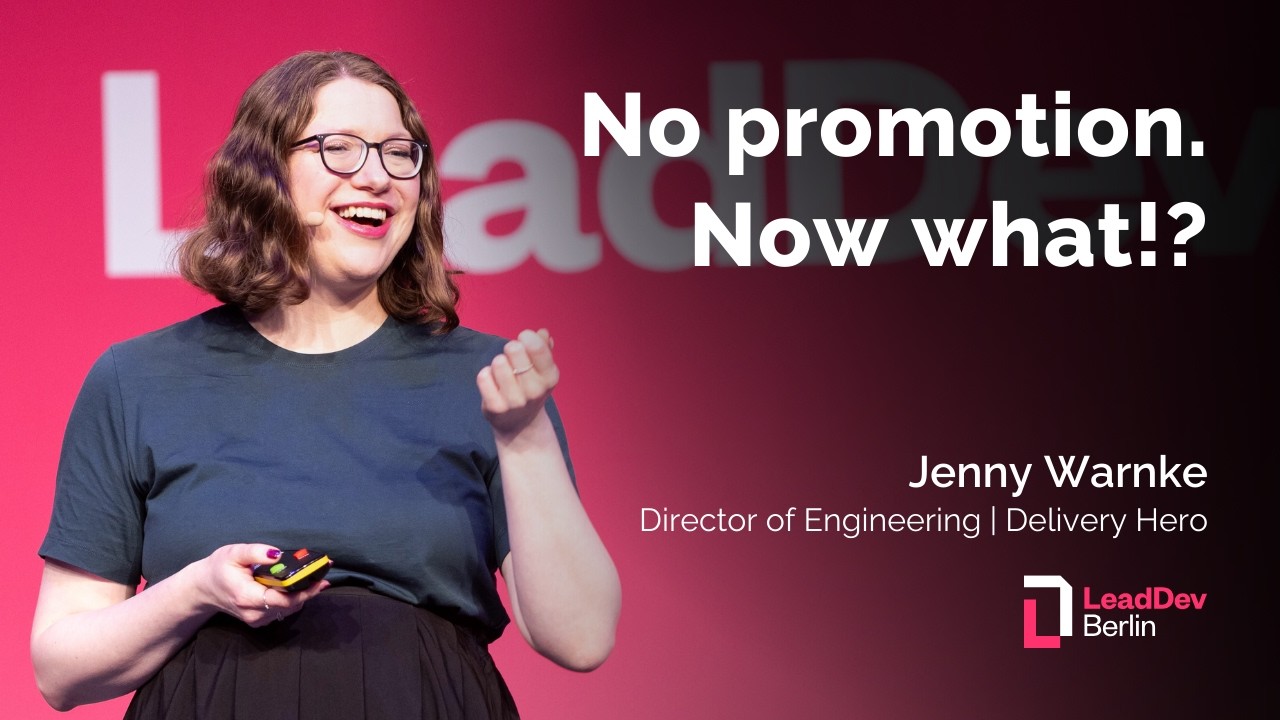
[[3. Resources/Readwise/Full Document Contents/Articles/No Promotion. Now What! Jenny Warnke LeadDev Berlin 2025|Full Document Contents]]
## Document Notes
> [!note]+ Document Notes
> tags: [career-development, professional-growth, leadership-transition]
> author: Jenny Warnke
> source: LeadDev Berlin 2025
> reference: https://www.youtube.com/watch?v=tRLXWo3uZ-8
> date created: 2025-01-11 14:22
>
> # 🏷️ Title: No promotion. Now what!? | Jenny Warnke | LeadDev Berlin 2025
>
<!-- deep-read:sections start -->
## 🧰 Action Inbox
- [H1] Create 30-day emotional recovery plan after rejection — focus on safe spaces and trusted support #career-development
- [H2] Schedule clarity session with manager about promotion denial reasons — prepare specific questions #performance-management
- [H3] Define success metrics beyond job titles — identify core motivations and alternative growth paths #professional-growth
## 🧭 Table of Contents
- [📝 Summary](#-summary)
- [📖 Main Content](#-main-content)
- [🗒️ Notes](#️-notes)
- [📚 References](#-references)
- [🗣️ Paraphrase](#️-paraphrase)
- [📰 Newsletter](#-newsletter)
- [✅ Action Items](#-action-items)
- [🧪 Hypotheses](#-hypotheses)
- [📊 Methodology](#-methodology)
- [❓ Questions](#-questions)
- [🔮 Future Research](#-future-research)
- [💡 Implications](#-implications)
- [🧠 Learning Styles Assessment](#-learning-styles-assessment)
- [📊 Accessibility Assessment](#-accessibility-assessment)
- [🌍 DEIB Assessment](#-deib-assessment)
- [✅ Logical Validity](#-logical-validity)
- [🛡️ DARVO Analysis](#-darvo-analysis)
- [🎯 Conclusion](#-conclusion)
### 🔗 References
- [LeadDev Berlin 2025](https://berlin2025.leaddev.com/)
- [Jenny Warnke LinkedIn](https://www.linkedin.com/in/jenny-warnke/)
## 📝 Summary
- Jenny Warnke shares a structured approach to handling promotion rejection through a 30-day recovery framework
- The framework focuses on emotional processing, gaining clarity on rejection reasons, reframing success beyond titles, and exploring next steps
- Personal experience: Speaker eventually received promotion 6 months later by addressing growth areas while maintaining work-life boundaries
- Key insight: Focus on what you can control (your growth) versus what you cannot (promotion decisions)
- Bottom line: Treat professional setbacks as growth opportunities with systematic recovery strategies
## 📖 Main Content
Jenny Warnke, a director of engineering with 16+ years experience, presents a practical framework for recovering from promotion rejection. Her approach treats professional setbacks as growth opportunities rather than career dead-ends.
The core framework involves four steps over 30 days: emotional first aid, clarity gathering, success reframing, and option evaluation. Warnke emphasizes that rejection reasons typically fall into three categories: personal readiness gaps, organizational changes (like reorgs), or unfair treatment.
A critical insight is redefining success beyond titles. Motivations for promotion often include salary, recognition, scope, or specific projects - many achievable without title changes. The speaker advocates for sustainable growth practices, including boundary setting and reducing unsustainable overwork patterns.
The decision framework includes staying and growing, leaving for new opportunities, or pursuing both paths simultaneously. Success factors depend on whether your current environment can meet your needs and growth objectives.
## 🗒️ Notes
#### ⏱️ [00:00](https://youtu.be/tRLXWo3uZ-8?t=0) — [H1] Introduction and personal experience
- Key idea: Professional rejections create identity crisis and emotional turmoil
- Evidence: "I cried a lot during my performance review in front of my manager, very classic"
#### ⏱️ [01:15](https://youtu.be/tRLXWo3uZ-8?t=75) — [H2] Three critical questions after rejection
- Key idea: Rejection triggers existential, analytical, and strategic questioning
- Evidence: "Who am I without this promotion? Is it me? Should I stay or should I go?"
#### ⏱️ [02:30](https://youtu.be/tRLXWo3uZ-8?t=150) — [H1] Treating setbacks as growth opportunities
- Key idea: Reframe professional disappointments as development catalysts
- Evidence: "There's one choice that you can make and that is to treat it as an opportunity for growth"
#### ⏱️ [03:00](https://youtu.be/tRLXWo3uZ-8?t=180) — [H2] 30-day bounce-back framework introduction
- Key idea: Structured recovery approach with four specific steps
- Evidence: "Focus on the first 30 days. That's why it's called 30-day bounceback plan"
#### ⏱️ [03:15](https://youtu.be/tRLXWo3uZ-8?t=195) — [H1] Step 1: Emotional first aid
- Key idea: Normalize and safely process rejection emotions
- Evidence: "It's totally normal that rejections feel personal even if they weren't meant to"
#### ⏱️ [04:20](https://youtu.be/tRLXWo3uZ-8?t=260) — [H1] Step 2: Getting clarity on rejection reasons
- Key idea: Three main categories explain most promotion denials
- Evidence: "Personal readiness, dumb luck and the role is not there anymore, or unfair treatment"
#### ⏱️ [06:45](https://youtu.be/tRLXWo3uZ-8?t=405) — [H2] Managing emotional impact during clarity conversations
- Key idea: Rejection affects trust and performance in broader work contexts
- Evidence: "There's most likely a potential trust or loss of trust with your manager or the company"
#### ⏱️ [07:30](https://youtu.be/tRLXWo3uZ-8?t=450) — [H1] Step 3: Reframing success beyond titles
- Key idea: Identify underlying motivations that don't require title changes
- Evidence: "You wanted to have a higher salary, recognition, bigger scope, or specific projects"
#### ⏱️ [08:15](https://youtu.be/tRLXWo3uZ-8?t=495) — [H2] Alternative growth paths without climbing ladder
- Key idea: Lateral growth can be equally valuable as vertical promotion
- Evidence: "You don't always need to climb the ladder to climb the ladder"
#### ⏱️ [08:45](https://youtu.be/tRLXWo3uZ-8?t=525) — [H2] Setting boundaries and sustainable practices
- Key idea: Use rejection as opportunity to establish healthier work patterns
- Evidence: "Maybe while working towards promotion, you did overtime, worked your ass off, said yes to everything"
#### ⏱️ [09:30](https://youtu.be/tRLXWo3uZ-8?t=570) — [H1] Step 4: Evaluating next steps and options
- Key idea: Three paths available - quit, double down on growth, or find internal alternatives
- Evidence: "You quit and look for a new job, double down on growth areas, or look into different alternative within company"
#### ⏱️ [10:15](https://youtu.be/tRLXWo3uZ-8?t=615) — [H2] Focus on controllable factors
- Key idea: Promotion decisions are outside your control, but growth planning isn't
- Evidence: "Focus on what is within your control and that is your own growth"
#### ⏱️ [11:00](https://youtu.be/tRLXWo3uZ-8?t=660) — [H1] Personal outcome and lessons learned
- Key idea: Structured approach led to promotion within 6 months
- Evidence: "I got the promotion 6 months after working on growth areas, still looked for jobs, cut down overtime"
#### ⏱️ [11:30](https://youtu.be/tRLXWo3uZ-8?t=690) — [H2] Key takeaways and conclusion
- Key idea: Systematic approach to professional setbacks with focus on controlled elements
- Evidence: "Emotions are part of every rejection, focus on 30 days, take control of your own growth"
## 📚 References
- [LeadDev Berlin 2025 Conference](https://berlin2025.leaddev.com/)
- [Jenny Warnke Speaking Profile](https://www.linkedin.com/in/jenny-warnke/)
- [LeadDev Learning Platform](https://leaddev.com/)
## 🗣️ Paraphrase
- Professional rejection triggers both emotional and strategic responses that require systematic processing over focused time periods
- Understanding rejection reasons helps distinguish between personal development needs, organizational constraints, and potential unfair treatment
- Success redefinition beyond titles often reveals alternative paths to achieve core motivations like salary, recognition, or project scope
## 📰 Newsletter
**Bouncing Back from Promotion Rejection: A 30-Day Framework**
Jenny Warnke's practical approach to handling career setbacks offers WordPress professionals a structured recovery plan. Her four-step framework - emotional processing, clarity gathering, success reframing, and option evaluation - applies directly to our community's growth challenges.
For WordPress developers and leaders, this resonates with promotion paths in agencies, product companies, or open source leadership roles. The key insight: focus on controllable growth elements like contributing to Core, leading community initiatives, or building specialized expertise.
Consider how you might reframe "success" in WordPress contexts - perhaps through Core committer status, plugin ownership, community recognition, or technical leadership roles that don't require traditional corporate ladders.
Resources: [Learn WordPress](https://learn.wordpress.org/), [Developer Docs](https://developer.wordpress.org/), [WP-CLI](https://wp-cli.org/)
## ✅ Action Items
#### DevRel
- Developer advocacy: Create promotion frameworks for community leadership roles, define career progression metrics
- Education: Develop workshops on handling rejection and career resilience for WordPress professionals
- Developer experience: Document alternative growth paths within WordPress ecosystem
- Developer marketing: Share success stories of non-traditional career advancement in open source
- Community management: Establish mentorship programs for professionals facing career setbacks
#### Community
- Maintainers: Create leadership pathways that don't depend on corporate promotion structures
- Contributors: Establish recognition systems for sustained contribution beyond commit privileges
- Sponsors: Fund career development programs for underrepresented groups facing advancement barriers
- Ecosystem: Document diverse success stories and career progression models
#### WordPress
- Core: Develop clear pathways for technical leadership roles and contributor advancement
- Community: Create structured mentorship programs for WordPress professionals
- Training: Build curricula around career development and professional resilience
- Marketing: Promote diverse career success stories within WordPress ecosystem
- Documentation: Document various leadership and growth opportunities available in WordPress
## 🧪 Hypotheses
- Systematic 30-day recovery frameworks reduce long-term career impact of promotion rejection
- Reframing success beyond titles increases job satisfaction and reduces promotion dependency
- Professional setbacks processed as growth opportunities lead to better career outcomes
- Focus on controllable growth factors improves promotion success rates in subsequent attempts
### 📊 Methodology
- Longitudinal study tracking career outcomes for individuals using structured rejection recovery versus ad-hoc approaches
- Survey analysis of motivation factors behind promotion desires and alternative satisfaction methods
- Comparative study of professionals who changed companies versus those who stayed after rejection
### ❓ Questions
- How do recovery frameworks vary effectiveness across different industry sectors and company sizes?
- What specific boundary-setting practices most effectively prevent burnout during promotion pursuit?
- How can organizations better support employees through promotion rejection without creating false expectations?
### 🔮 Future Research
- Development of industry-specific promotion rejection recovery frameworks
- Analysis of organizational cultures that minimize promotion rejection trauma
- Investigation of alternative career progression models in remote-first organizations
### 💡 Implications
- Practice: Managers need training on delivering promotion rejections constructively and supportively
- Policy: Organizations should establish clear promotion criteria and alternative recognition pathways
- Security: Career resilience becomes critical skill for professional sustainability in uncertain markets
- Education: Professional development programs should include rejection recovery and boundary-setting training
- Funding: Investment in career coaching and mentorship programs during organizational transitions
### 🧠 Learning Styles Assessment
Reading level estimate: Flesch-Kincaid Grade Level 8-9
#### 👀 Visual learners
- Present: Speaker presentation format with clear progression through framework steps
- Improve: Decision matrix templates, career pathway diagrams, emotion processing flowcharts
#### 🔊 Aural learners
- Present: Video presentation with clear verbal delivery and personal narrative
- Improve: Audio-only version, guided meditation recordings for emotional processing
#### 🗣️ Verbal learners
- Present: Clear definitions of framework steps, concrete examples, personal story structure
- Improve: Glossary of career development terms, analogies for different rejection types
#### 🧩 Kinesthetic learners
- Present: Step-by-step framework with actionable components
- Improve: Worksheets for each framework step, role-playing scenarios, reflection exercises
#### 🧠 Logical learners
- Present: Clear four-step framework, cause-and-effect reasoning for rejection categories
- Improve: Decision trees for stay/go choices, metrics for growth area assessment
#### 🧑🤝🧑 Social learners
- Present: Conference presentation format encouraging community discussion
- Improve: Peer support group guides, mentorship pairing frameworks, discussion prompts
#### 🧘♀️ Solitary learners
- Present: Self-reflection prompts, personal assessment opportunities
- Improve: Journaling templates, private self-assessment tools, independent growth planning guides
#### 🌿 Naturalistic learners
- Present: Organic career growth concepts, natural progression metaphors
- Improve: Seasonal career planning analogies, growth ecosystem thinking, sustainable practice emphasis
### 📊 Accessibility Assessment
#### Screen reader semantics
- Present: Clear heading structure in transcript, logical content flow
- Improve: Enhanced alt text for any visual elements, descriptive headings for framework steps
#### Keyboard navigation
- Present: Standard video player controls accessible via keyboard
- Improve: Timestamped navigation options, keyboard shortcuts for framework sections
#### Contrast and readability
- Present: Video format with clear audio delivery
- Improve: High-contrast transcript formatting, increased text size options for supplementary materials
#### Text resizing and reflow
- Present: Responsive video player, scalable transcript text
- Improve: Reflow-friendly framework summaries, mobile-optimized reference materials
#### Media and captions
- Present: Full transcript available, clear audio quality
- Improve: Professional captions with speaker identification, downloadable transcript formats
#### Forms and interactions
- Present: Basic video interaction controls
- Improve: Accessible feedback forms for framework implementation, labeled reflection tools
### 🌍 DEIB Assessment
#### Cultural breadth
- Present: Universal career challenges that cross cultural boundaries
- Improve: Examples from diverse organizational cultures, international promotion practices
#### Inclusive language
- Present: Gender-neutral career advice, accessible emotional vocabulary
- Improve: Avoid assumptions about family situations, include diverse relationship structures
#### Neurodiversity support
- Present: Structured framework approach, clear step progression
- Improve: Multiple processing timeframes beyond 30 days, alternative emotional regulation strategies
#### Representation
- Present: Female engineering leadership perspective, emotional vulnerability modeling
- Improve: Diverse case studies, varied career pathway examples, intersectional considerations
#### Psychological safety
- Present: Validation of emotional responses, non-judgmental framework presentation
- Improve: Content warnings for career trauma, resources for severe rejection impacts
### ✅ Logical Validity
#### Strong reasoning
- Deductive strength: Framework steps logically build from emotional processing to strategic planning
- Inductive strength: Personal experience generalizes appropriately to broader professional contexts
- Causal reasoning: Clear connections between systematic recovery and improved outcomes
- Analogical strength: Professional setbacks appropriately compared to other life challenges
#### Fallacies
- Survivorship bias: Success story doesn't account for cases where framework might not work, should include failure modes
- False dilemma: Stay/go decision oversimplifies complex career choices, could present more nuanced options
#### Tone of voice
- Overall tone: Vulnerable yet professional, combining personal authenticity with practical guidance
### 🛡️ DARVO Analysis
- Deny: No denial patterns present - speaker acknowledges multiple causes for rejection including unfair treatment
- Attack: No attacks on accusers - balanced view of manager/company relationships
- Reverse victim/offender: No reversal present - maintains appropriate responsibility boundaries
- Emotional cues and rhetoric: Healthy emotional processing model, validates feelings while promoting constructive action
## 🎯 Conclusion
Jenny Warnke's 30-day bounce-back framework offers a systematic approach to one of the most challenging professional experiences
---
## Full Transcript
[00:07] Hello everyone.<br>[00:10] So I'm Jenny. I'm a director of<br>[00:11] engineering and I'm in tech for over 16<br>[00:14] years now. So it's been a while. And<br>[00:16] today I want to talk about a topic that<br>[00:18] you might have experienced yourself and<br>[00:21] if not you maybe will.<br>[00:24] So just imagine you're in your role for<br>[00:27] a while and you want to grow to the next<br>[00:29] level. So you work with your manager<br>[00:32] towards your promotion and you have a<br>[00:34] growth plan and all of that and then you<br>[00:37] have your performance review and your<br>[00:40] manager says<br>[00:42] sorry you're not getting that promotion.<br>[00:46] So what do you do? I can tell you what I<br>[00:48] did when that happened to me a few years<br>[00:51] ago actually.<br>[00:53] So, I cried a lot during my performance<br>[00:57] review in front of my manager, very<br>[00:59] classic. Um, and there were not pretty<br>[01:02] tears, but really ugly ones because I<br>[01:05] was crushed. I felt rejected and I was<br>[01:09] also angry, too. And I had so many<br>[01:12] questions going through my head. And I<br>[01:14] think they boil down to three main ones.<br>[01:17] First, who am I without this promotion<br>[01:21] that I didn't get?<br>[01:23] because it very very felt like a<br>[01:26] personal rejection even if it was a<br>[01:28] professional one. And I went through a<br>[01:30] little bit of an identity crisis<br>[01:33] and I was also wondering is it me? Is it<br>[01:37] the company? Was there somebody that was<br>[01:40] not supporting me in my growth or like<br>[01:42] in my request or quest for the<br>[01:44] promotion? Um or could I have done<br>[01:47] something better? Was there something<br>[01:48] that I missed? Um, and then the question<br>[01:51] of the questions, should I stay or<br>[01:54] should I go? So, now what? Um, if you're<br>[01:58] ever in this situation or you've been in<br>[02:00] this situation or maybe a similar one,<br>[02:02] it could be that you applied for a job<br>[02:04] that you really wanted to have but you<br>[02:06] didn't get an offer. Um, or you wanted<br>[02:09] to lead a project that you were really<br>[02:11] aiming for and you didn't get that. Um<br>[02:14] and in my opinion there's one choice<br>[02:16] that you can make and that is to treat<br>[02:19] it as an opportunity for growth because<br>[02:22] like no matter in your professional or<br>[02:24] in your personal life you will have<br>[02:26] times where everything is great and<br>[02:28] everything is coming your way but then<br>[02:30] you will also have setbacks too and<br>[02:33] setbacks are great even if they suck and<br>[02:37] even if they're painful<br>[02:39] um and I suggest to just focus goes on<br>[02:43] the first 30 days. That's why it's<br>[02:46] called 30-day bounceback plan to<br>[02:48] basically come back to your feet. Um,<br>[02:51] and there are four steps I really would<br>[02:54] like to focus on. The first one is<br>[02:56] focusing on your f on your emotional<br>[02:59] first eight. And that means<br>[03:02] it's totally normal that rejections feel<br>[03:06] personally if even if they weren't meant<br>[03:08] to. It's fine to feel frustrated, sad,<br>[03:12] angry. Um, and I suggest to let it out<br>[03:15] in a safe space. I don't mean take your<br>[03:18] laptop and throw it through out a window<br>[03:20] at the office. Um, and talk to people<br>[03:24] that you trust to like maybe help you<br>[03:27] through it or to just vent in the end.<br>[03:30] And then<br>[03:33] it's also really important as a second<br>[03:35] step to get clarity on why the promotion<br>[03:38] was rejected. I think there are plenty<br>[03:41] of reasons. I think the in the end it<br>[03:44] will boil down to a few of them like one<br>[03:46] it could be really personal readiness.<br>[03:49] So maybe there was something that you<br>[03:52] were supposed to grow in or to achieve<br>[03:54] and that didn't happen. Maybe it was<br>[03:57] just dumb luck and the role is not there<br>[03:59] anymore. Maybe around that time there<br>[04:02] was a reorg and um it was decided that I<br>[04:07] don't know the team or that you were<br>[04:09] supposed to lead is now smaller so the<br>[04:10] role is not there anymore or maybe it<br>[04:13] was unfair treatment and somebody just<br>[04:17] [ __ ] you over. Um what that also means<br>[04:20] to get clarity is you need to speak to<br>[04:22] your manager again or maybe the manager<br>[04:25] of your manity manager. Um and<br>[04:30] I think the goal of these talks or like<br>[04:33] sessions is to really effectively<br>[04:35] address the reasons on why it was<br>[04:37] denied.<br>[04:39] >> Hope you're enjoying this video, but did<br>[04:41] you know lead has lots more to offer? So<br>[04:44] webinar, podcasts, I even like articles,<br>[04:48] conferences, events and most importantly<br>[04:50] community<br>[04:51] >> and even thinking about like process<br>[04:53] tech and people which is how a lead dev<br>[04:55] website is laid out. I really think this<br>[04:57] is the number one learning platform for<br>[04:59] me as an engineering manager. Don't<br>[05:01] forget to check out leadv.com.<br>[05:08] >> And I think there are a few things that<br>[05:10] you should just keep in mind for that is<br>[05:13] there's most likely an emotional impact<br>[05:15] of the rejection that you had. There's<br>[05:18] most likely a potential trust or loss of<br>[05:21] trust with your manager or the company<br>[05:24] or life in general. Um and there are<br>[05:27] different ways on how this<br>[05:28] disappointment can also manifest. So you<br>[05:31] could have I don't know a drop in<br>[05:32] performance. You might more be more<br>[05:35] sensitive in like discussion that<br>[05:37] doesn't even affect all about the<br>[05:39] promotion. Um which brings me to the<br>[05:42] third point which I think is a really<br>[05:44] really crucial one and that is about<br>[05:47] reframing what success means for you<br>[05:50] beyond the title. So that means take a<br>[05:53] step back and look into what do I really<br>[05:56] want or need in the next few months, one<br>[06:00] year, couple of years. Um, and look into<br>[06:04] what kind of motivation was actually<br>[06:06] behind you wanting this promotion. It<br>[06:09] could be the title, which is totally<br>[06:11] fine and totally valid, but it could<br>[06:14] also be, I don't know, you wanted to<br>[06:15] have a higher salary. You wanted to have<br>[06:17] the recognition. you wanted to have a<br>[06:20] bigger scope to work on um or specific<br>[06:24] projects to get your hands on. And we<br>[06:27] also had a talk yesterday that was about<br>[06:30] you don't always need to climb the<br>[06:32] ladder to climb the ladder. So if you're<br>[06:34] a senior software engineer um and you're<br>[06:38] comfortable in that, you don't need to<br>[06:40] climb higher to grow. There are other<br>[06:43] ways on how you can grow as well. And um<br>[06:47] I would also really use it as an<br>[06:49] opportunity to set boundaries. So maybe<br>[06:52] while you were working towards your<br>[06:54] promotion, you did a lot of over hours.<br>[06:57] You worked your ass off. You said yes to<br>[07:00] every opportunity and every side<br>[07:01] project. Um and that might be something<br>[07:05] to just reflect on. Is that something<br>[07:08] how you want to do your job after you<br>[07:10] get the promotion? Is that really how<br>[07:12] you want to grow healthy or more<br>[07:15] sustainable in in your career as well?<br>[07:18] Um,<br>[07:20] and that also brings us already to like<br>[07:23] what are the next steps afterwards and<br>[07:25] that can actually take longer than 30<br>[07:27] days. Um, and I think it's really about<br>[07:30] checking the options that you have. So<br>[07:32] the one obvious one is you quit and look<br>[07:35] for a new job or maybe the other way<br>[07:38] around depending on how much safety you<br>[07:40] need. You could double down on some<br>[07:43] growth areas that really make sense for<br>[07:45] you and really make make sense for your<br>[07:48] career as well or you look into a<br>[07:50] different alternative within your<br>[07:52] company and I think the factors will<br>[07:55] differ from person to person because<br>[07:57] everyone's motivation is different as<br>[07:59] well and in the end it could be maybe<br>[08:02] just I don't know having a decision<br>[08:04] matrix on should I stay or should I go<br>[08:06] or should I maybe do both maybe you<br>[08:09] decide to look for a job, still grow in<br>[08:13] areas and then see what comes first. Um,<br>[08:16] and really looking into can your current<br>[08:19] company or your manager or your team<br>[08:22] provide for your needs as well. Um, and<br>[08:26] I think what is really important is to<br>[08:28] focus on what is within your control and<br>[08:31] that is your own growth, your growth<br>[08:34] plan. um having regular check-ins with<br>[08:36] your manager and really asking okay is<br>[08:39] anything missing anything I need to be<br>[08:41] aware about also having sponsors or<br>[08:43] people who support you in your career as<br>[08:46] well is really important because<br>[08:48] unfortunately the decision on your<br>[08:50] promotion is not within your control<br>[08:54] you're working towards it but you will<br>[08:56] not make the decision your manager will<br>[08:58] make the decision and depending on the<br>[09:00] company maybe not your manager will not<br>[09:03] even make the final decision on that as<br>[09:04] well. So that also means it's quite a<br>[09:07] turbulent time as well is seek guidance.<br>[09:11] Maybe you have a great coach or a great<br>[09:13] mentor um or even your manager as well<br>[09:16] or therapist that can help sometimes as<br>[09:19] well. Um so to just conclude um actually<br>[09:24] in my journey I got the promotion 6<br>[09:26] months after I was working on some<br>[09:29] growth areas that made sense. Um I still<br>[09:32] looked in parallel for a job to just see<br>[09:35] what is out there. Um and I really cut<br>[09:38] down over the over hours because that<br>[09:40] was one of my issues as well. Um<br>[09:44] so to also just conclude emotions are<br>[09:47] part of every rejection and it's okay to<br>[09:50] be however you feel. Uh focus on just<br>[09:53] maybe the first 30 days. Um so emotions<br>[09:58] um getting clarity checking your options<br>[10:00] and then address the rest. Um and then<br>[10:04] also really take control of what is<br>[10:06] within your control which is your own<br>[10:08] growth. And that's it. Thank you.
<!-- deep-read:sections end -->
## Highlights
- Hello everyone. So I'm Jenny. I'm a director of engineering and I'm in tech for over 16 years now. So it's been a while. And today I want to talk about a topic that you might have experienced yourself and if not you maybe will. So just imagine you're in your role for a while and you want to grow to the next level. So you work with your manager ([View Highlight](https://read.readwise.io/read/01kj8nd7dxdj5rxm9zbw6484jh))
- Tags: 👻 ai highlighted
- company maybe not your manager will not even make the final decision on that as well. So that also means it's quite a turbulent time as well is seek guidance. Maybe you have a great coach or a great mentor um or even your manager as well or therapist that can help sometimes as well. Um so to just conclude um actually in my journey I got the promotion 6 months after I was working on some growth areas that made sense. Um I still ([View Highlight](https://read.readwise.io/read/01kj8nd7ers488d21zjnter1re))
- Tags: 👻 ai highlighted