ORC_License_DRAFT
[[3. Resources/Readwise/Full Document Contents/Articles/ORC_License_DRAFT|Full Document Contents]]
## Document Notes
---
tags:
- #orclicense
- #opencontent
- #ttrpg
- #gaming
- #opensource
Author: Brian Lewis
Source: Draft Open RPG Creative (ORC) License
Reference: https://www.azoralaw.com/orclicense
date created: 2025-08-28 00:00
---
# Title: ORC License (Draft) — Structure, Grants, and Use in TTRPG Publishing
## Table of Contents
- [[#📝 Summary:]]
- [[#📖 Main Content:]]
- [[#🗒️ Notes]]
- [[#📖 References:]]
- [[#🗣️ Paraphrase]]
- [[#📰 Newsletter]]
- [[#✅ Action Items]]
- [[#🧪 Hypotheses]]
- [[#📊 Methodology]]
- [[#❓ Questions]]
- [[#🔮 Future Research]]
- [[#💡 Implications]]
- [[#🧠 Learning Styles Assessment]]
- [[#📊 Accessibility Assessment]]
- [[#🌍 DEIB Assessment]]
- [[#✅ Logical validity]]
- [[#🔍 DARVO Analysis]]
- [[#🔍 SEO Evaluation]]
- [[#🎯 Conclusion]]
### References: Include a list of sources consulted and cited in the article.
- See the [📖 References](#-references) section.
## 📝 Summary:
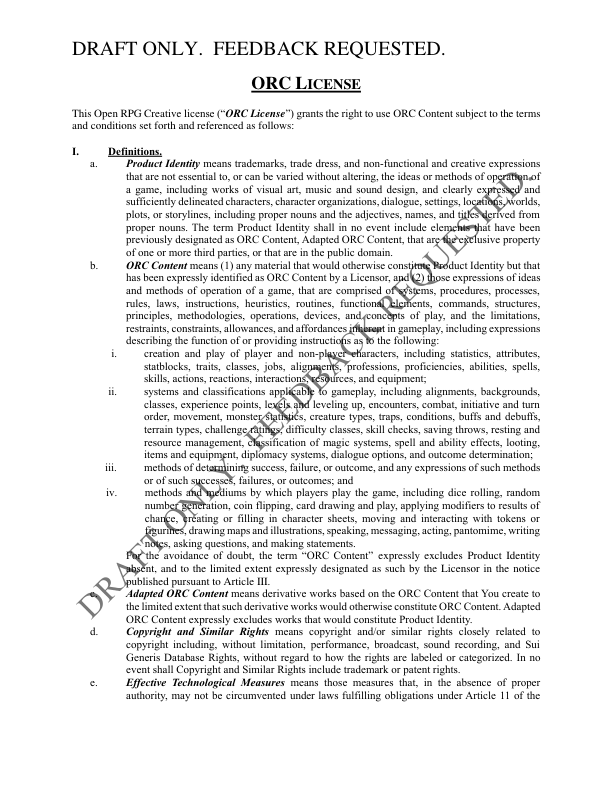
This draft of the Open RPG Creative (ORC) License establishes an irrevocable, royalty-free, worldwide license to use “ORC Content” in tabletop roleplaying games (TTRPGs). It distinguishes between “Product Identity” (e.g., trademarks, distinctive characters, creative settings) and “ORC Content” (systems, rules, procedures, and functional expressions of gameplay). The license grants broad rights to use, reproduce, and adapt ORC Content, requires downstream sharing of Adapted ORC Content under the same terms, and prohibits imposing additional restrictions (including technological protection measures) that would limit recipients’ rights.
The license includes attribution and notice requirements, clarifies that moral rights and personality rights are not licensed (with limited waivers), and provides robust warranty disclaimers and limitations of liability. Database rights are specifically addressed, allowing extraction and reuse where applicable. Termination occurs upon breach, with a 60-day cure period; downstream licensees retain their rights. The license text itself is non-modifiable and contains severability and non-waiver clauses.
Key quotes:
- “Product Identity means trademarks, trade dress, and non-functional and creative expressions…”
- “Subject to the terms and conditions… Licensor hereby grants You a worldwide, royalty-free, non-sublicensable, non-exclusive, irrevocable license…”
- “You may not… apply any Effective Technological Measures… if doing so restricts exercise of the Licensed Rights…”
## 📖 Main Content:
The ORC License is a purpose-built open content license tailored to TTRPG publishing. Its core design separates protectable brand/creative expression (Product Identity) from open, reusable, functional content (ORC Content) such as rules, systems, and procedures. This mirrors the copyright doctrine that ideas, systems, and methods of operation are not protected by copyright, while expressive elements are.
Major pillars:
- Definitions: Product Identity vs. ORC Content vs. Adapted ORC Content, Licensed Rights, and Sui Generis Database Rights.
- Grants: A perpetual-feeling (irrevocable) grant to use and adapt ORC Content; mandatory share-alike for Adapted ORC Content.
- Limitations: No implication of endorsement; moral/publicity rights excluded; waiver of royalties; prohibition on DRM that restricts licensed rights.
- Notices: Obligatory ORC license notice, attribution for upstream licensors, and a Product Identity declaration.
- Warranty/LIability: “As-is” licensing with broad disclaimers and limitations to the extent permitted by law.
- Enforcement/Termination: Auto-termination on breach with a cure period; enforcement limited to licensor and upstream licensors; downstream users remain protected.
- Non-modifiability: The license cannot be amended or revoked, ensuring predictability and stability.
This structure aims to protect creators’ brands and unique expression while enabling a robust commons of game mechanics and interoperable systems.
### 🗒️ Notes
- Definitions
- Product Identity
- Covers trademarks, trade dress, and “non-functional and creative expressions” like art, music, and clearly delineated characters, settings, worlds, and plots.
- Excludes anything previously designated as ORC Content, third-party property, or public domain.
- ORC Content
- Includes functional expressions of gameplay: systems, procedures, rules, instructions, and mechanics.
- Examples: character creation (stats, classes, skills, spells, equipment), combat and initiative, difficulty classes, saving throws, challenge ratings, item systems, dialogues and outcomes, methods for determining success/failure, and play mediums (dice, cards, RNG).
- Product Identity is expressly excluded unless explicitly designated as ORC Content by the licensor.
- Adapted ORC Content
- Derivative works based on ORC Content, to the extent they remain ORC Content.
- Expressly excludes Product Identity.
- Licensed Rights
- All copyright and similar rights that apply to use of ORC Content.
- Sui Generis Database Rights
- EU-style database rights accounted for; allows extract/reuse of substantial portions where applicable.
- Grants and Limitations
- Primary grant
- Worldwide, royalty-free, non-sublicensable, non-exclusive, irrevocable license to use ORC Content in all media, with necessary technical modifications permitted (including circumventing Effective Technological Measures where needed to exercise rights).
- Share-alike
- You must license Adapted ORC Content to recipients under the same ORC License terms; you cannot add restrictions or DRM that limits recipients’ rights.
- Database rights
- If you incorporate substantial database content, your database becomes Adapted ORC Content (but not its individual contents that may have separate rights).
- Non-endorsement
- No implication that your use is sponsored or endorsed by the licensor.
- Personality/moral rights
- Not licensed; limited waivers only to permit exercising licensed rights.
- Royalties
- Licensor waives rights to collect royalties from you where possible.
- Required Notices
- ORC License notice
- Example site references: “This product is licensed under the ORC License… available online at … azoralaw.com/orclicense … gencon.com/orclicense…”
- Attribution
- Identify each licensor/creator and upstream licensors; allow your own preferred credit line (including pseudonym).
- Product Identity notice
- Identify elements you designate as Product Identity; in case of conflict, the license’s definition controls.
- Warranty and Liability
- “As-is” and “as-available,” with broad disclaimers (title, merchantability, fitness, non-infringement, accuracy, errors).
- Broad limitation of liability for any damages to the extent permitted by law.
- Enforcement and Termination
- Automatic termination upon breach; reinstatement if cured within 60 days from discovery or if waived in writing.
- Does not affect rights of other licensors or downstream licensees.
- Only licensor and upstream licensors may enforce.
- Modifications and Severability
- License cannot be amended or revoked; separate agreements allowed if they don’t modify the license.
- Severability provision and no-implied-waiver clause.
- Practical Implications
- Encourages interoperable TTRPG ecosystems.
- Protects brands while enabling mechanics sharing.
- Clear compliance checklist (notices, attributions, PI designation).
- Reduces legal ambiguity around database rights and DRM.
## 📖 References:
- ORC License information page by counsel: Open RPG Creative License at Azora Law: https://www.azoralaw.com/orclicense
- Background on ORC initiative and community stewardship: Paizo’s ORC announcement: https://paizo.com/community/orc
- General overview of database rights: European Commission on Database Directive 96/9/EC: https://commission.europa.eu/law/law-topic/data-pr
> [!note]+ Document Notes
> tags:
> - #orclicense
> - #opencontent
> - #ttrpg
> - #gaming
> - #opensource
> Author: Brian Lewis
> Source: Draft Open RPG Creative (ORC) License
> Reference: https://www.azoralaw.com/orclicense
> date created: 2025-08-28 00:00
>
> # Title: ORC License (Draft) — Structure, Grants, and Use in TTRPG Publishing
>
<!-- deep-read:sections start -->
## Table of Contents
- [📝 Summary](#-summary)
- [📖 Main Content](#-main-content)
- [🗒️ Notes](#-️-notes)
- [📖 References](#-references)
- [🗣️ Paraphrase](#-paraphrase)
- [📰 Newsletter](#-newsletter)
- [✅ Action Items](#-action-items)
- [🧪 Hypotheses](#-hypotheses)
- [📊 Methodology](#-methodology)
- [❓ Questions](#-questions)
- [🔮 Future Research](#-future-research)
- [💡 Implications](#-implications)
- [🧠 Learning Styles Assessment](#-learning-styles-assessment)
- [📊 Accessibility Assessment](#-accessibility-assessment)
- [🌍 DEIB Assessment](#-deib-diversity-equity-inclusion-and-belonging-assessment)
- [✅ Logical validity](#-logical-validity)
- [🔍 DARVO Analysis](#-darvo-analysis)
- [🔍 SEO Evaluation](#-seo-evaluation)
- [🎯 Conclusion](#-conclusion)
### References: Include a list of sources consulted and cited in the article.
- See the [📖 References](#-references) section.
## 📝 Summary:
This draft of the Open RPG Creative (ORC) License establishes an irrevocable, royalty-free, worldwide license to use “ORC Content” in tabletop roleplaying games (TTRPGs). It distinguishes between “Product Identity” (e.g., trademarks, distinctive characters, creative settings) and “ORC Content” (systems, rules, procedures, and functional expressions of gameplay). The license grants broad rights to use, reproduce, and adapt ORC Content, requires downstream sharing of Adapted ORC Content under the same terms, and prohibits imposing additional restrictions (including technological protection measures) that would limit recipients’ rights.
The license includes attribution and notice requirements, clarifies that moral rights and personality rights are not licensed (with limited waivers), and provides robust warranty disclaimers and limitations of liability. Database rights are specifically addressed, allowing extraction and reuse where applicable. Termination occurs upon breach, with a 60-day cure period; downstream licensees retain their rights. The license text itself is non-modifiable and contains severability and non-waiver clauses.
Key quotes:
- “Product Identity means trademarks, trade dress, and non-functional and creative expressions…”
- “Subject to the terms and conditions… Licensor hereby grants You a worldwide, royalty-free, non-sublicensable, non-exclusive, irrevocable license…”
- “You may not… apply any Effective Technological Measures… if doing so restricts exercise of the Licensed Rights…”
## 📖 Main Content:
The ORC License is a purpose-built open content license tailored to TTRPG publishing. Its core design separates protectable brand/creative expression (Product Identity) from open, reusable, functional content (ORC Content) such as rules, systems, and procedures. This mirrors the copyright doctrine that ideas, systems, and methods of operation are not protected by copyright, while expressive elements are.
Major pillars:
- Definitions: Product Identity vs. ORC Content vs. Adapted ORC Content, Licensed Rights, and Sui Generis Database Rights.
- Grants: A perpetual-feeling (irrevocable) grant to use and adapt ORC Content; mandatory share-alike for Adapted ORC Content.
- Limitations: No implication of endorsement; moral/publicity rights excluded; waiver of royalties; prohibition on DRM that restricts licensed rights.
- Notices: Obligatory ORC license notice, attribution for upstream licensors, and a Product Identity declaration.
- Warranty/LIability: “As-is” licensing with broad disclaimers and limitations to the extent permitted by law.
- Enforcement/Termination: Auto-termination on breach with a cure period; enforcement limited to licensor and upstream licensors; downstream users remain protected.
- Non-modifiability: The license cannot be amended or revoked, ensuring predictability and stability.
This structure aims to protect creators’ brands and unique expression while enabling a robust commons of game mechanics and interoperable systems.
### 🗒️ Notes
- Definitions
- Product Identity
- Covers trademarks, trade dress, and “non-functional and creative expressions” like art, music, and clearly delineated characters, settings, worlds, and plots.
- Excludes anything previously designated as ORC Content, third-party property, or public domain.
- ORC Content
- Includes functional expressions of gameplay: systems, procedures, rules, instructions, and mechanics.
- Examples: character creation (stats, classes, skills, spells, equipment), combat and initiative, difficulty classes, saving throws, challenge ratings, item systems, dialogues and outcomes, methods for determining success/failure, and play mediums (dice, cards, RNG).
- Product Identity is expressly excluded unless explicitly designated as ORC Content by the licensor.
- Adapted ORC Content
- Derivative works based on ORC Content, to the extent they remain ORC Content.
- Expressly excludes Product Identity.
- Licensed Rights
- All copyright and similar rights that apply to use of ORC Content.
- Sui Generis Database Rights
- EU-style database rights accounted for; allows extract/reuse of substantial portions where applicable.
- Grants and Limitations
- Primary grant
- Worldwide, royalty-free, non-sublicensable, non-exclusive, irrevocable license to use ORC Content in all media, with necessary technical modifications permitted (including circumventing Effective Technological Measures where needed to exercise rights).
- Share-alike
- You must license Adapted ORC Content to recipients under the same ORC License terms; you cannot add restrictions or DRM that limits recipients’ rights.
- Database rights
- If you incorporate substantial database content, your database becomes Adapted ORC Content (but not its individual contents that may have separate rights).
- Non-endorsement
- No implication that your use is sponsored or endorsed by the licensor.
- Personality/moral rights
- Not licensed; limited waivers only to permit exercising licensed rights.
- Royalties
- Licensor waives rights to collect royalties from you where possible.
- Required Notices
- ORC License notice
- Example site references: “This product is licensed under the ORC License… available online at … azoralaw.com/orclicense … gencon.com/orclicense…”
- Attribution
- Identify each licensor/creator and upstream licensors; allow your own preferred credit line (including pseudonym).
- Product Identity notice
- Identify elements you designate as Product Identity; in case of conflict, the license’s definition controls.
- Warranty and Liability
- “As-is” and “as-available,” with broad disclaimers (title, merchantability, fitness, non-infringement, accuracy, errors).
- Broad limitation of liability for any damages to the extent permitted by law.
- Enforcement and Termination
- Automatic termination upon breach; reinstatement if cured within 60 days from discovery or if waived in writing.
- Does not affect rights of other licensors or downstream licensees.
- Only licensor and upstream licensors may enforce.
- Modifications and Severability
- License cannot be amended or revoked; separate agreements allowed if they don’t modify the license.
- Severability provision and no-implied-waiver clause.
- Practical Implications
- Encourages interoperable TTRPG ecosystems.
- Protects brands while enabling mechanics sharing.
- Clear compliance checklist (notices, attributions, PI designation).
- Reduces legal ambiguity around database rights and DRM.
## 📖 References:
- ORC License information page by counsel: Open RPG Creative License at Azora Law: https://www.azoralaw.com/orclicense
- Background on ORC initiative and community stewardship: Paizo’s ORC announcement: https://paizo.com/community/orc
- General overview of database rights: European Commission on Database Directive 96/9/EC: https://commission.europa.eu/law/law-topic/data-protection/reform/rules-business-and-organisations/transfer-personal-data-outside-eu-and-eea_en
## 🗣️ Paraphrase:
- Original (Primary Grant):
“Subject to the terms and conditions of this ORC License, for the Term Licensor hereby grants You a worldwide, royalty-free, non-sublicensable, non-exclusive, irrevocable license to exercise the Licensed Rights in the ORC Content… including technical modifications necessary to circumvent Effective Technological Measures.”
- Paraphrase:
Provided you follow the license terms, the licensor grants you a global, no-cost, non-exclusive license that can’t be revoked to use ORC Content. You’re allowed to make whatever technical changes are needed to use it across formats, even if that means bypassing technological locks—so long as doing so is solely to exercise the rights the license gives you.
- Original (Warranty & Limitation of Liability):
“Licensor licenses the ORC Content as-is and as-available, and makes no representations or warranties… in no event will the Licensor be liable to You… for any direct, special, indirect, incidental, consequential… losses…”
- Paraphrase:
The licensor provides ORC Content without guarantees of any kind and won’t be responsible for damages of any sort arising from your use of it, as far as the law allows. If certain disclaimers or limits aren’t permitted where you are, then those specific parts may not apply.
## 📰 Newsletter:
Title: WordPress Web Dev Weekly — Learn, Build, and Ship Smarter
Hey builders! This week we’re focusing on sharpening your WordPress and open web skills:
- Learn: Level up your PHP, JavaScript, HTML/CSS, and Git workflow with project-based practice. Try building a block theme starter and a custom REST endpoint to connect external services.
- Updates: Keep an eye on Gutenberg’s iterative improvements and performance gains in core. Review release notes on the WordPress.org News blog for the latest editor features and accessibility fixes: https://wordpress.org/news/
- Community Highlights: Contributor mentorship cohorts continue to welcome newcomers—great way to get involved in Testing, Docs, Training, and Core. Start at Make WordPress: https://make.wordpress.org/
- New Plugins & Tools: Explore site health tooling, modern caching layers, and block-pattern libraries. Tip: vet plugins for sustainability (maintenance cadence, open issues, active installs).
- Pro Tip: Treat your wp-content as an application with CI—lint, test, and deploy via GitHub Actions to stage before production.
Stay curious, ship often, and share what you learn!
## ✅ Action Items:
Strategic prompt for aligning articles with your Developer Advocate/OSPO goals:
“Analyze how this article:
1) advances open-source advocacy (e.g., governance models, license freedoms, sustainability),
2) improves contributor onboarding and retention (clear contribution pathways, mentorship, recognition),
3) supports education (reusable curricula, accessible docs, hands-on exercises),
4) strengthens WordPress/open web alignment (compatibility, interoperability, licensing),
5) surfaces OSPO-relevant policies (compliance, attribution, SBOMs, CLA/DCO, risk mitigation),
6) promotes DEIB and transparency (inclusive language, accessible pathways, decision logs),
7) enables sustainable funding (grant models, sponsorships, cooperative governance),
8) provides actionable playbooks (checklists, templates, sample notices),
9) showcases measurable impact (KPIs: contributors, review SLAs, docs coverage, onboarding time),
and conclude with a roadmap for adoption in the WordPress ecosystem (pilot, feedback loops, iteration, and public reporting).”
## 🧪 Hypotheses:
- H1: Clear separation of Product Identity from ORC Content will increase cross-publisher interoperability and third-party module creation.
- H2: Mandatory share-alike for Adapted ORC Content will grow a commons that accelerates new system design and remixing.
- H3: Explicit database rights language will reduce EU legal uncertainty, increasing adoption among data-rich bestiaries and compendia.
- H4: Strong non-endorsement and warranty disclaimers lower perceived legal risk, encouraging indie adoption.
- H5: Required attribution chains improve provenance, reducing content misuse disputes.
### 📊 Methodology:
- Data sources: Publisher adoption surveys; GitHub/GitLab repos tagged with ORC; marketplace listings; citation/attribution graphs; EU publishers’ participation rates.
- Designs:
- Quasi-experimental before/after study of content output pre/post ORC adoption.
- Network analysis of attribution chains to measure reuse density.
- Legal incident tracking (DMCA complaints, takedown disputes) year-over-year compared with alternative licenses.
- Analysis:
- Time series on publication volume and cross-compatibility.
- Social network metrics (degree centrality, clustering) for content reuse.
- Regression controlling for publisher size and market cycles.
### ❓ Questions:
- How do creators decide what remains Product Identity versus what they designate as ORC Content?
- Does the share-alike clause deter some commercial use cases, and if so, where is the balance?
- How do database rights interact with statblocks compiled from multiple sources?
- What compliance patterns emerge around attribution of “upstream licensors”?
- Could a standard Product Identity taxonomy reduce disputes?
### 🔮 Future Research:
- Comparative study: ORC vs. OGL vs. Creative Commons BY/SA for TTRPG mechanics.
- Best practices for Product Identity declarations to minimize ambiguity.
- Tooling for attribution chain generation and verification.
- Empirical effects of DRM prohibitions on VTT/module ecosystems.
### 💡 Implications:
- Stronger commons can lower barriers to entry, diversify creators, and speed innovation in TTRPGs.
- Clearer IP boundaries reduce chilling effects and legal overhead.
- Standardized notices and attribution could become industry-wide norms, informing policy and platform guidelines.
### 🧠 Learning Styles Assessment:
- Readability: Legal/professional reading level—likely college/graduate-level due to formal definitions and clauses.
1) Visual (Spatial)
- Present: Structured sections and lists aid scanning.
- Improve: Add flowcharts for “What is ORC Content?” and compliance checklists.
2) Aural (Auditory)
- Present: None inherent.
- Improve: Provide an audio summary and Q&A podcast episode.
3) Verbal (Linguistic)
- Present: Precise definitions and examples.
- Improve: Add plain-language commentary and illustrative scenarios.
4) Physical (Kinesthetic)
- Present: None.
- Improve: Interactive wizard to generate notices and PI designations.
5) Logical (Mathematical)
- Present: Clear if/then conditions and enumerations.
- Improve: Decision trees and comparison tables (ORC vs other licenses).
6) Social (Interpersonal)
- Present: Not directly.
- Improve: Link to community forums and office hours for Q&A.
7) Solitary (Intrapersonal)
- Present: Full text supports independent study.
- Improve: Reflection prompts and self-check quizzes.
8) Naturalistic
- Present: Not applicable.
- Improve: Use nature analogies sparingly, not essential here.
### 📊 Accessibility Assessment:
- Screen Reader Compatibility: As a legal document, it should use semantic headings; ensure proper H1–H3 structure and descriptive section titles.
- Improve: Add alt-text to any images (e.g., sample notices).
- Keyboard Navigation: Ensure all sections are reachable via tab order.
- Improve: Provide “Back to top” links and skip-to-content anchor.
- Contrast and Readability: Use high-contrast text and ample line spacing.
- Improve: Offer a dyslexia-friendly format and adjustable line height.
- Text Resizing: Ensure responsive layout with rem-based typography.
- Improve: Test at 200% zoom without layout breakage.
### 🌍 DEIB (Diversity, Equity, Inclusion, and Belonging) Assessment:
- Cultural Relevance: Neutral legal text; lacks diverse examples.
- Improve: Add examples spanning indie and international publishers.
- Inclusive Language: Generally neutral; legal jargon is heavy.
- Improve: Provide a plain-language companion guide and glossary.
- Neurodiversity Support: Dense paragraphs and legalese can overwhelm.
- Improve: Break into shorter clauses, bullet summaries per section, and visual decision aids.
- Representation: No imagery or case studies.
- Improve: Incorporate case studies from varied creator backgrounds.
- Psychological Safety: Neutral tone, but complexity can intimidate.
- Improve: Add assurances, FAQs, and “common mistakes” guidance.
### ✅ Logical validity:
- Sound reasoning examples
- Separation of Product Identity vs ORC Content
- Strength: Aligns with copyright’s idea/expression dichotomy; reduces ambiguity.
- Suggestion: Include side-by-side examples to reinforce boundaries.
- Share-alike for Adapted ORC Content
- Strength: Ensures downstream freedoms; prevents enclosure.
- Suggestion: Clarify edge cases (mixed works, partial reuse).
- Non-endorsement clause
- Strength: Prevents implied sponsorship; reduces trademark risk.
- Suggestion: Provide a standard “compatibility” statement template.
- DRM restriction against limiting Licensed Rights
- Strength: Protects practical exercisability of rights.
- Suggestion: Define acceptable platform protections vs. prohibited restrictions.
- Potential weaknesses/fallacies
- Ambiguity risk: “Sufficiently delineated characters” could be subjective.
- Improvement: Add criteria/examples or a guidance appendix.
- Attribution chains complexity: “All upstream licensors” may be hard to enumerate.
- Improvement: Provide tooling or a minimum viable attribution standard.
- Tone of voice: Formal, neutral, legalistic; minimal rhetorical devices.
🔍 DARVO Analysis:
- Deny: No denial tactics—this is a rights grant, not a defense against allegations.
- Attack: No targeting of accusers or opponents.
- Reverse Victim/Offender: Not present; the text does not frame parties as victims.
- Notes: The document avoids emotionally charged language and focuses on precise obligations and rights. No DARVO indicators detected.
### 🔍 SEO Evaluation:
- Keywords: “ORC License,” “Open RPG Creative,” “Product Identity,” “TTRPG license,” “open content.”
- Integration: Natural across title, intro, and headers is recommended.
- Meta Description: Add a concise summary with primary keyword, e.g., “The Open RPG Creative (ORC) License defines reusable TTRPG mechanics and protects Product Identity.”
- Title Tag: “Open RPG Creative (ORC) License — Draft” fits 50–60 chars and includes keyword.
- Headers: Use H1 for title; H2s for Definitions, Grants, Notices, Warranty, Termination, Modifications.
- Content Length: Adequate for legal content; add plain-language explainer for broader audiences.
- Links: Include authoritative external links (Azora Law page, Paizo ORC page).
- URL: Keep concise and keyworded, e.g., /open-rpg-creative-orc-license.
- Images: If sample notices are images, add descriptive alt text; compress files.
- Mobile: Ensure responsive layout and quick load; avoid heavy PDFs without HTML alt version.
- Engagement: Add FAQs, examples, and a compliance checklist to increase time-on-page.
- Schema: Use Article schema; consider FAQ schema for common questions.
- Social: Add Open Graph/Twitter Card tags with a compelling summary and preview image.
## 🎯 Conclusion:
The ORC License draft provides a robust, community-friendly framework for sharing TTRPG mechanics while safeguarding creators’ Product Identity. Its irrevocable grant, share-alike requirement for Adapted ORC Content, non-endorsement provisions, and strong warranty/liability clauses aim to balance openness with legal clarity. With clearer examples, tooling for attribution, and plain-language guidance, the ORC could become a stable, widely adopted cornerstone for interoperable, sustainable TTRPG ecosystems.
<!-- deep-read:sections end -->
## Highlights
- ORC LICENSE ([View Highlight](https://read.readwise.io/read/01gxnzr2whbg6b30c654grdbje))