Open and Affirming Sunday— June 28, 2026
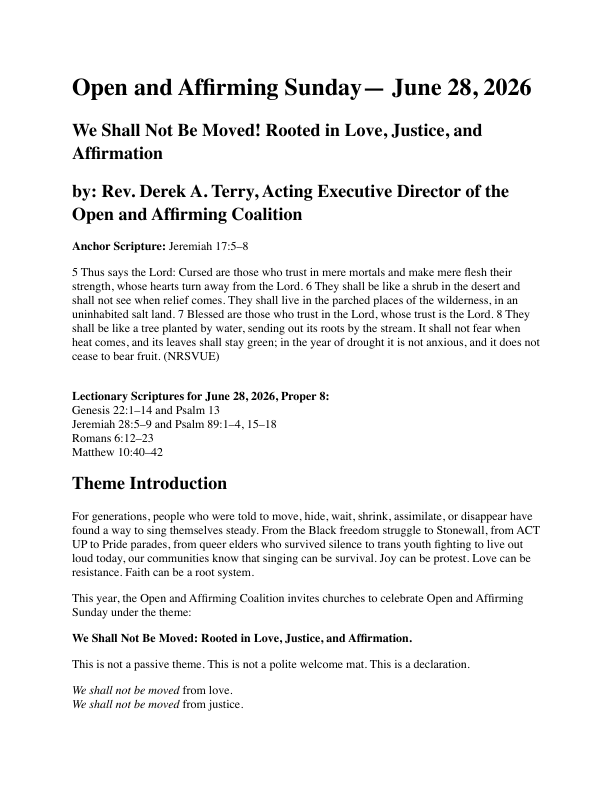
🔗 **Source:** [Open and Affirming Sunday— June 28, 2026](https://openandaffirming.org/wp-content/uploads/2026/05/Open-and-Affirming-Sunday%E2%80%94-June-28-2026-.pdf)
> [!note]+ Document Notes
> tags: [open-and-affirming, ucc, lgbtq-affirmation, worship-liturgy, lectionary, queer-theology]
> author: Rev. Derek A. Terry
> source: Open and Affirming Coalition (United Church of Christ)
> reference: https://openandaffirming.org/ona-sunday/
> date created: 2026-06-28 09:00
>
> # 🏷️ Title: Open and Affirming Sunday — June 28, 2026 — We Shall Not Be Moved: Rooted in Love, Justice, and Affirmation
>
<!-- deep-read:sections start -->
## 🧭 Table of Contents
- [📝 Summary](#-summary)
- [📖 Main Content](#-main-content)
- [🗒️ Notes](#️-notes)
- [📚 References](#-references)
- [🗣️ Paraphrase](#️-paraphrase)
- [📰 Newsletter](#-newsletter)
- [✅ Action Items](#-action-items)
- [🧪 Hypotheses](#-hypotheses)
- [📊 Methodology](#-methodology)
- [❓ Questions](#-questions)
- [🔮 Future Research](#-future-research)
- [💡 Implications](#-implications)
- [🧠 Learning Styles Assessment](#-learning-styles-assessment)
- [📊 Accessibility Assessment](#-accessibility-assessment)
- [🌍 DEIB Assessment](#-deib-assessment)
- [✅ Logical Validity](#-logical-validity)
- [🛡️ DARVO Analysis](#-darvo-analysis)
- [🎯 Conclusion](#-conclusion)
### 🔗 References
- [Open and Affirming Coalition](https://openandaffirming.org/) — the UCC ministry that publishes ONA Sunday resources.
- Anchor text: Jeremiah 17:5–8 (NRSVUE).
- Lectionary: Revised Common Lectionary, Proper 8, Year C.
- Freedom song: "We Shall Not Be Moved" (African American spiritual / labor-movement anthem).
- Movement references named in the text: Stonewall, ACT UP, the Black freedom struggle, Pride.
## 📝 Summary
- **What it is.** A complete ONA (Open and Affirming) Sunday worship kit for June 28, 2026, written by Rev. Derek A. Terry, Acting Executive Director of the Open and Affirming Coalition. It supplies a theme introduction, full liturgy (call to worship, prayers, confession, assurance, peace, offering, communion, benediction), a sermon outline, a children's moment, music suggestions, and a closing charge to churches.
- **Why it matters.** The resource moves the affirming-church posture from passive "welcome" to active "affirmation and belonging," framing LGBTQ+ inclusion as discipleship and public justice rather than tolerance. It arms congregations to hold that stance amid current backlash against trans and nonbinary lives.
- **Key stakeholders.** ONA-designated and ONA-considering UCC congregations; worship leaders, preachers, and music directors; LGBTQ+ members, especially trans and nonbinary people; children and chosen families; the wider movement the coalition organizes.
- **Risks and tradeoffs.** The material is unapologetically partisan toward affirmation, which is its intent but also its friction point in congregations still "in process." It assumes a progressive theological frame (liberation, justice-centered atonement language) that more traditional UCC or ecumenical partners may resist. Pastoral care is needed for members who feel pushed faster than they are ready.
- **Bottom line.** A rooted, singable, defiant-but-joyful liturgy that uses the tree-planted-by-water image of Jeremiah 17 to call affirming churches to stay grounded under pressure: "We shall not be moved."
## 📖 Main Content
- **The governing image.** Jeremiah 17:5–8 contrasts the shrub in the desert (those who trust in "mere mortals") with the tree planted by water (those who trust in God), which does not fear heat or drought and keeps bearing fruit. Terry reads the affirming church as that tree: its strength is not the absence of drought but the depth of its roots.
- **The thesis of the theme.** Affirmation is distinguished sharply from tolerance and from a "polite welcome mat." Welcome is declared "not enough." The text repeatedly defines affirmation positively: queer people do not need to be healed from who they are; trans and nonbinary people are "beloved members of the Body of Christ"; LGBTQ+ people belong "in the pulpit, at the table, in leadership, in the choir, in the nursery, in the streets."
- **Lectionary scaffolding.** The author reads the whole Proper 8 set as sharpening one call: Genesis 22 (reject theology that sacrifices our children), Psalm 13 (the holy cry "How long?"), Jeremiah 28 (warning against false peace), Psalm 89 (keep singing of steadfast love), Romans 6 (refuse death-dealing powers), Matthew 10 (belonging is sacred; even a cup of cold water is gospel resistance). The primary sermon text is Jeremiah 17:5–8, supported by Matthew 10:40–42 and Romans 6:12–23.
- **Movement memory.** The introduction grounds queer survival in a lineage — the Black freedom struggle, Stonewall, ACT UP, Pride, queer elders, trans youth — and names singing as survival, joy as protest, love as resistance.
- **Liturgical arc.** The service is built as call-and-response: the congregation's refrain "We shall not be moved" recurs through the Call to Worship, and the rootedness language (love / justice / affirmation) threads every prayer, the confession, the offering invitation, communion, and the benediction, giving the whole service one spine.
- **Contested or sensitive claims.** The communion and confession sections name "harm done in your name, especially to LGBTQ+ people" and reject "bad theology that rejects." These are theological judgments, not neutral descriptions; a congregation using the kit is endorsing a particular reading of the gospel as inherently affirming.
- **Terms defined.** *ONA / Open and Affirming* = a UCC covenant designation by which a congregation publicly declares full inclusion of LGBTQ+ people. *Affirmation* (per this text) = blessing what God has blessed, not merely permitting presence. *Chosen family* = non-biological kinship networks common in queer communities, here named "holy."
### 🗒️ Notes
- **Anchor scripture (Jeremiah 17:5–8, NRSVUE).** Curse/blessing doublet; the rooted tree "does not cease to bear fruit" in drought. This is the hermeneutical key for the whole kit.
- **Lectionary list.** Genesis 22:1–14 + Psalm 13; Jeremiah 28:5–9 + Psalm 89:1–4, 15–18; Romans 6:12–23; Matthew 10:40–42 (Proper 8).
- **Theme introduction.** "Joy can be protest. Love can be resistance. Faith can be a root system." Names the theme as a declaration, not a welcome mat. Litany of "We shall not be moved from love / justice / affirmation / protecting LGBTQ+ lives."
- **Call to Worship.** Antiphonal. Leader names grief, erasure, targeting of trans/nonbinary lives, fear, shame; People respond "We shall not be moved" / "we are still here." Closes "Rooted in love, justice, and affirmation, we worship with joy."
- **Opening Prayer.** "Holy and Liberating God" gathers "all our colors, all our names, all our bodies." Petition to "Root us beside living water."
- **Prayer for Transformation (Confession).** Confesses harm done in God's name to LGBTQ+ people — "exclusion, shame, silence, and fear" — plus the universal sin of "choosing comfort over courage."
- **Assurance of Grace.** Anaphora on "does not get the final word" (fear, exclusion, bad theology). "You are forgiven. You are beloved. You are free."
- **Passing of the Peace.** Peace reframed as "the fierce peace of justice, truth, and love," not "fragile politeness."
- **Invitation to Generosity.** Generosity framed as staying rooted; giving as investment in love against "a world investing in fear." "We plant seeds."
- **Offering Dedication.** Gifts as "seeds of holy resistance" growing into shelter, courage, care, justice.
- **Communion Invitation.** "This is not a table of tolerance." Christ's table welcomes the rejected; "chosen family is holy"; "there is room for all." Ties to Matthew 10: welcoming the ones Jesus sends welcomes him.
- **Communion Prayer.** Creation-good theology; institution narrative ("This is my body, given for you"); epiclesis asking the Spirit to make "trans and nonbinary siblings… safe, celebrated, and free to flourish."
- **Prayer After Communion.** Sends the church "in the streets, in the sanctuary… at the ballot box, in the classroom, at the bedside."
- **Benediction.** "Go now like trees planted by living water." "When fear rises, stand. When hatred shouts, sing." Closes on the refrain.
- **Sermon Pathways ("We Shall Not Be Moved").** Objective distinguishes stubbornness from rootedness. Five movements: world uproots → Jeremiah's rooted tree survives → Romans refuse death-dealing powers → Matthew makes welcome sacred → ONA churches called rooted, public, joyful, brave. Preaching line ends "as long as God is faithful, we shall not be moved."
- **Children's Moment ("Roots Help Us Stand").** Plant + rainbow object lesson. Names diverse family forms and gender expressions in child-accessible language; ties the Genesis rainbow (covenant) to the Pride rainbow (belonging).
- **Music Suggestions.** Freedom songs (We Shall Not Be Moved; Lift Every Voice and Sing; This Little Light of Mine; Ella's Song), affirming hymns (For All the Children; Draw the Circle Wide), gospel (Total Praise; I Need You to Survive), and queer-joy pop (I'm Coming Out; You Make Me Feel Mighty Real; True Colors; Born This Way; Freedom).
- **Final Charge.** Imperative cascade: "Say beloved. Say sacred. Say trans lives are holy… Say affirmation is discipleship. Say justice is worship. Say love is public."
## 📚 References
- **Jeremiah 17:5–8 (NRSVUE)** — anchor / primary sermon text; tree-by-water image.
- **Genesis 22:1–14** — the binding of Isaac; read as a mandate to "reject any theology that asks us to sacrifice our children."
- **Psalm 13** — lament; "How long?"
- **Jeremiah 28:5–9** — Hananiah vs. Jeremiah; warning against false peace.
- **Psalm 89:1–4, 15–18** — steadfast love (*chesed*); "keep singing."
- **Romans 6:12–23** — death vs. life; "refuse death-dealing powers."
- **Matthew 10:40–42** — welcome and the cup of cold water; belonging as sacred.
- **"We Shall Not Be Moved"** — African American spiritual adopted by labor and civil-rights movements; the kit's titular anthem.
- **"Lift Every Voice and Sing"** (J. Rosamond & James Weldon Johnson) — Black national hymn.
- **"For All the Children"** and **"Draw the Circle Wide"** — affirming-church hymnody (PDFs linked in source).
- **Historical movements named:** the Black freedom struggle, Stonewall (1969), ACT UP (AIDS activism), Pride.
- **Open and Affirming Coalition (UCC)** — publisher; ONA covenant program.
## 🗣️ Paraphrase
- For generations, people told to shrink or disappear have sung themselves steady; this kit gathers that lineage and tells affirming churches to root down rather than move. The theme is not a soft welcome but a public declaration that LGBTQ+ people are sacred, called, and necessary to the church.
- Jeremiah's tree planted by water is the working metaphor: an affirming church will face heat and backlash, but deep roots in God's love, justice, and community let it keep bearing fruit. The lectionary readings each add a facet — refuse child-sacrificing theology, voice lament, reject false peace, keep singing, refuse death-dealing powers, treat welcome as sacred.
- The liturgy enacts the theme through call-and-response, naming grief and threat honestly and answering each with "we shall not be moved." Communion is explicitly "not a table of tolerance" but Christ's table where the rejected come home and chosen family is holy.
- The sermon and final charge push past welcome to affirmation-as-discipleship: don't make queer people symbols, name the struggle and the joy together, and say plainly that trans lives are holy and love is public.
## 📰 Newsletter
- Not applicable to this source — worship/liturgy resource, not WordPress/OSS.
## ✅ Action Items
#### DevRel
- Not applicable to this source — worship/liturgy resource, not WordPress/OSS.
#### OSPO
- Not applicable to this source — worship/liturgy resource, not WordPress/OSS.
#### Community
- Not applicable to this source — worship/liturgy resource, not WordPress/OSS.
#### WordPress
- Not applicable to this source — worship/liturgy resource, not WordPress/OSS.
#### The WPCC
- Not applicable to this source — worship/liturgy resource, not WordPress/OSS.
#### Worship planning
- [ ] Decide whether June 28 (Proper 8) lands on an ONA-emphasis Sunday in your context and slot the kit accordingly — #things
- [ ] Pull and license-check the music set (freedom songs vs. CCLI pop tracks differ on copyright); confirm "For All the Children" / "Draw the Circle Wide" PDFs are usable — #things
- [ ] Adapt the Communion Prayer's epiclesis and institution narrative to your tradition's eucharistic norms before printing.
- [ ] Recruit a leader/people pairing to rehearse the antiphonal Call to Worship so the refrain lands as declaration, not recitation.
- [ ] Prepare the children's-moment supplies (plant or tree image + rainbow ribbon/flag) and pre-read the script for your kids' developmental range.
#### ONA / congregational
- [ ] Pair the service with a concrete next step (covenant renewal, a giving designation, a justice action) so "affirmation takes more than words" is enacted, not just preached.
- [ ] Brief ushers/care team for pastoral follow-up with members who may feel moved too fast or too far.
#### Personal study (Courtney)
- [ ] Compare this kit's reading of Genesis 22 ("reject theology that sacrifices our children") against traditional Akedah interpretations and note the hermeneutical move — #things
- [ ] Add a Literature note on the welcome-vs-affirmation distinction and link it to existing inclusion/queer-theology threads in the vault.
- [ ] File the freedom-song lineage (spiritual → labor → civil rights → ONA) as a worship-history atom for the church-resources MOC.
## 🧪 Hypotheses
Framed as reflective/pastoral propositions, since a worship resource invites discernment more than empirical falsification.
- **H1 (formative).** Congregations that use call-and-response refrains ("we shall not be moved") report stronger felt solidarity than those using monologic prayer, because embodied repetition builds collective identity.
- **H2 (theological).** Reframing affirmation as *discipleship* (not hospitality) changes how a congregation allocates resources — toward organizing and protection, not only signage.
- **H3 (pastoral).** The kit's defiant tone strengthens members already affirming but raises anxiety in "in-process" members; effect direction depends on prior congregational readiness.
- **H4 (homiletical).** The tree/root metaphor is more durable in memory than propositional argument, so hearers will recall "rooted" language weeks later more than the lectionary cross-references.
- **H5 (missional).** Naming specific movements (Stonewall, ACT UP) connects church witness to civic history and lowers the perceived novelty of LGBTQ+ affirmation for newcomers.
## 📊 Methodology
- **Genre.** This is a homiletical and liturgical resource, not an argumentative essay; its "method" is the construction of worship that forms a community.
- **Hermeneutic.** Liberationist and affirming reading of Scripture: the lectionary is read through the lens of the marginalized, with each pericope recruited to a single pastoral aim. The anchor (Jer 17) supplies a controlling metaphor that organizes the whole service.
- **Lectionary use.** Follows the Revised Common Lectionary (Proper 8, Year C), but selects Jeremiah 17:5–8 as the preaching text rather than one of the appointed readings — a deliberate departure to foreground the tree image.
- **Rhetorical technique.** Heavy use of anaphora (repeated openings: "We shall not be moved from…", "At Christ's table…", "Say…"), antithesis (tolerance vs. affirmation; shrub vs. tree), and call-and-response. The triad "love, justice, affirmation" functions as a refrain/mnemonic.
- **Theological framing.** Creation-goodness ("calling it good"), justice-centered atonement ("empire tried to silence him"), and pneumatology (Spirit "still making the church new"). Communion theology is open-table and explicitly anti-exclusionary.
- **Validation.** Effectiveness is judged liturgically (does it form rooted, courageous, joyful community?) rather than empirically.
## ❓ Questions
- Where is the line between prophetic clarity and alienating members who are genuinely "in process," and how does a congregation hold both?
- How should churches that are theologically affirming but liturgically traditional adapt the eucharistic language without losing the kit's intent?
- Does framing welcome as "not enough" risk discouraging congregations at the start of the journey, or rightly raise the bar?
- How does the Genesis 22 reading ("reject theology that sacrifices our children") hold up against the text's own canonical and rabbinic interpretations?
- What pastoral care plan accompanies a service this direct, for both LGBTQ+ members and dissenting members?
## 🔮 Future Research
- **Theological.** Trace the welcome → affirmation → belonging progression across UCC ONA literature and compare with other denominations' inclusion frameworks (e.g., Reconciling, More Light, Open Table).
- **Historical.** Document the genealogy of "We Shall Not Be Moved" from spiritual to labor to civil-rights to LGBTQ+ usage, and how borrowing Black freedom songs functions in predominantly white affirming churches (appreciation vs. appropriation).
- **Pastoral.** Study reception among trans and nonbinary congregants — does explicit naming read as safety or as exposure?
- **Liturgical.** Evaluate whether single-metaphor services (one controlling image across all elements) aid retention and formation versus multi-theme services.
- **Hermeneutical.** A fuller treatment of the Akedah and false-peace (Jer 28) texts that engages counter-readings rather than recruiting them to a single aim.
## 💡 Implications
- **Practice.** Gives worship planners a turnkey, internally consistent ONA service; the single-metaphor design makes it easy to extend into bulletin art, social posts, and follow-up classes.
- **Pastoral care.** The honesty about harm done "in God's name" can be deeply healing for wounded members but requires a care plan; the assurance section is doing real pastoral work and should not be cut for time.
- **Community.** Frames generosity and justice as the same act, nudging congregations from symbolic to material support (protection, organizing, education).
- **Education.** The children's moment models age-appropriate language about family and gender diversity that congregations can reuse beyond ONA Sunday.
- **Public witness.** Positions the local church within a civil-rights lineage, lowering the "this is new/political" objection by tying affirmation to a long freedom tradition.
## 🧠 Learning Styles Assessment
- **Reading level estimate.** Flesch–Kincaid Grade ≈ 7–8 (short declarative sentences, concrete vocabulary, high repetition); liturgical sections read aloud easily. Flesch Reading Ease estimated ~65–70 (fairly easy). The conceptual load (atonement, lectionary intertextuality) sits higher than the sentence-level reading grade.
#### 👀 Visual learners
- Present: the tree/roots and rainbow images are strong, reusable visuals; the children's moment is built around a physical object.
- Improve: add a one-page visual of the five sermon movements and a root-system infographic for the bulletin or screens.
#### 🔊 Aural learners
- Present: extensive music list; call-and-response and sung refrains are inherently aural; the whole liturgy is meant to be spoken.
- Improve: provide a 3–5 minute recorded theme intro and audio of the antiphonal call to worship for rehearsal.
#### 🗣️ Verbal learners
- Present: rich definitions of affirmation, vivid antitheses, repeated keyword triad.
- Improve: a short glossary (ONA, affirmation, chosen family, *chesed*) printed alongside the service.
#### 🧩 Kinesthetic learners
- Present: passing of the peace, coming to the table, the children's plant lesson, raising a flag/ribbon.
- Improve: add an embodied action (planting seeds, a rooted-feet posture during the benediction) to enact "rooted."
#### 🧠 Logical learners
- Present: the five-movement sermon outline and the lectionary-to-theme mapping give clear structure.
- Improve: a table mapping each lectionary text → its claim → its liturgical placement.
#### 🧑🤝🧑 Social learners
- Present: call-and-response, passing the peace, communion, chosen-family language — all communal.
- Improve: a post-service discussion guide and small-group prompts on welcome vs. affirmation.
#### 🧘♀️ Solitary learners
- Present: the confession and assurance invite private reflection; the benediction is personally addressed ("remember who you are").
- Improve: journaling prompts and a self-paced devotional from Jeremiah 17.
#### 🌿 Naturalistic learners
- Present: the dominant metaphor is botanical — tree, roots, water, drought, fruit, seeds, planting.
- Improve: tie to a literal congregational act (plant a tree/garden) and to creation-care themes already in the text.
## 📊 Accessibility Assessment
#### Screen reader semantics
- Present (as a PDF): clear section headings and consistent labels.
- Improve: ensure the published PDF is tagged with a proper heading hierarchy, real text (not scanned images), and reading order; provide an HTML version for screen-reader users.
#### Keyboard navigation
- Present: N/A for print, but a web posting should expose all hymn-PDF links as focusable, labeled links (the source has bare URLs).
- Improve: convert raw squarespace/rofum URLs into descriptive link text; verify tab order on any web version.
#### Contrast and readability
- Present: liturgical text is high-repetition and short-lined, aiding readability.
- Improve: print in ≥12pt with 4.5:1 contrast; offer a large-print bulletin for worship inclusion.
#### Text resizing and reflow
- Present: short paragraphs reflow well.
- Improve: ensure any web version supports 200% zoom without clipping; avoid fixed multi-column PDF layouts that break reflow.
#### Media and captions
- Present: music is referenced but not embedded.
- Improve: caption any projected lyrics/video; provide downloadable lyric sheets and avoid autoplay during worship.
#### Forms and interactions
- Present: N/A (no forms).
- Improve: if a giving/response form accompanies the offering, give it labels, clear errors, and adequate target size.
#### Standards reference
- Map gaps to WCAG 2.2 AA: 1.1.1 (non-text/alt), 1.3.1 (info & relationships / tagged PDF), 1.4.3 (contrast), 1.4.4 / 1.4.10 (resize & reflow), 2.4.4 (link purpose), 1.2.2 (captions). Worship inclusion (large print, ASL, assistive listening) directly supports the document's own affirmation aims.
## 🌍 DEIB Assessment
DEIB is the document's center of gravity, not an afterthought.
#### Cultural breadth
- Present: draws on Black freedom traditions, the labor/civil-rights songbook, Pride history, and gospel + queer-pop music; honors elders and youth.
- Improve: name the Black origins of the borrowed spirituals explicitly in the bulletin to credit sources; consider multilingual refrains for multicultural congregations.
#### Inclusive language
- Present: consistent person-first and identity-affirming language; explicit naming of trans and nonbinary people; "chosen family"; gender diversity described for children without pathologizing.
- Improve: a brief glossary; ensure pronoun practices in worship leadership match the printed values.
#### Neurodiversity support
- Present: predictable repeated refrains and consistent structure aid processing.
- Improve: provide a printed order of service so participants can anticipate transitions; offer a quiet/sensory-aware space given the service's emotional intensity.
#### Representation
- Present: wide range of identities, family forms, ages, and emotional states ("the loud and the quiet… the joyful and the grieving") are named and blessed.
- Improve: ensure visual/printed materials and worship leaders embody the diversity the text proclaims; avoid tokenizing single voices (the Final Charge itself warns against this).
#### Psychological safety
- Present: confession names harm done by the church and offers assurance; "you are safe, celebrated, and truly belong" is repeated; the table is explicitly non-conditional.
- Improve: pair the service with a stated care pathway and content awareness (references to targeting/erasure may be activating); train leaders to respond to disclosure.
## ✅ Logical Validity
This is homiletical and liturgical rhetoric, assessed on its own terms — persuasion and formation, not formal proof.
#### Strong reasoning
- **Analogical (Theme/Sermon).** The tree-by-water analogy from Jeremiah 17 is apt and sustained: roots → community/God; drought → backlash; fruit → faithful witness. It is strong because the source text already carries the figure and the application stays consistent across the whole service.
- **Inductive (Theme Introduction).** Listing Stonewall, ACT UP, the Black freedom struggle, and trans youth builds an inductive case that "singing can be survival" — a pattern generalized from named instances.
- **Deductive-ish (Communion / Matthew 10).** A clear syllogistic move: Jesus said welcoming the ones he sends welcomes him; LGBTQ+ and marginalized people are among those he sends; therefore welcoming them welcomes Christ. Valid given its scriptural premise.
#### Fallacies
- **False dilemma — located in the Communion Invitation ("This is not a table of tolerance") and Theme ("Not tolerance. Not token welcome").** The rhetoric implies only two options (full affirmation or mere tolerance), flattening the spectrum of congregations genuinely in process. *Fix:* acknowledge a journey/continuum while still naming affirmation as the goal — pastorally truer and rhetorically stronger.
- **Loaded language / appeal to emotion — throughout ("bad theology that rejects," "death-dealing powers").** Effective for formation but assumes the conclusion about what counts as "bad theology." *Fix:* where the aim is persuasion (not just worship), pair the emotive frame with a brief reasoned warrant.
- **Selective lectionary reading — Genesis 22 and Jeremiah 28.** Each text is recruited to a single application without engaging counter-readings; this is genre-appropriate for a sermon but would be a hasty generalization in an exegetical paper. *Fix (for study, not worship):* footnote the interpretive choice.
- Note: these are mild and expected in homiletics; none are deceptive.
#### Tone of voice
- Defiant yet pastoral; celebratory ("queer joy"), tender ("breathe deep"), and prophetic ("when hatred shouts, sing"). The register shifts deftly between comfort (Assurance) and challenge (Final Charge). Confident, declarative, and warm — never clinical.
## 🛡️ DARVO Analysis
- **Assessment: not applicable / minimal.** DARVO (Deny, Attack, Reverse Victim and Offender) describes a manipulation pattern by an accused party deflecting accountability. This document does the opposite: in the Confession it *accepts* responsibility ("we confess the harm done in your name, especially to LGBTQ+ people") rather than denying or deflecting.
- **Deny:** none; harm is named, not minimized.
- **Attack:** the text names "fear," "hate," "bad theology," and "empire" as forces, but does not attack a specific accuser's credibility; it critiques systems/ideas, not the integrity of named individuals.
- **Reverse victim/offender:** absent. The church is positioned as a (repentant) offender of past harm and as a present protector, not as the wronged party reclaiming victimhood.
- Any rhetorical heat here is prophetic critique, which is distinct from DARVO's accountability-evasion.
## 🎯 Conclusion
- **Bottom line.** This is a tightly integrated ONA Sunday worship kit that uses Jeremiah's tree-planted-by-water to call affirming churches from welcome to affirmation, and from affirmation to rooted, public, joyful courage under pressure. Its single controlling metaphor, call-and-response form, and movement-grounded memory make it both usable and formative.
- **Next steps for readers.** Worship planners: adapt the eucharistic language to your tradition, license the music, rehearse the antiphons, and pair the service with a concrete material action. ONA/in-process leaders: keep the prophetic clarity but add a pastoral care pathway for members at different points on the journey. For study: probe the Genesis 22 and Jeremiah 28 readings against their counter-interpretations, and trace the welcome-vs-affirmation distinction across the broader affirming-church literature.
## 🔄 Refactor Appendix — Open and Affirming Sunday 2026: We Shall Not Be Moved
> Density: 2–5 Literature atoms (H3), 0–3 Permanent candidates (H4).
> Defaults: 3 Literature, 1 Permanent. Resonance filter: if you can't
> articulate in one line why a claim matters, drop it.
### 📚 Literature Atoms (H3)
#### [H1] Affirmation is a declaration, not a welcome mat
> [!quote] ID:rw_h1
> This is not a passive theme. This is not a polite welcome mat. This is a declaration.
**Context & use**:
- Theme Introduction.
- Core distinction of the whole kit: affirmation ≠ tolerance; it is an active public stance. Anchors the welcome-vs-affirmation thread in the vault.
**Tags**: #xref #aphorisms
**Highlight**: [view highlight](readwise://)
<!-- atomicity: 1 idea ✓ -->
#### [H2] Queer people need no healing from who they are
> [!quote] ID:rw_h2
> Affirmation means queer people do not have to be healed from who they are.
**Context & use**:
- Theme Introduction (definition cascade).
- Names the theological pivot from "love the sinner" framings to identity-affirming theology. Load-bearing for queer-theology notes.
**Tags**: #xref
**Highlight**: [view highlight](readwise://)
<!-- atomicity: 1 idea ✓ -->
#### [H3] Rootedness, not stubbornness, makes a church immovable
> [!quote] ID:rw_h3
> We are not immovable because we are stubborn. We are immovable because we are rooted.
**Context & use**:
- Sermon Pathways, Objective.
- The homiletical hinge that ties the Jeremiah 17 tree image to resilience under backlash. Reusable beyond church contexts as a metaphor for grounded conviction.
**Tags**: #xref #aphorisms
**Highlight**: [view highlight](readwise://)
<!-- atomicity: 1 idea ✓ -->
#### [H4] Survival practices double as protest
> [!quote] ID:rw_h4
> Joy can be protest. Love can be resistance. Faith can be a root system.
**Context & use**:
- Theme Introduction.
- Links queer church witness to the Black freedom / civil-rights songbook lineage; useful for worship-history and protest-theology atoms.
**Tags**: #xref
**Highlight**: [view highlight](readwise://)
<!-- atomicity: 1 idea ✓ -->
#### [H5] The charge: name affirmation as discipleship and worship
> [!quote] ID:rw_h5
> Say affirmation is discipleship. Say justice is worship. Say love is public.
**Context & use**:
- Final Charge for Churches.
- Collapses the private/public and piety/justice binaries; the kit's closing imperative and its strongest summary line.
**Tags**: #xref #aphorisms
**Highlight**: [view highlight](readwise://)
<!-- atomicity: 1 idea ✓ -->
### 🧠 Permanent Candidates (H4)
#### [P1] Welcome names presence; affirmation blesses identity
**Claim** (one sentence, Courtney's voice): An affirming church distinguishes itself by blessing who people are, not merely permitting them to be present.
**Evidence pointer**: [[#H1]] and [[#H2]]
> [!quote]
> This is not a passive theme. This is not a polite welcome mat. This is a declaration.
**Scope & conditions**:
- Holds for inclusion frameworks that treat belonging as the goal (ONA, More Light, Reconciling).
- Breaks down where "affirmation" is asserted without material support, which the source itself flags ("affirmation takes more than words").
**Links**:
- [[Inclusion vs belonging]] — because extends
- [[Hospitality theology]] — because contrasts on depth of commitment
- [[ONA covenant practice]] — because applies-in congregational designation
<!-- atomicity: 1 idea ✓ -->
#### [P2] Single controlling metaphors form worshiping communities
**Claim** (one sentence, Courtney's voice): A liturgy organized around one scriptural image forms a community more durably than one stacking multiple themes.
**Evidence pointer**: [[#H3]]
**Scope & conditions**:
- Holds when the metaphor is concrete, scriptural, and threaded through every service element (as the tree/roots image is here).
- Breaks when the image is forced onto texts that resist it (risk in the Genesis 22 reading).
**Links**:
- [[Liturgical formation]] — because extends
- [[Homiletical metaphor]] — because evidence-for
<!-- atomicity: 1 idea ✓ -->
### ✏️ Fleeting Queue
- [F1] Trace "We Shall Not Be Moved" from spiritual → labor → civil rights → ONA; note appropriation-vs-honor question for white affirming churches — worship-history #fleeting #inbox
- [F2] Compare the kit's Genesis 22 reading with rabbinic Akedah interpretations — hermeneutics #fleeting #inbox
### → Things 3 (max 2 actions)
- [ ] Draft a vault Literature note on welcome-vs-affirmation and link the inclusion/queer-theology MOC — #things
- [ ] License-check and assemble the ONA Sunday music set before any planning meeting — #things
<!-- deep-read:sections end -->
📄 **Full text:** [[Full Document Contents/Articles/Open and Affirming Sunday— June 28, 2026.md|Open and Affirming Sunday— June 28, 2026 by Rev. Derek A. Terry]]
## Highlights
- For generations, people who were told to move, hide, wait, shrink, assimilate, or disappear have found a way to sing themselves steady. From the Black freedom struggle to Stonewall, from ACT UP to Pride parades, from queer elders who survived silence to trans youth fighting to live out loud today, our communities know that singing can be survival. Joy can be protest. Love can be resistance. Faith can be a root system. ([View Highlight](https://read.readwise.io/read/01kw83dhvsbdtjbnnmt0ev9dy2))
- Note: Zettel: "Joy can be protest. Love can be resistance. Faith can be a root system." — freedom-song lineage.
- Tags: atom/zettel/z1, queer-theology
- This is not a passive theme. This is not a polite welcome mat. This is a declaration. ([View Highlight](https://read.readwise.io/read/01kw83d8psqhpz19z52h0svgne))
- Note: Thesis of the theme: affirmation as declaration, not passive welcome.
- Tags: atom/literature/h1, open-and-affirming
- Affirmation means queer people do not have to be healed from who they are. ([View Highlight](https://read.readwise.io/read/01kw83dajd6jh9057pqtwr9wdh))
- Note: Defines affirmation vs. tolerance — the theological core distinction.
- Tags: atom/literature/h2, queer-theology, lgbtq-affirmation
- Objective: We are not immovable because we are stubborn. We are immovable because we are rooted. In a world that keeps trying to uproot LGBTQ+ people, erase trans lives, shame queer joy, and deny belonging to those who live beyond narrow norms, God calls us to be like trees planted by water: grounded in love, sustained by justice, and courageous enough to flourish even in hard seasons. Open and Affirming churches are called not merely to welcome, (welcome is not enough), but to ensure belonging and affirmation and to root people in beloved-ness and stand publicly for dignity, safety, and liberation. ([View Highlight](https://read.readwise.io/read/01kw83der5kg6ch4q8hxcn2j70))
- Note: Sermon objective: rooted, not stubborn (Jer 17:5-8); welcome is not enough — belonging + affirmation.
- Tags: atom/literature/h3, open-and-affirming, worship-liturgy
- Say affirmation is discipleship. ([View Highlight](https://read.readwise.io/read/01kw83dkd7ndj1jy74qt9wwxdr))
- Note: Final Charge climax: affirmation as discipleship, justice as worship, love as public.
- Tags: atom/literature/h2, open-and-affirming