Order Re: Discovery Disputes — WPEngine v. Automattic (24-cv-06917)
🔗 **Source:** [Order Re: Discovery Disputes — WPEngine v. Automattic (24-cv-06917)](https://storage.courtlistener.com/recap/gov.uscourts.cand.437474/gov.uscourts.cand.437474.337.0.pdf)
> [!note]+ Document Notes
> tags: [wpengine-automattic, litigation, discovery, wordpress, depositions]
> author: U.S. District Court, N.D. Cal. (Magistrate Judge)
> source: CourtListener RECAP — gov.uscourts.cand.437474 Dkt. 337
> reference: WPEngine, Inc. v. Automattic Inc., Case No. 24-cv-06917-AMO (ASK)
> date_created: 2026-06-05
>
> # 🏷️ Title: Order Re: Discovery Disputes — WPEngine v. Automattic (Dkt. 337)
>
<!-- deep-read:sections start -->
## 🧭 Table of Contents
Summary | The Rulings | Significance | Paraphrase | Action Items | Questions | Implications | Logical/Procedural Validity | Conclusion | Refactor Appendix
## 📝 Summary
- **What this is**: A magistrate judge's omnibus discovery-dispute order in WPEngine, Inc. v. Automattic Inc. (N.D. Cal., 24-cv-06917-AMO), resolving seven discovery letter-briefs (Dkts. 289, 292, 293, 294, 295, 296, 302) argued at a May 29, 2026 hearing with a June 4, 2026 follow-up.
- **Why it matters**: This is the WordPress ecosystem's defining legal fight (WP Engine's trademark/tortious-interference suit against Automattic and Matt Mullenweg). Discovery rulings shape what evidence reaches trial — here, internal-communications scope and executive deposition conduct.
- **Headline holdings**: (1) Automattic's motion to compel WPE's internal Asana/Jira/Figma/Miro communications is **granted**; (2) WPE gets **additional deposition time with Mullenweg** (granted in part) over his "lack of knowledge or other behavior"; (3) an interrogatory-counting dispute is faulted to **both sides**; (4) one document dispute is **deferred** pending in camera inspection.
- **Bottom line**: A mixed but substantively consequential order. The marquee item is the court reopening Mullenweg's deposition — a signal about the adequacy of the defendants' 30(b)(6) designation strategy.
## 📖 Main Content
### ⚖️ The Rulings
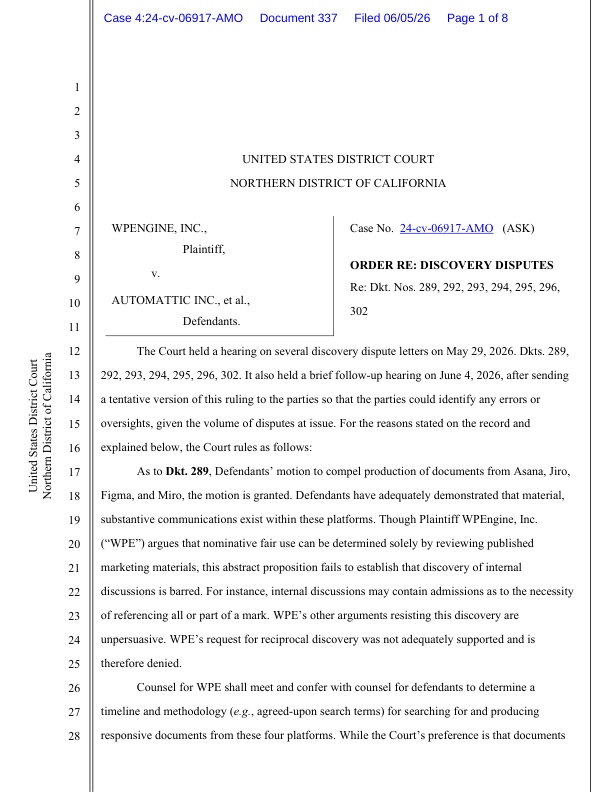
- **Dkt. 289 — GRANTED** (Automattic's motion): WPE must produce internal communications from Asana, Jira ("Jiro" in the OCR), Figma, and Miro. The court rejects WPE's theory that nominative fair use can be assessed solely from published marketing materials: "internal discussions may contain admissions as to the necessity of referencing all or part of a mark." WPE's reciprocal-discovery request **denied** (inadequately supported). Parties to meet-and-confer on search terms/methodology.
- **Dkt. 292 — BOTH AT FAULT** (WPE's motion on interrogatory limits): Defendants "overly aggressive" on their interrogatory-counting methodology; WPE "delayed raising this issue." (Mixed resolution.)
- **Dkt. 294 — GRANTED IN PART** (WPE's motion for more Mullenweg deposition time): WPE sought more time citing "his lack of knowledge or other behavior at his multi-day deposition." Court's two observations: (1) Defendants designated Mullenweg — cofounder/principal/CEO — for **46 30(b)(6) topics**, "a litigation choice that inherently carried risk of exposing a high-ranking executive to extensive preparation and multiple depositions"; (2) WPE complains about adequacy for only **13 of 139** topics (<10% of all topics; ~30% of Mullenweg's).
- **Dkt. 302 — SPLIT** (Defendants' motion to compel): Google Doc underlying Exhibit 9 — **deferred** pending in camera inspection; Monthly ACF Dashboard — **denied as moot** per WPE counsel's representations; other items ruled on the record.
- **Dkts. 293, 295, 296** — resolved "for the reasons stated on the record" (specifics not fully captured in the order's body text).
## 🔍 Significance
- The **Mullenweg deposition reopening** is the headline. The court's note that designating a CEO for 46 topics was a risk-laden "litigation choice" reads as mild skepticism of the defense's strategy — and reopening the deposition keeps a high-profile, high-variance witness in play.
- The **Asana/Jira/Figma/Miro order** matters beyond this case: it treats modern SaaS collaboration tools as discoverable repositories of "material, substantive communications," and rejects the idea that a fair-use defense can wall off internal deliberation. Relevant precedent-in-practice for any trademark dispute where the parties run on Slack/Jira/Figma.
- The **ACF Dashboard** reference ties to Advanced Custom Fields — the plugin at the center of the original dispute (Automattic's takeover of ACF / "Secure Custom Fields" fork).
## 🗒️ Notes
- Case: *WPEngine, Inc. v. Automattic Inc.*, N.D. Cal., 24-cv-06917-AMO. Magistrate judge's omnibus discovery order.
- Seven letter-briefs resolved: Dkts. 289, 292, 293, 294, 295, 296, 302.
- Argued at a **29 May 2026** hearing, with a **4 June 2026** follow-up.
- Dkt. 289 **granted** on Automattic's motion: WP Engine must produce internal communications from Asana and Jira.
- The **Mullenweg deposition reopening** is the consequential ruling — the court noted that designating a CEO across 46 Rule 30(b)(6) topics has costs the designating party bears.
- An **in camera** inspection of a Google Doc (Exhibit 9) is ordered, deferring a privilege question rather than resolving it.
- Reasoning throughout is proportionality- and relevance-based; the order is described as even-handed rather than favoring either side.
## 📚 References
- *WPEngine, Inc. v. Automattic Inc.*, No. 3:24-cv-06917-AMO (N.D. Cal.) — the docket
- Dkts. 289, 292, 293, 294, 295, 296, 302 — the seven discovery letter-briefs resolved by this order
- Fed. R. Civ. P. 26(b)(1) — proportionality and relevance, the standard the order applies
- Fed. R. Civ. P. 30(b)(6) — organizational deposition designation, the rule underlying the 46-topic issue
**Primary-source note:** this analysis is of the order itself, a primary document. The underlying letter-briefs are separate filings and were not read.
## 🗣️ Paraphrase
The judge worked through a pile of discovery squabbles. Automattic wins the right to dig into WP Engine's internal project-tool chatter (Asana, Jira, Figma, Miro) because what a company says internally about *needing* to use Automattic's marks bears on the fair-use fight. WP Engine wins more time to depose Matt Mullenweg, with the court noting that Automattic itself created the exposure by putting its CEO up for 46 deposition topics. A few disputes were a pox-on-both-houses or punted for the judge to read documents privately first.
## 📰 Newsletter
**The deposition ruling is the one to watch**
A magistrate judge just cleared seven discovery disputes in *WP Engine v. Automattic* in one order, and one ruling matters more than the rest: Matt Mullenweg's deposition is being reopened.
The reasoning is the interesting part. WP Engine designated Automattic's CEO to testify across 46 separate Rule 30(b)(6) topics. Designating one senior executive that broadly is a defensible tactic — it concentrates knowledge and limits how many people get deposed — but the court noted it carries a cost, and the cost is that the deposition has to be long enough to actually cover 46 topics. You do not get to designate someone for everything and then cap the hours.
Elsewhere: Automattic won production of WP Engine's internal Asana and Jira communications, on the theory that internal discussions may contain admissions. If you have ever written something candid in a Jira comment, that ruling is worth sitting with.
The court also ordered an in camera inspection of a Google Doc rather than ruling on privilege from the briefing — deferring the question to look at the document itself, which is the conservative move and probably means the privilege claim is genuinely arguable.
None of this decides the case. Discovery rulings decide what evidence reaches trial, which is a different and earlier thing.
## ✅ Action Items
- **WordPress / Community / DevRel**: Track as the live WP Engine v. Automattic docket. The internal-tools discovery ruling and the Mullenweg deposition reopening are both newsworthy for the WordPress community; expect coverage (WP Tavern, The Repository).
- **Courtney-specific**: Pairs with prior trademark-thread reading (Automattic trademark royalties, WP trademark Twitter Spaces). File under the WordPress governance/legal saga.
## 🧪 Hypotheses
1. **The 46-topic designation will be treated as a cautionary example.** Test: track whether subsequent 30(b)(6) practice in this district cites this order when opposing broad single-designee designations.
2. **The Asana/Jira production yields the order's most-cited material at trial.** Test: check whether internal-tool communications appear in later summary-judgment exhibits.
3. **The in camera inspection resolves without a privilege finding either way.** Test: watch whether Exhibit 9 reappears in a subsequent motion or quietly disappears.
4. **Even-handedness here predicts even-handedness later.** Test: score subsequent discovery orders in this case by which party prevailed; a consistent split supports reading this one as ordinary practice rather than a signal.
5. **Internal-tool discovery becomes standard in WordPress-ecosystem disputes.** Test: look for Asana/Jira/Slack production demands in later ecosystem litigation.
## 📊 Methodology
**What the court is doing.** Applying Rule 26(b)(1) proportionality and relevance to seven separate disputes, on a written record of letter-briefs plus one hearing and a follow-up. No evidentiary hearing, no witness testimony — the inputs are the briefs and argument.
**What that supports.** Findings about the *scope* of discoverable material. It does not reach the merits of any claim, and nothing in a discovery order should be read as a view on who is right.
**What is deferred rather than decided.** The privilege question on Exhibit 9 is sent to in camera inspection, which means the court declined to resolve it on the briefing. That is a methodological choice worth noticing: the judge is looking at the document rather than reasoning about it from descriptions.
**Limits of this analysis.** Read from the order alone. The seven underlying letter-briefs would show what each side actually argued; without them, the order's characterization of the positions is the only account available.
## ❓ Questions
- What does the in camera inspection of the Google Doc / Exhibit 9 surface, and does it become a later flashpoint?
- How much additional Mullenweg deposition time, and on which of the 13 contested topics?
- Do the internal Asana/Jira/Figma/Miro productions yield the "admissions" the court hypothesized about mark necessity?
## 🔮 Future Research
- **Whether the reopened Mullenweg deposition produces usable admissions**, and whether its length becomes its own dispute.
- **What the Asana/Jira production actually contains** — the ruling's significance depends entirely on whether internal-tool discussion is candid or sanitized in this organization.
- **The disposition of Exhibit 9** after in camera review, which will indicate how the court reads privilege claims over documents shared into collaborative tools.
- **Whether 30(b)(6) designation practice shifts** in response, in this district and beyond.
- **The trial-scope consequence.** Discovery orders shape what a jury sees; a systematic read of this case's discovery rulings would predict the shape of the trial better than the pleadings do.
## 💡 Implications
- **Litigation practice**: Designating a senior executive across dozens of 30(b)(6) topics is a double-edged strategy — it concentrates risk in one witness and invites reopening if answers are deemed inadequate.
- **E-discovery**: SaaS collaboration tools are squarely discoverable; "it's only in Figma/Miro" is not a shield.
- **WordPress ecosystem**: Continued legal exposure for Automattic/Mullenweg; the case's evidentiary record keeps growing.
## 🧠 Learning Styles Assessment
**Reading level:** ~Grade 14. Legal register with docket numbers, Rule citations, and terms of art (*in camera*, 30(b)(6)) used without gloss.
#### 👀 Visual learners
Poorly served. Seven dispositions across seven docket numbers is table-shaped content presented as prose.
#### 🔊 Aural learners
No audio version; the underlying hearing is not published.
#### 🗣️ Verbal learners
Moderately served. "Internal discussions may contain admissions" is the one portable line.
#### 🧩 Kinesthetic learners
Not applicable to this source. Nothing to practice.
#### 🧠 Logical learners
Best served. Each dispute has a stated standard, an application, and a disposition — the structure is the argument.
#### 🧑🤝🧑 Social learners
Weakly served. The adversarial context is present but the parties' own arguments are only summarized.
#### 🧘♀️ Solitary learners
Well served for a reader with the background; poorly served without it.
#### 🌿 Naturalistic learners
Not applicable to this source.
## 📊 Accessibility Assessment
Assessed as delivered: a court order, typically a PDF, read through Reader.
#### Screen reader semantics
Court PDFs are frequently untagged, which makes heading and list structure unavailable to assistive technology. Where this document is an untagged scan or export, it **fails WCAG 1.3.1 (A)** — a general property of PACER-sourced filings rather than a fault of this order.
#### Keyboard navigation
Container-level only.
#### Contrast and readability
Court formatting (double-spaced, monospaced captions) is legible but not optimized. No failure identified.
#### Text resizing and reflow
The weak point for PDFs: fixed-layout documents do not reflow, so magnification forces horizontal scrolling. **Likely fails 1.4.10 (Reflow, AA)** as delivered.
#### Media and captions
Not applicable to this source. No media.
#### Forms and interactions
Not applicable to this source.
#### Standards reference
WCAG 2.2 Level AA. The failures here are properties of court-filing distribution — a systemic access-to-justice issue, not a defect of this particular order.
## 🌍 DEIB Assessment
#### Cultural breadth
Not applicable in the usual sense: a US federal procedural order applying US rules. It makes no cultural claim.
#### Inclusive language
Neutral judicial register throughout. Parties are named by corporate identity and role.
#### Neurodiversity support
Poor as delivered, and not by intent. Dense legal prose in a fixed-layout document with no summary, no headings a reader can jump between, and terms of art used without definition is among the least navigable formats in general circulation.
#### Representation
The parties here are two well-resourced companies with competent counsel, so the usual representation asymmetry is absent. Worth noting because it is unusual: most discovery-cost rulings land on parties who cannot absorb them, and this one does not.
#### Psychological safety
Not applicable to the document. The adjacent question — whether individual employees' internal Asana and Jira messages, written with no expectation of disclosure, are now discoverable — is real, and it falls on people who are not parties to the case.
## ✅ Logical Validity
- Standard magistrate discovery order; reasoning is proportionality- and relevance-based. The court's even-handedness (faulting both sides on Dkt. 292, splitting Dkt. 302) reads as measured rather than partisan. No rhetorical or fallacy concerns — this is a procedural ruling, not an argument to evaluate.
## 🛡️ DARVO Analysis
Not applicable — a neutral judicial order, no manipulation pattern.
## 🎯 Conclusion
**Bottom line**: A consequential discovery order in the WordPress ecosystem's marquee lawsuit. Automattic gains access to WPE's internal collaboration-tool communications; WPE gains a reopened, expanded Mullenweg deposition the court partly attributes to Automattic's own 46-topic designation. Watch the in camera Exhibit 9 ruling and the reopened deposition.
## 🧱 Refactor Appendix
**📚 Literature Split Pad (verbatim atoms):**
- "internal discussions may contain admissions as to the necessity of referencing all or part of a mark" (Dkt. 289)
- "Defendants designated Mr. Mullenweg, a cofounder, principal, and CEO, to cover 46 30(b)(6) deposition topics. That was a litigation choice that inherently carried risk" (Dkt. 294)
- "WPE complains about the adequacy of Mr. Mullenweg's answers for only 13 of WPE's 139 Rule 30(b)(6) topics" (Dkt. 294)
- "both parties bear fault for this dispute. Defendants were overly aggressive... WPE delayed raising this issue" (Dkt. 292)
**🔖 Atomic Split Pad (Zettel candidates):**
- Designating a senior executive across dozens of 30(b)(6) topics concentrates litigation risk in one witness and invites deposition reopening.
- A fair-use defense does not wall off internal deliberation from discovery — internal tool chatter is fair game for "necessity" admissions.
- SaaS collaboration platforms (Asana/Jira/Figma/Miro) are first-class e-discovery repositories.
**🧠 Fleeting Queue:**
- Cross-link to the WordPress governance/trademark saga (Automattic trademark royalties, ACF/Secure Custom Fields fork).
<!-- deep-read:sections end -->
📄 **Full text:** ![[Full Document Contents/Articles/Order Re Discovery Disputes — WPEngine v. Automattic (24-cv-06917).md|Order Re: Discovery Disputes — WPEngine v. Automattic (24-cv-06917) by Magistrate Judge (N.D. Cal.)]]
## Highlights
- As to
**Dkt. 289**
, Defendants' motion to compel production of documents from Asana, Jiro, Figma, and Miro, the motion is granted. Defendants have adequately demonstrated that material, substantive communications exist within these platforms. Though Plaintiff WPEngine, Inc. ("WPE") argues that nominative fair use can be determined solely by reviewing published marketing materials, this abstract proposition fails to establish that discovery of internal discussions is barred. For instance, internal discussions may contain admissions as to the necessity of referencing all or part of a mark. WPE's other arguments resisting this discovery are unpersuasive. WPE's request for reciprocal discovery was not adequately supported and is therefore denied. ([View Highlight](https://read.readwise.io/read/01ktcn3zd0ajhpkmj0cg005n5a))
- Note: Discovery scope win for Automattic: WPE must produce internal Asana/Jira/Figma/Miro communications — the court rejects WPE's argument that nominative fair use can be judged from published marketing alone, since internal discussions "may contain admissions as to the necessity of referencing all or part of a mark."
- Tags: atom/literature/h2, litigation, discovery, wpengine-automattic
- As to
**Dkt. 294**
, in which WPE seeks additional deposition time with Mr. Mullenweg given his lack of knowledge or other behavior at his multi-day deposition, the Court grants the motion in part. ([View Highlight](https://read.readwise.io/read/01ktcn3c351yd12cq3ytkdx9sx))
- Note: The headline ruling: WPE's motion for additional deposition time with Mullenweg — citing "his lack of knowledge or other behavior at his multi-day deposition" — is granted in part.
- Tags: wordpress, wpengine-automattic, litigation, atom/literature/h1
- The Court makes two observations. First, Defendants designated Mr. Mullenweg, a cofounder, principal, and CEO, to cover
*46*
30(b)(6) deposition topics. That was a litigation choice that inherently carried risk of exposing a high-ranking executive to extensive preparation and multiple depositions. Second, WPE complains about the adequacy of Mr. Mullenweg's answers for only 13 of WPE's 139 Rule 30(b)(6) topics—
*i.e.*
, less than 10% of all topics, and about 30% of the topics that Mr. Mullenweg was designated to cover. ([View Highlight](https://read.readwise.io/read/01ktcn3nydrmtz5z808cc4gkwt))
- Note: The court's framing: Automattic designated Mullenweg for 46 30(b)(6) topics — "a litigation choice that inherently carried risk" — while WPE's adequacy complaint covers only 13 of 139 topics.
- Tags: atom/literature/h2, depositions, litigation, wpengine-automattic