Order Re Motions to Dismiss
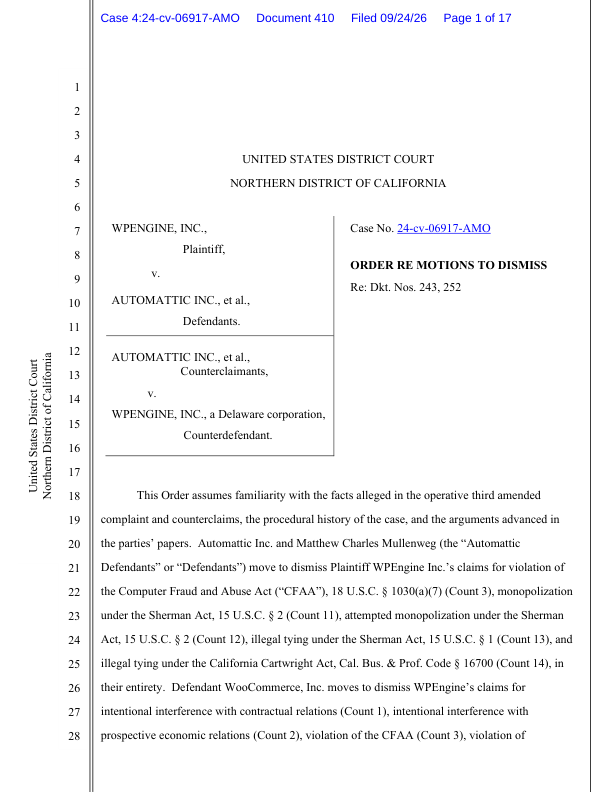
🔗 **Source:** [Order Re Motions to Dismiss](https://storage.courtlistener.com/recap/gov.uscourts.cand.437474/gov.uscourts.cand.437474.410.0.pdf)
> [!note]+ Document Notes
> tags: [antitrust-aftermarkets, cfaa-extortion, trademark-standing, wordpress-governance, motion-to-dismiss, open-source-litigation]
> author: Judge Araceli Martínez-Olguín (N.D. Cal.)
> source: United States District Court, Northern District of California (via CourtListener RECAP)
> reference: https://storage.courtlistener.com/recap/gov.uscourts.cand.437474/gov.uscourts.cand.437474.410.0.pdf
> date created: 2026-09-24 18:32
>
> > [!info] Generated analysis — not the author's words. Sections below are machine-written
> > from the captured source. Only text inside `> [!quote]` blocks is verbatim from the author.
> > Do not quote or attribute any other line to the named author.
>
> # 🏷️ Title: WPEngine v. Automattic, Dkt. 410 - Order Re Motions to Dismiss (N.D. Cal. Sept. 24, 2026)
>
<!-- deep-read:sections start -->
## 🧭 Table of contents
- [📝 Summary](#-summary)
- [📖 Main content](#-main-content)
- [🗒️ Notes](#️-notes)
- [📚 References](#-references)
- [🗣️ Paraphrase](#️-paraphrase)
- [📰 Newsletter](#-newsletter)
- [✅ Action items](#-action-items)
- [🧪 Hypotheses](#-hypotheses)
- [📊 Methodology](#-methodology)
- [❓ Questions](#-questions)
- [🔮 Future research](#-future-research)
- [💡 Implications](#-implications)
- [🧠 Learning styles assessment](#-learning-styles-assessment)
- [📊 Accessibility assessment](#-accessibility-assessment)
- [🌍 DEIB assessment](#-deib-assessment)
- [✅ Logical validity](#-logical-validity)
- [🛡️ DARVO analysis](#️-darvo-analysis)
- [🎯 Conclusion](#-conclusion)
- [🔄 Refactor appendix](#-refactor-appendix--order-re-motions-to-dismiss)
## 📝 Summary
- **What happened.** On September 24, 2026, Judge Araceli Martínez-Olguín (N.D. Cal.) filed a 17-page order (Document 410) in *WPEngine, Inc. v. Automattic Inc. et al.*, No. 4:24-cv-06917-AMO, resolving the Automattic Defendants' and WooCommerce's motion to dismiss (Dkt. No. 243) and WPEngine's motion to dismiss the counterclaims (Dkt. No. 252). The order runs 6,275 words with 9 footnotes and rules on 14 counts or counterclaim groupings.
- **The claim.** WPEngine's four antitrust counts (11 through 14) survive, reversing the court's own prior dismissal (footnote 2). WPEngine's CFAA extortion count (Count 3) fails as a matter of law and is dismissed without leave to amend. On the counterclaims, the false advertising portion of Count 2 is dismissed with leave to amend under Rule 9(b), and the trademark counterclaims (Counts 1, 3 through 5) are dismissed to the extent Automattic and Mullenweg assert them in their own right, since neither owns nor registers the marks.
- **The mechanism.** The antitrust reversal rests on *Surgical Instrument Serv. Co. v. Intuitive Surgical* (9th Cir. Aug. 13, 2026): a plaintiff who pleads foremarket power need not satisfy the Kodak/Epic single-brand aftermarket factors. The court finds direct evidence of market power in the allegation that wordpress.org access, free "as promised" for years, became a licensing fee demanded from at least 11 competitors, plus alleged quality degradation. The CFAA dismissal rests on *Levitt*: a payment demand is not extortion where the demander has a colorable claim to the payment, and WPEngine's own request for declaratory relief about the trademarks shows the right it claims is contested, not preexisting.
- **Why it matters.** A control point in an open-source ecosystem (wordpress.org) is now past the pleading stage as an alleged monopolized aftermarket. The login checkbox "I am not affiliated with WPEngine in any way" is a plausibly pleaded negative tie. Both are pleading-stage findings: the court takes the third amended complaint (TAC) as true and says so at page 5.
- **Key stakeholders.** WPEngine; Automattic Inc. and Matthew Charles Mullenweg (the "Automattic Defendants"); WooCommerce, Inc.; the WordPress Foundation (counterclaimant only); the at least 11 competitors and two paying partners the complaint describes.
- **Risks and tradeoffs.** Nothing here is a finding of fact. Every characterization of conduct ("scorched earth nuclear approach," "hijacked," "extortionate threats") is a TAC quotation with a paragraph cite. Market share is deferred (footnote 3), Noerr-Pennington unreached (footnote 6), the limitations date unresolved (page 14).
- **Bottom line.** WPEngine's antitrust case proceeds in full; its CFAA count is gone for good; the counterclaims proceed with two amendments required. The docket history that frames these rulings lives in the vault's Open Source Governance MOC, not in this order.
## 📖 Main content
### Disposition table
Every count or counterclaim the order addresses. "Pl.'s Mot." is WPEngine's brief, cited both when WPEngine opposes and when it moves; "Defs.' Mot." is Dkt. No. 243, carrying both the Automattic Defendants' and WooCommerce's arguments.
| Count | Claim | Movant | Ruling | Leave to amend | Page |
|---|---|---|---|---|---|
| Count 3 | CFAA, 18 U.S.C. § 1030(a)(7) | Automattic Defendants | Dismissed | Without leave; "fails as a matter of law" | 10 |
| Count 11 | Monopolization, Sherman Act § 2 | Automattic Defendants | Not dismissed | n/a | 4, 16-17 |
| Count 12 | Attempted monopolization, Sherman Act § 2 | Automattic Defendants | Not dismissed | n/a | 4, 16-17 |
| Count 13 | Tying, Sherman Act § 1 | Automattic Defendants | Not dismissed (negative tie plausibly pleaded) | n/a | 7 |
| Count 14 | Tying, Cartwright Act § 16700 | Automattic Defendants | Not dismissed (analyzed with federal claims, fn. 5) | n/a | 7 |
| Count 1 | Intentional interference with contractual relations | WooCommerce | Not dismissed | n/a | 11 |
| Count 2 | Intentional interference with prospective economic relations | WooCommerce | Not dismissed | n/a | 11 |
| Count 3 | CFAA (as to WooCommerce) | WooCommerce | Already dismissed; remaining arguments not reached (fn. 8) | Without leave | 11 |
| Count 4 | UCL, Cal. Bus. & Prof. Code § 17200 | WooCommerce | Not dismissed (sole ground was derivative) | n/a | 11 |
| Count 6 | Declaratory judgment of non-infringement | WooCommerce | Not dismissed | n/a | 12 |
| Count 7 | Declaratory judgment of non-dilution | WooCommerce | Dismissed as to WooCommerce | Without prejudice | 12 |
| Countercl. 1-7 | Laches, nominative fair use, famous-marks defenses | WPEngine | Not dismissed (fact issues) | n/a | 13 |
| Countercl. (state law) | Statute of limitations | WPEngine | Not dismissed | n/a | 14 |
| Countercl. 2 (false advertising portion) | Lanham Act § 1125(a) false advertising | WPEngine | Dismissed in part | With leave to amend | 16 |
| Countercl. 6-7 | Unfair competition, UCL and common law | WPEngine | Not dismissed (predicates survive) | n/a | 16 |
| Countercl. 1, 3-5 | Trademark infringement and dilution, as asserted by Automattic and Mullenweg | WPEngine | Dismissed to that extent | Not stated | 16 |
| Dkt. 243-1, 254, 258, 259, 263 | Requests for judicial notice and incorporation | Both sides | Granted, limited to existence of documents | n/a | 2 fn. 1 |
Two housekeeping rulings sit in footnotes. Footnote 1 grants the judicial-notice requests but limits them to the existence of documents, reads incorporated documents "to prevent artful pleading" without letting defendants "short-circuit" a well-pleaded claim (*Khoja*), and orders that future requests live inside the briefs and count against page limits. Footnote 6 declines Noerr-Pennington because Defendants omitted it from their prior motion (Rule 12(g)(2), via *In re Apple iPhone Antitrust Litig.*).
### I.A. The antitrust counts and the Kodak/Epic bypass
Defendants attacked Counts 11 through 14 on five grounds: no viable single-brand aftermarket, no market power, no antitrust injury, no anticompetitive conduct, no unlawful tying. The court takes market definition first under *Coronavirus Rep. v. Apple*.
WPEngine pleads a Web Content Management Systems foremarket (WordPress, Drupal, Joomla, others) and three WordPress-specific aftermarkets: Web Hosting Services, Custom Field Plugin, Plugin Distribution. Defendants conceded the foremarket was "the only market that isn't facially implausible" and attacked the aftermarkets on two *Epic Games* factors: restrictions "not generally known" at purchase, and information costs preventing life-cycle pricing.
The court's answer is one move. Under *Surgical Instrument* (9th Cir. Aug. 13, 2026, six weeks before this order), a single-brand aftermarket plaintiff has two routes: foremarket power, or the Kodak/Epic factors. WPEngine pleads foremarket power, so the factors drop out. Footnote 2 announces the departure from the prior order without a stated reason; the timing and placement of the *Surgical Instrument* citation are the evidence for inferring the cause, and it stays an inference.
**Market power.** Standard: *CoStar* quoting *Epic Games*. Monopoly power is the substantial ability to control prices or exclude competition, shown directly (reduced output, increased prices, decreased quality) or indirectly (predominant share). The court finds direct evidence in all four markets. Price: services free "for years, as promised," then licensing fees under an alleged "Restriction of choice plan," at least 11 competitors targeted with multi-million-dollar deals, at least two paying "exorbitant sums," with "carrot" and "stick" internal correspondence recited as allegations. Quality: stability alleged as a key competitive dimension and "eliminated," internal documents alleged to call the fallout "really hurt" and "a really big mistake," Defendants' "own customers vulnerable" to the block. Indirect evidence is not reached. Footnote 3 defers Defendants' point that WPEngine itself alleges Defendants' share fell, citing *DIPF* (a drop from 100 to 90 percent does not defeat a monopoly-power pleading).
**Antitrust injury.** *Gorlick*: harm to competition as a whole. Alleged: royalties from competitors who used WordPress free; exclusion of WPEngine "and others"; a competitor prevented from launching a mirror; mitigation costs on "millions of customers and partners"; harm to rival CMS providers via false "free" and "open" promises. *Apple v. Samsung* (N.D. Cal. 2011) is the comparator.
**Anticompetitive conduct.** *Trinko* and *Cascade Health* standards, then a one-sentence holding: the alleged "scorched earth nuclear approach to WP[Engine]" (TAC ¶ 97) satisfies the element. Footnote 4 refuses Defendants' three-category decomposition (statements, interference, solicitation); under *Free FreeHand* and *City of Anaheim*, practices are judged in the aggregate.
**Tying.** *Aerotec* recognizes negative ties; *Cascade Health* defines one as the customer promising not to take the tied product from the defendant's competitor. WPEngine alleges wordpress.org access conditioned on agreeing "I am not affiliated with WPEngine in any way" and that users "apparently cannot log into wordpress.org unless they check the box." Sufficient at the pleading stage under *Entri v. GoDaddy* (E.D. Va. 2024), where terms forbidding third-party aggregators were a negative tie. Footnote 5 folds the Cartwright Act into the federal analysis (*Olean*).
### I.B. Count 3, the CFAA extortion theory
Section 1030(a)(7) reaches a communication, transmitted with intent to extort, containing a threat to damage a protected computer or a demand for money in relation to such damage. WPEngine's theory as recited: a threat of "war" absent payment of a significant percentage of gross revenue; the wordpress.org block; Mullenweg's public posts about ACF alternatives; the ACF slug takeover overwriting millions of installations with SCF; preexisting rights to its own computers, to almost 15 years of wordpress.org access, and to software integrity, grounded in the GPL and community promises (footnote 7); and an alleged admission that the 8 percent demand was untethered to trademark value or cost.
The court holds the allegations "still fail" and quotes its prior ruling at block length. The rule from *Levitt* (765 F.3d at 1130-32, short form only): absent a preexisting right to be free of the threatened economic harm, threatening economic harm to induce payment for a legitimate service is not extortion. The decisive inference is the court's own: WPEngine cannot plead a preexisting right to use wordpress.org "or related trademarks in perpetuity for free" because its own claims seek declaratory relief about those trademarks. A right one asks the court to define is, by that request, contested. Defendants seek payment for something with "objective value," so they hold a "lawful claim," and threats of "war" or suspended access are hard bargaining. *SkyHop* (11th Cir. 2023), where defendants withheld the plaintiff's own digital property for $1.1 million or 32 percent of the company, is distinguished. WPEngine's three counterarguments (GPL or custom entitlement, nominative fair use, uninterrupted operation) are rejected together as leaving the extortion allegation "implausible." Dismissal is without leave because the defect is legal.
One tension deserves naming. Part I.A credits, for the price story, the allegation that Defendants' threat rested on "purported trademark rights that they do not even have." Part I.B holds the same fee demand seeks payment of objective value. The two coexist doctrinally (antitrust asks whether a price rose; CFAA asks whether the demander had a colorable claim, and a disputed right is colorable), but the order does not say so, and a reader must hold both halves.
### I.C. Claims against WooCommerce
WooCommerce said WPEngine lumps all "Defendants" together. "Not so": the TAC alleges a September 23, 2024 letter from counsel representing both Automattic and WooCommerce, and a WooCommerce employee's solicitation of at least one WPEngine customer after the access restriction, which the email itself mentioned. Counts 1 and 2 survive; Count 4 survives because WooCommerce's only argument was derivative; Count 6 survives because *Stone Brewing* observes that redundancy of mirror-image declaratory claims is hard to judge before trial. Count 7 is dismissed without prejudice as to WooCommerce: WooCommerce asserted no dilution counterclaim, and WPEngine's sole authority (*Stone Brewing* again) does not establish that a cease-and-desist letter creates a justiciable non-dilution controversy. The ruling is burden-based, not a holding that no controversy can exist.
### II. WPEngine's motion to dismiss the counterclaims
Counterclaimants (Automattic, Mullenweg, the WordPress Foundation, WooCommerce) assert trademark infringement (Count 1), false advertising, false designation, and unfair competition under § 1125(a) (Count 2), common law infringement (Count 3), federal and California dilution (Counts 4 and 5), and UCL and common law unfair competition (Counts 6 and 7).
**A. Laches, nominative fair use, famous marks.** All three are fact questions unsuited to Rule 12(b)(6): *Kourtis* (laches "seldom susceptible of resolution by summary judgment," harder still at the pleading stage), *Barkley v. Quizlet* (fair use "in rare cases" only), *Coach Servs.* and *Third Est.* (fame is factual). No merits evaluation.
**B. Statute of limitations.** WPEngine: counterclaims filed October 23, 2025 are untimely under a four-year maximum. Counterclaimants: tolled from the October 2, 2024 original complaint. The court picks neither date because under either, some portion may be timely: Counterclaimants allege WPEngine "substantially increased the frequency and visual dominance" of the marks on its homepage between 2021 and 2023. WPEngine's extrinsic materials showing awareness "well before 2020" cannot resolve competing theories against the complaint (*Khoja*). Denied.
**C. False advertising.** Counterclaimants argued their allegations are part of a confusion-based claim outside Rule 9(b), citing *Lloyds Plumbing*. Distinguished: that plaintiff expressly disclaimed false advertising; Counterclaimants do not. *Factory Direct Wholesale* controls. The pleaded statements are WPEngine's August 25, 2020 Five for the Future pledge announcement (five percent of resources) and a September 20, 2024 statement touting "tens of millions of dollars" of community support. Alleged falsity: failure to honor the pledge "in substance" and, on information and belief, non-contribution. The court holds these do not plead the "how of the fraud" or why statements "which concern a pledge" are misleading (*TransFresh*: who, what, when, where, how). Dismissed with leave. Footnote 9 declines deception and materiality as raised first in reply (*Zamani*).
**D. Unfair competition.** Derivative counterclaims survive because their predicates survive (*Bertolina* cited by contrast).
**E. Standing.** Mullenweg and Automattic are neither owners nor registrants (*Hem & Thread*; *Gianni Versace*) and hold no "truly exclusive license" allowing them to exclude the licensor (*Innovation Ventures*). The trademark counterclaims are dismissed to the extent these two assert them in their own right. Leave status is not stated; the Foundation's and WooCommerce's counterclaims are untouched.
### Held, assumed, and unreached
- **Held.** Foremarket power pleaded, so Kodak/Epic factors unnecessary. Direct evidence of market power via price and quality. Injury, conduct, and negative tie pleaded. CFAA fails as a matter of law. WooCommerce separately implicated. Count 7 lacks cited authority. Fact-bound trademark defenses wait. Rule 9(b) governs the false advertising counterclaim and is unmet. Non-owners lack trademark standing.
- **Assumed.** Every TAC and counterclaim allegation is true (Rule 12(b)(6)). Noticed documents exist; their contents are not adopted (footnote 1).
- **Unreached.** Indirect evidence and market share (page 5, footnote 3). Noerr-Pennington (footnote 6). WooCommerce's remaining CFAA arguments (footnote 8). Which filing date controls tolling (page 14). Deception and materiality (footnote 9). Merits of laches, fair use, fame.
Two drafting slips: the infringement counterclaim is cited as "15 U.S.C. § 1141(1)" at pages 2 and 12 while the standing analysis cites §§ 1114(1), 1127 at page 16 (§ 1114(1) is the infringement provision; § 1141 sits in the Madrid Protocol subchapter), and page 10 reads "As set the Court previously ruled." Neither affects a holding.
## 🗒️ Notes
#### Caption and scope
- Order Re Motions to Dismiss, Re: Dkt. Nos. 243, 252. Filed 09/24/26, 17 pages. The order "assumes familiarity" with the TAC, the counterclaims (Dkt. No. 238), and the parties' papers; it supplies no independent factual narrative.
- Movants: Automattic Defendants on Counts 3, 11-14; WooCommerce on Counts 1, 2, 3, 4, 6, 7; WPEngine on all seven counterclaims.
- Footnote 1: judicial notice and incorporation (Dkt. Nos. 243-1, 254, 258, 259, 263) granted with limits, plus a forward-looking rule.
> [!quote] [¶29]
> any request for judicial notice or incorporation by reference, and any opposition or reply thereto, must be included in the parties' briefing
#### I.A. Counts 11-14: antitrust claims
- Footnote 2 announces the reversal without stating a reason.
> [!quote] [¶30]
> The Court previously dismissed WPEngine's antitrust claims and departs from its prior order, now finding WPEngine's antitrust claims viable.
- Four alleged markets (TAC ¶ 261). Defendants conceded the foremarket and attacked the aftermarkets on two *Epic Games* factors.
- The bypass: *Surgical Instrument*, 2026 WL 2348455, at *11 (9th Cir. Aug. 13, 2026).
> [!quote] [¶34]
> These arguments fail. Because, as discussed below, WPEngine has adequately pleaded market power in the foremarket
#### I.A.2. Market power
- Standard: *CoStar*, 150 F.4th at 1067, quoting *Epic Games* at 998; direct proof requires actual detrimental effects.
> [!quote] [¶71]
> WPEngine has adequately alleged direct evidence of market power in all asserted markets.
- Price allegations recited: zero price "as promised" then licensing fees, "Restriction of choice plan" (TAC ¶¶ 206, 211); "Monetise all mutual merchants" (¶ 210); "carrot" or "stick" (¶ 211); "purported trademark rights that they do not even have" (¶ 212); at least 11 competitors (¶ 213); "fair game" (¶ 214); two competitors paying "exorbitant sums" (¶ 219).
> [!quote] [¶72]
> Defendants' ability to extract millions of dollars from their competitors for WordPress access that used to be free adequately establishes increased prices
- Quality allegations recited: stability "eliminated" (¶¶ 241-45); "really hurt," "a really big mistake" (¶ 246); bugs and vulnerabilities, "own customers vulnerable" (¶ 250); power shown by doing this without losing business (¶ 251).
> [!quote] [¶73]
> WPEngine has also plausibly pleaded decreased quality.
- Indirect evidence not reached. Footnote 3 defers the share-decline argument.
> [!quote] [¶98]
> They may raise that argument at a later stage, but as a matter of pleading,
#### I.A.3. Antitrust injury
- *Gorlick*, 723 F.3d at 1024-25. Five alleged marketwide harms: royalties (TAC ¶¶ 202, 213-215, 218-225); exclusion (¶¶ 254-55, 340); blocked mirror (¶ 238); mitigation costs on millions; false "free" and "open" promises harming rival CMS providers.
> [!quote] [¶121]
> WPEngine has adequately pleaded harm to competition.
#### I.A.4. Anticompetitive conduct
- *Trinko*, 540 U.S. at 407; *Cascade Health*, 515 F.3d at 894; *Kodak*, 125 F.3d at 1208.
> [!quote] [¶128]
> Defendants' "scorched earth nuclear approach to WP[Engine]," TAC ¶ 97, satisfies this
- Footnote 4: aggregate effect controls, not category-by-category review.
> [!quote] [¶165]
> [I]t would not be proper to focus on specific individual acts of an accused monopolist while refusing to consider their overall combined effect.
#### I.A.5. Unlawful tying
- *Aerotec*, 836 F.3d at 1178; *Cascade Health*, 515 F.3d at 913 n.23; *Entri v. GoDaddy*, 2024 WL 4468488, at *5.
> [!quote] [¶131]
> It alleges Defendants "conditioned access to wordpress.org on users agreeing 'I am not affiliated with WPEngine in any way.' "
- TAC ¶ 546: users "apparently cannot log into wordpress.org unless they check the box." Footnote 5: Cartwright Act tracks federal law (*Olean*). Footnote 6: Noerr-Pennington forfeited under Rule 12(g)(2).
#### I.B. Count 3: CFAA, 18 U.S.C. § 1030(a)(7)
- Allegations recited (TAC ¶¶ 400-412): blocking access; "forcibly overwriting millions of instances of the ACF plugin with the SCF plugin"; threat of "war"; public ACF posts; slug takeover; GPL-grounded preexisting rights (footnote 7); the 8 percent demand "completely untethered" to trademark value.
- Holding: allegations "still fail"; the prior ruling is quoted at block length.
> [!quote] [¶199]
> WPEngine cannot plausibly allege that it had a preexisting right to access and use Wordpress.org or related trademarks in perpetuity for free.
- Mechanism: WPEngine's declaratory-judgment claims (FAC ¶¶ 308-316, 317-327, 425-434) show the trademark rights are contested. *Levitt*, 765 F.3d at 1130-32: payment for "objective value" is a lawful claim; "hard bargaining does not amount to extortion."
> [!quote] [¶210]
> its allegations of purported extortion for purposes of Section 1030(a)(7) are implausible.
- *SkyHop*, 58 F.4th at 1227 (11th Cir.) distinguished. Dismissed without leave; "the claim fails as a matter of law."
#### I.C. Claims against Defendant WooCommerce
- Counts 1 and 2: the undifferentiated-pleading argument fails on two specific allegations (TAC ¶¶ 21-22 & Ex. A; ¶ 127). *Sanchez v. Green Messengers* distinguished.
> [!quote] [¶225]
> Not so. The operative complaint alleges that counsel, representing both Automattic and WooCommerce, sent a September 23, 2024 letter to WPEngine about alleged trademark misuse
- Count 4 (UCL): the sole ground falls with Counts 1 and 2. Count 6: *Ketab* redundancy argument declined on *Stone Brewing*. Count 7: dismissed without prejudice as to WooCommerce.
> [!quote] [¶233]
> does not establish that a party can assert a claim for declaratory judgment of non-dilution based on a cease-and-desist letter.
- Footnote 8: WooCommerce's remaining CFAA arguments not reached.
#### II.A. Laches, nominative fair use, famous marks
- *Kourtis*, 419 F.3d at 1000; *Barkley v. Quizlet*, 2025 WL 2946993, at *5; *Coach Servs.*, 668 F.3d at 1373; *Third Est.*, 2013 WL 12144110, at *3.
> [!quote] [¶287]
> Whether the counterclaims are barred by laches, nominative fair use, or because the WordPress Marks were not famous, are factual issues
#### II.B. Statute of limitations
- Competing dates: October 23, 2025 counterclaims (WPEngine, four-year maximum) versus tolling from the October 2, 2024 complaint (Counterclaimants, Dkt. No. 257 at 25). Countercl. ¶ 114: increased mark prominence 2021-2023. Extrinsic materials cannot resolve it (*Khoja*, 899 F.3d at 998).
> [!quote] [¶309]
> using either filing date, Counterclaimants have alleged that at least some portion of their counterclaims may be timely.
#### II.C. False advertising
- *Lloyds Plumbing* distinguished; *Factory Direct Wholesale*, 411 F. Supp. 3d at 923 applies Rule 9(b). Statements: August 25, 2020 pledge announcement (Countercl. ¶ 233); September 20, 2024 "tens of millions" statement (¶ 250). Falsity pleaded as failure "in substance" (¶ 235) and on information and belief.
> [!quote] [¶316]
> These allegations do not sufficiently plead the "how of the fraud," or facts showing why these statements, which concern a pledge, are misleading.
- *TransFresh*, 862 F. Supp. 2d at 1017. Granted with leave. Footnote 9: deception and materiality not reached (*Zamani*).
#### II.D. Unfair competition
> [!quote] [¶334]
> Because, at this stage, the other counterclaims survive the challenges WPEngine raises, the motion to dismiss the derivative unfair competition counterclaims is
#### II.E. Standing
- Counts 1, 3-5 as asserted by Mullenweg and Automattic. *Hem & Thread* (registrant); *Gianni Versace* (owner for dilution); *Innovation Ventures* (truly exclusive license).
> [!quote] [¶335]
> the Court dismisses the trademark counterclaims to the extent Mullenweg and Automattic purport to assert them in their own right.
#### Conclusion and signature
- Defendants' motion denied as to Counts 11-14; granted as to Count 3 (without leave) and Count 7 (without prejudice). WPEngine's motion denied except the false advertising portion of Count 2 (with leave) and the trademark counterclaims as asserted by Automattic and Mullenweg in their own right. Dated September 24, 2026; Araceli Martínez-Olguín, United States District Judge.
## 📚 References
The captured order contains no hyperlinks; authorities are cited in text. Principal authorities as the order gives them, grouped by the section that relies on them, then the docket entries.
**Source document**
- [Order Re Motions to Dismiss, Dkt. No. 410](https://storage.courtlistener.com/recap/gov.uscourts.cand.437474/gov.uscourts.cand.437474.410.0.pdf), *WPEngine, Inc. v. Automattic Inc. et al.*, No. 4:24-cv-06917-AMO (N.D. Cal. Sept. 24, 2026), via CourtListener RECAP.
**Docket entries named in the order**
- Dkt. No. 243 ("Defs.' Mot.") with Dkt. No. 243-1 (request for judicial notice); Dkt. No. 252 (WPEngine's motion, per the caption; cited in the body as "Pl.'s Mot."); Dkt. Nos. 254, 258, 259, 263 (further notice and incorporation filings); Dkt. No. 257 ("Defs.' Reply"); Dkt. No. 262 ("Pl.'s Reply"); Dkt. No. 238 ("Countercl."); Standing Order for Civil Cases ¶ H.3.
**Statutes and rules**
- 18 U.S.C. § 1030(a)(7); 15 U.S.C. §§ 1, 2; Cal. Bus. & Prof. Code §§ 16700, 17200, 14247; 15 U.S.C. §§ 1114(1), 1125(a), 1125(c), 1127 (the order's "§ 1141(1)" is flagged above as a likely transposition); Fed. R. Civ. P. 9(b), 12(b)(6), 12(g)(2).
**Market definition and aftermarkets (Part I.A.1)**
- *Coronavirus Rep. v. Apple, Inc.*, 85 F.4th 948, 955 (9th Cir. 2023); *Image Tech. Servs., Inc. v. Eastman Kodak Co.*, 125 F.3d 1195 (9th Cir. 1997); *Ohio v. Am. Express*, 585 U.S. 529 (2018); *Walker Process Equip., Inc. v. Food Mach. & Chem. Corp.*, 382 U.S. 172 (1965); *Epic Games, Inc. v. Apple, Inc.*, 67 F.4th 946 (9th Cir. 2023); *Eastman Kodak Co. v. Image Tech. Servs., Inc.*, 504 U.S. 451 (1992); *Newcal Indus., Inc. v. Ikon Office Sol.*, 513 F.3d 1038 (9th Cir. 2008).
- *Surgical Instrument Serv. Co., Inc. v. Intuitive Surgical, Inc.*, No. 25-1372, --- F.4th ---, 2026 WL 2348455, at *11 (9th Cir. Aug. 13, 2026): the pivot authority.
**Market power, injury, conduct, tying (Parts I.A.2-5)**
- *CoStar Grp., Inc. v. Com. Real Est. Exch., Inc.*, 150 F.4th 1056 (9th Cir. 2025); *Rebel Oil Co. v. Atl. Richfield Co.*, 51 F.3d 1421 (9th Cir. 1995); *In re Ductile Iron Pipe Fittings (DIPF) Direct Purchaser Antitrust Litig.*, 2013 WL 812143 (D.N.J. Mar. 5, 2013).
- *Gorlick Distrib. Ctrs., LLC v. Car Sound Exhaust Sys., Inc.*, 723 F.3d 1019 (9th Cir. 2013); *Apple Inc. v. Samsung Elecs. Co.*, 2011 WL 4948567 (N.D. Cal. Oct. 18, 2011).
- *Verizon Commc'ns Inc. v. L. Offs. of Curtis V. Trinko, LLP*, 540 U.S. 398 (2004); *Cascade Health Sols. v. PeaceHealth*, 515 F.3d 883 (9th Cir. 2008); *Free FreeHand Corp. v. Adobe Sys. Inc.*, 852 F. Supp. 2d 1171 (N.D. Cal. 2012); *City of Anaheim v. S. California Edison Co.*, 955 F.2d 1373 (9th Cir. 1992).
- *Aerotec Int'l, Inc. v. Honeywell Int'l, Inc.*, 836 F.3d 1171 (9th Cir. 2016); *Entri, LLC v. GoDaddy.com, LLC*, 2024 WL 4468488 (E.D. Va. Oct. 10, 2024); *Olean Wholesale Grocery Coop., Inc. v. Bumble Bee Foods LLC*, 31 F.4th 651 (9th Cir. 2022).
- *In re Apple iPhone Antitrust Litig.*, 846 F.3d 313 (9th Cir. 2017), aff'd sub nom. *Apple Inc. v. Pepper*, 587 U.S. 273 (2019) (footnote 6).
**CFAA (Part I.B)**
- *Levitt*, 765 F.3d at 1130-32, cited in short form only; the reporter citation corresponds to *Levitt v. Yelp! Inc.* (9th Cir. 2014). Confirm against the prior order before relying on it.
- *SkyHop Techs., Inc. v. Narra*, 58 F.4th 1211 (11th Cir. 2023) (distinguished).
**Procedure and judicial notice**
- *Khoja v. Orexigen Therapeutics, Inc.*, 899 F.3d 988 (9th Cir. 2018); *Zamani v. Carnes*, 491 F.3d 990 (9th Cir. 2007); *Sanchez v. Green Messengers, Inc.*, 2021 WL 5012150 (N.D. Cal. Oct. 28, 2021).
**Declaratory counts against WooCommerce (Part I.C)**
- *Ketab Corp. v. Mesriani & Assocs.*, 2015 WL 8022874 (C.D. Cal. 2015); *Stone Brewing Co., LLC v. MillerCoors LLC*, 2019 WL 1383273 (S.D. Cal. Mar. 26, 2019); *Alicea v. GE Money Bank*, 2009 WL 1766703 (N.D. Cal. June 18, 2009).
**Counterclaim defenses (Part II)**
- *Kourtis v. Cameron*, 419 F.3d 989 (9th Cir. 2005), abrogated on other grounds by *Taylor v. Sturgell*, 553 U.S. 880 (2008); *Barkley & Assocs., Inc. v. Quizlet, Inc.*, 2025 WL 2946993 (C.D. Cal. Sept. 11, 2025); *Coach Servs., Inc. v. Triumph Learning LLC*, 668 F.3d 1356 (Fed. Cir. 2012); *Third Est. LLC v. Cornerman Prods. LLC*, 2013 WL 12144110 (C.D. Cal. Aug. 5, 2013).
- *Lloyds Plumbing, Inc. v. Dutton Plumbing, Inc.*, 2018 WL 6164327 (C.D. Cal. Aug. 20, 2018); *Factory Direct Wholesale, LLC v. iTouchless Housewares & Prods., Inc.*, 411 F. Supp. 3d 905 (N.D. Cal. 2019); *TransFresh Corp. v. Ganzerla & Assoc., Inc.*, 862 F. Supp. 2d 1009 (N.D. Cal. 2012); *Bertolina v. Wachovia Mortg., FSB*, 2011 WL 3473527 (N.D. Cal. Aug. 9, 2011).
- *Hem & Thread, Inc. v. Wholesalefashionsquare.com, Inc.*, 2019 WL 6486039 (C.D. Cal. Aug. 23, 2019); *Gianni Versace, S.p.A. v. Versace 19.69 Abbigliamento Sportivo SRL*, 328 F. Supp. 3d 1007 (N.D. Cal. 2018); *Innovation Ventures, LLC v. Pittsburg Wholesale Grocers, Inc.*, 2013 WL 1007666 (N.D. Cal. Mar. 13, 2013).
**Vault context**
- The Open Source Governance MOC holds the docket history, prior orders, and public statements this order assumes. Nothing in this analysis about the underlying dispute comes from outside Document 410.
## 🗣️ Paraphrase
The court says, in effect: the last time WPEngine brought its antitrust theory here, I dismissed it. The Ninth Circuit has since made clear that a plaintiff who pleads market power in the foremarket does not have to run the Kodak and Epic Games gauntlet for single-brand aftermarkets. WPEngine pleads that wordpress.org access carried a zero price for years because Defendants promised it would, that Defendants then demanded licensing fees from at least 11 competitors and collect from at least two, and that they degraded the ecosystem's stability without losing business. Taken as true, that is direct evidence of the power to raise prices and lower quality. Harm to competition follows from the same allegations, the aggregate conduct satisfies the conduct element, and a login checkbox that requires disavowing a competitor is a plausible negative tie. Whether market share tells a different story is a question for another day.
On the CFAA count: you cannot call it extortion when the other side has a colorable claim to what it demanded. You say the trademark rights do not exist and you are asking me to declare that, which means the right you claim to free use is contested, not preexisting. Threats of "war" and cutting off access are hard bargaining under *Levitt*, and no amendment can fix a legal defect. On the counterclaims, most of WPEngine's defenses are factual and must wait. But false advertising is a fraud-type claim, and saying a company failed to honor a five percent pledge "in substance" does not say how the statement was false when made. And only the mark's owner, registrant, or truly exclusive licensee can sue for infringement or dilution. Automattic and Mullenweg are none of those; the Foundation and WooCommerce remain.
## 📰 Newsletter
**The antitrust case is back, and the login checkbox is Exhibit A.** Judge Martínez-Olguín's September 24 order in *WP Engine v. Automattic* (Dkt. 410) does something judges rarely do in writing: it departs from its own prior order. WP Engine's four antitrust counts, dismissed before, now survive. The likely reason is a Ninth Circuit ruling from August 13 (*Surgical Instrument v. Intuitive Surgical*) that lets a plaintiff skip the single-brand aftermarket factors if it pleads market power in the broader market. The court found that allegation adequate: free access that became a licensing fee demanded from at least 11 competitors, plus alleged instability that Defendants' own internal documents (as the complaint quotes them) called "a really big mistake."
For anyone with a WordPress.org account: the court holds that the "I am not affiliated with WPEngine in any way" checkbox is a plausibly pleaded negative tie under Sherman Act § 1. Pleading-stage, not a finding, but the first time a federal court has treated a community-site login gate as a potential tying arrangement. Elsewhere the news cuts the other way. WP Engine's CFAA "extortion" count is dismissed for good: demanding payment for something you have a colorable claim to is hard bargaining, and WP Engine's own request for a declaratory judgment about the trademarks shows the right is disputed. On the counterclaims, the Five for the Future false-advertising theory needs repleading under Rule 9(b), and Automattic and Mullenweg cannot sue on trademarks they do not own. The Foundation can.
Read it for the standards, not for facts; the order takes the complaint as true and says so. Link: [the order on CourtListener](https://storage.courtlistener.com/recap/gov.uscourts.cand.437474/gov.uscourts.cand.437474.410.0.pdf). Docket history: the vault's Open Source Governance MOC.
## ✅ Action items
#### DevRel
- Developer advocacy: quote the order's dispositions and standards; never restate the complaint's characterizations as findings. The order models this with a paragraph cite on every one.
- Education: a one-page explainer on "taken as true at the pleading stage," using footnote 3 (market share deferred) and footnote 6 (Noerr-Pennington unreached) as the examples.
- Developer experience: no direct action from this source; nearest relevance is that plugin slug reassignment and forced overwrites are recited as the CFAA factual basis, a reason to document how any distribution channel we ship handles identifier changes.
- Developer marketing: no direct action; the false-advertising counterclaim turns on pledge language ("five percent of resources," "tens of millions"), which is litigable under Rule 9(b) if a counterparty can plead the how.
- Community management: expect "the court ruled the checkbox illegal" to circulate. It did not. Prepare the correction: plausibly pleaded, not adjudicated.
- Internal/external/cross-project: share the disposition table so count-by-count status is consistent across teams.
#### OSPO
- Policy and governance: the court treats wordpress.org access as a thing with a price and the ability to change it as evidence of power. Any gated infrastructure we steward should have written terms and a documented change process.
- License compliance: WPEngine's GPL-based preexisting-right theory (footnote 7) did not save the CFAA count. The GPL grants rights in the software, not in a distribution channel. Note the distinction in license guidance.
- Security management: the alleged slug takeover overwriting millions of installations is now a litigated topic. Review who can reassign a package identifier in every registry we depend on.
- Software inventory: no direct action; nearest relevance is knowing which dependencies resolve through wordpress.org.
- Developer support: no direct action from this source.
- Community engagement: the "truly exclusive license" test (Part II.E) decides whether a corporate affiliate can enforce a foundation's marks. Check our own trademark licenses against it.
- Strategic alignment: log the antitrust survival and CFAA dismissal in the governance risk register with the pleading-stage caveat.
#### Community
- Maintainers: a login condition requiring disavowal of a competitor now has a federal pleading-stage ruling behind it as a negative tie.
- Contributors: no direct action; nearest relevance is that public contribution claims should be measurable, since a pledge is now the center of a Rule 9(b) counterclaim.
- Sponsors: the blocked-mirror allegation (TAC ¶ 238) counts toward antitrust injury at page 6. Sponsors of distribution infrastructure should read Part I.A.3.
- Ecosystem: no direct action; the deferred market-share question will need ecosystem-wide data if litigated.
#### WordPress
- Core: no direct action from this source.
- Core Performance: no direct action from this source.
- Core AI: no direct action from this source.
- **Core Program Team:** the only coordination note is that the Foundation's trademark counterclaims survive while Automattic's and Mullenweg's own-right claims do not, changing who the trademark party is.
- Mobile: no direct action from this source.
- Playground: no direct action from this source.
- Community: the Five for the Future pledge is the factual center of a false-advertising counterclaim. Program documentation about what a pledge promises and how it is measured is relevant evidence.
- Training: no direct action from this source.
- Marketing: no direct action; the order recites an allegation that "free" and "open" messaging harmed rival CMS providers.
- Support: no direct action from this source.
- Design: no direct action from this source.
- Documentation: no direct action from this source.
- Photos: no direct action from this source.
- TV: no direct action from this source.
- Polyglots: no direct action from this source.
- Accessibility: no direct action from this source.
- Meta: the wordpress.org login checkbox is the subject of the negative-tie holding at page 7. Meta owns that form.
- CLI: no direct action from this source.
- Hosting: at least 11 competitors allegedly targeted with licensing deals, two paying. Hosts are the alleged aftermarket participants.
- Tide: no direct action from this source.
- Openverse: no direct action from this source.
- Themes: no direct action from this source.
- Plugins: the ACF/SCF slug reassignment is recited as the CFAA basis; the count is gone but the facts remain in the antitrust counts as quality-degradation evidence. Slug reassignment governance is litigation-adjacent.
#### The WPOCC
- Programs: no direct action; nearest relevance is that a court has treated control of a community distribution point as a potential monopolized aftermarket, the gap The WP Open Community Collective exists to address.
- Projects: no direct action from this source.
- Funding experiments: no direct action from this source.
### FAIR
- Technical independence: the blocked-mirror allegation counts as antitrust injury at page 6. An independent distribution layer is the practical answer to the harm described, and the order shows the harm is litigable.
- Policies and covenants: only the owner, registrant, or truly exclusive licensee can enforce marks. Draft naming and attribution covenants with that party in mind.
- Productized governance artifacts: add "who controls the gate, and can they change the price" as a scorecard row, drawn from Part I.A.2.
## 🧪 Hypotheses
1. The departure from the prior antitrust dismissal is caused by *Surgical Instrument* (Aug. 13, 2026), not by new TAC allegations. Testable by checking whether the prior order rested on the Kodak/Epic factors.
2. Counterclaimants will amend the false advertising portion of Count 2 within the time set, adding who/what/when/how facts about WPEngine's contributions, and the amended claim will survive a second Rule 9(b) challenge at a rate consistent with N.D. Cal. Lanham Act repleadings.
3. Automattic and Mullenweg will plead a license from the WordPress Foundation in response to Part II.E, and the court will apply the *Innovation Ventures* "truly exclusive license" test.
4. The wordpress.org checkbox becomes a discovery focus, measurable by docket entries citing TAC ¶¶ 546 or 558 over 12 months.
5. The CFAA dismissal is not appealed before final judgment.
6. Footnote 1's page-limit rule reduces standalone requests for judicial notice on this docket to zero.
## 📊 Methodology
- **H1.** Pull the prior dismissal order from the Open Source Governance MOC. Code each antitrust paragraph by whether it applies a Kodak/Epic factor. If it did and this order removes them via *Surgical Instrument*, H1 holds. If the prior order dismissed on market power or injury grounds now found satisfied on the same allegations, the change is in the pleading.
- **H2.** Record the amendment deadline, the filing date, any renewed Rule 9(b) motion, and its outcome. Compare against 20 N.D. Cal. Lanham Act false-advertising cases dismissed with leave in 2022-2025, coded for survival of the amended claim.
- **H3.** Watch for an amended counterclaim or reconsideration motion. Check any pleaded license against the three *Innovation Ventures* elements the order names: all substantial rights, exclusivity, ability to exclude the licensor.
- **H4.** Count docket entries citing TAC ¶ 546 or ¶ 558, or using "not affiliated with WPEngine," over 12 months; baseline against any other single TAC paragraph.
- **H5.** Monitor for a Rule 54(b) motion or notice of appeal referencing Count 3 within 60 days.
- **H6.** Count standalone RJN entries 12 months before and after this order.
- **Controls.** All counts from CourtListener RECAP; record retrieval dates, because RECAP coverage is uneven.
## ❓ Questions
- What did the prior dismissal order hold about the aftermarkets, and does footnote 2 overrule its reasoning or only its result?
- How will the market-share-decline argument (footnote 3) fare at summary judgment, given that price and quality allegations were accepted as direct evidence?
- Does the negative-tie holding depend on the checkbox gating login, or would a narrower wordpress.org function suffice? The complaint's own word is "apparently."
- Why does the order leave leave-to-amend unstated for the standing dismissal when every other dismissal states it?
- What is the "how of the fraud" for a pledge? Is a pledge a forward-looking promise that cannot be false when made, or a representation of present commitment?
- Which filing date controls the limitations period, and how much of Counts 3 through 7 falls outside four years from each?
- Does treating WPEngine's declaratory claims as evidence of a contested right create a general rule that a party who sues to clarify a right cannot plead it as preexisting for extortion?
- Is "§ 1141(1)" a transposition in the order alone, or does it appear in Dkt. No. 238?
## 🔮 Future research
- **Aftermarket theory for open-source control points.** Map which other ecosystems (package registries, foundation-controlled certification marks, app stores for open platforms) share the shape: zero-price access, a single gatekeeper, a promised-free history.
- **The price-from-zero doctrine.** Collect cases where courts accepted or rejected a free-to-paid switch as an increased price, and isolate the allegation that made the difference (here, "as promised").
- **Negative ties in terms of service.** *Entri v. GoDaddy* and this order both find negative ties in click-through conditions. Survey disavowal clauses across developer platforms against the *Cascade Health* definition.
- **Declaratory relief as concession.** Trace whether other courts have read a plaintiff's own declaratory claims as proof a right is contested, and whether that creates a pleading dilemma.
- **Rule 9(b) and contribution pledges.** Research whether open-source contribution pledges have previously been litigated as false advertising and what pleading survived.
- **Affiliate trademark enforcement.** Catalog foundation-to-company trademark licenses in open source against the "truly exclusive license" standard.
## 💡 Implications
- **Practice.** Anyone operating a gated community resource now has a federal pleading-stage ruling that switching from promised-free to paid access can be pleaded as direct evidence of monopoly power. Write down access terms and the change process before a dispute.
- **Policy.** Footnote 4's refusal to slice conduct into categories means a governance body cannot defend each decision in isolation if the aggregate tends to exclude a rival. Review cumulative effect.
- **Security.** The alleged identifier reassignment that overwrote millions of installations stays in the case as quality-degradation evidence. Treat identifier reassignment as a security-relevant action with an audit trail.
- **Education.** The order is a compact teaching text on allegation versus finding: every characterization cites a TAC paragraph; every unreached question is footnoted.
- **Funding models.** A public contribution pledge can become a false-advertising theory if the counterparty pleads the how. Publish contribution numbers you can substantiate to Rule 9(b)'s standard.
- **Governance structure.** The standing holding separates the Foundation from the company as the enforcement party. Without a written exclusive license, the corporate affiliate has no trademark claim of its own.
## 🧠 Learning styles assessment
- **Reading level estimate.** Flesch-Kincaid Grade Level on the order's body text: approximately grade 17-18 (postgraduate). Sentences average roughly 35 words, with embedded citations and nested quotations. Flesch Reading Ease near 25-30. The audience is litigators; a non-lawyer needs the disposition table and the held/assumed/unreached list to navigate.
#### 👀 Visual learners
- Present: pleading-paper line numbers and section headings (I.A through II.E); bold capitals mark every disposition.
- Improve: no disposition table, no diagram of the four alleged markets, no timeline of the pledge and filing dates. The table above fills the first gap.
#### 🔊 Aural learners
- Present: nothing; a PDF order has no audio form.
- Improve: a 3-minute recorded summary of the disposition table; the bolded dispositions make a natural script.
#### 🗣️ Verbal learners
- Present: each legal standard is defined before it is applied, with the defining case quoted. A glossary in effect.
- Improve: doctrinal shorthand (Kodak/Epic factors, Noerr-Pennington, Rule 12(g)(2)) has no plain-language gloss.
#### 🧩 Kinesthetic learners
- Present: nothing hands-on.
- Improve: a reader can reproduce the method by taking one count, writing out the standard, and checking each cited TAC paragraph against it. The Notes section supports that exercise.
#### 🧠 Logical learners
- Present: strongest fit. Threshold-first ordering, element-by-element application, footnoted side rulings.
- Improve: the one-sentence conduct holding at pages 6-7 compresses a multi-element test into one TAC quotation. Spell out the aggregate-effect reasoning.
#### 🧑🤝🧑 Social learners
- Present: none; a court order is a monologue.
- Improve: pair with the motions (Dkt. 243, 252) and replies (Dkt. 257, 262) to see which arguments the court accepted.
#### 🧘♀️ Solitary learners
- Present: self-contained on the law, not on the facts, which it "assumes familiarity" with.
- Improve: the TAC paragraph numbers the order cites are the check. The Notes collect them.
#### 🌿 Naturalistic learners
- Present: the order borrows the complaint's ecosystem vocabulary ("WordPress ecosystem," "foment chaos," "stability") without developing it.
- Improve: the aftermarket framework is a dependency chain: aftermarket demand "depends entirely upon prior purchases in a foremarket." Framing that as ecological dependency is faithful to the doctrine.
## 📊 Accessibility assessment
This assesses the PDF as published on CourtListener, using the extracted text and the Reader capture as evidence of structure.
#### Screen reader semantics
- Present: text-based PDF, not scanned; all 6,275 words extract.
- Improve: the Reader capture shows 398 fragments, most of them bare line numbers ("1" through "28") interleaved with body text, which a screen reader following content order will announce between sentences. Headings are visual, not tagged; footnotes sit inline. WCAG 2.2 AA 1.3.1 (Info and Relationships), 1.3.2 (Meaningful Sequence), and 2.4.6 (Headings and Labels) are affected.
#### Keyboard navigation
- Present: standard viewer page navigation.
- Improve: no bookmarks or outline, so no jump to Part II. 2.4.5 (Multiple Ways) is the nearest criterion.
#### Contrast and readability
- Present: black on white meets 1.4.3.
- Improve: nested quotations with bracketed alterations stack three levels deep in Part I.B. A plain-text companion would help.
#### Text resizing and reflow
- Present: text scales in any viewer (1.4.4 passes).
- Improve: fixed layout does not reflow; 1.4.10 (Reflow) fails, as for nearly all court PDFs. An HTML version would cure it.
#### Media and captions
- Present: not applicable; no media.
- Improve: nothing to add.
#### Forms and interactions
- Present: not applicable; no forms.
- Improve: nothing to add.
#### Standards reference
- Gaps against WCAG 2.2 AA: **1.3.1** and **1.3.2** (line numbers and inline footnotes disrupt reading order), **2.4.6** (untagged headings), **1.4.10** (no reflow), **2.4.5** (no outline), **3.1.1** (language not declared in extracted metadata). A tagged PDF/UA export would address all but reflow.
## 🌍 DEIB assessment
#### Cultural breadth
- Present: two legal systems (California and federal) applied together.
- Improve: the ecosystem the complaint describes is global; the doctrines ("nominative fair use," "laches," "Rule 9(b)") are US-specific and need a note for readers elsewhere.
#### Inclusive language
- Present: consistent party names and defined terms; no characterization of parties in the court's own voice.
- Improve: the complaint's combative vocabulary ("scorched earth nuclear approach," "war," "hijacked") is quoted with citations, which is the correct treatment. Summaries should keep the quotation marks.
#### Neurodiversity support
- Present: strong predictability. Each section states the standard, applies it, marks the disposition in bold capitals.
- Improve: the CFAA section quotes the prior order quoting *Levitt*, three attribution levels deep. Page 10 needs a re-read.
#### Representation
- Present: one author, a federal district judge; parties are two companies, a foundation, one individual.
- Improve: the "millions of customers and partners" appear only as an allegation of harm. Their perspective is not in the record at this stage.
#### Psychological safety
- Present: neutral tone. "Not so" and "These arguments fail" address arguments, never parties.
- Improve: coverage will attribute "extortionate threats" and "scorched earth" to the judge. They are the complaint's words; say so in the first sentence of any summary.
## ✅ Logical validity
This section assesses the order's reasoning as reasoning: where it rests on precedent, where on the complaint's allegations, and where the two meet.
#### Strong reasoning
- **Threshold ordering, page 2.** Market definition first (*Coronavirus Rep.*), resolved via *Surgical Instrument*, disposes of Defendants' aftermarket arguments without evaluating the Kodak/Epic factors. Foremarket power pleaded (allegation) plus two-route rule (precedent) yields factors unnecessary (deduction). Valid and economical.
- **Direct-evidence route, pages 4-5.** Choosing the direct route and expressly declining the indirect one means footnote 3's share argument is deferred, not answered. Honest about what was decided.
- **Aggregate conduct, footnote 4.** Refusing the three-category decomposition follows *City of Anaheim*. Strong on precedent; thin on application, since the application is one TAC quotation.
- **Procedural forfeiture, footnotes 6 and 9.** Noerr-Pennington omitted from the first motion (Rule 12(g)(2)); deception and materiality raised first in reply (*Zamani*). Clean applications resting on precedent alone.
- **The declaratory-judgment inference, page 10.** WPEngine cannot claim a preexisting right to free trademark use while asking the court to declare the trademarks' scope. The sharpest inference in the order, resting on the complaint's own structure rather than on precedent, and sound as far as it goes.
- **Distinguishing *Lloyds*, pages 14-15.** The court names the operative fact (that plaintiff's express disclaimer of false advertising) and notes its absence. Distinguishing by fact, not label.
- **Standing, page 16.** Three authorities, three elements (registrant, owner, truly exclusive licensee), each checked. Compact and complete.
#### Fallacies
No formal fallacies appear; pleading-stage orders rest on stated standards and accepted allegations, and this one marks the boundary carefully. The following are tensions and thin spots:
- **Unreconciled halves, pages 4 and 10.** Part I.A credits the allegation that Defendants' threat rested on "purported trademark rights that they do not even have"; Part I.B holds the same demand seeks payment of "objective value." Doctrinally compatible (price rose; demander had a colorable claim), but unstated. *Fix:* one sentence in Part I.B acknowledging that a contested right suffices under *Levitt* even if the plaintiff alleges it does not exist.
- **Compressed conduct holding, pages 6-7.** "Defendants' 'scorched earth nuclear approach to WP[Engine],' TAC ¶ 97, satisfies this element" is the entire application of a standard with content (impairs rivals' opportunities; does not further competition on the merits). *Fix:* two sentences mapping alleged practices onto the standard.
- **Burden-based Count 7 ruling, page 12.** The dismissal rests on WPEngine's failure to cite authority, not on a holding that no controversy exists; the without-prejudice disposition reflects that. *Fix:* say so expressly.
- **Undifferentiated limitations ruling, page 14.** "At least some portion" suffices to deny the motion but identifies no portion. A deferral, and the court says "need not resolve." *Fix:* none needed now; the date question is live.
- **Unstated leave status on standing, page 16.** Every other dismissal states it. *Fix:* state it.
- **Drafting slips, pages 2, 10, 12.** "§ 1141(1)" for § 1114(1); "As set the Court previously ruled." No effect on reasoning.
#### Tone of voice
- Formal, declarative, terse where it rules: "Not so." "These arguments fail." "WPEngine's resort to the statute of limitations as a basis for dismissal is also unavailing." Dispositions in bold capitals. The court never characterizes a party in its own voice; every vivid phrase is quoted from the TAC with a paragraph cite, and the court's own verbs are sufficiency verbs ("adequately alleged," "plausibly pleaded," "implausible"). The register shifts once, in Part I.B, where the prior order is quoted at block length rather than restated, signaling that WPEngine's new arguments do not move the analysis. Footnote 1's page-limit rule and footnote 6's forfeiture ruling are docket discipline delivered without comment.
## 🛡️ DARVO analysis
Not applicable to this source. DARVO (Deny, Attack, Reverse Victim and Offender) describes a pattern in an accused party's response to accusation. A judicial order is a neutral's ruling on whether pleadings meet legal standards; the judge is not accused and does not defend herself.
What was checked instead: whether the order characterizes either party's conduct beyond the pleadings, in the court's own voice. It does not. Every characterization of Defendants' conduct ("scorched earth nuclear approach," "extortionate threats," "hijacked," "war," "stealing their sites") is a TAC quotation with a paragraph cite framed by "WPEngine alleges" or "According to WPEngine." Every characterization of WPEngine's conduct in Part II ("failed to meaningfully honor this pledge," "has not contributed tens of millions") is attributed to Counterclaimants with a cite. The closest first-person characterization is page 5, "Defendants' ability to extract millions of dollars from their competitors for WordPress access that used to be free adequately establishes increased prices," and it is prefaced by "Taking these allegations as true and drawing all inferences in WPEngine's favor."
For completeness across the three prongs as they apply to the parties' positions the order recites. **Deny:** the order records Defendants' denial of market power (footnote 3, share decreased) and defers it; it records WooCommerce's denial of differentiated conduct and rejects it on two allegations. **Attack:** no party's credibility is attacked; arguments are rejected, not advocates. **Reverse victim/offender:** the counterclaims are the structural place where accused becomes accuser, and the order applies the same pleading standards to them, dismissing the false advertising portion for the same Rule 9(b) specificity WPEngine's own fraud-type claims would need.
## 🎯 Conclusion
The order changes the case in three places. WPEngine's antitrust theory, dismissed once before, proceeds on all four counts because *Surgical Instrument* lets a plaintiff who pleads foremarket power skip the single-brand aftermarket factors, and because the court reads a switch from promised-free access to licensing fees demanded from at least 11 competitors as direct evidence of the power to raise prices. The wordpress.org login checkbox is a plausibly pleaded negative tie. WPEngine's CFAA extortion count is gone without leave, because a party with a colorable claim to payment is bargaining hard, and WPEngine's own request for declaratory relief shows the right it claims is contested. On the counterclaims, the Five for the Future false-advertising theory must be repleaded with Rule 9(b) particularity, and Automattic and Mullenweg cannot sue on marks they neither own nor exclusively license; the Foundation and WooCommerce can.
Nothing in the order is a finding of fact. The court says at page 5 that it takes the allegations as true, and it cites a TAC paragraph for every characterization of conduct. The open questions are marked: market share (footnote 3), Noerr-Pennington (footnote 6), the limitations date (page 14), deception and materiality (footnote 9), the merits of laches, fair use, and fame (page 13).
**Next steps for readers:** use the disposition table when reporting the order and attach "plausibly pleaded" to every holding that sounds like a finding. Pull the prior dismissal order from the Open Source Governance MOC and test whether *Surgical Instrument* alone explains the reversal. Watch the docket for the amended false advertising counterclaim and for any pleading of a Foundation-to-Automattic trademark license; those two filings will show how the parties read the two dismissals with the least guidance attached.
## 🔄 Refactor Appendix — Order Re Motions to Dismiss
> Density: 2-5 Literature atoms (H3 pad), 0-3 Permanent candidates (H4 pad).
> Emitted: 5 Literature, 2 Permanent. Resonance filter applied — the WooCommerce
> differentiation ruling and the Count 7 dismissal were dropped as case-specific.
>
> Konik claim-header rules: present tense, declarative, ≤10 words, searchable, unique.
>
> Atomicity: one declarative sentence per atom. "and"/"also" → split.
>
> Tag pool: #bmf · #addendum · #xref · #articleseed · #storystem · #share · #aphorisms
### 📚 Literature Split Pad
#### [H1] Foremarket power bypasses the Kodak/Epic aftermarket factors
> [!quote] [¶34]
> These arguments fail. Because, as discussed below, WPEngine has adequately pleaded market power in the foremarket
**Context & use**:
- Page 3, Part I.A.1, after Defendants' two-factor *Epic Games* attack. The court cites *Surgical Instrument* (9th Cir. Aug. 13, 2026) for the two-route rule.
- The hinge of footnote 2's reversal. An open-source control point can be pleaded as a monopolized aftermarket without proving lock-in, if the gatekeeper has power in the broader market.
**Tags**: #xref #articleseed
<!-- atomicity: 1 idea ✓ -->
#### [H2] Charging for promised-free access pleads increased prices
> [!quote] [¶72]
> Defendants' ability to extract millions of dollars from their competitors for WordPress access that used to be free adequately establishes increased prices
**Context & use**:
- Page 5, Part I.A.2, prefaced by "Taking these allegations as true and drawing all inferences in WPEngine's favor."
- The operative allegation is "as promised." That element turns a pricing decision into direct evidence of power; record it with the atom or the claim overstates.
**Tags**: #xref
<!-- atomicity: 1 idea ✓ -->
#### [H3] A contested right is not a preexisting right for extortion
> [!quote] [¶199]
> WPEngine cannot plausibly allege that it had a preexisting right to access and use Wordpress.org or related trademarks in perpetuity for free.
**Context & use**:
- Page 10, Part I.B, inside the block quotation of the prior ruling. The next sentence supplies the mechanism: WPEngine's own declaratory claims show the rights are disputed.
- Under *Levitt*, a demander with a colorable claim is bargaining, not extorting. The GPL grant (footnote 7) did not convert a channel expectation into a preexisting right.
**Tags**: #xref #articleseed
<!-- atomicity: 1 idea ✓ -->
#### [H4] A login disavowal checkbox pleads a negative tie
> [!quote] [¶131]
> It alleges Defendants "conditioned access to wordpress.org on users agreeing 'I am not affiliated with WPEngine in any way.' "
**Context & use**:
- Page 7, Part I.A.5. *Cascade Health* defines the negative tie; *Entri v. GoDaddy* supplies the terms-of-service analogue.
- Pleading-stage only, and the complaint's own word is "apparently." The holding is that a click-through disavowal fits the definition well enough to proceed.
**Tags**: #xref #share
<!-- atomicity: 1 idea ✓ -->
#### [H5] Non-owners cannot assert trademark counterclaims in their own right
> [!quote] [¶335]
> the Court dismisses the trademark counterclaims to the extent Mullenweg and Automattic purport to assert them in their own right.
**Context & use**:
- Page 16, Part II.E. Three elements from three cases: registrant (*Hem & Thread*), owner (*Gianni Versace*), truly exclusive licensee (*Innovation Ventures*).
- Leave status unstated. The Foundation's and WooCommerce's counterclaims stand, relocating the trademark fight to the entity that holds the marks.
**Tags**: #xref #addendum
<!-- atomicity: 1 idea ✓ -->
### 🧠 Atomic Split Pad
#### [P1] A promised-zero price that becomes a fee is direct evidence of power
**Claim** (one sentence, Courtney's voice): A court will treat a gatekeeper's switch from free to paid access as direct evidence of monopoly power at the pleading stage when the plaintiff alleges the zero price was promised and the fee was then demanded from multiple rivals.
**Evidence pointer**: [[#H2]] · [[#H1]]
**Scope & conditions**: Holds at Rule 12(b)(6), where allegations are taken as true; the order defers the market-share rebuttal (footnote 3). Requires the "as promised" allegation and multiple targets (here, at least 11 competitors and two payers). Breaks if the price change is pleaded without the promise, or if the defendant later shows rivals switched away without cost, the indirect-evidence question the court did not reach.
**Links**:
- [[A Defendant's Admissions Constrain the Record Its Denials Do Not]] — because extends: the "carrot" and "stick" correspondence the complaint quotes is what makes the price story plausible
- [[Trademarks Are the Only Asset a Fork Cannot Route Around]] — because applies-in: the fee was pleaded as a trademark license, and the antitrust analysis treats that license as the price of access
- [[A Litigant's Public Statement Is Dated Evidence Not a Verdict]] — because contrasts on evidentiary weight: the promise of free access is pleaded from public statements and accepted only as allegation
<!-- atomicity: 1 idea ✓ -->
#### [P2] Suing to define a right concedes it is contested
**Claim** (one sentence, Courtney's voice): A plaintiff who asks a court to declare the scope of a right cannot, in the same case, plead that right as preexisting for an extortion theory, because the request itself shows the right is disputed.
**Evidence pointer**: [[#H3]]
**Scope & conditions**: Drawn from the CFAA § 1030(a)(7) analysis under *Levitt*. The inference rests on the complaint's structure, not on precedent, so it is a district-court reasoning move rather than settled doctrine. Contrast *SkyHop* (11th Cir.), where defendants withheld the plaintiff's own digital property: a right to one's own property is not contested by asking for its return. Does not apply where the declaratory claim concerns a different right than the one pleaded as preexisting.
**Links**:
- [[A Same-Day Magistrate Referral Classifies a Motion Before Briefing]] — because contrasts on procedural posture: classification before argument there; the plaintiff's own claim structure read against it after full briefing here
- [[Trademarks Are the Only Asset a Fork Cannot Route Around]] — because evidence-for: the court treats a trademark license demand as payment of objective value even while the plaintiff alleges the marks confer no such right
- [[A Defendant's Admissions Constrain the Record Its Denials Do Not]] — because extends: the mirror principle for plaintiffs, whose own pleadings can constrain their theories
<!-- atomicity: 1 idea ✓ -->
### ✏️ Fleeting Queue
- [F1] Pull the prior dismissal order from the Open Source Governance MOC and check whether it rested on the Kodak/Epic factors; footnote 2 departs from it without saying why #fleeting #inbox
- [F2] Confirm whether "§ 1141(1)" at pages 2 and 12 appears in the counterclaims (Dkt. No. 238) or only in the order; the standing section cites § 1114(1) #fleeting #inbox
- [F3] Open question: does the "suing to define a right concedes it is contested" inference appear in other CFAA or Hobbs Act extortion rulings? #fleeting #inbox
- [F4] Track whether Automattic and Mullenweg plead a Foundation trademark license in response to Part II.E, and whether it meets the *Innovation Ventures* test #fleeting #inbox
- [F5] Article seed: "The checkbox as a tying arrangement": what *Entri v. GoDaddy* and this order together say about click-through disavowal conditions on developer platforms #fleeting #inbox #articleseed
- [F6] Watch for the amended false advertising counterclaim; "statements, which concern a pledge" raises whether a forward-looking pledge can be false when made #fleeting #inbox
- [F7] Count standalone RJN filings on this docket after footnote 1's page-limit rule; a drop to zero is a cheap test #fleeting #inbox
### → Things 3 (max 2 actions)
- [ ] Compare Dkt. 410 footnote 2 against the prior antitrust dismissal order and record whether *Surgical Instrument* alone explains the reversal — Open Source Governance MOC, 30 min #things
- [ ] Add the Dkt. 410 disposition table to the WP Engine v. Automattic docket note with the pleading-stage caveat on every antitrust holding — vault update, 15 min #things
<!-- deep-read:sections end -->
📄 **Full text:** [[Full Document Contents/Articles/Order Re Motions to Dismiss.md|Order Re Motions to Dismiss by Judge Araceli Martínez-Olguín (N.D. Cal.)]]
## Highlights
- 22 23 24 25 26 27 28 These arguments fail. Because, as discussed below, WPEngine has adequately pleaded market power in the foremarket, it "[i]s not required to prove the Kodak/Epic factors for any of its antitrust claims." Surgical Instrument Serv. Co., Inc. v. Intuitive Surgical, Inc. , No. 25-1372, --- F.4th ---, ----, 2026 WL 2348455, at \*11 (9th Cir. Aug. 13, 2026) ("[A] plaintiff seeking to pursue an antitrust claim based on the defendant's possession of market power in a single-brand aftermarket has two options: (1) show that the defendant has market power in the foremarket, or (2) if the plaintiff cannot show that the defendant possesses market power in the foremarket, ([View Highlight](https://read.readwise.io/read/01m3asngqnjmq7qs3gaww37gbd))
- Note: [H1] Foremarket power bypasses the Kodak/Epic aftermarket factors
- Tags: atom/literature/h1
- thereby effectively eliminating those competitors." Id. ¶ 214. According to WPEngine, Defendants' internal correspondence states, "if they don't take the carrot we'll give them the stick." Id. At least two competitors "are paying Defendants exorbitant sums as part of deals that include 'the use of' Defendants' trademarks." Id. ¶ 219. Taking these allegations as true and drawing all inferences in WPEngine's favor, Defendants' ability to extract millions of dollars from their competitors for WordPress access that used to be free adequately establishes increased prices at the pleading stage. ([View Highlight](https://read.readwise.io/read/01m3asnk66kea5fz7yknxrzv1n))
- Note: [H2] Charging for promised-free access pleads increased prices
- Tags: atom/literature/h2
- WPEngine has plausibly pleaded a negative tie. It alleges Defendants "conditioned access to wordpress.org on users agreeing 'I am not affiliated with WPEngine in any way.' " Pl.'s Mot. ([View Highlight](https://read.readwise.io/read/01m3asnr8sdtwmwnydetmbybga))
- Note: [H4] A login disavowal checkbox pleads a negative tie
- Tags: atom/literature/h3
- [U]nless a person has a preexisting right to be free of the threatened economic harm, threatening economic harm to induce a person to pay for a legitimate service is not extortion. Levitt , 765 F.3d at 1130. WPEngine cannot plausibly allege that it had a preexisting right to access and use Wordpress.org or related trademarks in perpetuity for free. Indeed, several of its claims in this action seek declaratory relief as to Defendants' trademark rights. See FAC ¶¶ 308-316 (seeking declaratory judgment of noninfringement); ¶¶ 317- 327 (seeking declaratory judgment of non-dilution), ¶¶ 425-434 (seeking declaratory judgment of trademark misuse). Because Defendants seek "payment for services that have some 'objective value,'. . . [they have] a lawful claim to the property obtained" such that their demands for a licensing fee does not constitute extortionate conduct sufficient to support a Section 1030(a)(7) claim. See Levitt , 765 F.3d at 1131 (internal quotations and citation omitted). Nor are Defendants' threats of war or suspension of access. See id. at 1131-32 (endorsing Seventh Circuit's conclusion that " 'hard bargaining does not amount to extortion' "). ([View Highlight](https://read.readwise.io/read/01m3asnnrefq0b98r6am23rmps))
- Note: [H3] A contested right is not a preexisting right for extortion
- Tags: atom/literature/h3
- WPEngine contends that neither Mullenweg nor Automattic have standing to bring trademark counterclaims (Counts 1, 3-5). Pl.'s Mot. at 24; Dkt. No. 262 ("Pl.'s Reply" at 17). Because these Counterclaimants are neither owners nor registrants of the marks at issue, see Hem & Thread, Inc. v. Wholesalefashionsquare.com, Inc. , No. 2:19-CV-283-CBM-AFMX, 2019 WL 6486039, at \*1 (C.D. Cal. Aug. 23, 2019) ("Section 32(1) permits the 'registrant'—which includes 'legal representatives, predecessors, successors and assigns' of the registrant—of a trademark to bring a civil action for infringement.") (citing 15 U.S.C. §§ 1114(1), 1127), Gianni Versace, S.p.A., v. Versace 19.69 Abbigliamento Sportivo SRL , 328 F. Supp. 3d 1007, 1031 (N.D. Cal. 2018) ("[O]nly a mark's owner has standing under federal and state law to bring claims for trademark dilution[.]"), nor possess "a truly exclusive license that grants all substantial trademark rights, including the ability to exclude the licensor from using the marks," see Innovation Ventures, LLC v. Pittsburg Wholesale Grocers, Inc. , No. C 12-05523 WHA, 2013 WL 1007666, at \*5 (N.D. Cal. Mar. 13, 2013), the Court dismisses the trademark counterclaims to the extent Mullenweg and Automattic purport to assert them in their own right. CONCLUSION ([View Highlight](https://read.readwise.io/read/01m3asnth5qqa80x8x6np54ghn))
- Note: [H5] Non-owners cannot assert trademark counterclaims in their own right
- Tags: atom/literature/h3
## New Highlights added 2026-09-30 at 10:09 AM
- 28 2 The Court previously dismissed WPEngine's antitrust claims and departs from its prior order, now finding WPEngine's antitrust claims viable. ([View Highlight](https://read.readwise.io/read/01m3s7wx6jxpjjrzg8tp4p60rz))
- Note: [H1] The Court reverses its earlier antitrust dismissal
- Tags: atom/literature/h1
- thereby effectively eliminating those competitors." Id. ¶ 214. According to WPEngine, Defendants' internal correspondence states, "if they don't take the carrot we'll give them the stick." Id. At least two competitors "are paying Defendants exorbitant sums as part of deals that include 'the use of' Defendants' trademarks." Id. ¶ 219. Taking these allegations as true and drawing all inferences in WPEngine's favor, Defendants' ability to extract millions of dollars from their competitors for WordPress access that used to be free adequately establishes increased prices at the pleading stage. ([View Highlight](https://read.readwise.io/read/01m3s7x05309mmggjcwzknx60z))
- Note: [H2] Alleged fee demands count as increased prices
- Tags: atom/literature/h2
- WPEngine has plausibly pleaded a negative tie. It alleges Defendants "conditioned access to wordpress.org on users agreeing 'I am not affiliated with WPEngine in any way.' " Pl.'s Mot. ([View Highlight](https://read.readwise.io/read/01m3s7x2h0dab9z5qz4q87csea))
- Note: [H3] A negative tie is plausibly pleaded
- Tags: atom/literature/h3
- [U]nless a person has a preexisting right to be free of the threatened economic harm, threatening economic harm to induce a person to pay for a legitimate service is not extortion. Levitt , 765 F.3d at 1130. WPEngine cannot plausibly allege that it had a preexisting right to access and use Wordpress.org or related trademarks in perpetuity for free. Indeed, several of its claims in this action seek declaratory relief as to Defendants' trademark rights. See FAC ¶¶ 308-316 (seeking declaratory judgment of noninfringement); ¶¶ 317- 327 (seeking declaratory judgment of non-dilution), ¶¶ 425-434 (seeking declaratory judgment of trademark misuse). Because Defendants seek "payment for services that have some 'objective value,'. . . [they have] a lawful claim to the property obtained" such that their demands for a licensing fee does not constitute extortionate conduct sufficient to support a Section 1030(a)(7) claim. See Levitt , 765 F.3d at 1131 (internal quotations and citation omitted). Nor are Defendants' threats of war or suspension of access. See id. at 1131-32 (endorsing Seventh Circuit's conclusion that " 'hard bargaining does not amount to extortion' "). ([View Highlight](https://read.readwise.io/read/01m3s7x53z3kd1nnymgn65cfa5))
- Note: [H4] No preexisting right to free perpetual access
- Tags: atom/literature/h3
- WPEngine contends that neither Mullenweg nor Automattic have standing to bring trademark counterclaims (Counts 1, 3-5). Pl.'s Mot. at 24; Dkt. No. 262 ("Pl.'s Reply" at 17). Because these Counterclaimants are neither owners nor registrants of the marks at issue, see Hem & Thread, Inc. v. Wholesalefashionsquare.com, Inc. , No. 2:19-CV-283-CBM-AFMX, 2019 WL 6486039, at \*1 (C.D. Cal. Aug. 23, 2019) ("Section 32(1) permits the 'registrant'—which includes 'legal representatives, predecessors, successors and assigns' of the registrant—of a trademark to bring a civil action for infringement.") (citing 15 U.S.C. §§ 1114(1), 1127), Gianni Versace, S.p.A., v. Versace 19.69 Abbigliamento Sportivo SRL , 328 F. Supp. 3d 1007, 1031 (N.D. Cal. 2018) ("[O]nly a mark's owner has standing under federal and state law to bring claims for trademark dilution[.]"), nor possess "a truly exclusive license that grants all substantial trademark rights, including the ability to exclude the licensor from using the marks," see Innovation Ventures, LLC v. Pittsburg Wholesale Grocers, Inc. , No. C 12-05523 WHA, 2013 WL 1007666, at \*5 (N.D. Cal. Mar. 13, 2013), the Court dismisses the trademark counterclaims to the extent Mullenweg and Automattic purport to assert them in their own right. CONCLUSION ([View Highlight](https://read.readwise.io/read/01m3s7x7e26jqe2xapytfnty06))
- Note: [H5] Non-owners cannot assert trademark counterclaims themselves
- Tags: atom/literature/h3