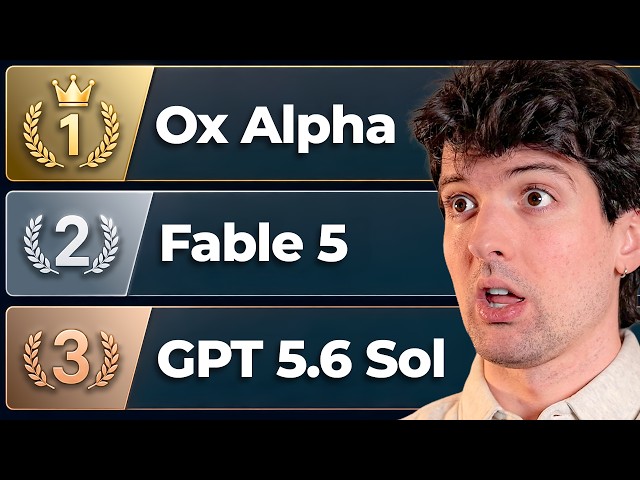
Ox Alpha Is INSANE
🔗 **Source:** [Ox Alpha Is INSANE](https://www.youtube.com/watch?v=Xdxp3lbQKyQ)
> [!note]+ Document Notes
> > [!info] Analysis generated 2026-08-27 by Claude (Opus 5) via readwise-deep-read.
> > **Source:** YouTube — https://www.youtube.com/watch?v=Xdxp3lbQKyQ · ~8,690 words · video (model review + live demo).
> > **Author:** Theo Browne (t3.gg). Reader's author field says "youtube.com"; the actual creator is Theo, referencing collaborator Ben Davis (benchmarks) and "Barl" (hardware research).
> > Register key: [STATED] · [EVIDENCE] · [INFERENCE] · [RECOMMEND]. Full transcript read. Auto-captions — garbles noted (e.g. "sub aents"→sub-agents, "comput"→compute, "rldled"→RL'd, "hundth"→hundredth, "codeex"→Codex).
>
> # 🏷️ Title: Ox Alpha is INSANE (it's GLM 5.3 Flash)
>
<!-- deep-read:sections start -->
## 🧭 Table of Contents
- [📝 Summary](#-summary)
- [📖 Main Content](#-main-content)
- [🗒️ Notes](#️-notes)
- [📚 References](#-references)
- [🗣️ Paraphrase](#️-paraphrase)
- [📰 Newsletter](#-newsletter)
- [✅ Action Items](#-action-items)
- [🧪 Hypotheses](#-hypotheses)
- [📊 Methodology](#-methodology)
- [❓ Questions](#-questions)
- [🔮 Future Research](#-future-research)
- [💡 Implications](#-implications)
- [🧠 Learning Styles Assessment](#-learning-styles-assessment)
- [📊 Accessibility Assessment](#-accessibility-assessment)
- [🌍 DEIB Assessment](#-deib-assessment)
- [✅ Logical Validity](#-logical-validity)
- [🛡️ DARVO Analysis](#-darvo-analysis)
- [🎯 Conclusion](#-conclusion)
## 📝 Summary
**The reveal.** [STATED] The anonymous model "Ox Alpha," announced through OpenCode and OpenRouter with a claimed *"capacity for 100 trillion tokens per day,"* is **GLM 5.3 Flash** from Z.AI (Zhipu). Theo used it heavily during the anonymous window and says it *"behaves on par with models like Opus 4.8 at a tenth to a hundredth the price."*
**The specs.** [STATED] 320B total parameters, only **18B active** per expert (MoE) — a tenth the size of Kimi K3's 3T. 1M-token context. Full multimodality: image, audio, and video input (GLM 5.3 non-Flash *"couldn't even take a screenshot"*). Hybrid sparse + linear attention, so **price doesn't step up at long context**. 30T-token multimodal pre-training corpus. Open weights.
**The price.** [STATED] With the current discount: **7.5¢/M input, 25¢/M output** — "Gemini Flash 2 pricing." Artificial-analysis-style cost: ~9¢/task vs GPT-5.6 Luna's 5¢, with meaningfully higher intelligence (60 vs Kimi K3's 57 on the index).
**The headline demo.** [EVIDENCE] Theo had it audit every open PR in the T3 Code repo — *"all thousand plus PRs"* — with sub-agent fan-out, risk/mergeability ranking, and issue cross-linking. Three of six sub-agents died on API auth failures; the model *"realized that the sub agent auth failures were consistently happening. So it fell back to just audit directly rather than waiting on the broken delegation."* Total measured cost after checking cache pricing: **$0.12** (≈6B tokens in, vast majority cached, ~300k out). The same job scoped to only his own PRs on Fable cost *"like over $100."* He merged eight PRs it surfaced and found a real 6-hour-old bugfix PR he'd otherwise have missed.
**The framework.** [STATED] Theo splits model capability into **intelligence** (knowledge; GPT-4.5, Gemini 3.1 Pro) and **behavior** (applying what you're told; staying on task, absorbing mid-task steering, self-unblocking). GLM 5.3 Flash is his first model that is *"both genuinely stupid but also genuinely awesome to work with"* — behavior floor cleared without frontier intelligence, via Z.AI's RL post-training in provisioned environments.
**The kicker.** [STATED] It's served *"entirely on Chinese AI chips"* — Huawei Ascend 910B/C — which is why Z.AI could give away trillions of free tokens and price the real release near zero.
**Tier-list outcome.** [STATED] 5.3 Flash moves up next to GPT-5.6 Soul; DeepSeek V4 Flash moves down (*"no reason to use it anymore"* — no vision in the open weights; the vision endpoint is a closed API feature, not a model capability).
## 📖 Main Content
### The anonymous drop and why it worked
[STATED] Ox Alpha appeared anonymously a week before the video via OpenCode and OpenRouter. The 100T-tokens/day capacity claim stood out: Theo's heaviest personal days run ~7B tokens, and *"all of Google's Gemini traffic in a given day is estimated in the 150 trillion token range."* Either hidden compute reserves or a tiny, cheap model. It was the latter.
[EVIDENCE] Ben Davis benched the anonymous model against the public subset of "deep suite" problems: GPT-5.6 Soul 52%, "People five" [caption garble — likely another frontier model] 65%, **Ox 80%**. [STATED] Theo flags these numbers as *"misleading, but it doesn't mean the model is bad."*
[STATED] On the marketing: *"If they had just put out this blog post without the early access window and without the anonymous ox drop, I would have called [BS] on this and probably not even looked."* The free anonymous window generated genuine hands-on conviction that a benchmark blog post never would. It hit #1 on OpenRouter and OpenCode, doing 43T params-worth [garble — likely tokens] of traffic during the test window.
### The PR-audit demo, in detail
[EVIDENCE] First prompt pattern — Theo's standard new-model shakedown: *"Take a look at all the pull requests I currently have open in this repo. Help me prioritize them based on ease of merge and the value that they provide to our users."* Then two mid-task steers: (1) exclude Codex-authored PRs, only Fable/Claude Code ones; (2) *"put your findings in HTML so that I can more easily look at them on my phone."*
[STATED] Why the steering test matters: *"I cannot tell you how many times I sent something like this to another model… and it would respond immediately to that saying okay I'll let you know when the findings are done… and then not keep going until you say hey you should finish the work you were just doing."* GLM 5.3 Flash absorbed both steers and kept working.
[EVIDENCE] The 5-day-cohort run: audit all PRs updated in the last 5 days (hundreds), *"use lots of sub agents to break up the work,"* rank by overlap, issues fixed, merge risk, confidence, ease of action. Six sub-agents spun up; three failed on provider auth errors (Theo's hacked Codex proxy, not the model); it recovered them, then noticed the failures were consistent and **abandoned delegation for direct auditing** — *"This is really, really good debugging work that the agent is doing. Not to debug things in my codebase, but to debug its own flows. The agent can unblock itself."* Completed in ~20 minutes.
[EVIDENCE] Output-quality details Theo calls out: it produced clickable PR links unprompted (*"I cannot tell you how many models, even frontier models, don't make these links"*); the HTML report included a snapshot timestamp (*"I might make that a rule in my skill"*); the follow-up pass (post-merge, drafts ignored) correctly closed issues fixed by merged PRs and reported *"No open PR claims 5276, 5289 or 7233."*
[EVIDENCE] The scope lesson: a report included PRs he didn't expect. *"I thought it might have went rogue… I should have second guessed what I sent because Ox aka 5.3 Flash does what you told it."* He'd said "all the pull requests in the repo." He contrasts this with expensive models that silently re-widen scope after a steer.
[EVIDENCE] Cost accounting: he asked the model itself to compute the day's usage from local Codex logs at the stated rates. First answer ~50¢; corrected for cache pricing: **$0.12**. *"6 billion tokens in, the vast majority of which were cached, 300k out, useful [stuff] for 12 [cents]."* Plan: *"I'm going to set up a bot that runs this every 3 hours and pings me when there's a pull request that thinks it's ready to merge."*
### Intelligence vs. behavior
[STATED] Theo's two-axis model, built from failure modes he sees in users:
- One-track users: always pick the biggest model + highest reasoning, burn their quota, complain. *"Most of the people who feel that way would be totally fine with a model like Luna."*
- Too-many-tracks users: want a per-domain router ("GLM for math, Grok for jokes"). *"Nothing is that simple."*
[STATED] His buckets: **intelligence** = knowledge baked in; **behavior** = *"the ones that apply what they're told the best."* Exemplars:
- GPT-4.5: rumored ~10T params, enormous knowledge, no reasoning, no agentic capability — pure intelligence, poor behavior.
- Gemini 3.1 Pro: *"unbelievably intelligent still to this day"* — 95–97% on Theo's closed-source Skatebench (naming skate tricks from physical descriptions), the only model in the 90s, where the next best (GPT-5.4) got 88% and OpenAI's 5.5/5.6 regressed. But agentic coding: *"it's going to reason a bunch of nonsense and then say, okay, I'm going to rebuild your codebase because it lost track of what it's doing."*
- GPT-5.6 Soul: *"RL'd to hell and back to get the task done no matter what"* — behavior-dominant frontier. Fable: intelligence-leaning with worse behavior.
- GLM 5.3 Flash: the first model that's low-intelligence and high-behavior *and still useful* — there's *"a floor that you have to hit with behavior before you can be useful at all."*
[STATED] Attribution for the behavior: Z.AI's post-training *"with provisioned environments that allow the models to do real work to learn how to work better."*
### Token efficiency — the one criticism
[EVIDENCE] ~47k tokens/task on artificial analysis vs Luna-max 20k, Soul 17k, Muse Spark 30k, Sonnet 5 roughly half of 5.3 Flash's usage. [STATED] Why efficiency matters even when you win on price: wall-clock time, and context self-bloat — *"If you use more tokens to complete a task, your context window gets filled faster and your likelihood of getting to the solution before you max out your context goes down."*
[EVIDENCE] On Z.AI's codebench, 5.3 Flash on "high" lands near its own "max" score at under half the tokens, and matches Opus 4.8's high/max band while Opus takes 120k tokens to 5.3 Flash's 70k.
### Vision, front-end, and the toy builds
[EVIDENCE] Vision confirmed live: screenshot pasted mid-thread, model reasons over it. [STATED] Vision powers self-debugging: layout issues it wrote were fixed after it *saw* the rendered page; it drove Codex's computer-use *"surprisingly well."*
[EVIDENCE] Design bench (Dar's): default output mediocre; with the design skill/markdown applied, several pages land — scroll-covering card animation, and copy that *"doesn't read like usual AI generated slop"* (the "Understory" notes-app tagline). Fish-tank game ("fish slop"): solid feel, good sprite-ordering for motion, added sound — but logic bugs (fish stop moving after first feed, eat when not hungry, meter timing). 3D port: ugly but functional, self-made models. [EVIDENCE] Z.AI's own showcase: 12 hours unattended in Blender produced photoreal-ish restaurant kitchen environments.
### The hardware angle
[STATED] Serving runs on **Huawei Ascend 910B/C** (research credited to "Barl"), memory-constrained and optimized *"probably at the cost of throughput"* — observed post-launch slowdown to 33 TPS on Z.AI while Base10 hits 114 TPS on the open weights, time-to-first-token 4.4s. *"The reason they can serve it so cheap is because they have chips that aren't Nvidia."*
### Tier list and the V4 Flash demotion
[STATED] The list ranks *"what unique value does this model bring,"* not raw intelligence. 5.3 Flash slots next to Soul: *"with Fable, Soul, and 5.3 Flash, there is practically zero reason to use anything else in this list."* Muse Spark's edge (vision, speed, contributor-tier price) now costs you your code as training data or 10× the price; 5.3 Flash matches the price, behaves better, and *"way more private because you can run it on your own [hardware]."* DeepSeek V4 Flash demoted: no vision in any downloadable weights (the "vision endpoint" is DeepSeek API-side), gets *"distracted and lost"* on long runs even in the 0731 snapshot.
## 🗒️ Notes
- [INFERENCE] The PR-audit pattern is exactly the shape of work Courtney's `credit-routing` policy sends away from frontier models: bulk reading + mechanical triage + report generation. Theo's numbers ($0.12 vs $100+) are the strongest concrete cost datum this reading queue has produced for that policy.
- [INFERENCE] "Behavior vs intelligence" maps onto the routing matrix's existing model/effort split, but adds a testable axis: mid-task steering compliance. Theo's shakedown prompt (audit open PRs → steer twice mid-run) is a reusable behavior probe for any new model.
- [INFERENCE] The self-unblocking anecdote (fall back from broken sub-agent delegation to direct work) is the same failure Courtney hit this session in reverse — a killed background job reported as complete. A model that *notices its delegation is failing* is rarer and more valuable than one that delegates.
- [EVIDENCE] The scope mistake ("all PRs" meant ALL PRs) demonstrates the flip side of high obedience: precise prompts become load-bearing. Matches the CLAUDE.md rule "re-issue narrowed to what/where/how/when."
- [INFERENCE] The anonymous-drop strategy (free window → hands-on conviction → paid reveal) is the same playbook as Horizon Alpha/Beta (GPT-5 era) and Quasar. Expect it to recur; treat anonymous OpenRouter drops as vendor marketing, not community mysteries.
- [STATED] Caption garbles worth noting for anyone quoting this video: "sub aents"=sub-agents, "rldled"=RL'd, "codeex"=Codex (Theo's fork "T3 code" wraps Codex and Claude Code), "Kimmy K3"=Kimi K3, "56 soul/Luna/Terra"=GPT-5.6 variants, "Muse Spark"/"Grock"/"DCV4" as heard.
- [INFERENCE] The Huawei Ascend serving claim, if accurate, is a bigger story than the model: a competitive frontier-adjacent model served at scale with zero Nvidia in the pipeline undercuts the export-control thesis that compute restrictions gate Chinese model deployment.
## 📚 References
[EVIDENCE] Named: **GLM 5.3 Flash / GLM 5.3 / GLM 5.2** (Z.AI/Zhipu), **Ox Alpha** (the anonymous name), **OpenRouter**, **OpenCode**, **Codex**, **Claude Code**, **T3 Code** (Theo's harness), **Kimi K3**, **GPT-4.5**, **GPT-5.4/5.5/5.6 (Soul, Luna, Terra)**, **Opus 4.8 / Opus 5**, **Fable**, **Sonnet 5**, **Gemini 3.1 Pro / 3.6 Flash / 3.7 Flash**, **DeepSeek V4 Flash (+0731 snapshot)**, **Muse Spark**, **Qwen 38 Flash** [as heard], **Huawei Ascend 910B/C**, **Base10** (hosting), **Blender**, **Skatebench** (Theo's private benchmark), **artificial analysis** (index), **Whisper Flow** (voice input), **DGX Spark** (local inference target). People: **Ben Davis** (benchmarks/podcast), **Dar** (design bench), **Barl** (hardware research). Sponsors: **CodeRabbit** (security review + deep audit product), **DNSimple**.
## 🗣️ Paraphrase
An anonymous free model on OpenRouter turned out to be Z.AI's GLM 5.3 Flash: 320B params (18B active), 1M context, image/audio/video input, open weights, 7.5¢/25¢ per million tokens. It isn't frontier-smart, but it's the best-*behaved* cheap model Theo has used — it follows instructions exactly, absorbs mid-task corrections, and debugs its own broken workflows. It audited 1,000+ open PRs in his repo for 12 cents, a job that cost $100+ on a frontier model, and found mergeable work he'd missed. It's served on Huawei chips, which is why it's nearly free. His conclusion: Fable for hard thinking, Soul for grinding, 5.3 Flash for everything cheap — and DeepSeek V4 Flash is now pointless.
## 📰 Newsletter
**The 12-cent code review.** Theo Browne spent a week with "Ox Alpha" before learning it was GLM 5.3 Flash — Z.AI's 320B-total/18B-active open-weight flash model at 7.5¢ in / 25¢ out per million tokens. The demo that matters: it audited every open PR in his repo (1,000+), self-recovered from failing sub-agents by switching to direct auditing, produced linked, timestamped HTML reports, and billed $0.12. His framing is the takeaway: judge models on *intelligence* (knowledge) and *behavior* (doing what you said, staying steered, unblocking itself) as separate axes — and behavior has a usefulness floor that this is the first cheap model to clear. It runs on Huawei Ascend silicon, no Nvidia involved.
## ✅ Action Items
1. [RECOMMEND] Add a cheap-model bulk-triage lane to the routing matrix with this as the concrete benchmark: PR/backlog auditing, report generation, and repo sweeps belong on flash-class models; reserve Opus/frontier for the merge *decisions*. The 830× cost gap ($0.12 vs $100+) is the number to cite in `tool-routing.md`.
2. [RECOMMEND] Steal the shakedown prompt as a standing new-model probe: "audit all open PRs, rank by ease-of-merge × user value," then steer twice mid-run (narrow the scope, change the output format). Score the model on whether it absorbs both steers without stopping or re-widening.
3. [RECOMMEND] Steal the report conventions for any agent-generated audit: clickable links (never bare PR/issue numbers) and a snapshot timestamp on every generated report. Theo: "I might make that a rule in my skill" — it's a good rule.
4. [RECOMMEND] Treat anonymous OpenRouter model drops as vendor pre-launch marketing with free-token windows; the window is the cheap time to run your own evals.
## 🧪 Hypotheses
- [INFERENCE] H1: Behavior (instruction adherence under steering) is trained, not emergent from scale — Z.AI got frontier-adjacent behavior at 18B active via environment-based RL. If true, behavior scores across model families should correlate with post-training method, not parameter count.
- [INFERENCE] H2: The "obedience precision" trade-off generalizes: as behavior improves, prompt scope errors surface *more* often because the model stops silently correcting them. High-behavior models shift error responsibility to the prompter.
- [INFERENCE] H3: Non-Nvidia serving at these prices, if sustained, predicts a structural price floor collapse for flash-class inference by 2027 — the constraint was never FLOPs but supply-chain access.
## 📊 Methodology
[EVIDENCE] Theo's evaluation method, reconstructed: (1) extended anonymous-window daily-driver use before knowing the vendor — removes brand bias; (2) a standardized first task (PR audit) with known-cost baselines from prior models; (3) deliberate mid-task steering as a behavior probe; (4) cost verification by having the model compute its own token usage from local logs, then correcting for cache pricing; (5) third-party triangulation (Ben Davis's deep-suite subset, Dar's design bench, artificial analysis, Barl's hardware digging); (6) toy builds (fish game, 3D port) to find the intelligence ceiling. [INFERENCE] Weakness: nearly all quantitative claims flow through Theo's own harness ("I've been hacking the hell out of my Codex") — the auth failures and slow skill reads he narrates are harness artifacts that a cleaner setup wouldn't hit, and none of the benchmark numbers are independently checkable from the video.
## ❓ Questions
- [INFERENCE] What exactly did the 80% deep-suite subset score measure, and why does Theo call the circulating numbers "misleading" without elaborating?
- What's the actual privacy posture of Z.AI's hosted plan vs self-hosting the weights — the video treats "open weight" as settling the privacy question, but his own usage runs through his Z.AI subscription.
- Does the 3-hour PR-audit bot survive contact with reality (notification fatigue, false-confidence merges), and what guardrails does it get?
- How much of the "behavior" advantage persists outside coding harnesses — the video tests exactly one domain.
## 🔮 Future Research
- [RECOMMEND] Watch for the DGX Spark local-inference run Theo promised — a 320B/18B MoE on desk hardware is the self-hosting datum that matters for the privacy claim.
- [RECOMMEND] Track whether Qwen's same-day flash release (as heard, "Qwen 38 Flash") and future DeepSeek snapshots adopt vision in open weights — the axis V4 Flash was demoted on.
- [INFERENCE] Skatebench-style private benchmarks (obscure domain, closed question set) are becoming the trusted currency as public benches saturate; worth cataloging which reviewers maintain one.
## 💡 Implications
- [INFERENCE] For Courtney's stack specifically: the video validates the existing credit-routing architecture and sharpens it — the missing piece isn't a smarter orchestrator but a *cheaper executor* for bulk sweeps. A GLM-5.3-Flash-class model behind the Agent tool's model override (or an external executor) would make whole-repo audits routine instead of budgeted.
- [INFERENCE] For WordPress-ecosystem review work: 12-cent full-repo audits change the economics of plugin review at scale — the same lever Wordfence's PRISM/Argus story showed from the security side. Cheap, well-behaved models make *continuous* auditing (every 3 hours) plausible where weekly manual review was the ceiling.
- [STATED→INFERENCE] "At a given level of intelligence, the costs go down exponentially" — Theo's line reframes AI-cost complaints: intelligence is what's getting expensive; yesterday's intelligence is approaching free. Budget arguments should name the intelligence tier a task actually needs.
## 🧠 Learning Styles Assessment
[EVIDENCE] Screen-recorded live demo with narration — strong for visual/sequential learners; the tier-list segment gives spatial learners a ranking anchor. [INFERENCE] Weak for reading/writing learners: the quantitative claims are scattered across ~40 minutes with no written summary; the two-axis framework is explained verbally through examples rather than defined once. The intelligence/behavior 2×2 would be one diagram; it never appears.
## 📊 Accessibility Assessment
[EVIDENCE] Auto-captions only, with heavy garbling of model names ("rldled," "sub aents," "Kimmy K3," "codeex") — a caption-dependent viewer cannot reliably distinguish which model is being discussed at several points, which is the video's core content. Charts are read aloud partially but referenced deictically ("it's so far over here"). Blurred on-screen security findings are described verbally. [RECOMMEND] Human-corrected captions and a written companion post with the actual numbers would fix most of it.
## 🌍 DEIB Assessment
[EVIDENCE] The hardware segment treats Huawei/Chinese chip manufacturing with straightforward technical respect ("incredible hardware manufacturers") while noting the US ban factually. [INFERENCE] The "their IQ level is low" riff about users who max every setting punches down at his own customers for a laugh; it's the one passage where the register turns contemptuous. Mild profanity throughout; no other notable concerns. Sponsor segment humanizes a small founder-run company ("married couple… handwritten letter") — a deliberate contrast against VC-backed vendors.
## ✅ Logical Validity
- [EVIDENCE] Strong: the central claim (cheap + well-behaved is a distinct, useful niche) is supported by a reproducible demo with a cost receipt, and Theo corrects his own numbers on camera twice (50¢→12¢; the 4m40s→4.4s TTFT misread; the Gemini 3.6/3.7 Flash efficiency misremembering). Self-correction on camera is evidence of calibration.
- [INFERENCE] Weaker: "misleading benchmark numbers" is asserted, never explained — he keeps the 80% figure's rhetorical force while disclaiming it. The log-scale caveat on the Pareto chart cuts both ways and he applies it only in the model's favor. The privacy argument (open weights = private) conflates *possible* self-hosting with his *actual* hosted usage. Sponsor adjacency: a security-audit sponsor read sits inside a video about cheap audit agents; the editorial content stands on its own, but the theme alignment is not accidental.
- [EVIDENCE] The tier-list criterion is explicitly stated (unique value, not intelligence), which makes the placements internally consistent even where they'd look wrong on a raw-capability axis.
## 🛡️ DARVO Analysis
Not applicable to this source — enthusiast product review; no accusations, reversals, or victim-offender dynamics. Closest adjacent pattern: the "users with low IQ pick X-high" segment blames users for a UI design that invites the error, a mild responsibility-shift but not DARVO.
## 🎯 Conclusion
The reveal (Ox Alpha = GLM 5.3 Flash) matters less than the framework the video builds around it: **behavior and intelligence are separate axes, behavior has a usefulness floor, and behavior is now available for 25¢/M output tokens.** The 12-cent thousand-PR audit is the single most quotable datum in this reading batch for the credit-routing thesis — bulk triage on flash models, judgment on frontier ones. The caveats stay attached: one reviewer, one domain, his own broken harness, benchmark numbers he himself calls misleading, and a hosted-vs-self-hosted privacy conflation. But the demo is a receipt, not a vibe, and the two mid-task steers plus the self-unblocking fallback are behavior probes worth stealing regardless of which model you point them at.
<!-- deep-read:sections end -->
📄 **Full text:** [[Full Document Contents/Articles/Ox Alpha Is INSANE.md|Ox Alpha Is INSANE by Theo Browne (t3.gg)]]
## Highlights
- realized that the sub agent off failures were consistently happening. So it fell back to just audit directly rather than waiting on the broken delegation. I'll use the GitHub inspection skill and machine generated summaries, then manually review the highest risk and easiest action PRs. This is phenomenal. ([View Highlight](https://read.readwise.io/read/01m12vfh07k2j36r3j279snkvw))
- Note: The behavior finding that matters: the model noticed its own delegation was consistently failing and switched strategies unaided — self-unblocking, not just self-recovery. [STATED/EVIDENCE]
- understand how crazy this is. Like 6 billion tokens in, the vast majority of which were cashed, 300k out, useful [ \_\_ ] for 12. And to be fair, I'm not even ([View Highlight](https://read.readwise.io/read/01m12vfsew457cb0w8rx70skfa))
- Note: The cost receipt: auditing 1,000+ open PRs on GLM 5.3 Flash = 6B tokens in (mostly cached), 300k out, $0.12 total. Same job scoped to only his own PRs on a frontier model: $100+. The strongest bulk-triage routing datum in this batch. [EVIDENCE]