Panel Why We’re Backing WordPress in 2026
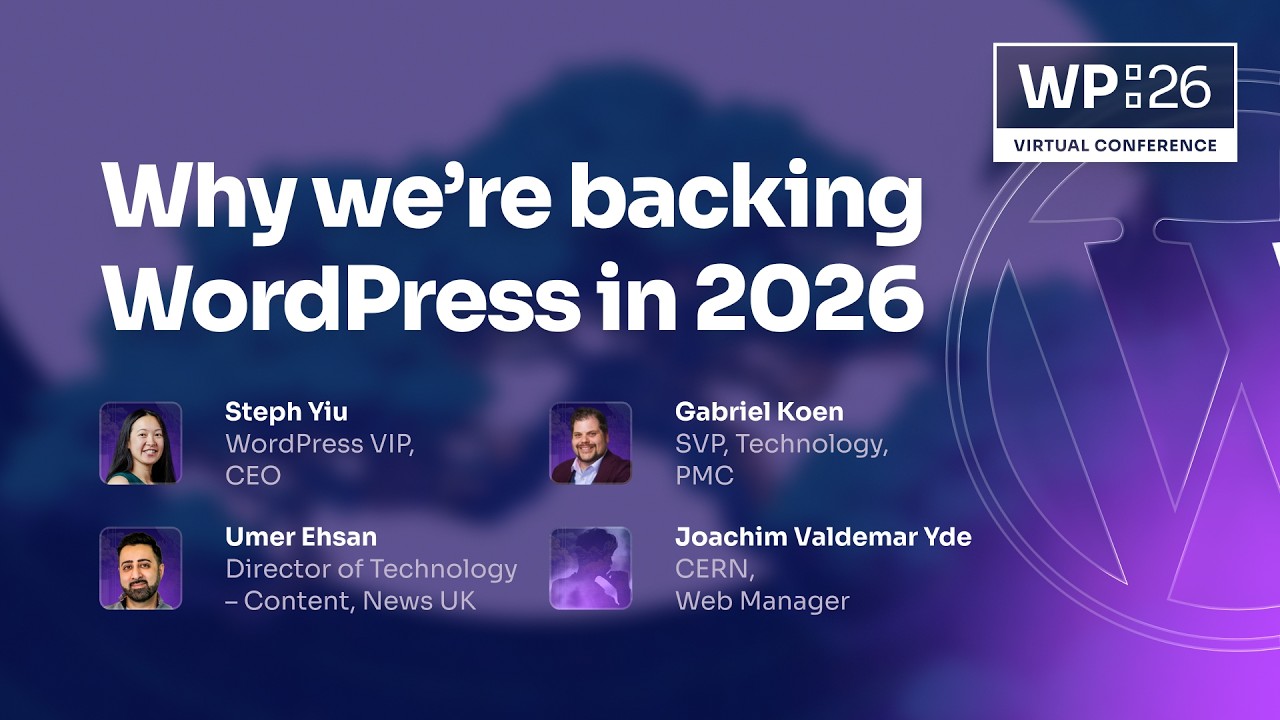
🔗 **Source:** [Panel Why We’re Backing WordPress in 2026](https://www.youtube.com/watch?v=1xt8vyIay58)
> [!note]+ Document Notes
> tags: #wordpress #enterprise #artificial-intelligence #content-management #media-publishing
> author: Human Made
> source: YouTube
> reference: https://www.youtube.com/watch?v=1xt8vyIay58
> date created: 2025-01-11 10:30
>
> # 🏷️ Title: Panel: Why we're backing WordPress in 2026
>
<!-- deep-read:sections start -->
## 🧰 Action Inbox
- [H1] Evaluate WordPress VIP's Forward Deployed Engineer model for enterprise AI implementation — 45:30 #enterprise #wordpress
- [H2] Research CERN's WordPress migration methodology and tooling — 22:15 #migration #enterprise
- [H3] Implement disciplined AI experimentation frameworks with proper governance — 35:20 #artificial-intelligence #governance
## 🧭 Table of Contents
- [[#📝 Summary]]
- [[#📖 Main Content]]
- [[#🗒️ Notes]]
- [[#📚 References]]
- [[#🗣️ Paraphrase]]
- [[#📰 Newsletter]]
- [[#✅ Action Items]]
- [[#🧪 Hypotheses]]
- [[#📊 Methodology]]
- [[#❓ Questions]]
- [[#🔮 Future Research]]
- [[#💡 Implications]]
- [[#🧠 Learning Styles Assessment]]
- [[#📊 Accessibility Assessment]]
- [[#🌍 DEIB Assessment]]
- [[#✅ Logical Validity]]
- [[#🛡️ DARVO Analysis]]
- [[#🎯 Conclusion]]
### 🔗 References
- [WordPress VIP](https://wpvip.com/)
- [CERN](https://home.cern/)
- [Penske Media Corporation](https://pmc.com/)
- [News UK](https://www.news.co.uk/)
## 📝 Summary
- Four enterprise WordPress leaders discuss why they're committed to WordPress in 2026
- Key themes include platform consolidation, AI integration, and architectural evolution
- Organizations include WordPress VIP, Penske Media, News UK, and CERN
- Focus on moving from AI experimentation to production implementation
- Emphasis on WordPress's adaptability and open ecosystem advantages
## 📖 Main Content
This panel featured leaders from major WordPress implementations discussing their strategic commitment to the platform. Steph Yu (WordPress VIP CEO) moderated alongside Gabriel Cohen (Penske Media SVP), Uma Harish (News UK Technology Director), and Yoshim Pillay (CERN Staff Engineer).
The discussion centered on three major themes: platform consolidation and simplification, architectural thinking for future-proofing, and disciplined AI experimentation. CERN's migration from Drupal represents one of the largest CMS migrations in progress, involving thousands of websites. News UK is evolving from headless to full-stack WordPress implementations, while Penske Media continues expanding AI capabilities across their media properties.
All panelists emphasized WordPress's core strength: its ability to evolve alongside organizational needs while maintaining ease of use for content creators. The open-source nature provides flexibility for customization while benefiting from ecosystem-wide innovation.
## 🗒️ Notes
#### ⏱️ [00:00](https://youtu.be/1xt8vyIay58?t=0) — [H1] Opening and introductions
- Key idea: Panel features enterprise WordPress leaders discussing 2026 strategy
- Evidence: "We've got an amazing panel who I will bring on stage momentarily"
#### ⏱️ [06:45](https://youtu.be/1xt8vyIay58?t=405) — [H2] WordPress VIP enterprise themes
- Key idea: Two persistent enterprise themes are consolidation/simplification and architecture focus
- Evidence: "There are some themes that have never gone away, which is consolidation and simplification"
#### ⏱️ [08:30](https://youtu.be/1xt8vyIay58?t=510) — [H1] Penske Media's WordPress scale
- Key idea: PMC uses WordPress as central platform for all major properties over 16 years
- Evidence: "Sites like Hollywood Reporter, Billboard, Rolling Stone, Variety... WordPress is kind of their core outlet"
#### ⏱️ [10:15](https://youtu.be/1xt8vyIay58?t=615) — [H1] News UK's hybrid approach evolution
- Key idea: News UK migrated from headless to full-stack WordPress for The Sun and Times
- Evidence: "We undertook quite a large project to migrate to a full stack web implementation of WordPress"
#### ⏱️ [12:30](https://youtu.be/1xt8vyIay58?t=750) — [H1] CERN's massive WordPress adoption
- Key idea: CERN migrated from Drupal after extensive 14-requirement evaluation process
- Evidence: "We just about 300 websites on WordPress. In a couple of months that number will be doubled"
#### ⏱️ [18:45](https://youtu.be/1xt8vyIay58?t=1125) — [H2] WordPress evolution advantage
- Key idea: WordPress's adaptability allows long-term platform evolution with organizational needs
- Evidence: "WordPress does a great job of staying modern... still the platform that we're seeing for the next several years"
#### ⏱️ [25:20](https://youtu.be/1xt8vyIay58?t=1520) — [H1] Enterprise demand for open platforms
- Key idea: AI is driving new enterprise interest in open, future-proof platforms over closed systems
- Evidence: "AI is forcing innovation across every business... Closed just isn't going to cut it for me anymore"
#### ⏱️ [28:15](https://youtu.be/1xt8vyIay58?t=1695) — [H2] CERN's evaluation methodology
- Key idea: Year-long evaluation with 14 requirements, building test sites for each platform
- Evidence: "We ranked all the different solutions... built individual sites as if we had adopted that technology"
#### ⏱️ [32:30](https://youtu.be/1xt8vyIay58?t=1950) — [H1] AI moving beyond experimentation
- Key idea: 2026 represents shift from AI experimentation to production implementation
- Evidence: "The majority of the projects on our road map right now are not WordPress specific for probably the first time"
#### ⏱️ [35:45](https://youtu.be/1xt8vyIay58?t=2145) — [H2] PMC's AI use cases in production
- Key idea: PMC uses AI for translation, archive processing, and content stitching
- Evidence: "Using AI to help translate some of our content into Spanish for Billboard Espanol"
#### ⏱️ [38:30](https://youtu.be/1xt8vyIay58?t=2310) — [H1] News UK's workflow automation focus
- Key idea: AI must remove entire swaths of effort, not just small time savings
- Evidence: "If you want to make a dent with AI, you have to take entire swaths of effort out of your business"
#### ⏱️ [45:20](https://youtu.be/1xt8vyIay58?t=2720) — [H2] VIP's Forward Deployed Engineers
- Key idea: WordPress VIP embeds engineers with customers to co-build AI solutions
- Evidence: "We embed our engineers into our customers and we co-build with them based on the primitives"
#### ⏱️ [47:15](https://youtu.be/1xt8vyIay58?t=2835) — [H1] Enterprise AI governance requirements
- Key idea: Businesses need audit logging, permissions, and security guarantees for AI implementation
- Evidence: "Audit logging, permissions... protecting against prompt injections, all of these things need to be considered"
#### ⏱️ [49:30](https://youtu.be/1xt8vyIay58?t=2970) — [H1] WordPress ecosystem power
- Key idea: WordPress's strength comes from community, contributors, and real-world enterprise implementations
- Evidence: "WordPress's real power comes from its ecosystem. The community, contributors, and organizations using the platform at scale"
## 📚 References
- [WordPress VIP](https://wpvip.com/)
- [CERN Web Services](https://home.cern/)
- [Penske Media Corporation](https://pmc.com/)
- [News UK](https://www.news.co.uk/)
- [Human Made](https://humanmade.com/)
## 🗣️ Paraphrase
- WordPress enterprise adoption is accelerating in 2026 driven by AI innovation needs and the demand for open, adaptable platforms over proprietary systems
- Major organizations like CERN, News UK, and Penske Media are deepening WordPress commitments through large-scale migrations and architectural evolution projects
- The focus is shifting from AI experimentation to production implementation, with emphasis on governance, security, and workflow automation that removes significant operational overhead
## 📰 Newsletter
Enterprise WordPress adoption is reaching new heights in 2026! This fascinating panel brought together leaders from WordPress VIP, CERN, Penske Media, and News UK to discuss why major organizations are betting big on WordPress.
The highlights? CERN is migrating thousands of websites from Drupal after an extensive year-long evaluation. News UK evolved from headless back to full-stack WordPress. And everyone's moving from AI experimentation into real production use cases.
What's driving this? The need for open, adaptable platforms that can evolve with rapidly changing AI capabilities. WordPress's combination of developer flexibility and content creator ease-of-use continues to be unmatched.
Key takeaway for WordPress professionals: Enterprise demand is growing, but these organizations need opinionated, enterprise-grade solutions and better governance tooling.
Resources: [Learn WordPress](https://learn.wordpress.org/), [Developer Docs](https://developer.wordpress.org/), [WP-CLI](https://wp-cli.org/)
## ✅ Action Items
#### DevRel
- Developer advocacy: Showcase enterprise WordPress success stories and implementation patterns
- Education: Develop AI integration workshops for WordPress developers
- Developer experience: Improve documentation for enterprise WordPress architectural patterns
- Developer marketing: Create case study content featuring CERN, News UK, and PMC implementations
- Community management: Facilitate connections between enterprise users and core contributors
#### WordPress
- Core: Prioritize AI primitives and enterprise-ready features in core development
- Core AI: Expand capabilities API and agent integration foundations
- Community: Support enterprise contributor programs and governance frameworks
- Documentation: Create enterprise implementation guides and architectural decision trees
- Accessibility: Ensure AI features maintain WCAG compliance standards
- Meta: Improve enterprise onboarding resources and migration tooling
## 🧪 Hypotheses
- WordPress adoption will accelerate among enterprises seeking AI-ready, open platforms in 2026
- Organizations will increasingly prefer full-stack WordPress over headless implementations for operational simplicity
- Forward deployed engineering models will become standard for enterprise platform providers
- AI governance and security features will become primary enterprise WordPress differentiators
### 📊 Methodology
- Survey enterprise WordPress implementations to quantify AI adoption patterns
- Case study analysis of CERN's 14-requirement evaluation framework for CMS selection
- Longitudinal study of headless-to-monolith migration outcomes at media organizations
- Comparative analysis of open vs. proprietary platform AI integration capabilities
### ❓ Questions
- How can WordPress better support enterprise AI governance and compliance requirements?
- What architectural patterns emerge from large-scale WordPress enterprise implementations?
- How do forward deployed engineering models scale across enterprise customer bases?
### 🔮 Future Research
- Long-term impact of CERN's open-source migration tooling on WordPress ecosystem
- Evolution of enterprise AI use cases beyond content creation and translation
- Development of WordPress-specific AI governance frameworks and best practices
### 💡 Implications
- Practice: Enterprise WordPress development requires deeper AI integration expertise
- Policy: Need for industry-standard AI governance frameworks in content management
- Security: AI-specific security considerations become critical for enterprise implementations
- Education: Training programs must include enterprise architecture and AI governance
- Funding: Investment opportunities in WordPress enterprise tooling and services
### 🧠 Learning Styles Assessment
Reading level estimate: 12th grade
#### 👀 Visual learners
- Present: Organization logos and speaker identification
- Improve: Architecture diagrams showing WordPress AI integration patterns, migration flowcharts
#### 🔊 Aural learners
- Present: Full video discussion with multiple speakers and perspectives
- Improve: Audio-only version with enhanced speaker identification
#### 🗣️ Verbal learners
- Present: Panel discussion format with extensive Q&A and real-world examples
- Improve: Glossary of enterprise WordPress and AI terminology
#### 🧩 Kinesthetic learners
- Present: Real implementation examples from working enterprises
- Improve: Step-by-step migration checklists and architectural decision frameworks
#### 🧠 Logical learners
- Present: CERN's 14-requirement evaluation methodology, clear organizational comparisons
- Improve: Decision matrices for enterprise WordPress implementation choices
#### 🧑🤝🧑 Social learners
- Present: Panel format encouraging cross-organizational learning
- Improve: Community forums for enterprise WordPress implementers
#### 🧘♀️ Solitary learners
- Present: Individual case study details for each organization
- Improve: Self-assessment tools for enterprise WordPress readiness
#### 🌿 Naturalistic learners
- Present: Ecosystem thinking about WordPress community and open source
- Improve: Sustainability considerations for long-term platform choices
### 📊 Accessibility Assessment
#### Screen reader semantics
- Present: Video has speaker identification and contextual information
- Improve: Structured transcript with speaker roles and time markers
#### Keyboard navigation
- Present: Standard YouTube player controls
- Improve: Enhanced transcript navigation with jump-to-speaker functionality
#### Contrast and readability
- Present: Standard video player interface
- Improve: High-contrast transcript options
#### Text resizing and reflow
- Present: Responsive video embedding
- Improve: Scalable transcript text with maintained formatting
#### Media and captions
- Present: Auto-generated YouTube captions
- Improve: Professional captions with technical term accuracy, downloadable transcript
#### Forms and interactions
- Present: Standard video controls
- Improve: Accessible feedback forms for enterprise WordPress interests
### 🌍 DEIB Assessment
#### Cultural breadth
- Present: International organizations (CERN in Switzerland, News UK, US-based PMC)
- Improve: More geographic diversity in enterprise case studies
#### Inclusive language
- Present: Professional business terminology, technical jargon explained in context
- Improve: Plain language summaries for non-technical stakeholders
#### Neurodiversity support
- Present: Clear section structure and consistent formatting
- Improve: Executive summary bullets, visual content organization
#### Representation
- Present: Mix of organizational roles and company types
- Improve: More diverse speaker representation in future panels
#### Psychological safety
- Present: Professional, collaborative discussion tone
- Improve: Explicit invitation for questions from different experience levels
### ✅ Logical Validity
#### Strong reasoning
- Deductive strength: Strong - open platforms enable faster innovation, therefore WordPress will benefit from AI acceleration
- Inductive strength: Good - multiple enterprise examples support broader adoption trends
- Causal reasoning: Sound - AI demands driving platform flexibility requirements
- Analogical strength: Effective - comparing WordPress ecosystem to broader open source AI development
#### Fallacies
- Survivorship bias: Only successful WordPress implementations featured, no discussion of failed migrations
- Appeal to authority: Heavy reliance on enterprise customer testimonials without critical analysis
#### Tone of voice
- Overall tone: Professional, collaborative, forward-looking with industry insider knowledge
### 🛡️ DARVO Analysis
- Deny: No significant denials observed
- Attack: No attacks on competing platforms or critics
- Reverse victim/offender: Not applicable to this business/technology discussion
- Emotional cues and rhetoric: Positive, optimistic framing focused on opportunities rather than problems
## 🎯 Conclusion
The panel demonstrates strong enterprise momentum for WordPress in 2026, driven by AI innovation requirements and the advantages of open, adaptable platforms. Key success factors include disciplined AI experimentation, architectural thinking for long-term evolution, and the unique WordPress combination of developer flexibility with content creator accessibility.
For WordPress professionals, this represents significant opportunity in enterprise services, AI integration expertise, and governance tooling. The community should focus on supporting these large-scale implementations as they drive platform evolution and contribute back to the ecosystem.
The emphasis on moving from AI experimentation to production implementation suggests 2026 will be a pivotal year for demonstrating WordPress's enterprise viability in the AI era.
## 🧱 Refactor Appendix
### 📚 Literature Split Pad
Purpose: Stage CEE units that become Literature notes.
Split level: H3
### [H1] Enterprise WordPress adoption accelerates with AI-driven platform demands
> [!quote] Panel: Why we're backing WordPress in 2026 by Human Made via YouTube. Published 2026. Accessed 2025-01-11.
> "AI is forcing innovation
---
## Full Transcript
[00:05] We are live. Hello Tom.<br>[00:08] >> Whoa. Hello Peter. Hello everybody.<br>[00:11] >> Good afternoon. Hello everybody. Uh<br>[00:14] >> it is it is the afternoon here. Yeah,<br>[00:16] >> it is the afternoon. Yeah, it<br>[00:17] >> we made it to the last session.<br>[00:19] >> We did. Yes, we did. We survived uh<br>[00:22] another virtual uh WordPress uh<br>[00:26] humanmade uh conference. I'm super<br>[00:28] excited for this one.<br>[00:30] >> Don't know whether I'd say survived.<br>[00:31] Yeah, we still have we still have to get<br>[00:32] through this session.<br>[00:34] >> Like 30 more minutes like we've seen.<br>[00:36] Yeah. All right. So, for everybody that<br>[00:37] doesn't know this guy, this is um Tom<br>[00:40] Wilnut. He is the CEO of Human Made. U<br>[00:44] really nice guy. Um been<br>[00:48] >> uh yeah, who's been my boss for the last<br>[00:50] 11 years. Uh so uh without further ado,<br>[00:53] I'm going to hand over to him uh and<br>[00:55] this panel of uh amazing folks from all<br>[00:59] over the WordPress ecosystem uh who are<br>[01:02] going to talk about why they're backing<br>[01:04] WordPress uh this year.<br>[01:08] >> Cool. Thank you, Petra. I'm very excited<br>[01:10] about this final session. We've got an<br>[01:11] amazing panel uh who I will bring on<br>[01:14] stage momentarily and introduce. Um, we<br>[01:18] were hoping to also have Mary Hubard<br>[01:20] join us, uh, executive director of<br>[01:21] WordPress, who I'm sure many of you will<br>[01:23] know. Um, unfortunately, she's been<br>[01:25] unable to, but she has actually, uh,<br>[01:28] sent us what I think is a great, uh,<br>[01:32] little intro video. And so, I thought<br>[01:33] we'd actually start with that. I think<br>[01:35] it'll kind of set the set the frame for<br>[01:38] this conversation really nicely.<br>[01:41] So, I'm going to click some buttons to<br>[01:43] bring<br>[01:45] this on stage. and I'll play that video.<br>[01:48] I'll bring the panel on. We'll do some<br>[01:50] introductions. We'll get into this<br>[01:51] conversation. Um and uh stick around<br>[01:54] because I think it's going to be uh it's<br>[01:56] going to be a good one. Uh the f this is<br>[01:59] the first little technical test actually<br>[02:01] because we'll see will will we get sound<br>[02:03] as I play this video.<br>[02:20] Cool. I already see I already see we're<br>[02:22] not getting sound. So, that's a great<br>[02:24] start. Uh,<br>[02:27] someone send me YouTube link and I'll<br>[02:29] try a different way.<br>[02:43] I'm getting the YouTube link now from uh<br>[02:46] Oh, it's just the file. Oh. Um, okay.<br>[02:50] Well, that's frustrating. I don't know<br>[02:51] how to make it do sound, folks. So, uh,<br>[02:55] we're going to skip that.<br>[02:58] That's a shame. I just assumed the sound<br>[03:00] will work. Uh, and I can't really debug<br>[03:02] that live. Um, and so exact decision,<br>[03:06] closing screen,<br>[03:09] bringing panel on stage.<br>[03:12] Welcome Steph, welcome Gabriel. Welcome<br>[03:14] Yoshim. And where? Welcome Uma. Alex,<br>[03:19] I've accidentally added you. I'm putting<br>[03:20] you back.<br>[03:23] Uh, there we go. We're all on stage.<br>[03:26] Fantastic. Okay. Thank you. Well, that's<br>[03:28] okay. We'll just we'll just uh use some<br>[03:31] of what I know Mary was going to say uh<br>[03:33] to inform this discussion. Um but thanks<br>[03:36] very much for being here everybody. It's<br>[03:37] so great to see you all. I think<br>[03:39] collectively you run some of the most<br>[03:41] interesting WordPress platforms in the<br>[03:43] world. Um so I'm super excited. Uh and I<br>[03:47] already know quite a bit about them. So<br>[03:48] I'm super excited to hear more. I know<br>[03:50] the audience listening are going to be<br>[03:52] uh even more excited. Um I think we<br>[03:54] should start with some introductions.<br>[03:55] Steph, I'm going to start with you. tell<br>[03:57] us like who you are and what you do. Um,<br>[04:00] and then uh uh a little bit about I mean<br>[04:03] you can tell us a little bit about<br>[04:03] WordPress VIP and what you see across uh<br>[04:06] across your customer base because I<br>[04:07] think you've got one of the most like<br>[04:09] largest and interesting enterprise<br>[04:10] customer spaces in WordPress. Um Gabriel<br>[04:13] Uma Yoshim tell us a bit about how you<br>[04:14] use WordPress in your organization. Uh<br>[04:17] uh give us a kind of base understanding<br>[04:20] >> on that Steph.<br>[04:22] >> Hi everyone.<br>[04:23] >> Uh Tom, thanks for having us here first<br>[04:25] of all. It's great to see everyone. My<br>[04:27] name is Steph Yu. I'm the CEO of<br>[04:29] WordPress VIP and I've actually been<br>[04:32] within WordPress VIP for about 13 years.<br>[04:35] Uh, prior to being CEO, I was our chief<br>[04:38] customer officer. Um, and we power<br>[04:40] enterprise WordPress platforms. And<br>[04:43] instead of me actually, you know,<br>[04:45] telling you about our platform, we<br>[04:46] actually have two of our customers,<br>[04:48] Gabriel Ume, who we work with every<br>[04:52] single day. And I think I actually<br>[04:53] personally may have helped onboard<br>[04:55] Gabriel like 13 years ago. Um, so I<br>[04:58] actually want to pass things over to<br>[04:59] Gabriel and have him tell us a little<br>[05:01] bit about what he's doing on our<br>[05:03] platform.<br>[05:04] >> Sure. Hi. So, Gabriel Cohen, I'm the SVP<br>[05:07] of technology at Pinsky Media. Uh, been<br>[05:10] with the company for about 16 years. So,<br>[05:14] uh, and we've been on WordPress VIP for<br>[05:17] most of that time. Um I you know I I<br>[05:21] think going back to uh when I first<br>[05:24] started at the company as a developer um<br>[05:29] part of our strategy has always been to<br>[05:32] centralize all of our publishing on one<br>[05:33] platform and that was WordPress because<br>[05:36] everybody knows it all the writers are<br>[05:37] used to it. Uh you know the ecosystem<br>[05:40] makes it so easy to find developers or<br>[05:44] you know other folks who know it. So,<br>[05:46] it's really uh kind of central to we're<br>[05:49] a media company, so we publish a lot of<br>[05:50] content. So, we use WordPress the way<br>[05:52] it's supposed to be. Um, but also given<br>[05:54] some of the capabilities of WordPress,<br>[05:56] we use it in ways that it's not really<br>[05:58] supposed to be meant for as well.<br>[06:00] >> And what's give us a kind of uh just<br>[06:02] paint the picture of the scope of this<br>[06:05] WordPress platform. Are you running lots<br>[06:07] of different sites? Like h what's the<br>[06:09] kind of scope of that platform just just<br>[06:11] to help the audience understand a little<br>[06:13] bit?<br>[06:13] >> Yeah. Yeah. So, uh, all of our sites,<br>[06:16] um, are using WordPress, uh, as the<br>[06:19] primary CMS. Um, so that's, you know,<br>[06:22] sites like Hollywood Reporter,<br>[06:23] Billboard, uh, Rolling Stone, Variety,<br>[06:26] etc. Um, even South by Southwest, uh,<br>[06:29] you know, they've WordPress is kind of<br>[06:31] their core, uh, outlet for getting news<br>[06:36] out there and and sort of forms the hub<br>[06:38] of of the rest of their content. And I<br>[06:40] mention them, too, because their event<br>[06:41] is starting today, basically.<br>[06:44] Very cool. Very cool. Cool. Thank you.<br>[06:46] Okay. Well, that's great. Um, I'll come<br>[06:47] to you next because you're next on the<br>[06:48] screen. Uh, tell us who you are and talk<br>[06:50] a bit about how News UK uses WordPress.<br>[06:52] What does that look like?<br>[06:53] >> Sure. Thank you. Hi, everyone. Uh, so<br>[06:56] I'm a director of technology here at<br>[06:58] News UK. Nice to see you again, Steph.<br>[07:01] It's been a while since we shared<br>[07:02] oysters in Boston. Um,<br>[07:06] so uh yeah, so I'm I'm responsible for<br>[07:09] uh the delivery and engineering teams<br>[07:11] across News UK. For those of you who are<br>[07:13] less familiar with our brand, um the<br>[07:15] kind of key media publications that we<br>[07:17] we we're responsible for are The Sun,<br>[07:20] The Times, um and and the broadcast<br>[07:23] brands, which includes talk sport, talk<br>[07:26] radio, talk TV, so on. Um so, as you'll<br>[07:29] kind of understand, we we have uh both<br>[07:32] really really high volume traffic with<br>[07:34] the sun where tens of millions of people<br>[07:37] uh come and come to our pages every<br>[07:39] single day. Um and we have uh really<br>[07:42] high subscriber um traffic as well. So<br>[07:46] uh on the times we've got near enough<br>[07:47] 700,000 monthly subscribers who really<br>[07:50] come to us for trusted content uh on<br>[07:53] world affairs like the kinds of affairs<br>[07:55] that you're seeing right now basically.<br>[07:56] So um yeah that's what we do and in the<br>[07:59] way that we're implemented especially as<br>[08:02] of the last few years we we've kind of<br>[08:03] really leaned into the hybrid approach<br>[08:06] for uh WordPress. So um with uh the sun<br>[08:11] we were purely headless until about a<br>[08:13] year ago or so maybe less than a year<br>[08:14] ago in fact and we undertook quite a<br>[08:16] large project to migrate to a full stack<br>[08:20] um uh uh web implementation of WordPress<br>[08:24] um and then we have a separate service<br>[08:25] for where we um render on the app and<br>[08:28] it's a similar story on the times<br>[08:31] although less of a forced migration to<br>[08:34] to kind of um to a full stack<br>[08:36] implementation and more surrept<br>[08:37] fictitiously were we're were inching<br>[08:39] towards more and more kind of monolith<br>[08:41] on on the times as well. So we we<br>[08:44] started out uh migrating to WordPress on<br>[08:46] the times around three three or four<br>[08:48] years ago now we did that from from our<br>[08:50] kind of legacy CMS um and over the last<br>[08:54] year I'd say we've been very actively<br>[08:57] moving to article rendering using<br>[08:59] WordPress. Soon enough at some point I'm<br>[09:01] sure we'll start rendering our index<br>[09:03] pages and homepage with with WordPress<br>[09:05] as well. It's a matter of time, but<br>[09:07] yeah, we have a separate API through<br>[09:09] which we deliver our app content.<br>[09:12] >> Cool. That's super interesting.<br>[09:13] Actually, this this monolithic versus<br>[09:16] headless uh piece. I'm interested to to<br>[09:19] dig into that. I've forgotten that<br>[09:20] you've kind of been on that whole<br>[09:21] journey. Uh which is which is really<br>[09:23] interesting. Sorry Steph, I think you<br>[09:25] were going to say something.<br>[09:25] >> Yeah, I was going to say at the at the<br>[09:26] top of the conversation, you kind of<br>[09:28] asked what am I seeing across our<br>[09:30] customer base as we work with<br>[09:31] enterprises. And I think Gabriel and<br>[09:33] Umear both illustrated something really<br>[09:35] valuable to just pay attention to,<br>[09:37] right? So first of all, when we're<br>[09:39] working with enterprises for the last<br>[09:40] decade, there are some themes that have<br>[09:42] never gone away, which is consolidation<br>[09:44] and simplification. Like that will<br>[09:45] always be persistent in every large<br>[09:47] organization. But I would say in 2026<br>[09:50] something that's emerging is that you as<br>[09:53] you hear from Umare there's a real focus<br>[09:56] on thinking about the architecture<br>[09:57] because the underlying architecture will<br>[09:59] enable you know a futurep proof<br>[10:02] organization. So something that Ume's<br>[10:04] team is thinking really deeply about and<br>[10:06] working with our team on is how do we<br>[10:07] architect the future of a WordPress<br>[10:09] stack when Umeare has hundreds if not<br>[10:12] thousands of people in their in their<br>[10:14] back end right and then Gabriel's team<br>[10:17] is deeply because they also power all of<br>[10:19] these media organizations they're deeply<br>[10:21] thinking about things like disciplined<br>[10:24] experimentation with AI like when we<br>[10:25] work with Gabriel's team they're<br>[10:27] thinking about so much AI<br>[10:28] experimentation but in a way that is you<br>[10:31] know demonstrates governance and safety<br>[10:32] within their organization. And so I'm so<br>[10:34] excited they both talked about that<br>[10:36] because um those are just two themes<br>[10:37] that have emerged throughout our<br>[10:39] customer platform too.<br>[10:41] >> I think it won't be the last time we<br>[10:43] talk about the them on this panel as<br>[10:45] well because I'm I'm excited to get to<br>[10:46] both of those. Um Yoshim, I'd love to<br>[10:48] come to you though and learn a bit about<br>[10:50] I think we probably all know the least<br>[10:51] about actually because you know PMC and<br>[10:54] news have been on WordPress for a while<br>[10:55] and so uh we're perhaps a little bit<br>[10:57] more familiar with that. Um but yeah,<br>[10:59] love to get a bit of an overview. Well,<br>[11:01] thank you Tom and thank you all. It's<br>[11:03] very nice to be here. So, so my name is<br>[11:04] Yim. I'm a staff software engineer at<br>[11:07] CERN, which is the European Organization<br>[11:09] for Nuclear Research based just outside<br>[11:11] of Geneva and Switzerland. For those of<br>[11:13] you who don't know us, we are the<br>[11:15] world's biggest laboratory for particle<br>[11:17] physics. Uh though the truth of the<br>[11:19] matter is we do a whole lot of software<br>[11:21] as well. And one of the things we have<br>[11:23] done is the invention of the worldwide<br>[11:24] web back in ' 89. So we have uh what's<br>[11:27] that 37 years of experience with the<br>[11:30] internet and with websites. We are quite<br>[11:32] new however when it comes to WordPress.<br>[11:35] Um, in fact, we we just made the<br>[11:38] decision to adopt two WordPress last<br>[11:40] year that follows a very extensive uh<br>[11:43] review process that we can talk more<br>[11:45] about, but I think it's it's interesting<br>[11:47] just to give some initial numbers<br>[11:48] because obviously over the course of<br>[11:50] almost 37 years, you end up having tens<br>[11:53] of thousands of websites across a whole<br>[11:57] wide range of different technologies and<br>[11:59] different stacks. The move towards<br>[12:02] WordPress is really certain trying to<br>[12:03] streamline into some sort of cohesive<br>[12:06] unified look and feel as well as of<br>[12:09] course from a technical perspective how<br>[12:11] we actually host manage secure and all<br>[12:13] of these things. Um very excited to talk<br>[12:16] about our experiences and uh take the<br>[12:18] questions from the panel and the<br>[12:20] audience as well of course.<br>[12:21] >> Very cool. And where did you migrate<br>[12:23] from? I'd I'd love to know where you<br>[12:25] migrate from. I think the about 13 years<br>[12:28] ago we had a similar sort of issue which<br>[12:32] was that we have so many websites and<br>[12:34] there's no real way of managing them. So<br>[12:37] 13 years ago the decision was to adapt<br>[12:39] uh Drupal which we have been running now<br>[12:42] and I think in a quite unique way<br>[12:45] because we have thousands of websites<br>[12:48] millions of notes uh tens of thousands<br>[12:50] of users and hundreds of thousands of<br>[12:52] files to to serve. So it was all a very<br>[12:55] customized way of serving it. However,<br>[13:00] due to<br>[13:02] let's say the the overarching<br>[13:06] the direction of Drupal over the past<br>[13:08] few years, we've seen more and more<br>[13:10] challenges in maintaining status quo.<br>[13:12] And so the most<br>[13:14] >> the biggest chunk of websites we've<br>[13:16] migrated from Drupal onto WordPress is<br>[13:18] in fact an ongoing process right now. Uh<br>[13:20] the latest numbers we just about 300<br>[13:22] websites on on WordPress. In a couple of<br>[13:25] months that number will be doubled. End<br>[13:27] of the year it will be even bigger. Um<br>[13:29] wow.<br>[13:29] >> So so big chunk from Drupal, big chunk<br>[13:32] from older CMS systems. We have a few<br>[13:36] things running in Jumla. We have a few<br>[13:38] things just plain HTML, PHP, various<br>[13:41] React projects, etc. All of it is really<br>[13:44] being on boarded onto WordPress in<br>[13:45] different stages.<br>[13:47] >> Super cool. That is very cool. Um, if we<br>[13:50] had have watched the video from Mary,<br>[13:52] I've got the transcript here. Uh, one of<br>[13:53] the things she talked about uh was this<br>[13:56] like uh kind of core strength of<br>[13:59] WordPress which is which is that it's<br>[14:01] this uh kind of a platform that can<br>[14:02] evolve with you, right? You adopt this<br>[14:04] platform and it evolves with you over<br>[14:06] over a long period. Um, Gabriel, I know<br>[14:10] that that's something that that you've<br>[14:11] both like invested in really deeply. Um,<br>[14:14] and I think it's it's it's a real<br>[14:16] difference between proprietary<br>[14:17] platforms, right? the like level of<br>[14:19] responsibility that that maybe asks of<br>[14:21] you to take, but then the the what that<br>[14:23] the advantages that delivers over time<br>[14:25] as you really build these platforms. So,<br>[14:27] I'd love to just like use that as a bit<br>[14:28] of a frame to get you to talk about how<br>[14:31] you how you think about that<br>[14:33] responsibility and that investment and<br>[14:35] uh the yeah like how how that's become a<br>[14:37] strength I suppose for for your<br>[14:39] platforms over the long term. Um and<br>[14:41] then Steph, I want to come to you uh<br>[14:43] kind of on a on a slightly different uh<br>[14:44] perspective on that afterwards. But<br>[14:46] yeah, maybe Uma, you jump in first uh on<br>[14:49] that point.<br>[14:51] >> Sure. Yeah, I think um I mean you heard<br>[14:53] from some of the speakers earlier<br>[14:54] talking about AI and I think um the sort<br>[14:57] of speed at which tools in the landscape<br>[14:59] of tools is changing is um a little bit<br>[15:01] startling. Uh if anything I think what<br>[15:04] WordPress represents is um one a<br>[15:08] platform that delivers like a consistent<br>[15:10] extensible experience um and gives us<br>[15:14] confidence about like where we want to<br>[15:16] go from here. So we can experiment, we<br>[15:18] can grow, we can do different things but<br>[15:20] we we can do that with WordPress rather<br>[15:22] than than against it. Um, so yeah, it<br>[15:26] for us the the the big themes as as as a<br>[15:29] sort of media publisher and particularly<br>[15:32] one that prides itself on being sort of<br>[15:34] like the the go-to place for for news, I<br>[15:37] think things like speed to publish are<br>[15:39] are critical for us. So<br>[15:42] >> our our kind of emphasis is um anything<br>[15:45] that beds into the way that we work has<br>[15:47] to be there to support driving the speed<br>[15:49] at which we could deliver workflows to<br>[15:51] our users. We don't want the human cost<br>[15:53] of retraining them on different apps or<br>[15:56] different ways of doing things. So the<br>[15:58] the strategy very much so over the last<br>[16:00] few years and and if anything<br>[16:02] accelerated by AI is how we meet the<br>[16:04] users where they are um with WordPress<br>[16:06] and and new capabilities. So I think<br>[16:09] it's driving two things. One is where<br>[16:11] we've done things um outside of<br>[16:13] WordPress. There's there's a greater<br>[16:15] emphasis on bringing it in. Um so a good<br>[16:18] example of that is across news core I<br>[16:21] would say there's maybe three or four<br>[16:23] homegrown curation tools uh for how we<br>[16:27] you know provision index content pages<br>[16:29] um and that's something that we we just<br>[16:31] don't want to live any with anymore. So<br>[16:33] the introduction of things like falseart<br>[16:35] editing real-time collaboration there<br>[16:38] are opportunities for us. So we like<br>[16:39] actively looking now at well this is a<br>[16:41] good time for us to natively build<br>[16:43] curation capabilities within WordPress<br>[16:46] and that's an exciting project for us to<br>[16:48] kind of undertake kind of going forwards<br>[16:50] that wouldn't have been open before. Um,<br>[16:52] so I think areas like that around um,<br>[16:54] uh, uh, tools that we already have that<br>[16:57] that kind of exist outside the WordPress<br>[16:59] landscape, but I think we're also, and<br>[17:01] Steph might me calling her out publicly<br>[17:03] hopefully, we're exerting a lot of<br>[17:05] pressure on the likes of WordPress VIP<br>[17:08] to support um, enterprise media and and<br>[17:11] the needs that we have. Um because I<br>[17:13] think one of the areas one one of the<br>[17:16] areas of opportunity for WordPress to<br>[17:18] grow into from from from that angle is<br>[17:20] really understanding the full um<br>[17:22] publishing life cycle. I think it's<br>[17:25] great at producing content and<br>[17:28] publishing content. But there's the bits<br>[17:30] that exist before that. The planning of<br>[17:32] content, the ingestion of different<br>[17:34] assets and different content that we're<br>[17:36] going to use to produce that content,<br>[17:38] the the feedback loop of analytics.<br>[17:40] there's a lot there that could be a lot<br>[17:42] better. Um, and I think that's that's<br>[17:45] the other part. So, as well as the tools<br>[17:47] that we will will kind of grow or change<br>[17:49] ourselves, it's how we you how we exert<br>[17:51] the influence on the likes of VIP to go<br>[17:53] make this a well-rounded development uh<br>[17:55] publishing life cycle. Sorry. Um, and<br>[17:58] give us the tools we need to own the<br>[17:59] entire end to end of the publishing<br>[18:01] experience.<br>[18:03] Yeah, actually that that I mean that's<br>[18:05] really interesting and and I mean<br>[18:06] Gabriel may maybe that I can kind of<br>[18:08] tweak the question uh then for you to<br>[18:11] answer. You've obviously got WordPress<br>[18:13] core uh which is you know adapting at<br>[18:16] pace. You've got the platform you're on<br>[18:17] in your case VIP. You've got your own<br>[18:19] custom development. You've got this vast<br>[18:21] ecosystem of plugins. There's a lot of<br>[18:23] flexibility there and a lot of pieces to<br>[18:24] bring together. How do you how do you<br>[18:26] kind of navigate that and make decisions<br>[18:28] about you know what you're adopting<br>[18:30] that's core what you expect from<br>[18:32] platform what you're developing<br>[18:33] yourselves and owning.<br>[18:36] >> Yeah it's um you know I I think one one<br>[18:40] thing that I want to highlight it's it<br>[18:42] was an undercurrent of something that<br>[18:43] Omar was saying um that I'm incredibly<br>[18:48] grateful for is WordPress does a great<br>[18:50] job of staying modern. uh you know the<br>[18:53] fact that we've been able to build on<br>[18:55] top of it um for you know almost two<br>[18:59] decades at this point and it's still the<br>[19:01] the platform that you know we're we're<br>[19:04] seeing for the next several years is<br>[19:06] pretty remarkable honestly. Um, you<br>[19:10] know, we as as time goes on, it's it I<br>[19:13] think one thing that's interesting is we<br>[19:16] build a lot more plugins and<br>[19:17] capabilities than we use from uh open-<br>[19:20] source sources. Um,<br>[19:24] >> and a lot of that is really because, you<br>[19:26] know, we need one or two features and a<br>[19:29] plugin that's out there that might be<br>[19:30] popular, well-maintained is going to<br>[19:32] have 30 features. So just, you know,<br>[19:34] being able to kind of keep our our<br>[19:37] feature set a little bit more<br>[19:38] streamlined and have a little bit more<br>[19:40] control over what gets exposed to our<br>[19:43] our staff and, you know, we don't want<br>[19:45] to completely overwhelm them with uh<br>[19:47] buttons and capabilities. Um, you know,<br>[19:50] so that that's definitely been a part of<br>[19:52] it.<br>[19:54] >> That makes a lot of sense. Steph, I feel<br>[19:56] like this is a great time to let you<br>[19:57] respond to that uh to that throw down<br>[20:00] from email. Um uh but I but I I think<br>[20:03] yeah I think that it is a really it's a<br>[20:04] really good point and I think this must<br>[20:06] be something you're thinking about a lot<br>[20:07] right WordPress gives users a lot of<br>[20:10] flexibility and so they can take that<br>[20:12] responsibility and and evolve their<br>[20:13] platform over time but also how do we as<br>[20:15] a platform how does VIP as an enterprise<br>[20:18] platform make sure that it's evolving to<br>[20:20] and like building on top of WordPress to<br>[20:23] meet the needs of of its enterprise<br>[20:25] customers.<br>[20:25] >> Yeah. Yeah.<br>[20:26] >> Which are not, you know, not the primary<br>[20:27] customers of WordPress, the open source<br>[20:29] project often.<br>[20:30] >> Yeah. So, let let me take a step back<br>[20:33] because I think the title of this panel<br>[20:35] is why are we backing WordPress in 2026<br>[20:38] and one of the things I wanted to make<br>[20:40] sure to share and communicate is that we<br>[20:43] are seeing new interest in WordPress<br>[20:46] from the enterprise market. And the<br>[20:48] reason that's happening is because AI is<br>[20:51] forcing innovation across every<br>[20:54] business. M<br>[20:55] >> and so we are talking to enterprises,<br>[20:57] customers, prospects who are telling us<br>[20:59] we want to build on a futurep proof uh<br>[21:02] platform. Closed just isn't going to cut<br>[21:04] it for me anymore. I want to build on an<br>[21:06] open stack. Right? That's going to be<br>[21:08] durable that's trusted and it is the<br>[21:11] future. Now the challenge is that lots<br>[21:14] of folks coming into this ecosystem are<br>[21:17] brand new. They don't have the decades<br>[21:19] of experience that the group the folks<br>[21:21] in this room have. They're not going to<br>[21:23] know which plugins or setups are<br>[21:26] enterprisegrade, reliable, secure,<br>[21:29] compliant, can scale when it's Oscars<br>[21:32] night, can handle a breaking news<br>[21:34] situation. Like, they just don't know.<br>[21:36] And so being much more opinionated on<br>[21:39] what supports enterprise is really where<br>[21:42] VIP is headed, right? We want to be that<br>[21:45] opinionated platform for enterprises.<br>[21:48] >> Cool. That that makes a ton of sense.<br>[21:50] That makes a ton of sense. I think you<br>[21:52] know is is is makes those people coming<br>[21:54] into WordPress makes their lives a lot<br>[21:56] easier. I mean Y maybe this is a good<br>[21:58] segue. you've just been through this<br>[22:00] like huge evaluation uh which I think in<br>[22:03] itself actually you could probably just<br>[22:04] give some numbers around h how uh how<br>[22:06] big a project that was because I think<br>[22:08] that's an unusually large evaluation<br>[22:10] project probably um and yeah how did you<br>[22:13] how important was this and how how how<br>[22:15] did you kind of evaluate that ecosystem<br>[22:18] and the uh you know how did you think<br>[22:20] about that as I you know I imagine<br>[22:21] you're going to be committed to<br>[22:22] WordPress for a while now this is a this<br>[22:23] is a major<br>[22:24] >> yeah no I mean this is this is an<br>[22:26] investment not just for the next few<br>[22:27] years we hope to be in WordPress for at<br>[22:29] least another decade uh ideally beyond<br>[22:32] that as well. I mean so so the way<br>[22:34] towards WordPress was quite uh<br>[22:38] extensive. What we did initially was to<br>[22:41] evaluate our broader web presence and we<br>[22:43] really tried to narrow it down to a set<br>[22:47] of requirements. I believe we ended up<br>[22:48] with 14 different requirements. Think<br>[22:50] you know all from avoiding data<br>[22:52] duplication to web accessibility,<br>[22:54] reducing maintenance work, security etc<br>[22:57] etc. We ranked uh all the different<br>[23:00] solutions that we had. We looked at<br>[23:02] WordPress, Wix, Squarespace, etc. Really<br>[23:06] evaluated, built individual sites as if<br>[23:09] we had adopted that technology. Reviewed<br>[23:12] it from a content creation perspective,<br>[23:14] reviewed it from what's deployment<br>[23:16] looking like, what's backup restoration<br>[23:18] looking like, what's the security aspect<br>[23:20] looking like, how well does it scale, uh<br>[23:23] how do we deploy it? All of these things<br>[23:25] were evaluated and WordPress came out on<br>[23:28] top. Of course, you know, we have a<br>[23:31] very, I think, unique set of uses in<br>[23:33] that we do not really have clients. We<br>[23:36] have scientists, research people,<br>[23:38] posttos um and they just need to post.<br>[23:42] They just need to create content. They<br>[23:45] should not be frustrated or worry about<br>[23:47] how you do XY Z. They just need to be<br>[23:50] able to share with the world the amazing<br>[23:53] science that they're doing. And so we<br>[23:55] needed also to engage various<br>[23:57] stakeholders throughout the<br>[23:58] organization. We identified in some ways<br>[24:01] we call them web representatives. You<br>[24:02] can think of them as ambassadors,<br>[24:04] representatives for the different<br>[24:05] sections, the different groups etc. that<br>[24:08] would then engage with their people to<br>[24:10] get you know these are the requirements<br>[24:12] from us and all of this went into it<br>[24:14] took about a year to do this whole<br>[24:17] exercise uh that ended up having<br>[24:19] WordPress uh come out on top. And in<br>[24:22] some ways I think what we really care<br>[24:25] about from a technical point of view is<br>[24:27] also that we had a clear path of<br>[24:30] migration. So from all the existing<br>[24:32] tools we have are we able to extract<br>[24:34] that in a uniform way<br>[24:36] >> and actually input it into WordPress<br>[24:39] >> ideally as automated as possible. Uh and<br>[24:41] and that's what we're doing today.<br>[24:43] >> And when were you only evaluating open<br>[24:46] source? Oh, sorry, Gabriel. John,<br>[24:49] >> um the the uh ability of publishing like<br>[24:53] you know, just how easy WordPress makes<br>[24:55] it um and how is it's like that's I<br>[24:58] think one of the reasons why it's still<br>[25:01] as popular as it is. Uh you know, a lot<br>[25:03] of the newer platforms that I've worked<br>[25:05] with, it it really is kind of<br>[25:07] complicated sometimes to to actually<br>[25:09] just get a<br>[25:11] >> Yes. I mean, uh, we for some of the<br>[25:14] Drupal sites we had, I mean, we would<br>[25:16] offer people a two-day training course,<br>[25:17] as example. I mean, obviously, if you<br>[25:19] build a Django platform, it takes even<br>[25:21] longer and you need more knowledge of of<br>[25:24] other technologies. Um, we wanted our<br>[25:28] users to be content creators, not web<br>[25:31] developers. And we wanted to be able to<br>[25:33] unify everything and have central<br>[25:36] governance. Um, and that was just very<br>[25:39] very difficult to do with the uh<br>[25:41] alternatives.<br>[25:43] >> Sorry Tom, you were about to ask another<br>[25:44] question. Uh,<br>[25:45] >> well, I mean, it's a great point though<br>[25:47] and it's something actually that I think<br>[25:48] those of us inside the WordPress<br>[25:50] ecosystem can really like take for<br>[25:52] granted and forget just how uh how like<br>[25:55] yeah, valuable that is actually uh<br>[25:57] especially if you don't spend time in<br>[25:59] other enterprise content management<br>[26:01] systems. Um uh and it's like I think it<br>[26:04] is actually really useful for us to keep<br>[26:06] keep reminding ourselves of that. Um<br>[26:09] I've completely forgotten the question<br>[26:10] the follow-up question I was going to<br>[26:11] ask but um but that's that's fine. That<br>[26:14] means it wasn't as good as the one<br>[26:15] Gabriel asked. Uh so I appreciate that.<br>[26:17] Um oh that's it. I was going to ask were<br>[26:20] you just evaluating open open source<br>[26:22] platforms or did you also consider<br>[26:23] proprietary as well?<br>[26:26] So at Stern we we really value open<br>[26:29] science which means we also value open<br>[26:31] source.<br>[26:32] >> Uh however we and and as you mentioned<br>[26:35] all the work that we're doing now<br>[26:37] including the migration tool that we are<br>[26:39] building all of this eventually will go<br>[26:41] open source. We will be presenting it uh<br>[26:43] when it's ready to be presentable will<br>[26:45] become open source. Um, we did also<br>[26:50] choose to evaluate various commercial<br>[26:53] solutions really just to make sure we<br>[26:55] covered uh all options. We wanted to<br>[26:57] make sure that we didn't just choose a<br>[27:00] solution that happened to be open<br>[27:01] source. We wanted really to choose the<br>[27:03] best solution because ultimately<br>[27:06] >> if we want to have one system for for<br>[27:08] websites and web applications at CERN,<br>[27:11] it needs to be the best and that's<br>[27:14] really where that's<br>[27:15] >> Yeah. Okay, that makes sense. Yeah, this<br>[27:17] this like open-source proprietary kind<br>[27:20] of uh must that you know that that must<br>[27:23] be an evaluation you see a lot of<br>[27:24] customers making, Steph, as they're<br>[27:27] evaluating VIP perhaps versus other<br>[27:28] proprietary platforms. How do you think<br>[27:30] about this kind of open ecosystem closed<br>[27:32] platforms dichotomy? Is that a major<br>[27:36] differentiator<br>[27:37] or a major kind of driving decision uh<br>[27:40] factor for decisions uh amongst the<br>[27:42] customers that you're talking to? Yeah,<br>[27:44] I would absolutely say so. I mean, you<br>[27:46] know, we kind of opened the conversation<br>[27:48] saying that an open platform is durable<br>[27:50] because it can evolve. Um, I would also<br>[27:53] add because you were just talking about<br>[27:54] it, that ease of use component is so<br>[27:58] valuable. I think one of the things that<br>[28:00] makes WordPress such a special place is<br>[28:03] that it is inclusive to both developers<br>[28:06] and content creators and not just the<br>[28:08] software itself, but also the ecosystem.<br>[28:11] Right? When you think about word camps<br>[28:12] and events, it is inclusive of both<br>[28:14] technical and non-technical folks. And<br>[28:17] that means that when you are onboarding<br>[28:19] a thousand people onto your enterprise<br>[28:21] platform, there is already so much<br>[28:23] content that you can lean on. I think<br>[28:25] one hope I have as we think about how<br>[28:28] WordPress evolves into the future is<br>[28:30] we're building all of these amazing<br>[28:33] primitives and foundations of how AI and<br>[28:35] LLM and agents interact with WordPress.<br>[28:38] And right now much of it is very<br>[28:40] developer forward. And so I hope to see<br>[28:43] that as we evolve the AI components of<br>[28:46] WordPress that it is also as inclusive<br>[28:48] to the content creators as as it is to<br>[28:50] developers. And I think it will come.<br>[28:52] But I think that that is an area that<br>[28:54] will help us continue to work well with<br>[28:56] enterprises.<br>[28:58] >> Oh, that is a great that is a great<br>[28:59] point. That's like already got me<br>[29:01] thinking actually. I mean that's a great<br>[29:02] great segue because that must be<br>[29:04] something you're facing Uma and Gabriel<br>[29:06] every day. I know you're both doing a<br>[29:08] lot of AI experimentation. An impressive<br>[29:10] amount actually. Like I think you're uh<br>[29:13] uh pretty far ahead in terms of just the<br>[29:15] amount of experimentation I've seen both<br>[29:17] of your teams doing. I may maybe you<br>[29:19] could just talk a little bit about that<br>[29:20] and how how you're I guess another thing<br>[29:23] I'm seeing is that perhaps we have we've<br>[29:25] been through this period of like dipping<br>[29:27] our toes in experimentation. It feels<br>[29:29] like this next year 2026 is going to be<br>[29:31] the year where uh a lot of that needs to<br>[29:34] get real, right? uh and it moves out of<br>[29:36] experimentation. And so perhaps you can<br>[29:38] talk a little bit about that as well<br>[29:39] because I think you've been at the<br>[29:40] forefront of this experimentation<br>[29:41] phrase. Maybe uh Gabriel, I'll come to<br>[29:43] you first at PMC and uh yeah, talk a bit<br>[29:45] about about this AI stuff because<br>[29:47] everyone wants to know about it.<br>[29:50] It's it's interesting because when I was<br>[29:52] thinking about um you know how we're<br>[29:54] using WordPress this year and how it's<br>[29:57] uh differed from from other years,<br>[29:59] >> it's uh I would say the majority of the<br>[30:02] projects on our road map right now are<br>[30:04] not WordPress specific for probably the<br>[30:06] first time in a in a while.<br>[30:09] >> Um but WordPress is still a key part of<br>[30:11] it. Uh, and um, you know, we're we're<br>[30:15] looking at a number of different AI use<br>[30:18] cases, but they're all behind the<br>[30:20] scenes. They're all to power things that<br>[30:22] we're, you know, putting forward for<br>[30:23] users. So, um, you know, one that's<br>[30:27] probably been in production for for the<br>[30:29] longest is, uh, using AI to help<br>[30:31] translate some of our content into<br>[30:33] Spanish for Billboard Espanol. Um and uh<br>[30:39] we've, you know, we're uh doing some<br>[30:42] work now to um use AI to process our our<br>[30:47] vast amount of print archives. Uh you<br>[30:50] know, a lot of our our publications go<br>[30:53] back well over a hundred years, but a<br>[30:55] lot of the, you know, uh digitization of<br>[30:57] of that is just scans of pages. and<br>[31:01] being able to use AI now. It's really<br>[31:04] good at being able to do things like not<br>[31:07] just tell you what words are on the<br>[31:09] page, but um gives you better tools to<br>[31:13] be able to connect content. Like in in<br>[31:15] older publications, you might start an<br>[31:17] article on one page, finish it on<br>[31:18] another page, uh and maybe it skips<br>[31:21] around in between a little bit, too. And<br>[31:23] being able to stitch those things<br>[31:24] together and identify editorial from ads<br>[31:27] and, you know, so forth. just things<br>[31:29] that weren't even possible yeah 5 years<br>[31:32] ago. Um so it's it's definitely<br>[31:39] >> um<br>[31:39] >> are you seeing similar things um uh at<br>[31:42] at news?<br>[31:43] >> Uh how how are you approaching this<br>[31:45] transition from experimentation into<br>[31:48] shipping real production stuff you know<br>[31:50] at scale and and it becoming just more<br>[31:52] normal normalized?<br>[31:54] Yeah, I think um I think there's a for<br>[31:59] us it's kind of trying to move it into<br>[32:01] attacking real problems. I think when<br>[32:03] when we started the journey of kind of<br>[32:05] like using AI, a lot of it was kind of<br>[32:08] what everyone was doing was like where<br>[32:10] are the obvious summarization<br>[32:12] opportunities and where can we reduce,<br>[32:14] you know, two minutes of effort here and<br>[32:15] three minutes of effort there. And you<br>[32:17] quickly realize that those things don't<br>[32:19] really pay down a tremendous amount of<br>[32:21] value necessarily. Like you if you want<br>[32:24] to make a dent with AI, you have to take<br>[32:26] entire sades of of effort out of your<br>[32:30] business. And I think that's that's<br>[32:32] really where the the fundamentals are<br>[32:33] for us at the moment. So we're still um<br>[32:36] we're still a print business. Um and<br>[32:39] it's a huge part of our revenue stream.<br>[32:41] Uh so although it's sort of counter to<br>[32:43] to kind of the the WordPress ethos,<br>[32:46] WordPress is where we um do all of our<br>[32:49] authoring for our print content or<br>[32:51] certainly where we want to move all of<br>[32:53] our authoring for uh our print content<br>[32:55] alongside um our digital content. So, a<br>[32:58] big part of what we're working on at the<br>[33:00] moment is how we streamline workflows to<br>[33:03] um uh sub and lay out newspapers um so<br>[33:07] that we can print continue to print<br>[33:10] newspapers that people love for the next<br>[33:11] 1015 years as it as it gets increasingly<br>[33:14] expensive and and AI is is absolutely<br>[33:16] one of the critical ways in which we're<br>[33:18] going to deliver on those outcomes and<br>[33:19] aims. Um I think there's there's a lot<br>[33:22] more as well. I mentioned earlier on<br>[33:25] about um planning workflows and and kind<br>[33:27] of picture workflows and things like<br>[33:29] that. So again, it's a really similar<br>[33:31] thing. We we<br>[33:33] >> shame shame you'll know actually Tom<br>[33:35] because you you helped set up the sun's<br>[33:37] digital um WordPress CMS how many moons<br>[33:40] ago? 10 12 years ago. Yeah. Yeah.<br>[33:43] Embarrassing a long time ago. Yeah.<br>[33:45] >> Yeah. But but despite them being digital<br>[33:47] CMSs, they they kind of incorporated<br>[33:49] print print workflows in in the way that<br>[33:52] um content's put together like you have,<br>[33:55] you know, rooms of people uh watching<br>[33:57] text wires come in and other rooms of<br>[33:59] people watching pictures come in and<br>[34:02] somewhere somewhere along the way<br>[34:03] they'll meet where somebody asks for a<br>[34:05] picture and asks for something else and<br>[34:06] whatever. And like you know we're very<br>[34:09] much kind of keen to look at how we<br>[34:11] explode all of that to kind of have a<br>[34:13] much more recommendations based approach<br>[34:15] to how we plan and gather content that<br>[34:18] we that we can produce and publish. Um<br>[34:21] so again similarly our ability to like<br>[34:24] tag content um you know recognize you<br>[34:28] know what we're looking for improve<br>[34:29] search capabilities on there and then<br>[34:32] have like a multi- channelannel kind of<br>[34:33] syndication approach with different<br>[34:36] capabilities like text to speech and<br>[34:38] whatever else means our content is is<br>[34:40] put together better. It's much more like<br>[34:43] appropriate and um it's much more<br>[34:45] accessible for our audiences. So there's<br>[34:48] a lot of experiments we're doing right<br>[34:49] now without sort of getting too too<br>[34:51] detailed into it. But absolutely AI is<br>[34:53] critical to that and and I think the<br>[34:55] next worry for us probably is a Steph<br>[34:58] and and VIP showed us some really cool<br>[35:00] stuff around um uh the ability to build<br>[35:04] uh blocks using AI and putting that in<br>[35:06] the hands of users. So I think the next<br>[35:08] form of shadow IT for us is the fear<br>[35:11] that um our newsrooms will basically<br>[35:14] just sideline us and produce every other<br>[35:16] type of block or uh post that they think<br>[35:19] is appropriate for them without any<br>[35:20] control. So there's there's<br>[35:22] >> I have some empathy for that for you.<br>[35:24] >> Yeah.<br>[35:27] Um, I want to be respectful of<br>[35:29] everyone's time because uh I know we're<br>[35:31] running a bit over. Um, and I'm sure<br>[35:32] we've all got other things that that we<br>[35:34] have to get to even though I mean I've<br>[35:36] got like a million follow-up questions I<br>[35:38] could keep asking. Um, so I think we'll<br>[35:40] I'll I'll bring this kind of AI topic to<br>[35:42] a close and and then we'll wrap. Um, but<br>[35:44] Yoshim, I'd love to hear from you uh how<br>[35:46] you're thinking about kind of AI and how<br>[35:49] important that is as as a feature for<br>[35:51] for WordPress. Was that part of your<br>[35:52] evaluation? Did you kind of already come<br>[35:54] into that with ideas of what you wanted<br>[35:57] to do or is that something you're you're<br>[35:58] going to evaluate you know after you've<br>[36:00] migrated?<br>[36:02] >> So for us AI is sort of happening in<br>[36:05] parallel to to the whole WordPress uh<br>[36:08] migration and adoption.<br>[36:09] >> However obviously as all of this<br>[36:12] unfolded with LLMs and such we we did<br>[36:14] factor it in as part of our review<br>[36:16] process. Um so the solution that we're<br>[36:20] developing our WordPress service in some<br>[36:22] ways is AI ready from from day one.<br>[36:24] However depending on you know where our<br>[36:27] editors like to go the science writers<br>[36:29] where would the translation team like to<br>[36:31] go that will all dictate how we then<br>[36:34] implement it. So our expectation is<br>[36:36] really to do this in a phased phased<br>[36:38] manner. So we'll wrap up the migration<br>[36:40] onto WordPress if the flagship websites<br>[36:42] come online for the coming months and<br>[36:44] then we imagine you know multiple<br>[36:46] updates throughout the coming years to<br>[36:48] to on board the various initiatives.<br>[36:51] Very cool. Um okay well Steph I think<br>[36:54] that leaves leaves me to come to you<br>[36:57] maybe to paint a little bit of of a<br>[37:00] picture of this future through 2026.<br>[37:03] Um, as Gabriel said, we, you know, we we<br>[37:07] a lot of the work that's happening this<br>[37:09] year is AI work. Uh, WordPress is a is a<br>[37:12] kind of foundational piece of that and<br>[37:13] we're seeing these foundational building<br>[37:15] blocks shipping within WordPress core<br>[37:17] now, which is really cool. Null touched<br>[37:19] on that in the opening session of today.<br>[37:21] Um, and so yeah, this this kind of idea<br>[37:24] of an intelligent CMS with these<br>[37:26] capabilities built in is forming. How<br>[37:28] how are you thinking about that? How are<br>[37:29] you kind of talking about that? What's<br>[37:31] this next year looking like?<br>[37:33] >> Yeah, absolutely. So, you know, I think<br>[37:36] what you're hearing from Gabriel and Ume<br>[37:38] and Wim is this experimentation with AI.<br>[37:41] And I think that's possible because<br>[37:43] we're on an open platform that I think<br>[37:45] we t talked about how WordPress is so<br>[37:47] great at staying modern and continuing<br>[37:49] to innovate on the primitives to make<br>[37:51] sure everything is agent legible. I<br>[37:53] would say a couple things that um we<br>[37:56] need to keep in mind. One is governance<br>[37:58] and security which Umare talked about.<br>[38:00] But I think a lot of businesses are<br>[38:01] really reluctant to implement AI tools<br>[38:04] without that guarantee. So really<br>[38:06] thinking through audit logging,<br>[38:08] permissions, all you know prompt um<br>[38:11] protecting against prompt injections,<br>[38:12] all of these things need to be<br>[38:14] considered when you're working in an<br>[38:15] enterprise environment. The other thing<br>[38:17] that we're doing on VIP is we're really<br>[38:19] taking a customer-led approach into<br>[38:22] implementing AI because the use cases<br>[38:24] are so broad and varied right now. So a<br>[38:27] new role we introduced within VIP last<br>[38:29] year is actually the concept of a<br>[38:31] forward deployed engineer where we embed<br>[38:33] our engineers into our customers and we<br>[38:37] co-build with them based on the<br>[38:38] primitives PC's and areas to help them<br>[38:41] experiment and that's helping us sort of<br>[38:44] iterate with our customers and grow with<br>[38:46] our customers in a time of rapid<br>[38:47] innovation.<br>[38:50] >> That's very cool. I love that idea. I<br>[38:51] can see how that could create this like<br>[38:53] flywheel of learning and then bringing<br>[38:55] some of that stuff back to platform. Uh<br>[38:58] that's very cool. Um I man I having<br>[39:01] talked to you know especially w you know<br>[39:04] doing a ton of really interesting stuff<br>[39:06] uh you know news PMC there's so many<br>[39:09] interesting stories about how you're<br>[39:10] using WordPress. I encourage you to like<br>[39:12] keep telling them because I think it's<br>[39:14] uh the ecosystem could learn so much<br>[39:16] from how you're using it and and that<br>[39:17] evaluation that you went through. you<br>[39:19] know, so so much interesting information<br>[39:20] there that can feed back into this like<br>[39:23] future uh this future that we're all<br>[39:26] contributing towards building. Um, so<br>[39:27] that's my little that's my little uh uh<br>[39:29] wish for you all. Um, but we're we're<br>[39:32] way over time. So, I want to just thank<br>[39:33] you all uh for for being here, being so<br>[39:36] gracious with your time um and uh being<br>[39:39] so open to sharing uh uh how you're<br>[39:42] using WordPress. Super cool for me. I've<br>[39:44] seen in chat people have really really<br>[39:46] appreciated it and enjoyed it. Um, I'm<br>[39:49] getting capital letters. Tom, you need<br>[39:50] to wrap up. We're going way too long.<br>[39:52] Sent to me in the back channels. Um, so<br>[39:54] thank you very much and uh I'm gonna<br>[39:56] invite Petra back on stage and we'll<br>[39:58] close this conference out.<br>[40:01] >> Thank you. Thank you.<br>[40:03] >> Thank you everybody. That was such a<br>[40:05] wonderful panel. And uh let's be honest<br>[40:07] with the people. Tom, this is your<br>[40:10] message in Slack that I am just like<br>[40:12] posting a link to.<br>[40:15] I posted it as a joke earlier and it's<br>[40:17] come true.<br>[40:20] >> It's going full circle, but honestly uh<br>[40:23] it's uh it's really awesome to be<br>[40:25] closing the event with uh this panel and<br>[40:28] I mean how lucky are we first of all how<br>[40:31] lucky like the whole the overall<br>[40:33] WordPress project is that it's being<br>[40:35] used by uh the people that are paving<br>[40:38] the way towards kind of new<br>[40:40] technological advancements. I was<br>[40:42] listening here and kind of just like<br>[40:44] writing little notes of uh you know<br>[40:46] things we can do to kind of bring this<br>[40:49] whole process full circle and if I can<br>[40:52] also kind of bring us back to Mary's uh<br>[40:55] message that we couldn't play but like<br>[40:57] it's actually saying that<br>[40:59] >> yeah it's saying it's saying that pretty<br>[41:02] clearly you know it's it's kind of<br>[41:04] WordPress is real core power is the<br>[41:07] ecosystem you know it's like the<br>[41:10] community contributors and organizations<br>[41:12] using it like all going full circle to<br>[41:14] kind of benefit one another. Uh and uh I<br>[41:17] think it's such an exciting time right<br>[41:19] now to be kind of experimenting and<br>[41:22] embedding um you know the community into<br>[41:25] the organizations and vice versa like<br>[41:27] kind of just to meet this challenge that<br>[41:30] uh this rapidly changing environment<br>[41:32] posts. Um all right<br>[41:34] >> what a lovely wrap up that was well done<br>[41:38] you hadn't prepared that. That was<br>[41:39] brilliant. Shall we how we um uh bump<br>[41:42] these fine folks off stage and then and<br>[41:45] then they can uh close their laptops and<br>[41:47] get on with their lives and we'll uh<br>[41:49] we'll wrap up.<br>[41:50] >> We will. Thank you so much everybody<br>[41:52] again.<br>[41:53] >> Thanks everybody. Very much appreciated.<br>[41:58] >> Goodbye.<br>[41:59] >> I saw a question in chat saying, "Will<br>[42:01] we share Mary's video?" We definitely<br>[42:03] will. Um it is really good. I think it<br>[42:05] does a really nice job of just like<br>[42:07] setting the stage for for 20 WordPress<br>[42:09] in 2026. So we'll definitely share that<br>[42:12] and and along with all the videos from<br>[42:13] all the sessions which we'll have<br>[42:15] >> when you get when you get your this the<br>[42:17] promise from our marketing team when you<br>[42:19] get your rec like your videos as<br>[42:22] attendees from all of the sessions.<br>[42:24] Mary's video is actually going to be<br>[42:26] embedded at the beginning of this panel<br>[42:28] discussion as it was supposed to be. So<br>[42:30] the video will have Mary's video and we<br>[42:32] can also kind of obviously share the<br>[42:34] transcript and the summary. Um but yeah,<br>[42:37] I mean actually like the message in<br>[42:39] Mary's video is something that I think<br>[42:41] is probably pretty great for us to use<br>[42:44] as a wrap-up. Uh and maybe I will just<br>[42:46] like read a little bit of uh the<br>[42:48] summary. What do you think?<br>[42:50] >> What a great idea. Do it. Yeah, love it.<br>[42:52] Okay, so driven by AI, the CMS landscape<br>[42:56] is evolving ra really rapidly in 2026.<br>[42:59] You know, higher expectations around<br>[43:01] accessibility and performance and the<br>[43:03] need for more intelligent integrated<br>[43:05] digital experiences. For enterprise<br>[43:07] organizations, the key question is no<br>[43:10] longer just which CMS to choose, but<br>[43:12] which platform can evolve alongside<br>[43:16] their needs. And WordPress's<br>[43:18] longstanding strength has always been<br>[43:21] its ability to adapt. And with<br>[43:23] capabilities like deep integrations,<br>[43:26] flexible architecture, and tools such as<br>[43:28] the uh abilities API, WordPress is<br>[43:31] continuing to support increasingly<br>[43:33] sophisticated enterprise workflows.<br>[43:36] WordPress's real power comes from its<br>[43:39] ecosystem. The community, contributors,<br>[43:42] and organizations using the platform at<br>[43:44] scale all help shape the future through<br>[43:47] real world implementation.<br>[43:51] >> Almost as good as Mary reading it<br>[43:53] herself. So well done. That was<br>[43:55] brilliant.<br>[43:56] >> Well, I tell you what really struck me<br>[43:58] actually just listening to you uh<br>[44:00] reading that was how much almost<br>[44:03] everything that was said there was just<br>[44:05] reflected in the panel. That's really<br>[44:07] that's just like a really good sign,<br>[44:08] right? we're all like thinking the same<br>[44:10] things. We've got a nice kind of<br>[44:12] coherent<br>[44:13] uh ecosystem. That's good. A good place<br>[44:15] to be.<br>[44:16] >> Yeah, I think so. Uh I really think so.<br>[44:19] And it was, you know, it was inspiring.<br>[44:22] I was I'm I'm always a little bit kind<br>[44:25] of skittish around the discussions<br>[44:28] whether or not like AI is going to kill<br>[44:31] our industry and and all of all of these<br>[44:33] things. But like listening to just how<br>[44:36] eager everybody is in in in you know<br>[44:40] doing innovation within the<br>[44:42] organizations etc like and knowing how<br>[44:45] big a part kind of just implementing and<br>[44:49] integrating all of these things in our<br>[44:51] own process at humanmade are of our kind<br>[44:54] of strategic goals for next year. You<br>[44:56] know I don't think I think we're we're<br>[44:58] going to be busy for for quite a long<br>[45:00] time. Yeah.<br>[45:03] >> Yeah. I I you know I I that's exactly<br>[45:06] what I'm seeing too. I actually think<br>[45:08] this AI moment is a really exciting<br>[45:11] opportunity for WordPress because it<br>[45:13] really does drive the need home for a an<br>[45:16] open and flexible platform because you<br>[45:18] really it's moving so fast you almost<br>[45:21] can't uh rely on a proprietary platform<br>[45:23] because it's just not going to be able<br>[45:23] to keep up. Uh you really need the kind<br>[45:25] of power of uh an open source ecosystem.<br>[45:28] uh which we're seeing in open s in in AI<br>[45:30] itself. A lot of the activity in AI<br>[45:33] itself actually is open source because<br>[45:34] it's just a uh it's a better model for<br>[45:37] innovation ultimately. Um and so I think<br>[45:39] that's very very exciting. Um we should<br>[45:43] wrap up. We should wrap up though.<br>[45:45] >> Let's do it. Let's do it.<br>[45:46] >> We could just do another panel. We could<br>[45:47] just do another panel with me and you. I<br>[45:49] almost feel um do what do we have to<br>[45:52] say? We got some thanks to to give. Do<br>[45:54] we have any housekeeping stuff?<br>[45:57] Thank you to everybody that joined in uh<br>[45:59] today. Um a big big thank you to Cuban<br>[46:02] Mate's amazing marketing team who threw<br>[46:04] in this event and you are absolutely<br>[46:06] fantastic. It was so smooth regardless<br>[46:09] of technical issues. You everybody that<br>[46:12] attended and signed up for the event is<br>[46:14] going to get videos from the event in<br>[46:16] the next uh in the next day or so. Uh<br>[46:19] stay tuned for more amazing virtual<br>[46:22] content from Human May. We love<br>[46:23] organizing these. We love organizing<br>[46:25] events that we enjoy attending and truly<br>[46:28] kind of, you know, uh, live and breathe.<br>[46:31] So, um, I'm hoping that, uh, you are<br>[46:34] enjoying those, too. Um, and thank you,<br>[46:37] Tom, for um,<br>[46:41] >> for hosting this final panel, uh, and<br>[46:44] for a kind of steering human made in a<br>[46:47] direction that we're actually able to do<br>[46:49] that. And actually like let me wrap up<br>[46:52] by saying this. We are supporting quite<br>[46:54] a lot of the contributors that are uh<br>[46:56] spearheading some of these deep<br>[46:58] integrations of kind of AI into<br>[47:00] WordPress. And I'm encouraging every<br>[47:03] organization that cares about the<br>[47:05] development WordPress to do the same.<br>[47:08] Yeah, I mean I think that that's a great<br>[47:09] point to wrap up and I think if we can<br>[47:11] achieve something this year there around<br>[47:13] better connecting the enterprises who<br>[47:16] are using WordPress and running into all<br>[47:18] of these opportunities and challenges<br>[47:19] with the people building it like I think<br>[47:20] that would be a really cool role for us<br>[47:22] to play. Um okay well thank you to you<br>[47:24] Petra too. I definitely want to echo<br>[47:26] thanks for the for the marketing team<br>[47:28] like the fact that me and Pet can just<br>[47:29] turn up and this all works. All the<br>[47:31] technical issues were our fault not<br>[47:32] theirs. um uh as usual. Um and um if<br>[47:37] people, you know, have heard some things<br>[47:40] there that they're interested in, have<br>[47:41] got ideas for future things that they'd<br>[47:42] love to hear, um let us know. You know,<br>[47:45] uh we know a lot of people in the<br>[47:46] WordPress ecosystem and so um maybe we<br>[47:48] could get them to come speak at the next<br>[47:49] event. So, uh so tell us. Um all right,<br>[47:54] >> have a good day, evening, and night<br>[47:56] everybody. And we will see you soon.<br>[47:58] Bye-bye.
<!-- deep-read:sections end -->
📄 **Full text:** ![[Full Document Contents/Articles/Panel Why We’re Backing WordPress in 2026|Panel Why We’re Backing WordPress in 2026, YouTube]]
## Highlights
- few years and and if anything accelerated by AI is how we meet the users where they are um with WordPress and and new capabilities. So I think it's driving two things. One is where we've done things um outside of WordPress. There's there's a greater emphasis on bringing it in. Um so a good example of that is across news core I would say there's maybe three or four homegrown curation tools uh for how we you know provision index content pages um and that's something that we we just ([View Highlight](https://read.readwise.io/read/01kkvtep7tq3r75g7hxsxtgjt7))
- Tags: 👻 ai highlighted
- don't want to live any with anymore. So the introduction of things like falseart editing real-time collaboration there are opportunities for us. So we like actively looking now at well this is a good time for us to natively build curation capabilities within WordPress and that's an exciting project for us to kind of undertake kind of going forwards that wouldn't have been open before. Um, so I think areas like that around um, uh, uh, tools that we already have that that kind of exist outside the WordPress landscape, but I think we're also, and ([View Highlight](https://read.readwise.io/read/01kkvtep9tpsmpb5ezqjng1w9q))
- Tags: 👻 ai highlighted
- that's core what you expect from platform what you're developing yourselves and owning. >> Yeah it's um you know I I think one one thing that I want to highlight it's it was an undercurrent of something that Omar was saying um that I'm incredibly grateful for is WordPress does a great job of staying modern. uh you know the fact that we've been able to build on top of it um for you know almost two decades at this point and it's still the ([View Highlight](https://read.readwise.io/read/01kkvtepdam3zpyt4sdv97brj9))
- Tags: 👻 ai highlighted
- the platform that you know we're we're seeing for the next several years is pretty remarkable honestly. Um, you know, we as as time goes on, it's it I think one thing that's interesting is we build a lot more plugins and capabilities than we use from uh open- source sources. Um, >> and a lot of that is really because, you know, we need one or two features and a plugin that's out there that might be ([View Highlight](https://read.readwise.io/read/01kkvtepgre7pkxnxwtra06bh9))
- Tags: 👻 ai highlighted
- we're building all of these amazing primitives and foundations of how AI and LLM and agents interact with WordPress. And right now much of it is very developer forward. And so I hope to see that as we evolve the AI components of WordPress that it is also as inclusive to the content creators as as it is to developers. And I think it will come. But I think that that is an area that will help us continue to work well with enterprises. >> Oh, that is a great that is a great point. That's like already got me ([View Highlight](https://read.readwise.io/read/01kkvtepmqn6syn1b8wrk9wppd))
- Tags: 👻 ai highlighted
- picture of this future through 2026. Um, as Gabriel said, we, you know, we we a lot of the work that's happening this year is AI work. Uh, WordPress is a is a kind of foundational piece of that and we're seeing these foundational building blocks shipping within WordPress core now, which is really cool. Null touched on that in the opening session of today. Um, and so yeah, this this kind of idea of an intelligent CMS with these capabilities built in is forming. How how are you thinking about that? How are you kind of talking about that? What's ([View Highlight](https://read.readwise.io/read/01kkvtepskgxmb06q428nnwyxe))
- Tags: 👻 ai highlighted
- this next year looking like? >> Yeah, absolutely. So, you know, I think what you're hearing from Gabriel and Ume and Wim is this experimentation with AI. And I think that's possible because we're on an open platform that I think we t talked about how WordPress is so great at staying modern and continuing to innovate on the primitives to make sure everything is agent legible. I would say a couple things that um we need to keep in mind. One is governance and security which Umare talked about. But I think a lot of businesses are ([View Highlight](https://read.readwise.io/read/01kkvteq3fr54ggb5bw8y52f0q))
- Tags: 👻 ai highlighted
- continuing to support increasingly sophisticated enterprise workflows. WordPress's real power comes from its ecosystem. The community, contributors, and organizations using the platform at scale all help shape the future through real world implementation. >> Almost as good as Mary reading it herself. So well done. That was brilliant. >> Well, I tell you what really struck me actually just listening to you uh ([View Highlight](https://read.readwise.io/read/01kkvteq9zbjk0yqa91f3fgkb6))
- Tags: 👻 ai highlighted
- time. Yeah. >> Yeah. I I you know I I that's exactly what I'm seeing too. I actually think this AI moment is a really exciting opportunity for WordPress because it really does drive the need home for a an open and flexible platform because you really it's moving so fast you almost can't uh rely on a proprietary platform because it's just not going to be able to keep up. Uh you really need the kind of power of uh an open source ecosystem. uh which we're seeing in open s in in AI ([View Highlight](https://read.readwise.io/read/01kkvteqp7dnqk64en5f12761x))
- Tags: 👻 ai highlighted