Proposed Order Denying Amended Motion for Contempt
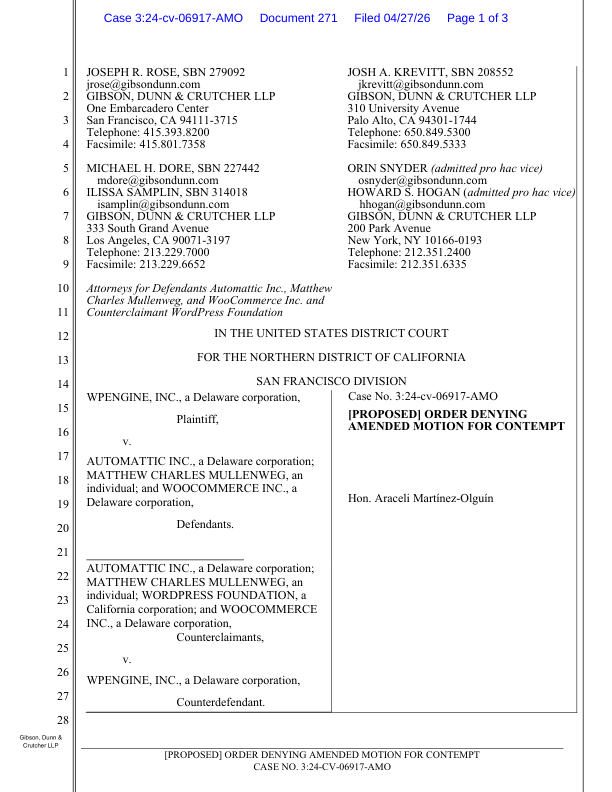
🔗 **Source:** [Proposed Order Denying Amended Motion for Contempt](https://readwise.io/reader/document_raw_content/449370025)
> [!note]+ Document Notes
> ```yaml
> tags: [law, federal-court, wordpress-legal]
> author: [MISSING]
> source: [MISSING]
> reference: [https://readwise.io/reader/document_raw_content/449370025]
> date created: 2026-04-29 10:00
>
> ---
>
> # 🏷️ Title: Proposed Order Denying Amended Motion For Contempt
> ```
>
<!-- deep-read:sections start -->
## 🧭 Table of Contents
- [📝 Summary](#-summary)
- [📖 Main Content](#-main-content)
- [🗒️ Notes](#️-notes)
- [📚 References](#-references)
- [🗣️ Paraphrase](#️-paraphrase)
- [📰 Newsletter](#-newsletter)
- [✅ Action Items](#-action-items)
- [🧪 Hypotheses](#-hypotheses)
- [📊 Methodology](#-methodology)
- [❓ Questions](#-questions)
- [🔮 Future Research](#-future-research)
- [💡 Implications](#-implications)
- [🧠 Learning Styles Assessment](#-learning-styles-assessment)
- [📊 Accessibility Assessment](#-accessibility-assessment)
- [🌍 DEIB Assessment](#-deib-assessment)
- [✅ Logical Validity](#-logical-validity)
- [🛡️ DARVO Analysis](#-darvo-analysis)
- [🎯 Conclusion](#-conclusion)
### 🔗 References
- Include links cited in or relevant to the article.
## 📝 Summary
- A non-party, Michael Willman, filed an amended motion to hold Automattic Inc. and Matt Mullenweg in contempt of a preliminary injunction.
- The court finds he lacks standing and, even if he had it, fails to show any violation—civil or criminal.
- Stakeholders: Willman, Automattic/WordPress.org, the original parties, the court.
- Risks: overbroad use of contempt against platform security operations.
- Bottom line: contempt is denied.
## 📖 Main Content
- The order holds that Rule 71 limits contempt standing to non-parties explicitly granted relief; Willman is not an intended beneficiary.
- Even assuming standing, he does not show by clear and convincing evidence that Automattic or Mullenweg violated the preliminary injunction or failed to substantially comply in good faith.
- The injunction expressly allows wordpress.org to maintain “security and operability” under existing policies, which the court finds were followed.
- For criminal contempt, Willman does not meet Federal Rule of Criminal Procedure 42’s procedural requirements and offers no proof beyond a reasonable doubt of willful disobedience.
### 🗒️ Notes
- Amended motion brought by non-party Michael Willman under Federal Rule of Civil Procedure 71.
- Court finds Rule 71 applies only when a non-party is specifically identified as a beneficiary or granted relief; Willman is neither.
- Civil contempt standard: clear and convincing evidence of violation plus lack of substantial, good-faith compliance.
- Court finds no evidence Automattic or Mullenweg exceeded the preliminary injunction.
- Injunction text preserves wordpress.org’s ability to ensure site “security and operability” under policies in place as of September 20, 2024.
- Court concludes Automattic’s actions fit within those policies and procedures.
- Criminal contempt: must comply with Fed. R. Crim. P. 42 (notice, procedures, due process), which Willman’s filing does not.
- Criminal contempt also requires willful disobedience proved beyond a reasonable doubt; record does not support this.
- Result: proposed order denies the amended motion for contempt in full.
## 📚 References
- Federal Rule of Civil Procedure 71
- Federal Rule of Criminal Procedure 42
- DBD Credit Funding LLC v. Silicon Labs, Inc., 2016 WL 6893882 (N.D. Cal. 2016)
- SunEarth, Inc. v. Sun Earth Solar Power Co., 2015 WL 13719574 (N.D. Cal. 2015)
- Clemente v. United States, 766 F.2d 1358 (9th Cir. 1985)
## 🗣️ Paraphrase
- The court rules that a non-party cannot invoke contempt unless the injunction clearly grants that non-party rights or relief, which it does not for Willman.
- Independently, the court finds no persuasive evidence that Automattic or Mullenweg violated the injunction, and Willman’s attempt to frame the conduct as criminal contempt fails both procedurally and on the merits.
## 📰 Newsletter
Today’s court filing underscores how platform governance and legal process intersect for the WordPress ecosystem. A non-party’s contempt motion against Automattic over a preliminary injunction failed on standing and proof, with the judge reaffirming wordpress.org’s latitude to protect “security and operability” under existing policies. For WordPress builders and hosts, it’s a reminder to keep governance docs, security policies, and legal review tightly aligned as your plugins, themes, and services scale.
## ✅ Action Items
#### DevRel
- Clarify for developers how wordpress.org security and operability policies interact with court orders and injunctions.
- Prepare a brief guide on how legal process (subpoenas, injunctions, contempt) can affect plugins and hosting environments.
- Add FAQs or docs explaining Automattic’s approach to compliance and good-faith interpretation of court orders.
- Consider a webinar or office hours session on “Legal basics for WordPress developers.”
#### OSPO
- Document procedures for responding to court orders that touch open-source infrastructure or contributor content.
- Ensure legal review paths and escalation playbooks exist for potential injunctions affecting project operations.
- Track case law where open-source platforms’ security policies are tested against injunctions.
#### Community
- Share a neutral summary of the order to reduce misinformation.
- Encourage maintainers to align project policies with host platform security and legal requirements.
- Offer guidance on when community members are, and are not, intended beneficiaries of court orders.
#### WordPress
- Core: Align any security-affecting changes with clearly published policies to ease future legal scrutiny.
- Core Performance: Consider documenting how performance-related mitigations might intersect with enforcement or moderation.
- Core AI: Build in auditability so actions triggered by AI systems can be defended as reasonable and good-faith.
- Core Program Team: Maintain up-to-date documentation for wordpress.org “security and operability” procedures.
- Community: Provide legal-literacy sessions at meetups and WordCamps.
- Training: Add a module on “Legal context of open-source platforms.”
- Marketing: Communicate platform safety measures without overstating legal protections.
- Support: Prepare support scripts for questions about account actions taken under security policies.
- Documentation: Clarify terms-of-service language that reflects the latitude affirmed by the court.
- Accessibility / Meta / CLI / other teams: ensure any enforcement-related tooling has logs suitable for legal review.
#### The WPOCC
- Track this and similar cases as precedents for how courts view community vs. corporate responsibilities.
- Explore microgrants for legal-education content for maintainers.
- Consider templates for governance charters that reference legal-compliance expectations.
### FAIR
- Emphasize independence of governance documents from any single sponsor while remaining legally robust.
- Consider model covenants describing how injunctions affecting shared infrastructure are handled.
- Provide reusable charters and operator agreements that anticipate legal process.
## 🧪 Hypotheses
- H1: Courts will narrowly construe non-party standing to seek contempt under Rule 71.
- H2: Explicit carveouts for “security and operability” in injunctions reduce successful contempt claims against platforms.
- H3: Failure to comply with Rule 42 procedures will doom most private attempts at criminal contempt.
- H4: Clear written policies at the time of an injunction materially aid a platform’s defense against contempt motions.
### 📊 Methodology
- Conduct a case-law review of federal decisions citing Rule 71 and standing of non-parties in contempt.
- Analyze injunctions involving major platforms for “security and operability” or similar carveouts, then track subsequent contempt outcomes.
- Review criminal-contempt cases dismissed for Rule 42 noncompliance.
- Interview platform counsel on the role of pre-existing written policies in litigation.
### ❓ Questions
- Under what conditions, if any, can a platform user be an “intended beneficiary” of an injunction against a platform?
- How specific must “security and operability” exceptions be to protect good-faith enforcement?
- Should there be clearer statutory guidance on non-party contempt standing in platform contexts?
### 🔮 Future Research
- Comparative analysis of how different circuits treat non-party attempts at contempt.
- Empirical study of injunction drafting patterns in tech/platform litigation.
- Best-practice frameworks for open-source infrastructure responding to court orders.
### 💡 Implications
- Practice: Platforms should maintain and publish stable, documented security policies to show good-faith compliance.
- Policy: Courts may continue to respect operational carveouts in injunctions when reasonably framed.
- Security: Legal clarity supports decisive action to protect users and infrastructure.
- Education: Developers and community leaders benefit from basic training in civil and criminal contempt standards.
- Funding: Legal-readiness could become a criterion for funding shared infrastructure.
### 🧠 Learning Styles Assessment
- Reading level: roughly 11th–12th grade (legal-technical; approximate Flesch-Kincaid based on complex sentences and citations).
#### 👀 Visual learners
- Present: Legal structure is clear but text-only.
- Improve: Flowcharts of contempt standards (civil vs. criminal), diagrams of parties and standing.
#### 🔊 Aural learners
- Present: None.
- Improve: Short audio summary of the order and its holdings.
#### 🗣️ Verbal learners
- Present: Defined references to rules and cases, formal legal reasoning.
- Improve: More analogies (“locksmith” or “gatekeeper” metaphors for platform roles).
#### 🧩 Kinesthetic learners
- Present: None.
- Improve: Step-by-step exercise: “Walk through whether you’d have standing in this scenario.”
#### 🧠 Logical learners
- Present: Strong, structured legal argument; clear standards and conclusions.
- Improve: Tables contrasting requirements for Rule 71 standing and Rule 42 compliance.
#### 🧑🤝🧑 Social learners
- Present: Implied relationships among parties (non-party vs. defendants vs. court).
- Improve: Discussion prompts for study groups on platform responsibility and user rights.
#### 🧘♀️ Solitary learners
- Present: Dense text suitable for close reading.
- Improve: Reflection questions at the end (“How would you draft an injunction here?”).
#### 🌿 Naturalistic learners
- Present: None.
- Improve: Analogies to ecosystem governance (platform as habitat steward, users as species).
### 📊 Accessibility Assessment
#### Screen reader semantics
- Present: PDF likely has minimal tagging.
- Improve: Add logical headings and tags for sections, ensure case citations have readable text.
#### Keyboard navigation
- Present: Dependent on PDF viewer; document itself is static.
- Improve: Tagged PDF with navigable headings and bookmarks.
#### Contrast and readability
- Present: Standard court formatting; adequate contrast.
- Improve: Slightly larger line spacing and font size in digital versions.
#### Text resizing and reflow
- Present: Standard PDF; reflow depends on reader.
- Improve: Provide HTML version for better reflow and zoom.
#### Media and captions
- Present: None needed (text only).
- Improve: Optional audio narration with transcript.
#### Forms and interactions
- Present: None.
- Improve: N/A.
#### Standards reference
- Map improvements to WCAG 2.2 AA for documents (1.3.1 Info and Relationships, 1.4.4 Resize text, 2.4.6 Headings and Labels).
### 🌍 DEIB Assessment
#### Cultural breadth
- Present: U.S. federal legal context only.
- Improve: Brief notes acknowledging jurisdiction-specific nature and global implications for open-source platforms.
#### Inclusive language
- Present: Neutral legal language.
- Improve: Occasional plain-language summaries to broaden accessibility.
#### Neurodiversity support
- Present: Structured, but dense.
- Improve: More headings, summaries, and bullet lists to break up complexity.
#### Representation
- Present: Purely institutional; no individuals’ identities discussed.
- Improve: N/A for a short procedural order.
#### Psychological safety
- Present: Non-emotional, procedural tone.
- Improve: Clear explanations of what contempt is and is not, to avoid chilling community participation.
### ✅ Logical Validity
#### Strong reasoning
- The court’s syllogism on Rule 71 standing (beneficiary requirement → Willman not beneficiary → no standing) is a straightforward, valid application of precedent.
- The civil contempt analysis logically ties standard (“clear and convincing evidence” and substantial compliance) to the factual record, finding no evidence of violation.
- Criminal contempt reasoning correctly couples procedural (Rule 42) and substantive (willful disobedience beyond reasonable doubt) requirements.
#### Fallacies
- None apparent; the order is concise and closely tracks established standards.
#### Tone of voice
- Formal, restrained, and authoritative; cites rules and cases without rhetorical flourish or emotive language.
### 🛡️ DARVO Analysis
- Deny: The court implicitly rejects the claim that Automattic/Mullenweg violated the injunction by finding no supporting evidence.
- Attack: No personal attacks; criticisms are directed at legal insufficiencies (standing, evidence, procedure).
- Reverse victim/offender: No attempt by the court to recast defendants as victims; analysis remains focused on legal standards.
## 🎯 Conclusion
- The proposed order denies Michael Willman’s amended motion for contempt because he lacks standing under Rule 71, fails to prove any civil contempt, and does not meet the procedural or substantive requirements for criminal contempt. For readers working around WordPress and open-source platforms, the practical takeaway is to maintain clear, documented security and operability policies that can be shown to align with any court-ordered constraints.
## 🧱 Refactor Appendix (append after 🎯 Conclusion)
### 📚 Literature Split Pad
- Purpose: Stage Konik CEE units that become per-source Literature notes.
- Split level: **H3**.
- Include verbatim quotes under 25 words and a [view highlight] link.
### [H1] 5–10-word present-tense claim
> [!quote] [Proposed Order Denying Amended Motion For Contempt](https://readwise.io/reader/document_raw_content/449370025) by an unnamed author via an unnamed author. Published 2026-04-27.
> “Mr. Willman lacks standing to bring a contempt motion pursuant to Rule 71.”
Two lines: context and use. Cite data if relevant.
[view highlight](https://readwise.io/reader/document_raw_content/449370025#H1) #xref #articleseed ID:rw_[MISSING]
### [H2] 5–10-word present-tense claim
> [!quote] [Proposed Order Denying Amended Motion For Contempt](https://readwise.io/reader/document_raw_content/449370025)
> “Mr. Willman fails to demonstrate that Defendants violated the Preliminary Injunction.”
Two lines: context and use.
[view highlight](https://readwise.io/reader/document_raw_content/449370025#H2) #xref ID:rw_[MISSING]
---
### 🔖 Atomic Split Pad (Zettel Candidates)
- Purpose: Promote reusable claims into Atomic notes.
- Split level: **H4**.
- Each item: one idea, present tense, specific, testable.
#### [Z1] Non-parties need clear beneficiary status for contempt
- Applies when a non-party seeks to enforce an injunction under Rule 71.
- Pointer: Willman order; Rule 71 discussion.
- Links: [[Civil-Procedure]] [[Standing]]
#### [Z2] Operational carveouts help platforms resist contempt
- Applies where injunctions preserve “security and operability” under existing policies.
- Pointer: Willman order; injunction language analysis.
- Links: [[Platform-Governance]] [[Injunction-Drafting]]
---
### ✏️ Fleeting Queue (Extract by Selection)
- Purpose: Capture quick actions or sparks for Fleeting notes.
- Extraction: **Select one line** → “Refactor: Extract selection to new note (content only).”
- Keep each line short and self-contained.
- [F1] Summarize Rule 71 standing limits using this case as example — context/https://readwise.io/reader/document_raw_content/449370025 #fleeting #inbox
- [F2] Draft a diagram of civil vs. criminal contempt standards — context/https://readwise.io/reader/document_raw_content/449370025 #fleeting #inbox
- [F3] Create WordPress community explainer on injunction carveouts — context/https://readwise.io/reader/document_raw_content/449370025 #fleeting #inbox
---
<!-- deep-read:sections end -->
📄 **Full text:** ![[Full Document Contents/Articles/Proposed Order Denying Amended Motion for Contempt.md|Proposed Order Denying Amended Motion for Contempt by Joseph R. Rose, Michael H. Dore, Ilissa S. Samplin, Josh A. Krevitt, Orin Snyder, Howard S. Hogan]]
## Highlights
- Mr. Willman lacks standing to bring a contempt motion pursuant to Rule 71 because he is not an intended beneficiary of the Preliminary Injunction ([View Highlight](https://read.readwise.io/read/01kqcxvyrfx67b2gr3jm8wc33e))
- The Preliminary Injunction “does not preclude wordpress.org’s ability to ensure the security and operability of its site consistent with procedures and policies in place as of September 20, 2024,” Dkt. 64, at 41, and Mr. Willman has not demonstrated that Defendants’ actions were inconsistent with such procedures and policies. ([View Highlight](https://read.readwise.io/read/01kqcxy6kp45ftqr1gkna8j8rc))