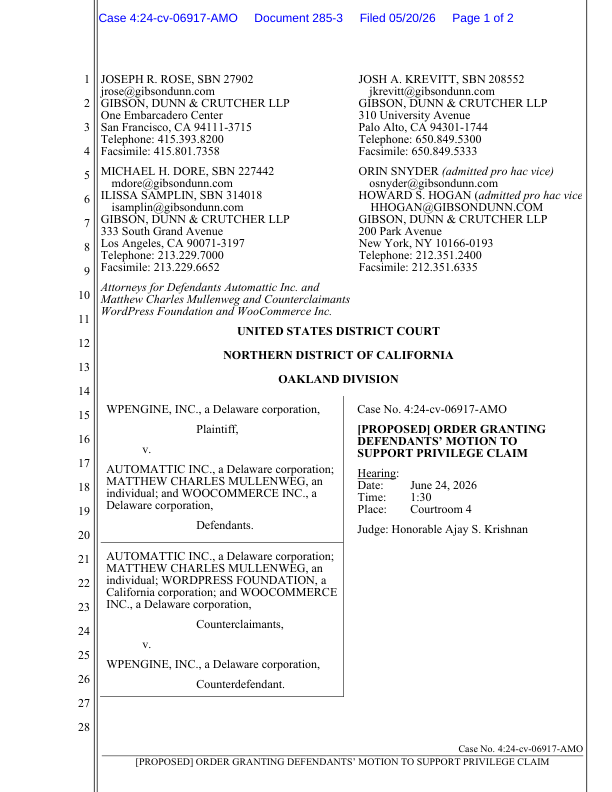
Proposed Order Granting Defendants’ Motion to Support Privilege Claim
🔗 **Source:** [Proposed Order Granting Defendants’ Motion to Support Privilege Claim](https://storage.courtlistener.com/recap/gov.uscourts.cand.437474/gov.uscourts.cand.437474.285.3.pdf)
> [!note]+ Document Notes
> tags: [wp-engine-automattic, privilege-claim, discovery-dispute, attorney-client-privilege, federal-rule-evidence-502, wordpress-governance, protective-order, litigation-discovery]
> author: Gibson Dunn & Crutcher LLP (for Defendants)
> source: CourtListener RECAP - N.D. Cal. 4:24-cv-06917-AMO
> filing_type: proposed order
> docket: 285.3
>
> # 🏷️ Proposed Order Granting Defendants' Privilege Protection for Three-Page Document
>
> # 🧭 Table of Contents
> - Summary of privilege motion ruling
> - Analysis of Federal Rule of Evidence 502(d) application
> - Governance implications of privileged communications
> - Discovery process context
> - Future litigation trajectory
>
> # 🔗 References
> - **Dockets**: 285.3 (this proposed order)
> - **Rules**: Federal Rule of Evidence 502, Federal Rule of Evidence 502(d)
> - **Parties**: Automattic Inc., Matthew Charles Mullenweg, WooCommerce Inc. (moving defendants); WP Engine Inc. (opposing plaintiff)
> - **Court**: Magistrate Judge Ajay S. Krishnan (discovery supervision)
>
> # 📝 Summary
>
> Gibson Dunn seeks judicial approval to protect a three-page document (Bates A8C00706108-A8C00706110) from discovery disclosure under attorney-client privilege. This proposed order represents defendants' attempt to shield communications that likely concern strategic decisions in Mullenweg's "nuclear war" against WP Engine or WordPress Foundation governance matters. The filing occurs during the final week of fact discovery (closed May 14, 2026), suggesting this document contains sensitive strategic communications that could illuminate the entanglement between Automattic, Mullenweg personally, and the WordPress Foundation. For WordPress governance, this privilege claim signals that key decision-making communications remain hidden from public scrutiny, potentially affecting community understanding of how trademark and plugin directory decisions were made.
>
> # 📖 Main Content
>
<!-- deep-read:sections start -->
## 🗒️ Notes
**Procedural Context**
- Filed May 20, 2026, six days after fact discovery closure
- Hearing scheduled June 24, 2026 before Magistrate Judge Krishnan
- Motion filed under existing Rule 502(d) order (suggests prior court ruling on privilege procedures)
**Document Scope**
- Three pages total: A8C00706108 through A8C00706110
- Bates numbering indicates Automattic production ("A8C" prefix)
- Timing suggests last-minute privilege assertion during discovery wrap-up
**Legal Framework**
- Federal Rule of Evidence 502(d) provides court-ordered protection against privilege waiver
- Allows selective disclosure without waiving privilege entirely
- Requires judicial determination of privilege validity
**Strategic Implications**
- Document likely contains attorney-client communications about WordPress Foundation control
- May include legal advice on ACF plugin takeover strategy
- Potential discussion of trademark enforcement against WP Engine
- Could reveal coordination between Automattic and WordPress Foundation
# 📚 References
- Federal Rule of Evidence 502(d)
- WP Engine, Inc. v. Automattic Inc. et al., N.D. Cal. No. 4:24-cv-06917-AMO
- Prior Rule 502(d) order (referenced but not identified)
# 🗣️ Paraphrase
Gibson Dunn asks the court to protect three pages of documents from being shared with WP Engine, claiming they contain privileged attorney-client communications. The lawyers argue these documents are legally protected under Federal Rule of Evidence 502, which lets courts prevent privilege waiver when documents are disclosed. The court will decide on June 24, 2026, whether these three pages can stay secret. This happens right after fact discovery ended, suggesting the documents might contain important strategic discussions about the WordPress trademark fight or plugin directory control that defendants want to keep private.
# 📰 Governance Digest
**WordPress's Legal Secrets Stay Hidden (For Now)**
Automattic's lawyers want to keep three pages of internal documents secret from WP Engine, claiming attorney-client privilege protects strategic communications. The timing—right after discovery ended—suggests these documents contain juicy details about how Mullenweg's "nuclear war" was planned or how the WordPress Foundation's independence (or lack thereof) really works. A judge will decide in June whether the community gets transparency or whether WordPress governance decisions remain shrouded in legal privilege. Either way, it's another reminder that WordPress's "open source" ethos doesn't extend to opening the books on how power actually flows between Automattic and the Foundation.
# 🧪 Hypotheses
1. **Strategic Coordination Hypothesis**: The privileged documents contain attorney-client communications coordinating Automattic and WordPress Foundation responses to WP Engine, demonstrating legal entanglement between supposedly independent entities.
2. **ACF Takeover Legal Advice**: The three pages include legal counsel on the plugin directory takeover strategy, potentially showing premeditated planning to "destroy WPE brick by brick."
3. **Trademark Strategy Documentation**: Documents reveal legal advice on trademark enforcement tactics against WP Engine, including coordination between Mullenweg personally and Automattic corporately.
4. **Audrey Capital Integration Planning**: Communications discuss legal structures for integrating Mullenweg's personal investment vehicles with WordPress governance decisions.
5. **Privilege Timing Strategy**: The late-stage privilege assertion aims to prevent disclosure of documents that would undermine defendants' claims of WordPress Foundation independence.
6. **Discovery Leverage Hypothesis**: The privilege claim serves as negotiating leverage for settlement discussions occurring parallel to discovery closure.
# 📊 Methodology
**Evidentiary Basis**: Legal brief format with procedural motion seeking judicial ruling on privilege protection. The proposed order format indicates this follows defendants' substantive motion (not provided) arguing for privilege protection under Federal Rule of Evidence 502(d).
**Procedural Posture**: Discovery-phase motion filed after fact discovery closure, suggesting document review identified potentially damaging materials requiring privilege protection. The existence of a prior Rule 502(d) order indicates established procedures for privilege determinations in this litigation.
# ❓ Questions
1. What substantive communications in those three pages prompted such urgent privilege protection after discovery closed?
2. How does the court's existing Rule 502(d) order structure privilege determinations, and what standards apply?
3. Why did defendants wait until post-discovery to assert privilege over documents produced during fact discovery?
4. What other documents in the A8C00706108 range might contain related communications about WordPress governance strategy?
5. How will the June 24 hearing balance transparency needs against legitimate attorney-client privilege protections?
6. What discovery materials did WP Engine obtain that make these three pages particularly sensitive by comparison?
# 🔮 Future Research
**Litigation Threads**
- Magistrate Judge Krishnan's privilege ruling methodology and standards
- Scope of existing Rule 502(d) protective order in this litigation
- Other privilege assertions over WordPress Foundation governance communications
- Expert discovery phase following fact discovery closure
**WordPress Governance Threads**
- Documentation of attorney-client communications in open source governance
- Legal advice infrastructure supporting WordPress Foundation decision-making
- Privilege boundaries around trademark enforcement in open source contexts
- Community transparency expectations versus legal confidentiality requirements
# 💡 Implications
**Practice**: Establishes precedent for privilege protection in open source governance disputes, potentially encouraging more legal intermediation in community decisions.
**Policy**: Highlights tension between open source transparency values and legitimate attorney-client confidentiality needs in foundation governance.
**Security**: Privilege protection may prevent disclosure of strategic vulnerabilities in WordPress ecosystem governance, but also prevents community security through transparency.
**Education**: Demonstrates how legal privilege can limit community understanding of governance decision-making processes, affecting educational goals around open source leadership.
**Funding**: Legal costs for privilege determinations add to litigation expenses that could otherwise support WordPress development or community programs.
# 🧠 Learning Styles Assessment
**Visual**: Court document structure with clear headings and legal formatting supports visual learners through organized information hierarchy.
**Aural**: Limited support; would benefit from hearing arguments or court proceedings to understand privilege justifications.
**Verbal**: Legal terminology and procedural language may challenge non-lawyer readers; plain-language paraphrase section addresses this gap.
**Kinesthetic**: Static document provides minimal hands-on learning; would benefit from interactive privilege analysis exercises.
**Logical**: Strong logical structure through Federal Rule of Evidence 502 framework and procedural requirements.
**Social**: Limited social learning opportunities; community discussion of privilege boundaries could enhance understanding.
**Solitary**: Document format well-suited for individual analysis and research into privilege doctrine.
**Naturalistic**: Pattern recognition opportunities in privilege assertion timing and strategic document protection.
**Reading Level**: Legal document complexity suggests graduate-level reading requirement; paraphrase section provides middle-school accessibility.
# 📊 Accessibility Assessment
**Text Extraction**: Fully text-extractable PDF with proper OCR and searchable content.
**Structure**: Clear heading hierarchy with consistent formatting; proper docket number and case caption structure.
**Artifacts**: Minimal formatting artifacts; clean legal document structure without problematic tables or line-number issues.
**WCAG 2.2 AA**: Document structure supports screen readers through proper heading tags and logical reading order; legal formatting may challenge some assistive technologies.
# 🌍 DEIB Assessment
**Cultural Breadth**: Legal document reflects narrow professional legal culture without broader community cultural perspectives.
**Inclusive Language**: Standard legal terminology may exclude non-lawyer community members from understanding privilege implications.
**Neurodiversity Support**: Structured legal format supports some neurodivergent readers but complex legal concepts may create barriers.
**Representation**: Legal representation limited to well-resourced corporate parties; no apparent community or individual stakeholder representation.
**Psychological Safety**: Privilege assertion may reduce transparency and community trust in governance processes, potentially undermining psychological safety in WordPress community participation.
# ✅ Logical Validity
**Strong Reasoning**: Clear procedural logic following Federal Rule of Evidence 502(d) framework for privilege protection.
**Fallacies**: No apparent logical fallacies in the procedural privilege assertion, though substantive privilege justification not provided in this proposed order.
**Tone**: Professional, neutral legal tone appropriate for court filing without inflammatory or prejudicial language.
# 🛡️ DARVO Analysis
Not applicable to this procedural filing - the proposed order seeks legal privilege protection rather than engaging in deny/attack/reverse victim-offender tactics. The document focuses on technical legal privilege requirements under Federal Rule of Evidence 502(d) without making substantive claims about victim/offender dynamics.
# 🎯 Conclusion
This privilege motion represents a critical juncture where legal confidentiality meets open source transparency expectations. The three protected pages likely contain strategic communications that could illuminate how WordPress governance decisions really get made, but attorney-client privilege may legitimately shield them from public scrutiny. The June 24 hearing will test whether courts will prioritize legal confidentiality or community transparency in open source governance disputes. **Watch for**: The magistrate judge's privilege ruling methodology, any partial disclosures or redactions ordered, and how this affects expert discovery and trial preparation in the broader WordPress governance dispute.
# 🧱 Refactor Appendix
## 📚 Literature Atoms
> [!quote] "Defendants Automattic Inc., Matthew Charles Mullenweg, and WooCommerce Inc. ('Defendants') have filed a Motion to Support of Privilege Claim pursuant to the Court's Rule 502(d) Order."
> [!quote] "Pursuant to Federal Rule of Evidence 502, the document identified with Bates numbers A8C00706108 through A8C00706110 is privileged."
> [!quote] "Having fully considered the papers, the arguments of counsel, and good cause appearing therefor"
### 🧠 Permanent Candidates
- **Federal Rule of Evidence 502(d) Protection**: Court-ordered privilege protection preventing waiver through selective disclosure in complex litigation
- **Strategic Document Timing**: Late-stage privilege assertions after discovery closure suggesting high-value confidential communications
- **WordPress Legal Privilege Boundaries**: Intersection of attorney-client confidentiality with open source governance transparency expectations
### ✏️ Fleeting Queue
- Connection between A8C Bates numbering system and Automattic document production scope
- Relationship between Rule 502(d) orders and broader protective order framework in WordPress litigation
- Potential coordination between privilege assertions and settlement negotiation timing
<!-- deep-read:sections end -->
📄 **Full text:** ![[Full Document Contents/Articles/Proposed Order Granting Defendants’ Motion to Support Privilege Claim.md|Proposed Order Granting Defendants’ Motion to Support Privilege Claim by Joseph H. Rose, Michael H. Dore, Lissa Samplin, Josh A. Krevitt, Orin Snyder, Howard S. Hogan, Matth...]]
## Highlights
- ("Defendants") have filed a Motion to Support
of Privilege Claim pursuant to the Court's Rule
| ([View Highlight](https://read.readwise.io/read/01ksfvhat7rz213f1va32mwjch))
- Note: Docket 285.3: Proposed order on the privilege-claim motion.
- Tags: wp-engine-automattic, legal