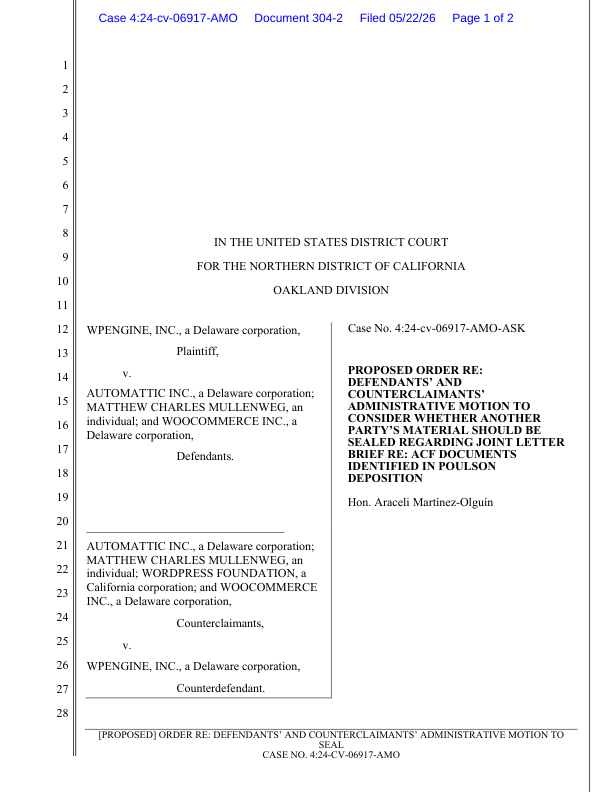
Proposed Order Re: Defendants' and Counterclaimants' Administrative Motion to Seal
🔗 **Source:** [Proposed Order Re: Defendants' and Counterclaimants' Administrative Motion to Seal](https://storage.courtlistener.com/recap/gov.uscourts.cand.437474/gov.uscourts.cand.437474.304.2.pdf)
> [!note]+ Document Notes
> tags: [wp-engine-automattic, discovery-dispute, sealing-motion, acf-plugin, deposition-testimony, poulson-deposition, wordpress-governance, protective-order]
> author: Defendants and Counterclaimants (Automattic Inc., Matthew Charles Mullenweg, WordPress Foundation, WooCommerce Inc.)
> source: CourtListener RECAP - N.D. Cal. 4:24-cv-06917-AMO
> filing_type: proposed order
> docket: 304.2
>
> # 🏷️ Proposed Sealing Order for ACF-Related Discovery Materials
>
> # 🧭 Table of Contents
> - [References](#-references)
> - [Summary](#-summary)
> - [Main Content](#-main-content)
> - [Governance Digest](#-governance-digest)
> - [Hypotheses](#-hypotheses)
> - [Questions](#-questions)
> - [Future Research](#-future-research)
> - [Implications](#-implications)
> - [Conclusion](#-conclusion)
>
> # 🔗 References
> - **Dockets**: 304.2 (this filing), Rule 30(b)(6) deposition of Iain Poulson (April 10, 2026)
> - **Federal Rules**: Rule 30(b)(6) (corporate depositions)
> - **Local Rules**: N.D. Cal. sealing procedures
> - **Key Documents**: Joint Letter Brief, Declaration of Ilissa Samplin, Declaration of Kaitlin Keohane
>
> # 📝 Summary
> This proposed order addresses Automattic's administrative motion to seal portions of discovery materials related to the Advanced Custom Fields (ACF) plugin dispute. The motion seeks partial sealing of briefing materials and full sealing of exhibits stemming from Iain Poulson's Rule 30(b)(6) deposition on April 10, 2026. Poulson appears connected to ACF development, making his testimony central to understanding Automattic's takeover of the plugin. The sealing request places WP Engine as the party bearing the burden to justify public access, creating a procedural hurdle for transparency in this governance dispute affecting the entire WordPress ecosystem.
>
> # 📖 Main Content
>
<!-- deep-read:sections start -->
## 🗒️ Notes
**Procedural Framework**
- Administrative motion filed by all WordPress-affiliated defendants (Automattic, Mullenweg, WordPress Foundation, WooCommerce)
- Targets materials from Iain Poulson's April 10, 2026 Rule 30(b)(6) corporate representative deposition
- Discovery phase context: fact discovery closed May 14, 2026, indicating this deposition occurred near the deadline
**Sealing Scope and Burden Allocation**
- Joint Letter Brief: Partial sealing requested, WP Engine bears burden to substantiate public access need
- Declaration of Ilissa Samplin (supporting WordPress parties): Partial sealing requested
- Exhibit 1 to Samplin Declaration: Full sealing requested
- Exhibit 1 to Kaitlin Keohane Declaration (supporting WP Engine): Full sealing requested
**Strategic Implications**
- WordPress-affiliated parties control the sealing motion despite WP Engine bearing the burden of justification
- Poulson's deposition appears central to ACF-related claims, suggesting significant revelations about the plugin takeover
- Timing near discovery deadline indicates potential urgency or strategic positioning
# 📚 References
- Case 4:24-cv-06917-AMO (N.D. Cal.)
- Federal Rule of Civil Procedure 30(b)(6)
- Declaration of Ilissa Samplin in Support of Administrative Motion
- Declaration of Kaitlin Keohane in Support of WP Engine
# 🗣️ Paraphrase
Automattic and its co-defendants want to keep parts of their legal filings secret, specifically materials that came up during a deposition of someone named Iain Poulson about the ACF plugin controversy. They're asking the court to seal both partial sections of their legal briefs and entire exhibits, while making WP Engine argue why these materials should be public. The proposed order would grant these sealing requests, effectively hiding potentially important details about how WordPress's governing entities handled the ACF plugin takeover from public scrutiny.
# 📰 Governance Digest
**The WordPress Foundation and Automattic want to hide ACF plugin details from the public eye.** Court documents reveal that testimony from Iain Poulson (likely connected to ACF development) triggered a rush to seal discovery materials just days before the fact-finding deadline. While the WordPress community built ACF as an open-source tool, the legal maneuvering around its controversial takeover is heading behind closed doors. The irony is thick: entities that profit from open-source transparency are now arguing for legal opacity when their governance decisions face scrutiny.
# 🧪 Hypotheses
1. **Poulson testimony revealed damaging communications**: The rush to seal materials from his deposition suggests revelations about internal coordination regarding ACF takeover
2. **Financial arrangements exposed**: Full sealing requests for exhibits likely protect sensitive business terms or compensation structures
3. **WordPress Foundation independence questioned**: Coordination between Automattic and Foundation on sealing motion suggests continued governance entanglement
4. **Strategic discovery timing**: Deposition occurring April 10, 2026 (near May 14 deadline) indicates either delayed cooperation or last-minute strategic positioning
5. **Asymmetric burden allocation**: Placing justification burden on WP Engine while WordPress parties control the motion creates procedural advantage
6. **Plugin governance precedent at stake**: ACF case details could establish liability framework for future WordPress.org plugin directory disputes
# 📊 Methodology
This proposed order emerges from administrative motion practice following Rule 30(b)(6) deposition testimony. The filing lacks substantive evidentiary basis as it's purely procedural, seeking sealing determinations rather than presenting factual claims. Declarations from Ilissa Samplin (supporting WordPress parties) and Kaitlin Keohane (supporting WP Engine) presumably provide personal knowledge basis for sealing arguments, though their specific roles and knowledge bases are not detailed in this proposed order format.
# ❓ Questions
1. What is Iain Poulson's specific role in ACF development and why was his corporate representative testimony crucial enough to trigger immediate sealing motions?
2. Why do exhibits from both sides' declarations require full sealing while briefing materials only need partial redaction?
3. How does the WordPress Foundation's participation in this sealing motion align with its claimed independence from Automattic's commercial interests?
4. What governance precedent will this sealing decision establish for transparency in WordPress ecosystem disputes?
5. Does the timing of Poulson's deposition near discovery deadline indicate strategic delay or genuine scheduling constraints?
# 🔮 Future Research
**Litigation Threads**: Monitor whether sealing motion is granted and what redacted materials eventually become public; track Poulson's continued involvement and testimony scope; analyze whether sealed materials leak through other discovery channels or witness testimony.
**WordPress Governance**: Investigate Poulson's historical role in ACF development and relationship to Elliot Condon (ACF's original developer); examine WordPress Foundation's decision-making process for joining sealing motions; assess whether similar sealing strategies emerge in future plugin directory disputes.
# 💡 Implications
**Practice**: Establishes procedural template for sealing WordPress ecosystem disputes, potentially encouraging opacity in future governance conflicts. **Policy**: Tests judicial willingness to balance open-source community transparency interests against traditional commercial litigation privacy. **Security**: Hidden details about plugin takeover mechanisms could obscure security implications of WordPress.org directory control. **Education**: Reduces public information available for community understanding of WordPress governance structures. **Funding**: Concealed financial arrangements may obscure how commercial interests influence ostensibly independent WordPress Foundation decisions.
# 🧠 Learning Styles Assessment
**Visual**: Clean table format presents sealing requests clearly; benefits from document structure headers. **Aural**: Legal terminology may require spoken explanation for comprehension. **Verbal**: Dense legal language suits text-focused learners but may overwhelm others. **Kinesthetic**: Static document provides no hands-on engagement opportunities. **Logical**: Systematic table organization appeals to sequential processors. **Social**: Limited collaborative learning potential from court filing format. **Solitary**: Well-suited for individual analysis and research. **Naturalistic**: Lacks real-world categorization opportunities. **Reading Level**: Graduate/professional level due to legal terminology and procedural complexity.
# 📊 Accessibility Assessment
**Text Extraction**: Fully text-extractable PDF with clear OCR quality. **Structure**: Proper heading hierarchy with numbered sections and clear table formatting. **Artifacts**: Minimal line number interference; standard court filing format maintains readability. **WCAG 2.2 AA**: Table structure supports screen readers; adequate contrast in standard court formatting; logical reading order maintained throughout document.
# 🌍 DEIB Assessment
**Cultural Breadth**: Limited - reflects U.S. federal court procedures without international WordPress community consideration. **Inclusive Language**: Standard legal terminology without exclusionary language, though highly technical. **Neurodiversity Support**: Structured format aids processing for some neurodivergent readers; complex legal language may create barriers for others. **Representation**: Corporate legal actors only; no community voice representation in procedural filing. **Psychological Safety**: Neutral procedural tone, though sealing implications may reduce community trust in governance transparency.
# ✅ Logical Validity
**Strong Reasoning**: Procedural logic follows standard court sealing motion framework appropriately. **Fallacies**: None identified - this is a procedural template rather than argumentative document. **Tone**: Appropriately neutral and professional for court filing; maintains judicial formality without bias indicators.
# 🛡️ DARVO Analysis
Not applicable to this procedural filing - the proposed order template contains no victim-offender dynamics or defensive rhetoric, focusing solely on administrative sealing determinations.
# 🎯 Conclusion
This sealing motion represents a critical transparency test for WordPress governance disputes. While procedurally routine, the motion's targeting of ACF-related testimony suggests Poulson's deposition revealed significant details about plugin takeover mechanisms that WordPress-affiliated entities prefer to keep private. The community should watch whether courts will prioritize traditional litigation privacy or recognize the public interest in transparent governance of open-source infrastructure. **Next Watch**: Magistrate Judge Krishnan's ruling on the sealing motion and any subsequent public disclosure of redacted materials.
# 🧱 Refactor Appendix
## 📚 Literature Atoms
> [!quote] Case Caption Structure
> "WPENGINE, INC., a Delaware corporation, Plaintiff, v. AUTOMATTIC INC., a Delaware corporation; MATTHEW CHARLES MULLENWEG, an individual; and WOOCOMMERCE INC., a Delaware corporation, Defendants."
> [!quote] Counterclaimant Configuration
> "AUTOMATTIC INC., a Delaware corporation; MATTHEW CHARLES MULLENWEG, an individual; WORDPRESS FOUNDATION, a California corporation; and WOOCOMMERCE INC., a Delaware corporation, Counterclaimants"
> [!quote] Sealing Burden Allocation
> "Party with burden to substantiate need to seal: WP Engine" (for all contested materials)
> [!quote] Deposition Timeline
> "April 10, 2026 Rule 30(b)(6) deposition of Iain Poulson" (occurring shortly before May 14, 2026 discovery deadline)
### 🧠 Permanent Candidates
- **Iain Poulson ACF Connection**: Individual whose corporate representative testimony triggered immediate sealing motion
- **WordPress Foundation Sealing Participation**: Foundation's coordination with commercial entities on litigation strategy
- **Discovery Deadline Strategy**: Timing of sensitive depositions near fact discovery closure
- **Asymmetric Sealing Burden**: WP Engine bears justification burden while WordPress parties control motion
## ✏️ Fleeting Queue
- Poulson's relationship to original ACF developer Elliot Condon needs investigation
- WordPress Foundation's litigation coordination may contradict independence claims
- Pattern analysis needed: are other plugin developers being deposed near deadline?
- Sealing motion coordination suggests unified defense strategy despite multiple corporate entities
<!-- deep-read:sections end -->
📄 **Full text:** ![[Full Document Contents/Articles/Proposed Order Re Defendants' and Counterclaimants' Administrative Motion to Seal.md|Proposed Order Re: Defendants' and Counterclaimants' Administrative Motion to Seal by Hon. Araceli Martínez-Olguín]]
## Highlights
- The Court has considered Defendants' and Counterclaimants' Administrative Motion to Consider Whether Another Party's Material Should Be Sealed in connection with the Joint Letter Brief ("Letter Brief") regarding ACF-related documents identified during the April 10, 2026 Rule 30(b)(6) deposition of Iain Poulson [Dkt. \_\_], any Statement filed by WP Engine in connection therewith, and the Declaration of Ilissa Samplin in Support of the Administrative Motion. ([View Highlight](https://read.readwise.io/read/01ksfv9vhscewx05s34s0za5p7))
- Note: Docket 304.2: Proposed order re sealing (ACF documents, Poulson 30(b)(6)).
- Tags: wp-engine-automattic, legal