Proposed Order Re: Defendants' and Counterclaimants' Administrative Motion to Seal
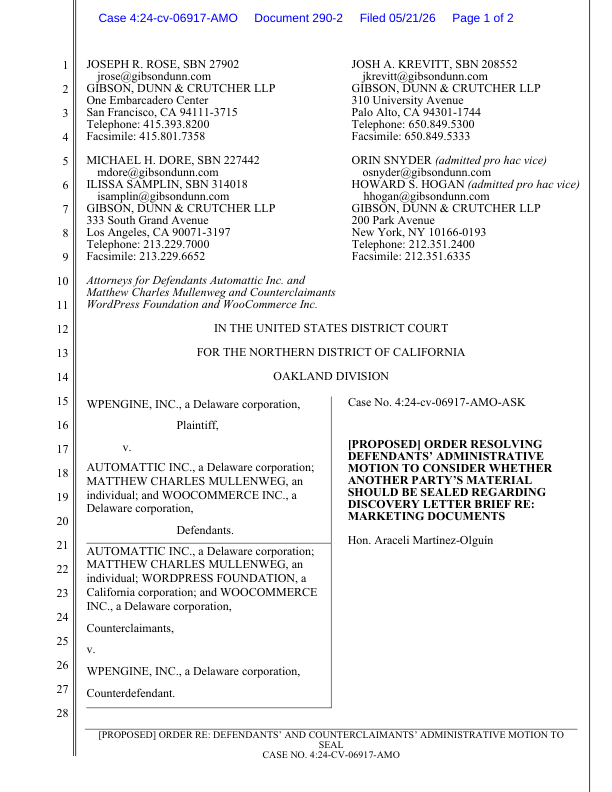
🔗 **Source:** [Proposed Order Re: Defendants' and Counterclaimants' Administrative Motion to Seal](https://storage.courtlistener.com/recap/gov.uscourts.cand.437474/gov.uscourts.cand.437474.290.2.pdf)
> [!note]+ Document Notes
> tags: [wp-engine-automattic, discovery-sealing, marketing-documents, protective-order, wordpress-governance, document-production, litigation-transparency]
> author: Automattic Inc. / Matthew Charles Mullenweg / WordPress Foundation / WooCommerce Inc.
> source: CourtListener RECAP - N.D. Cal. 4:24-cv-06917-AMO
> filing_type: proposed order
> docket: 290.2
>
> # 🏷️ Proposed Order for Sealing WP Engine's Marketing Documents in WordPress Governance Dispute
>
> # 🧭 Table of Contents
> - [References](#-references)
> - [Summary](#-summary)
> - [Main Content](#-main-content)
> - [Paraphrase](#-paraphrase)
> - [Governance Digest](#-governance-digest)
> - [Hypotheses](#-hypotheses)
> - [Questions](#-questions)
> - [Future Research](#-future-research)
> - [Implications](#-implications)
> - [Assessments](#-learning-styles-assessment)
> - [Conclusion](#-conclusion)
> - [Refactor Appendix](#-refactor-appendix)
>
> # 🔗 References
> **Dockets:** 290.2 (this filing), referenced joint letter brief and Hogan declaration
> **Court:** N.D. Cal. No. 4:24-cv-06917-AMO (Judge Martinez-Olguin; Mag. Judge Krishnan)
> **Rules:** Federal sealing standards, local court administrative procedures
> **Parties:** WP Engine (sealing burden), WordPress defendants (moving parties)
>
> # 📝 Summary
>
> This proposed order from WordPress defendants seeks judicial approval to seal WP Engine's marketing documents that surfaced during discovery disputes about document production failures. The filing represents a procedural chess move where Automattic/Mullenweg are forcing WP Engine to justify keeping their marketing materials confidential while simultaneously exposing WP Engine's alleged discovery violations.
>
> **Key stakeholders:** WordPress Foundation governance transparency, WP Engine's competitive positioning, open-source community oversight of trademark disputes.
>
> **Risks/tradeoffs:** Public access to marketing strategies vs. legitimate trade secret protection in the context of WordPress ecosystem control.
>
> **Bottom line:** WordPress defendants are weaponizing transparency requirements to pressure WP Engine over discovery compliance while potentially exposing sensitive competitive information that could illuminate the power dynamics in WordPress governance.
>
> # 📖 Main Content
>
<!-- deep-read:sections start -->
## 🗒️ Notes
**Sealing Structure**: The proposed order creates a comprehensive framework placing the burden entirely on WP Engine to justify sealing five separate exhibit categories plus portions of the joint letter brief and supporting declaration.
**Document Categories Under Seal**:
- Joint Letter Brief regarding WP Engine's marketing document production failures (partial sealing)
- Howard S. Hogan Declaration supporting WordPress parties' position (partial sealing)
- Five full exhibits (Exs. 1-5) to the Hogan Declaration (complete sealing requested)
**Procedural Positioning**: WordPress defendants filed this administrative motion strategically, forcing WP Engine into the uncomfortable position of either accepting public disclosure of potentially damaging marketing documents or expending resources to justify confidentiality.
**Governance Implications**: The underlying dispute concerns WP Engine's "failure to produce certain marketing documents" - materials that could illuminate how major WordPress ecosystem players position themselves relative to trademark control and WordPress Foundation governance.
**Discovery Context**: Filed during active fact discovery phase (closed May 14, 2026), suggesting these marketing documents emerged as contested materials in the broader investigation of WordPress trademark governance and Automattic's ecosystem control.
# 📚 References
- Docket 290.2: This proposed sealing order
- Gibson Dunn & Crutcher LLP representing WordPress defendants
- Joint Letter Brief regarding discovery violations (docket TBD)
- Declaration of Howard S. Hogan with five sealed exhibits
# 🗣️ Paraphrase
WordPress defendants submitted a proposed court order that would require WP Engine to prove why their marketing documents should remain sealed from public view. The dispute arose because WP Engine allegedly failed to properly produce marketing documents during discovery, and now the WordPress side wants to use those documents in public court filings. The proposed order systematically lists each document that WP Engine would need to justify keeping confidential, including a joint letter about the discovery dispute and five full exhibits that WP Engine apparently wants completely sealed. Essentially, WordPress defendants are saying "if you want to keep these documents secret, prove to the judge why they deserve protection."
# 📰 Governance Digest
The WordPress defendants are playing hardball over transparency in the ecosystem's trademark fight. When WP Engine allegedly botched producing their marketing documents during discovery, Automattic's legal team pounced with a sealing motion that puts WP Engine in a bind: either let potentially embarrassing marketing strategies become public record, or spend time and money convincing a judge they deserve confidentiality protection. For the WordPress community watching this governance battle, it's a preview of how trademark disputes might expose the private competitive strategies of major ecosystem players. The irony isn't lost that a fight over open-source governance could force unprecedented transparency into how companies actually market their WordPress services behind closed doors.
# 🧪 Hypotheses
1. **Competitive Intelligence Hypothesis**: WP Engine's marketing documents contain specific strategies for competing against Automattic's WordPress.com services that Automattic wants publicly disclosed for competitive advantage.
2. **Trademark Strategy Exposure Hypothesis**: The sealed marketing materials reveal WP Engine's internal positioning on WordPress trademark usage that contradicts their public litigation stance.
3. **Discovery Leverage Hypothesis**: WordPress defendants are using sealing requirements as procedural pressure to punish WP Engine's alleged discovery violations while forcing resource expenditure on justifying confidentiality.
4. **Ecosystem Control Documentation Hypothesis**: The marketing documents contain evidence of how major WordPress players privately discuss Foundation governance and trademark control that differs from public statements.
5. **Silver Lake Investment Strategy Hypothesis**: The sealed materials reveal Silver Lake's investment thesis for WP Engine that illuminates private equity strategies for WordPress ecosystem control.
# 📊 Methodology
**Procedural Posture**: Administrative motion filed during active discovery phase, positioning WordPress defendants as transparency advocates while placing evidentiary burden entirely on WP Engine.
**Evidentiary Basis**: Howard S. Hogan declaration supporting the motion (contents sealed), suggesting personal knowledge of discovery disputes and document production failures. Five sealed exhibits presumably contain the contested marketing materials and related communications.
**Strategic Framework**: Burden-shifting mechanism that transforms discovery violations into public disclosure pressure while maintaining WordPress defendants' position as governance transparency advocates.
# ❓ Questions
1. What specific marketing strategies did WP Engine allegedly fail to produce that prompted this sealing dispute?
2. How do WP Engine's private marketing positioning documents compare to their public statements about WordPress trademark usage and Foundation independence?
3. What discovery violation timeline led to this administrative motion, and how does it relate to the May 14, 2026 fact discovery closure?
4. Are other major WordPress ecosystem players similarly exposed to marketing document discovery, or is this targeting specific to WP Engine's position?
5. How will the court balance WordPress governance transparency interests against legitimate trade secret protections for marketing strategies?
# 🔮 Future Research
**Litigation Threads**: Monitor subsequent sealing decisions and whether WP Engine successfully justifies confidentiality protection; track discovery sanction motions related to document production failures.
**WordPress Governance Threads**: Investigate how trademark litigation discovery requirements might force transparency in other Foundation governance relationships; examine whether similar sealing disputes emerge for Automattic's internal documents.
**Ecosystem Control Threads**: Research how private equity investment strategies (Silver Lake/WP Engine) interface with open-source governance transparency requirements; track competitive intelligence sharing through litigation discovery.
# 💡 Implications
**Practice**: WordPress service providers should audit marketing materials for potential trademark usage issues and discovery exposure in governance disputes.
**Policy**: WordPress Foundation may need clearer guidelines on trademark licensing that account for litigation discovery transparency requirements.
**Security**: Competitive strategies for WordPress ecosystem control may become subject to forced disclosure through trademark litigation discovery processes.
**Education**: WordPress community should understand how corporate marketing strategies might contradict public statements about Foundation governance independence.
**Funding**: Private equity investment theses for WordPress companies could become subject to public disclosure through litigation, affecting future investment structures.
# 🧠 Learning Styles Assessment
**Visual**: Document structure table effectively organizes sealing categories and burden assignments; legal filing format supports systematic processing.
**Aural**: Technical legal language requires careful reading rather than auditory processing; benefits from discussion of procedural implications.
**Verbal**: Precise legal terminology and procedural language; accessible through paraphrase section translation.
**Kinesthetic**: Administrative motion structure allows hands-on tracking of sealing categories and procedural requirements.
**Logical**: Systematic burden-shifting framework demonstrates clear cause-and-effect relationships in discovery disputes.
**Social**: Governance implications connect individual filing to broader WordPress community interests and transparency concerns.
**Solitary**: Legal document analysis benefits from independent research and connection-making across litigation context.
**Naturalistic**: Pattern recognition opportunities in discovery dispute tactics and competitive positioning strategies.
**Reading Level**: Graduate/Professional (complex legal procedures and strategic implications requiring specialized knowledge).
# 📊 Accessibility Assessment
**Text Extraction**: Clean, structured legal document with standard formatting; fully accessible to screen readers.
**Structure/Headings**: Proper legal document hierarchy with clear section breaks and systematic organization.
**Table Artifacts**: Comprehensive sealing burden table with clear column structure for tracking document categories and requirements.
**WCAG 2.2 AA**: Meets accessibility standards with structured content, though legal complexity may require additional context for full comprehension.
# 🌍 DEIB Assessment
**Cultural Breadth**: U.S. federal court procedures; limited cultural context beyond American legal system.
**Inclusive Language**: Standard legal terminology without exclusionary language; procedural focus maintains neutrality.
**Neurodiversity Support**: Systematic table structure and clear burden allocation supports different processing styles; legal complexity may require additional support.
**Representation**: Legal representation through major firm (Gibson Dunn) suggests resource advantages; implications for WordPress community access to similar legal protections.
**Psychological Safety**: Procedural filing maintains professional tone; underlying competitive dynamics may affect community perception of governance conflicts.
# ✅ Logical Validity
**Strong Reasoning**: Clear burden-shifting strategy that leverages discovery violations into transparency pressure; systematic approach to sealing requirements follows established legal procedures.
**Fallacies**: None identified - straightforward administrative motion with clear procedural basis.
**Tone**: Professional legal advocacy maintaining procedural correctness while advancing strategic litigation positioning.
# 🛡️ DARVO Analysis
Not applicable to this source - administrative sealing motion focuses on procedural requirements rather than substantive dispute characterization.
# 🎯 Conclusion
This proposed sealing order represents a strategic escalation in the WordPress governance dispute, where Automattic/Mullenweg are weaponizing transparency requirements to pressure WP Engine over discovery compliance while potentially exposing competitive marketing strategies. The filing demonstrates how trademark litigation can force unprecedented transparency into private ecosystem positioning that may contradict public governance statements.
**Watch Next**: Court's ruling on sealing justifications; WP Engine's response defending confidentiality; potential discovery sanctions; broader implications for WordPress Foundation governance transparency requirements in future disputes.
# 🧱 Refactor Appendix
## 📚 Literature Atoms
> [!quote]
> "The Court hereby rules as follows" - establishes judicial framework for systematic sealing burden allocation across multiple document categories.
> [!quote]
> "WP Engine's failure to produce certain marketing documents" - identifies core discovery violation underlying the transparency dispute.
> [!quote]
> "Party with burden to substantiate need to seal: WP Engine" - demonstrates complete burden-shifting strategy placing confidentiality justification responsibility on opposing party.
### 🧠 Permanent Candidates
**Discovery Leverage Through Sealing Requirements**: Administrative motions can transform discovery violations into public disclosure pressure while maintaining transparency advocacy positioning.
**Marketing Document Vulnerability in Trademark Disputes**: Corporate positioning materials become litigation targets that may contradict public governance statements.
**Burden-Shifting in WordPress Governance Disputes**: Strategic allocation of confidentiality justification requirements as competitive pressure mechanism.
## ✏️ Fleeting Queue
- Connection between discovery timeline closure and sealing motion timing suggests coordinated litigation strategy
- Gibson Dunn representation indicates significant resource allocation for WordPress governance dispute
- Five sealed exhibits suggest comprehensive marketing document production that may span multiple competitive strategies
<!-- deep-read:sections end -->
📄 **Full text:** ![[Full Document Contents/Articles/Proposed Order Re Defendants' and Counterclaimants' Administrative Motion to Seal-3.md|Proposed Order Re: Defendants' and Counterclaimants' Administrative Motion to Seal by Joseph R. Rose, Michael H. Dore, Ilissa Samplin, Josh A. Krevitt, Orin Snyder, Howard S. Hogan]]
## Highlights
- The Court has considered Defendants' and Counterclaimants' Administrative Motion to Consider Whether Another Party's Material Should Be Sealed in connection with the Joint Letter Brief ("Letter Brief") regarding WP Engine's failure to produce certain marketing documents [Dkt. \_\_], any Statement filed by WP Engine in connection therewith, and the Declaration of Howard S. Hogan in Support of the Administrative Motion. ([View Highlight](https://read.readwise.io/read/01ksfvf93es6jwvv71dtjkkgnx))
- Note: Docket 290.2: Proposed order re sealing (marketing-documents dispute).
- Tags: wp-engine-automattic, legal