SBOM at a Glance
[[3. Resources/Readwise/Full Document Contents/Articles/SBOM at a Glance|Full Document Contents]]
## Document Notes
1. What are some of the key benefits and use cases for implementing a Software Bill of Materials (SBOM)?
2. What are the recommended machine-readable formats and tools for generating and processing SBOMs?
3. How are SBOMs shared and exchanged across the supply chain, and what are some best practices to ensure interoperability?
1. What are the three formats that focus on identifying software entities and conveying associated metadata, and what are some tools available to produce and consume these SBOMs?
A: The three formats that focus on identifying software entities and conveying associated metadata are SPDX, CycloneDX, and SWID. Tools are available to produce, consume, and transform these SBOMs.
2. What is the primary purpose of an SBOM?
A: The primary purpose of an SBOM is to uniquely and unambiguously identify components and their relationships to one another.
3. What is an SBOM and what information does it contain?
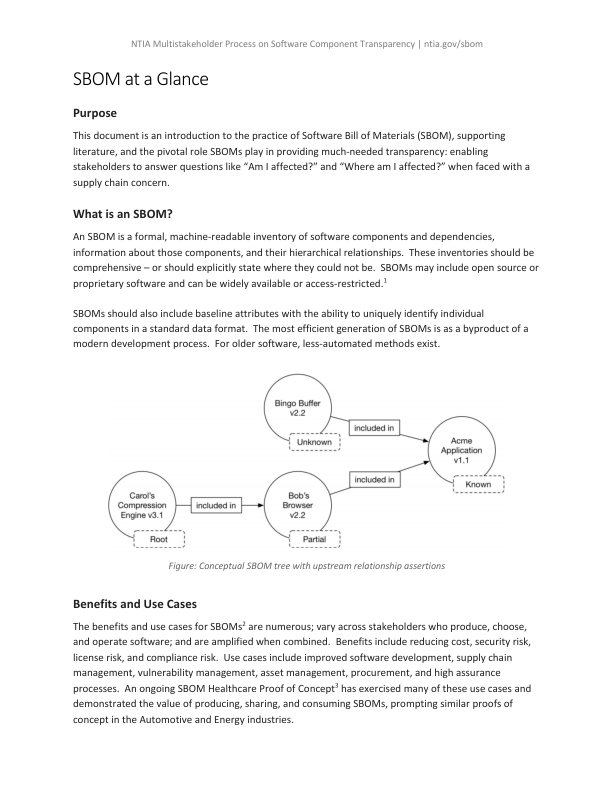
A: An SBOM is a formal, machine-readable inventory of software components and dependencies, information about those components, and their hierarchical relationships.
The Software Bill of Materials (SBOM) is a formal, machine-readable inventory of software components that includes information about those components and their hierarchical relationships. SBOMs are essential for providing transparency in the software supply chain and can include open source or proprietary software. SBOMs can benefit stakeholders by reducing costs, security risks, license risks, and compliance risks while improving software development, supply chain management, vulnerability management, asset management, procurement, and high assurance processes. Interoperability across the supply chain requires standardized data formats and identification schemes. SBOM data can be shared through various technical platforms, data formats, and operational processes. More information can be found at www.ntia.gov/sbom.
> [!note]+ Document Notes
> 1. What are some of the key benefits and use cases for implementing a Software Bill of Materials (SBOM)?
> 2. What are the recommended machine-readable formats and tools for generating and processing SBOMs?
> 3. How are SBOMs shared and exchanged across the supply chain, and what are some best practices to ensure interoperability?
>
> 1. What are the three formats that focus on identifying software entities and conveying associated metadata, and what are some tools available to produce and consume these SBOMs?
> A: The three formats that focus on identifying software entities and conveying associated metadata are SPDX, CycloneDX, and SWID. Tools are available to produce, consume, and transform these SBOMs.
>
> 2. What is the primary purpose of an SBOM?
> A: The primary purpose of an SBOM is to uniquely and unambiguously identify components and their relationships to one another.
>
> 3. What is an SBOM and what information does it contain?
> A: An SBOM is a formal, machine-readable inventory of software components and dependencies, information about those components, and their hierarchical relationships.
>
> The Software Bill of Materials (SBOM) is a formal, machine-readable inventory of software components that includes information about those components and their hierarchical relationships. SBOMs are essential for providing transparency in the software supply chain and can include open source or proprietary software. SBOMs can benefit stakeholders by reducing costs, security risks, license risks, and compliance risks while improving software development, supply chain management, vulnerability management, asset management, procurement, and high assurance processes. Interoperability across the supply chain requires standardized data formats and identification schemes. SBOM data can be shared through various technical platforms, data formats, and operational processes. More information can be found at www.ntia.gov/sbom.
## Highlights
- An SBOM is a formal, machine-readable inventory of software components and dependencies, information about those components, and their hierarchical relationship ([View Highlight](https://read.readwise.io/read/01h49tg53a0dgxfbfc1evq63ft))
- relationships. ([View Highlight](https://read.readwise.io/read/01h49tgcabqx8422w2ksm5jc35))
- The primary purpose of an SBOM is to uniquely and unambiguously identify components and their relationships to one anothe ([View Highlight](https://read.readwise.io/read/01h49thh1t92f6agphhbyyy2sh))
- The following three formats4 focus on the core problem of identifying software entities and conveying associated metadata – and have the requisite fields to cover the needs for the baseline SBOM. Tools are available to produce, consume, and transform these SBOMs.5
Format SPDX Specification Known Tools https://spdx.github.io/spdx-spec/ https://tiny.cc/SPDX
CycloneDX https://cyclonedx.org ISO/IEC 19770-2:2015
SWID ([View Highlight](https://read.readwise.io/read/01h49tjwed6z782r22c0y2kk38))