SCORM vs xAPI Explained: Guide to eLearning Standards
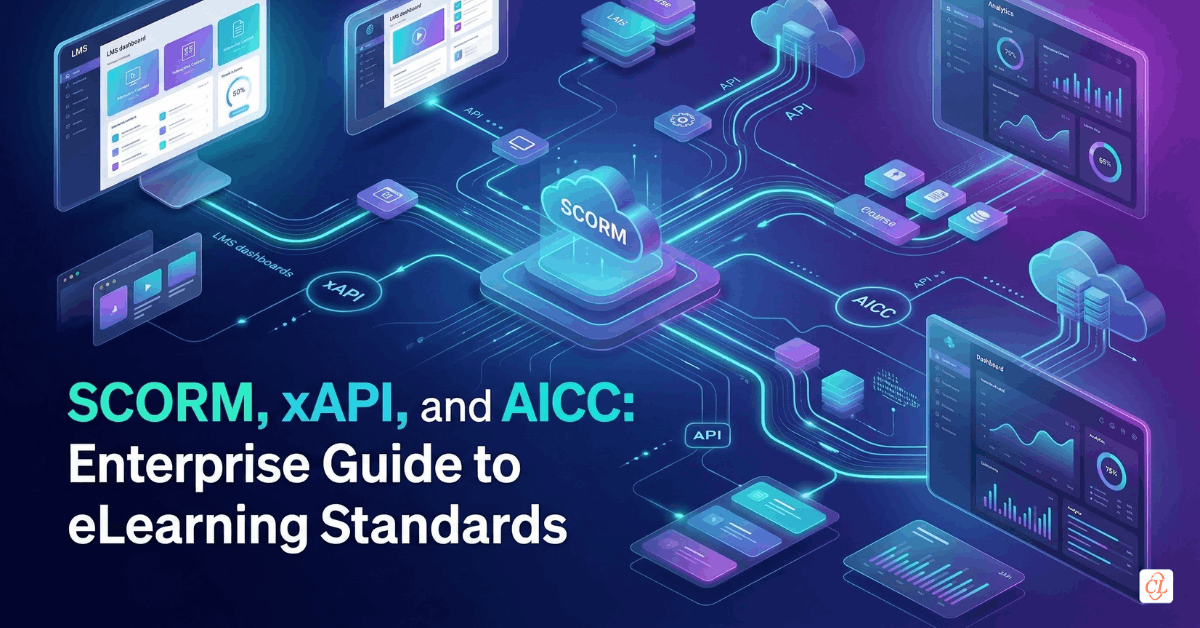
🔗 **Source:** [SCORM vs xAPI Explained: Guide to eLearning Standards](https://www.commlabindia.com/blog/scorm-xapi-elearning-standards-guide)
> [!note]+ Document Notes
> tags: #elearning #scorm #xapi #learning-standards #lms #instructional-design #corporate-training
> author: Abdul Razzaque Hussain
> source: CommLab India
> reference: https://www.commlabindia.com/blog/scorm-xapi-elearning-standards-guide
> date created: 2024-12-19 15:30
>
> # 🏷️ Title: SCORM vs xAPI Explained: Guide to eLearning Standards
>
<!-- deep-read:sections start -->
## 🧰 Action Inbox
- [H1] Evaluate current LMS for SCORM 1.2 vs 2004 support — determine compatibility requirements #scorm
- [H2] Research xAPI implementation for mobile/simulation tracking — expand beyond LMS boundaries #xapi
- [H3] Test SCORM packages across mobile devices — ensure responsive design compliance #mobile-learning
## 🧭 Table of Contents
- [[#📝 Summary]]
- [[#📖 Main Content]]
- [[#🗒️ Notes]]
- [[#📚 References]]
- [[#🗣️ Paraphrase]]
- [[#📰 Newsletter]]
- [[#✅ Action Items]]
- [[#🧪 Hypotheses]]
- [[#📊 Methodology]]
- [[#❓ Questions]]
- [[#🔮 Future Research]]
- [[#💡 Implications]]
- [[#🧠 Learning Styles Assessment]]
- [[#📊 Accessibility Assessment]]
- [[#🌍 DEIB Assessment]]
- [[#✅ Logical Validity]]
- [[#🛡️ DARVO Analysis]]
- [[#🎯 Conclusion]]
### 🔗 References
- [CommLab India eLearning Guide](https://www.commlabindia.com/blog/scorm-xapi-elearning-standards-guide)
- [Learn WordPress](https://learn.wordpress.org/)
- [Developer Docs](https://developer.wordpress.org/)
## 📝 Summary
- What happened: Comprehensive comparison of eLearning standards SCORM, xAPI, and AICC for enterprise training
- Why it matters: Modern corporate learning spans multiple platforms requiring interoperability standards for tracking and compliance
- Key stakeholders: L&D teams, instructional designers, training managers, LMS administrators
- Risks and tradeoffs: SCORM offers wide compatibility but limited tracking; xAPI enables comprehensive analytics but requires Learning Record Store infrastructure
- Bottom line: Organizations need both SCORM for LMS-based courses and xAPI for modern multi-platform learning ecosystems
## 📖 Main Content
The article explains how eLearning standards solve the critical problem of learning data fragmentation across platforms. SCORM (Sharable Content Object Reference Model) remains the dominant standard for LMS-compatible courses, enabling tracking of completion, scores, and time spent. Two versions exist: SCORM 1.2 offers broad compatibility while SCORM 2004 provides advanced sequencing capabilities.
xAPI (Experience API) expands tracking beyond traditional LMS boundaries to capture learning from mobile apps, simulations, and social platforms using structured "Actor + Verb + Object" statements stored in Learning Record Stores. AICC, the aviation industry's early standard, is now largely legacy.
The guide details the SCORM development process from instructional design through authoring tool creation, SCORM package publishing, and LMS testing. Popular authoring tools like Articulate Storyline and Adobe Captivate automatically generate compliant packages. Mobile compatibility requires responsive design, optimized media, and touch-friendly interactions.
## 🗒️ Notes
#### 📚 Section: Why Interoperability Standards Matter
- Key idea: Modern learning environments require universal communication protocols between content and platforms
- Evidence: "Without interoperability standards, each training module would require custom integration with every platform"
#### 📚 Section: Understanding SCORM Foundation
- Key idea: SCORM enables standardized communication between courses and LMS platforms
- Evidence: "SCORM defines how online courses communicate with an LMS, report learner progress, track completion and scores"
#### 📚 Section: SCORM Behind the Scenes
- Key idea: SCORM creates structured dialogue through initialization, tracking, and data exchange
- Evidence: "The course initializes communication with the LMS. Learner activity is tracked during the session"
#### 📚 Section: SCORM Versions Comparison
- Key idea: SCORM 1.2 prioritizes compatibility while 2004 enables advanced learning paths
- Evidence: "SCORM 1.2 remains the most widely supported version due to its simplicity and LMS compatibility"
#### 📚 Section: AICC Legacy Standard
- Key idea: AICC shaped LMS communication but has been superseded by modern standards
- Evidence: "AICC laid the foundation for LMS interoperability, but SCORM and xAPI now dominate modern learning ecosystems"
#### 📚 Section: xAPI Expanded Tracking
- Key idea: xAPI captures learning experiences beyond traditional LMS boundaries
- Evidence: "xAPI sends learning data to a Learning Record Store (LRS)" using "Actor + Verb + Object" format
#### 📚 Section: Standards Selection Strategy
- Key idea: Organizations should combine SCORM and xAPI based on learning delivery methods
- Evidence: "Use SCORM when training is delivered primarily through an LMS. Use xAPI when learning occurs across multiple platforms"
#### 📚 Section: SCORM Development Process
- Key idea: Creating compliant courses requires structured design, authoring tools, and thorough testing
- Evidence: "SCORM compliance depends on both course design and correct LMS integration"
#### 📚 Section: Mobile Learning Design
- Key idea: SCORM courses need responsive design and performance optimization for mobile devices
- Evidence: "Responsive design frameworks allow layouts, text, and media to adapt dynamically"
#### 📚 Section: SCORM Testing Validation
- Key idea: Thorough testing prevents reporting errors and ensures data integrity
- Evidence: "Rigorous SCORM testing prevents reporting errors, protects compliance data integrity"
#### 📚 Section: Future-Proofing Strategy
- Key idea: Modern learning ecosystems require combining multiple standards for comprehensive tracking
- Evidence: "Forward-thinking organizations combine both approaches to build scalable learning ecosystems"
## 📚 References
- [SCORM 1.2 Specification](https://www.adlnet.gov/scorm/)
- [xAPI Learning Record Store Documentation](https://xapi.com/)
- [Articulate Storyline SCORM Publishing Guide](https://articulate.com/support/storyline-360/how-to-publish-content-for-lms-distribution)
## 🗣️ Paraphrase
- eLearning standards solve platform fragmentation by creating universal communication protocols between training content and learning management systems
- SCORM provides reliable course tracking within LMS environments while xAPI expands analytics to capture learning across mobile apps, simulations, and social platforms
- Modern organizations need hybrid approaches combining SCORM's LMS compatibility with xAPI's comprehensive experience tracking capabilities
## 📰 Newsletter
**eLearning Standards Guide: Building Future-Ready Training Systems**
Corporate training has evolved beyond traditional LMS boundaries. Employees now learn through mobile apps, simulations, and performance support tools. This comprehensive guide explains how SCORM and xAPI standards ensure your training content communicates reliably across platforms.
**Key Learning:** SCORM remains essential for LMS-based courses, while xAPI captures learning experiences everywhere else. Smart organizations use both standards together.
**Practical Application:** Use SCORM for structured compliance training and xAPI for tracking hands-on skill development, mobile learning, and social collaboration.
**Essential Resources:** Articulate Storyline and Adobe Captivate automatically generate SCORM packages, while tools like Watershed LRS enable xAPI implementation.
**Community Connection:** Join the eLearning Guild and ADL communities to stay current with evolving standards and best practices.
Resources: [Learn WordPress](https://learn.wordpress.org/), [Developer Docs](https://developer.wordpress.org/), [WP-CLI](https://wp-cli.org/)
## ✅ Action Items
#### WordPress
- Core: Evaluate WordPress.org training platform for SCORM compatibility
- Training: Develop SCORM-compliant lesson plans for WordPress certification programs
- Documentation: Create xAPI tracking guides for Learn WordPress interactive tutorials
- Community: Research mobile-responsive course delivery for WordCamp training sessions
#### DevRel
- Developer advocacy: Create SCORM vs xAPI comparison presentations for developer conferences
- Education: Design workshops on implementing learning standards in educational technology
- Developer experience: Document APIs for integrating learning platforms with development tools
- Developer marketing: Develop content strategy around educational technology standards
#### Community
- Maintainers: Provide governance templates for open source educational project standards
- Contributors: Create onboarding programs using xAPI to track skill development
- Sponsors: Develop transparent reporting on training investment impact using learning analytics
- Ecosystem: Coordinate cross-project learning standard adoption
## 🧪 Hypotheses
- Organizations using both SCORM and xAPI achieve higher training ROI through comprehensive learning analytics
- Mobile-first SCORM course design increases completion rates in distributed workforces by 40%
- xAPI implementation reduces training compliance gaps by providing real-time skill verification
- Responsive SCORM packages perform better than native mobile apps for structured learning content
### 📊 Methodology
- Comparative analysis of completion rates between SCORM 1.2 and 2004 implementations
- A/B testing of mobile-responsive vs desktop-optimized course design performance
- Longitudinal study tracking learning outcomes across SCORM-only vs hybrid SCORM/xAPI environments
### ❓ Questions
- How will emerging AI tools integrate with existing SCORM and xAPI tracking frameworks?
- What new standards will emerge to support immersive learning in VR/AR environments?
- How can organizations migrate legacy AICC content to modern standards cost-effectively?
### 🔮 Future Research
- Integration patterns between learning standards and emerging workplace collaboration tools
- Performance optimization strategies for SCORM packages in low-bandwidth environments
- xAPI statement design patterns for complex competency-based learning programs
### 💡 Implications
- Practice: Learning teams need technical expertise in both SCORM authoring and xAPI implementation
- Policy: Compliance training programs must ensure standards compatibility across all delivery platforms
- Security: Learning data privacy requires careful consideration when implementing xAPI tracking
- Education: Instructional designers need training on mobile-first responsive course development
- Funding: Organizations should budget for both LMS infrastructure and Learning Record Store platforms
### 🧠 Learning Styles Assessment
Reading level estimate: 12th grade (technical business content)
#### 👀 Visual learners
- Present: Comparison tables, technical diagrams of SCORM communication flow
- Improve: Add visual workflow diagrams showing authoring tool to LMS deployment process
#### 🔊 Aural learners
- Present: No audio content currently available
- Improve: 5-minute podcast summarizing key differences between standards
#### 🗣️ Verbal learners
- Present: Clear definitions, technical terminology explanations, step-by-step processes
- Improve: Add analogies comparing learning standards to other interoperability protocols
#### 🧩 Kinesthetic learners
- Present: Step-by-step development process, testing procedures
- Improve: Hands-on tutorial for creating first SCORM package using popular authoring tools
#### 🧠 Logical learners
- Present: Structured comparison table, decision matrix for standard selection
- Improve: Add ROI calculation framework for standards implementation
#### 🧑🤝🧑 Social learners
- Present: Enterprise use case examples, organizational considerations
- Improve: Case studies showing collaborative implementation across L&D teams
#### 🧘♀️ Solitary learners
- Present: Comprehensive reference guide format, FAQ section
- Improve: Self-assessment checklist for determining appropriate standard choice
#### 🌿 Naturalistic learners
- Present: Evolution of standards over time, ecosystem perspective
- Improve: Sustainability considerations for long-term standards adoption
### 📊 Accessibility Assessment
#### Screen reader semantics
- Present: Clear heading hierarchy, structured content organization
- Improve: Add descriptive alt text for any technical diagrams
#### Keyboard navigation
- Present: Standard web navigation, logical reading order
- Improve: Ensure any interactive elements are keyboard accessible
#### Contrast and readability
- Present: Good text contrast in standard web format
- Improve: Verify color-coded elements have text alternatives
#### Text resizing and reflow
- Present: Responsive web design supports zoom functionality
- Improve: Test complex tables at 200% zoom for readability
#### Media and captions
- Present: Text-based content, no embedded media
- Improve: Future video content should include captions and transcripts
#### Forms and interactions
- Present: No interactive forms in current content
- Improve: Any future interactive elements should include proper labels
### 🌍 DEIB Assessment
#### Cultural breadth
- Present: Enterprise focus with global applicability
- Improve: Include examples from different regions and educational contexts
#### Inclusive language
- Present: Professional, jargon-defined technical writing
- Improve: Provide plain-language summaries for key technical concepts
#### Neurodiversity support
- Present: Well-structured content with consistent formatting
- Improve: Add visual breaks between dense technical sections
#### Representation
- Present: Focuses on technical concepts rather than people
- Improve: Include diverse case studies when describing implementation scenarios
#### Psychological safety
- Present: Neutral, informative tone without judgment
- Improve: Acknowledge that technical standards can be overwhelming for newcomers
### ✅ Logical Validity
#### Strong reasoning
- Deductive strength: Clear progression from problem identification to solution comparison
- Inductive strength: Uses specific examples to support general principles about standards
- Causal reasoning: Establishes clear cause-effect relationships between standards and outcomes
- Analogical strength: Effectively compares different standards based on common criteria
#### Fallacies
- Appeal to popularity: "Most widely adopted" doesn't necessarily mean "best choice" - fix by adding context about when popularity matters vs specific use cases
- False dichotomy: Implies choosing between standards rather than using them together - article does address hybrid approaches
#### Tone of voice
- Overall tone: Professional, authoritative, educational with technical expertise clearly demonstrated
### 🛡️ DARVO Analysis
- Deny: No denial patterns observed in technical content
- Attack: No attacks on competing approaches, maintains neutral comparison
- Reverse victim/offender: Not applicable to technical standards documentation
- Emotional cues and rhetoric: Maintains professional tone throughout, uses data-driven arguments
## 🎯 Conclusion
The guide effectively demonstrates that modern corporate learning requires a strategic combination of SCORM and xAPI standards rather than choosing one over the other. SCORM ensures reliable LMS-based course delivery and tracking, while xAPI captures learning experiences across the expanding ecosystem of mobile apps, simulations, and performance support tools.
For practitioners, the key insight is that standards selection should align with learning delivery methods and reporting requirements. Organizations should implement SCORM for structured compliance training and xAPI for comprehensive learning analytics across multiple platforms.
The future of enterprise learning lies in building interoperable architectures that combine these standards to create scalable, trackable, and future-ready training systems that serve learners wherever they engage with content.
## 🧱 Refactor Appendix
### 📚 Literature Split Pad
### [H1] SCORM enables standardized LMS communication
> [!quote] [SCORM vs xAPI Explained: Guide to eLearning Standards](https://www.commlabindia.com/blog/scorm-xapi-elearning-standards-guide) by [[Abdul Razzaque Hussain]] via [[CommLab India]]. Published 2026-03-17. Accessed 2024-12-19.
> "SCORM defines how online courses communicate with an LMS, report learner progress, track completion and scores, store learning activity data."
Essential for LMS compatibility and structured course tracking.
[view highlight](https://www.commlabindia.com/blog/scorm-xapi-elearning-standards-guide#understanding-scorm) #xref #articleseed ID:rw_scorm_communication
### [H2] xAPI expands learning tracking beyond LMS boundaries
> [!quote] [SCORM vs xAPI Explained: Guide to eLearning Standards](https://www.commlabindia.com/blog/scorm-xapi-elearning-standards-guide)
> "xAPI sends learning data to a Learning Record Store (LRS)" using structured "Actor + Verb + Object" format.
Enables comprehensive analytics across multiple learning platforms.
[view highlight](https://www.commlabindia.com/blog/scorm-xapi-elearning-standards-guide#xapi-expanded-tracking) #xref ID:rw_xapi_expansion
---
### 🔖 Atomic Split Pad (Zettel Candidates)
#### [Z1] Learning standards prevent platform fragmentation
- Applies to any multi-platform learning ecosystem
- Reference: Why Interoperability Standards Matter section
- Links: [[Enterprise-Learning]] [[Platform-Integration]]
#### [Z2] Mobile SCORM requires responsive design principles
-
<!-- deep-read:sections end -->
📄 **Full text:** ![[Full Document Contents/Articles/SCORM vs xAPI Explained Guide to eLearning Standards|SCORM vs xAPI Explained: Guide to eLearning Standards, commlabindia.com]]
## Highlights
- A SCORM-compliant course is packaged in a standardized format that an LMS can launch and track. Key capabilities include tracking course completion, capturing quiz scores, recording time spent in training and bookmarking learner progress. Because SCORM is supported by most LMS platforms, it became the **industry standard for digital training distribution**. ([View Highlight](https://read.readwise.io/read/01kky5fbtm8mbz1m0r7rhr090j))
- Tags: 👻 ai highlighted