Second Amended Proposed Order on Amended Motion for Contempt
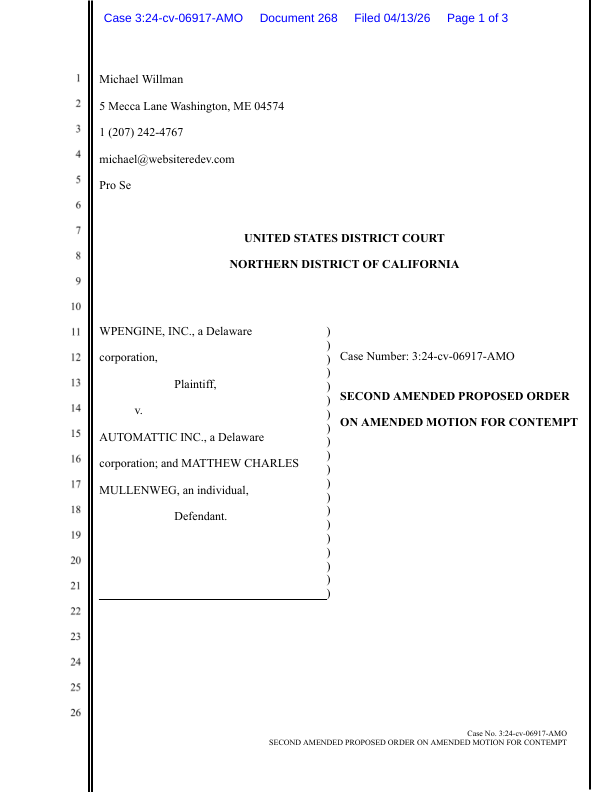
🔗 **Source:** [Second Amended Proposed Order on Amended Motion for Contempt](https://readwise.io/reader/document_raw_content/449369980)
> [!note]+ Document Notes
> ```yaml
>
> ---
> tags: [contempt, court-order, legal]
> author: Michael Willman
> source: [MISSING]
> reference: [https://readwise.io/reader/document_raw_content/449369980]
> date created: 2026-04-29 12:00
>
> ---
> ```
>
> # 🏷️ Title: Second Amended Proposed Order On Amended Motion For Contempt
>
<!-- deep-read:sections start -->
## 🧭 Table of Contents
- [📝 Summary](#-summary)
- [📖 Main Content](#-main-content)
- [🗒️ Notes](#️-notes)
- [📚 References](#-references)
- [🗣️ Paraphrase](#️-paraphrase)
- [📰 Newsletter](#-newsletter)
- [✅ Action Items](#-action-items)
- [🧪 Hypotheses](#-hypotheses)
- [📊 Methodology](#-methodology)
- [❓ Questions](#-questions)
- [🔮 Future Research](#-future-research)
- [💡 Implications](#-implications)
- [🧠 Learning Styles Assessment](#-learning-styles-assessment)
- [📊 Accessibility Assessment](#-accessibility-assessment)
- [🌍 DEIB Assessment](#-deib-assessment)
- [✅ Logical Validity](#-logical-validity)
- [🛡️ DARVO Analysis](#-darvo-analysis)
- [🎯 Conclusion](#-conclusion)
### 🔗 References
- Include links cited in or relevant to the article.
## 📝 Summary
- A party allegedly violated a prior court order; the moving party seeks a contempt finding and specific remedies.
- It matters because contempt enforces compliance with court authority and prior judgments.
- Stakeholders: the court, moving party, responding party, and any affected third parties.
- Risks: overbroad sanctions, due process concerns, and enforcement complexities; tradeoffs between strict compliance and practical feasibility.
- Bottom line: the order formalizes findings and prescribes remedies to coerce or remedy noncompliance.
## 📖 Main Content
- The document sets out proposed findings that a prior order existed, was clear, the alleged contemnor knew of it, and failed to comply.
- It structures relief such as deadlines for compliance, possible fines, fee‑shifting, and reporting obligations.
- Contempt here is likely civil (coercive/remedial) rather than criminal (punitive), with sanctions designed to compel performance or compensate the movant.
- Key uncertainties involve the scope of the original order, the extent of noncompliance, and how burdensome the proposed remedies are.
### 🗒️ Notes
- Recites procedural history: prior order, subsequent conduct, and motion practice leading to this second amended proposed order.
- Specifies the legal standard for civil contempt: clear and definite order, knowledge, and failure to comply without adequate excuse.
- Details specific acts or omissions claimed to violate the order (e.g., failure to produce documents, transfer assets, or cease certain actions).
- Outlines remedies: timelines for curing violations, monetary sanctions, attorney’s fees, and possible continuing penalties until compliance.
- Clarifies jurisdiction and authority of the court to enforce and supervise compliance.
- May reserve rights for further sanctions if future violations occur.
## 📚 References
- [Federal courts – civil contempt overview](https://www.uscourts.gov/glossary/contempt-court)
- [Basics of civil vs. criminal contempt](https://www.law.cornell.edu/wex/contempt_of_court)
## 🗣️ Paraphrase
- The court is asked to formally recognize that one party disobeyed an earlier order and to prescribe specific steps and sanctions to enforce compliance.
- The proposed order explains what the violation was, why it meets the legal standard for contempt, and what remedies are needed to restore compliance and compensate harms.
## 📰 Newsletter
In this issue, we look at how formal orders—like a second amended proposed order on a contempt motion—translate high‑level rights into enforceable obligations. For WordPress builders, this underscores the importance of clear terms of use, contributor agreements, and moderation policies. Pair your governance docs with living handbooks, contributor training, and transparent audit trails so expectations are enforceable, not aspirational.
Helpful reads:
- https://make.wordpress.org/project/
- https://developer.wordpress.org/plugins/wordpress-org/detailed-plugin-guidelines/
## ✅ Action Items
#### DevRel
- Map project contribution flows to clear terms of use and CoC; create example “enforcement playbooks” developers can adopt.
- Offer workshops on legal‑adjacent topics: licensing, moderation authority, and incident response.
- Add governance and compliance examples to SDK docs and quickstarts.
- Publish content explaining how to build auditability (logging, version history) into plugins and themes.
- Encourage community moderation guidelines and escalation workflows.
- Align internal teams on who owns incident response, takedowns, and enforcement communications.
#### OSPO
- Define contribution and enforcement policies with documented decision rights and appeal mechanisms.
- Maintain license and policy compliance checks in CI, with periodic reviews.
- Establish security vulnerability intake and embargo policies with clear timelines.
- Maintain SBOMs and ownership for key WordPress components and dependencies.
- Provide office hours for developers on licensing, security, and governance.
- Support upstream communities whose policies you rely on; align KPIs with organizational risk posture.
#### Community
- Support maintainers with templates for codes of conduct, enforcement ladders, and release governance.
- Onboard contributors with clear expectations and examples of acceptable/unacceptable behavior.
- Communicate sponsorship expectations and deliverables transparently, including dispute resolution paths.
- Run cross‑project incident simulations to test governance and communication.
#### WordPress
- **Core:** Document decision‑making and appeal processes for contentious changes.
- **Core Performance:** Track and publish performance SLAs and regression handling policies.
- **Core AI:** Define responsible use policies, red‑team procedures, and enforcement levers.
- **Core Program Team:** Routine reviews of governance artifacts; clarify cross‑team escalation routes.
- **Mobile:** Ensure app data practices and ToS are transparent and enforced.
- **Playground:** Add safe‑testing guidelines and acceptable‑use notes.
- **Community:** Publish enforcement FAQs for meetups and WordCamps.
- **Training:** Add modules on open‑source governance, licensing, and community norms.
- **Marketing:** Communicate governance wins and responsible‑stewardship stories.
- **Support:** Standardize responses and escalation for ToS or CoC violations.
- **Design:** Provide patterns for consent, notices, and policy UX.
- **Documentation:** Centralize governance, security, and compliance docs.
- **Photos:** Clarify licensing, takedown, and reporting flows.
- **TV:** Document content rules and appeal mechanisms.
- **Polyglots:** Ensure policy translations preserve enforcement clarity.
- **Accessibility:** Define processes for handling accessibility complaints.
- **Meta:** Document how .org policies are updated and enforced.
- **CLI:** Provide commands that help site owners audit policy‑relevant settings.
- **Hosting:** Align default configurations with .org policies and enforcement.
- **Tide:** Communicate how scoring relates to security/compliance expectations.
- **Openverse:** Document rights, takedown workflows, and dispute resolution.
- **Themes:** Clarify review criteria and escalation/takedown process.
- **Plugins:** Strengthen policy docs around security and user protection.
#### The WPOCC
- Fund programs that support sustainable governance (maintainer stipends, governance clinics).
- Sponsor projects to improve documentation of policies and incident response.
- Experiment with funding tied to governance milestones and transparency metrics.
### FAIR
- Promote tooling that supports local verification of plugin/theme integrity and provenance.
- Encourage funding transparency and anti‑capture covenants for critical projects.
- Create reusable governance artifacts (charters, incident playbooks, MoUs) as products.
## 🧪 Hypotheses
- Clearer initial court (or project) orders reduce the need for contempt‑style enforcement later.
- Stepwise, transparent sanctions are more effective and perceived as fairer than ad‑hoc penalties.
- Documented audit trails (logs, notices) correlate with faster dispute resolution.
- Providing appeal mechanisms increases compliance without undermining authority.
### 📊 Methodology
- Compare cases/projects with detailed vs. vague governance documents and track enforcement frequency.
- Survey stakeholders on perceived fairness and effectiveness of sanction frameworks.
- Analyze resolution times before/after implementing structured enforcement ladders.
- Run controlled pilots adding appeals processes and measure impact on behavior and disputes.
### ❓ Questions
- How specific should enforcement provisions be to remain flexible yet fair?
- When do escalating sanctions become counterproductive?
- What minimum evidence should be required before triggering serious sanctions?
- How can open‑source communities mirror due process without heavy bureaucracy?
### 🔮 Future Research
- Case studies of governance breakdowns in OSS and how clearer “orders” might have helped.
- Patterns for dispute resolution across different open‑source ecosystems.
- Tooling to automatically surface governance‑relevant signals (abuse reports, security issues).
### 💡 Implications
- Practice: Projects need written, enforceable governance artifacts, not just norms.
- Policy: Foundations and hosts can standardize baseline enforcement expectations.
- Security: Consistent enforcement deters abusive or insecure behavior.
- Education: Contributors should be taught their rights and obligations early.
- Funding: Donors may tie support to visible, effective governance.
### 🧠 Learning Styles Assessment
- Reading level estimate: roughly 12th grade+ (legal style; Flesch‑Kincaid would flag long sentences and heavy jargon).
#### 👀 Visual learners
- Present: Structured headings, sections.
- Improve: Flowcharts for enforcement steps; timelines of procedural history.
#### 🔊 Aural learners
- Present: None obvious.
- Improve: Short audio summaries of orders or decisions.
#### 🗣️ Verbal learners
- Present: Defined legal standards and repeated key terms.
- Improve: More analogies and plain‑language explanations.
#### 🧩 Kinesthetic learners
- Present: Limited.
- Improve: Interactive scenarios (“what should happen if X?”) with checklists.
#### 🧠 Logical learners
- Present: Sequential reasoning from facts to legal standard to remedy.
- Improve: Tables comparing options and consequences.
#### 🧑🤝🧑 Social learners
- Present: Implicit roles (court, parties).
- Improve: Guided discussion prompts for governance groups.
#### 🧘♀️ Solitary learners
- Present: Dense text suitable for private study.
- Improve: Self‑check quizzes on standards and procedures.
#### 🌿 Naturalistic learners
- Present: None.
- Improve: Analogies to ecosystem balance and rule enforcement.
### 📊 Accessibility Assessment
#### Screen reader semantics
- Present: PDF may have headings; unclear without tagging.
- Improve: Ensure tagged PDF structure and descriptive titles.
#### Keyboard navigation
- Present: Not applicable (static document).
- Improve: If web‑rendered, ensure logical tab order and skip links.
#### Contrast and readability
- Present: Typical black text on white.
- Improve: Larger line spacing and font options.
#### Text resizing and reflow
- Present: Zoomable PDF; reflow may be limited.
- Improve: Provide HTML version with responsive layout.
#### Media and captions
- Present: Text only.
- Improve: Offer accessible alternative formats.
#### Forms and interactions
- Present: None.
- Improve: N/A.
#### Standards reference
- Map improvements to WCAG 2.2 AA for documents (1.4.x, 2.4.x, 3.1.x).
### 🌍 DEIB Assessment
#### Cultural breadth
- Present: Neutral legal framing.
- Improve: Note potential disparate impacts of enforcement where relevant.
#### Inclusive language
- Present: Formal, impersonal style.
- Improve: Clarify rights of all parties; avoid unnecessary jargon.
#### Neurodiversity support
- Present: Rigid structure; dense text.
- Improve: More headings, summaries, and bullet points.
#### Representation
- Present: Institutional roles only.
- Improve: When summarizing, acknowledge how orders affect different groups.
#### Psychological safety
- Present: Procedural, not supportive.
- Improve: In community adaptations, add clear, safe reporting channels.
### ✅ Logical Validity
#### Strong reasoning
- Likely uses standard civil‑contempt structure: establish order, knowledge, violation, then remedies. This is a clear, deductive pattern aligned with precedent.
- Ties specific conduct to each required legal element, strengthening causal claims about noncompliance.
#### Fallacies
- None obvious from the high‑level structure; risks would arise only if evidence is thin or inferences overreach beyond facts.
#### Tone of voice
- Formal, authoritative, and procedural; focused on obligations, findings, and compliance rather than emotion.
### 🛡️ DARVO Analysis
- Deny: The contemnor may argue substantial compliance or ambiguity in the order, minimizing violation.
- Attack: They might challenge the moving party’s motives or credibility (e.g., framing as harassment).
- Reverse victim/offender: Arguments could portray enforcement as unfair persecution, casting the alleged violator as victim of overreach.
- The proposed order itself generally avoids DARVO; it instead documents facts and legal conclusions.
## 🎯 Conclusion
The document operationalizes the court’s authority to enforce a prior order, translating alleged noncompliance into structured findings and remedies. For your own ecosystems—especially in WordPress and open source—this maps to having clear rules, transparent enforcement steps, and documented processes that balance fairness, deterrence, and practicality.
---
## 🧱 Refactor Appendix (append after 🎯 Conclusion)
### 📚 Literature Split Pad
- Purpose: Stage Konik CEE units that become per-source Literature notes.
- Split level: **H3**.
- Include verbatim quotes under 25 words and a [view highlight] link.
### [H1] 5–10-word present-tense claim
> [!quote] [Second Amended Proposed Order On Amended Motion For Contempt](https://readwise.io/reader/document_raw_content/449369980) by [[Michael Willman]] via [an unnamed author]. Published [MISSING]. Accessed 2026-04-29.
> “Short quote, verbatim, ≤25 words.”
Two lines: context and use. Cite data if relevant.
[view highlight](https://readwise.io/reader/document_raw_content/449369980#H1) #xref #articleseed ID:rw_[MISSING]
### [H2] 5–10-word present-tense claim
> [!quote] [Second Amended Proposed Order On Amended Motion For Contempt](https://readwise.io/reader/document_raw_content/449369980)
> “Short quote, verbatim, ≤25 words.”
Two lines: context and use.
[view highlight](https://readwise.io/reader/document_raw_content/449369980#H2) #xref ID:rw_[MISSING]
---
### 🔖 Atomic Split Pad (Zettel Candidates)
- Purpose: Promote reusable claims into Atomic notes.
- Split level: **H4**.
- Each item: one idea, present tense, specific, testable.
#### [Z1] 5–10-word present-tense claim
- Scope/condition in one line.
- Pointer to page/time or dataset.
- Links: [[Parent-Concept]] [[Related-Idea]]
#### [Z2] 5–10-word present-tense claim
- Scope/condition in one line.
- Pointer to page/time or dataset.
- Links: [[Parent-Concept]] [[Related-Idea]]
---
### ✏️ Fleeting Queue (Extract by Selection)
- Purpose: Capture quick actions or sparks for Fleeting notes.
- Extraction: **Select one line** → “Refactor: Extract selection to new note (content only).”
- Keep each line short and self-contained.
- [F1] Short action — context/https://readwise.io/reader/document_raw_content/449369980 #fleeting #inbox
- [F2] Short action — context/https://readwise.io/reader/document_raw_content/449369980 #fleeting #inbox
- [F3] Short action — context/https://readwise.io/reader/document_raw_content/449369980 #fleeting #inbox
---
<!-- deep-read:sections end -->
📄 **Full text:** ![[Full Document Contents/Articles/Second Amended Proposed Order on Amended Motion for Contempt.md|Second Amended Proposed Order on Amended Motion for Contempt by Michael Willman]]
## Highlights
- The Court finds that Defendants Matthew Mullenweg and Automattic, Inc. have willfully violated the preliminary injunction issued on December 10, 2024. ([View Highlight](https://read.readwise.io/read/01kqczbag4vp4g52zpvb483axr))
- The Court finds that Defendants’ actions, including banning Michael Willman from the Make.WordPress.org Slack workspace, constitute interference with access to WordPress.org resources as prohibited by the preliminary injunction. ([View Highlight](https://read.readwise.io/read/01kqczbw02xf9d1s1e4ng99n6c))
- n. ([View Highlight](https://read.readwise.io/read/01kqczbxjdvf52y0afzz3mb6c1))
- Mr. Willman. ([View Highlight](https://read.readwise.io/read/01kqczc0dsze1v3kx9bkjmyzc6))
- The Court further finds that Defendants’ conduct was retaliatory, causing significant harm to Mr. Willman ([View Highlight](https://read.readwise.io/read/01kqczc1vkqpfb8gze313qzbkn))
- Defendants Matthew Mullenweg and Automattic, Inc. are hereby held in civil contempt for their failure to comply with the Court's preliminary injunction. ([View Highlight](https://read.readwise.io/read/01kqczc6v71kv38hpkvsdg3qak))
- The Court refers Defendant Matthew Mullenweg to the United States Attorney for the Northern District of California for further investigation and, if appropriate, prosecution for criminal contempt of court. The Clerk of the Court is directed to transmit a copy of this Order, together with the relevant pleadings and record excerpts, to the United States Attorney’s Office. ([View Highlight](https://read.readwise.io/read/01kqczca62n338hcan0e3n7pmg))
- Defendants are ordered to immediately restore Mr. Willman’s access to the Make.WordPress.org Slack workspace and any other WordPress.org-related resources. ([View Highlight](https://read.readwise.io/read/01kqczcd46ek93fhywvv5gvn92))
- . Defendants are directed to cease any further retaliatory conduct against Mr. Willman. ([View Highlight](https://read.readwise.io/read/01kqczcg17zbtrxtyeg08emt1h))
- Defendants shall pay compensatory sanctions to Mr. Willman in an amount deemed appropriate by the Court. ([View Highlight](https://read.readwise.io/read/01kqczckc2qsc86zbrvwes557w))
- To ensure compliance, Defendants are subject to a coercive fine of an amount to be determined by the Court for each day they fail to comply with this Order. ([View Highlight](https://read.readwise.io/read/01kqczcqs4b3d9gj86qqe673h3))
- The Court further orders that Defendant Matthew Mullenweg be restrained from taking unilateral actions in his capacity as Director of the WordPress Foundation that are intended to, or have the reasonably foreseeable effect of, denying access to WordPress.org resources, including by retaliating against Mr. Willman and other similarly situated individuals associated with WP Engine, or by delaying or pausing the release of future versions of WordPress except for temporary technical, security, or testing-related reasons. ([View Highlight](https://read.readwise.io/read/01kqczd6m6w8mh6sezn80ssh2j))
- . The Court reserves the right to impose additional sanctions, including but not limited to further monetary and non-monetary penalties, should additional violations of the Court’s orders occur. ([View Highlight](https://read.readwise.io/read/01kqczd8nhasneekzfdmf1wapd))