Stipulated Amended Protective Order
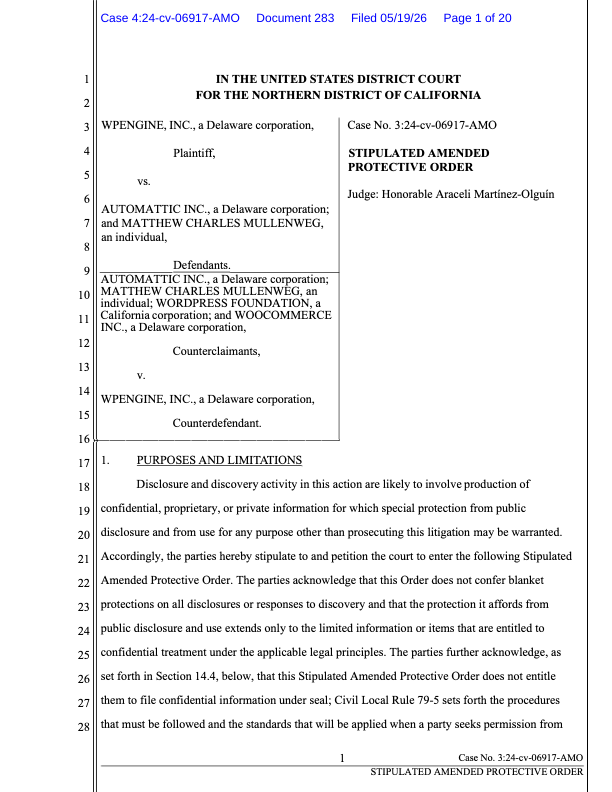
🔗 **Source:** [Stipulated Amended Protective Order](https://storage.courtlistener.com/recap/gov.uscourts.cand.437474/gov.uscourts.cand.437474.283.0.pdf)
> [!note]+ Document Notes
> tags: [wp-engine-automattic, protective-order, discovery-dispute, confidentiality, source-code, wordpress-governance, litigation-procedure, trade-secrets]
> author: WPEngine, Inc. and Automattic Inc. (Stipulated)
> source: CourtListener RECAP - N.D. Cal. 4:24-cv-06917-AMO
> filing_type: stipulated amended protective order
> docket: 283.0
>
> # 🏷️ Stipulated Amended Protective Order - Discovery Confidentiality Framework
>
> # 🧭 Table of Contents
> - [References](#-references)
> - [Summary](#-summary)
> - [Main Content](#-main-content)
> - [Governance Digest](#-governance-digest)
> - [Hypotheses](#-hypotheses)
> - [Questions](#-questions)
> - [Future Research](#-future-research)
> - [Implications](#-implications)
> - [Conclusion](#-conclusion)
>
> # 🔗 References
> **In-page citations:**
> - Docket 283.0 (this filing)
> - Federal Rule of Civil Procedure 26(c)
> - Civil Local Rule 79-5 (N.D. Cal. sealing procedures)
> - Case No. 4:24-cv-06917-AMO
> - Judge Araceli Martinez-Olguin
> - Magistrate Judge Ajay S. Krishnan
>
> # 📝 Summary
> This stipulated protective order establishes a three-tier confidentiality framework for discovery materials in the WP Engine v. Automattic litigation. The order creates "CONFIDENTIAL," "HIGHLY CONFIDENTIAL-ATTORNEYS' EYES ONLY," and "HIGHLY CONFIDENTIAL-SOURCE CODE" designations, with the latter category specifically protecting computer code, algorithms, and software architecture details. Key stakeholders include both litigation teams, their experts, and potentially the broader WordPress development community whose code may be at issue. The framework balances litigation transparency against protection of trade secrets and proprietary information, particularly source code that could reveal competitive advantages. Bottom line: This creates the legal infrastructure for handling sensitive technical materials in a case that could expose WordPress ecosystem internals.
>
> # 📖 Main Content
>
<!-- deep-read:sections start -->
## 🗒️ Notes
**Three-Tier Protection System:**
- **CONFIDENTIAL**: Basic protection under Fed. R. Civ. P. 26(c)
- **HIGHLY CONFIDENTIAL-ATTORNEYS' EYES ONLY**: "extremely sensitive" materials creating "substantial risk of serious harm"
- **HIGHLY CONFIDENTIAL-SOURCE CODE**: Computer code, algorithms, engineering specs, formulas defining software/hardware designs
**Key Procedural Requirements:**
- Material must be designated before production (Section 5.2)
- Mass/indiscriminate designations prohibited (Section 5.1)
- 21-day window to designate deposition testimony (Section 5.2(b))
- Inadvertent failures can be corrected if timely (Section 5.3)
**Access Restrictions:**
- Outside Counsel of Record and House Counsel permitted
- Expert witnesses allowed if not competitor employees
- Professional vendors (litigation support) included
- Civil Local Rule 79-5 governs any court filings under seal
**Challenge Process:**
- Any party can challenge designations anytime (Section 6.1)
- Must meet and confer in "voice to voice dialogue" (Section 6.2)
- Written notice required citing specific protective order paragraph
**Duration and Scope:**
- Protections survive final disposition until written agreement or court order (Section 4)
- Covers copies, excerpts, summaries, testimony revealing protected material (Section 3)
- Public domain and prior knowledge exceptions apply
# 📚 References
- Federal Rule of Civil Procedure 26(c) (discovery protection standards)
- Civil Local Rule 79-5 (Northern District of California sealing procedures)
- Exhibit A referenced (Acknowledgment and Agreement to Be Bound form)
# 🗣️ Paraphrase
The parties agreed on rules for keeping sensitive information secret during the lawsuit. They created three levels of protection: regular confidential stuff, super-secret attorney-only material, and ultra-protected computer code. Companies have to mark documents before sharing them and can't just stamp everything as secret. Lawyers can see most things, but source code gets extra protection. If someone thinks something shouldn't be secret, they have to call and talk it out first. The secrecy rules last even after the lawsuit ends unless both sides agree to lift them.
# 📰 Governance Digest
**What happened:** WP Engine and Automattic agreed on a secret-keeping system for their lawsuit discovery process.
**Why it matters for WordPress:** This case involves core WordPress infrastructure - the plugin directory, trademark control, and potentially WordPress.org's source code. The special "SOURCE CODE" protection category suggests both sides expect to exchange sensitive technical details about how WordPress actually works behind the scenes.
**The governance angle:** For the first time, we may get a legal framework forcing transparency about how WordPress Foundation, Automattic, and wordpress.org really operate. The protective order is the appetizer - the main course will be what documents actually get produced under these rules.
**Bottom line:** The WordPress community is about to learn a lot more about how their ecosystem really works, just not immediately and not all at once.
# 🧪 Hypotheses
1. **Source code sensitivity hypothesis**: The specific "SOURCE CODE" category indicates both parties possess proprietary algorithms or architectural details they consider competitively sensitive, likely related to WordPress.org infrastructure or plugin directory operations.
2. **Trade secret strategy hypothesis**: The three-tier system suggests Automattic/WordPress Foundation will claim trade secret protection over wordpress.org operational details, attempting to limit public disclosure of governance mechanisms.
3. **Expert witness limitation hypothesis**: The prohibition on competitor-employee experts indicates both sides plan technical testimony but want to prevent direct competitive intelligence gathering through the litigation process.
4. **Mass designation prevention hypothesis**: The anti-"routinized designation" language suggests prior disputes or expectations about over-broad confidentiality claims, particularly around WordPress codebase materials.
5. **Duration strategy hypothesis**: Post-litigation confidentiality survival suggests both sides view this as precedent-setting for future WordPress ecosystem disputes requiring long-term information protection.
# 📊 Methodology
**Procedural posture:** Stipulated agreement filed post-fact discovery closure (May 14, 2026), indicating amendment to address issues encountered during discovery process. No evidentiary declarations attached - purely procedural framework document establishing future handling protocols.
# ❓ Questions
- What specific source code triggered the need for the specialized protection category?
- How will wordpress.org governance documents be classified under this framework?
- Will WordPress Foundation operational details receive "HIGHLY CONFIDENTIAL" treatment?
- What "mass designation" problems occurred in initial discovery to necessitate the amendment?
- How does this protective order interact with WordPress's open-source transparency principles?
- Which expert witnesses are being planned that required competitor-employee restrictions?
# 🔮 Future Research
**Litigation threads:**
- Monitor which documents receive "SOURCE CODE" designation to understand technical disputes
- Track confidentiality challenges to identify transparency battles
- Watch expert witness disclosures for technical testimony scope
**WordPress governance threads:**
- Analyze how protective order affects WordPress Foundation transparency obligations
- Monitor whether wordpress.org operational details become public through discovery
- Track how trade secret claims intersect with open-source governance principles
# 💡 Implications
**Practice implications:** WordPress developers and agencies should prepare for potential disclosure of previously private wordpress.org operational details, affecting their platform assumptions and business strategies.
**Policy implications:** The tension between litigation transparency and trade secret protection may force clarification of what aspects of WordPress governance are genuinely "open" versus proprietary.
**Security implications:** Source code protection measures suggest potential exposure of WordPress.org infrastructure details that could have security ramifications if disclosed.
**Education implications:** The protective order framework may limit public access to educational materials about WordPress ecosystem operations that emerge from litigation.
**Funding implications:** Trade secret designations could affect how WordPress Foundation and related entities structure their financial and operational transparency to avoid future litigation exposure.
# 🧠 Learning Styles Assessment
- **Visual:** Document structure and protection tier diagrams would aid comprehension
- **Aural:** Legal terminology may require verbal explanation for accessibility
- **Verbal:** Heavy legal language demands strong reading comprehension
- **Kinesthetic:** Abstract legal concepts lack hands-on learning opportunities
- **Logical:** Clear procedural framework appeals to systematic learners
- **Social:** Stipulated nature shows collaborative legal problem-solving
- **Solitary:** Dense legal text suitable for individual study and analysis
- **Naturalistic:** Pattern recognition valuable for understanding protection categories
**Reading level:** Graduate/professional (dense legal terminology, complex procedural requirements)
# 📊 Accessibility Assessment
**Text extraction:** Fully accessible OCR'd document with clean text structure. **Structure:** Clear numbered sections and subsections with consistent formatting. **Artifacts:** Minimal court filing artifacts (case numbers, page headers). **WCAG 2.2 AA:** Text-based format meets accessibility standards; legal terminology may require plain-language alternatives for broader accessibility.
# 🌍 DEIB Assessment
**Cultural breadth:** Limited - standard U.S. federal court legal framework without cultural considerations. **Inclusive language:** Formal legal language may create barriers for non-native English speakers or those without legal training. **Neurodiversity support:** Dense, technical formatting may challenge some cognitive processing styles. **Representation:** Corporate legal document without diverse perspective consideration. **Psychological safety:** Protective order framework supports confidentiality but legal context may feel intimidating to community members.
# ✅ Logical Validity
**Strong reasoning:** Logical progression from general principles to specific procedures, with clear definitions and systematic protection categories.
**Fallacies:** None identified - procedural document follows established legal frameworks.
**Tone:** Formal, neutral legal language appropriate for court filing; professional and objective throughout.
# 🛡️ DARVO Analysis
Not applicable to this source - stipulated protective order represents collaborative procedural agreement rather than adversarial positioning involving victim/offender dynamics.
# 🎯 Conclusion
This amended protective order establishes critical infrastructure for handling sensitive WordPress ecosystem information in litigation discovery. The three-tier framework, particularly the specialized source code protections, signals that core WordPress operational details will be exchanged between parties under strict confidentiality. For WordPress governance, this creates both risk and opportunity - risk that community transparency may be limited by trade secret claims, but opportunity that litigation may finally force disclosure of how WordPress's power structures actually operate. Watch for which materials receive the highest protection levels and any confidentiality challenges that could bring WordPress governance details into public view.
# 🧱 Refactor Appendix
## 📚 Literature Atoms
> [!quote] **Three-tier protection system definition**
> "CONFIDENTIAL" Information or Items: information (regardless of how it is generated, stored or maintained) or tangible things that qualify for protection under Federal Rule of Civil Procedure 26( c ). (Section 2.2)
> [!quote] **Source code specific protection**
> "HIGHLY CONFIDENTIAL-SOURCE CODE" Information or Items: extremely sensitive "Confidential Information or Items" representing computer code and associated comments and revision histories, formulas, engineering specifications, or schematics that define or otherwise describe in detail the algorithms or structure of software or hardware designs (Section 2.8)
> [!quote] **Mass designation prohibition**
> Mass, indiscriminate, or routinized designations are prohibited. Designations that are shown to be clearly unjustified or that have been made for an improper purpose (e.g., to unnecessarily encumber or retard the case development process or to impose unnecessary expenses and burdens on other parties) expose the Designating Party to sanctions. (Section 5.1)
> [!quote] **Post-litigation confidentiality duration**
> Even after final disposition of this litigation, the confidentiality obligations imposed by this Order shall remain in effect until a Designating Party agrees otherwise in writing or a court order otherwise directs. (Section 4)
### 🧠 Permanent Candidates
- **Protective order framework precedent for WordPress litigation**
- **Source code protection in open-source ecosystem disputes**
- **Trade secret vs. transparency tension in WordPress governance**
- **Discovery confidentiality as litigation strategy tool**
## ✏️ Fleeting Queue
- How does source code protection interact with GPL licensing requirements?
- Could this framework be template for future WordPress ecosystem disputes?
- What role does WordPress Foundation's nonprofit status play in confidentiality claims?
- How might this affect WordPress's relationship with other open-source projects?
<!-- deep-read:sections end -->
📄 **Full text:** ![[Full Document Contents/Articles/Stipulated Amended Protective Order.md|Stipulated Amended Protective Order by Matthew Charles Mullenweg, WordPress Foundation, WooCommerce Inc.]]
## Highlights
- 17 13.3 Filing Protected Material. Without written permission from the Designating Party 18 or a court order secured after appropriate notice to all interested persons, a Party may not file in 19 the public record in this action any Protected Material. A Party that seeks to file under seal any 20 Protected Material must comply with Civil Local Rule 79-5. Protected Material may only be filed 21 under seal pursuant to a court order authorizing the sealing of the specific Protected Material at 22 issue. Pursuant to Civil Local Rule 79-5, a sealing order will issue only upon a request 23 establishing that the Protected Material at issue is privileged, protectable as a trade secret, or 24 otherwise entitled to protection under the law. If a Receiving Party's request to file Protected 25 Material under seal pursuant to Civil Local Rule 79-5 is denied by the court, then the Receiving 26 Party may file the Protected Material in the public record pursuant to Civil Local Rule 79-5 unless 27 otherwise instructed by the court. ([View Highlight](https://read.readwise.io/read/01ksfvhf66shk951jc14k6et8a))
- Note: Docket 283: Protective Order §13.3 — procedure for filing Protected Material under seal.
- Tags: wp-engine-automattic, legal