Students Built 108 Websites in Two Weeks in Bangladesh
🔗 **Source:** [Students Built 108 Websites in Two Weeks in Bangladesh](https://wordpress.org/news/2026/09/108-student-websites/)
> [!note]+ Document Notes
> tags: [campus-connect, wordpress-credits, wordpress-education, student-contributors, open-source-training]
> author: WordPress.org
> source: WordPress.org
> reference: https://wordpress.org/news/2026/09/108-student-websites/
> date created: 2026-09-10
>
> > [!info] Generated analysis — not the author's words. Sections below are machine-written
> > from the captured source. Only text inside `> [!quote]` blocks is verbatim from the author.
> > Do not quote or attribute any other line to the named author.
>
> # 🏷️ Title: Students Built 108 Websites in Two Weeks in Bangladesh
>
<!-- deep-read:sections start -->
## 🧭 Table of Contents
- [📝 Summary](#-summary)
- [📖 Main Content](#-main-content)
- [🗒️ Notes](#️-notes)
- [📚 References](#-references)
- [🗣️ Paraphrase](#️-paraphrase)
- [📰 Newsletter](#-newsletter)
- [✅ Action Items](#-action-items)
- [🧪 Hypotheses](#-hypotheses)
- [📊 Methodology](#-methodology)
- [❓ Questions](#-questions)
- [🔮 Future Research](#-future-research)
- [💡 Implications](#-implications)
- [🧠 Learning Styles Assessment](#-learning-styles-assessment)
- [📊 Accessibility Assessment](#-accessibility-assessment)
- [🌍 DEIB Assessment](#-deib-assessment)
- [✅ Logical Validity](#-logical-validity)
- [🛡️ DARVO Analysis](#-darvo-analysis)
- [🎯 Conclusion](#-conclusion)
- [🔄 Refactor Appendix](#-refactor-appendix--students-built-108-websites-in-two-weeks-in-bangladesh)
### 🔗 References
- [Kishoreganj success stories page](https://events.wordpress.org/campusconnect/2026/kishoreganj/success-stories/) — primary count of 150+ participants
- [Bulamogi College Gadumire recap](https://events.wordpress.org/campusconnect/2026/central-eastern-ug/gadu-maya-wordpress-campus-connect-finds-a-home-at-bulamogi-college-gadumire/) — organizer's own account of the no-electricity session
- [Costa Rica replicable guide (PDF)](https://make.wordpress.org/community/files/2026/07/EN_WPCredits-Replicable-Guide.pdf) — the artifact Courtney's Training work could reuse directly
- [Monthly Education Buzz Report, July 2026](https://make.wordpress.org/community/2026/08/05/monthly-education-buzz-report-july-2026/) — source roundup this article is drawn from
## 📝 Summary
- **What happened.** A wordpress.org/news roundup covers five WordPress education events from July 2026: two Campus Connect sessions in Kishoreganj, Bangladesh (108 sites, 150+ students, organized by Muhibul Haque); a Campus Connect workshop at Bulamogi College Gadumire in eastern Uganda that ran with no electricity for 100+ learners (organized by Mariam Nairuba, facilitated by Moses Ssebunya); a two-session Campus Connect workshop in Mataró, Spain led by Josep Morán where 100 vocational students used Playground and AI to build a shore-fishing-time calculator plugin; and two WordPress Credits pilots in Costa Rica led by Rita Robles Loaiza — a STEM workshop for 40 high school girls at a Tecnológico de Monterrey/MIT camp, and a 13-student translation project moving WordPress into es_CR.
- **Why it matters.** The article frames these as evidence that WordPress's volunteer education pipeline (Campus Connect, WordPress Credits, Student Clubs) is producing measurable output at scale: WordPress Credits passed 226 graduates in July, up from 199 in June, across 38 partner institutions in 16 countries. For Courtney's DevRel/training work, this is a live case study in student-led, curriculum-shared, zero-cost workshop delivery that's explicitly designed to be copied — the Costa Rica team published a replicable guide, and the Bangladesh, Uganda, and Spain organizers are all named individuals whose format could be studied or contacted directly.
- **Key stakeholders.** Named organizers (Haque, Nairuba, Ssebunya, Morán, Robles Loaiza), the WordPress Community team that runs Campus Connect/Credits/Student Clubs, partner institutions (Kishoreganj University, Kishoreganj Polytechnic Institute, Bulamogi College Gadumire, Escola Pia Sta. Anna, Universidad Fidélitas, Liceo Experimental Bilingüe José Figueres Ferrer), and the Costa Rican Spanish Polyglots team.
- **Risks and tradeoffs.** The article is a promotional roundup built from the July Monthly Education Buzz Report — it selects five strong stories out of what the Buzz Report itself says is a larger set (it explicitly references a sixth, Kyoto University of Advanced Science, only in passing). No retention, completion, or post-workshop outcome data appears anywhere: readers don't learn how many of the 108 Bangladesh sites are still live, what fraction of the 150+ counted students actually built a site individually versus in a group, or whether the "no cost to bring this to a school" claim (stated for the reader, not the organizer) accounts for volunteer labor and hardware the Uganda team brought and couldn't even use.
- **Bottom line.** Five well-documented, individually-sourced stories support a real claim — WordPress's volunteer education programs are running and growing (226 graduates, up from 199) — but the piece is a curated highlight reel, not a program evaluation, and it never measures what happens to a student, a site, or an institution after the workshop ends.
## 📖 Main Content
The article opens with three short vignettes — Bangladesh, Uganda, Costa Rica — before naming the two programs behind them. WordPress Campus Connect is described as free, volunteer-run, curriculum-based sessions for schools and universities. WordPress Credits goes further: it places students in mentored internships where they contribute to WordPress itself and earn academic credit. The article states Credits "passed 226 graduates in July, up from 199 in June," now spanning 38 partner institutions across 16 countries — the only hard growth metric in the piece, and it's presented without a longer trendline (no prior-month or prior-year comparison beyond the single June-to-July delta).
**Bangladesh.** Muhibul Haque ran Campus Connect at two Kishoreganj institutions two weeks apart: 38 sites at Kishoreganj University, then "nearly 70 more" at Kishoreganj Polytechnic Institute, where guest speaker Shipon Karmakar traveled over 80 kilometers to attend. The series' own success-stories page counts 150+ participating students, with two more institutions still to run — meaning the "108 websites" headline number is a snapshot mid-series, not a final total.
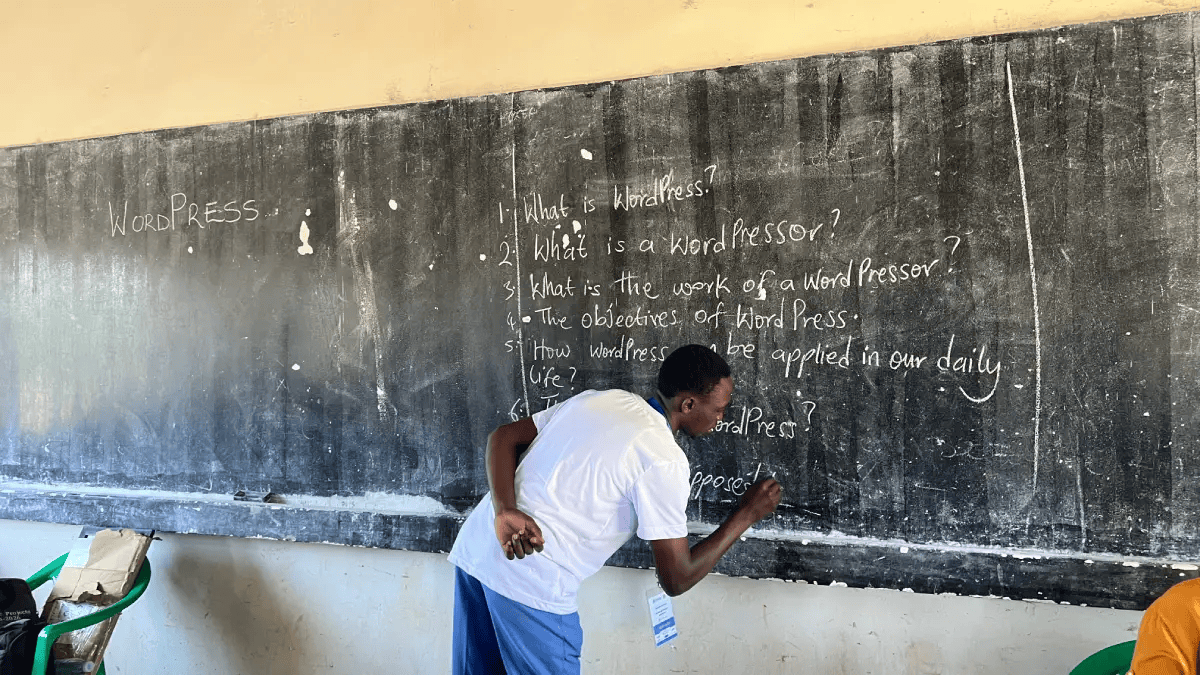
**Uganda.** This is the article's strongest narrative beat. Mariam Nairuba, a former student at Bulamogi College Gadumire, asked organizer Moses Ssebunya at a December event in Kaliro whether Campus Connect could come to her old school. She arranged it herself; on July 29 the team arrived with laptops, a projector, and extension cables to find no electricity and 100+ learners waiting. Rather than cancel, the team (including Nairuba and fellow first-time volunteer John Wayera) asked the room two open questions — what do you already know about WordPress, what do you want to know — and ran the session off the answers, writing questions on a blackboard as they came in. The school's Director of Studies, who hadn't known about the power situation either, received a Certificate of Appreciation in front of the school's governing body.
**Spain.** Josep Morán ran two four-hour sessions at Escola Pia Sta. Anna in Mataró for 100 vocational students, who used the WordPress Playground and AI assistance to build a working plugin that calculates the best time for shore fishing locally — a deliberately local, functional artifact rather than a demo site. The article reports students and faculty converged on two takeaways: the certificate, and that the skills map to jobs that actually exist in Mataró.
**Costa Rica.** Rita Robles Loaiza ran two separate pilots on the premise that recent graduates of the program are the best people to teach it next. First: three students from the second WordPress Credits cohort at Universidad Fidélitas designed and delivered a workshop for 40 high school girls at Patrones Hermosos, a Tecnológico de Monterrey/MIT STEM camp making its first stop in Costa Rica. Every participant built and presented a site; reported satisfaction was 100 percent; the team then wrote up a replicable guide (linked as a PDF) so any school or community group can run the same session. Second, longer-horizon pilot: 13 students at Liceo Experimental Bilingüe José Figueres Ferrer — the first high school in the Americas admitted to WordPress Credits — are translating WordPress into es_CR with the Costa Rican Spanish Polyglots team as their community-service requirement.
The article closes on a pitch (no cost to bring Campus Connect to a school; Credits gives a mentor and "real contributions to software that runs more than 40 percent of the web"; Student Clubs keep campus groups meeting after a workshop ends) and points to the full July Buzz Report for events it didn't have room to cover, naming two: a Campus Connect session run entirely by students at Kyoto University of Advanced Science, and a Student Club in Dhaka now organizing its own event.
## 🗒️ Notes
- **Two-week framing is narrower than the article's scope.** The headline promises "two weeks," which accurately describes only the Bangladesh series (two sessions, two weeks apart). The body then covers four other countries and a full month of Buzz Report activity — the title generalizes a local timeframe to the whole piece.
- **108 sites vs. 150+ students is an unreconciled gap.** 38 + ~70 = 108 sites is presented as the headline count, but the success-stories page the article itself cites counts 150+ participants. The article never states whether sites were built solo or in groups, so the ratio between "student" and "website" is not recoverable from the text.
- **The Uganda story is the only one with a named improvisation under failure.** Every other story describes a workshop running as planned; Uganda is the one case where the plan (laptops, projector, extension cables) failed on arrival and the team adapted live. This is also the only story where the article names the *method* of adaptation (two open questions, blackboard capture) in enough detail to be reused.
- **"No cost" is scoped to the school, not the program.** The Get Involved section says "there is no cost to bring any of this to a school" — true from the host institution's side, but the Uganda story shows real costs exist (volunteer travel, hardware brought and unused, unpaid organizer time coordinating with the school). The article doesn't reconcile the two claims; they aren't in tension for the reader being pitched, but they would be for anyone costing out the program from the volunteer side.
- **Image accessibility gap, verifiable from the captured HTML.** The three gallery images embedded after the Uganda section (`image.png`, `image-1.png`, `image-2.png`) all carry `alt=""` — no descriptive alt text. For a Community team post documenting a specific, describable moment (a powerless classroom, a blackboard full of questions), this is a missed opportunity and a WCAG 1.1.1 gap, not an inference — it's in the raw markup.
- **Every organizer named is individually attributed and linked** to a wordpress.org profile — Haque, Karmakar, Morán, Ssebunya, Robles Loaiza. This is a deliberate credit-and-discoverability pattern: a reader interested in running a similar session has a direct contact, not just a program name.
- **The Costa Rica translation pilot is the only story with an institutional milestone attached** (first high school in the Americas admitted to WordPress Credits) rather than just an attendance number — worth flagging separately from the STEM workshop pilot, which the article bundles under the same "Rita Robles Loaiza published two pilots" sentence even though they're different schools, different student groups, and different deliverables (a workshop guide vs. an in-progress translation).
## 📚 References
- [WordPress Campus Connect — Kishoreganj event page](https://events.wordpress.org/campusconnect/2026/kishoreganj/)
- [Kishoreganj success stories page](https://events.wordpress.org/campusconnect/2026/kishoreganj/success-stories/)
- [Muhibul Haque — wordpress.org profile](https://profiles.wordpress.org/devmuhib/)
- [Shipon Karmakar — wordpress.org profile](https://profiles.wordpress.org/shiponkarmakar/)
- [Josep Morán — wordpress.org profile](https://profiles.wordpress.org/josepmoran/)
- [Moses Ssebunya — wordpress.org profile](https://profiles.wordpress.org/mosescursor/)
- [Bulamogi College Gadumire Campus Connect recap](https://events.wordpress.org/campusconnect/2026/central-eastern-ug/gadu-maya-wordpress-campus-connect-finds-a-home-at-bulamogi-college-gadumire/)
- [Rita Robles Loaiza — wordpress.org profile](https://profiles.wordpress.org/roblesloaiza/)
- [Make/Community: "Exploring new ways to contribute to WordPress through WPCredits"](https://make.wordpress.org/community/2026/07/31/exploring-new-ways-to-contribute-to-wordpress-through-wpcredits/)
- [Universidad Fidélitas](https://ufidelitas.ac.cr/)
- [WPCredits Replicable Guide (PDF)](https://make.wordpress.org/community/files/2026/07/EN_WPCredits-Replicable-Guide.pdf)
- [Costa Rican Spanish Polyglots team](https://make.wordpress.org/polyglots/teams/)
- [Monthly Education Buzz Report, July 2026](https://make.wordpress.org/community/2026/08/05/monthly-education-buzz-report-july-2026/)
## 🗣️ Paraphrase
Five WordPress education stories from July 2026 make the case that the program's volunteer-run training pipeline — Campus Connect for one-off workshops, WordPress Credits for mentored, credit-bearing internships, Student Clubs for ongoing campus groups — is running at real scale and adapting to real conditions. Students in Bangladesh built over a hundred sites across two sessions organized two weeks apart; a Ugandan team improvised an entire session from scratch after arriving to a school with no power, at the request of a former student who'd asked for the program herself; a Spanish class built a functional local-utility plugin instead of a demo site; and two Costa Rican pilots show recent graduates immediately becoming the next cohort's teachers, one running a STEM workshop for high school girls and the other translating WordPress into regional Spanish for course credit.
The throughline is that this isn't top-down content distribution — it's a shared curriculum plus local judgment. Every story credits a specific named organizer who adapted the format to their setting: Haque running back-to-back sessions at two institutions, Nairuba pulling in her own former school, Morán steering toward a locally useful plugin, Robles Loaiza deliberately using recent Credits graduates as instructors. What the article doesn't do is verify any of it past the workshop's end — attendance and enthusiasm are documented in detail; retention, site survival, and post-program outcomes are not mentioned once.
## 📰 Newsletter
Five stories, one pipeline: WordPress's Campus Connect and WordPress Credits programs put up real numbers in July — 226 Credits graduates (up from 199 in June), 38 partner institutions, 16 countries, and a 108-site, two-session run in Bangladesh alone. The standout is Uganda: a Campus Connect team showed up to a school with no electricity and 100+ waiting students, and ran the workshop anyway by asking the room what they already knew and what they wanted to learn — writing the answers on a blackboard as the session went. Costa Rica's contribution is the one worth stealing directly: a WordPress Credits cohort wrote up their own STEM workshop for 40 high schoolers as a step-by-step replicable guide (PDF linked below), so any Training team — including ours — can run the same session without reinventing it. Worth a read if you run or fund WordPress workshops: the format (shared curriculum, local adaptation, named organizer credit) is the actual product here, not any single event.
## ✅ Action Items
#### DevRel
- Advocacy: the five named organizers (Haque, Nairuba, Ssebunya, Morán, Robles Loaiza) are exactly the kind of grassroots voices a DevRel talk-and-demo pipeline should be recruiting for WordCamp or meetup sessions on "teaching WordPress in low-resource settings" — the Uganda story alone is a ready-made case study.
- Developer marketing: the "skills map to local jobs" takeaway from the Spain workshop is a reusable framing for recruitment copy aimed at vocational/technical students specifically, distinct from university CS-track messaging.
#### OSPO
- Not applicable to this source — no licensing, SBOM, or formal governance content; Credits' "academic credit for contributing to WordPress" is a training/education mechanism, not an OSPO policy artifact.
#### Community
- Sponsors: the article's growth numbers (226 graduates, 38 institutions, 16 countries) are exactly the kind of metric a Community team impact report needs, but they're presented without a baseline or a completion/dropout rate — worth requesting the underlying Buzz Report data if this is going into a funding case.
- Cross-project: the Costa Rica replicable-guide pattern (run it once, document it precisely enough for someone else to run it cold) is worth formalizing as a standard deliverable for every Campus Connect session, not just the ones that happen to write one up.
#### WordPress
- **Training** — directly replicable here: (1) the Costa Rica STEM guide is a ready-made lesson plan Courtney's training work could adapt or benchmark against rather than build from scratch; (2) the Uganda "ask what you know / what you want to know" opening is a low-infrastructure session-design technique worth testing in any workshop where equipment or connectivity is uncertain, not just as an emergency fallback. What's unmeasured and shouldn't be assumed: none of the five sessions report a skills-retention check, a follow-up survey, or whether students kept building after the workshop — "replicable" here means the *format* is documented, not that the *outcome* is proven.
- **Community** — the Student Clubs mechanism (keeping a campus group meeting after a workshop ends) is the piece most directly relevant to converting one-off workshop attendance into sustained local WordPress communities; the article names Dhaka's self-organizing Student Club as a real instance but gives zero detail on how many workshop attendees convert into ongoing club members, which is the actual metric that would validate the pipeline (workshop → Student Club → Credits) as a funnel rather than three unconnected programs.
- Core Program Team / Meta: not applicable — no core software, roadmap, or .org platform content in this source.
- Marketing: the "40 percent of the web" line and the certificate-plus-local-jobs framing are both directly reusable in recruitment copy for a training program targeting vocational or technical-school partnerships.
- Documentation: the replicable guide format (Costa Rica) is worth cross-referencing against existing Training team lesson-plan templates to check for duplication or a gap it fills.
#### The WPOCC
- Not applicable to this source — no fellowship, funding, or governance content; program growth here runs through Community team infrastructure (Campus Connect/Credits/Student Clubs), not The WPOCC's remit.
#### FAIR
- Not applicable to this source — no federation, provenance, or governance-artifact content.
## 🧪 Hypotheses
- H1: Workshops that explicitly steer toward a locally useful build target (Spain's shore-fishing plugin, Costa Rica's Spanish-language localization) produce higher completion rates than workshops using a generic demo-site exercise.
- H2: A "recent graduate teaches the next cohort" structure (Costa Rica's model) produces higher student engagement or satisfaction than sessions taught exclusively by long-tenured volunteers.
- H3: Sessions with a named, personally-invested local organizer (Nairuba requesting her own former school) have higher turnout and lower cancellation risk than centrally-scheduled sessions without a local advocate.
- H4: Infrastructure failure (no power, no internet) doesn't reduce workshop-reported satisfaction when the session pivots to a discussion/Q&A format rather than a hands-on build.
- H5: The "no cost to the school" framing undercounts true program cost; volunteer time and hardware account for a measurable, non-zero cost per session that the current messaging omits.
### 📊 Methodology
- For H1: compare completion/satisfaction rates across a sample of Campus Connect sessions coded by build-target type (generic demo site vs. locally-functional tool vs. localization/translation task), controlling for session length and student count.
- For H2: A/B or historical comparison of sessions taught by first-time Credits-graduate instructors versus veteran Campus Connect volunteers, holding curriculum and venue type constant; measure post-session survey scores and 30/60/90-day site-activity retention.
- For H3: code each 2026 Campus Connect session for whether it was organizer-requested-by-a-local-alum versus centrally scheduled; compare turnout and no-show/cancellation rates.
- For H4: track satisfaction and stated learning outcomes for infrastructure-disrupted sessions (Uganda-style) against matched sessions that ran as planned.
- For H5: build a per-session cost model (volunteer hours, travel, hardware, prep time) from a sample of organizer debriefs and compare against the "no cost" framing used in outward-facing recruitment material.
### ❓ Questions
- How many of the 108 Bangladesh sites, and the sites from the other four sessions, are still live and updated 90 days after the workshop?
- What conversion rate exists between Campus Connect attendance and either a Student Club join or a WordPress Credits application — is there a funnel here, or three disconnected programs sharing a brand?
- Does the 226-graduates-in-July figure represent net growth or does it include a cohort that would have graduated regardless of this month's specific push — is month-over-month comparison (199 to 226) meaningful without a longer trend?
- What made the Uganda team's "what do you know / what do you want to know" pivot work well enough to be reported as a success — was it captured by a post-session survey, or is "the room exploded" the organizers' own retrospective framing with no independent measure?
- Since the article states 150+ Kishoreganj participants against 108 built sites, were any sites built by pairs or small groups, and does that change what "108 websites in two weeks" actually claims?
### 🔮 Future Research
- No published data connects any of these five workshops to downstream outcomes — job placement, continued WordPress use, or open-source contribution — beyond the workshop day itself.
- No comparison across programs of cost-effectiveness (dollars or volunteer-hours per graduate) between Campus Connect (one-off, unpaid, curriculum-based) and WordPress Credits (mentored, multi-month, academic-credit-bearing).
- No study of what makes an organizer like Nairuba or Haque effective at recruiting and running sessions repeatedly, versus a one-time volunteer — this matters for scaling the program past individual champions.
- No public accounting of the "40 percent of the web" claim's relevance to specific regional job markets named in the article (Bangladesh, Uganda, Spain, Costa Rica) — the Spain story asserts local job relevance but doesn't cite labor-market data.
### 💡 Implications
- **Practice.** For Courtney's training/DevRel work, the most directly reusable artifact is the Costa Rica PDF guide — it's a tested, documented lesson plan for a specific audience (high-school STEM outreach) that could be benchmarked, adapted, or explicitly credited rather than rebuilt.
- **Policy/governance.** None named in the source; growth metrics (226 graduates, 38 institutions) suggest the program has crossed a scale where a standard outcome-reporting template (retention, site survival, conversion to Student Clubs) would strengthen future funding or governance conversations, but no such template appears here.
- **Security.** Not applicable to this source — no security content.
- **Education.** The Uganda pivot (ask what the room already knows and wants, then teach to that) is the single most portable technique in the piece — it doesn't require the Obsidian/AI tooling or any specific curriculum, just a facilitator willing to improvise from a blank blackboard.
- **Funding models.** The "no cost to the school" pitch is effective recruitment language but obscures the real input cost (volunteer travel, hardware, unpaid coordination time shown explicitly in the Uganda story); a funding pitch built on this article's numbers should account for that gap rather than repeat the "no cost" framing uncritically.
### 🧠 Learning Styles Assessment
- **Reading level estimate:** Flesch-Kincaid Grade Level ≈ 11.3. Basis: 842 words, 42 sentences (≈20 words/sentence), 1.62 syllables/word on average — longer than typical news copy because of dense proper-noun clusters (institution names, program names, Spanish/Bangla place names) rather than complex vocabulary.
#### 👀 Visual learners
- **Present:** a three-image gallery documenting the Uganda session (classroom, blackboard, group).
- **Improve:** the images carry no alt text (`alt=""` in the captured markup) and no in-article captions identifying what's shown — a visual learner gets three unlabeled photos with no way to confirm what they depict without cross-referencing the linked recap post.
#### 🔊 Aural learners
- **Present:** none — no audio, podcast, or narrated version exists for this text-only news post.
- **Improve:** a short audio recap (2–3 minutes) covering the five stories and the two headline metrics (226 graduates, 108 sites) would extend reach to aural-preference readers.
#### 🗣️ Verbal learners
- **Present:** clear definitions of the three programs (Campus Connect, Credits, Student Clubs) given up front before any story is told.
- **Improve:** the article never defines "es_CR" (the Costa Rican Spanish locale code) or explains what a Polyglots team does — both assumed knowledge for a general reader.
#### 🧩 Kinesthetic learners
- **Present:** the Costa Rica replicable guide is a genuine hands-on artifact linked directly from the article.
- **Improve:** only one of five stories links to a reusable how-to document; the Bangladesh, Uganda, and Spain sessions describe outcomes but leave no downloadable curriculum or checklist a reader could run themselves.
#### 🧠 Logical learners
- **Present:** the growth metric (226 graduates, up from 199, across 38 institutions/16 countries) gives a clear numeric anchor.
- **Improve:** a simple table mapping story → country → program → headcount → artifact-produced would make the five parallel cases scannable instead of requiring five separate paragraph reads to extract the same fields.
#### 🧑🤝🧑 Social learners
- **Present:** the "students teaching students" framing (Costa Rica) and the credited, linkable organizer profiles across all five stories support direct follow-up contact.
- **Improve:** no discussion prompt or comment thread is referenced; a call-to-action inviting readers to connect with a named organizer in their region would extend the social loop the article already implies.
#### 🧘♀️ Solitary learners
- **Present:** the Costa Rica PDF guide is explicitly designed for a reader to pick up and run solo, without needing to contact the original team.
- **Improve:** none needed — this is the strongest self-serve element in the article.
#### 🌿 Naturalistic learners
- **Present:** the Spain plugin (shore-fishing timing) is a direct local-environment application, though the article doesn't develop it beyond one sentence.
- **Improve:** more detail on how the plugin uses tide or weather data would give naturalistic learners a concrete technical hook; as written it's mentioned, not explained.
### 📊 Accessibility Assessment
*Assessed from the captured article markup, not a live rendered page — layout, contrast, and interactive behavior of the published post were not directly observed.*
#### Screen reader semantics
- **Present:** clear `<h2>` section structure (What the Students Built, A Workshop Without Power, Students Teaching Students in Costa Rica, Get Involved) that maps cleanly to landmarks.
- **Improve:** the three gallery images use interactive lightbox markup (`data-wp-interactive="core/image"`, click-to-expand) with no visible text alternative for what each image shows to a screen-reader user (WCAG 2.2 SC 1.3.1, 4.1.2).
#### Keyboard navigation
- **Not observed** — the lightbox gallery's keyboard operability (opening/closing via keyboard, focus return) isn't verifiable from the captured markup alone; flag for direct testing (SC 2.1.1, 2.4.3).
#### Contrast and readability
- **Not observed** — text/background contrast on the live page wasn't visually reviewed (SC 1.4.3, 1.4.11).
#### Text resizing and reflow
- **Not observed** — the gallery figure's responsive `sizes`/`srcset` attributes suggest image reflow is handled, but text reflow at 200% zoom wasn't tested (SC 1.4.4, 1.4.10).
#### Media and captions
- **Present:** no audio/video in this post, so no caption requirement applies.
- **Improve:** the three images have empty `alt=""` attributes — this is the article's clearest, most verifiable accessibility gap (WCAG 2.2 SC 1.1.1 Non-text Content), confirmed directly in the captured HTML rather than inferred.
#### Forms and interactions
- **Present:** the gallery's click-to-expand lightbox is the only interactive element.
- **Improve:** confirm the lightbox trigger has an accessible name and that focus is managed on open/close (SC 2.4.3, 4.1.2).
#### Standards reference
- Gaps above map to WCAG 2.2 AA: 1.1.1 (confirmed — empty alt text), 1.3.1, 1.4.3, 1.4.4, 1.4.10, 1.4.11, 2.1.1, 2.4.3, 4.1.2. Only 1.1.1 is confirmed from the captured markup; the rest require direct review of the live page.
### 🌍 DEIB Assessment
#### Cultural breadth
- **Present:** genuinely global — Bangladesh, Uganda, Spain, and Costa Rica in the main text, plus Japan (Kyoto) and a second Bangladesh city (Dhaka) named in the closing pointer to the full Buzz Report.
- **Improve:** all five detailed stories are told through the organizer's or article's framing; no direct student quote appears anywhere in the piece, so the breadth is geographic, not necessarily representational of student voice.
#### Inclusive language
- **Present:** consistent, plain, non-idiomatic language throughout — reads well for readers translating the article via machine translation, which matters given the international subject matter.
- **Improve:** none needed.
#### Neurodiversity support
- **Present:** short paragraphs, one story per section, consistent `<h2>` chaptering.
- **Improve:** the Uganda paragraph is denser than the others (multiple named people, a timeline, a twist) without an internal subheading — a reader tracking structure could lose the thread partway through.
#### Representation
- **Present:** three of five named organizers/leads are women (Nairuba, Robles Loaiza, plus the STEM workshop's explicit "increase female participation" goal); the Costa Rica STEM pilot is the only story with a stated gender-equity purpose.
- **Improve:** the other four stories (Bangladesh, Uganda's general session, Spain, Costa Rica's translation pilot) report no gender or demographic breakdown of the ~350+ combined participants — representation data exists for one story out of five and is silently absent from the rest.
#### Psychological safety
- **Present:** the Uganda story frames an equipment failure without blame — no institution or person is criticized for the power outage; the piece stays solution-focused.
- **Improve:** none needed; the tone is uniformly supportive and non-judgmental across all five stories.
### ✅ Logical Validity
#### Strong reasoning
- **Causal, individually-sourced narrative (Uganda, throughout):** the chain from "Nairuba asks Ssebunya at a December event" to "she personally arranges it" to "she co-facilitates alongside a first-time volunteer on July 29" is a specific, checkable causal sequence with named actors and a date — not a vague "the community came together" claim.
- **Concrete artifact as evidence (Costa Rica):** the claim that the STEM workshop is replicable isn't just asserted — a linked PDF guide is the actual evidence, letting a reader verify the claim rather than take it on faith.
#### Fallacies
- **Hasty generalization from a curated sample.** Location: the article implicitly frames five hand-picked stories as representative of "what's happening" in WordPress education this month, while its own final paragraph admits the full Buzz Report "has the events that didn't fit here." Why it's weak: five successful, well-documented stories say nothing about the sessions that didn't go well, weren't written up, or produced weaker outcomes — success stories are, by definition, selected for success. Fix: a line noting how many total Campus Connect/Credits sessions ran in July, with the five featured stories explicitly framed as a sample, would let a reader calibrate how representative the highlights are.
- **Equivocation on "no cost."** Location: "There is no cost to bring any of this to a school" (Get Involved section) sits in the same article as the Uganda story, where the team brought laptops, a projector, and extension cables that went unused, and an organizer personally coordinated logistics with a school administration. Why it's weak: "no cost" is true for the *host institution* but false as a description of the *program's* total input cost — the article doesn't distinguish the two, so a reader could reasonably (and incorrectly) conclude the program has no real resource cost anywhere.
#### Tone of voice
- Warm, promotional, third-person journalistic register; consistent narrative structure per story (context → named organizer → what happened → outcome); no hedging language anywhere — every reported outcome (100% satisfaction, "the room exploded," skills mapping to local jobs) is stated as settled fact with no attribution to a survey instrument or methodology.
### 🛡️ DARVO Analysis
- **Deny:** Not applicable to this source — no accusation exists anywhere in the article for anyone to deny.
- **Attack:** Not applicable to this source — no critic, complainant, or accuser appears; the piece contains zero adversarial framing.
- **Reverse victim/offender:** Not applicable to this source — there is no victim/offender narrative to reverse. The closest structural parallel is the Uganda power outage, but the article explicitly declines to assign blame to the school or anyone else for it, which is the opposite of DARVO's victim-blaming reversal — it's a straightforward "the team adapted" story, not an accused party recasting themselves as wronged.
## 🎯 Conclusion
The article documents five real, individually-verifiable WordPress education events from July 2026 and a genuine program-level growth number (226 Credits graduates, up from 199 in June, across 38 institutions in 16 countries) — but it's a curated highlight reel built from a monthly Buzz Report, not a program evaluation, and it never measures what happens after a workshop ends: site survival, skills retention, or conversion into Student Clubs or Credits applications. The most immediately useful thing in it for training and community work is the Costa Rica replicable guide — a tested, documented artifact rather than a narrated anecdote — and the Uganda team's low-infrastructure "ask what the room knows and wants" pivot, which needs no tooling to reuse. Practical next step: pull the underlying Buzz Report data (completion/attendance across all July sessions, not just the five featured here) before citing this article's numbers in a funding or program-design case, and treat the "no cost" framing as scoped to the host school, not the program's real volunteer cost.
## 🔄 Refactor Appendix — Students Built 108 Websites in Two Weeks in Bangladesh
> Density: 4 Literature atoms (H4), 2 Permanent candidates (H4).
> Konik claim-header rules: present tense, declarative, ≤10 words, searchable, unique.
> Atomicity: one declarative sentence per atom.
### 📚 Literature Atoms
#### [H1] WordPress Credits graduated 226 students in July
> [!quote]
> Credits passed 226 graduates in July, up from 199 in June, and now works with 38 partner institutions across 16 countries.
**Context & use**:
- The article's only hard program-growth metric, given without a longer trendline beyond the single month-over-month delta.
- Anchors the piece's implicit claim that the education pipeline is scaling; useful as a citable figure for a funding or program-design case, with the caveat noted in Questions about whether one month's delta is meaningful.
**Tags**: #xref
<!-- atomicity: 1 idea ✓ -->
#### [H2] Uganda workshop ran despite no electricity onsite
> [!quote]
> So was the school’s Director of Studies, who learned that day there was no electricity.
**Context & use**:
- The pivot point of the Bulamogi College Gadumire story: the team's equipment (laptops, projector, extension cables) became unusable on arrival, and the session ran anyway.
- Grounds the "ask what the room knows and wants" adaptation technique covered in Notes and Implications.
**Tags**: #xref #aphorisms
<!-- atomicity: 1 idea ✓ -->
#### [H3] Open questions to the room replaced the lost lesson plan
> [!quote]
> “The room exploded,” the organizers wrote in their recap of the day.
**Context & use**:
- Direct quote from the organizers' own recap post, describing the room's reaction to being asked what they already knew and wanted to learn, instead of receiving the planned hands-on curriculum.
- The article's only first-person-sourced (not third-party-narrated) line; everything else is the wordpress.org author's paraphrase of events.
**Tags**: #xref
<!-- atomicity: 1 idea ✓ -->
#### [H4] Credits pitches mentorship and real code contribution
> [!quote]
> WordPress Credits gives a student a mentor, real contributions to software that runs more than 40 percent of the web, and something concrete to put on a resume.
**Context & use**:
- The article's closing recruitment pitch for WordPress Credits, distinct from Campus Connect's one-off workshop pitch ("no cost," "a certificate").
- Useful as reusable recruitment language for a training program targeting students who want an ongoing, resume-relevant contribution path rather than a single session.
**Tags**: #xref
<!-- atomicity: 1 idea ✓ -->
### 🧠 Permanent Candidates (H4)
#### [P1] Ask the room what it knows before teaching it anything
**Claim** (Courtney's voice): When a planned curriculum can't run, I get a better session by asking the room what it already knows and wants to learn than by trying to recover the original lesson plan.
**Evidence pointer**: [[#H2]]
**Scope & conditions**: Tested here under infrastructure failure (no power), not as a general opening technique for sessions that go as planned; the article gives no comparison to how the same group would have responded to the originally planned hands-on format.
**Links** (≥1 with annotation):
- [[Low-infrastructure teaching]] — because applies-in: any WordPress workshop where connectivity, power, or hardware can't be guaranteed in advance.
<!-- atomicity: 1 idea ✓ -->
#### [P2] Recent graduates teaching the next cohort compounds a curriculum
**Claim** (Courtney's voice): A workshop curriculum gets more durable and more locally relevant when I have its most recent graduates re-teach it, rather than keeping delivery with the original designers.
**Evidence pointer**: [[#H1]] [[#H4]]
**Scope & conditions**: Demonstrated once, in the Costa Rica STEM pilot, by three second-cohort Credits students teaching 40 high schoolers; the article doesn't report whether the resulting replicable guide has since been run by a third party independent of the original team.
**Links** (≥1 with annotation):
- [[Train-the-trainer model]] — because extends: applies the general train-the-trainer pattern specifically to a WordPress Credits cohort as the trainer pool.
- [[Replicable documentation]] — because evidence-for: the PDF guide is what makes this claim checkable rather than anecdotal.
<!-- atomicity: 1 idea ✓ -->
### ✏️ Fleeting Queue
- [F1] Request the underlying July Monthly Education Buzz Report data (total sessions run, not just the five featured) before citing this article's growth numbers in any funding or program-design document. — https://make.wordpress.org/community/2026/08/05/monthly-education-buzz-report-july-2026/ #xref
- [F2] Check whether the Costa Rica replicable guide format could be adapted as a standard template for other Campus Connect sessions, given only one of five stories in this article produced a reusable document. — #xref #articleseed
### → Things 3 (max 2 actions)
- [ ] Pull the Costa Rica WPCredits Replicable Guide PDF and compare its lesson structure against current WordPress Training team lesson plans for gaps or duplication — context #wp-training #things
- [ ] Draft a one-page low-infrastructure workshop fallback technique (based on the Uganda "what do you know / what do you want to know" pivot) for any session where power or connectivity isn't guaranteed — context #wp-training #things
<!-- deep-read:sections end -->
📄 **Full text:** [[Full Document Contents/Articles/Students Built 108 Websites in Two Weeks in Bangladesh.md|Students Built 108 Websites in Two Weeks in Bangladesh by WordPress.org]]
## Highlights
- So was the school’s Director of Studies, who learned that day there was no electricity. ([View Highlight](https://read.readwise.io/read/01m25w2qp2y479n93mwqpza7wt))
- Note: The Uganda low-infrastructure pivot — the most replicable detail in the piece, and unreconciled with its "no cost" framing.
- Tags: xref, wordpress-education