Studio: The Future of AI WordPress Is NOW
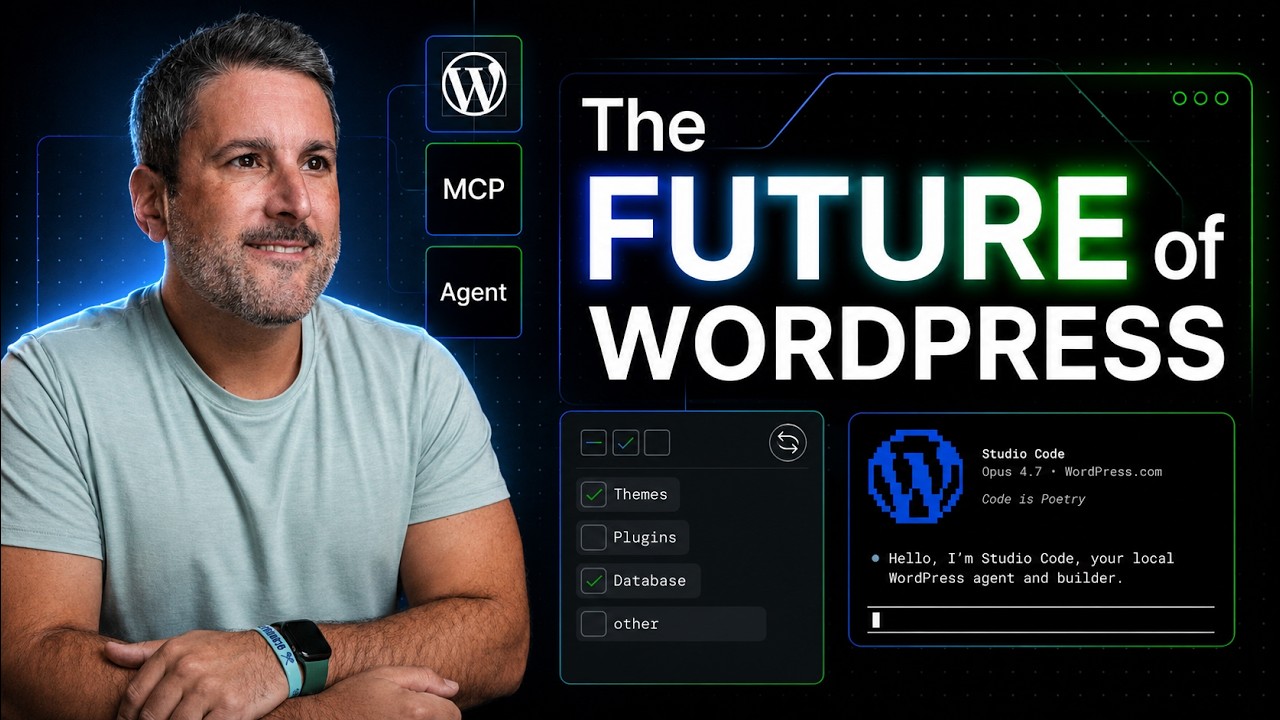
🔗 **Source:** [Studio: The Future of AI WordPress Is NOW](https://www.youtube.com/watch?v=BUhehyvFw6o)
> [!note]+ Document Notes
> tags: [agentic-wordpress, ai-website-builders, wordpress-studio, ai-assisted-development, gutenberg-blocks]
> author: Matt Medeiros (The WP Minute) — inferred from host creating a demo user with email
[email protected]; not explicitly stated on camera
> source: The WP Minute (YouTube)
> reference: https://www.youtube.com/watch?v=BUhehyvFw6o
> date created: 2026-08-14
>
> > [!info] Generated analysis — not the author's words. Sections below are machine-written
> > from the captured source. Only text inside `> [!quote]` blocks is verbatim from the author.
> > Do not quote or attribute any other line to the named author.
>
> # 🏷️ Title: Studio: The Future of AI WordPress is NOW
>
<!-- deep-read:sections start -->
## 🧭 Table of Contents
- [📝 Summary](#-summary)
- [📖 Main Content](#-main-content)
- [🗒️ Notes](#️-notes)
- [📚 References](#-references)
- [🗣️ Paraphrase](#️-paraphrase)
- [📰 Newsletter](#-newsletter)
- [✅ Action Items](#-action-items)
- [🧪 Hypotheses](#-hypotheses)
- [📊 Methodology](#-methodology)
- [❓ Questions](#-questions)
- [🔮 Future Research](#-future-research)
- [💡 Implications](#-implications)
- [🧠 Learning Styles Assessment](#-learning-styles-assessment)
- [📊 Accessibility Assessment](#-accessibility-assessment)
- [🌍 DEIB Assessment](#-deib-assessment)
- [✅ Logical Validity](#-logical-validity)
- [🛡️ DARVO Analysis](#-darvo-analysis)
- [🎯 Conclusion](#-conclusion)
### 🔗 References
- [Studio (Automattic local WordPress dev app)](https://developer.wordpress.com/studio/)
- [WordPress.com](https://wordpress.com)
- [GeneratePress](https://generatepress.com)
- Source video: [Studio: The Future of AI WordPress is NOW](https://www.youtube.com/watch?v=BUhehyvFw6o)
## 📝 Summary
- **What happened.** The host live-tests Studio 2.0 beta — Automattic's local WordPress development app — which now embeds an agentic "AI WordPress expert" connected through wordpress.com and running on Claude Sonnet 5, Claude Opus 5, and a ChatGPT 5-series model (heard on the auto-captions as "5.6 Soul," almost certainly a mis-transcription — treat the exact model name as unverified). Over roughly 46 minutes of recorded testing, the agent restyles a GeneratePress child theme, edits the wp-admin dashboard, writes and illustrates three blog posts, recategorizes content, creates a WordPress user account and assigns authorship, builds a full landing page (hero, CTAs, services, testimonials), and generates a custom Gutenberg block packaged as an installable plugin.
- **Why it matters.** This is presented as the first agentic WordPress builder the host has tested that follows WordPress-native conventions by default — generating a child theme instead of hacking core theme files, and using `functions.php` rather than screen-option toggles. If reliable, this closes the gap between chat-based "vibe coding" and professional WordPress build practice, with direct implications for freelancers, agencies, and higher-ed/enterprise WordPress operators who manage large numbers of sites and user accounts.
- **Key stakeholders.** Automattic/WordPress.com (product and messaging), Studio users (freelancers, agencies, WordPress power users), the broader WordPress open-source community, competing "vibe-coding" platforms mentioned in passing (e.g., "Miles"), and end clients whose sites get built this way.
- **Risks and tradeoffs.** No stated usage/token quota or pricing threshold for the wordpress.com AI connection (host says he doesn't know where it is). Generated content is thin and generic (a two-sentence pizza description) and not client-ready without human editing. Generated imagery is illustrative, not usable for e-commerce/marketing as-is. The agent mis-scoped a query (selected only the three demo posts instead of an entire category) without being told to — a class of silent scope error the host flags as something builders must audit for. `functions.php` is described by the host as becoming "a dumping ground" absent more structure. Automattic has not, per the host, publicly marketed or announced this capability to the WordPress community.
- **Bottom line.** Agentic, WordPress-convention-respecting site building is now functionally real inside an official Automattic product, not just a third-party MCP hack — but it ships with real content-quality, cost-transparency, and communications gaps that a buyer or WordPress professional should account for before relying on it in front of clients.
## 📖 Main Content
- The host frames the segment against prior approaches: ad hoc MCP connections piping Claude or ChatGPT/Codex into a WordPress site, and at least one competing "vibe-coding" platform (heard as "Miles") that modified theme files directly rather than following WordPress conventions. Studio 2.0 beta is positioned as the first tested tool that defaults to a proper child theme.
- Connecting Studio to an "AI WordPress expert" requires linking the local site to a wordpress.com account — the monetization and hosting path Automattic is building toward. The host explicitly does not know what usage limits or billing thresholds apply once a wordpress.com account is connected for AI use, and says he'll try to confirm with the Automattic team.
- Studio's new browser-style interface bundles WP admin, phpMyAdmin (database), Finder (files), and Terminal access directly in the app shell — mirroring the "harness with built-in browser" pattern the host associates with Claude Code Desktop, Codex Desktop, and Cursor. He frames this as a natural interface convergence rather than a WordPress-specific innovation.
- Three capability tiers get tested in sequence: (1) design/theming — auto-restyle to "modern and welcoming," generating a real child theme with typography/color/header/nav/footer changes; (2) admin/system-level actions — removing the Quick Draft dashboard widget via a `functions.php` edit, creating a new WordPress user account with an editor role, and reassigning post authorship; (3) content and functionality — writing three recipe blog posts with AI-generated featured images, recategorizing posts, building a full landing page, and generating a custom Gutenberg block bundled as a standalone plugin ("Matt's Pizza Shop plugin v1.0").
- The host repeatedly narrates both successes and rough edges in the same breath rather than only showcasing wins: a hidden page title left unaddressed, front-end/back-end button style mismatches, a block that queried only the three demo posts instead of an entire category without being told to scope it that way, and placeholder testimonials fabricated on request.
- Model switching is available mid-session (Sonnet 5 → Opus 5) with no visible warning about cost or token consumption, which the host flags as a transparency gap for anyone budgeting AI usage on wordpress.com.
- Closing point: the host's core reservation isn't about capability — it's about communication. He says Automattic/WordPress has not surfaced or marketed this to the community, and speculates an announcement could land at WordCamp US.
### 🗒️ Notes
#### ⏱️ [00:00](https://www.youtube.com/watch?v=BUhehyvFw6o&t=0) Intro and thesis
- Frames Studio 2.0 beta against prior MCP-based agentic WordPress workflows.
- "The future of agentic WordPress website building is here in a more official capacity."
#### ⏱️ [00:45](https://www.youtube.com/watch?v=BUhehyvFw6o&t=45) Local Studio site + wordpress.com AI connection
- Studio runs the site locally; connecting to wordpress.com activates the "AI WordPress expert."
- Monetization/hosting path: publish directly to wordpress.com.
#### ⏱️ [01:56](https://www.youtube.com/watch?v=BUhehyvFw6o&t=116) Auto-restyle prompt on GeneratePress
- Built-in chat prompt: "Update the site's colors and fonts to feel more modern and welcoming."
- Result: a proper GeneratePress child theme and child stylesheet, not a core-file edit — contrasted with a prior tool ("Miles") that hacked theme files directly.
#### ⏱️ [04:23](https://www.youtube.com/watch?v=BUhehyvFw6o&t=263) New embedded browser/dev interface
- WP admin, phpMyAdmin, Finder, and Terminal are now accessible inside Studio's own interface.
- Host compares this to the "harness with built-in browser" pattern of Claude Code Desktop / Codex Desktop / Cursor.
#### ⏱️ [06:41](https://www.youtube.com/watch?v=BUhehyvFw6o&t=401) Agentic dashboard edit
- Prompt: "Can we remove this from the dashboard?" (Quick Draft widget).
- Agent removes it by unregistering it via the child theme's `functions.php`, not a screen-options toggle.
#### ⏱️ [08:14](https://www.youtube.com/watch?v=BUhehyvFw6o&t=494) Content creation: three pizza posts
- Prompt asks for three posts with recipes and a featured image per post.
- Agent produces margherita, pepperoni, and quattro formaggi posts with AI-generated (not stock-sourced) featured images; content described by the host as "fairly thin."
#### ⏱️ [11:04](https://www.youtube.com/watch?v=BUhehyvFw6o&t=664) Maintenance: recategorization
- Prompt: move the three posts into a "Pizza" category and remove "Uncategorized."
- Host frames this as one of three time-consuming/daunting WordPress tasks (design, content, taxonomy) now addressable by chat.
#### ⏱️ [12:33](https://www.youtube.com/watch?v=BUhehyvFw6o&t=753) User management
- Prompt creates a new user "Matt" (email
[email protected]), editor role, and reassigns the three posts to that account.
- Host connects this to WordPress's use at scale in higher-ed and other multi-site, many-user organizations.
#### ⏱️ [14:06](https://www.youtube.com/watch?v=BUhehyvFw6o&t=846) Landing page generation
- Prompt requests a homepage for "Matt's Pizza Shop": hero with two CTA buttons, a services section (three columns), and a testimonials section (fabricated on request).
- Host notes the "skill visual design" is explicitly loaded mid-task — a sign of a structured skills layer behind the agent, not a raw LLM-to-site connection.
- Result after ~485 seconds: a usable homepage with a real gap in styling (hidden page title) and imperfect font/button matching.
#### ⏱️ [18:14](https://www.youtube.com/watch?v=BUhehyvFw6o&t=1094) Custom Gutenberg block / plugin
- Prompt: build a Gutenberg block letting a user add a "sale item" to the homepage; host switches the model to Opus 5 for this task.
- Agent builds a "pizza sale" block with custom input fields, packaged as an installable plugin ("Matt's Pizza Shop plugin v1.0") — satisfying the explicit "make this a plugin" instruction.
- Host observes the block queried only the three demo posts rather than the whole Pizza category, without being told to scope it that way — flagged as a class of silent-scope surprise to watch for.
#### ⏱️ [22:21](https://www.youtube.com/watch?v=BUhehyvFw6o&t=1341) Wrap-up and closing thesis
- Tour of the "new site" flow (blank site, blueprint import, backup import) and device-preview switching (mobile/tablet/desktop).
- Closing framing: capability is real ("it's here"), but Automattic/WordPress has not publicly marketed or communicated it to the community; host speculates a WordCamp US announcement.
## 📚 References
- Primary source: [Studio: The Future of AI WordPress is NOW (YouTube)](https://www.youtube.com/watch?v=BUhehyvFw6o)
- [Automattic Studio](https://developer.wordpress.com/studio/) — the local WordPress development app under test
- [GeneratePress](https://generatepress.com) — the classic theme used as the restyling baseline
- [wordpress.com](https://wordpress.com) — hosting/account layer that activates the AI connection
## 🗣️ Paraphrase
- The host opens by distinguishing this from earlier DIY agentic setups (MCP servers piping Claude or ChatGPT into a WordPress site) — Studio 2.0 beta is Automattic's own official, integrated version of the same idea.
- He connects his local Studio site to wordpress.com to unlock the "AI WordPress expert," noting this is also the monetization and hosting on-ramp for Automattic.
- A single built-in prompt restyles his GeneratePress demo site, and — critically to him — the agent does this the "correct" WordPress way, via a child theme, rather than editing the parent theme directly like a prior tool he tested.
- Studio's interface now folds in WP admin, the database GUI, file access, and a terminal, which he reads as convergence with the "AI coding harness with embedded browser" pattern he's used elsewhere.
- He runs the agent through admin-level UI changes (removing a dashboard widget via `functions.php`), then content creation (three illustrated blog posts), then taxonomy cleanup, then user-account creation and authorship reassignment — treating these as representative of real day-to-day WordPress admin labor.
- A full landing page build follows, which he calls "rough" in prompt but largely successful in output, with a few visible gaps he'd still need to fix by hand.
- He finishes by having the agent build a custom Gutenberg block, delivered as an actual installable plugin, and notes a scoping surprise (it only queried the three demo posts, not the full category).
- He closes on an optimistic-but-critical note: the capability itself has arrived, but Automattic hasn't told the WordPress community it exists.
## 📰 Newsletter
Automattic just quietly shipped the agentic WordPress builder a lot of us have been duct-taping together with MCP servers — and it's actually playing by WordPress's own rules. In this walkthrough, a WordPress pro puts **Studio 2.0 beta** through its paces: restyling a GeneratePress site into a proper child theme, editing the wp-admin dashboard through `functions.php`, drafting and illustrating three blog posts, wrangling categories, spinning up a new user account, building a full landing page, and — the real party trick — generating a custom Gutenberg block packaged as an installable plugin. It's powered by Claude Sonnet 5 and Opus 5 (plus a ChatGPT 5-series model) sitting behind wordpress.com's "AI WordPress expert," with no visible token meter and no public word yet from Automattic about what any of this costs at scale. If you build WordPress sites for clients, this is worth 45 minutes of your time — bring your skepticism about generated stock photography and un-scoped block queries along with your optimism. [Studio](https://developer.wordpress.com/studio/) · [GeneratePress](https://generatepress.com)
## ✅ Action Items
#### DevRel
- Developer advocacy: produce an official Automattic-branded walkthrough of Studio 2.0's agentic features, since the host explicitly notes the absence of outbound comms.
- Education: publish a guide on what the agent will and won't do unprompted (e.g., query scoping, `functions.php` usage) so builders know what to audit.
- Developer experience: document the model-switching UX (Sonnet 5 / Opus 5 / GPT-5-series) and any token/cost implications before a user hits a paywall mid-build.
- Developer marketing: coordinate a community-facing announcement, potentially timed to WordCamp US as the host speculates.
- Community management: monitor and respond to early beta feedback threads as agentic Studio usage spreads.
- Internal/external/cross-project: align Studio's messaging with existing wordpress.com AI-feature communications so users aren't discovering this by accident, as this video's host did.
#### OSPO
- Policy & Governance: define a contribution/support policy for community-reported bugs in agent-generated theme/plugin code (e.g., mismatched front-end/back-end button styles).
- License Compliance: confirm licensing terms for AI-generated child themes, illustrations, and plugin code shipped through Studio.
- Security Management: establish a review path for agent-generated `functions.php` edits and custom plugins before they reach production sites.
- Software Inventory: track which Studio-generated artifacts (child themes, plugins, blocks) exist per site for future maintainability.
- Developer Support: staff a support channel specifically for agentic-build issues distinct from standard Studio/local-dev support.
- Community Engagement: solicit structured beta feedback from agencies and freelancers who build client sites at volume.
- Strategic Alignment: define what "done" looks like for Studio's agentic feature relative to broader Automattic AI investment.
#### Community
- Maintainers: assess whether Core coding standards should publish explicit guidance for what "acceptable" agent-generated `functions.php`/child-theme output looks like, given the host's "dumping ground" concern.
- Contributors: recruit testers specifically for the scoping-error class of bug (agent silently narrowing a query without being asked).
- Sponsors: consider sponsoring independent audits of AI-generated WordPress code quality as adoption grows.
- Ecosystem: coordinate with third-party AI/WordPress tool builders (the host references a competing tool, "Miles") on shared conventions for agent-generated code.
#### WordPress
- Core: define coding-standard guidance for AI agents that write directly to `functions.php`, since the host flags it becoming "a dumping ground for things."
- Core Performance: benchmark whether AI-generated child themes and blocks introduce performance regressions versus hand-built equivalents.
- Core AI: this video is direct primary-source evidence for Core AI's remit — track it as a real-world case study of agentic build quality and gaps.
- **Core Program Team:** coordinate messaging between the Studio team and community communications so releases like this don't ship without an announcement.
- Mobile: evaluate whether Studio's agentic features are relevant to or should be mirrored in the WordPress mobile app roadmap.
- Playground: test whether Studio-generated blueprints can be validated or previewed inside WordPress Playground before deployment.
- Community: prepare WordCamp session material demoing agentic Studio, as the host anticipates an announcement there.
- Training: build a lesson plan around the three capability tiers demoed here (design, admin/system, content/functionality) for onboarding new users to agentic building.
- Marketing: close the awareness gap the host explicitly names — "no one's knocking on my door" — with a dedicated campaign.
- Support: prepare HelpHub/support documentation for agent-generated plugin troubleshooting (e.g., front-end/back-end style mismatches).
- Design: audit AI-generated landing pages (like the one demoed) against WordPress design-system conventions to reduce visible gaps (hidden titles, mismatched buttons).
- Documentation: document the underlying "skills" system the host observes being loaded mid-task (e.g., "visual design" skill) so builders understand what's driving agent behavior.
- Photos: evaluate whether Openverse/Photos assets should be offered as an alternative to AI-generated illustration for featured images, addressing the host's "wouldn't sell the pizza" observation.
- TV: consider featuring this kind of agentic-build demo on WordPress.tv as reference material.
- Polyglots: confirm whether Studio's AI expert and generated content support non-English prompts/output.
- Accessibility: audit AI-generated landing pages and blocks for WCAG compliance before they reach client sites (see Accessibility Assessment below).
- Meta: track Studio 2.0 beta issues and feedback through .org channels once broader rollout begins.
- CLI: evaluate whether agentic build actions (theme restyle, block creation) should be scriptable via WP-CLI for reproducibility outside the Studio GUI.
- Hosting: define defaults/telemetry for hosts supporting Studio-built sites migrating from local to production.
- Tide: consider scoring agent-generated plugins for baseline quality/security signals before client deployment.
- Openverse: same as Photos — offer a real-image alternative path to AI-generated illustration in content-creation flows.
- Themes: review whether agent-generated child themes meet Theme Review Team baseline standards.
- Plugins: define a review path for plugins generated via the agentic block-builder flow (e.g., "Matt's Pizza Shop plugin") before wp.org submission would ever be considered.
#### The WPOCC
- Programs: consider a microgrant or fellowship track for independent research into agentic WordPress build quality and security.
- Projects: a documentation sprint specifically covering "what AI agents do by default in WordPress" (child themes, `functions.php`, taxonomy) would directly extend this video's findings.
- Funding experiments: fund an independent, non-vendor audit of agent-generated WordPress code across multiple tools (Studio, and competitors like the "Miles" platform mentioned).
### FAIR
- Technical independence: evaluate whether agent-generated plugins/blocks carry adequate provenance metadata (what generated them, when, with what model) for future auditing.
- Policies and covenants: consider guidance on vendor lock-in risk given the tight coupling between Studio's AI expert and a wordpress.com account.
- Productized governance artifacts: a scorecard for "agentic build quality" (scope accuracy, convention adherence, generated-content usability) would let buyers compare tools like Studio against alternatives.
## 🧪 Hypotheses
- **H1.** Agentic WordPress builders that default to WordPress-native conventions (child themes, `functions.php`, standard user-role APIs) will produce lower rework/cleanup cost for professional builders than tools that edit core theme files directly.
- **H2.** Without visible token/cost metering, users of AI-connected wordpress.com accounts will under-forecast usage costs when switching between models (e.g., Sonnet 5 to Opus 5) mid-session.
- **H3.** Agentic content-generation tools will systematically under-scope database queries (e.g., selecting only recently-created posts instead of an entire taxonomy) unless the prompt explicitly specifies scope — a predictable, testable failure mode.
- **H4.** Products that ship a functioning agentic feature without a coordinated public announcement (as described here) will see slower community adoption than features paired with explicit marketing, independent of underlying quality.
- **H5.** AI-generated featured images produced without a stock-photo or brand-asset directive will be rated by target audiences as less commercially usable than sourced or brand-matched imagery, even when visually competent.
## 📊 Methodology
- **For H1/H3:** A controlled comparison across multiple agentic WordPress tools (Studio, the "Miles" platform referenced, others), using identical prompts (theme restyle, taxonomy change, block creation) with a rubric scoring convention-adherence, scope accuracy, and human-cleanup time required.
- **For H2:** A cost-tracking study following a cohort of wordpress.com AI-connected users across a billing cycle, correlating model-switch events with reported "surprise" charges or quota warnings.
- **For H4:** A/B or historical comparison of feature-adoption curves for Automattic product launches with vs. without coordinated community marketing (e.g., WordCamp announcements) at launch.
- **For H5:** A small user study showing target audiences (e.g., prospective pizza-shop customers) pages with AI-generated vs. stock vs. professional photography, measuring purchase-intent or credibility ratings.
## ❓ Questions
- What is the actual usage/token threshold before a wordpress.com account is required to pay for AI-powered Studio building, and how is it communicated to users before they hit it?
- Does Studio's agent ever fall back to editing a parent theme's files directly, or is child-theme scaffolding guaranteed across all site/theme combinations?
- What determines when the agent decides to generate a custom field vs. a heading block vs. a full custom plugin for a given content request — and can builders steer that choice explicitly?
- Is there a review/approval gate before agent-written `functions.php` code or generated plugins are activated on a production (not just local) site?
- Will Automattic publish the "skills" library referenced mid-demo (e.g., "visual design" skill), and can community members contribute to or audit it?
- Why did the block agent scope its query to only the three demo posts instead of the full "Pizza" category without being asked to narrow it — is this a general pattern or a one-off?
## 🔮 Future Research
- Longitudinal tracking of Studio 2.0's public rollout, pricing disclosure, and community reception following this beta.
- Independent security review of agent-generated `functions.php` code and custom plugins at scale, given the "dumping ground" concern raised in the video.
- Comparative usability research between Studio's agentic builder and competing tools (the "Miles" platform, third-party MCP-based WordPress agents) on the same benchmark tasks.
- Study of professional/agency workflows adapting around "blueprint" reuse (saving an agentic build as a template for future clients), which the host raises but doesn't fully demonstrate.
## 💡 Implications
- **Practice.** Freelancers and agencies may compress theme-restyle, basic content, and taxonomy work from hours to minutes, but should budget human review time for scope errors, generic content, and styling mismatches before client delivery.
- **Policy.** WordPress Core/Theme/Plugin review teams may need explicit guidance for AI-agent-generated submissions as this workflow scales from local demos to production and potentially to wp.org.
- **Security.** Unreviewed, agent-written `functions.php` edits and auto-packaged plugins raise a code-review gap that hosts and agencies should close before deploying to production, especially at the "many blogs, many sites" scale the host references for higher-ed and enterprise use.
- **Education.** Training material should explicitly teach the three capability tiers demoed (design, admin/system, content/functionality) and the failure modes observed (scope narrowing, thin content, generated imagery) rather than presenting agentic building as uniformly reliable.
- **Funding models.** Lack of visible usage/cost transparency on the AI-connected wordpress.com tier is a funding-model risk for both Automattic (support burden from surprised users) and users (unbudgeted costs) alike.
## 🧠 Learning Styles Assessment
- **Reading level estimate:** Using a rough Flesch-Kincaid approximation on the transcript's conversational, unscripted register (~6,300 words, long run-on sentences, frequent filler and self-correction), the estimated grade level is approximately **7th–8th grade** (Flesch Reading Ease ~65–70, "fairly easy," typical of spoken screencast narration rather than edited prose).
#### 👀 Visual learners
- **Present:** Screen-recorded UI walkthrough of Studio's interface, dashboard, editor, and generated landing page — the entire artifact is inherently visual.
- **Improve:** Add labeled before/after screenshots of the theme restyle and landing-page build directly in any written recap; a side-by-side diagram of the child-theme file structure would help viewers who skip the video.
#### 🔊 Aural learners
- **Present:** The source itself is narrated video/audio — well suited to this learning style as-is.
- **Improve:** A 2–3 minute audio-only summary extracting just the three capability-tier demos would serve aural learners who don't need the full 46 minutes.
#### 🗣️ Verbal learners
- **Present:** The host defines terms conversationally as he goes (child theme vs. parent theme, `functions.php`, custom fields vs. WordPress custom fields).
- **Improve:** A short glossary distinguishing "custom input fields" (as used loosely here) from true WordPress custom fields would resolve an ambiguity the host himself flags mid-video.
#### 🧩 Kinesthetic learners
- **Present:** The video is itself a hands-on, prompt-by-prompt demo that a viewer could replicate step for step.
- **Improve:** A companion checklist of the exact prompts used (restyle, dashboard edit, three posts, recategorize, new user, landing page, Gutenberg block) would let viewers reproduce the same test on their own Studio install.
#### 🧠 Logical learners
- **Present:** The host implicitly runs a structured three-tier test (design → admin/system → content/functionality) even though he doesn't label it that way.
- **Improve:** A decision-tree or scoring rubric (task type → expected agent behavior → observed behavior → gap) would make the informal QA process explicit and repeatable.
#### 🧑🤝🧑 Social learners
- **Present:** The host invites comments and reactions ("let me know what you think in the comments below").
- **Improve:** A structured discussion prompt (e.g., "what agentic WordPress task would you test first?") would give social learners a concrete entry point.
#### 🧘♀️ Solitary learners
- **Present:** Viewers can pause and replicate individual steps independently on their own local Studio install.
- **Improve:** A self-paced worksheet mapping each demoed task to "try this yourself" checkpoints.
#### 🌿 Naturalistic learners
- **Present:** Not a natural fit for this content; no ecological or sustainability framing present.
- **Improve:** Not applicable to this source — the subject matter (agentic software building) has no meaningful sustainability/ecosystem angle to develop.
## 📊 Accessibility Assessment
#### Screen reader semantics
- **Present:** None assessed directly — this is a video artifact; the Reader-ingested transcript provides text-equivalent access.
- **Improve:** Publish a properly headed (H2/H3) written summary of the demo steps for screen-reader users who won't watch 46 minutes of screencast.
#### Keyboard navigation
- **Present:** Not applicable to the source video itself (a passive recording); Studio's own in-app keyboard navigation is not demonstrated or discussed on camera.
- **Improve:** N/A — outside what this source can assess.
#### Contrast and readability
- **Present:** The video shows the generated landing page's button/CTA contrast being deliberately requested ("good contrast against the call to actions").
- **Improve:** Studio's agent should validate generated color choices against WCAG 4.5:1 contrast programmatically rather than relying on a one-off prompt request.
#### Text resizing and reflow
- **Present:** Device-preview switching (mobile/tablet/desktop) is demonstrated in Studio's interface, which supports responsive-layout review.
- **Improve:** No zoom/200%-reflow testing is shown; this should be a documented QA step for agent-generated pages before publish.
#### Media and captions
- **Present:** The source video is auto-captioned (visible transcript artifacts like "GeneratePress" mis-heard as "Generate Press," mishears elsewhere in the raw captions) — captions exist but contain recognizable errors.
- **Improve:** A human-reviewed caption/transcript pass would fix proper-noun errors (product and platform names) that could confuse readers relying on captions alone.
#### Forms and interactions
- **Present:** The agent adds interactive elements (buttons, a custom Gutenberg block with input fields) during the demo.
- **Improve:** No accessible-label or focus-order validation is shown for agent-generated interactive blocks; this should be an explicit QA gate before such blocks ship to production.
#### Standards reference
- Gaps above map primarily to **WCAG 2.2 AA 1.4.3 (Contrast Minimum)**, **1.4.10 (Reflow)**, **2.4.6 (Headings and Labels)**, and **4.1.2 (Name, Role, Value)** for the generated interactive block.
## 🌍 DEIB Assessment
#### Cultural breadth
- **Present:** None demonstrated — single English-language, US-context demo (pizza shop, higher-ed industry references).
- **Improve:** Test and document how the agent performs with non-English prompts and non-US business contexts.
#### Inclusive language
- **Present:** Casual, informal register throughout; no exclusionary or jargon-gatekeeping language observed.
- **Improve:** Define a few WordPress-specific terms used loosely (e.g., "custom fields," "skills") for newcomers unfamiliar with Core terminology.
#### Neurodiversity support
- **Present:** The video is long (46 minutes), unscripted, and non-linear ("I'm going to piecemeal some of this stuff and jump around"), which can be harder to follow for some neurodivergent viewers.
- **Improve:** Timestamped chapters (as reconstructed in this note's 🗒️ Notes section) and a short written summary would substantially improve accessibility for viewers who need chunked, predictable structure.
#### Representation
- **Present:** Single narrator/demo; no other people, identities, or roles represented in the source.
- **Improve:** Not applicable beyond noting the narrow, single-voice format inherent to this content type.
#### Psychological safety
- **Present:** Tone is low-stakes and exploratory; the host openly narrates failures and uncertainty ("I don't know where that threshold is," "this still does not look good") without defensiveness.
- **Improve:** None needed — this is a strength of the source as-is.
## ✅ Logical Validity
#### Strong reasoning
- **Inductive, well-supported:** The host's conclusion that Studio's agent "follows standard WordPress development practices" (child theme, `functions.php`) is built from direct, repeated, falsifiable observation across three separate tasks (theme restyle, dashboard edit, block/plugin creation) rather than a single anecdote — a reasonably strong inductive base.
- **Balanced/non-cherry-picked demonstration:** The host consistently reports failures alongside successes in the same breath (hidden page title, button mismatches, mis-scoped query, thin content) rather than only showcasing wins, which strengthens the credibility of his positive claims by showing he isn't suppressing disconfirming evidence.
- **To clarify further:** The core claim would be stronger with a named, reproducible test protocol (exact prompts, expected vs. observed outputs) rather than an off-the-cuff walkthrough — see Methodology above.
#### Fallacies
- **Hasty generalization** (~22:00, master-DB highlight `#fallacy/hasty-generalization`): "This was definitely going to be probably better than, let's be generous, about 60% of the pizza websites that are out there." A specific statistic is invented with no comparison sample or criteria, undercut by the host's own hedge ("let's be generous"). **Fix:** drop the fabricated percentile; replace with a qualitative comparison against 2–3 named reference sites if a comparison claim is wanted at all.
- **Appeal to novelty** (closing line, master-DB highlight `#fallacy/appeal-to-novelty`): "Agentically building with WordPress, it's here. It's coming. It's almost here. It's there. It's the future." Stacking arrival-language treats newness/inevitability as validation, without re-addressing the specific gaps (cost opacity, thin content, scope errors, no vendor marketing) documented earlier in the same video. **Fix:** pair the closing thesis with an explicit "and here's what still needs to improve" callback to keep the claim proportionate to the evidence shown.
#### Tone of voice
- Enthusiastic, informal, self-interrupting, and exploratory ("I'm going to piecemeal some of this stuff and jump around because this is still brand new to me"). The tone is candidly uncertain in places ("I don't know," "who knows how this is going to work") rather than authoritative, which supports the video's credibility as a genuine first-look rather than polished marketing.
## 🛡️ DARVO Analysis
- **Not applicable to this source.** This is a solo screencast product demo with no accusation, conflict, or interpersonal dispute present — there is no deny/attack/reverse-victim-offender pattern to analyze. The one critical statement in the video (Automattic's lack of marketing) is a straightforward, undefensive complaint directed at an absent third party, not a response to any accusation made against the host.
## 🎯 Conclusion
- **Bottom line.** Studio 2.0 beta demonstrates that agentic, convention-respecting WordPress site building is no longer speculative — it works, end to end, across design, admin/system actions, and content/functionality tasks, inside an official Automattic product. But it ships today with unresolved gaps: no visible cost/usage transparency, generic default content and imagery, at least one silent query-scoping error, and — per the host — no public communication from Automattic to the WordPress community about any of it.
- **Practical next steps for readers.** (1) Test Studio 2.0 beta on a low-stakes local site before trusting it with client work. (2) Explicitly scope every content/query prompt (category, post type, count) rather than assuming the agent will infer intent correctly. (3) Treat all agent-generated `functions.php` edits and plugins as requiring the same code review as any other contributor's pull request. (4) Ask Automattic directly (support or WordCamp) about AI usage thresholds and billing before connecting a production wordpress.com account.
## 🧱 Refactor Appendix — Studio: The Future of AI WordPress is NOW
> Density: 2–5 Literature atoms (H3), 0–3 Atomic/Zettel candidates (H4).
> Tag pool used: `#atom/literature/*`, `#atom/zettel/*`, `#fallacy/*`, `#atom/summary`.
> Highlight IDs below are real master-DB Readwise highlight IDs (book id 62762367), posted via `readwise_create_highlights` prior to finalizing this note.
### 📚 Literature Split Pad (H3)
#### [H1] Agentic WordPress building ships officially
> [!quote] ID:rw_1044264363
> The future of agentic WordPress website building is here in a more official capacity.
**Context & use**:
- ~[00:00](https://www.youtube.com/watch?v=BUhehyvFw6o&t=0)
- Opening thesis distinguishing Studio 2.0 from prior DIY MCP-based agentic setups.
**Tags**: #xref #atom/literature/h1
**Highlight**: [view highlight](readwise://open?id=1044264363)
<!-- atomicity: 1 idea ✓ -->
#### [H2] Studio's agent defaults to child-theme scaffolding
> [!quote] ID:rw_1044264364
> I created a proper child theme, GeneratePress child, rather than editing GeneratePress's own files. This keeps your changes safe from future updates, very cool.
**Context & use**:
- ~[01:56](https://www.youtube.com/watch?v=BUhehyvFw6o&t=116)
- Contrasts against a prior tool ("Miles") that edited theme files directly; direct evidence for the video's core capability claim.
**Tags**: #xref #atom/literature/h2
**Highlight**: [view highlight](readwise://open?id=1044264364)
<!-- atomicity: 1 idea ✓ -->
#### [H3] The core gap is communication, not capability
> [!quote] ID:rw_1044264365
> My biggest qualm here is I'm not hearing this coming from automatic and WordPress. No one's knocking on my door, and I haven't really seen it being spread throughout the WordPress community.
**Context & use**:
- ~[22:21](https://www.youtube.com/watch?v=BUhehyvFw6o&t=1341)
- Host's central criticism; grounds the Action Items DevRel/Marketing recommendations above.
**Tags**: #xref #atom/literature/h3 #articleseed
**Highlight**: [view highlight](readwise://open?id=1044264365)
<!-- atomicity: 1 idea ✓ -->
### 🔖 Atomic Split Pad (H4)
#### [Z1] Agentic builders that default to child themes over core edits reduce client-site risk
**Claim** (one sentence, Courtney's voice): An agentic WordPress builder is safer to hand to a client the moment it defaults to child-theme/`functions.php` conventions instead of editing parent-theme or core files.
**Evidence pointer**: [[#H2]]
**Scope & conditions**: Holds as long as the agent consistently applies this convention across theme types (block themes, not just classic themes like GeneratePress — unverified here); breaks if the agent ever silently falls back to direct core edits under different conditions.
**Tags**: #xref #atom/zettel/z1
**Highlight**: [view highlight](readwise://open?id=1044264366)
<!-- atomicity: 1 idea ✓ -->
#### [Z2] Unscoped image requests default to AI illustration, not real photography
**Claim** (one sentence, Courtney's voice): When an agentic site builder isn't told where to source an image, it defaults to generating illustrative art rather than searching stock or brand photo libraries.
**Evidence pointer**: [[#H1]] (pizza post featured images, ~[08:14](https://www.youtube.com/watch?v=BUhehyvFw6o&t=494))
**Scope & conditions**: Holds for this Studio session's default configuration; would likely break if the agent is explicitly directed to a stock-photo or Openverse source.
**Tags**: #xref #atom/zettel/z2
**Highlight**: [view highlight](readwise://open?id=1044264367)
<!-- atomicity: 1 idea ✓ -->
### ✏️ Fleeting Queue
- [F1] Unknown token/usage threshold before wordpress.com requires payment for AI-powered Studio building — worth following up directly with Automattic. #fleeting #inbox
- [F2] Watch for an Automattic/WordPress announcement of Studio's agentic features at WordCamp US, per the host's speculation. #fleeting #inbox
- [F3] Named fallacies logged as master-DB highlights: `#fallacy/hasty-generalization` (ID:rw_1044264368), `#fallacy/appeal-to-novelty` (ID:rw_1044264369). #fleeting #xref
- [F4] Top-level summary claim logged as `#atom/summary` (ID:rw_1044264370) for cross-referencing in future synthesis passes. #fleeting #xref
### → Things 3 (max 2 actions)
- [ ] Follow up on wordpress.com AI usage/token threshold with Automattic support before recommending Studio 2.0 for client billing-sensitive work — source: [Studio: The Future of AI WordPress is NOW](https://www.youtube.com/watch?v=BUhehyvFw6o) #things
- [ ] Check WordCamp US session list for a Studio 2.0 agentic-building announcement — source: [Studio: The Future of AI WordPress is NOW](https://www.youtube.com/watch?v=BUhehyvFw6o) #things
<!-- deep-read:sections end -->
📄 **Full text:** [[Full Document Contents/Articles/Studio The Future of AI WordPress Is NOW.md|Studio: The Future of AI WordPress Is NOW by YouTube]]
## Highlights
- The future of agentic WordPress website building is here in a more official capacity. Sure, there's been some MCP connections that you could always pipe to your WordPress site with Claude or ChatGPT Codex, that kind of thing. But, the Studio app is now in version 2.0. It's a beta mode. It's got a little beta flag that we can see right down here. I've recently upgraded to it. I ran my first test against it because I was as shocked as you that this was out and ready to start testing. Now, uh I'm ([View Highlight](https://read.readwise.io/read/01m01694t9k0wpzjf0mq7e8p42))
- Note: Opening thesis of the video.
- Tags: atom/literature/h1
- using, which is really cool. So, I created a proper child theme, GeneratePress child, rather than editing GeneratePress's own files. This keeps your changes safe from future updates, very cool. Then, it's going to go through and tell me what it's using for typography, the color palette, uh, the details covered, header, navigation, buttons, footer, all restyled consistently. And again, it's knowing the components, which has been the challenge up until this point. And just to give you a feel of what we have control of here, Sonnet 5, Opus 5, and ([View Highlight](https://read.readwise.io/read/01m0169bqc2sfaamr4sw6ptatz))
- Note: Agent defaults to a proper child theme rather than editing the parent theme's files.
- Tags: atom/literature/h2
- draft widget from the dashboard by unregistering it via the child theme's functions.php." Fascinating that it's using the functions.php and maybe not even toggling the screen options here. So, really cool stuff. The quick draft panel is now gone from the dashboard. The sidebar just shows site health status at a glance done the quick draft way. Listen, I you know I'm dying on the hill of WordPress as a content management system and as a multi-human publication platform. [laughter] ([View Highlight](https://read.readwise.io/read/01m0169h64zq7h2nxxnxpgjdrt))
- Note: Agentic dashboard edit: the agent removes the Quick Draft widget via the child theme's functions.php rather than a UI toggle.
- Tags: atom/literature/h2, action/h3
- a blueprint, drop it anywhere. I'll make Here's the thing. We're getting close. I mean, the experience of building WordPress sites agentically is getting close like I mean, it's here. Like quite literally, it is right here. I've just demoed it for you. There's a little bit of rough edges. My biggest qualm here is I'm not hearing this coming from automatic and WordPress. Uh no one's knocking on my door, and I haven't really seen it being spread throughout uh the WordPress community. They got to be able to get this out here and talk to people and ([View Highlight](https://read.readwise.io/read/01m0169phqz30m66bxpnbezhkd))
- Note: Core criticism: the capability is real but Automattic hasn't communicated it to the WordPress community.
- Tags: articleseed, atom/literature/h3
- saving blueprints in Studio. You build it agentically. You save that as a blueprint. You import it for the next customer, and you can start to compound off of that with the different types of customers that you service. Agentically building with WordPress, it's here. It's coming. It's almost here. It's there. It's the future. Leave a comment below. Subscribe to the channel. Thumbs up if you like the video. Share on social media. We'll see you in the next one. ([View Highlight](https://read.readwise.io/read/01m0169tf5ssv7f5j6cr1xsjs4))
- Note: Closing thesis; also flagged in Logical Validity as an appeal-to-novelty rhetorical pattern.
- Tags: atom/summary, fallacy/appeal-to-novelty