Sunday, September 6 2026- Ten Commandments: Do Not Covet
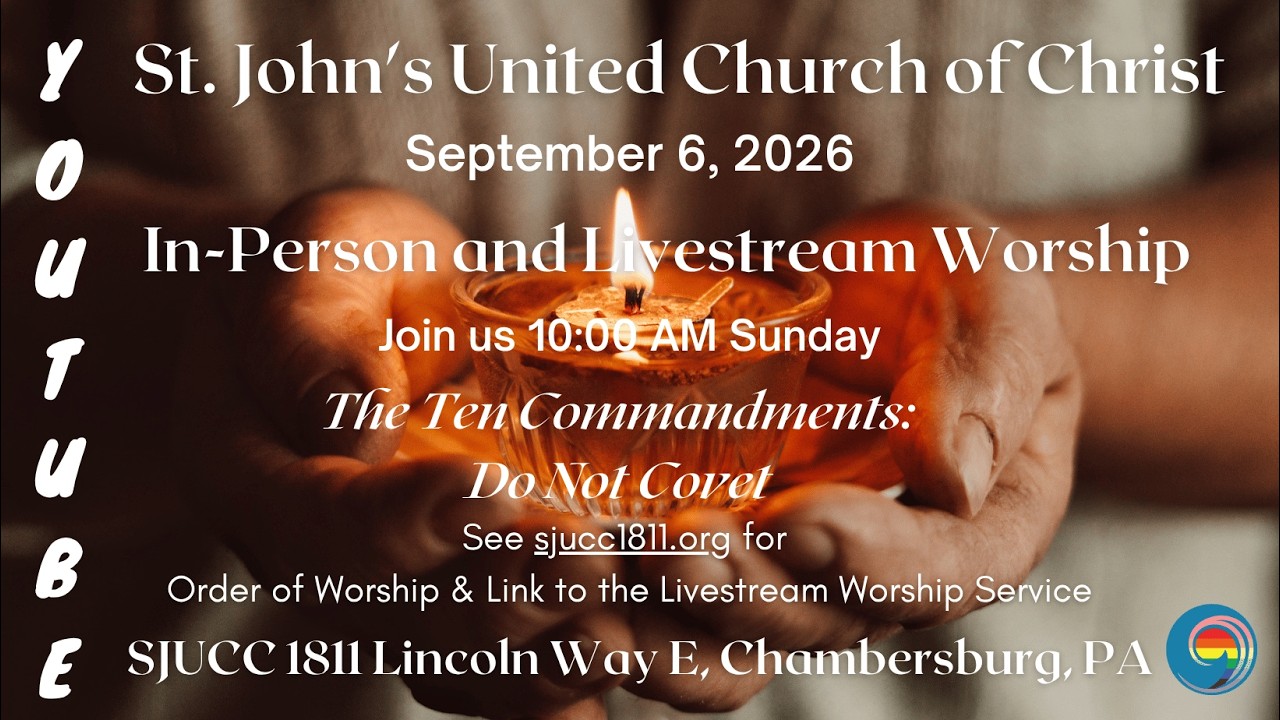
🔗 **Source:** [Sunday, September 6 2026- Ten Commandments: Do Not Covet](https://www.youtube.com/watch?v=hvaackTco0k)
> [!note]+ Document Notes
> tags: [ten-commandments, coveting, wealth-inequality, biblical-ethics, worship-liturgy]
> author: "[MISSING]"
> source: St. John's United Church of Christ (YouTube)
> reference: https://www.youtube.com/watch?v=hvaackTco0k
> date created: 2026-09-08
>
> > [!info] Generated analysis — not the author's words. Sections below are machine-written
> > from the captured source. Only text inside `> [!quote]` blocks is verbatim from the author.
> > Do not quote or attribute any other line to the named author.
>
> # 🏷️ Title: Sunday, September 6 2026- Ten Commandments: Do Not Covet
>
<!-- deep-read:sections start -->
## 🧭 Table of Contents
- [[#📝 Summary]]
- [[#📖 Main Content]]
- [[#🗒️ Notes]]
- [[#📚 References]]
- [[#🗣️ Paraphrase]]
- [[#📰 Newsletter]]
- [[#✅ Action Items]]
- [[#🧪 Hypotheses]]
- [[#📊 Methodology]]
- [[#❓ Questions]]
- [[#🔮 Future Research]]
- [[#💡 Implications]]
- [[#🧠 Learning Styles Assessment]]
- [[#📊 Accessibility Assessment]]
- [[#🌍 DEIB Assessment]]
- [[#✅ Logical Validity]]
- [[#🛡️ DARVO Analysis]]
- [[#🎯 Conclusion]]
- [[#🔄 Refactor Appendix — Sunday, September 6 2026- Ten Commandments: Do Not Covet]]
## 🔗 References
- Source: a YouTube capture of the full Sunday, September 6, 2026 worship service at St. John's United Church of Christ. The channel/uploader is not stated as a byline in the captured content (the raw `Author`/`Site` fields both just say "YouTube"), so author is `[MISSING]`; the church name is stated directly in the service's own welcome ("Welcome to worship at St. John's United Church of Christ"), so it is used as source rather than asserted from any domain.
- No outbound links exist in this capture — confirmed via `paras2.py --links` (zero results). This is expected for a YouTube transcript capture and is not itself a finding.
- The preacher is named once, informally, as "Pastor Caroline"; no surname is given in the transcript.
## 📝 Summary
- **What happened:** A full Sunday worship livestream — prelude, opening hymn, announcements, passing of peace, call to worship, a Litany for Deliverance, a scripture reading (Matthew 22:34-40), a children's "Godly Play" retelling of the Exodus culminating in the Ten Commandments, a second scripture reading (Exodus 20:17), the closing sermon of a summer-long Ten Commandments series ("Do Not Covet"), congregational prayers of joy and concern, the Lord's Prayer, offering, communion by intinction, a closing hymn, a 10-year-service recognition for the church's director of children and youth ministries, and a benediction.
- **Why it matters:** The sermon is the series' capstone and argues that the tenth commandment — the only one repeated within itself in Exodus 20:17 — is not a minor addendum but the hinge that connects private desire to public harm, using two Hebrew Bible narratives (David/Bathsheba, Ahab/Jezebel/Naboth) and then extending that logic to contemporary systemic examples (cobalt mining, climate displacement, war).
- **Key stakeholders:** the preacher and congregation of St. John's UCC; the children present for the Godly Play lesson; Roxann Davenport, honored for 10 years as director of children and youth ministries; the individuals named in the pastoral prayers (several by first name, including a fellow congregant identified as "Courtney," who shares a family health update about her father).
- **Risks and tradeoffs:** the sermon's own risk, which it names rather than conceals, is applying a personal-vice category (coveting) to structural harms (extractive mining, climate change, war) without fully arguing the causal mechanism connecting them — discussed under Logical Validity below.
- **Bottom line:** the sermon's closing move is confessional rather than accusatory — the preacher states her own difficulty distinguishing wants from needs — and it ends with a call to choose generosity over greed as a discipline, not a solved problem.
## 📖 Main Content
The captured video is a full 96-minute worship-service livestream, not an edited sermon clip. The first roughly 19 minutes are pre-service: a tech/sound check with a "champagne glass with fake diamonds" illustration prop mentioned in passing, an opening hymn ("Open My Eyes That I May See"), and informal chatter, none of which the ASR transcript captures cleanly (see Accessibility Assessment).
The service proper opens at 19:48 with a welcome that names the church explicitly and states an inclusion formula:
> [!quote] ID:rw_01m20gype5fsq7n79jwdgxzkm4
> "No matter who you are or where you are on life's journey, you are welcome here."
Announcements follow (a family fun day, a Habitat for Humanity book sale, a pastor's travel talk on a recent Ireland trip, and a request to claim lost skis and sleds from Vacation Bible School), then passing of peace, a sung call to worship built around three covenant images — Noah's rainbow, Moses's stone tablets, and the prophets' promise of a covenant "written in our hearts" — and a responsive Litany for Deliverance. The litany is a corporate confession naming systemic sins (idolatry of "many gods," "the slavery of self-centeredness," "watering down love and marriage," "the legal robberies of the stock exchange," "TV programs that twist the facts") rather than only individual ones, which sets up the sermon's later move from personal to structural framing.
The scripture reading is Matthew 22:34-40, the Great Commandment (love God, love neighbor, "on these two commandments hang all the law and the prophets"), read before a children's Godly Play retelling of the Exodus wilderness story. The children's lesson frames all Ten Commandments as "the 10 best ways" summarized as "Love God. Love people. God loves us," explicitly naming that they are "hard, perhaps even impossible, but we are supposed to try" — a framing the adult sermon later returns to.
A second scripture reading, Exodus 20:17, sets up the sermon directly:
> [!quote] ID:rw_01m20gype5fsq7n79jwdgxzkm4
> "Do not desire and try to take your neighbor's house. Do not desire and try to take your neighbor's wife, male or female servant, ox, donkey, or anything else that belongs to your neighbor."
The sermon itself opens by noting this is the series finale, recapping its theme as "relationship comes before rules... we are to be tuned in to God and turned toward our neighbors," and observes that the coveting commandment is unique among the ten for being internally repeated, and that "in other traditions, the coveting commandments are split into two" — offered as evidence of how seriously "our ancestors in faith" treated this specific danger. The preacher offers two paraphrases of the command: "do not let your internal desires lead you to harm another" and "do not use power over others to get what you want."
Two narrative case studies carry the argument. First, King David and Bathsheba (2 Samuel 11-12, cited by chapter): David, already married with "plenty of access to women in the palace," sees Bathsheba and takes her; when she becomes pregnant, he arranges for her husband Uriah to be abandoned in battle and killed. The prophet Nathan confronts David ("Nathan will hold up a mirror. And David doesn't like what he sees"), and the sermon reads Psalm 51 as David's resulting repentance. The sermon names two commandments broken in this story — adultery and coveting — and roots both in a failure to love neighbor.
Second, King Ahab, Queen Jezebel, and Naboth's vineyard (1 Kings 21, cited by chapter): Ahab offers to buy or trade for Naboth's vineyard; Naboth refuses because it is ancestral inheritance; Jezebel has false witnesses testify against Naboth, and he is stoned to death, after which Ahab takes the vineyard. Here the sermon names three commandments broken — coveting, false witness, and (via a state-sanctioned killing) murder — concluding "it all started with a little coveting" in both stories.
The sermon then pivots from these two narratives to a sustained, uncited contemporary application — cobalt mining in the Democratic Republic of Congo tied to smartphone and electric-vehicle demand, flooding in Nepal tied to glacier melt and a warming planet, and children killed by war, disease, and hunger — repeating the refrain "Don't their lives matter? Aren't they also our neighbors?" three times across this section. This is the sermon's most rhetorically weighted passage and its most analytically exposed one (see Logical Validity), since none of these contemporary claims are sourced or footnoted the way the two biblical narratives are grounded in named chapters.
> [!quote] ID:rw_01m20gype5fsq7n79jwdgxzkm4
> "We seem to be living in a season in which the powerful among us are allowed to take whatever they want without consequence or accountability."
The sermon closes by turning inward rather than only outward: the preacher states she has "no real answers," offers a personal confession about distinguishing wants from needs, and reframes the commandment's two paraphrases as a personal practice rather than a settled verdict on others, ending with a call to choose generosity — named as a fruit of the Spirit alongside faithfulness and self-control — over greed, and an allusion to "do justice, love kindness, and walk humbly with our God" (Micah 6:8, not cited by name in the audio).
## 🗒️ Notes
#### ⏱️ [19:48](https://www.youtube.com/watch?v=hvaackTco0k&t=1188) Welcome and announcements
- Explicit inclusion statement opens the service.
- Housekeeping: family fun day, Habitat for Humanity book sale, a pastor's Ireland travel talk, and a lost-and-found request for VBS props.
#### ⏱️ [24:49](https://www.youtube.com/watch?v=hvaackTco0k&t=1489) Call to worship and Litany for Deliverance
- Covenant imagery: rainbow (Noah), stone tablets (Moses), covenant "written in our hearts" (the prophets).
- The litany is a corporate, systemic confession (self-centeredness, prejudice, busyness, ageism, militarism, commodified sexuality, financial "legal robberies," media distortion, "greed as a virtue") — this is the service's first, not the sermon's first, move from private to structural sin-naming.
#### ⏱️ [30:35](https://www.youtube.com/watch?v=hvaackTco0k&t=1835) Scripture: Matthew 22:34-40
- The Great Commandment (love God, love neighbor) is read before the children's lesson and before the sermon — establishing the interpretive frame ("on these two commandments hang all the law and the prophets") that the sermon later applies specifically to coveting.
#### ⏱️ [34:44](https://www.youtube.com/watch?v=hvaackTco0k&t=2084) Children's message: Godly Play retelling of Exodus
- A scripted, prop-based retelling (desert hardship → the people's freedom → the Ten Commandments given at Sinai) summarized for children as "the 10 best ways," collapsed to "Love God. Love people. God loves us."
- Explicitly names the commandments as "hard, perhaps even impossible, but we are supposed to try" — the same tension the adult sermon returns to in its closing confession.
#### ⏱️ [47:34](https://www.youtube.com/watch?v=hvaackTco0k&t=2854) Scripture: Exodus 20:17 and sermon opening
- Second scripture reading is the coveting commandment itself, immediately preceding the sermon.
- Sermon frames itself as the finale of a summer series with the stated throughline "relationship comes before rules."
#### ⏱️ [48:33](https://www.youtube.com/watch?v=hvaackTco0k&t=2913) Sermon: framing the commandment
- Names coveting as the only commandment repeated within itself in the text; claims other traditions split it into two commandments (a checkable claim — see Hypotheses).
- Offers two working paraphrases: "do not let your internal desires lead you to harm another" and "do not use power over others to get what you want."
#### ⏱️ [50:12](https://www.youtube.com/watch?v=hvaackTco0k&t=3012) Case study: David and Bathsheba (2 Samuel 11-12)
- David takes Bathsheba, then arranges Uriah's death in battle; Nathan confronts him; Psalm 51 read as his repentance.
- Sermon names two commandments broken: adultery and coveting, both "rooted in the love of our neighbor."
#### ⏱️ [52:55](https://www.youtube.com/watch?v=hvaackTco0k&t=3175) Case study: Ahab, Jezebel, and Naboth's vineyard (1 Kings 21)
- Ahab wants Naboth's vineyard; Naboth refuses on inheritance grounds; Jezebel has him falsely accused and stoned; Ahab takes the land.
- Sermon names three commandments broken: coveting, false witness, and (via legal-form execution) murder.
#### ⏱️ [55:58](https://www.youtube.com/watch?v=hvaackTco0k&t=3358) Contemporary application: systemic coveting
- Extends the coveting/harm pattern to named contemporary cases: DRC cobalt mining tied to smartphone/EV demand, flooding in Nepal tied to a warming planet, and children killed by war, disease, and hunger — none footnoted, unlike the two biblical case studies.
- Repeated refrain: "Don't their lives matter? Aren't they also our neighbors?"
#### ⏱️ [61:19](https://www.youtube.com/watch?v=hvaackTco0k&t=3679) Confession and closing of the sermon
- Preacher states she has no complete answer, then discloses her own struggle to "discern the difference between my wants and my needs."
- Closes on generosity as a discipline (named a fruit of the Spirit) rather than greed, with an unattributed allusion to Micah 6:8.
#### ⏱️ [65:38](https://www.youtube.com/watch?v=hvaackTco0k&t=3938) Pastoral prayers of joy and concern
- A long, named prayer list: a friend discerning a life transition; a member recovering from a fractured sacrum and gallbladder removal; a couple managing a cardiac event; a member recently entered into hospice care; a congregant (identified as "Courtney") sharing that her father was undergoing testing at a lung transplant center for a possible double lung transplant tied to a long-COVID cardiopulmonary condition, with an incidentally discovered blocked artery; a nephew's successful quadruple bypass surgery; a member recovering from knee replacement; a prayer for 9/11 survivors ahead of the 25th anniversary; a member recovering from a fall; two families anticipating births; and gratitude for the relevance of the Ten Commandments series.
- This section is included here as a factual record of what the service contained, consistent with treating the source on its own terms; it is not analyzed further.
#### ⏱️ [78:16](https://www.youtube.com/watch?v=hvaackTco0k&t=4696) Communion liturgy
- An extended welcome-table liturgy explicitly naming rejection, loneliness, shame, and self-loathing before the invitation, administered by intinction (bread dipped in the cup) or pre-packaged elements.
#### ⏱️ [91:44](https://www.youtube.com/watch?v=hvaackTco0k&t=5504) Recognition and benediction
- Roxann Davenport recognized for 10 years as director of children and youth ministries, with a gift, reception, and cake.
- Closing hymn "I Have Brought You Out of Egypt" (sung to the tune "Come, Thou Fount of Every Blessing"), followed by a traditional benediction ("Go forth into the world in peace...").
## 📚 References
- Matthew 22:34-40 (the Great Commandment) — read as the service's scripture lesson before the children's message and sermon.
- Exodus 20:17 (the tenth commandment, against coveting) — read immediately before the sermon.
- 2 Samuel 11-12 — cited by the sermon for the David and Bathsheba narrative.
- 1 Kings 21 — cited by the sermon for the Ahab, Jezebel, and Naboth narrative.
- Psalm 51 — referenced as David's psalm of repentance.
- Micah 6:8 — alluded to in the closing prayer ("do justice, love kindness, and walk humbly with our God") without being named in the audio.
- "Open My Eyes That I May See" — opening hymn (composer/hymnal not stated in the capture).
- Hymn "number 458 in the green hymnal," referenced as "Let Us Talents and Tongues Employ" — sung at the call to worship (hymnal edition not stated).
- "I Have Brought You Out of Egypt," sung to the tune "Come, Thou Fount of Every Blessing" — closing hymn (hymnal/author not stated in the capture).
- No web links are present in this capture (`paras2.py --links` returns zero results), which is expected for a YouTube transcript and not itself a finding.
## 🗣️ Paraphrase
The service is a full Ten Commandments series finale built around one specific command: don't want, and don't take, what belongs to your neighbor. The sermon treats this as uniquely serious — it's the one commandment the text itself repeats — and reads it through two stories where wanting turned into taking and taking turned into death: a king who saw a married woman and took her, then had her husband killed to cover it up; and a royal couple who wanted a vineyard, framed its owner with false witnesses, and had him executed to get it. From there the sermon widens the lens: if coveting plus power equals harm in Scripture, what does it mean that the same pattern — wanting what belongs to someone else, backed by power, without consequence — shows up now in mineral extraction, climate-driven displacement, and violence against children, dressed up as "sound investing" or "trade negotiations"? The sermon doesn't resolve that widened claim with the same specificity it brings to the two biblical stories; instead it turns the question back on the preacher herself, who admits she struggles to tell her own wants from her needs, and ends on generosity chosen as an ongoing discipline rather than a solved argument.
## 📰 Newsletter
Not applicable to this source. This is a church worship-service recording with no developer, WordPress, or open-source community content; there is nothing here for a WordPress-audience newsletter blurb.
## ✅ Action Items
#### DevRel
Not applicable to this source. No developer advocacy, talks, or technical education content.
#### OSPO
Not applicable to this source. No licensing, governance, or software-supply-chain content.
#### Community
Not applicable to this source in the template's sense (maintainers/contributors/sponsors of a software project). The service does model a different kind of community practice — a 10-year staff recognition (Roxann Davenport), a named prayer list, and a corporate systemic-sin liturgy — but this is a faith community, not the OSS/WordPress community this subsection is built for.
#### WordPress
Not applicable to this source. No WordPress, hosting, or core-contributor content of any kind.
#### The WPOCC
Not applicable to this source.
### FAIR
Not applicable to this source.
## 🧪 Hypotheses
1. The sermon's claim that "in other traditions, the coveting commandments are split into two" is checkable against comparative enumeration of the Decalogue — for example, whether a named Jewish, Catholic, or Reformed tradition's official numbering counts the house-clause and wife-clause of Exodus 20:17 as two separate commandments rather than one.
2. The sermon's claim that the Ahab/Jezebel/Naboth narrative breaks three specific commandments (coveting, false witness, murder-by-legal-execution) is checkable by a close textual reading of 1 Kings 21:1-16 against the Decalogue's own wording.
3. The sermon's unsourced claim that "we seem to be living in a season in which the powerful among us are allowed to take whatever they want without consequence or accountability" implies a testable comparative claim (that impunity for the powerful is measurably higher now than in a prior period) that the sermon does not attempt to measure or cite.
4. If the sermon's coveting/harm pattern generalizes as claimed, cases of documented corporate or state land/resource seizure (e.g., artisanal cobalt-mining land disputes in the DRC) should show the same three-part structure named in the Ahab story — desire, obstruction by the rightful holder, and a legal or quasi-legal process used to overcome that obstruction — which would be checkable against specific, named cases rather than the general reference the sermon makes.
## 📊 Methodology
Not applicable in the empirical-research sense the template's Methodology section describes — this is a homiletical sermon, not a study, and cites no data. Its actual method is textual and typological: two named, chapter-cited Hebrew Bible narratives are read for a shared moral pattern (desire → transgression → harm), then that pattern is extended by analogy to uncited contemporary cases. That method, and where its evidentiary footing changes between the biblical and contemporary halves, is discussed in Main Content and under Logical Validity.
## ❓ Questions
- What specific tradition does "in other traditions, the coveting commandments are split into two" refer to, and does that split occur in the numbering the sermon implies (house vs. wife/servant/animal) or on some other division?
- The sermon names three commandments broken in the Ahab/Jezebel story but does not explicitly name a fourth candidate — theft (the vineyard itself) — worth asking whether that's a deliberate exclusion (since the seizure was nominally "legal") or an omission.
- What would it look like, concretely, for a congregation to act on the sermon's closing call to "examine what we desire and what we covet and who bears the cost" — does the series (or a future one) name specific practices, rather than the general disposition the sermon calls for here?
- The sermon states a personal confession about the difficulty of separating wants from needs without offering a discernment method — is there a companion resource (in this church's tradition or elsewhere) that operationalizes that discernment beyond naming it as hard?
## 🔮 Future Research
- The sermon itself flags that "we'll do a deeper dive later this fall into the story of David and Bathsheba" — a natural follow-up capture once that sermon airs, to see how the fuller version treats the same coveting/power argument sketched here.
- A comparative-tradition note on how different faith communities enumerate the Decalogue's coveting clause(s) would directly test Hypothesis 1 above and could sit alongside this note in the vault's Bible Study material.
- Tracing the sermon's specific contemporary references (DRC cobalt mining, Nepal flooding) to named reporting or data would let a future note evaluate the systemic-application section with the same rigor the sermon itself brings to its two biblical case studies.
## 💡 Implications
- **Practice:** the sermon's own proposed practice is personal — discerning wants from needs, weighing the impact of one's decisions on "the lives of others, of my neighbors" — offered as an ongoing discipline, not a checklist.
- **Theology/homiletics:** structuring a single sermon around two independently-cited biblical narratives, then explicitly extending (rather than replacing) that pattern into contemporary application, is a reusable preaching structure worth naming for future sermon-note capture in this vault.
- **Education:** the Godly Play children's retelling compresses the same Ten-Commandments material the adult sermon addresses into "Love God. Love people. God loves us." — a genuinely different register aimed at a different audience, worth comparing against the adult sermon's systemic-application section as a study in register-shifting the same content for different ages.
- **Policy/security/funding:** not addressed in the source; not applicable to a worship-service recording.
## 🧠 Learning Styles Assessment
- **Reading level estimate:** not meaningfully assessable — this is a spoken, sung, and enacted worship service rather than written prose, and the auto-generated transcript's heavy garbling (see Accessibility Assessment) makes any Flesch-Kincaid-style score on the raw text unreliable as a proxy for the service's actual comprehensibility to a listener.
#### 👀 Visual learners
- Present: the Godly Play children's lesson is explicitly prop- and gesture-based ("this is the desert... watch"), a strong visual/kinesthetic teaching method even though the video itself is not described in enough visual detail here to assess screen presentation.
- Improve: not applicable — this is a live-service capture, not authored content designed for a reading audience.
#### 🔊 Aural learners
- Present: strongly served by design — hymns, a sung call to worship, spoken liturgy, and a preached (not read) sermon.
- Improve: none needed; this is the service's native mode.
#### 🗣️ Verbal learners
- Present: the sermon defines its key move in plain restated language twice ("do not let your internal desires lead you to harm another," "do not use power over others to get what you want"), which functions as an in-text glossary of the commandment's meaning.
- Improve: none needed.
#### 🧩 Kinesthetic learners
- Present: the Godly Play retelling and the physical communion practice (walking forward, intinction) are both hands-on, embodied elements of the service.
- Improve: not applicable to a worship-service capture.
#### 🧠 Logical learners
- Present: the sermon's two-case-study structure (David/Bathsheba, Ahab/Jezebel/Naboth), each naming the specific commandments broken, gives logical learners a clear, comparable pattern across both narratives.
- Improve: a simple side-by-side naming of "which commandments were broken" across the two stories (adultery + coveting; coveting + false witness + murder) would make the shared and distinct elements more scannable than the prose delivery allows.
#### 🧑🤝🧑 Social learners
- Present: the corporate, responsive Litany for Deliverance and the shared pastoral prayer time are both explicitly communal, participatory liturgical forms.
- Improve: none needed; this is a core strength of the service format itself.
#### 🧘♀️ Solitary learners
- Present: the sermon's closing confession ("here is my confession... I don't really have any answers") models a self-examination move a solitary learner could adapt into private reflection.
- Improve: none needed.
#### 🌿 Naturalistic learners
- Present: the contemporary-application section explicitly ties coveting to environmental harm (cobalt mining, glacier melt and flooding) and frames "our shared home" as itself a neighbor to be loved rather than extracted from.
- Improve: not applicable — already a substantive part of the sermon's own argument.
## 📊 Accessibility Assessment
#### Screen reader semantics
- Not assessable from the captured plain-text transcript; no DOM/page structure is present in this capture.
#### Keyboard navigation
- Not applicable to a YouTube video capture.
#### Contrast and readability
- Not assessable from the captured plain-text transcript; no visual/UI content is present in this capture.
#### Text resizing and reflow
- Not applicable to a YouTube video capture.
#### Media and captions
- Present: the video has auto-generated captions, which is what produced this transcript.
- A genuine finding: caption quality degrades sharply during every sung passage. Sung portions are rendered largely as `[singing]`/`[music]` tags with fragmented, often meaningless interstitial text (for example, extended runs of the word "Heat" during hymns and the doxology, almost certainly a mis-hearing of a repeated "Hallelujah"/refrain-style lyric rather than an actual word sung). A Deaf or hard-of-hearing viewer relying on these auto-captions would get essentially no usable content during any hymn, the call to worship, or the doxology — only the spoken portions (welcome, litany, scripture, sermon, prayers) are reliably transcribed.
- Improve: human-corrected captions or a printed order of worship/lyrics sheet linked in the video description would close this gap; this is a real, checkable accessibility gap in the capture, not a capture-pipeline artifact of this analysis.
#### Forms and interactions
- Not applicable to a YouTube video capture.
#### Standards reference
- Cannot map to WCAG 2.2 AA criteria beyond the captions finding above (1.2.2, Captions - Prerecorded) without access to the live video's caption track settings and description field.
## 🌍 DEIB Assessment
#### Cultural breadth
- The service explicitly widens "neighbor" past the congregation to include miners in the Democratic Republic of Congo, flood victims in Nepal, and children affected by war "across the world, even the ones that border ours" — a deliberate globalizing move within the sermon's own argument.
#### Inclusive language
- The opening welcome states an explicit inclusion formula ("No matter who you are or where you are on life's journey, you are welcome here"). The service uses gendered language for the divine in places (e.g., "Father" in the Lord's Prayer, a traditional text) alongside gender-neutral "God" and "Holy Spirit" elsewhere. No pronouns are stated for the preacher or any named individual in the transcript, so none are used in this analysis.
#### Neurodiversity support
- The service follows a predictable, named liturgical order (welcome → announcements → call to worship → confession → scripture → children's message → scripture → sermon → prayers → communion → benediction), which supports predictability; the Godly Play segment is explicitly slow, scripted, and repetitive by design ("must do it word for word").
#### Representation
- The pastoral prayer section names multiple congregants by first name across a range of life situations (illness, recovery, hospice, birth, grief) without editorializing on any of them; the sermon's contemporary-application section names miners, flood victims, and war-affected children as groups without individualizing or stereotyping any of them.
#### Psychological safety
- The communion liturgy explicitly names shared negative experience ("rejection and loneliness, shame and self-loathing, guilt and fear") before pivoting to affirmation ("We are beloved. We are enough. We are worthy"), and the sermon's own closing confession models vulnerable self-disclosure rather than only directing critique outward — both function as psychological-safety-building moves within the service's own design.
## ✅ Logical Validity
#### Strong reasoning
- The two-case-study structure is a coherent inductive argument: two independently sourced, chapter-cited narratives (2 Samuel 11-12; 1 Kings 21) both exhibit the same pattern (desire → abuse of power → harm to a neighbor → additional commandments broken), which is a legitimate way to establish a generalizable claim about the coveting commandment before extending it further.
- The sermon's closing move — naming its own difficulty living out the command, rather than only prescribing it to others — strengthens its ethical authority (ethos) by avoiding a stance of exemption from its own argument.
#### Fallacies
- **Analogical extension without an argued mechanism.** The sermon moves from two well-sourced biblical narratives of individual, face-to-face coveting (a king wanting a specific woman or a specific vineyard) to structural, systemic harms (global cobalt-mining supply chains, climate-driven flooding, war) using the same word — "coveting" — without arguing how the causal mechanism of *personal* desire-driven power abuse maps onto *structural* systems that operate through markets, geopolitics, and diffuse corporate decision-making rather than any single person's want. This is a common and rhetorically effective move in prophetic preaching, and the sermon does not claim more precision than it has (it explicitly says "I don't really have any answers"), but the argument would be strengthened by naming, even briefly, why the same moral category applies at both scales rather than relying on the reader/listener to supply that bridge. `#fallacy/faulty-analogy`
- **Unsourced generalization in the systemic-application section.** "We seem to be living in a season in which the powerful among us are allowed to take whatever they want without consequence or accountability" is stated as a description of the present moment without a comparison point (a season compared to what prior season?) or a source. This is consistent with prophetic-address genre conventions (it is not framed as an empirical claim) but is worth naming as unsourced rather than treating it as established fact. `#fallacy/hasty-generalization`
#### Tone of voice
Pastoral and prophetic-lament in register: it moves from historical exposition (measured, chapter-cited) to a repeated lament refrain ("Don't their lives matter? Aren't they also our neighbors?") to a personal, vulnerable confession, closing on a disciplined-hope register rather than either despair or triumphalism.
## 🛡️ DARVO Analysis
Not applicable to this source. There is no accusation being denied, attacked, or reversed here — the sermon's structure is the opposite of a DARVO pattern: it names wrongdoing in two biblical figures without excusing them, extends the same moral category to unnamed contemporary systems, and then turns the same scrutiny on the preacher herself as a personal confession, rather than defending against or deflecting any charge.
## 🎯 Conclusion
The sermon's durable claim is that the tenth commandment is not a minor coda but a hinge: unmanaged desire, paired with power, is what turns "I want" into concrete harm to a specific neighbor — demonstrated twice in Scripture (David/Bathsheba; Ahab/Jezebel/Naboth) with named chapters and named broken commandments in each case. The sermon then extends that same pattern, more loosely, to contemporary systemic harms it does not source with the same specificity. Rather than resolving that gap, the sermon turns inward, ending on a personal confession and a call to choose generosity — named a fruit of the Spirit — as an ongoing discipline. Practical next step for a reader/listener: the sermon's own two-part paraphrase of the commandment ("do not let your internal desires lead you to harm another"; "do not use power over others to get what you want") is stated as a personal practice to examine, not a verdict to render on others.
## 🔄 Refactor Appendix — Sunday, September 6 2026- Ten Commandments: Do Not Covet
### 📚 Literature Atoms (H3)
#### [H1] Coveting is the only commandment repeated within itself
> [!quote] ID:rw_01m20gype5fsq7n79jwdgxzkm4
> "Do not desire and take or covet your neighbor's house or anything or anyone that belongs to your neighbor."
Establishes the sermon's textual hook for treating coveting as uniquely serious: Exodus 20:17 repeats its own prohibition (house; then wife/servant/animal/anything), which the sermon reads as a deliberate scriptural emphasis rather than redundancy. Caveat: the sermon's further claim that other traditions split this into two separate commandments is asserted, not sourced (see Hypotheses).
Tags: `#xref`
**Highlight**: [view highlight](readwise://01m20gype5fsq7n79jwdgxzkm4)
<!-- atomicity: 1 idea ✓ -->
#### [H2] The sermon reads present impunity for the powerful as a season, not a constant
> [!quote] ID:rw_01m20gype5fsq7n79jwdgxzkm4
> "the powerful among us are allowed to take whatever they want without consequence or accountability"
The pivot sentence from the sermon's two biblical case studies into its uncited contemporary-application section (cobalt mining, climate flooding, war). Names the pattern claimed to generalize; does not cite evidence that the present differs from any prior period in this respect.
Tags: `#xref`
**Highlight**: [view highlight](readwise://01m20gype5fsq7n79jwdgxzkm4)
<!-- atomicity: 1 idea ✓ -->
#### [H3] The preacher's confession reframes the command as her own practice, not a verdict on others
> [!quote] ID:rw_01m20gype5fsq7n79jwdgxzkm4
> "There are things that I may want. But I am working hard to discern the difference between my wants and my needs."
The sermon's turn from indicting external systems to a first-person admission of the same struggle — the rhetorical move that keeps the sermon's closing register confessional rather than accusatory.
Tags: `#xref`
**Highlight**: [view highlight](readwise://01m20gype5fsq7n79jwdgxzkm4)
<!-- atomicity: 1 idea ✓ -->
#### [H4] The sermon's operative paraphrase of the commandment is about internal desire and power, not mere wanting
> [!quote] ID:rw_01m20gype5fsq7n79jwdgxzkm4
> "Do not let your internal desires lead you to harm another. Do not use power over others to get what you want."
The sermon's own working translation of "do not covet" — narrower and more actionable than the commandment's face-value wording, and the definition the closing confession is measured against.
Tags: `#xref`
**Highlight**: [view highlight](readwise://01m20gype5fsq7n79jwdgxzkm4)
<!-- atomicity: 1 idea ✓ -->
### 🧠 Permanent Candidates (H4)
#### [P1] A moral category applied at both individual and systemic scale needs its mechanism argued, not just implied by juxtaposition
**Claim** (one sentence, Courtney's voice): When an argument extends a category proven at one scale (an individual coveting a specific neighbor's property) to a different scale (a structural system like a supply chain or a warming climate) using the same word, the extension persuades by juxtaposition rather than by demonstrated mechanism unless the speaker explicitly names how the smaller-scale causal logic maps onto the larger one.
**Evidence pointer**: [[#H2]]
**Scope & conditions**: Applies broadly to prophetic, political, and advocacy rhetoric that moves from a vivid individual case to a systemic claim; does not mean the systemic claim is false, only that its persuasive force currently rests on analogy rather than argument — worth flagging whenever reading or writing this kind of extension.
**Links**:
- [[Sunday, September 6 2026- Ten Commandments: Do Not Covet]] — because evidence-for the source reasoning this candidate generalizes from
<!-- atomicity: 1 idea ✓ -->
#### [P2] A costed personal confession strengthens a prophetic claim more than repeating the claim louder
**Claim** (one sentence, Courtney's voice): A speaker making a hard structural or moral claim against a system gains credibility by naming a specific, personal way they themselves fall short of that same claim, rather than by only directing the claim outward at others.
**Evidence pointer**: [[#H3]] · [[#H4]]
**Scope & conditions**: Holds when the confession is specific (naming an actual struggle, as here — wants vs. needs) rather than a generic disclaimer; a vague "we all fall short" does not carry the same rhetorical weight as this sermon's concrete admission.
**Links**:
- [[Sunday, September 6 2026- Ten Commandments: Do Not Covet]] — because evidence-for the source reasoning this candidate generalizes from
<!-- atomicity: 1 idea ✓ -->
### ✏️ Fleeting Queue
- The claim that "other traditions" split the coveting commandment into two is worth confirming against a specific named tradition's enumeration for future Bible Study notes. `#xref`
- The sermon promises a fuller David-and-Bathsheba treatment "later this fall" — worth capturing as a follow-up transcript once it airs, to compare against this summary version. `#xref`
### → Things 3 (max 2 actions)
- [ ] If continuing Ten Commandments Bible study notes in the vault, cross-reference this sermon's two case studies (2 Samuel 11-12; 1 Kings 21) against the fall David/Bathsheba deep-dive once that sermon is preached. `#things`
<!-- deep-read:sections end -->
📄 **Full text:** [[Full Document Contents/Articles/Sunday, September 6 2026- Ten Commandments Do Not Covet.md|Sunday, September 6 2026- Ten Commandments: Do Not Covet by [MISSING]]]
## Highlights
- that it's the only one that is repeated. Do not desire and take or covet your neighbor's house or anything or anyone that belongs to your neighbor. In other traditions, the coveting commandments are split into two. That's how mindful our ancestors in faith were about the danger of this behavior. It speaks to the desires of the heart and how those desires can become ([View Highlight](https://read.readwise.io/read/01m20hq11sm360b1dsqv8spra1))
- Note: H1 — the only commandment repeated within itself; the sermon's textual hook for treating coveting as uniquely serious. #atom/literature/h1
- Tags: atom/literature/h1
- which the powerful among us are allowed to take whatever they want without consequence or accountability. We see the erosion of social norms and regulations designed to allow us to live in ways that respect the lives of our neighbors. the ones who live next door and the ones who live in countries across the world, even the ones that border ours. The Ten Commandments may be posted in ([View Highlight](https://read.readwise.io/read/01m20hq58wbm5gc9z2mms7kg4h))
- Note: H2 — pivot into the sermon's uncited contemporary-application section; names the pattern claimed to generalize from the two biblical case studies. #atom/literature/h2
- Tags: atom/literature/h2
- So here is my confession. There are things that I may want. But I am working hard to discern the difference between my wants and my needs. And I'm trying to be more mindful to consider what impact my decisions and desires have on the lives of others, of my neighbors. ([View Highlight](https://read.readwise.io/read/01m20hqeg2ykxrm513k196baed))
- Note: H3 — the preacher's own confession; reframes the command as her practice, not a verdict on others. #atom/literature/h3
- Tags: atom/literature/h3
- Do not let your internal desires lead you to harm another. Do not use power over others to get what you want. And we may fall short and we may stumble and we keep trying to do justice, love kindness and walk humbly with our God. So let us be generous ([View Highlight](https://read.readwise.io/read/01m20hqhaqa7bzfk4nnnw5hjr2))
- Note: H4 — the sermon's own operative paraphrase of "do not covet," the definition the closing confession is measured against. #atom/literature/h4
- Tags: atom/literature/h4