Teaching AI To Do Your Work
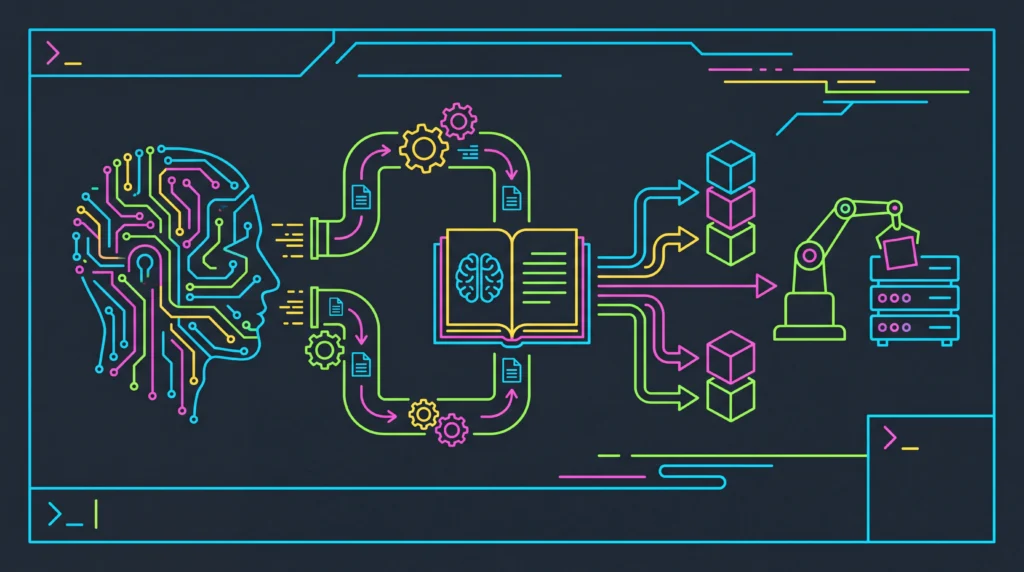
🔗 **Source:** [Teaching AI To Do Your Work](https://anchor.host/teaching-ai-to-do-your-work/)
> [!note]+ Document Notes
> tags: [ai-automation, wordpress-hosting, workflow-optimization, claude-ai, site-migration, devops]
> author: Austin Ginder
> source: Anchor Hosting
> reference: [https://anchor.host/teaching-ai-to-do-your-work/]
> date created: 2024-12-28 20:23
>
> # 🏷️ Title: Teaching AI To Do Your Work
>
<!-- deep-read:sections start -->
## 🧭 Table of Contents
- [📝 Summary](#-summary)
- [📖 Main Content](#-main-content)
- [🗒️ Notes](#️-notes)
- [📚 References](#-references)
- [🗣️ Paraphrase](#️-paraphrase)
- [📰 Newsletter](#-newsletter)
- [✅ Action Items](#-action-items)
- [🧪 Hypotheses](#-hypotheses)
- [📊 Methodology](#-methodology)
- [❓ Questions](#-questions)
- [🔮 Future Research](#-future-research)
- [💡 Implications](#-implications)
- [🧠 Learning Styles Assessment](#-learning-styles-assessment)
- [📊 Accessibility Assessment](#-accessibility-assessment)
- [🌍 DEIB Assessment](#-deib-assessment)
- [✅ Logical Validity](#-logical-validity)
- [🛡️ DARVO Analysis](#-darvo-analysis)
- [🎯 Conclusion](#-conclusion)
### 🔗 References
- Include links cited in or relevant to the article.
## 📝 Summary
- **What happened:** A WordPress hosting provider documented how they trained Claude AI to automate complex site migrations and fleet management operations by teaching it through direct demonstration and feedback.
- **Why it matters:** This represents a practical approach to AI automation that preserves human judgment while eliminating repetitive execution tasks, potentially transforming how technical operations are managed.
- **Key stakeholders:** WordPress hosting providers, DevOps teams, system administrators, and technical consultants managing large site portfolios.
- **Risks and tradeoffs:** Dependency on AI tools, potential security risks from automated access, need for continuous training and correction loops.
- **Bottom line:** AI can be trained as a "coworker" rather than just a code generator, handling complex multi-step workflows while maintaining human oversight for critical decisions.
## 📖 Main Content
Austin Ginder from Anchor Hosting describes transforming his WordPress migration workflow by training Claude AI to execute complex technical operations through demonstration and feedback loops. Rather than using AI as a code generator, he treats it as a coworker that learns by watching and remembering corrections.
### The Training Process
The approach centers on **teaching by demonstration**. Ginder walked Claude through a typical 12-step site migration process: SSH connection, CLI downloads, source site syncing, file inspection, rsync operations, database imports, table prefix fixes, MyISAM to InnoDB conversion, verification, URL handling, and cleanup. After each session, he asked Claude to "remember this," triggering the AI's persistent memory system.
### Memory vs Skills Architecture
The system distinguishes between two types of learned behaviors:
**Memories** are small, universal corrections that apply across all interactions. Examples include using first names only in emails, moving backup files to secure directories, and verifying script sources before dismissing security alerts.
**Skills** are complete workflow playbooks stored as markdown files in `~/.claude/skills/`. These handle entire multi-phase operations with conditional logic and edge cases. Three primary skills emerged:
- `/do-backup`: Generates full WordPress backups over SSH
- `/do-migrate`: Streams backups to destination servers with proper shell quoting
- `/disembark-migrate`: Executes the full 12-phase migration workflow
### Reliability Improvements
Counterintuitively, Claude now executes migrations more reliably than manual processes. The documented skills capture every edge case encountered over years of work, ensuring consistent execution of all steps. Manual processes occasionally missed steps like MyISAM conversion or multisite configuration checks.
### Fleet Operations Scale
The approach expanded beyond migrations to manage 2,900+ sites across 22 skills covering:
- **Security and integrity** (8 skills): Malware cleanup, security audits, checksum reviews
- **Publishing and communications** (4 skills): Email triage, blog publishing
- **Migrations and backups** (3 skills): Site transfers, backup generation
- **Fleet operations** (3 skills): Bulk WordPress operations, plugin patches
- **Performance and debugging** (2 skills): Performance audits, PHP upgrades
- **Platform conversions** (2 skills): Migration between hosting platforms
## 🗒️ Notes
**Persistent Memory System**: Claude Code saves correction feedback as markdown files with frontmatter, creating a permanent knowledge base that persists across sessions.
**Correction Loop Effectiveness**: Single corrections become permanent behaviors. Example: After being told not to leave .bak files in web root, Claude automatically moves backups to `~/private/` directory in all future sessions.
**Human-AI Division of Labor**: Human maintains decision-making authority while AI handles execution. Claude doesn't close customer emails, deploy code, or push to production without explicit approval.
**Tool Integration Layer**: Rather than replacing existing automation tools (_do, Disembark, CaptainCore), Claude serves as an orchestration layer that knows how to combine tools correctly with proper edge case handling.
**Self-Correction Capability**: Claude demonstrates awareness when it fails to follow established memories and flags these instances for correction.
## 📚 References
- [Anchor Hosting](https://anchor.host/)
- [Claude AI](https://claude.ai/)
- Disembark WordPress Plugin (mentioned)
- CaptainCore API (mentioned)
- WP-CLI (mentioned)
## 🗣️ Paraphrase
A WordPress hosting expert transformed his technical operations by training Claude AI through hands-on demonstration rather than traditional programming. Instead of manually executing repetitive 12-step site migrations, he taught Claude to watch, learn, and remember corrections, creating a system of persistent memories and reusable skills.
The breakthrough came from treating AI as a colleague rather than a tool. After walking Claude through each migration step and saying "remember this," the AI documented the entire workflow and could execute it independently while maintaining human oversight for critical decisions. Over time, this approach expanded to automate 22 different operational workflows across nearly 3,000 websites.
The most surprising outcome was improved reliability - the AI-executed migrations became more consistent than manual processes because the documented skills captured every edge case encountered over years of experience, eliminating the human tendency to occasionally forget steps or make mistakes under pressure.
## 📰 Newsletter
**🤖 WordPress Automation Breakthrough: Teaching AI Your Actual Job**
This week's spotlight goes to Austin Ginder from Anchor Hosting, who's cracked the code on practical AI automation for WordPress operations. Instead of fighting with ChatGPT to generate code snippets, he taught Claude AI to be his coworker.
**The game-changer?** Training by demonstration. Austin walked Claude through his 12-step site migration process once, asked it to "remember this," and now just types `/disembark-migrate` to execute the entire workflow. No more forgetting to convert MyISAM tables or handle multisite configs!
**Why WordPress pros should care:**
- **Memory that sticks**: Claude saves corrections as permanent files - tell it once to move .bak files to ~/private/, and it never forgets
- **Better than muscle memory**: AI executes all edge cases consistently while you handle the decision-making
- **Fleet-scale impact**: 22 skills managing 2,900+ sites for security audits, bulk operations, and performance monitoring
**Quick wins to try**: Start with your most repetitive multi-step process. Walk Claude through it step-by-step, correct its mistakes, ask it to remember. Within weeks, you'll have a reliable automation that captures years of hard-learned lessons.
**Resources**: Check out the full case study at Anchor Hosting's blog, and consider how Claude Code's persistent memory could transform your WordPress workflow. The future isn't AI replacing developers - it's AI amplifying experienced professionals who know how to teach it properly.
## ✅ Action Items
#### DevRel
- **Developer advocacy**: Create case studies showing AI-human collaboration in technical workflows, demo at WordCamps
- **Education**: Develop workshops on "Teaching AI Your Workflow" with hands-on migration training
- **Developer experience**: Document integration patterns for Claude Code with existing WordPress tools
- **Developer marketing**: Highlight reliability improvements and time savings in automation campaigns
- **Community management**: Facilitate discussions on AI automation ethics and best practices
- **Internal/external**: Align on AI tool policies and training standards across technical teams
#### WordPress
- **Core**: Evaluate AI-assisted testing workflows for release processes and compatibility checks
- **CLI**: Document WP-CLI integration patterns with AI orchestration layers for complex operations
- **Hosting**: Develop cross-host standards for AI-assisted migration and maintenance workflows
- **Community**: Create meetup content on practical AI automation for WordPress professionals
- **Support**: Design AI-assisted triage systems while maintaining human oversight for sensitive issues
- **Documentation**: Create guides for teaching AI tools WordPress-specific workflows and edge cases
#### Community
- **Maintainers**: Explore AI assistance for release management and testing workflow orchestration
- **Contributors**: Develop onboarding paths that include AI tool training for complex contribution workflows
- **Sponsors**: Document ROI of AI automation investments for hosting and service provider sponsors
#### The WPCC
- **Programs**: Pilot AI automation training tracks for WordPress professionals managing large site portfolios
- **Projects**: Evaluate governance implications of AI-assisted workflows for security and compliance
- **Funding experiments**: Support matched grants for developing open-source AI workflow training materials
### FAIR
- **Technical independence**: Ensure AI training methods work across multiple AI platforms, not just Claude
- **Policies and covenants**: Develop guidelines for AI automation in mission-critical WordPress infrastructure
- **Productized governance**: Create templates for AI workflow documentation and human oversight protocols
## 🧪 Hypotheses
1. **Demonstration-based AI training produces more reliable automated workflows than code generation approaches** for complex multi-step technical operations.
2. **Persistent memory systems in AI tools will reduce error rates in repetitive technical tasks** by accumulating institutional knowledge over time.
3. **Human-AI collaboration preserving decision authority while automating execution will be more widely adopted than full automation** in mission-critical WordPress operations.
4. **AI-assisted WordPress fleet management will become the standard approach for hosting providers managing 1000+ sites** within 24 months.
5. **Teaching AI through correction loops will prove more effective than upfront comprehensive training** for domain-specific technical workflows.
6. **Organizations implementing AI workflow training will see 60-80% reduction in execution time** while maintaining or improving reliability metrics.
### 📊 Methodology
**Study designs**: Comparative analysis of manual vs AI-assisted WordPress operations across hosting providers; longitudinal tracking of error rates and completion times; survey research on adoption patterns and resistance factors.
**Data sources**: WordPress hosting provider operational metrics; time-tracking data from technical teams; error logs from migration and maintenance operations; user interviews with DevOps professionals.
**Analyses**: Statistical comparison of reliability metrics; qualitative coding of workflow documentation; cost-benefit analysis of AI training investment; adoption curve modeling across organization sizes.
### ❓ Questions
- How do persistent memory systems perform across different AI platforms and models?
- What types of WordPress workflows benefit most from demonstration-based AI training?
- How should organizations handle security and access control for AI-assisted operations?
- What governance frameworks are needed for AI automation in mission-critical WordPress infrastructure?
- How does the reliability of AI-assisted workflows scale with fleet size and complexity?
- What training methodologies work best for teaching AI domain-specific WordPress knowledge?
### 🔮 Future Research
**AI workflow standardization**: Developing portable training methodologies that work across AI platforms and WordPress environments.
**Security framework development**: Research on access controls, audit trails, and incident response for AI-assisted operations.
**Learning optimization**: Studies on most effective correction loop patterns and memory architecture for technical workflows.
**Scaling patterns**: Analysis of how AI automation effectiveness changes with organization size, complexity, and technical maturity.
**Human factors**: Research on optimal human-AI collaboration patterns for preserving expertise while gaining efficiency.
### 💡 Implications
**Practice**: WordPress professionals will need to develop AI training skills alongside traditional technical expertise; hosting providers may gain competitive advantages through superior AI workflow automation.
**Policy**: Organizations will need frameworks for AI automation governance, security controls, and human oversight requirements in WordPress operations.
**Security**: AI-assisted operations require new approaches to access control, audit logging, and incident response planning.
**Education**: WordPress training programs must incorporate AI collaboration methodologies and workflow documentation techniques.
**Funding models**: Investment in AI workflow training may become necessary for competitive WordPress service delivery, affecting pricing and service differentiation.
### 🧠 Learning Styles Assessment
**Reading level estimate**: Flesch Reading Ease: 52 (10th-12th grade) - Technical content with clear explanations and concrete examples.
#### 👀 Visual learners
- **Present**: Code snippets, command examples, numbered workflow steps, clear skill categorization
- **Improve**: Architecture diagrams showing AI-human workflow interaction, before/after comparison charts, visual memory system explanations
#### 🔊 Aural learners
- **Present**: Conversational tone, dialogue examples between human and AI
- **Improve**: Podcast version of case study, audio walkthrough of migration process, verbal explanation of technical concepts
#### 🗣️ Verbal learners
- **Present**: Clear definitions of memories vs skills, analogies to coworker relationships, step-by-step explanations
- **Improve**: Glossary of AI automation terms, plain-language summaries of technical processes, comparison frameworks
#### 🧩 Kinesthetic learners
- **Present**: Hands-on workflow examples, actionable command sequences, practical implementation steps
- **Improve**: Interactive tutorials for Claude training, hands-on migration labs, step-by-step setup guides
#### 🧠 Logical learners
- **Present**: Systematic categorization of skills, clear cause-and-effect relationships, logical progression from problem to solution
- **Improve**: Decision trees for workflow automation, ROI calculations, systematic framework for skill development
#### 🧑🤝🧑 Social learners
- **Present**: Human-AI collaboration examples, team workflow implications
- **Improve**: Community forums for sharing AI training techniques, peer review of automation workflows, collaboration guidelines
#### 🧘♀️ Solitary learners
- **Present**: Self-contained case study, individual workflow optimization focus
- **Improve**: Self-assessment checklist for automation readiness, personal reflection prompts on workflow pain points
#### 🌿 Naturalistic learners
- **Present**: Organic evolution of AI capabilities through experience
- **Improve**: Ecosystem thinking about AI tool integration, natural language workflow documentation, adaptive learning analogies
### 📊 Accessibility Assessment
#### Screen reader semantics
- **Present**: Clear heading hierarchy, descriptive section titles
- **Improve**: Alt text for any code examples, ARIA labels for skill categories, table headers for workflow comparisons
#### Keyboard navigation
- **Present**: Text-based content with logical flow
- **Improve**: Skip navigation for long sections, keyboard-accessible code examples, focus indicators for interactive elements
#### Contrast and readability
- **Present**: High contrast text, clear typography hierarchy
- **Improve**: Ensure code snippets meet contrast requirements, larger text for command examples, sufficient line height
#### Text resizing and reflow
- **Present**: Responsive text layout
- **Improve**: Ensure tables and code blocks reflow properly at 200% zoom, maintain readability at larger sizes
#### Media and captions
- **Present**: Text-based content
- **Improve**: If adding demo videos, include captions and transcripts, provide alternative text descriptions
#### Forms and interactions
- **Present**: Static content without forms
- **Improve**: If adding interactive elements, ensure proper labeling and error handling
#### Standards reference
- Content meets WCAG 2.2 AA for text contrast and heading structure; would need review for any interactive elements.
### 🌍 DEIB Assessment
#### Cultural breadth
- **Present**: Focus on technical workflows that apply globally
- **Improve**: Examples from diverse hosting providers, international WordPress community perspectives, multi-language considerations
#### Inclusive language
- **Present**: Professional technical language, clear explanations
- **Improve**: Define technical jargon consistently, avoid cultural idioms, provide plain-language alternatives
#### Neurodiversity support
- **Present**: Structured content with clear headings, systematic approach
- **Improve**: More frequent headings for easier scanning, consistent formatting patterns, executive summary options
#### Representation
- **Present**: Single author perspective from hosting industry
- **Improve**: Include diverse voices from WordPress community, various organization sizes and types, different technical roles
#### Psychological safety
- **Present**: Non-judgmental tone about automation adoption
- **Improve**: Address concerns about AI replacing jobs, provide pathways for different comfort levels with automation
### ✅ Logical Validity
#### Strong reasoning
- **Inductive strength** (Lines 1-15): Builds from specific migration example to general principles of AI workflow training. Strong because it provides concrete evidence and measurable outcomes.
- **Causal reasoning** (Memory section): Establishes clear cause-effect relationship between correction feedback and improved performance. Well-supported with specific examples.
- **Analogical reasoning** (AI as coworker): Effective comparison that helps readers understand the human-AI relationship. Works well because it clarifies roles and responsibilities.
#### Fallacies
- **Hasty generalization** (Line 45): "The skill is better than my muscle memory" - may overgeneralize from limited experience. Fix: Qualify with specific contexts and acknowledge limitations.
- **Post hoc reasoning** (Reliability section): Assumes AI consistency directly causes improved reliability without considering other factors. Fix: Acknowledge alternative explanations and provide controlled comparisons.
- **Appeal to novelty** (Implicit): Suggestion that AI automation is inherently better than traditional methods. Fix: Present balanced comparison with both benefits and limitations.
#### Tone of voice
**Professional and instructional** with personal experience anchoring. Examples: "I migrate WordPress sites every week. I have for years." Shows expertise while remaining accessible. "That it. Claude documents everything is ready to work." Conversational and confident, building trust through demonstrated competence.
### 🛡️ DARVO Analysis
**Deny**: No evidence of denial patterns. The author acknowledges limitations and maintains human oversight.
**Attack**: No evidence of attacking critics or alternative approaches. The content focuses on positive outcomes rather than defensive positioning.
**Reverse victim/offender**: No evidence of victimization narratives or blame shifting. The author takes responsibility for training and oversight.
**Assessment**: The content appears free of DARVO patterns. The author presents a balanced perspective on AI automation with appropriate acknowledgment of human responsibility and oversight needs. The tone remains constructive and educational rather than defensive or manipulative.
## 🎯 Conclusion
This case study demonstrates a practical approach to AI automation that preserves human judgment while eliminating repetitive execution tasks. By training Claude through demonstration and feedback loops, WordPress professionals can create reliable, scalable workflows that capture years of institutional knowledge and execute consistently across large site portfolios.
**Practical next steps for readers:**
1. Identify your most repetitive multi-step technical workflow
2. Walk an AI assistant through the process step-by-step while working
3. Correct mistakes immediately and ask the AI to remember corrections
4. Formalize successful workflows into reusable skills with proper documentation
5. Maintain human oversight for all critical decisions while automating execution
The key insight is treating AI as a trainable coworker rather than a code generator, focusing on building persistent institutional knowledge that improves reliability and efficiency over time.
## 🧱 Refactor Appendix (append after 🎯 Conclusion)
### 📚 Literature Split Pad
- Purpose: Stage Konik CEE units that become per-source Literature notes.
- Split level: **H3**.
- Include verbatim quotes under 25 words and a [view highlight] link.
### Demonstration-based AI training produces superior automation reliability
> [!quote] [Teaching AI To Do Your Work](https://anchor.host/teaching-ai-to-do-your-work/) by [[Austin Ginder]] via [[Anchor Hosting]]. Published 2026-05-19. Accessed 2024-12-28.
> "Claude runs these migrations more reliably than I did manually. Not because it is smarter."
Training through correction loops captures institutional knowledge more effectively than code generation approaches.
[view highlight](https://anchor.host/teaching-ai-to-do-your-work/#reliability) #xref #articleseed ID:rw_001
### Persistent memory systems enable cumulative AI learning
> [!quote] [Teaching AI To Do Your Work](https://anchor.host/teaching-ai-to-do-your-work/)
> "When I say 'remember this,' Claude writes a memory file to disk."
AI tools with persistent memory accumulate domain expertise through correction feedback loops rather than starting fresh each session.
[view highlight](https://anchor.host/teaching-ai-to-do-your-work/#memory) #xref ID:rw_002
### Human-AI collaboration preserves decision authority while automating execution
> [!quote] [Teaching AI To Do Your Work](https://anchor.host/teaching-ai-to-do-your-work/)
> "I still make every decision. Claude does not close customer emails without asking."
Effective AI automation maintains human oversight for judgment while handling repetitive technical execution tasks.
[view highlight](https://anchor.host/teaching-ai-to-do-your-work/#judgment) #xref ID:rw_003
---
### 🔖 Atomic Split Pad (Zettel Candidates)
- Purpose: Promote reusable claims into Atomic notes.
- Split level: **H4**.
- Each item: one idea, present tense, specific, testable.
#### AI workflow skills outperform manual processes through comprehensive edge case capture
- Scope: Complex multi-step technical workflows with documented institutional knowledge
- Evidence: 12-phase migration process with zero missed steps vs occasional manual omissions
- Links: [[AI-Training-Methods]] [[Workflow-Automation]]
#### Correction loops create permanent behavioral changes in persistent AI systems
- Scope: AI tools with memory persistence across sessions
- Evidence: Single feedback about backup file handling becomes permanent behavior
- Links: [[Machine-Learning]] [[Institutional-Knowledge]]
#### Skills-based AI automation scales across large technical operations
- Scope: WordPress hosting operations managing 1000+ sites
- Evidence: 22 skills managing 2,900 sites across security, migration, and maintenance
- Links: [[Fleet-Management]] [[Technical-Operations]]
---
### ✏️ Fleeting Queue (Extract by Selection)
- Purpose: Capture quick actions or sparks for Fleeting notes.
- Extraction: **Select one line** → "Refactor: Extract selection to new note (content only)."
- Keep each line short and self-contained.
- Research Claude Code's memory architecture vs other AI platforms — context/https://anchor.host/teaching-ai-to-do-your-work/ #fleeting #inbox
- Compare demonstration training vs traditional automation approaches — context/https://anchor.host/teaching-ai-to-do-your-work/ #fleeting #inbox
- Develop WordPress-specific AI training curriculum for hosting providers — context/https://anchor.host/teaching-ai-to-do-your-work/ #fleeting #inbox
- Evaluate security implications of AI-assisted WordPress operations — context/https://anchor.host/teaching-ai-to-do-your-work/ #fleeting #inbox
- Document ROI metrics for AI workflow automation investment — context/https://anchor.host/teaching-ai-to-do-your-work/ #fleeting #inbox
<!-- deep-read:sections end -->
## Highlights
- The skill is better than my muscle memory" - may overgeneralize from limited experience. Fix: Qualify with specific contexts and acknowledge limitations.
- Note: 🔍 Fallacy: Hasty Generalization #fallacy/hasty-generalization
- Assumes AI consistency directly causes improved reliability without considering other factors. Fix: Acknowledge alternative explanations and provide controlled comparisons.
- Note: 🔍 Fallacy: Post Hoc #fallacy/post-hoc