The AI SDR Playbook
🔗 **Source:** [The AI SDR Playbook](https://www.commonroom.io/blog/ai-sdr-playbook/)
> [!note]+ Document Notes
> tags: [ai-sdr, signal-based-selling, sales-automation, outbound-sales, go-to-market, community-led-growth]
> author: [MISSING]
> source: Common Room
> reference: https://www.commonroom.io/blog/ai-sdr-playbook/
> date created: {{date:YYYY-MM-DD}} {{time:HH:mm}}
>
> # 🏷️ Title: The AI SDR Playbook
>
<!-- deep-read:sections start -->
## 🧭 Table of Contents
- [📝 Summary](#-summary)
- [📖 Main Content](#-main-content)
- [🗒️ Notes](#️-notes)
- [📚 References](#-references)
- [🗣️ Paraphrase](#️-paraphrase)
- [📰 Newsletter](#-newsletter)
- [✅ Action Items](#-action-items)
- [🧪 Hypotheses](#-hypotheses)
- [📊 Methodology](#-methodology)
- [❓ Questions](#-questions)
- [🔮 Future Research](#-future-research)
- [💡 Implications](#-implications)
- [🧠 Learning Styles Assessment](#-learning-styles-assessment)
- [📊 Accessibility Assessment](#-accessibility-assessment)
- [🌍 DEIB Assessment](#-deib-assessment)
- [✅ Logical Validity](#-logical-validity)
- [🛡️ DARVO Analysis](#-darvo-analysis)
- [🎯 Conclusion](#-conclusion)
### 🔗 References
- [Common Room — The AI SDR Playbook](https://www.commonroom.io/blog/ai-sdr-playbook/)
- [Common Room — platform homepage](https://www.commonroom.io/)
## 📝 Summary
- **What happened.** Common Room published a playbook arguing that traditional outbound sales development is broken because reps drown in manual list building, account research, and signal monitoring. It pitches an "AI-native" workflow that automates the mechanical work across three stages: targeting, sequencing, and follow-up.
- **Why it matters.** The piece reframes the SDR role and the SDR manager's job around signal-based outbound — working live buyer signals instead of static lists — and positions AI as leverage that frees reps for conversations only humans can have.
- **Key stakeholders.** SDR reps, SDR managers, RevOps/GTM leaders, and Common Room (the vendor whose platform the playbook sells).
- **Risks and tradeoffs.** This is vendor content, so the framing is promotional and the "broken system" narrative conveniently resolves with one product. Claims like turning a 15-minute task into 2 minutes and 20 accounts into 50 are unsourced. Over-automation can also amplify generic outreach if the underlying signal quality is weak.
- **Bottom line.** Outbound's bottleneck isn't rep effort, it's the manual gap between knowing who to reach and reaching them. Automate the mechanical work, and the only output left is conversations and pipeline — which exposes skill gaps that no system can fake.
## 📖 Main Content
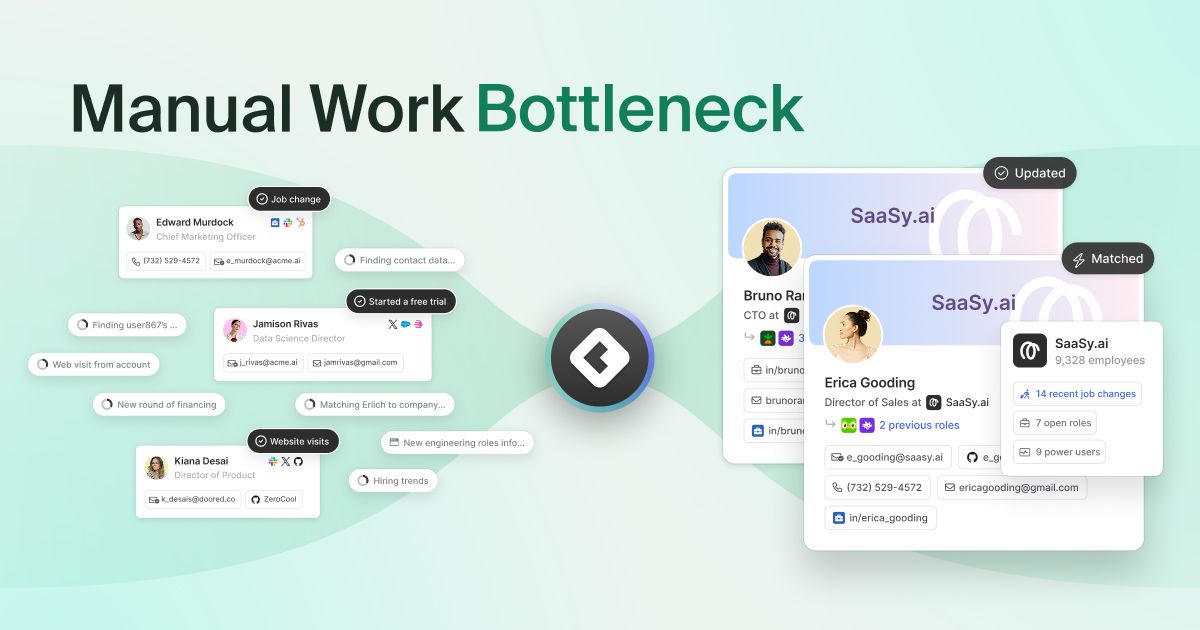
- The core argument: outbound volume is up but results are down, and the gap is filled with manual work — building lists by hand, researching accounts one at a time, writing personalized sequences slowly, and acting on signals days after the window closes. The author insists this is "not a talent problem"; it's a system designed for an older era that never scaled.
- A counter-warning frames the AI pitch: bolting AI onto a broken foundation just produces "more noise, faster." The fix is rebuilding the foundation, not adding activity.
- **Targeting — "stop building lists, start working signals."** An AI-native targeting layer builds lists from live signals (accounts showing buying behavior now, contacts who changed into purchasing-authority roles, companies in a growth pattern matching best customers) rather than static firmographic criteria. The manager's job shifts from defining the list to making sure reps work it.
- **Sequencing — "context before contact."** Generic sequences fail because buyers recognize and delete them. AI does the research before the rep opens a compose window, generating context-grounded messaging. The rep's job becomes "review, refine, and send" rather than research and write.
- **Follow-up — "stop missing the window."** Timing is "almost everything." Signals often live in one tool while follow-up happens in another, so windows close before information travels. An AI-native system fires a task when a signal fires and starts a sequence on a trigger, making follow-up systematic instead of dependent on which rep checked a dashboard.
- **The payoff scene.** The same Monday morning: the queue is prioritized by real events, context is pre-loaded, and a rep touches 50 accounts by noon — not by working faster, but because the system handled research, list building, signal monitoring, and initial drafts. What's left is "judgment, relationship, conversation."
- **The vendor turn.** Common Room is named as the platform "built for exactly this system," mapping its features onto all three stages.
- **The management reframe.** Managers coach conversations and messaging instead of troubleshooting data problems. "There's nowhere to hide" once manual work is gone — the only output that matters is conversations and pipeline.
- **Contested / uncertain claims.** Productivity figures (15→2 minutes, 20→50 accounts, 60 activities/day target) are illustrative, not measured. "Signal" quality and data freshness are assumed, not demonstrated. The whole "broken foundation" premise is structured to make one product the resolution.
### 🗒️ Notes
- Opening hook is a pain narrative: "Outbound volume is up, results are down," with the gap being manual work "that shouldn't require a human at all."
- Three-part spine repeated as a rhetorical pattern: each stage opens with "The [first/second/third] place manual work kills [SDR teams/outbound]."
- "Signal" is the load-bearing concept — pricing-page visits, a new VP of Sales, trial-activity spikes — defining who "deserves your team's attention today."
- The democratization claim: an AI-native system gives every rep the prioritization instinct top performers have, "except it's not intuition. It's data."
- "AI as leverage" is explicitly defined as not replacing reps and not automating the whole motion — "Handling the infinite, mechanical work, so the human can focus on the work that only a human can do."
- The manager section is the sharpest non-promotional insight: removing manual work removes hiding places, so coaching has to target real skill.
- Closing CTA: "we'd love to show you what Monday morning looks like when it isn't" [building lists by hand].
## 📚 References
- [Common Room — The AI SDR Playbook](https://www.commonroom.io/blog/ai-sdr-playbook/)
- [Common Room — AI-native GTM platform](https://www.commonroom.io/)
## 🗣️ Paraphrase
- Outbound effort keeps rising while results fall because reps lose half the day to manual research, list building, and slow personalization — and they often act on signals after the buying window has already closed. The reps aren't the problem; the legacy system is.
- A modern AI-native workflow removes that mechanical work across targeting (work live signals, not static lists), sequencing (AI assembles context before the rep writes), and follow-up (signals auto-create tasks and trigger sequences). The rep is freed for conversation, the manager coaches skill instead of chasing data, and Common Room is positioned as the platform purpose-built to run it.
## 📰 Newsletter
- Selling something on the internet? This Common Room playbook is a tidy case study in "signal-based" go-to-market — and it maps cleanly onto community-led growth, which is exactly the angle WordPress folks running plugin businesses should steal. Swap "pricing-page visit" for "opened a support thread, starred the repo, posted in the forum," and the same logic applies: work the people showing intent right now, not a stale list.
- Worth reading with one eyebrow raised: it's vendor content, so every "broken system" road leads to one product. Still, the management insight is free and real — automate the busywork and "there's nowhere to hide," because the only output left is conversations and pipeline.
- Community parallel for your own project: Common Room is a community-intelligence tool (you've already got a Literature note on it). The playbook is basically community-led growth wearing a sales hat. Helpful link: [the playbook itself](https://www.commonroom.io/blog/ai-sdr-playbook/).
## ✅ Action Items
#### DevRel
- Developer advocacy: treat first-party community signals (forum posts, repo stars, Slack joins, docs visits) as the DevRel equivalent of buyer signals; build a prioritized "who to engage today" queue instead of a static contributor list.
- Education: run a workshop on signal-based community engagement — translate the targeting/sequencing/follow-up spine into advocate outreach.
- Developer experience: instrument docs and onboarding so high-intent moments (a stuck quickstart, a repeated error) fire a follow-up task while the window is open.
- Developer marketing: map the "context before contact" idea to personalized advocate outreach; measure reply quality, not send volume.
- Community management: define which community events count as actionable signals and route them to owners automatically, so follow-up isn't a function of who checked the dashboard.
- Internal/external/cross-project: align community-signal definitions with sales/GTM so the same Common Room view serves both DevRel and revenue.
#### OSPO
- Policy & Governance: set a policy on what community signals may drive automated outreach and where human review is required.
- License Compliance: not applicable to this source.
- Security Management: not applicable to this source.
- Software Inventory: not applicable to this source.
- Developer Support: use signal triggers to route support windows before they go cold.
- Community Engagement: fund and formalize community-intelligence tooling as upstream investment, not just sales tooling.
- Strategic Alignment: report community-signal-to-pipeline as a shared KPI across OSPO and GTM.
#### Community
- Maintainers: prioritize contributor attention by live activity signals rather than intuition or recency bias.
- Contributors: trigger a "first issue"/pairing invite automatically when a newcomer hits an intent signal (forks, opens a draft PR).
- Sponsors: report signal-driven engagement outcomes in impact reports.
- Ecosystem: share signal definitions across projects so coordinated outreach doesn't double-touch the same person.
#### WordPress
- Community: apply the signal-based model to meetup/WordCamp follow-up — act on attendee intent while it's fresh.
- Training: build a lesson on community-led growth using this playbook as the sales-side analogue.
- Marketing: borrow the "more activity isn't the goal, better outcomes are" framing for plugin-business narratives.
- Documentation: instrument DevHub/HelpHub for intent signals (repeated searches, abandoned tutorials) to drive proactive help.
#### The WPCC
- Programs: pilot community-intelligence tooling for maintainer-stipend programs to target high-signal contributors.
#### FAIR
- Policies and covenants: set transparency rules for any AI that acts on community member behavior signals.
## 🧪 Hypotheses
- Reps working a signal-prioritized queue touch measurably more accounts per day than reps building lists manually, holding hours constant.
- Outreach grounded in pre-assembled account/contact context gets higher reply rates than generic firmographic-fit sequences.
- Follow-up triggered automatically on signal-fire produces more booked meetings than follow-up dependent on manual dashboard checks.
- Removing manual work widens, not narrows, the visible performance gap between top and average reps before coaching closes it.
- Community-led-growth teams applying the same signal model see engagement lift comparable to the sales outcomes claimed here.
### 📊 Methodology
- A/B test SDR cohorts: signal-prioritized queue vs. manual list building; measure accounts touched, reply rate, meetings booked over a fixed window.
- Controlled message test: AI-context-grounded sequences vs. generic templates, randomized across matched contacts, measuring reply and positive-reply rates.
- Time-and-motion study to validate the 15→2 minute and 20→50 account claims with instrumented logs rather than illustration.
- Longitudinal manager study: track rep performance variance before and after manual work is automated.
### ❓ Questions
- What defines a high-quality signal, and how is signal freshness and false-positive rate measured?
- Where does AI-generated context fail — and how often does "grounded in real signal" still produce off-target outreach?
- Does automating follow-up risk over-contacting prospects and accelerating list fatigue?
- How transferable is this sales model to community-led growth where "buying intent" is fuzzier and consent matters more?
### 🔮 Future Research
- Independent (non-vendor) benchmarks of signal-based vs. list-based outbound productivity and pipeline.
- Study of buyer/community-member reactions to AI-generated, signal-triggered outreach over time (trust, fatigue, opt-out).
- Frameworks for signal quality scoring and the human-review threshold for automated action.
### 💡 Implications
- **Practice:** the SDR role narrows to judgment and conversation; the manager role shifts from data troubleshooting to skill coaching.
- **Policy:** automated action on behavioral signals raises consent and transparency questions, especially in community settings.
- **Security:** aggregating first-party and "real-world buyer activity" signals concentrates sensitive behavioral data — a governance and privacy surface.
- **Education:** community and DevRel programs can teach signal-based engagement as a transferable skill.
- **Funding models:** community-intelligence tooling becomes a shared GTM + community investment rather than a single-team cost.
### 🧠 Learning Styles Assessment
- Reading level estimate: Flesch-Kincaid Grade ~7–8 (short sentences, plain business vocabulary, conversational fragments). Flesch Reading Ease ~60–70 (fairly easy).
#### 👀 Visual learners
- Present: none — pure prose, no diagrams, charts, or screenshots.
- Improve: add a before/after Monday-morning workflow diagram and a targeting→sequencing→follow-up flow.
#### 🔊 Aural learners
- Present: none.
- Improve: offer a 3-minute audio summary or narrated version.
#### 🗣️ Verbal learners
- Present: strong — analogies ("blank page" vs. "brief"), defined terms ("AI as leverage"), and concrete examples (pricing page, new VP).
- Improve: add a short glossary for "signal," "AI-native," "firmographic."
#### 🧩 Kinesthetic learners
- Present: none — no checklist or hands-on steps.
- Improve: add a "build your signal list this week" checklist.
#### 🧠 Logical learners
- Present: moderate — clear three-part structure and cause/effect framing.
- Improve: add a table mapping each manual task to its automated replacement and the KPI it moves.
#### 🧑🤝🧑 Social learners
- Present: weak — no discussion prompts.
- Improve: add reflection questions for SDR team retros.
#### 🧘♀️ Solitary learners
- Present: moderate — self-assessment framing ("nobody mentions this gap out loud").
- Improve: add a self-audit worksheet for your current outbound stack.
#### 🌿 Naturalistic learners
- Present: none.
- Improve: frame "signal ecosystem" and lifecycle of a buying window as an environment metaphor.
### 📊 Accessibility Assessment
#### Screen reader semantics
- Present: clear heading hierarchy in the source article structure.
- Improve: ensure section headings map to real `<h2>`/`<h3>` and any future diagrams carry descriptive alt text.
#### Keyboard navigation
- Present: standard article (no interactive traps).
- Improve: ensure the CTA link has a visible focus state.
#### Contrast and readability
- Present: not assessable from text alone.
- Improve: verify 4.5:1 body text contrast on the live blog.
#### Text resizing and reflow
- Present: not assessable from text.
- Improve: confirm reflow at 200% zoom on the published page.
#### Media and captions
- Present: no media, so no captions needed.
- Improve: if an audio/video version is added, ship captions and a transcript.
#### Forms and interactions
- Present: only a CTA link.
- Improve: ensure any demo-request form has labeled fields and inline validation.
#### Standards reference
- Map gaps to WCAG 2.2 AA: 1.4.3 (contrast), 1.4.10 (reflow), 2.4.7 (focus visible), 1.1.1 (non-text content) once visuals are added.
### 🌍 DEIB Assessment
#### Cultural breadth
- Present: none — generic US B2B SaaS framing, no regional or multilingual examples.
- Improve: add examples from non-US markets and note locale differences in outbound norms.
#### Inclusive language
- Present: gender-neutral throughout ("your reps," "a rep," "they").
- Improve: define jargon ("firmographic," "AI-native") for non-specialist readers.
#### Neurodiversity support
- Present: strong — chunked sections, repeated structure, short paragraphs, predictable patterns.
- Improve: add icon+text labels for the three stages.
#### Representation
- Present: minimal — roles only (rep, manager), no identities.
- Improve: vary illustrative personas if examples are expanded.
#### Psychological safety
- Present: mixed — "nowhere to hide" framing could read as pressure on reps.
- Improve: pair the accountability message with support/coaching framing to avoid a punitive tone.
### ✅ Logical Validity
#### Strong reasoning
- **Causal (¶3–4, "the gap... is filled with manual work"):** strong identification of the bottleneck as manual work between intent and action, not effort. Clarify further by quantifying the time cost with real data.
- **Analogical ("bolt AI onto a broken foundation... more noise, faster"):** a strong, memorable analogy distinguishing automation-as-amplifier from automation-as-rebuild. Clarify by naming concrete failure cases.
- **Inductive (manager section):** the inference that removing manual work exposes skill is well-reasoned and is the least promotional, most defensible claim.
#### Fallacies
- **False dilemma / either-or:** the piece frames outbound as either a "broken foundation" legacy system or the AI-native rebuild, with the vendor as the only path. Fix: acknowledge incremental and non-Common-Room approaches.
- **Unsupported statistics (¶ "turn a 15-minute pre-email process into a two-minute one"; "By noon they've touched 50 accounts"):** specific numbers presented as illustration but read as evidence. Fix: cite measured data or label clearly as hypothetical.
- **Appeal to consequences / promotional framing:** as vendor content, the entire problem narrative is constructed so the product is the resolution. The article even pre-empts skepticism ("slapping AI software somewhere and hoping it makes magic") while selling AI software — a rhetorical inoculation. Fix: present third-party evidence and name tradeoffs of the recommended approach.
- **Hasty generalization ("Generic sequences don't work anymore... They delete all of them"):** absolute claims about buyer behavior without data. Fix: qualify with reply-rate evidence.
#### Tone of voice
- Confident, conversational, lightly provocative coaching tone ("Nobody mentions this gap out loud. Everyone knows it's there."). Direct address to managers and reps ("your reps," "your job"). Sales-forward but restrained — the pitch is held until late. Reassuring on the human role ("Not replacing reps").
### 🛡️ DARVO Analysis
- Not applicable to this source — DARVO (Deny, Attack, Reverse Victim and Offender) describes responses to accusation or abuse. This is a marketing playbook with no accuser, accused, or wrongdoing to deflect. The closest rhetorical move is a pre-emptive inoculation against AI skepticism, but that's persuasion framing, not DARVO.
## 🎯 Conclusion
- **Bottom line:** outbound is bottlenecked by the manual gap between knowing who to reach and reaching them. An AI-native workflow automates targeting, sequencing, and follow-up so reps spend their time on conversations and pipeline — and Common Room is pitched as the platform built to run it.
- **Next steps for readers:** read it as a sharp strategic frame (signal-based, "AI as leverage," manager-coaches-skill) while discounting the vendor-shaped premise and unsourced numbers. If you run community-led growth, port the targeting/sequencing/follow-up spine to community signals — you already have Common Room in your stack and a Literature note on it. Validate any productivity claims with your own instrumented A/B test before buying the narrative.
## 🔄 Refactor Appendix — The AI SDR Playbook
> Density: 2–5 Literature atoms (H3), 0–3 Permanent candidates (H4).
> Defaults: 3 Literature, 1 Permanent.
### 📚 Literature Atoms (H3)
#### [H1] Outbound's real problem is manual work, not effort
> [!quote] ID:rw_pending
> the gap between knowing who to reach and actually reaching them is filled with manual work that shouldn't require a human at all
**Context & use**:
- ¶ "This is the real problem with outbound in 2026."
- Reframes the bottleneck from rep capability to system design — the load-bearing premise of the whole playbook and the bridge to community-led growth.
**Tags**: #xref
**Highlight**: [view highlight](readwise://)
<!-- atomicity: 1 idea ✓ -->
#### [H2] Adding AI to a broken system just scales the noise
> [!quote] ID:rw_pending
> bolt AI onto a broken foundation and you don't fix the foundation, you just produce more noise, faster
**Context & use**:
- ¶ following the Monday-morning scene.
- The piece's strongest caution: automation amplifies whatever foundation it sits on, so fix targeting before adding volume.
**Tags**: #xref #aphorisms
**Highlight**: [view highlight](readwise://)
<!-- atomicity: 1 idea ✓ -->
#### [H3] AI as leverage handles mechanical work, not the human part
> [!quote] ID:rw_pending
> Handling the infinite, mechanical work, so the human can focus on the work that only a human can do
**Context & use**:
- ¶ "This is what AI as leverage actually means."
- Defines the human/AI division of labor — the reusable principle that transfers cleanly to DevRel and community work.
**Tags**: #xref
**Highlight**: [view highlight](readwise://)
<!-- atomicity: 1 idea ✓ -->
### 🧠 Permanent Candidates (H4)
#### [P1] Automation amplifies a foundation rather than fixing it
**Claim** (one sentence, Courtney's voice): Adding automation to a broken process scales its output, not its quality, so you have to repair the underlying targeting before you add volume.
**Evidence pointer**: [[#H2]]
**Scope & conditions**: Holds for any signal-driven system (sales, DevRel, community-led growth); breaks when the existing foundation is already sound and automation is purely additive.
**Links**:
- [[Community-led growth]] — because applies-in community signal work
- [[Common Room]] — because evidence-for the vendor's own framing
<!-- atomicity: 1 idea ✓ -->
### ✏️ Fleeting Queue
- [F1] Port the targeting/sequencing/follow-up spine to community signals (forum, repo, docs intent) — community-led-growth analogue #fleeting #inbox
- [F2] The "nowhere to hide" manager insight applies to DevRel leads too — coaching shifts to conversation quality once busywork is automated #fleeting #inbox
### → Things 3 (max 2 actions)
- [ ] Draft a community-led-growth note linking this playbook to the existing Common Room Literature note — #things
- [ ] Cross-check the AI-as-leverage atom against existing AI identity/effort permanent notes — #things
<!-- deep-read:sections end -->
📄 **Full text:** [[Full Document Contents/Articles/The AI SDR Playbook.md|The AI SDR Playbook by commonroom.io]]
## Highlights
- This is the real problem with outbound in 2026. It's not that reps aren't trying, it's that the gap between knowing who to reach and actually reaching them is filled with manual work that shouldn't require a human at all. ([View Highlight](https://read.readwise.io/read/01kvy6hyhpkyk13nha58cdpdw6))
- Note: Reframes outbound's bottleneck from rep effort to system design — the bridge to community-led growth.
- Tags: signal-based-selling, atom/literature/h1
- But bolt AI onto a broken foundation and you don't fix the foundation, you just produce more noise, faster. More sequences. More activity. More output from a system that's still pointed at the wrong accounts. ([View Highlight](https://read.readwise.io/read/01kvy6hzt1zjgy9nzs2njp7gkm))
- Note: Strongest caution: automation amplifies whatever foundation it sits on — fix targeting before adding volume.
- Tags: sales-automation, atom/literature/h2
- This is what AI as leverage actually means. Not replacing reps. Not automating the whole motion. Handling the infinite, mechanical work, so the human can focus on the work that only a human can do. ([View Highlight](https://read.readwise.io/read/01kvy6j1nca9d8046yeyck5c5n))
- Note: The human/AI division of labor — the reusable "AI as leverage" principle that transfers to DevRel and community work.
- Tags: atom/literature/h3, go-to-market
## Links
- [[AI's Leverage Comes From the Data Foundation Not the Model]] — existing Permanent captures the playbook's warning that automation amplifies noisy or fragmented buyer signals.
- [[Content Progression Does Not Create Consent for Sales Contact]] — applies-in: signal-based outbound still needs an explicit boundary between audience behavior and permission to contact.