The Azusa Fire: Who Owns the Flame | Pentecostal History
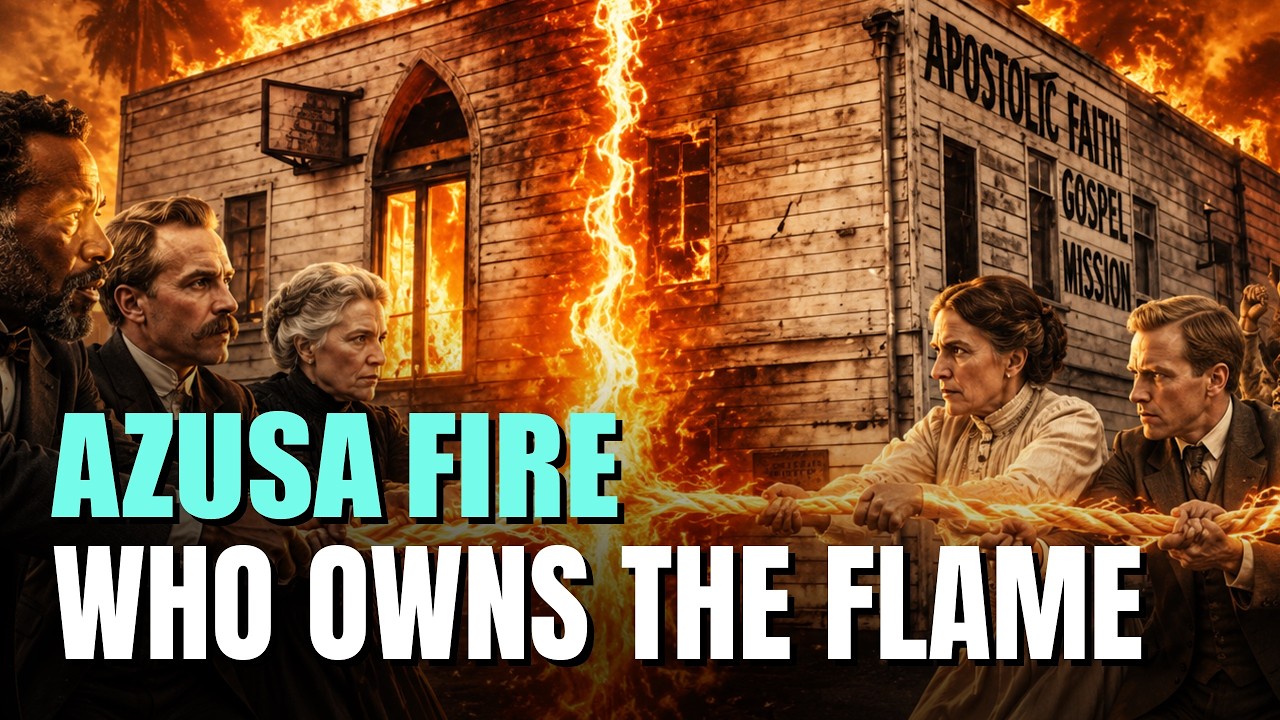
🔗 **Source:** [The Azusa Fire: Who Owns the Flame | Pentecostal History](https://www.youtube.com/watch?v=-q7Bxxtw42Y)
> [!note]+ Document Notes
> tags: [pentecostal-history, azusa-street, religious-authority, charismatic-movements, church-governance]
> author: John Collins
> source: Leaving the Message
> reference: https://www.youtube.com/watch?v=-q7Bxxtw42Y
> date created: 2026-08-04 12:00
> > [!info] Generated analysis — not the author's words. Sections below are machine-written
> > from the captured source. Only text inside `> [!quote]` blocks is verbatim from the author.
> > Do not quote or attribute any other line to the named author.
>
> # 🏷️ Title: The Azusa Fire: Who Owns the Flame | Pentecostal History
>
<!-- deep-read:sections start -->
## 🧭 Table of Contents
- [📝 Summary](#-summary)
- [📖 Main Content](#-main-content)
- [🗒️ Notes](#️-notes)
- [📚 References](#-references)
- [🗣️ Paraphrase](#️-paraphrase)
- [📰 Newsletter](#-newsletter)
- [✅ Action Items](#-action-items)
- [🧪 Hypotheses](#-hypotheses)
- [📊 Methodology](#-methodology)
- [❓ Questions](#-questions)
- [🔮 Future Research](#-future-research)
- [💡 Implications](#-implications)
- [🧠 Learning Styles Assessment](#-learning-styles-assessment)
- [📊 Accessibility Assessment](#-accessibility-assessment)
- [🌍 DEIB Assessment](#-deib-assessment)
- [✅ Logical Validity](#-logical-validity)
- [🛡️ DARVO Analysis](#-darvo-analysis)
- [🎯 Conclusion](#-conclusion)
### 🔗 References
- [The Azusa Fire: Who Owns the Flame | Pentecostal History](https://www.youtube.com/watch?v=-q7Bxxtw42Y)
- The transcript mentions Acts 2, *The Apostolic Faith*, historical newspapers, the Leaving the Message research site, and books associated with the host. It doesn't provide enough bibliographic detail to cite individual editions or archival items safely.
- No primary-source packet accompanies the supplied transcript. Historical claims below remain attributed to the episode unless marked as interpretation.
## 📝 Summary
- **What happened:** John Collins examines competing claims to spiritual authority associated with the Azusa Street Revival. He discusses William J. Seymour, Charles Fox Parham, Florence Crawford, Clara Lum, William Durham, a 1933 Kentucky killing, William Branham, the Latter Rain movement, and later charismatic movements.
- **Why it matters:** The episode asks how a movement decides who may speak for God when spiritual experience itself functions as a credential.
- **Key stakeholders:** Early Pentecostal leaders, congregants, later Pentecostal and charismatic communities, survivors of high-control religious groups, historians, clergy, and institutions responsible for safeguarding.
- **Historical material presented:** The host reports disputes over Azusa leadership, control of *The Apostolic Faith* mailing list, Durham’s doctrinal break with Seymour, and later movements that claimed renewed spiritual authority. The transcript doesn't supply the underlying documents.
- **Host’s interpretation:** Collins argues that control of the metaphorical flame shifted to whichever leader could persuade followers that a new revelation outranked earlier claims.
- **Later-continuity claim:** Collins traces a line from Azusa through Latter Rain, William Branham, the Shepherding movement, the Kansas City Prophets, the International House of Prayer, and the New Apostolic Reformation. The episode asserts this continuity; the transcript alone doesn't establish every organizational, doctrinal, or personal link.
- **Risks and tradeoffs:** Critiquing unaccountable authority can support safeguarding, but broad historical claims may flatten differences among Pentecostal traditions or treat one extreme case as representative.
- **Bottom line:** The episode’s strongest governance question concerns what happens when claimed manifestations outrank education, character assessment, supervision, and a community’s ability to challenge leaders.
## 📖 Main Content
### Historical account presented
Collins describes Azusa Street as a defining event in Pentecostal history whose later retellings have acquired mythic features. He contrasts those retellings with newspaper reports and other historical material discussed across his podcast series, though those records aren't reproduced in this transcript.
The episode presents Seymour as the mission’s pastor and Parham as an early figure whom Seymour and others called the movement’s father. It then turns to Crawford and Lum, whose move to Portland and control of *The Apostolic Faith* mailing list allegedly shifted the movement’s communications network away from Seymour.
Durham serves as the main internal counterexample. Collins says Durham received the Pentecostal experience at Azusa, praised Seymour, built a major Chicago ministry, and later returned with a doctrine that attracted part of Seymour’s audience. Seymour’s decision to exclude Durham is presented as evidence that a supposedly open spiritual movement still required someone to police its boundaries.
### Authority and credentialing
Collins argues that early Pentecostal experience could function as a portable credential. On this account, a manifestation could grant authority without formal theological education, supervised ministry, background checks, or years of demonstrated character.
That observation raises a sound institutional question: what safeguards remain when an experience authenticates both the message and the messenger? The episode connects this question to the emergence of rival leaders who claimed equal or greater revelation.
The host sometimes moves too quickly from a reported absence of formal credentials to a general claim that the movement rejected accountability as such. Informal communities can possess real accountability practices, while formally credentialed institutions can fail at safeguarding. Comparative evidence would strengthen the argument.
### Ownership of communications and memory
The Crawford–Lum episode suggests that communications infrastructure can influence whose version of a movement survives. Control of a publication, subscriber list, archive, or distribution network can shape recognition even when formal leadership remains elsewhere.
Collins interprets the mailing-list transfer as a practical separation of the flame from Seymour. That is an interpretive claim about authority and institutional memory, not merely a historical fact about possession of a list. He acknowledges that historians disagree about whether the transfer was authorized.
### Extreme harm and explanatory limits
The episode recounts the 1933 death of Lucinda Mills in eastern Kentucky. Collins says her son, John H. Mills, killed her during a gathering whose participants believed a divine revelation required sacrifice. He explicitly says the case shouldn't be treated as proof that Pentecostalism directly caused the killing.
Despite that qualification, he places the case within a broad progression from religious mythology to human sacrifice. That connection requires stronger comparative evidence than the transcript supplies. One extreme event can expose a possible failure mode without demonstrating a general historical law.
### Claims about later movements
Collins argues that unmet expectations of an imminent culmination encouraged later leaders to redefine the flame. He applies this pattern to Latter Rain, Branham-related movements, the Shepherding movement, the Kansas City Prophets, the International House of Prayer, and the New Apostolic Reformation.
This is the host’s continuity thesis. A historical demonstration would need dated primary sources, doctrinal comparisons, documented personal networks, institutional records, and evidence of influence in each transition. Similar language or authority structures alone wouldn't prove direct descent.
## 🗒️ Notes
#### ⏱️ [00:00:49](https://www.youtube.com/watch?v=-q7Bxxtw42Y&t=49) Myth and recorded history
- Collins describes Azusa Street as central to later Pentecostal history.
- He frames the series as an effort to separate recorded events from later mythology.
- The transcript refers to newspaper evidence shown elsewhere but doesn't reproduce it.
- His warning that mythology tends toward destruction is an interpretive generalization, not a finding established within this episode.
#### ⏱️ [00:06:49](https://www.youtube.com/watch?v=-q7Bxxtw42Y&t=409) Who owns the fire?
- The central question concerns who may define, transmit, and correct a spiritual experience.
- Collins compares early Pentecostal claims with his reading of Acts 2.
- He argues that Azusa participants presented Pentecost as newly restored and tied it to imminent Christian unity and Christ’s return.
- Scriptural interpretation and historical reconstruction overlap here; the transcript doesn't present competing readings from Pentecostal scholars.
#### ⏱️ [00:12:40](https://www.youtube.com/watch?v=-q7Bxxtw42Y&t=760) Early divisions
- Seymour, Parham, Crawford, Lum, Durham, and the wider body of participants appear as competing centers of authority.
- Collins treats disagreement over the nature and transmission of the fire as evidence that experience didn't produce a single settled theology.
- The video description supports these figures as the episode’s historical focus.
- The transcript supports the host’s comparison of their roles, but it doesn't independently verify each biographical or institutional claim.
#### ⏱️ [00:15:23](https://www.youtube.com/watch?v=-q7Bxxtw42Y&t=923) Publication and participation
- Collins reports a circulation of roughly 40,000 copies for *The Apostolic Faith* by 1907.
- He argues that loss of the subscriber list weakened Seymour’s control over the movement’s public voice.
- Azusa services are described as spontaneous and participatory, yet Collins says people who questioned the experience could be excluded.
- This creates a tension between broad participation and centralized boundary enforcement.
#### ⏱️ [00:19:54](https://www.youtube.com/watch?v=-q7Bxxtw42Y&t=1194) Crawford, Lum, and distribution power
- Crawford established an independent work in Portland.
- Lum joined her and brought the publication’s mailing list.
- Collins admits that the transcript doesn't establish whether this was an authorized transfer or theft.
- His ownership argument depends on interpreting communications control as spiritual and institutional authority.
#### ⏱️ [00:25:56](https://www.youtube.com/watch?v=-q7Bxxtw42Y&t=1556) Experience as credential
- Collins argues that ordinary people gained opportunities to preach and lead without conventional theological formation.
- He sees both democratization and danger in that development.
- His key concern is that a manifestation could authenticate a leader without independent examination of doctrine or character.
- His decreasing-potency model is a rhetorical reconstruction of lineage-based prestige, not a documented theological formula presented by all participants.
#### ⏱️ [00:32:01](https://www.youtube.com/watch?v=-q7Bxxtw42Y&t=1921) The Mills case
- The host introduces the Mills case as an extreme example of a claimed revelation overriding moral restraint.
- He reports that Lucinda Mills was killed by her adult son during or after an intense religious gathering in 1933.
- Collins says participants failed to intervene and helped prepare or burn the victim’s body.
- These are serious historical claims, but the transcript supplies no court record, newspaper citation, or case identifier.
- Collins denies a simple claim that Pentecostalism caused the killing, yet still uses the event to support his systemic argument.
#### ⏱️ [00:40:07](https://www.youtube.com/watch?v=-q7Bxxtw42Y&t=2407) Durham’s internal challenge
- Durham matters because his challenge came from within the movement.
- Collins says Durham received the Azusa experience in 1907, praised Seymour, returned to Chicago, and later drew crowds while preaching a different doctrine.
- Seymour’s response shows that claims of direct spiritual guidance didn't eliminate institutional conflict.
- Collins interprets the dispute as a recursive problem: the experience supposedly empowered someone to correct the community that authenticated the experience.
#### ⏱️ [00:45:22](https://www.youtube.com/watch?v=-q7Bxxtw42Y&t=2722) Revision after failed expectations
- Collins contrasts early expectations of imminent Christian perfection with later reinterpretations.
- He argues that rival leaders repeatedly changed the meaning of the flame.
- The episode presents theological competition as a structural result of personal revelation becoming difficult to test.
- Claims about an unbroken historical pattern require comparison with traditions that developed accountable governance or rejected these later teachings.
#### ⏱️ [00:46:57](https://www.youtube.com/watch?v=-q7Bxxtw42Y&t=2817) Latter Rain and Branham
- The host connects Azusa to the postwar Latter Rain and healing revivals.
- Branham appears as a leader whose followers assigned exceptional authority to his claimed revelation.
- Collins argues that Branham-related ministries reproduced disputes resembling the Seymour–Durham conflict.
- The claimed line of continuity is central to the host’s interpretation but isn't fully documented in this transcript.
#### ⏱️ [00:52:30](https://www.youtube.com/watch?v=-q7Bxxtw42Y&t=3150) Competing revelations
- Collins summarizes Seymour, Parham, Crawford, Lum, Durham, the Mills family, and Latter Rain as rival claimants or transmitters.
- He then extends the pattern to the Shepherding movement, Kansas City Prophets, the International House of Prayer, and the New Apostolic Reformation.
- The common feature in his account is a leader claiming divine authorization to revise an earlier teaching.
- Similar authority language may indicate continuity, recurring social dynamics, or both. The episode doesn't test those alternatives.
#### ⏱️ [00:58:01](https://www.youtube.com/watch?v=-q7Bxxtw42Y&t=3481) Closing claim
- The host concludes that current charismatic conflict isn't historically new.
- He attributes recurring division to a structure in which proximity to a founding event grants status while new revelations permit later leaders to displace earlier ones.
- The governance concern is clear: followers must choose among claims that lack a shared test.
- The episode leaves open how accountable Pentecostal communities understand discernment, education, ordination, and correction.
## 📚 References
- [The Azusa Fire: Who Owns the Flame | Pentecostal History — Leaving the Message](https://www.youtube.com/watch?v=-q7Bxxtw42Y)
- **Acts 2:** Discussed by the host, but no translation or edition is identified.
- ***The Apostolic Faith*:** Discussed as an early publication, but no issue-level citation is supplied.
- **Historical newspapers:** The host says prior episodes displayed relevant articles, but this transcript doesn't identify them.
- **Lucinda Mills case:** The episode supplies names, place, and year but no archival or legal citation.
- **Later-movement links:** The transcript names Latter Rain, William Branham, the Shepherding movement, the Kansas City Prophets, the International House of Prayer, and the New Apostolic Reformation without a source list.
- No external verification was performed for this note.
## 🗣️ Paraphrase
- Collins begins from the premise that Azusa Street became surrounded by later mythology. He wants listeners to examine contemporary records rather than accept devotional retellings.
- He questions the claim that a restored Pentecostal experience could instantly prepare people for ministry. In his reading, spiritual manifestation replaced education, supervision, character review, and formal credentials.
- Seymour presented the revival as the Holy Spirit’s work rather than his personal creation. Yet the mission still exercised authority by excluding dissenters and deciding which teachings belonged.
- Crawford and Lum moved the publication network toward Portland. Collins treats their control of the mailing list as evidence that practical ownership followed distribution rather than pastoral office.
- Lineage from Azusa gave some speakers greater status than later recipients. Collins interprets this as evidence that human proximity to the founding event, not divine action alone, determined authority.
- The Mills case shows the worst possible result when a claimed revelation faces no effective moral challenge. Collins qualifies the example but still places it inside his larger theory about religious mythology.
- Durham complicates the original-authority model because he received the recognized experience and then challenged Seymour’s doctrine. The same experience was invoked to authorize both sides of the dispute.
- Collins says later movements resolved failed expectations by redefining the source, purpose, or bearer of spiritual power. Each reinterpretation created another authority center.
- He applies that pattern to Branham and later charismatic networks. These connections are presented as historical continuity, though the transcript doesn't establish every step.
- The final lesson is that communities need a way to assess competing claims beyond charisma, lineage, personal experience, or a leader’s assertion of divine speech.
## 📰 Newsletter
A history podcast about Azusa Street raises a live question for open-source governance: who gets to speak for a community, and how can everyone else test that authority?
John Collins traces disputes involving Seymour, Parham, Crawford, Lum, Durham, and later charismatic movements. His argument is sharpest when he shows how experience, proximity to a founding event, and control of a publication network could become credentials. Some broader continuity claims need primary-source checking, especially where one extreme case carries too much explanatory weight.
For WordPress communities, the relevance isn't that a religious revival maps neatly onto a software project. It doesn't. The useful question is narrower: do written roles, public decisions, conflict-of-interest rules, contributor protections, and appeal paths remain effective when a respected figure claims special standing? Charisma may open a room, but it shouldn't own the keys.
Start with the [episode](https://www.youtube.com/watch?v=-q7Bxxtw42Y), then separate its documented history from its interpretation before repeating its claims.
## ✅ Action Items
#### DevRel
- **Developer advocacy:** Create a session on authority, trust, and accountable representation in contributor-led communities, with clear learning outcomes.
- **Education:** Teach contributors how to distinguish primary records, later retellings, and a presenter’s interpretation.
- **Developer experience:** Not applicable to this source — it doesn't discuss APIs, tooling, examples, or onboarding interfaces.
- **Developer marketing:** Avoid founder-centered narratives that erase disputed history or imply that one person speaks for a whole community.
- **Community management:** Review moderation and escalation paths for cases involving charismatic or high-status contributors.
- **Internal/external/cross-project:** Document who may represent a project publicly and how disputed claims receive correction.
#### OSPO
- **Policy & Governance:** Record decision rights, removal procedures, appeal paths, and the limits of informal authority.
- **License Compliance:** Not applicable to this source — it contains no licensing, reuse, or copyright-compliance issue.
- **Security Management:** Not applicable to this source — it doesn't address vulnerability intake, embargoes, signing, or attestations.
- **Software Inventory:** Not applicable to this source — it discusses no software assets, dependencies, or ownership register.
- **Developer Support:** Train staff to recognize when reputation or claimed special access is replacing documented process.
- **Community Engagement:** Fund independent governance reviews and make findings available to contributors.
- **Strategic Alignment:** Track concentration of decision-making power, unresolved appeals, and contributor trust as governance indicators.
#### Community
- **Maintainers:** Publish role boundaries, succession plans, review requirements, and procedures for challenging a maintainer’s decision.
- **Contributors:** Explain how authority is earned, checked, transferred, and revoked during onboarding.
- **Sponsors:** Require transparent budgets and prohibit funding arrangements that grant undisclosed governing control.
- **Ecosystem:** Create cross-project reporting paths for harmful conduct that moves between communities.
#### WordPress
- **Core:** Require decisions to rest on public technical and governance records rather than personal standing.
- **Core Performance:** Not applicable to this source — it offers no performance measurements, budgets, or profiling work.
- **Core AI:** Not applicable to this source — it doesn't discuss AI systems, evaluation, or responsible-use policy.
- **Core Program Team:** Map decision rights and cross-team escalation paths before release pressure exposes ambiguous authority.
- **Mobile:** Not applicable to this source — it contains no mobile product or application concerns.
- **Playground:** Not applicable to this source — it proposes no browser experiment, demonstration environment, or reproducible technical case.
- **Community:** Add power-awareness, safeguarding, and appeal guidance to meetup and WordCamp organizer training.
- **Training:** Develop a lesson on separating historical evidence, institutional memory, and interpretive claims.
- **Marketing:** Check origin stories against primary records and include contested points instead of presenting one authorized narrative.
- **Support:** Maintain safe escalation routes when a respected community figure is the subject of a complaint.
- **Design:** Not applicable to this source — it contains no interface, user-research, or design-system material.
- **Documentation:** Preserve governance decisions, role changes, dissent, and corrections in searchable public records.
- **Photos:** Not applicable to this source — it discusses no image collection, moderation, or taxonomy issue.
- **TV:** Pair historical talks with accurate captions, source lists, content notes, and speaker disclosures.
- **Polyglots:** Translate governance and reporting guidance so authority doesn't depend on access to English-only information.
- **Accessibility:** Require captions and corrected transcripts for governance training and historical presentations.
- **Meta:** Make contributor roles, affiliations, and decision records easier to find across WordPress.org.
- **CLI:** Not applicable to this source — it includes no command-line workflow or tooling requirement.
- **Hosting:** Not applicable to this source — it addresses no hosting standard, operational checklist, or reliability concern.
- **Tide:** Not applicable to this source — it contains no plugin-quality scoring or automated review issue.
- **Openverse:** Not applicable to this source — it discusses no media ingestion, licensing catalog, or moderation workflow.
- **Themes:** Not applicable to this source — it contains no theme review, testing, or mentorship issue.
- **Plugins:** Not applicable to this source — it contains no plugin review, provenance, or security-review issue.
#### The WPOCC
- **Programs:** Offer governance clinics for maintainers who need succession, accountability, and conflict-resolution structures.
- **Projects:** Support documentation sprints that preserve decision histories and make authority boundaries visible.
- **Funding experiments:** Tie grants to public milestones and decision records without granting funders hidden governing power.
#### FAIR
- **Technical independence:** Not applicable to this source — it doesn't discuss software distribution, metadata, signatures, or infrastructure control.
- **Policies and covenants:** Define anti-capture rules, transparent funding disclosures, appeal rights, and leadership sunset provisions.
- **Productized governance artifacts:** Publish reusable charters, role descriptions, conflict-of-interest forms, and decision logs.
## 🧪 Hypotheses
- Communities that treat extraordinary experience as sufficient leadership qualification experience more leadership disputes than communities requiring supervised formation and review.
- Control of publications and contact lists predicts practical influence during leadership conflicts better than formal title alone.
- Failed imminent predictions are followed by reinterpretations that preserve institutional identity while changing the original claim.
- Leaders who claim direct continuity with a founding event receive greater initial credibility than leaders without that lineage.
- Movements with independent complaint and removal procedures experience fewer severe harms from unchecked revelation claims.
- Later charismatic groups display several possible relationships to Azusa—documented descent, selective borrowing, retrospective identification, or recurring social structure—and these relationships won't always coincide.
### 📊 Methodology
- Build a dated corpus of early Pentecostal newspapers, mission records, letters, sermons, denominational minutes, and secular press reports.
- Create a prosopography of Seymour, Parham, Crawford, Lum, Durham, and their associates.
- Map publication ownership, subscriber networks, travel, ordination, and institutional affiliation over time.
- Code authority claims by source: lineage, manifestation, office, education, publication control, prophecy, or communal recognition.
- Compare the episode’s claims about the Mills case with court records and contemporary reporting before using it as explanatory evidence.
- Trace each claimed transition to Latter Rain and later movements through dated documents rather than similarity of language alone.
- Compare Pentecostal communities with different credentialing and accountability structures.
- Pre-register criteria for direct influence, indirect influence, shared background, retrospective association, and unsupported continuity.
- Include Pentecostal historians and survivors in review while disclosing institutional commitments and possible conflicts.
### ❓ Questions
- Which primary documents support each claim about Crawford and Lum’s control of the mailing list?
- How did early participants distinguish divine empowerment from authorization to hold office?
- What formal or informal accountability practices existed at Azusa that the episode doesn't discuss?
- How did race, gender, class, and access to publishing affect who could claim authority?
- Did Durham’s dispute concern the source of authority, the doctrine of sanctification, institutional control, or all three?
- Which later groups explicitly claimed descent from Azusa, and which links are imposed retrospectively?
- How representative was the Mills gathering of Pentecostal practice in eastern Kentucky?
- What evidence would falsify the host’s continuity thesis?
- How do accountable Pentecostal communities test prophecy and remove harmful leaders?
- When does democratized participation widen access, and when does it reduce safeguards?
### 🔮 Future Research
- Locate the newspaper articles and early *Apostolic Faith* issues referenced by Collins.
- Identify archival evidence for the mailing-list transfer and disagreements over its authorization.
- Reconstruct Durham’s 1907 visit and later return through dated contemporary records.
- Locate legal and newspaper documentation for the Mills case.
- Compare accounts written by Pentecostal, secular, Black church, women’s-history, and survivor scholars.
- Test whether the decreasing-flame model appears in historical sources or functions only as Collins’s explanatory metaphor.
- Build a source chain for each claimed connection from Azusa to Latter Rain, Branham, Shepherding, the Kansas City Prophets, the International House of Prayer, and the New Apostolic Reformation.
- Study traditions that retained Pentecostal spirituality while developing education, safeguarding, and accountable governance.
### 💡 Implications
- **Practice:** Spiritual or charismatic credibility shouldn't replace role definitions, supervision, character review, or complaint procedures.
- **Policy:** Communities need written rules for recognizing, limiting, transferring, and revoking authority.
- **Security and safeguarding:** Unchallengeable revelation claims can increase the risk of coercion, abuse, retaliation, and bystander inaction.
- **Education:** Historical-literacy training should teach the difference between a primary record, a later institutional memory, and a host’s thesis.
- **Funding:** Independent archives and governance research need support that doesn't make findings dependent on organizational approval.
- **Open-source governance:** Contributor communities benefit when status, sponsorship, tenure, or founder proximity can't bypass public process.
- **WordPress communities:** Organizers and project leaders need visible mandates, documented decisions, conflict disclosures, safe reporting, and meaningful appeals.
### 🧠 Learning Styles Assessment
- **Reading level estimate:** Approximate Flesch–Kincaid grade 9–11. This is an estimate because fragmented automatic captions make sentence boundaries and syllable-based scoring unreliable.
#### 👀 Visual learners
- **Present:** The speaker says names and publication images appeared on screen, but those visuals aren't included in the supplied transcript.
- **Improve:** Add a dated timeline, leadership map, publication-network diagram, and labels distinguishing evidence from interpretation.
#### 🔊 Aural learners
- **Present:** The source is a narrated podcast episode with repetition, humor, and verbal summaries.
- **Improve:** Add chapter markers and a short closing recap that labels the host’s thesis separately from verified events.
#### 🗣️ Verbal learners
- **Present:** The recurring fire metaphor gives the argument a memorable vocabulary.
- **Improve:** Define revival, Pentecostal baptism, Latter Rain, charismatic movement, and New Apostolic Reformation without assuming prior knowledge.
#### 🧩 Kinesthetic learners
- **Present:** No participatory exercise appears in the transcript.
- **Improve:** Invite readers to classify sample statements as primary evidence, reported history, interpretation, or continuity claim.
#### 🧠 Logical learners
- **Present:** The episode follows a rough chronology and tests internal tensions in rival authority claims.
- **Improve:** Add a claim-evidence table and identify premises, counterevidence, and confidence levels for each historical link.
#### 🧑🤝🧑 Social learners
- **Present:** The episode refers to comments and conversations with Pentecostal researchers.
- **Improve:** Pair discussion questions with moderation guidance so believers, former members, and survivors can participate safely.
#### 🧘♀️ Solitary learners
- **Present:** The central ownership question supports personal reflection.
- **Improve:** Add a worksheet for identifying which authority claims a listener accepts, why, and what evidence could change that judgment.
#### 🌿 Naturalistic learners
- **Present:** The spreading-flame image evokes an organic process but doesn't examine environmental systems.
- **Improve:** Use lifecycle analysis only where it clarifies institutional growth and decline; avoid treating a metaphor as historical proof.
### 📊 Accessibility Assessment
#### Screen reader semantics
- **Present:** The supplied transcript uses `br` tags as line breaks and includes timestamps.
- **Improve:** Convert the transcript into semantic paragraphs and headings. This supports WCAG 2.2 criteria 1.3.1 and 2.4.6.
#### Keyboard navigation
- **Present:** Not verifiable from the transcript.
- **Improve:** Confirm that playback, captions, chapters, volume, and transcript controls work by keyboard under criteria 2.1.1 and 2.1.2.
#### Contrast and readability
- **Present:** Not verifiable without inspecting the video and platform interface.
- **Improve:** Check text contrast under 1.4.3 and non-text interface contrast under 1.4.11.
#### Text resizing and reflow
- **Present:** Not verifiable from the captured text.
- **Improve:** Test the transcript and description at 200% zoom and narrow widths under criteria 1.4.4 and 1.4.10.
#### Media and captions
- **Present:** A timestamped transcript exists, but apparent name errors such as inconsistent spellings reduce accuracy.
- **Improve:** Correct names, identify speakers, mark non-speech audio, and verify synchronized captions under 1.2.2. Provide a reviewed transcript as a media alternative under 1.2.3.
#### Forms and interactions
- **Present:** Not applicable to the transcript itself.
- **Improve:** If comments or contribution forms are part of the source page, verify labels, errors, status messages, and target sizes under 3.3.1, 3.3.2, 4.1.3, and 2.5.8.
#### Standards reference
- **Relevant WCAG 2.2 AA criteria:** 1.2.2 Captions, 1.2.3 Audio Description or Media Alternative, 1.3.1 Info and Relationships, 1.4.3 Contrast, 1.4.4 Resize Text, 1.4.10 Reflow, 1.4.11 Non-text Contrast, 2.1.1 Keyboard, 2.1.2 No Keyboard Trap, 2.4.6 Headings and Labels, 2.5.8 Target Size, 3.3.1 Error Identification, 3.3.2 Labels or Instructions, and 4.1.3 Status Messages.
- Caption timing, visual contrast, keyboard behavior, and platform controls weren't verified.
### 🌍 DEIB Assessment
#### Cultural breadth
- **Present:** The episode addresses an interracial revival and names both men and women in its leadership history.
- **Improve:** Include Black Pentecostal scholarship, global Pentecostal perspectives, and accounts from communities outside the later movements Collins studies.
#### Inclusive language
- **Present:** The host distinguishes ordinary believers from institutional leaders and sometimes qualifies broad claims.
- **Improve:** Replace dismissive descriptions with precise conduct-based language, define insider terms, and avoid treating Pentecostalism as a single undifferentiated community.
#### Neurodiversity support
- **Present:** Repetition reinforces the central question.
- **Improve:** Reduce recursive metaphor, add chapters, summarize claims in tables, and distinguish facts from interpretation with consistent labels.
#### Representation
- **Present:** Seymour, Crawford, and Lum appear in the narrative, but the analysis centers largely on male doctrinal conflict.
- **Improve:** Examine how race and gender shaped access to pulpits, publications, archives, and later historical recognition.
#### Psychological safety
- **Present:** The host speaks from experience leaving a destructive religious movement and warns listeners about coercive authority.
- **Improve:** Add a content note before the homicide discussion, avoid laughter near traumatic material, provide survivor resources, and clarify that criticism of leaders isn't condemnation of every believer.
### ✅ Logical Validity
#### Strong reasoning
- **Internal comparison:** The Seymour–Durham conflict is relevant because both figures operated inside the same movement. This makes the dispute harder to dismiss as outside hostility.
- **Institutional mechanism:** Connecting publication control with practical influence identifies a concrete mechanism through which authority can shift.
- **Acknowledged uncertainty:** Collins says the record doesn't settle whether the mailing-list transfer was authorized.
- **Causal restraint:** He says the Mills killing shouldn't be reduced to a claim that Pentecostalism directly caused it.
- **Testable concern:** The question of whether manifestations displaced credentialing can be examined through ordination records, mission policies, biographies, and disciplinary proceedings.
#### Fallacies
- **Slippery slope — 03:24–04:25 and 32:01–32:23:** The episode treats mythology as tending toward human sacrifice. One possible extreme outcome doesn't establish a regular progression. Fix this by stating necessary conditions and comparing cases that did and didn't produce violence.
- **Hasty generalization — 34:57–39:13:** The Mills case is used to illuminate a broad authority system despite being identified as extreme. Fix this by establishing prevalence and selecting comparison cases.
- **False analogy — 04:28–05:14:** Ancient mythologies and twentieth-century Pentecostal movements are compared through a shared violent endpoint. Similar outcomes don't establish similar causes. Fix this with evidence about mechanisms rather than outcome resemblance.
- **Reification or equivocation — throughout:** The fire shifts among theological experience, moral transformation, doctrinal correctness, lineage, publication control, and personal authority. Fix this by defining each meaning and showing when the argument moves between them.
- **Genetic-fallacy risk — 46:57–58:24:** Later movements may be judged by a contested account of their origins rather than their own beliefs and practices. Fix this by evaluating each movement independently before assessing continuity.
- **Circularity diagnosis — 43:41–45:10:** Collins plausibly identifies a self-sealing pattern in which every failed version authorizes a corrective revelation. The analysis needs primary examples showing adherents making each step rather than relying on a reconstructed dialogue.
#### Tone of voice
- The tone is polemical, skeptical, survivor-informed, and often sardonic.
- Humor and repeated flame imagery make the argument memorable.
- Terms that dismiss historical actors can obscure distinctions between documented misconduct, disputed allegations, theological disagreement, and the host’s moral judgment.
- Laughter near the homicide discussion risks undercutting the seriousness of the subject.
### 🛡️ DARVO Analysis
- **Deny:** Not applicable to this source — the transcript doesn't present a complete response in which an accused party denies a specific allegation.
- **Attack:** Not applicable to this source — Collins criticizes leaders, but criticism alone isn't the attack stage of a documented DARVO sequence.
- **Reverse victim/offender:** Not applicable to this source — no clear exchange shows an alleged offender recasting themselves as the victim of the person reporting harm.
- **Related rhetoric:** Collins says some believers interpret historical criticism as an attack. Without their full statements, this can't be classified as reversal or credibility undermining.
- **Emotional cues:** Survivor experience, sarcasm, warnings, and graphic harm shape the listener’s response. These cues warrant attention but don't prove DARVO.
- **Assessment:** No complete DARVO pattern can be established from the supplied transcript.
## 🎯 Conclusion
The episode asks a consequential question about religious authority: what can a community do when spiritual experience validates the messenger, the message, and every later correction?
Collins presents valuable historical leads involving Seymour, Parham, Crawford, Lum, Durham, publishing control, credentialing, and later movements. His distinction between an outside critic and Durham’s internal challenge strengthens the core inquiry. His acknowledgment of uncertainty around the mailing list and direct causation in the Mills case is responsible.
The weakest parts turn the fire metaphor into an explanatory mechanism, use an extreme killing to support a system-wide pattern, and assert later continuity without showing the full source chain. Readers should preserve the governance question while checking the historical claims against primary records and scholarship from several perspectives.
Practical next steps are to verify the mailing-list history, source the Mills case, trace each later-movement connection, and compare communities with different forms of education, discernment, supervision, and removal.
## 🔄 Refactor Appendix — The Azusa Fire: Who Owns the Flame | Pentecostal History
> Density: 3 Literature atoms, 1 Permanent candidate.
>
> Historical events, the host’s interpretation, and later-continuity claims remain separate.
>
> Quotes below preserve the supplied transcript’s wording, including its spelling of Azusa as Isuza.
### 📚 Literature Atoms (H3)
### [H1] Manifestation substitutes for accountable credentialing
> [!quote] ID: Reader highlight ID not supplied
> the manifestation authenticated the messenger.
**Context & use**:
- At [00:28:10](https://www.youtube.com/watch?v=-q7Bxxtw42Y&t=1690), Collins condenses his concern about experience functioning as authority.
- Useful for examining governance systems that allow claimed manifestations to bypass education, character review, supervision, or appeal.
- This is the host’s interpretation of the historical pattern.
**Tags**: #xref #articleseed
**Highlight**: [view source](https://www.youtube.com/watch?v=-q7Bxxtw42Y&t=1690)
<!-- atomicity: 1 idea ✓ -->
### [H2] Distribution control shifts practical authority
> [!quote] ID: Reader highlight ID not supplied
> when she took that mailing list it demonstrated that the fire could actually be separated from Seymour.
**Context & use**:
- At [00:20:16](https://www.youtube.com/watch?v=-q7Bxxtw42Y&t=1216), Collins interprets control of *The Apostolic Faith* mailing list as a shift in movement authority.
- The transfer itself is a historical claim; its meaning as ownership of the flame is the host’s interpretation.
- Useful for research on communications infrastructure, institutional memory, and succession disputes.
**Tags**: #xref #articleseed
**Highlight**: [view source](https://www.youtube.com/watch?v=-q7Bxxtw42Y&t=1216)
<!-- atomicity: 1 idea ✓ -->
### [H3] Rival revelations create recurring authority disputes
> [!quote] ID: Reader highlight ID not supplied
> Every generation since the Isuza Street revival repeats this pattern
**Context & use**:
- At [00:54:42](https://www.youtube.com/watch?v=-q7Bxxtw42Y&t=3282), Collins states his continuity thesis.
- The episode applies this pattern to several later movements, but the supplied transcript doesn't document every historical link.
- Useful as a research hypothesis rather than a settled conclusion.
**Tags**: #xref #articleseed
**Highlight**: [view source](https://www.youtube.com/watch?v=-q7Bxxtw42Y&t=3282)
<!-- atomicity: 1 idea ✓ -->
### 🧠 Permanent Candidates (H4)
#### [P1] Authority claims need independent tests
**Claim**: Authority claims remain unsafe when communities cannot test or revoke them.
**Evidence pointer**: [[#H1]]
**Scope & conditions**:
- Holds when personal experience or founder proximity can override documented standards.
- Needs qualification where communities possess credible discernment, supervision, complaint, and removal practices.
- Doesn't imply that formal credentials alone prevent abuse.
**Links**:
- [[Charisma cannot replace governance]] — because extends the claim into institutional design.
- [[Historical continuity requires source chains]] — because contrasts documented influence with resemblance.
- [[Contributor authority needs public limits]] — because applies-in open-source communities.
- [[Manifestation substitutes for accountable credentialing]] — because evidence-for the governance concern.
<!-- atomicity: 1 idea ✓ -->
### ✏️ Fleeting Queue
- [F1] Locate primary documents for the Crawford–Lum mailing-list transfer — episode claim requiring archival confirmation #xref
- [F2] Trace each proposed link from Azusa to later charismatic movements — separate descent, borrowing, and recurring structure #articleseed
### → Things 3 (max 2 actions)
- [ ] Compare the mailing-list account with dated issues, correspondence, and archival histories — Pentecostal governance research #things
- [ ] Build a claim-source matrix for the Mills case and later-continuity thesis — evidence audit #things
<!-- deep-read:sections end -->
📄 **Full text:** [[Full Document Contents/Articles/The Azusa Fire Who Owns the Flame Pentecostal History.md|The Azusa Fire: Who Owns the Flame | Pentecostal History by YouTube]]
## Highlights
- the argument that I think I'll make with Seymour. um his experience basically became a portable credential which is really odd because if you think how the fire spread those who attended the revival they were believed to have received the fire and therefore without any justification some of them did not have background checks they were spreading there were people who may not ([View Highlight](https://read.readwise.io/read/01kz6jp3eefj7bbq0y9h9yj13w))
- Note: The host argues that revival experience functioned as a portable credential.
- Tags: atom/literature/h1
- uh in Portland. Clara Lum joined her and took or transferred or stole. We don't we don't have the actual history of this but the newspapers mailing list which was one of the most important things in this movement. So when she took that mailing list it demonstrated that the fire could actually be separated from Seymour. So at that point Crawford and Lum were effectively becoming the chief apostles of the fire. So if you think ([View Highlight](https://read.readwise.io/read/01kz6jp5ndszve45my7e4tzcm6))
- Note: The mailing-list dispute illustrates how control of distribution could shift practical authority.
- Tags: atom/literature/h2
- denounce the original flame. They only questioned this. who had the authority to say that he had a new flame or she had a new flame. Every generation since the Isuza Street revival repeats this pattern and they change and alter what the flame is or how it comes to the people. William Brandham who led the uh latter rain revival, post World War II healing revival, he said the angel gave him the flame. In other words, it wasn't ([View Highlight](https://read.readwise.io/read/01kz6jp7sas8nas1hbgv3d9yqe))
- Note: The host presents recurring rival revelations as a repeated authority pattern.
- Tags: atom/literature/h3
- And it puts the people into a place where they have to be they have to be somewhat confused. Is God really talking to this person? Is God talking to the other person? This person is now in prison because God talked to him. And we find out he was a total scoundrel. This other person, they're not in prison, but their doctrines aren't quite right. It's not what I'm reading in the Bible. Yet they said God told them these doctrines and they're holding this torch. So if I go to them and I get the flame, what kind of flame am I getting? [laughter] ([View Highlight](https://read.readwise.io/read/01kz6jp9me9fmvgahr080rg5f0))
- Note: Competing private revelations leave followers without an independent way to adjudicate leadership claims.
- Tags: atom/zettel/z1
## Links
- [[3. Resources/Permanent Notes/Experience Is Not a Portable Credential Without Independent Vetting]] — supports: revival participation became an authority claim that traveled without a shared vetting process.
- [[3. Resources/MOCs/NAR and Charismatic Authority Critique MOC]] — belongs-to: Pentecostal authority lineage and rival revelation claims.