The Council of Nicaea | How Politics and Persecution Shaped Christianity
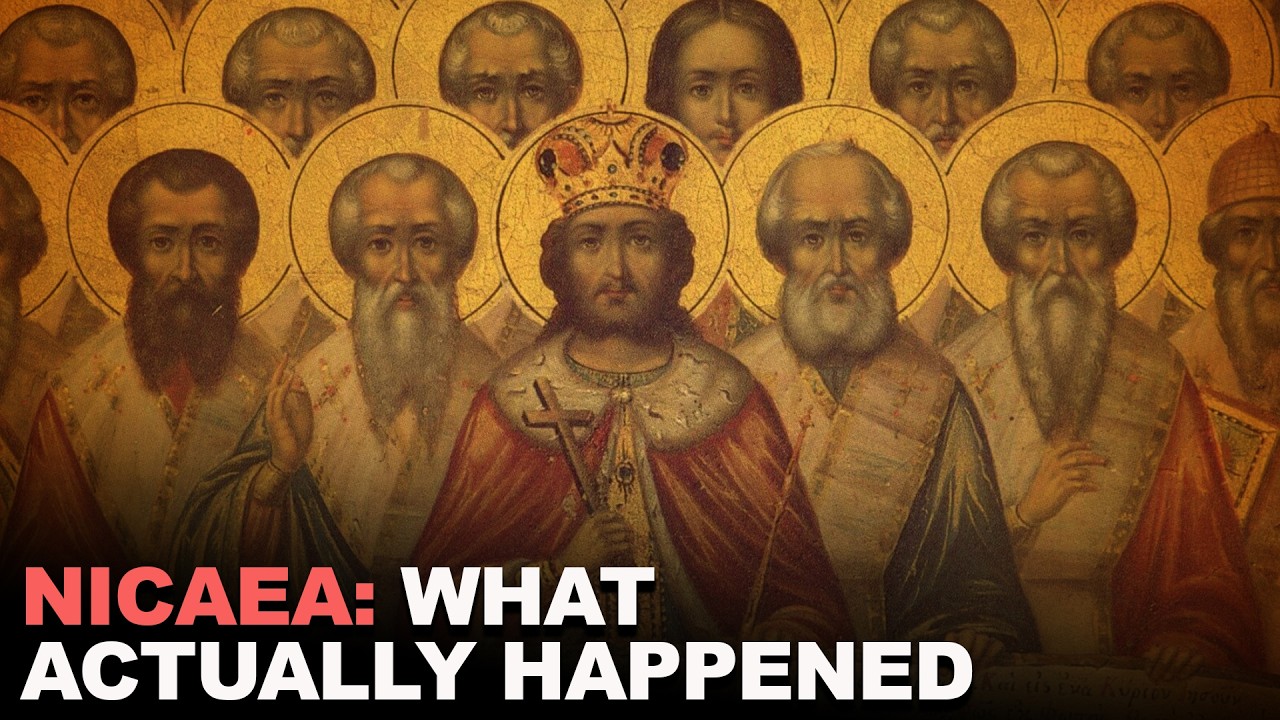
🔗 **Source:** [The Council of Nicaea | How Politics and Persecution Shaped Christianity](https://www.youtube.com/watch?v=OqTLSxeCJjM&feature=youtu.be)
> [!note]+ Document Notes
> > [!info] Provenance
> > **Analysis generated:** 2026-08-27 by Claude (Opus 5) via the `readwise-deep-read` pipeline.
> > **Source:** YouTube — https://www.youtube.com/watch?v=OqTLSxeCJjM
> > **Published:** 2026-05-01 · **Transcript:** ~32,900 chars · video
> > **Byline:** **Not determinable from the captured metadata.** Reader's `author` and `site_name` fields both read `YouTube`; no channel name appears in the transcript or the document record. The presenter refers to prior videos on "Arianism" and "the Great Persecution of Diocletian" and uses a first-person solo register, so this is a single-presenter religious-history channel. **No individual or channel is named below, because none can be verified from what was captured.**
> > **Register key used throughout:** `[STATED]` author-stated claim · `[EVIDENCE]` demonstrated evidence · `[INFERENCE]` reviewer inference · `[RECOMMEND]` reviewer recommendation.
> > **Coverage:** Full transcript read end to end. **Transcript is machine-generated** — `[music]` markers interrupt sentences mid-clause and at least one technical term is mis-transcribed (see [Transcription artifacts](#transcription-artifacts)). Claims below are drawn from the transcript text; where a defect is plausibly the captioner's rather than the presenter's, that is stated.
> > **Verification performed:** Dates, arithmetic, and Greek terminology checked against standard chronology. Three substantive errors found and are recorded with the reasoning. `[INFERENCE]` I did not consult the video's on-screen graphics, which may correct some of what the audio says.
>
> # 🏷️ Title: The Council of Nicaea | How Politics and Persecution Shaped Christianity
>
<!-- deep-read:sections start -->
## 🧭 Table of Contents
- [📝 Summary](#-summary)
- [📖 Main Content](#-main-content)
- [🗒️ Notes](#️-notes)
- [📚 References](#-references)
- [🗣️ Paraphrase](#️-paraphrase)
- [📰 Newsletter](#-newsletter)
- [✅ Action Items](#-action-items)
- [🧪 Hypotheses](#-hypotheses)
- [📊 Methodology](#-methodology)
- [❓ Questions](#-questions)
- [🔮 Future Research](#-future-research)
- [💡 Implications](#-implications)
- [🧠 Learning Styles Assessment](#-learning-styles-assessment)
- [📊 Accessibility Assessment](#-accessibility-assessment)
- [🌍 DEIB Assessment](#-deib-assessment)
- [✅ Logical Validity](#-logical-validity)
- [🛡️ DARVO Analysis](#-darvo-analysis)
- [🎯 Conclusion](#-conclusion)
### 🔗 References
Primary sources named in the video (none linked on screen per the transcript):
- **Lactantius**, *On the Deaths of the Persecutors* — the dream account before the Milvian Bridge
- **Eusebius of Caesarea** — the sky-vision account, *In Hoc Signo Vinces*; also the council proceedings
- **Athanasius of Alexandria** — the "318 bishops" figure, c. 40 years after the council
- **Genesis 14:14** — Abraham's 318 trained men, the numerological source
- **The Nicene Creed of 325** and its anathema clause
- Named actors: Diocletian · Maximian · Galerius · Constantius Chlorus · Constantine · Maxentius · Licinius · Arius · Alexander of Alexandria · Hosius of Corduba · Eusebius of Nicomedia · Theognis of Nicaea · Marcellus of Ancyra · Macarius of Jerusalem · Pope Sylvester I (absent; represented by Vitus and Vicentius) · Theonius of Marmarica and Secundus of Ptolemais (the two non-signers) · Constantius II · Theodosius I
## 📝 Summary
**What it is.** A ~30-minute narrative history of the Council of Nicaea (325 AD), built as a myth-correction: `[STATED]` the council did **not** choose the books of the Bible, Constantine did **not** impose his own theology, and the council did **not** invent the Trinity or first decide that Jesus was God. It then reconstructs the political road to Nicaea — Diocletian's tetrarchy and Great Persecution, the Milvian Bridge, the Edict of Milan, the Arian controversy — and the council's proceedings and aftermath.
**The thesis, and it is a good one.** `[STATED]` Nicaea was a **stability operation**, not primarily a theological one. Constantine's interest was imperial unity; the church was useful to him because it was already organised. `[STATED]` *"Christian churches were already organized into a tight network of local dioceses, which, if he could tap into that network, would give him insights into what was going on all throughout the empire. It was like a system of intel had just been dropped into his lap."* That is the video's sharpest single observation and it carries the whole argument.
**Its best passage.** `[EVIDENCE]` The **318 analysis**. The traditional attendance figure is almost certainly symbolic: Genesis 14:14 gives Abraham 318 trained men who win against impossible odds, and in Greek isopsephy 318 is τιη — tau (300, read as the cross) plus iota-eta (18, the first two letters of Ἰησοῦς). `[INFERENCE]` This is real source criticism, correctly executed, in a popular video, and it models exactly the habit the rest of the video needs more of: **ask what a number was for before asking whether it is true.**
**Risks and tradeoffs.** `[EVIDENCE]` **Three substantive errors**, one of them internally contradictory with the video's own definitions, plus a methodological inconsistency: the video correctly warns that Eusebius writes hagiography rather than history, then uses Eusebius uncritically for two council anecdotes.
**Bottom line.** `[INFERENCE]` The framing is right and the myth-corrections are worth propagating. But **the video's opening myth-bust is in tension with its own ending**, and it never resolves it: "Constantine didn't force his theology" is true in the narrow sense that the theology wasn't his — and it sits alongside the video's own account of an emperor personally deciding the creed's most contested word, then ordering books burned with execution for concealment. `[RECOMMEND]` Keep the political thesis. Check the three facts before repeating them.
## 📖 Main Content
### The thesis: an organisational asset, not a conversion
`[STATED]` The video is careful about Constantine's religious status: *"Constantine, despite what Eusebius would like us to believe, was probably not a full-blown Christian at this point in time,"* and he *"remained the Pontifex Maximus of the traditional Roman state gods… a title he held until his death in 337."*
`[EVIDENCE]` Correct, and the surrounding argument is the video's strongest work. Constantine's patronage is explained by **administrative utility** rather than piety: an empire-wide network of dioceses with literate personnel, internal correspondence, and local authority is an intelligence and administration asset. The concrete grants follow — clergy tax exemption, imperial funding for basilicas, bishops as civic advisors — and then the decisive step: `[STATED]` *"Constantine himself began to intervene in ecclesiastical matters, especially ones that he thought could threaten social unity."*
`[INFERENCE]` The causal chain is clean and it is the right one: **the church became worth protecting because it was organised, and once it was worth protecting, its internal disputes became imperial business.** Nicaea follows from that, not from a conversion experience.
### The thirteen-year swing
`[STATED]` *"311 was a terrible time to be a Christian. 325? Pretty amazing."*
`[EVIDENCE]` The video's most effective rhetorical passage asks the viewer to stand in 311 — eight years of hiding, churches destroyed, scriptures burned, people you know tortured or killed — and then in 313, legal. `[INFERENCE]` Making the reader feel the *rate* of change is the right instinct, because the rate is what explains the behaviour at Nicaea. Bishops who had been hunted a decade earlier are now travelling at imperial expense, with armed escort, to a palace. That is not a group positioned to say no to the emperor who arranged it, and the video supplies every element of that observation without quite assembling it.
### Where the myth-bust argues against the video's own ending
`[STATED]` The opening: *"the Emperor Constantine didn't try to force his own theology on important decision-makers."*
`[STATED]` The middle: on *homoousios*, *"Constantine, advised by Hosius, urged acceptance… And here is really where we see Constantine use his imperial authority, because here, and really only here, he himself tipped the balance of the scales. Constantine chose to have the word homoousios stay in the creed."*
`[STATED]` The end: *"Constantine issued an edict. The writings of Arius were to be burned. Anyone concealing them could be executed, and Arius and his supporters were banished to Illyria. The emperor distributed the creed throughout the empire and made adherence to this newly stamped orthodoxy a requirement."*
`[INFERENCE]` **These do not sit together comfortably, and the video never returns to reconcile them.** The myth-bust is defensible on a narrow reading — the theology originated with the Alexandrian party, not with Constantine, and he had no personal stake in *homoousios* as doctrine. But the natural reading of "didn't try to force his own theology" is that imperial coercion was not applied to the outcome, and by the video's own account it plainly was: to the decisive term, and then to enforcement, with a capital penalty for possessing the losing side's books.
`[RECOMMEND]` The precise version — and it is a better line than the myth-bust — is: **Constantine did not supply the theology. He supplied the enforcement.** That preserves the correction against the popular myth while remaining consistent with the video's own evidence.
`[INFERENCE]` The same tension runs through the claim that Constantine *"presided symbolically, but not theologically"* and *"sat as the convener and protector, not as a participant in the debate."* An actor who personally decides the single contested word is a participant. The video half-notices this — *"here, and really only here"* — and treats the exception as small. It is the only decision that mattered.
### Three factual problems
`[EVIDENCE]` **1. The tetrarchy date is wrong, and the video contradicts itself.** `[STATED]` *"Diocletian created something known as a tetrarchy in the year 329 AD."* The tetrarchy dates to **293 AD**. The video's own subsequent timeline makes 329 impossible: it has the Great Persecution beginning in 303 and Diocletian retiring in 305, both under a system it just said began in 329 — and 329 is four years *after* Nicaea. `[INFERENCE]` Almost certainly a script or caption slip for 293, but as delivered it is a hard error in the video's foundational paragraph, and an attentive viewer building a timeline will hit the contradiction.
`[EVIDENCE]` **2. The *homoousios* / *homoiousios* distinction is inverted at the end.** Earlier the video defines the Nicene term correctly: `[STATED]` *"the term homoousios, or same essence."* In the aftermath section it then says: `[STATED]` *"the Homoousians who believed the son was of similar substance with the father."* **Those are two different words and the video has just used one of them correctly.** *Homoousios* (ὁμοούσιος) is *same* substance — the Nicene position. *Homoiousios* (ὁμοιούσιος) is *similar* substance — the semi-Arian position. The group described is the **Homoiousians**. `[INFERENCE]` Compounding it, the video then lists *"the Semi-Arians, who tried to find a middle ground"* as a **separate** third group, when the Homoiousians substantially *are* the semi-Arians. The post-Nicene taxonomy as given is both mislabelled and double-counted. This is the most consequential error, because the one-iota difference between these words is the single most famous detail of the entire controversy.
`[EVIDENCE]` **3. "Anathema" is overstated.** `[STATED]` *"if you don't know what anathema is, it means it's a belief that will damn you to eternal hell."* Anathema is a **juridical act of the church** — formal exclusion from the community. `[INFERENCE]` Defensible as popularisation of what the framers meant to convey, but it is the video's strongest claim and its loosest definition, and it is stated as a definition rather than as an implication.
### The methodological inconsistency
`[EVIDENCE]` The video handles Eusebius well once. On the vision: `[STATED]` *"Eusebius seems to be writing from the standpoint of theology more so than history. Eusebius' account of Constantine functions more like a hagiography or bio of a saint which is used to inspire faith more than it is to depict unbiased historical facts."* That is the correct caution, correctly placed.
`[INFERENCE]` It is then not reapplied. Two council anecdotes come from the same author with no renewed caveat: `[STATED]` *"Eusebius of Caesarea says they tore up the document and covered their ears denouncing it as blasphemous"* and `[STATED]` *"Constantine burned their complaints publicly urging forgiveness."* Both are vivid, both flatter the winning side and the emperor, and both come from the source the video has just told us writes to inspire faith. **A source flagged as hagiographic in one section is not rehabilitated by the next section.**
### The epistemics the video supplies and does not draw
`[STATED]` *"The writings of Arius were to be burned. Anyone concealing them could be executed."*
`[INFERENCE]` **This is the most important methodological fact in the video and it is delivered as a plot point.** If the losing side's texts were destroyed under penalty of death, then almost everything we know about what Arius actually taught reaches us **through the quotations of his opponents.** Every characterisation of Arian belief in this video — including its own clear summary of it — descends from a corpus curated by the winners.
`[RECOMMEND]` That single caveat would improve the video more than any other addition, and it costs one sentence. It also generalises well past church history: **when a controversy ends with one side's documents destroyed, the surviving account of what they believed is a hostile summary, not a record.**
### The 318 analysis — what the video does best
`[EVIDENCE]` `[STATED]` *"about 40 years after the Council of Nicaea, Athanasius of Alexandria gives a report of who was there, and he states that there was 318 people."* The video's two reasons for doubting it are both real:
1. **Genesis 14:14** — Abraham's 318 trained men, outnumbered and victorious. `[STATED]` *"the number 318 began taking on a symbolic message that if you trust in the Lord, nothing can stand in your way."*
2. **Isopsephy** — `[STATED]` *"318 in Greek numerology is written as tau, iota, eta. The tau is like the cross… Iota eta together equals 18, and is the first two letters of Jesus' name in Greek."*
`[INFERENCE]` Both are correct, and the conclusion — `[STATED]` *"Athanasius almost certainly put that number in because it was close enough and theologically significant"* — is the right one. `[INFERENCE]` The video's own working estimate of **220–250** is at the low end; the more common scholarly range runs to roughly 300, and the video gives its figure as *"my best guess"*, which is the honest register for it.
### Arithmetic, checked
`[EVIDENCE]` `[STATED]` *"Christianity at this point in history is estimated to be around only 5 to 10% of the Roman Empire, 5 to 10% of an empire that's 50 to 60 million in total is around 2.5 to 6 million Christians."* 5% of 50M = 2.5M; 10% of 60M = 6M. **Correct.**
`[EVIDENCE]` `[STATED]` The Edict of Milan did not make Christianity the official religion — *"That wouldn't come for another 67 years with the Edict of Thessalonica under Emperor Theodosius I first in the year 380."* 313 + 67 = 380. **Correct**, and the distinction between toleration and establishment is one the video is right to insist on.
`[EVIDENCE]` `[STATED]` *"in 335 just 10 years after the Council of Nicaea, Constantine recalled Arius and exiled Athanasius, his former ally, instead."* **Correct**, and it is the video's best single piece of evidence for its own thesis: if the emperor's concern were doctrine, he would not have reversed the personnel a decade later. If his concern were quiet, he would. He did.
## 🗒️ Notes
Dense notes. `[INFERENCE]` The transcript carries no usable timestamps — `[music]` markers appear mid-clause and no time codes survive in the captured text — so timestamped subheadings are omitted rather than invented.
### Transcription artifacts
- `[EVIDENCE]` **"the Cairo"** appears repeatedly where the presenter said **Chi-Rho** (☧). The surrounding explanation is correct — `[STATED]` *"it includes the first two letters of Christ in Greek"* (Χ chi + Ρ rho) — so this is a **captioner error, not the presenter's.** `[RECOMMEND]` Anyone quoting this transcript will propagate "Cairo" as a Christian symbol. Correct it at the source.
- `[EVIDENCE]` `[music]` markers interrupt sentences mid-clause (*"these small, but rapidly growing group of atheists known as >> [music] >> the Christians"*), confirming machine generation.
- `[INFERENCE]` The `>> ... >>` speaker-change markers around single words are further auto-caption artifacts, not a second speaker.
### Substantive points
- **The tax-exemption detail is a 1,700-year continuity and the video notices it.** `[STATED]` *"Constantine granted Christians privileges such as tax exemptions for clergy. And yes, you heard that right. Religious institutions were tax exempt even way back then."* `[INFERENCE]` The aside is played for surprise; it is the single most directly transferable fact in the video for anyone working on contemporary church-state questions.
- **Constantine's invitation carried civil force**, and the video is right that this is under-discussed. `[STATED]` *"Constantine's invitation to these bishops carried civil authority. Meaning, bishops risked imperial disfavor if they ignored it."* `[INFERENCE]` Combined with fully-funded travel, lodging, meals and armed escort, this is a council whose attendance was both **subsidised and compelled** — a materially different thing from a voluntary assembly, and it bears on how much the near-unanimous signing tells us.
- **Two non-signers out of 220–318**, exiled with Arius; two more signed and were later deposed *"for signing insincerely."* `[INFERENCE]` A ratification rate that high, under those conditions, is weak evidence of consensus and strong evidence of pressure. The video reports both facts and does not connect them.
- **Nicaea's site selection is a good small case study in venue politics** — `[STATED]` neutral ground not dominated by a major bishopric, 40 miles from Constantine's eastern capital, adequate palace complex, and a name derived from *Nike*, victory: *"no good emperor can resist the opportunity for a little good old-fashioned propaganda stunt."* All four criteria are administrative or symbolic. None is theological.
- **The 20 disciplinary canons get one sentence**, and the video is right that they are ignored: ordination rules, the Meletian schism, a prohibition on self-castration, and the dating of Easter independent of Passover. `[INFERENCE]` That last one has by far the longest consequences of anything on the list and receives half a clause. **Separating the Christian calendar from the Jewish one is a decision with a very long downstream history**, and it is the largest omission in the video's coverage.
- **The Nicholas of Myra slap** is correctly labelled legend — `[STATED]` *"clearly mythical"* — and used well: *"it captures something that is true. The discussions… were extremely emotionally charged."* Handling a legend as evidence of mood rather than of event is the right move.
- **The closing counterfactual is appropriately hedged.** `[STATED]` *"I think Christianity would have survived even without Constantine and the Council of Nicaea, but what it would have looked like, your guess is as good as mine."* `[INFERENCE]` Refusing to answer an unanswerable question is a mark in the video's favour.
## 📚 References
`[EVIDENCE]` **No sources are cited on screen or linked**, per the captured transcript. Ancient authors are named in the narration — Lactantius, Eusebius, Athanasius — and Genesis 14:14 is cited precisely. No modern scholarship is named anywhere.
`[INFERENCE]` For a video whose best passage is a source-critical argument about Athanasius's number, the absence of a bibliography is a real gap: **the 318 analysis is not the presenter's own discovery**, it is a standard observation in the scholarship, and a viewer who wants to check it is given no route. `[RECOMMEND]` A pinned comment or description bibliography would cost nothing and would let the video's genuine strength be verified rather than trusted.
`[INFERENCE]` The distinction the video needs and does not make is between **sources it is reporting** (Eusebius, Athanasius — partisan, ancient) and **scholarship it is relying on** (unnamed, modern). Naming the first and not the second is the usual shape of popular history, and it leaves the audience unable to tell which claims are contested.
## 🗣️ Paraphrase
The Council of Nicaea in 325 didn't decide which books belong in the Bible, didn't invent the Trinity, and didn't first establish that Jesus was divine. What it did was settle — temporarily — a fight about whether the Son had always existed.
The road there was political. Diocletian split the empire into four administrative zones to stop it tearing itself apart, and in 303 began the most severe persecution Christians had faced, which backfired: martyrs made converts, and by the early fourth century Christians were perhaps 5–10% of an empire of 50–60 million. After Diocletian's unprecedented voluntary retirement in 305, the succession collapsed into civil war. Constantine won the west at the Milvian Bridge in 312 — preceded by a vision that Lactantius reports as a dream and Eusebius as a sign in the sky — and with Licinius legalised all religions in 313.
Constantine favoured the church less from belief than from utility: it was already organised into a network that reached everywhere he needed information. He exempted clergy from tax, funded buildings, made bishops advisors — and started intervening when church disputes threatened public order. Arius's teaching that the Son was created, not eternal, was exactly such a dispute.
So the emperor of Rome, still chief priest of the traditional gods, convened the first empire-wide church council. He paid for everyone's travel, and ignoring the invitation carried real risk. He opened the session, then handed it over — except on the decisive word, *homoousios*, "of one substance," where he personally settled the argument. Nearly everyone signed; two didn't and were exiled. Arius's books were ordered burned, with execution for anyone hiding them.
It didn't hold. Within a decade Constantine recalled Arius and exiled Athanasius instead, and the empire swung between positions depending on who was emperor. The lasting change wasn't the creed. It was that from then on, Christian doctrine was decided in a room where imperial power was present.
## 📰 Newsletter
**A solid myth-correction with three facts worth checking first.** This history video opens by clearing away the usual claims — Nicaea didn't pick the biblical canon, didn't invent the Trinity, didn't first decide Jesus was divine — and then makes a genuinely good argument: Nicaea was a **stability operation**. The line that carries it is about why Constantine backed the church at all: its dioceses were *"a tight network… like a system of intel had just been dropped into his lap."* Not piety. Infrastructure.
**The best passage is the number 318.** Athanasius reported 318 bishops forty years later, and the video shows why that's almost certainly symbolic: Genesis 14:14 gives Abraham 318 men who win against impossible odds, and in Greek isopsephy 318 spells τιη — tau as the cross, iota-eta as the first letters of Jesus. That's real source criticism in a popular video, and it models the right habit: **ask what a number was for before asking whether it's true.**
**Three things to fix before repeating any of it.** The tetrarchy is dated to **329 AD** — it's 293, and the video's own timeline contradicts it four sentences later. The aftermath section says *"the Homoousians who believed the son was of similar substance"* — that's **Homoi**ousians; *homoousios* is *same* substance, as the video itself correctly said earlier. And "anathema" is defined as damnation when it's formal exclusion from the community. Also, if you're reading the auto-transcript, "**the Cairo**" is the **Chi-Rho**.
**And one thing the video hands you without picking up.** It reports that Arius's writings were burned, with execution for concealment — then keeps describing what Arians believed. If the losing side's books were destroyed under penalty of death, nearly everything we know about them comes through their opponents' quotations. That caveat costs one sentence and generalises well past church history: **when a controversy ends with one side's documents destroyed, what survives is a hostile summary, not a record.**
The sharpest version of the video's own thesis is a line it never quite writes: **Constantine didn't supply the theology. He supplied the enforcement.**
## ✅ Action Items
#### DevRel
- Not applicable to this source — a religious-history video with no developer-relations surface.
- **Education:** `[RECOMMEND]` One transferable teaching pattern *is* here and it is worth stealing: the **318 analysis** is a compact worked example of source criticism — take a number everyone repeats, ask what it meant to the person who wrote it, show the two independent reasons it is symbolic, then give a working estimate with the uncertainty attached. That structure ports to any domain where a figure gets repeated because it sounds authoritative.
#### OSPO
- **Policy & Governance:** `[INFERENCE]` One genuine structural parallel, offered as an analogy and not as a claim about any project: Nicaea is a case where **a dispute that participants could not resolve was settled by the entity that funded the venue.** Convener, funder, and enforcer were the same party. Any governance model that separates those roles is guarding against this specific failure, and the case is a clean illustration of why.
- **License Compliance / Security Management / Software Inventory / Developer Support / Community Engagement / Strategic Alignment:** Not applicable to this source.
#### Community
- **Maintainers:** `[INFERENCE]` The attendance detail generalises: participation was **both subsidised and compelled**, and near-unanimous ratification followed. When a decision process pays participants' costs and carries a penalty for absence, a high approval rate is weak evidence of agreement. Worth remembering when reading any consensus claim about a funded process.
- **Contributors / Sponsors / Ecosystem:** Not applicable to this source.
#### WordPress
- **All teams:** Not applicable to this source. It is fourth-century religious history and touches no WordPress surface. `[INFERENCE]` Listing the teams individually here would manufacture relevance the source does not have.
#### The WPOCC
- **Programs / Projects / Funding experiments:** Not applicable to this source.
### FAIR
- **Technical independence / Policies and covenants / Productized governance artifacts:** Not applicable to this source.
### Research (Courtney's NAR / Christian-nationalism corpus)
`[RECOMMEND]` This is where the video actually earns its place, and the connections are specific:
- **The instrumentalisation runs in both directions, and this batch now has both cases.** Nicaea is **political power adopting a religious network** for its organisational value — Constantine takes the dioceses because they are already built. The Natalie Harp material in this same batch is the **inverse**: a religious movement deliberately building businesses and institutions to acquire political power, with the Lausanne Committee's "Faith at Work" and marketplace-ministry framing as the explicit method. `[INFERENCE]` **Same fusion, opposite direction of initiative.** Holding the two together is more analytically useful than either alone, because it separates the mechanism from the motive.
- **Clergy tax exemption dates to Constantine**, granted as political patronage to a network the emperor found useful. `[INFERENCE]` Whatever one concludes about the contemporary policy, its origin was not a neutral principle about religion — it was a payment. That is a checkable historical fact worth having in hand.
- **Enforcement boundaries — the founding instance.** `[INFERENCE]` This batch has tracked nine cases of a boundary being enforced, ending with X's cease-and-desist closing Nitter in 29 hours. Nicaea is the same structure at its origin and at its most violent: **a doctrinal boundary drawn, then enforced by state power, with book-burning and a capital penalty for concealment.** The X case was notable for using lawyers where technical measures had failed; here the mechanism is imperial edict. The constant across all ten is that **the boundary is only as strong as the enforcement apparatus attached to it** — and at Nicaea the apparatus was the empire.
- **The reversal is the evidence.** `[INFERENCE]` Constantine recalling Arius and exiling Athanasius in 335 is the strongest available support for the video's political reading, and it deserves to be the headline rather than a coda. **An emperor who cared about the doctrine would not have swapped the personnel a decade later; an emperor who cared about quiet would.**
## 🧪 Hypotheses
1. **H1 — The "318" figure is symbolic rather than a count.** Athanasius's number was selected for its Genesis 14:14 and isopsephic resonance, and the actual attendance was materially lower.
2. **H2 — Near-unanimity at Nicaea reflects conditions, not consensus.** The 2-of-~250 refusal rate is explained better by imperial funding plus civil compulsion than by theological agreement, and later reversals are the test.
3. **H3 — Constantine's interventions track civil-order risk, not doctrine.** Across his reign, imperial intervention in church disputes correlates with public-disorder potential and not with the theological content of the dispute.
4. **H4 — Our picture of Arianism is a hostile reconstruction.** A substantial majority of surviving quotations of Arian teaching occur inside anti-Arian works, so the position is known primarily through its opponents.
5. **H5 — The Easter-dating canon has larger downstream consequences than the creed's disputed term.** Measured by durable institutional effect, canon-level calendar separation outweighs the *homoousios* settlement, which was contested for decades afterward.
6. **H6 — Popular history videos propagate caption errors into citation.** Technical terms mangled by auto-captioning (Chi-Rho → "Cairo") reappear in downstream summaries, notes, and AI-generated content that ingest the transcript rather than the audio.
## 📊 Methodology
- **H1 — settled, not open.** Already well established in the scholarship; the video reproduces it correctly. `[INFERENCE]` Listed for completeness rather than as live research. The testable residue is the *actual* figure, which depends on the surviving signatory lists — a philological problem, not an empirical one.
- **H2:** Prosopographical. Take the signatory list, code each bishop by region, travel distance, and prior persecution exposure, then test whether later defection or reversal correlates with those. **Confound:** survival bias in the lists themselves is severe, and the lists are exactly the documents most likely to have been curated. State it rather than model around it.
- **H3:** Code every documented Constantinian intervention in church affairs by (a) doctrinal content and (b) public-disorder indicators — riots, rival claimants, contested sees. Test which predicts intervention. `[RECOMMEND]` **This is the one hypothesis here that would genuinely test the video's thesis**, and the corpus is finite and well catalogued. **Confound:** disorder is reported by the same partisan sources, so disorder-reporting and doctrinal-hostility may be collinear.
- **H4 — cheapest and most decisive.** Corpus analysis: locate every surviving quotation of Arian teaching and classify its container as friendly, hostile, or neutral. Report the ratio. `[INFERENCE]` The likely answer is overwhelming, and having the number would let the caveat be stated with a figure rather than as an impression.
- **H5:** Comparative institutional history, and honestly **weak as a design** — "durable institutional effect" resists operationalisation, and any metric chosen will drive the result. Listed because the substantive point stands even though the study does not.
- **H6:** Straightforward and current. Search for "Cairo" co-occurring with Constantine or Milvian Bridge across summaries, study notes, and AI-generated content; date the instances against the video's publication. **A positive result is a concrete argument for human-corrected captions**, which is why this one is worth actually running.
## ❓ Questions
- If Constantine supplied enforcement rather than theology, **what does the video's opening myth-bust actually mean** — and should it be reworded rather than defended?
- What is the strongest surviving *non-hostile* evidence for what Arius taught? The video never says whether any exists.
- Why does the Easter canon get half a clause? `[INFERENCE]` It is plausibly the council decision with the longest tail, and separating the Christian calendar from Passover has a history the video does not touch at all.
- How much did the funded-and-compelled attendance shape the outcome? The video supplies both facts and draws no conclusion from either.
- **What did the losing side think they were defending?** The video explains Arianism accurately but entirely from the outside — as an error to be corrected rather than a position someone held for reasons.
- Was the near-unanimous signing understood *at the time* as consensus, given that two signatories were later deposed for signing insincerely?
## 🔮 Future Research
- **Quantifying the hostile-transmission problem for Arianism.** A ratio, not an impression. `[INFERENCE]` This is the gap that most affects what anyone can responsibly say about fourth-century theology.
- **The Easter-dating canon's downstream history**, which is the video's largest omission and a subject with far more consequence than the attendance dispute.
- **Constantine's interventions coded by disorder risk versus doctrinal content** — the direct empirical test of the political-stability thesis.
- **Caption fidelity in educational video.** `[INFERENCE]` A history channel whose captions turn Chi-Rho into "Cairo" is producing a transcript that reads as authoritative and is wrong at exactly the technical terms a student needs. Nobody appears to have measured how often this happens or how far the errors travel.
## 💡 Implications
- **Practice.** `[RECOMMEND]` Use the video for its framing and the 318 analysis. Verify the tetrarchy date (293), the *homoousios*/*homoiousios* distinction, and the definition of anathema before repeating any of them.
- **Policy.** `[INFERENCE]` Clergy tax exemption originates as imperial patronage to a politically useful network, not as a principle about religious liberty. That is a checkable fact with obvious contemporary relevance and no partisan valence — it constrains the historical claim, not the policy conclusion.
- **Security.** Not applicable to this source.
- **Education.** `[EVIDENCE]` The video demonstrates both the best and worst of popular history in one artifact: **rigorous source criticism applied to one number, and no source criticism applied to the anecdotes from the author it just flagged as unreliable.** `[INFERENCE]` As a teaching object about *how history gets made*, that inconsistency is more instructive than a cleaner video would be.
- **Funding models.** Not applicable to this source.
## 🧠 Learning Styles Assessment
**Reading level estimate.** `[INFERENCE]` By **Flesch–Kincaid Grade Level**, the transcript runs roughly **grade 9–10** — conversational sentences, direct address, heavy use of "so," "well," and "now" as connectives. Hand estimate from sentence and syllable counts on the ~32,900-char transcript, not a tool score; ±1.5 grades. **The vocabulary load is much higher than the syntax suggests**: *tetrarchy*, *augusti*, *Caesars*, *Pontifex Maximus*, *presbyter*, *homoousios*, *anathema*, *isopsephy*, *hagiography*, *ecumenical*, *Meletian schism*. `[EVIDENCE]` To the video's credit, **almost all of these are glossed on first use** — *"a presbyter was basically what we think of today as a local parish priest"* is a model of it.
#### 👀 Visual learners
- **Present:** Not assessable — the transcript captures no on-screen graphics. `[INFERENCE]` A video of this kind almost certainly has maps and portraits; I did not view it and make no claim.
- **Improve:** `[INFERENCE]` The content that most needs a diagram is the **tetrarchy** — two augusti, two Caesars, four capitals, then the failed second tetrarchy with *"one Augusti and five Caesars"* — which is a genuinely hard structure to hold from audio. The other is a **timeline**: 293, 303, 305, 306, 312, 313, 318, 325, 335, 380. A visible timeline would also have made the 329 error obvious to the presenter.
#### 🔊 Aural learners
- **Present:** **The native format**, and the register is well suited to it — narrative, paced, with deliberate pauses (*"let's pause for a moment"*) used as structural signposts.
- **Improve:** `[EVIDENCE]` Music stings interrupt sentences mid-clause. Whatever they do visually, in the audio stream they land inside the syntax — *"a small, but rapidly growing group of atheists known as [music] the Christians"* — which is a comprehension cost for exactly the listeners who rely on audio alone.
#### 🗣️ Verbal learners
- **Present:** **The video's strongest dimension.** Terms defined on first use, Greek explained rather than dropped, and one genuinely excellent explanatory sequence in the 318 numerology, which walks tau → 300 → cross and iota-eta → 18 → Ἰησοῦς step by step.
- **Improve:** `[EVIDENCE]` The *homoousios*/*homoiousios* error is a **verbal** failure specifically — the entire historical point is that these two words differ by one letter, and the video defines one correctly and then applies its name to the other. For a video this careful with vocabulary, it is the error most out of character.
#### 🧩 Kinesthetic learners
- **Present:** Nothing. `[INFERENCE]` Little natural fit; narrative history does not readily offer a hands-on task, and inventing one would be worse than the omission.
- **Improve:** The nearest honest option is a source-comparison exercise — read Lactantius and Eusebius on the vision side by side and list what differs. The video already does this comparison; handing it to the viewer as a task would be a small change.
#### 🧠 Logical learners
- **Present:** Clear causal spine — instability → persecution → backfire → civil war → Constantine → utility of the church → intervention → council. Each link is argued rather than asserted.
- **Improve:** `[EVIDENCE]` **Two internal contradictions a logical viewer will catch**: the 329 tetrarchy date against the 303/305 events that follow it, and the "didn't force his theology" opening against the *homoousios* decision and the burn-or-be-executed edict. `[INFERENCE]` The second is the more damaging, because a viewer who notices it has no way to tell which half the video actually believes.
#### 🧑🤝🧑 Social learners
- **Present:** A single call to action — subscribe, watch the related videos on Arianism and the Great Persecution.
- **Improve:** No discussion prompt, no question posed to the audience, and no acknowledgment that the subject is one many viewers hold personal stakes in. `[INFERENCE]` For material this close to live belief, an explicit invitation to disagree would serve the audience better than a subscribe prompt.
#### 🧘♀️ Solitary learners
- **Present:** Self-contained; a viewer needs no prior knowledge and the narrative closes.
- **Improve:** `[EVIDENCE]` **No bibliography.** For the solitary learner — the one most likely to want to check the 318 argument themselves — that is the single most limiting omission, and a pinned comment would fix it.
#### 🌿 Naturalistic learners
- **Present:** Nothing.
- **Improve:** `[INFERENCE]` No honest fit. Forcing an environmental or lifecycle angle onto fourth-century conciliar history would be padding, and saying so is more useful than manufacturing one.
## 📊 Accessibility Assessment
Assessed against **WCAG 2.2 AA**. `[INFERENCE]` **Scope limit stated plainly:** this assesses the video **as captured** — transcript text and document metadata only. I did not view the video, so contrast, on-screen text legibility, flashing, focus behaviour, and player controls are **not assessed**, and absence of a finding is not a pass.
#### Screen reader semantics
- **Not applicable** in the usual sense — this is a video, not a document. The relevant question is caption and transcript quality, below.
#### Keyboard navigation
- **Not testable from the captured content.** YouTube's player has its own keyboard support; nothing about this video's implementation is assessable here.
#### Contrast and readability
- **Not testable** — no visual content captured.
#### Text resizing and reflow
- **Not applicable** to a video.
#### Media and captions
- **Present:** `[EVIDENCE]` Captions exist. A transcript is retrievable.
- **Improve:** `[EVIDENCE]` **The captions are machine-generated and wrong at the technical vocabulary**, which is the part that matters most. "Chi-Rho" is rendered **"the Cairo"** throughout — a term the video then spends a paragraph explaining. `[music]` markers land mid-clause, and spurious `>>` speaker-change markers appear around single words. **WCAG 1.2.2 Captions (Prerecorded), Level A**, requires captions to be an *equivalent* for the audio; captions that corrupt the proper nouns a history lesson turns on are not equivalent. `[INFERENCE]` This is the video's most consequential accessibility defect: **a deaf or hard-of-hearing viewer relying on these captions learns the wrong name for the symbol the video is teaching them about.**
- **Improve:** `[INFERENCE]` **No audio description need is evident from the transcript**, but the narration references visual material implicitly (the tetrarchy structure, the Chi-Rho symbol itself), and if those appear only on screen, a blind viewer loses them. Not assessable without viewing; flagged as the thing to check.
#### Forms and interactions
- **Not applicable** — no interactive content.
#### Standards reference
- **1.2.2 Captions (Prerecorded), Level A** — **likely failure.** Auto-captions corrupt key terminology. Confirmed from the transcript text.
- **1.2.3 / 1.2.5 Audio Description, Level A / AA** — **not assessable** without viewing.
- **3.1.3 Unusual Words (AAA, aspirational)** — **largely satisfied**, and unusually so. Nearly every technical term is glossed on first use.
## 🌍 DEIB Assessment
#### Cultural breadth
- **Present:** `[EVIDENCE]` Genuinely broad for the subject. The council's participants are located across *"Egypt, Syria-Palestine, Asia Minor, Greece, Macedonia, Spain, Gaul, North Africa, and even Persian and Gothic bishops."* The video also notes the **east/west asymmetry** — roughly 1,000 eastern bishops to 800 western, with *"only a handful from the Latin-speaking west"* attending — which matters and is often skipped.
- **Improve:** `[INFERENCE]` The framing is Roman-imperial throughout. Christian communities outside the empire — Persian, Armenian, Ethiopian, Indian — are mentioned only as possible attendees whose *"identities are a bit uncertain."* The video's story is the story of the imperial church, and it does not say so.
#### Inclusive language
- **Present:** Neutral, and careful in a way that matters here: the video consistently describes what parties *believed* rather than characterising them as good or bad actors.
- **Improve:** `[EVIDENCE]` One repeated exception. Arian views are introduced as *"shocking,"* *"dangerous,"* *"inconceivably controversial,"* and the reaction as *"disgusted"* — all reported as contemporaries' reactions, which is legitimate. `[INFERENCE]` But the cumulative effect is that **the losing side is described in the winners' emotional vocabulary and never in its own**, which compounds the transmission problem noted above.
#### Neurodiversity support
- **Present:** `[EVIDENCE]` Strong. Explicit signposting throughout — *"let's pause for a moment,"* *"so that's everything that led up to,"* *"okay, so what were the requirements"* — plus consistent recapping before transitions. Predictable chronological structure with no flashbacks.
- **Improve:** `[INFERENCE]` The proper-noun density is genuinely heavy: roughly twenty individuals, many sharing names (three Eusebii, two Maximians/Maxentius, two Constantiuses). A viewer who loses track has no on-ramp back, and the audio-only format offers no way to check a name without scrubbing.
#### Representation
- **Present:** Named actors across the empire; the video is careful to distinguish the three factions (Arian, Alexandrian, and the *"middle or moderate group"* it correctly identifies as the actual majority).
- **Improve:** `[EVIDENCE]` **Every named person in a ~30-minute history is a man**, which is accurate to the surviving record of a bishops' council and is never remarked on. `[INFERENCE]` One clause noting that the record is what it is — and why — would cost nothing. More substantively: the video is entirely a history of elites. **Ordinary Christians appear only as the imagined viewer in the 311 passage**, which is the video's most humane moment and its only one.
#### Psychological safety
- **Present:** `[EVIDENCE]` Handled well. The video takes a subject with live confessional stakes and neither mocks belief nor preaches. The myth-corrections are directed at popular claims rather than at believers, and the closing counterfactual explicitly declines to overclaim.
- **Improve:** `[INFERENCE]` The anathema over-definition — *"a belief that will damn you to eternal hell"* — is the one line likely to land hard on a viewer with a personal stake, and it is also the one that is imprecise. Getting it right would be both more accurate and gentler.
## ✅ Logical Validity
#### Strong reasoning
- **The 318 argument is the best reasoning in the video** and would be good in any register. Two **independent** lines of evidence — a scriptural parallel and a numerological one — converge on the same conclusion, and the conclusion is appropriately hedged (*"very unlikely,"* *"my best guess"*). Convergent independent evidence with calibrated confidence is exactly right.
- **The 335 reversal is deployed as genuine evidence, not as an anecdote.** Constantine recalling Arius and exiling Athanasius ten years later is a **prediction the political thesis makes and the doctrinal thesis does not.** The video uses it correctly.
- **The Lactantius/Eusebius comparison is proper source criticism**: two accounts, differences named (dream at night vs. sign by day), and the later, more elaborate one identified as the more theologically motivated. Textbook, and correctly executed.
- **The toleration/establishment distinction is precise and matters.** `[STATED]` The Edict of Milan *"did not, however, make Christianity the official religion of Rome… That wouldn't come for another 67 years."* Popular accounts collapse these constantly.
#### Fallacies
- **Internal contradiction — the framing versus the evidence.** *"Constantine didn't try to force his own theology"* against *"he himself tipped the balance of the scales"* and an edict imposing *"execution"* for concealing Arius's books. **Weakness:** the viewer cannot tell which claim the video endorses. **Fix:** "Constantine didn't supply the theology; he supplied the enforcement."
- **Internal contradiction — chronology.** The tetrarchy dated to **329 AD**, followed by events in 303 and 305 that require it to already exist. **Fix:** 293.
- **Equivocation — *homoousios* / *homoiousios*.** The video defines *homoousios* as *"same essence,"* then attaches the name "Homoousians" to a group *"of similar substance."* **Weakness:** the one-letter distinction is the most famous detail of the whole controversy, so the error lands precisely where precision was the point. **Fix:** Homoi*ousians*, and merge with semi-Arians rather than listing both.
- **Special pleading — selective source scepticism.** Eusebius is flagged as hagiographic, then used uncritically two sections later for the document-tearing and complaint-burning. **Weakness:** the scepticism is applied where it supports the video's myth-busting and withheld where the anecdote is vivid. **Fix:** re-flag, or drop the anecdotes.
- **Suppressed evidence — the destroyed corpus.** The video reports that Arius's writings were burned under penalty of death and continues to describe Arian belief without noting that this fact undermines the evidentiary basis for those descriptions. **Weakness:** it is the video's own reported fact working against its own confident summary. **Fix:** one sentence.
- **Overstated definition — anathema.** Given as damnation; it is formal exclusion. **Fix:** state the juridical meaning, then the implication the framers intended.
#### Tone of voice
`[EVIDENCE]` Enthusiastic-explanatory, with a deliberate corrective posture set in the opening seconds — *"what definitely didn't happen"* — and sustained through *"this information hardly ever makes news headlines"* and *"something that's not discussed very often."* `[INFERENCE]` The register is **insider-correcting-outsiders**, which is effective and carries a risk the video mostly avoids: confidence calibrated to how *contrarian* a claim is rather than to how *supported* it is. The two places it slips — the 329 date and the Homoousian mislabel — are both delivered in the same assured tone as the well-supported material, with no audible change in certainty.
`[EVIDENCE]` The humour is light and lands (*"jolly old Saint Nick, allegedly slapped Arius in the face"*; *"no good emperor can resist… a little good old-fashioned propaganda stunt"*), and the video is willing to say what it does not know (*"your guess is as good as mine"*). `[INFERENCE]` That last habit is the tonal high point and is rarer in the genre than it should be.
## 🛡️ DARVO Analysis
**No DARVO pattern present.** `[EVIDENCE]` DARVO — Deny, Attack, Reverse Victim and Offender — describes a response to an accusation directed at the speaker or a party the speaker defends. This is third-party historical narration; the presenter is not accused of anything, defends no institution, and takes no confessional side.
Checking each element explicitly rather than omitting the section:
- **Deny:** `[EVIDENCE]` The video opens with denials — the canon wasn't decided, the Trinity wasn't invented, Jesus's divinity wasn't first established at Nicaea. `[INFERENCE]` These are **corrections of popular historical claims**, offered with reasons and consistent with mainstream scholarship. Denial of a false claim is not the DARVO element, which requires denial of a **true accusation**. Not DARVO.
- **Attack:** None. `[EVIDENCE]` No person, group, or scholar is attacked. The video does not name the popular sources it is correcting, which — whatever else it costs in verifiability — removes any target.
- **Reverse victim/offender:** None. `[EVIDENCE]` Notably, the video does **not** take the available move of casting the fourth-century church as the persecuted party throughout. It states the persecution plainly for 303–311 and then describes the church's own exercise of power after 325, including exile and book-burning, without softening.
`[INFERENCE]` Two adjacent observations, recorded separately because they are **not** DARVO and calling them so would inflate the finding:
1. **The narrative sympathies sit with the winners.** The Alexandrian party's reactions are rendered from inside (*"shocked,"* *"disgusted"*), Arius's position from outside. That is a perspective imbalance, already logged under DEIB and Logical Validity — not a rhetorical manoeuvre.
2. **The myth-bust framing does soften Constantine**, and the video's own later evidence undercuts it. Also already logged. `[INFERENCE]` It reads as a framing set before the research was fully assembled rather than as an attempt to recast anyone as a victim.
## 🎯 Conclusion
**Bottom line.** `[INFERENCE]` **A good argument with three checkable errors and one unexploited insight.** The thesis is right and worth carrying: Nicaea was a stability operation, and Constantine backed the church because it was **already organised** — *"like a system of intel had just been dropped into his lap."* The myth-corrections in the first minute are accurate and worth propagating.
Four things to carry:
1. **Verify three facts before repeating them.** The tetrarchy is **293 AD**, not 329 — and the video's own timeline contradicts itself four sentences later. The group believing *"similar substance"* is the **Homoi**ousians, not the Homoousians, whose term the video had already defined correctly as *"same essence."* **Anathema** is formal exclusion from the community, not automatic damnation. And in the transcript, *"the Cairo"* is the **Chi-Rho** — a caption error, not the presenter's.
2. **The sharper version of the video's own thesis is a line it never writes:** *Constantine didn't supply the theology. He supplied the enforcement.* That keeps the correction against the popular myth while staying consistent with the video's account of an emperor deciding *homoousios*, ordering books burned with execution for concealment, and making the creed a requirement.
3. **The video hands you the epistemics and doesn't pick them up.** It reports the burning of Arius's writings under penalty of death, then keeps describing what Arians believed. `[RECOMMEND]` **When a controversy ends with one side's documents destroyed, what survives is a hostile summary, not a record.** One sentence, and it generalises well past church history.
4. **The 318 analysis is the model.** Genesis 14:14 and Greek isopsephy, two independent lines converging, conclusion hedged. `[INFERENCE]` That is the habit — **ask what a number was for before asking whether it's true** — and it is transferable to any field where a figure gets repeated because it sounds authoritative.
**For the NAR corpus specifically.** `[INFERENCE]` This pairs directly with the Natalie Harp material in the same batch, and the pairing is the point: **Nicaea is political power adopting a religious network for its organisational value; the Harp material is a religious movement building businesses and institutions to acquire political power.** Same fusion, opposite direction of initiative. Two further specifics worth keeping: **clergy tax exemption originates with Constantine as patronage**, not as a principle; and Nicaea is the **founding instance of this batch's enforcement-boundaries thread** — a doctrinal line drawn and then enforced by the state, which is the same structure as X's cease-and-desist against Nitter, 1,700 years earlier and far more violent. The constant across all ten cases: **the boundary is only as strong as the apparatus attached to it.**
**Practical next steps.**
1. Correct the three facts in any notes taken from this video, and correct "Cairo" to Chi-Rho in any quoted transcript.
2. Treat every characterisation of Arian belief — here and elsewhere — as reaching you through the winners.
3. If citing the 318 argument, find the underlying scholarship; the video supplies no bibliography and the argument is not its own.
4. `[INFERENCE]` Note the Easter-dating canon as the video's largest omission — half a clause for plausibly the council decision with the longest tail.
<!-- deep-read:sections end -->
📄 **Full text:** [[Full Document Contents/Articles/The Council of Nicaea How Politics and Persecution Shaped Christianity.md|The Council of Nicaea | How Politics and Persecution Shaped Christianity by YouTube]]
## Highlights
- all throughout the empire. It was like a system of intel had just been dropped into his lap. And all he needed to do was keep in good standing with the Christians. So, Christian ([View Highlight](https://read.readwise.io/read/01m11knvn5szj77x3qkyp9brzg))
- Note: THE VIDEO'S SHARPEST OBSERVATION — it carries the whole thesis. Constantine backed the church because it was ALREADY ORGANISED: an empire-wide network of dioceses with literate personnel, internal correspondence, and local authority is an intelligence and administration asset. Not piety. INFRASTRUCTURE. The causal chain that follows is clean and it's the right one: the church became worth protecting because it was organised, and once it was worth protecting, ITS INTERNAL DISPUTES BECAME IMPERIAL BUSINESS. Nicaea follows from that, not from a conversion experience — and the video is careful to note Constantine "was probably not a full-blown Christian at this point" and remained Pontifex Maximus of the traditional gods until his death in 337. FOR THE NAR CORPUS — THIS IS THE PAIRING THAT MATTERS. Nicaea is POLITICAL POWER ADOPTING A RELIGIOUS NETWORK for its organisational value. The Natalie Harp material in this same batch is the INVERSE: a religious movement deliberately building businesses and institutions to acquire political power, with the Lausanne Committee's "Faith at Work" marketplace-ministry framing as the explicit method. SAME FUSION, OPPOSITE DIRECTION OF INITIATIVE. Holding both together separates the mechanism from the motive. AND THE CONCRETE CARRY-OVER: clergy tax exemption originates HERE, granted as political patronage to a network the emperor found useful — not as a neutral principle about religious liberty. Checkable historical fact, no partisan valence, constrains the historical claim rather than the policy conclusion. #atom/zettel/z1
- edict. The writings of Arius were to be burned. Anyone concealing them could be executed, and Arius and his supporters were banished to Illyria. ([View Highlight](https://read.readwise.io/read/01m11kqjnaf9h5de048r4gp2nx))
- Note: THE MOST IMPORTANT METHODOLOGICAL FACT IN THE VIDEO, DELIVERED AS A PLOT POINT. If the losing side's texts were destroyed under penalty of death, then almost everything we know about what Arius actually taught reaches us THROUGH THE QUOTATIONS OF HIS OPPONENTS. Every characterisation of Arian belief in this video — including its own clear, fair-sounding summary of it — descends from a corpus curated by the winners. The video reports the burning and then keeps confidently describing what Arians believed, never connecting the two. ONE SENTENCE WOULD FIX IT, AND IT GENERALISES WELL PAST CHURCH HISTORY: WHEN A CONTROVERSY ENDS WITH ONE SIDE'S DOCUMENTS DESTROYED, WHAT SURVIVES IS A HOSTILE SUMMARY, NOT A RECORD. Compounding it, the video applies source criticism SELECTIVELY: it correctly flags Eusebius as writing "more like a hagiography… used to inspire faith more than… to depict unbiased historical facts" — then uses Eusebius uncritically two sections later for the document-tearing and the complaint-burning, both vivid, both flattering to the winning side and the emperor. A SOURCE FLAGGED AS HAGIOGRAPHIC IN ONE SECTION IS NOT REHABILITATED BY THE NEXT SECTION. TESTABLE VERSION worth actually running: locate every surviving quotation of Arian teaching, classify each container as friendly/hostile/neutral, report the ratio. The answer is likely overwhelming — and having the NUMBER would let the caveat be stated with a figure instead of an impression. #atom/zettel/z3 #action/h2
- orthodoxy. As a matter of fact, in 335 just 10 years after the Council of Nicaea, Constantine recalled Arius and exiled Athanasius, his former ally, instead. ([View Highlight](https://read.readwise.io/read/01m11kpvsxvr7pcm9q39fp5afr))
- Note: THE STRONGEST EVIDENCE FOR THE VIDEO'S OWN THESIS, AND IT'S BURIED AS A CODA. This is a PREDICTION THE POLITICAL THESIS MAKES AND THE DOCTRINAL THESIS DOES NOT: an emperor who cared about the doctrine would not have swapped the personnel ten years later. An emperor who cared about quiet would. He did. Should be the headline, not the aftermath. IT ALSO EXPOSES THE VIDEO'S UNRESOLVED CONTRADICTION. The opening myth-bust says "Constantine didn't try to force his own theology on important decision-makers." But by the video's own account he personally decided the creed's single contested word ("here, and really only here, he himself tipped the balance of the scales" on homoousios), then issued an edict burning Arius's writings with EXECUTION FOR CONCEALMENT, banished dissenters, and "made adherence to this newly stamped orthodoxy a requirement." The myth-bust is true narrowly (the theology wasn't his) and misleading broadly (imperial force absolutely was applied). THE SHARPER LINE THE VIDEO NEVER WRITES: CONSTANTINE DIDN'T SUPPLY THE THEOLOGY. HE SUPPLIED THE ENFORCEMENT. That keeps the correction against the popular myth and stays consistent with the evidence. ENFORCEMENT-BOUNDARIES THREAD — THIS IS THE FOUNDING INSTANCE. Ten cases tracked this batch, ending with X's cease-and-desist closing Nitter in 29 hours. Same structure here at its origin and at its most violent: a doctrinal boundary drawn, then enforced by state power, with book-burning and a capital penalty for possession. The constant across all ten: THE BOUNDARY IS ONLY AS STRONG AS THE APPARATUS ATTACHED TO IT. At Nicaea the apparatus was the empire — and even that only held ten years. #atom/zettel/z2
- splinter groups. For example, the Homoousians who believed the son was of similar substance with the father. And ([View Highlight](https://read.readwise.io/read/01m11kpbsv8b5m1nt5za5147t1))
- Note: ERROR — AND THE VIDEO CONTRADICTS ITS OWN EARLIER DEFINITION. Homoousios (ὁμοούσιος) is SAME substance — the Nicene term, which this video defined correctly earlier as "homoousios, or same essence." Homoiousios (ὁμοιούσιος) is SIMILAR substance — the semi-Arian position. The group described here is the HOMOIOUSIANS. Compounding it, the video then lists "the Semi-Arians, who tried to find a middle ground" as a SEPARATE third group, when the Homoiousians substantially ARE the semi-Arians — so the post-Nicene taxonomy is both mislabelled and double-counted. THIS IS THE MOST CONSEQUENTIAL OF THE VIDEO'S THREE ERRORS, because the one-iota difference between these two words is the single most famous detail of the entire controversy — it's where the phrase "not one iota of difference" comes from. Also the error most out of character: this video glosses nearly every technical term carefully on first use, and this is a VERBAL failure specifically. TWO OTHER FACTS TO FIX BEFORE REPEATING ANYTHING FROM THIS VIDEO: (1) "Diocletian created something known as a tetrarchy in the year 329 AD" — it's 293, and the video's own timeline contradicts it four sentences later (Great Persecution 303, Diocletian retires 305, both impossible under a system beginning in 329, which is also four years AFTER Nicaea). (2) "anathema… means it's a belief that will damn you to eternal hell" — anathema is a JURIDICAL ACT, formal exclusion from the community. Defensible as popularisation; stated as a definition. AND IN THE TRANSCRIPT: "the Cairo" is the CHI-RHO (☧) — a caption error, not the presenter's, since the surrounding explanation ("first two letters of Christ in Greek," Χ + Ρ) is correct. Anyone quoting this transcript will propagate "Cairo" as a Christian symbol. #atom/literature/h1 #action/h1