The Developer Journey Map
[[3. Resources/Readwise/Full Document Contents/Articles/The Developer Journey Map|Full Document Contents]]
## Document Notes
1. What are the most effective ways to optimize the developer experience across the different stages?
2. What are the key metrics for evaluating the success of the Developer Journey Map?
3. How can I use the Developer Journey Map to increase product adoption and revenue potential?
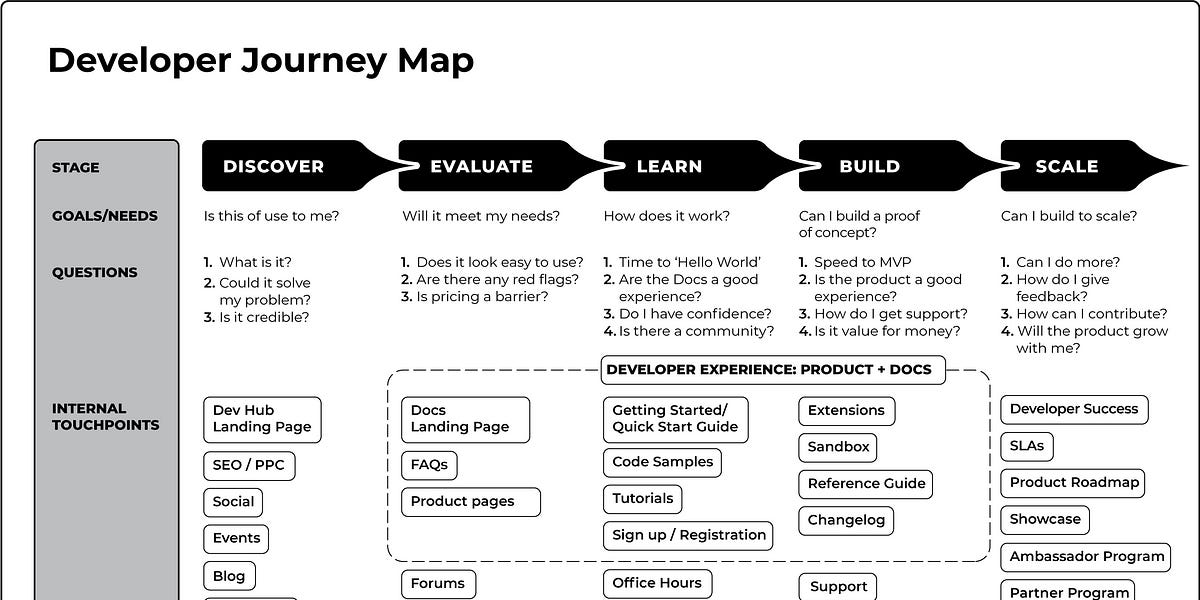
The Developer Journey Map is a framework that seeks to document the end-to-end life cycle of a developer interacting with a DevRel program. It visualizes the path a developer follows, identifies the touchpoints of interaction with the brand, team, and product, and helps to identify any shortcomings or friction in the experience. The five stages of the map indicate changes in the developer’s intent and actions, and each stage has a goal, key questions, and touchpoints (owned and earned). The goal of the map is to progress the developer from left to right as quickly as possible to increase product adoption and revenue potential. To evaluate the effectiveness of the journey, friction logging, journey data evaluation, and asking the community are recommended.
> [!note]+ Document Notes
> 1. What are the most effective ways to optimize the developer experience across the different stages?
> 2. What are the key metrics for evaluating the success of the Developer Journey Map?
> 3. How can I use the Developer Journey Map to increase product adoption and revenue potential?
>
> The Developer Journey Map is a framework that seeks to document the end-to-end life cycle of a developer interacting with a DevRel program. It visualizes the path a developer follows, identifies the touchpoints of interaction with the brand, team, and product, and helps to identify any shortcomings or friction in the experience. The five stages of the map indicate changes in the developer’s intent and actions, and each stage has a goal, key questions, and touchpoints (owned and earned). The goal of the map is to progress the developer from left to right as quickly as possible to increase product adoption and revenue potential. To evaluate the effectiveness of the journey, friction logging, journey data evaluation, and asking the community are recommended.
## Highlights
- The end-to-end life cycle of a developer within your DevRel program. ([View Highlight](https://read.readwise.io/read/01gw28sq93t9b96b6bsx17ngzc))
- Note: Abstract:
This document, titled The Developer Journey Map, outlines the end-to-end life cycle of a developer in a DevRel program. The document includes a detailed analysis of how developers move through the program, including how they are onboarded and what activities they are involved in. It also provides recommendations on how to create an effective and engaging journey map that can be used to track and measure the progress of developers in the program. The document serves as a useful resource for DevRel program managers to help them create successful Developer Journey Maps.
- The Developer Journey Map ([View Highlight](https://read.readwise.io/read/01gw28v0d6e0rhctxd2nkzaerm))
- Note: Digital power unleashed: 💻
Simple programs working together 🤝
A force of automation 🤖
- Discover, Evaluate, Learn, Build, Scale
The fives stages of the map indicate significant changes in the developer’s *intent and actions* ([View Highlight](https://read.readwise.io/read/01gw28wkw7csaybtsq8m9h6s4q))
- Note: 🔎🧐📚🧱⬆️
- Here are three ways to identify friction in both quantitative and qualitative ways to understand if your journey is working optimally:
1. Ask your community
2. Friction Logging / Friction Audits
3. Journey Data Evaluation and Measurement ([View Highlight](https://read.readwise.io/read/01gw28x74wkpz2455hy7sk3p8z))
- Note: Take some highlights and try this prompt again.