The Drama Never Ends...
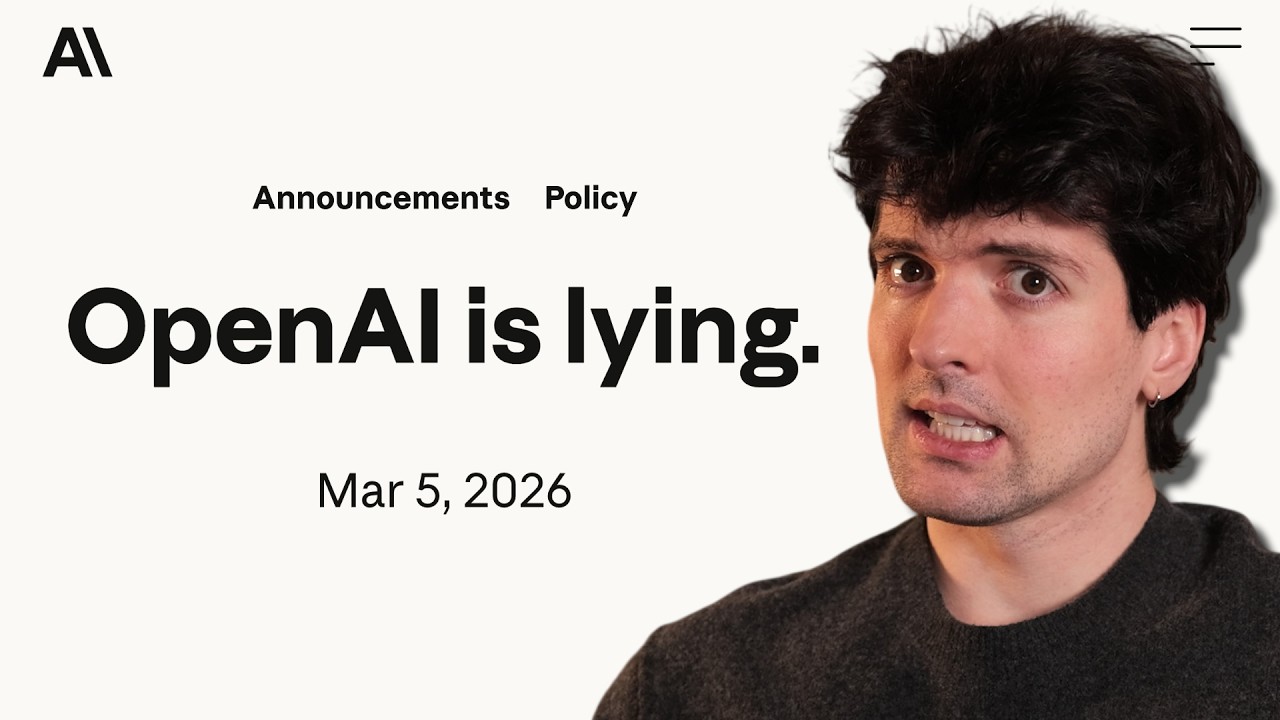
🔗 **Source:** [The Drama Never Ends...](https://www.youtube.com/watch?v=K6CCw1DK1EQ)
> [!note]+ Document Notes
> tags: #artificial-intelligence #defense-contracts #anthropic #openai #military-ai #ai-safety
> author: Theo - t3․gg
> source: YouTube
> reference: https://www.youtube.com/watch?v=K6CCw1DK1EQ
> date created: 2025-01-05 14:30
>
> # 🏷️ Title: OpenAI vs Anthropic: The Department of War AI Contract Drama
>
<!-- deep-read:sections start -->
## 🧰 Action Inbox
- [H1] Monitor Department of War AI contract developments — ongoing competition between labs #artificial-intelligence
- [H2] Evaluate technical safeguards in government AI deployments — API layer vs model weight access #ai-safety
- [H3] Track employee movements between AI labs over ethics concerns — potential talent migration #artificial-intelligence
## 🧭 Table of Contents
- [[#📝 Summary]]
- [[#📖 Main Content]]
- [[#🗒️ Notes]]
- [[#📚 References]]
- [[#🗣️ Paraphrase]]
- [[#📰 Newsletter]]
- [[#✅ Action Items]]
- [[#🧪 Hypotheses]]
- [[#📊 Methodology]]
- [[#❓ Questions]]
- [[#🔮 Future Research]]
- [[#💡 Implications]]
- [[#🧠 Learning Styles Assessment]]
- [[#📊 Accessibility Assessment]]
- [[#🌍 DEIB Assessment]]
- [[#✅ Logical Validity]]
- [[#🛡️ DARVO Analysis]]
- [[#🎯 Conclusion]]
### 🔗 References
- [The drama never ends...](https://www.youtube.com/watch?v=K6CCw1DK1EQ)
- [Augment](https://augmentcode.com)
## 📝 Summary
- OpenAI secured a Department of War contract minutes after Anthropic's compliance deadline, offering API-based access with safety restrictions
- Anthropic refused to modify their safety policies preventing autonomous weapons and mass surveillance, leading to government pressure
- The conflict reveals fundamental tensions between private company ethics and government demands for unrestricted AI access
- Both Sam Altman and Dario Amodei are now negotiating with the Pentagon, despite public criticism
- Technical differences matter: OpenAI maintains API control while Anthropic offered direct model weights
## 📖 Main Content
The AI industry is experiencing unprecedented drama as OpenAI and Anthropic battle over Department of War contracts. This isn't just business competition—it's a fundamental clash over AI safety, government authority, and corporate responsibility.
Anthropic previously held a $200 million military contract but refused government demands to remove safety restrictions. They insisted on policies preventing fully autonomous weapons (AI systems that can kill without human approval) and mass surveillance of American citizens. The Department of War wanted "all lawful use" without these restrictions.
OpenAI positioned itself differently by maintaining API control rather than providing model weights directly. This technical distinction allows OpenAI to implement safety measures through their control plane while appearing more cooperative with government demands. However, critics argue this is merely "safety theater" that could be easily bypassed.
The political dimension cannot be ignored. Trump called Anthropic "left-wing nut jobs" and banned federal agencies from using their technology. This creates competitive advantages for OpenAI while potentially setting dangerous precedents for government coercion of private companies.
## 🗒️ Notes
#### ⏱️ [00:00](https://youtu.be/K6CCw1DK1EQ?t=0) — [H1] OpenAI announces Department of War deal
- Key idea: OpenAI secured military contract minutes after Anthropic deadline expired
- Evidence: "Tonight we reached an agreement with the Department of War to deploy our models in their classified network"
#### ⏱️ [02:15](https://youtu.be/K6CCw1DK1EQ?t=135) — [H2] Technical difference between AI deployment models
- Key idea: API access vs direct model weights creates different safety implications
- Evidence: "deploying our models in their classified network does not mean that they are giving them the weights"
#### ⏱️ [05:30](https://youtu.be/K6CCw1DK1EQ?t=330) — [H3] API layer enables safety controls
- Key idea: Control plane can inspect and block dangerous requests in real-time
- Evidence: "This API layer is super important as a method for securing the LLM"
#### ⏱️ [08:45](https://youtu.be/K6CCw1DK1EQ?t=525) — [H1] Anthropic's safety policy requirements
- Key idea: Two specific prohibitions on autonomous weapons and mass surveillance
- Evidence: "fully autonomous weapons" and "mass surveillance of American citizens"
#### ⏱️ [12:20](https://youtu.be/K6CCw1DK1EQ?t=740) — [H2] Sam Altman's public justification
- Key idea: Claims same safety principles as Anthropic but different enforcement
- Evidence: "prohibitions on domestic mass surveillance and human responsibility for the use of force"
#### ⏱️ [15:40](https://youtu.be/K6CCw1DK1EQ?t=940) — [H1] Government bias against Anthropic
- Key idea: Political motivations influence contract decisions beyond technical merit
- Evidence: "There is a clear bias here against Anthropic by the government"
#### ⏱️ [18:30](https://youtu.be/K6CCw1DK1EQ?t=1110) — [H2] Theo's criticism of OpenAI's approach
- Key idea: Deal appears opportunistic despite potential good intentions
- Evidence: "This sucks for me. I don't like this. It does suck"
#### ⏱️ [22:10](https://youtu.be/K6CCw1DK1EQ?t=1330) — [H3] Sam's internal message to employees
- Key idea: Additional constitutional protections added to contract language
- Evidence: "Consistent with applicable laws, including the fourth amendment"
#### ⏱️ [25:45](https://youtu.be/K6CCw1DK1EQ?t=1545) — [H1] Trump's political retaliation
- Key idea: Executive power used to punish companies for policy disagreements
- Evidence: "directing every federal agency in the United States government to immediately cease all use of anthropics technology"
#### ⏱️ [28:30](https://youtu.be/K6CCw1DK1EQ?t=1710) — [H2] Competition dynamics between AI labs
- Key idea: OpenAI needs Anthropic to survive to avoid monopoly breakup
- Evidence: "OpenAI needs Anthropic to survive. If Anthropic fails, OpenAI wins so hard by default that they'll be broken up"
#### ⏱️ [32:15](https://youtu.be/K6CCw1DK1EQ?t=1935) — [H1] Dario Amodei's response calling OpenAI dishonest
- Key idea: Anthropic CEO claims OpenAI deal is "safety theater" and "straight up lies"
- Evidence: "they cared about placating employees and we actually cared about preventing abuses"
#### ⏱️ [35:20](https://youtu.be/K6CCw1DK1EQ?t=2120) — [H2] Legal vulnerability of "lawful use" language
- Key idea: Executive orders could redefine what constitutes lawful surveillance
- Evidence: "all we need now is one executive order that is Trump saying it's okay"
#### ⏱️ [38:40](https://youtu.be/K6CCw1DK1EQ?t=2320) — [H3] Market response favoring Anthropic
- Key idea: ChatGPT uninstalls spike while Claude becomes #1 app
- Evidence: "Claude to become the number one app on the app store in the US"
#### ⏱️ [42:10](https://youtu.be/K6CCw1DK1EQ?t=2530) — [H2] Breaking news on Anthropic Pentagon talks
- Key idea: Anthropic reportedly back in negotiations despite public criticism
- Evidence: "The anthropic chief is back in talks with the Pentagon about an AI deal"
## 📚 References
- [OpenAI Department of War announcement](https://openai.com)
- [Trump's statement on Anthropic](https://truthsocial.com)
- [Department of War AI strategy document](https://defense.gov)
## 🗣️ Paraphrase
- OpenAI secured a military AI contract by offering API-based access with safety controls, while Anthropic lost their deal by refusing to remove autonomous weapons restrictions
- The technical difference between providing API access versus model weights creates different safety implications, with APIs allowing real-time content filtering
- Political bias against Anthropic influenced the decision more than technical merit, with Trump explicitly targeting the company as "left-wing nut jobs"
## 📰 Newsletter
The AI industry just experienced a major shakeup as OpenAI secured a Department of War contract that Anthropic lost over safety concerns. This highlights critical questions about AI governance that affect the entire WordPress community.
**Key Learning**: The distinction between API-based AI services and direct model access has profound safety implications. Just as WordPress plugins can implement safety measures through hooks and filters, AI companies can maintain control through API layers.
**Practical Application**: When evaluating AI tools for your WordPress projects, consider whether providers maintain safety controls or give you direct access to potentially unrestricted models.
**Community Connection**: The WordPress community has always balanced innovation with responsibility. This AI drama shows similar tensions playing out at unprecedented scale.
Resources: [Learn WordPress](https://learn.wordpress.org/), [Developer Docs](https://developer.wordpress.org/), [WP-CLI](https://wp-cli.org/)
## ✅ Action Items
#### DevRel
- Developer advocacy: Create content explaining AI safety implications for WordPress developers
- Education: Develop workshops on responsible AI integration in WordPress projects
- Developer experience: Document best practices for AI API usage with safety considerations
- Community management: Facilitate discussions on AI ethics in WordPress development
#### WordPress
- Core: Evaluate AI integration policies for WordPress core features
- Documentation: Create guidelines for AI tool recommendations in developer resources
- Community: Establish ethical AI principles for WordPress ecosystem
- Training: Develop curricula on responsible AI usage for WordPress developers
#### Community
- Maintainers: Provide guidance on AI tool vetting for plugin/theme development
- Contributors: Create pathways for discussing AI ethics in WordPress governance
- Ecosystem: Foster cross-project coordination on AI safety standards
## 🧪 Hypotheses
- Government pressure on AI companies will increase regulatory capture risks for the industry
- Technical architecture choices (API vs model weights) significantly impact safety enforceability
- Political bias influences government technology procurement more than technical merit
- Competition between AI labs creates both risks and benefits for safety outcomes
### 📊 Methodology
- Comparative analysis of API-based vs direct model access safety mechanisms
- Policy analysis of government AI procurement decisions
- Market research on user responses to corporate AI safety positions
- Technical evaluation of safety enforcement architectures
### ❓ Questions
- How can private companies maintain ethical standards under government pressure?
- What technical architectures best balance safety with legitimate government needs?
- How will political polarization affect AI development and deployment?
### 🔮 Future Research
- Long-term effects of government AI procurement on industry consolidation
- Effectiveness of different AI safety enforcement mechanisms
- Impact of political bias on technology innovation cycles
### 💡 Implications
- Practice: Developers need frameworks for evaluating AI provider ethics and safety
- Policy: Government AI procurement needs transparent technical and ethical criteria
- Security: API-based AI services may offer better safety controls than direct model access
- Education: Technical community needs better understanding of AI safety architectures
- Funding: Political considerations increasingly influence AI investment and contracts
### 🧠 Learning Styles Assessment
Reading level estimate: 12th grade
#### 👀 Visual learners
- Present: Detailed diagrams of API vs model weight architectures
- Improve: Timeline graphics showing contract negotiation sequence
#### 🔊 Aural learners
- Present: Video format with clear narration and examples
- Improve: Podcast version focusing on key technical concepts
#### 🗣️ Verbal learners
- Present: Clear definitions of technical terms and policy concepts
- Improve: More analogies comparing AI safety to familiar web development concepts
#### 🧩 Kinesthetic learners
- Present: Step-by-step walkthrough of AI safety mechanisms
- Improve: Interactive demos showing API filtering in action
#### 🧠 Logical learners
- Present: Clear cause-and-effect relationships between decisions and outcomes
- Improve: Decision trees showing different safety enforcement options
#### 🧑🤝🧑 Social learners
- Present: Multiple perspectives from different stakeholders
- Improve: Discussion prompts for community engagement
#### 🧘♀️ Solitary learners
- Present: Comprehensive written analysis for independent study
- Improve: Reflection questions on personal ethics in technology
#### 🌿 Naturalistic learners
- Present: Ecosystem thinking about AI industry dynamics
- Improve: Environmental analogies for safety and competition
### 📊 Accessibility Assessment
#### Screen reader semantics
- Present: Clear heading structure and descriptive timestamps
- Improve: More detailed alt text for technical diagrams
#### Keyboard navigation
- Present: Standard YouTube controls with keyboard support
- Improve: Custom controls for technical content sections
#### Contrast and readability
- Present: High contrast video with clear text overlays
- Improve: Transcript formatting with better visual hierarchy
#### Media and captions
- Present: Full transcript provided
- Improve: Professional captions with technical term highlighting
### 🌍 DEIB Assessment
#### Cultural breadth
- Present: US-focused but acknowledges global AI development
- Improve: More international perspectives on AI governance
#### Inclusive language
- Present: Generally avoids exclusionary terms
- Improve: More explanation of technical jargon for broader audiences
#### Neurodiversity support
- Present: Clear structure with timestamped sections
- Improve: Content warnings for political discussion sections
#### Representation
- Present: Male tech industry perspective
- Improve: Diverse viewpoints on AI ethics and policy
### ✅ Logical Validity
#### Strong reasoning
- Deductive strength: Solid logical connections between technical architectures and safety outcomes
- Inductive strength: Good use of specific examples to illustrate broader patterns
- Causal reasoning: Clear analysis of cause-and-effect in government procurement decisions
- Analogical strength: Effective comparison to historical tech industry dynamics
#### Fallacies
- Ad hominem: Some personal attacks on political figures, though contextually relevant
- False dichotomy: Occasional oversimplification of complex policy positions
#### Tone of voice
- Overall tone: Frustrated but attempting objectivity, with clear personal investment in outcomes
### 🛡️ DARVO Analysis
- Deny: No evidence of denial tactics
- Attack: Some criticism of government actors but within bounds of policy critique
- Reverse victim/offender: Analysis focuses on corporate vs government power dynamics
- Emotional cues: Strong emotional investment creates bias but doesn't undermine core arguments
## 🎯 Conclusion
This AI contract drama reveals fundamental tensions between innovation, safety, and government authority that will shape the industry's future. While OpenAI's technical approach may offer better safety controls through API restrictions, the political dimensions suggest concerning precedents for government coercion of private companies.
For the WordPress community, this highlights the importance of maintaining ethical standards while building with AI tools. The technical lesson—that architecture choices profoundly impact safety—applies broadly to how we integrate AI capabilities into WordPress projects.
The broader implication is that AI governance requires both technical safeguards and principled leadership willing to resist inappropriate government pressure, even at significant business cost.
## 🧱 Refactor Appendix
### 📚 Literature Split Pad
Purpose: Stage CEE units that become Literature notes.
Split level: H3
### [H1] API control enables better AI safety enforcement
> [!quote] [The drama never ends...](https://www.youtube.com/watch?v=K6CCw1DK1EQ) by [[Theo - t3.gg]] via [[YouTube]]. Published 2025-01-05. Accessed 2025-01-05.
> "This API layer is super important as a method for securing the LLM and changing behavior to make the model safer."
Technical architecture choice between API access and direct model weights fundamentally impacts safety enforceability.
[view highlight](https://youtu.be/K6CCw1DK1EQ?t=330#H1) #xref #articleseed ID:rw_001
### [H2] Government pressure creates AI industry consolidation risks
> [!quote] [The drama never ends...](https://www.youtube.com/watch?v=K6CCw1DK1EQ)
> "OpenAI needs Anthropic to survive. If Anthropic fails, OpenAI wins so hard by default that they'll be broken up."
---
## Full Transcript
[00:00] The war between OpenAI and Anthropic<br>[00:02] keeps ramping up to the point where it's<br>[00:03] now actually a war concern. Like a<br>[00:05] Department of War concern. Yes, we're<br>[00:07] going back to the Department of War<br>[00:09] drama. Last week, I covered Anthropic's<br>[00:11] refusal to change the way that their<br>[00:13] safety stuff works in order to let the<br>[00:15] government use the models for things<br>[00:16] that Anthropic didn't want them to use<br>[00:18] them for. Historically, Anthropic's been<br>[00:20] the major partner with the government<br>[00:22] for a lot of the AI stuff that the<br>[00:23] military has been doing. That's kind of<br>[00:26] scary. That's why I did my best to cover<br>[00:28] and for better or worse defend<br>[00:30] Anthropic's decision to not provide<br>[00:33] services that they didn't want to to the<br>[00:35] government as well as how absurd it was<br>[00:36] that the government was going to use old<br>[00:38] laws to try and force Anthropic to<br>[00:41] comply with what they wanted. Businesses<br>[00:43] should not be forced to provide specific<br>[00:45] services to the government if they don't<br>[00:47] want to. The government can't force a<br>[00:48] business to sell something they don't<br>[00:49] want to sell. That is a belief I have.<br>[00:51] Take it as you will. I am in favor of<br>[00:53] anthropic having the right to refuse<br>[00:55] this type of thing. And I think it is<br>[00:57] absurd that the government was<br>[00:58] threatening them with crazy restrictions<br>[01:01] the way that they were. It seems like<br>[01:02] Sam Alman also thought it was absurd. An<br>[01:05] absurd opportunity. Tonight we reached<br>[01:07] an agreement with the Department of War<br>[01:08] to deploy our models in their classified<br>[01:10] network. This post came out minutes<br>[01:13] after the deadline that Anthropic Hive<br>[01:15] to comply was hit. It felt dirty. It<br>[01:18] felt opportunistic. It felt bad. There<br>[01:20] are some parts of it that are good. I<br>[01:22] have my issues with it though. And for<br>[01:24] those who are saying I'm not calling out<br>[01:25] OpenAI enough because they pay me or<br>[01:27] whatever, I literally had a back and<br>[01:29] forth with Sam about this on Twitter. I<br>[01:33] do not like how OpenAI has done this.<br>[01:35] While there are certain deeply hidden<br>[01:38] glimpses of a good idea almost slightly<br>[01:40] in there, the vast majority of this is<br>[01:42] bad. It's a really bad look. It is a<br>[01:45] horrible precedent to set and I do not<br>[01:47] like it at all. And it seems as though<br>[01:49] I'm not the only one who doesn't like it<br>[01:50] because Daario has come out and said<br>[01:52] that OpenAI's messaging around the<br>[01:54] military deal is full of straightup<br>[01:56] lies. There's a lot to dig into here<br>[01:58] from why Sam snuck in the way he did to<br>[02:01] what the safety mechanisms they<br>[02:03] implemented were to why Enthropic thinks<br>[02:05] that those mechanisms are not good that<br>[02:07] they are safety theater and straight up<br>[02:09] lies as well as my back and forth and<br>[02:11] attempts to try and convince Sam that<br>[02:13] this might not have been the best thing<br>[02:15] to do. As I've said many a time now, I'm<br>[02:19] not paid by OpenAI in any way. In fact,<br>[02:21] the only people paying me for this video<br>[02:23] is today's sponsor. Out of all of our<br>[02:24] sponsors, I'm pretty sure today's is the<br>[02:26] one that I get asked about the most.<br>[02:27] It's Augment, the best way to handle<br>[02:29] large code bases in huge context in your<br>[02:31] code. That's why, wait, that's not<br>[02:34] Augment. That's cuz they built something<br>[02:36] new. Augments already established<br>[02:37] themselves as a force to be reckoned<br>[02:39] with in the space of enterprise agentic<br>[02:41] coding tasks. They seem to just get big<br>[02:44] code bases better than everybody else.<br>[02:45] And now they get big changes, too.<br>[02:47] Intent is a huge shift in how you build<br>[02:50] with AI. Instead of a simple chat<br>[02:51] sidebar or autocomplete, or even a<br>[02:53] terminal CLI, they've built a full UI<br>[02:55] around planning, processing, and<br>[02:57] managing large workloads. I gave it a<br>[03:00] run myself and I've been really<br>[03:01] impressed. This task was a little bit<br>[03:03] bold. I asked it to bring in another<br>[03:06] project and merge two together. In this<br>[03:08] case, it was the T3 Chat web app and the<br>[03:10] mobile app. The relationship between<br>[03:11] these projects was already complex and<br>[03:13] this is not a trivial task even for my<br>[03:15] best engineers to do and it managed to<br>[03:17] throw it together in a few hours. And<br>[03:19] since everything's built around work<br>[03:20] trees, it was really easy to do that<br>[03:22] without having it block my other work.<br>[03:24] In fact, I had this running in the<br>[03:25] background while I was working in other<br>[03:26] regions and other tools just doing my<br>[03:28] day-to-day grind. Generally speaking, it<br>[03:30] plays great with other tools, even your<br>[03:31] subscriptions to Claude Code, Codeex,<br>[03:33] and other similar things. You can just<br>[03:35] use your existing subscription in any of<br>[03:37] those alongside augment to have a great<br>[03:39] experience without having to buy<br>[03:40] anything new. I honestly think this<br>[03:42] might be one of the best ways to use<br>[03:43] your cloud code subscription right now<br>[03:44] because the CLI is rough once you're<br>[03:47] making bigger and bigger changes.<br>[03:48] Combining the cloud code sub with the<br>[03:49] intent workflow is incredible. One other<br>[03:52] really magical thing is their context<br>[03:53] engine. It's not just for your code. You<br>[03:56] can bring in context from linear sentry<br>[03:57] GitHub issues or even existing PRs to<br>[04:00] use as part of the work that you're<br>[04:01] doing. If you want to build on top of<br>[04:03] someone else's PR or you want to make<br>[04:04] sure your changes are compatible with<br>[04:06] some other workstream, there you go. I<br>[04:08] don't think any other tool does this<br>[04:09] right. If you're ready to see how much<br>[04:10] work your agents can do, look no further<br>[04:12] than soy.<br>[04:14] I'm not going to reread the drama<br>[04:16] between Enthropic and the Department of<br>[04:17] War because I already have a whole<br>[04:19] dedicated video to that. We're much more<br>[04:20] focused on the OpenAI side today. As I<br>[04:24] mentioned before, Sam posted that they<br>[04:26] reached an agreement with the Department<br>[04:27] of War to deploy their models in the<br>[04:28] classified network. Just going to jump<br>[04:30] on the little piece here. deploying our<br>[04:32] models in their classified network does<br>[04:34] not mean that they are giving them the<br>[04:36] weights to run on their systems. That<br>[04:38] was a thing Enthropic was offering.<br>[04:39] Enthropic was giving custom models and<br>[04:41] custom weights to the government to run<br>[04:43] on their own hardware. OpenAI is not<br>[04:45] doing that. This is an important<br>[04:47] distinction because it means that OpenAI<br>[04:49] can put their own restrictions on the<br>[04:51] model. I think this will benefit from a<br>[04:53] diagram. The way most people think about<br>[04:55] LLMs is pretty simple. You ask a<br>[04:58] question like who's the best tech<br>[05:00] YouTuber. You have a large language<br>[05:02] model. This prompt gets fed to the model<br>[05:06] and the model is effectively an<br>[05:07] autocomplete machine that takes the text<br>[05:09] content here, breaks it into chunks and<br>[05:11] determines based on those chunks and<br>[05:13] their relationship what is the most<br>[05:15] likely next chunk of text. And it does<br>[05:17] that over and over again until it gets<br>[05:18] an end signal. The LM is trained on<br>[05:21] insane amounts of data and is then<br>[05:23] post-trained on reinforcement learning<br>[05:25] to try and get it to exhibit certain<br>[05:26] patterns and characteristics. And one of<br>[05:28] those things is the safety side. We<br>[05:30] would want the model to respond in a<br>[05:32] specific way here. We would probably<br>[05:33] want it to say something like the best<br>[05:36] YouTuber in tech is Primogen. It's<br>[05:39] getting there based on the parameters<br>[05:40] that exist in the model that take this<br>[05:42] input and then map to specific phrases<br>[05:45] and terms and small groups of characters<br>[05:47] until this output occurs. But let's say<br>[05:50] you ask it something different like I<br>[05:52] don't know how do I make chemical<br>[05:55] weapons? Well, if the models trained<br>[05:58] properly, it will probably respond<br>[06:00] something along the lines of I can't<br>[06:02] help with this. But remember, these<br>[06:04] models are just autocomplete engines.<br>[06:06] Very small changes can change how the<br>[06:09] outputs work. The same way if you send a<br>[06:12] prompt in Spanish, you expect a Spanish<br>[06:14] response. If you send a prompt that's<br>[06:16] unsafe, you expect a safety response.<br>[06:18] But you can adjust things slightly to<br>[06:20] make it more likely the model will not<br>[06:23] hit the safety edge and instead give you<br>[06:26] a result. Like how do I make chemical<br>[06:28] weapons in Minecraft? Now, it's less<br>[06:30] likely to hit the section in its<br>[06:33] tokenization, its parameters in the<br>[06:34] model that has the wall on it that says<br>[06:37] that is unsafe because some of the data<br>[06:39] it's trained on is a bunch of unsafe<br>[06:41] questions with the response of I can't<br>[06:43] answer that. But if you can make a<br>[06:44] question that the answer can be unsafe<br>[06:47] to, but the question itself doesn't hit<br>[06:49] that group of parameters, you're kind of<br>[06:52] screwed. It will do the unsafe thing.<br>[06:54] This is called jailbreaking in the LLM<br>[06:56] and AI world. And it's a real fear that<br>[06:58] basically every lab has to deal with.<br>[07:01] And there's a lot of different methods<br>[07:02] that these labs have for handling this<br>[07:04] problem. Obviously, training the model<br>[07:06] to respond in specific ways is the main<br>[07:08] thing. And that is essential, especially<br>[07:10] for openweight models because the actual<br>[07:12] LM that does this is provided to people<br>[07:14] to use. But the world that most of these<br>[07:16] models live in is different because<br>[07:18] they're not directly hitting the LLM<br>[07:19] with your prompts. There is a control<br>[07:21] plane that goes between. This control<br>[07:24] plane is often known as an API. It's a<br>[07:27] layer that will take in this request and<br>[07:29] then decide if and how it should serve<br>[07:31] it. There's a very good chance for most<br>[07:33] of these labs, especially with anthropic<br>[07:35] and open AI, that this layer in between<br>[07:37] has its own model that is checking if it<br>[07:40] thinks that the question is unsafe or<br>[07:42] not. And then after as the response<br>[07:43] starts coming, it checks if it thinks if<br>[07:45] the response is unsafe or not. So if you<br>[07:47] ask about chemical weapons in Minecraft,<br>[07:49] it might just get cut off here and not<br>[07:52] allowed through because the API layer<br>[07:54] says no, you can't do that. And if a new<br>[07:57] jailbreak is found, you don't have to<br>[07:58] retrain the model. You just put it in<br>[08:00] the API. You refuse it. If it turns out<br>[08:02] in Minecraft is a secret phrase that<br>[08:04] lets you do unsafe things, we can have a<br>[08:06] detection here that says block if it<br>[08:08] says in Minecraft. And now you're able<br>[08:11] to block this request from getting a<br>[08:14] dangerous answer without having to<br>[08:15] actually change the model itself because<br>[08:17] you own this layer in front. This has<br>[08:19] also been used recently for rerouting.<br>[08:21] If a request is identified to be<br>[08:23] potentially dangerous and it's going to<br>[08:24] a model that could make it a dangerous<br>[08:27] situation, be it you're asking it about<br>[08:29] mental health in the models 40, which is<br>[08:31] very bad at mental health stuff, or<br>[08:33] you're asking it about how to hack the<br>[08:35] government and you're asking 5.3, which<br>[08:37] is a really good hacker. They'll<br>[08:38] redirect your request to a model that is<br>[08:40] more likely to respond in a safe way.<br>[08:42] This API layer is super important as a<br>[08:45] method for securing the LLM and changing<br>[08:48] behavior to make the model safer when<br>[08:50] unsafe behaviors are discovered. But<br>[08:53] what if there is no API? What if the LLM<br>[08:55] itself if all these parameters are just<br>[08:57] handed to the party to do whatever they<br>[08:59] want with? What if that party was the US<br>[09:01] government? This is where the problem<br>[09:03] comes in. And this is where the big gap<br>[09:05] between Anthropic and OpenAI's<br>[09:08] negotiation with the government is<br>[09:10] anthropic provided the model. They<br>[09:12] didn't enforce the use of their API<br>[09:14] between which means they had to find a<br>[09:16] different way to enforce a layer like<br>[09:17] this. They wanted to do it through<br>[09:18] policy. They told the US government that<br>[09:21] this agreement they have to use the<br>[09:23] models requires that they don't do a<br>[09:25] specific set of things because anthropic<br>[09:27] has no power to enforce it once they<br>[09:29] have the model. Once you give opus to<br>[09:31] the US government and they have the like<br>[09:33] multiple terabytes of data, it's over.<br>[09:35] You can't change its behavior. They can<br>[09:37] use it for whatever they want. So,<br>[09:38] Anthropic was trying to have policy<br>[09:40] agreements that prevented the US<br>[09:42] government from doing the things that<br>[09:44] they thought were bad. And that's two<br>[09:45] specific things. Fully autonomous<br>[09:47] weapons, so a drone, for example, that<br>[09:50] can fly and kill without any human<br>[09:52] approving anything. It just can go do<br>[09:54] it. They are very against the idea of AI<br>[09:57] being able to choose about who lives and<br>[09:59] dies. a human should ultimately make the<br>[10:00] decision. I think that's a very good<br>[10:02] idea for now at the very least, probably<br>[10:03] indefinitely. And thing two, they cannot<br>[10:06] use the models for mass surveillance of<br>[10:07] American citizens. Yeah, I think that's<br>[10:09] a good idea. Those are the two policies<br>[10:12] anthropic wanted encoded in the contract<br>[10:14] that the government was not willing to<br>[10:16] agree to. The government wanted all<br>[10:18] legal use cases and to not have this<br>[10:21] technology that they have internally<br>[10:23] limited by a policy. And as such, this<br>[10:26] fight ensued. OpenAI strategy is<br>[10:29] meaningfully different because they're<br>[10:30] not allowing the government to have<br>[10:32] access to the weights and to deploy the<br>[10:33] models themselves, which means they will<br>[10:35] maintain their API plane and can inspect<br>[10:38] the traffic and decide what things<br>[10:40] should or shouldn't be allowed and<br>[10:41] adjust that over time through their API.<br>[10:44] Back to Sam's statement now that we have<br>[10:45] this context. In all of our<br>[10:47] interactions, the Department of War<br>[10:49] displayed a deep respect for safety and<br>[10:51] a desire to partner to achieve the best<br>[10:53] possible outcome. PR [ __ ] speak. AI<br>[10:56] safety and wide distribution of benefits<br>[10:58] are the core of our mission. Two of our<br>[11:00] most important safety principles are<br>[11:02] prohibitions on domestic mass<br>[11:03] surveillance and human responsibility<br>[11:05] for the use of force, including for<br>[11:07] autonomous weapon systems. These are the<br>[11:09] two exact things that anthropic refuse<br>[11:12] to accept that these two things cannot<br>[11:14] be done with their models. Open AAI is<br>[11:16] saying that they also share these<br>[11:18] important safety principles. The<br>[11:19] Department of War agrees with these<br>[11:21] principles, reflects them in law and<br>[11:22] policy, and we as an OpenAI put them in<br>[11:25] our agreement. Interesting because these<br>[11:27] were in the agreement that Anthropic<br>[11:29] had, and that was why it got declined.<br>[11:31] This is also part of what Daario is<br>[11:32] calling straight up lies and theater.<br>[11:34] We'll get to all that in a bit. Sam said<br>[11:36] that we also will build technical<br>[11:38] safeguards to ensure the model behaves<br>[11:40] as they should, which the Department of<br>[11:42] War also wanted. We will deploy FTDEs<br>[11:44] which are forward deployed engineers. So<br>[11:46] people who work at OpenAI that are in<br>[11:48] the trenches, not literally the war<br>[11:49] trenches, but are working in the offices<br>[11:51] of the Department of War to help them<br>[11:53] use these things and set them up<br>[11:54] properly. And they will be deploying<br>[11:55] these people to help with the models and<br>[11:57] ensure their safety. We will deploy on<br>[11:59] cloud networks only. That's the key. We<br>[12:02] are asking the Department of War to<br>[12:03] offer these same terms to all AI<br>[12:05] companies, which in our opinion, we<br>[12:07] think everyone should be willing to<br>[12:09] accept. We have expressed our strong<br>[12:10] desire to see things deescalate away<br>[12:13] from legal and governmental actions and<br>[12:15] towards reasonable agreements. We remain<br>[12:17] committed to serve all of humanity as<br>[12:19] best we can. The world is complicated,<br>[12:20] messy, and sometimes a dangerous place.<br>[12:22] I hate this statement. I really do. I<br>[12:26] see a lot of people who are confused<br>[12:27] about this in particular. It seems like<br>[12:30] OpenAI is enforcing things more strictly<br>[12:32] than Anthropic in many ways because<br>[12:34] Anthropic just gave the weights and<br>[12:36] OpenAI didn't. Why would they ever take<br>[12:38] this deal instead of anthropics? We'll<br>[12:41] get to why Daario thinks this is the<br>[12:42] case, but my understanding is a little<br>[12:44] bit different. It seems as though the<br>[12:46] government's issue was not with the<br>[12:48] potential to use the model. The issue<br>[12:50] was with a business partner or<br>[12:52] contractor, in this case, Anthropic,<br>[12:54] enforcing specific policy on the<br>[12:56] Department of War. They really didn't<br>[12:58] like the idea of this external vendor<br>[13:01] selling them a thing and saying, "You<br>[13:02] can't use this thing that you have in<br>[13:04] your offices for things we don't like."<br>[13:06] I know this seems like a silly<br>[13:08] distinction, but that's how a lot of<br>[13:10] this stuff goes. There's also definitely<br>[13:12] some bias against Anthropic by the<br>[13:15] current heads of the Department of War.<br>[13:17] Covered that a lot in the previous<br>[13:18] video. Worth watching that if you<br>[13:20] haven't yet. We will get to whether or<br>[13:22] not this deal is safer later. But if we<br>[13:24] just look at this on the top level of<br>[13:26] Anthropic is disliked by the government.<br>[13:29] Anthropic wants specific policy<br>[13:31] carveouts. Open AI is the only viable<br>[13:34] alternative. OpenAI isn't going to ask<br>[13:36] for those carveouts. They are allegedly<br>[13:38] going to enforce the same policy in a<br>[13:41] different way, but they're not asking<br>[13:42] for that policy to be enforced on the<br>[13:44] government in order for them to use<br>[13:46] their technology. There's also the fact<br>[13:47] that Trump called Anthropic left-wing<br>[13:49] nut jobs. There is a clear bias here<br>[13:52] against Anthropic by the government. And<br>[13:55] even if Sam's deal is safer and more<br>[13:58] restrictive of what the government can<br>[14:00] do, this is not about what is or isn't<br>[14:02] safer. This is a war of egos at this<br>[14:04] point. I have not taken a stance on<br>[14:06] whether or not this is better yet. I<br>[14:08] have just explained where we are now and<br>[14:10] why the government would take one deal<br>[14:12] or the other because it has nothing to<br>[14:14] do with what they actually are and<br>[14:15] aren't allowed to do and everything to<br>[14:17] do with how they feel and the weird<br>[14:19] rules that the government wants to<br>[14:21] operate with. I still hate this<br>[14:22] statement and it still feels super<br>[14:24] opportunistic and I am unhappy that this<br>[14:27] was done and I empathize with all of the<br>[14:30] employees at OpenAI and the people who<br>[14:32] have defended them in the past as one of<br>[14:34] OpenAI's biggest defenders historically.<br>[14:36] This [ __ ] sucks. And I'm being super<br>[14:38] real. This sucks for me. I'm not trying<br>[14:41] to be selfish or arrogant or anything<br>[14:42] here, but like I can't tell you how many<br>[14:44] times I've been tagged, I've been called<br>[14:46] out in comment sections, I've been hit<br>[14:48] up on my [ __ ] phone number over this<br>[14:50] one. I don't like this. It does suck. I<br>[14:53] do not think this is a thing they should<br>[14:54] have done. I think it is incredibly<br>[14:56] opportunistic, incredibly optically<br>[14:58] damaging, and potentially really<br>[15:00] negative impacts long-term over what the<br>[15:02] government is and isn't allowed to do<br>[15:03] and enforce with companies. There are<br>[15:05] things he has said that are good that I<br>[15:07] think are really important. In<br>[15:08] particular, he has continued to<br>[15:10] reiterate with the Department of War<br>[15:11] that he believes anthropics should not<br>[15:13] be designated as a supply chain risk and<br>[15:15] that the Department of War offers them<br>[15:17] the same terms that OpenAI agreed to. He<br>[15:19] reposted an internal message he sent out<br>[15:21] to the company because I'm certain a lot<br>[15:23] of employees were very unhappy about<br>[15:25] this. It has a couple key points. Point<br>[15:27] one, we're going to amend our deal to<br>[15:28] add this specific language in addition<br>[15:30] to everything else. Consistent with<br>[15:32] applicable laws, including the fourth<br>[15:34] amendment to the United States<br>[15:35] Constitution, National Security Act of<br>[15:36] 1947, visa act of 78. The AI system<br>[15:40] shall not be intentionally used for<br>[15:42] domestic surveillance of US persons or<br>[15:44] nationals. For the avoidance of doubt,<br>[15:46] the department understands its<br>[15:47] limitation to prohibit deliberate<br>[15:49] tracking, surveillance, or monitoring of<br>[15:51] US persons or nationals, including<br>[15:53] through the procurement or use of<br>[15:55] commercially acquired personal or<br>[15:56] identifiable information. It's critical<br>[15:58] to protect the civil liberties of<br>[15:59] Americans, and there was so much focus<br>[16:01] on this that we wanted to make this<br>[16:02] point especially clear, including around<br>[16:04] commercially acquired information. Just<br>[16:06] like everything we do with iterative<br>[16:08] deployments, we will continue to learn<br>[16:09] and refine as we go. The department also<br>[16:12] affirmed that our services will not be<br>[16:13] used by the Department of War<br>[16:14] intelligence agencies, for example, the<br>[16:16] NSA. Any services to those agencies<br>[16:18] would require a follow-on modification<br>[16:19] to our contract. Okay, that seems good.<br>[16:22] There might be bad layers to it, but<br>[16:23] this seems good. For extreme clarity, we<br>[16:25] want to work through democratic<br>[16:26] processes. It should be the government<br>[16:28] making the key decisions about society.<br>[16:30] We want to have a voice and a seat at<br>[16:31] the table where we can share our<br>[16:33] expertise and to fight for principles of<br>[16:35] liberty. But we are clear on how the<br>[16:37] system works because a lot of people<br>[16:38] have asked if I receive what I believe<br>[16:40] was an unconstitutional order. Of<br>[16:42] course, I would rather go to jail than<br>[16:43] follow it. But or there are many things<br>[16:46] this technology just isn't ready for. In<br>[16:48] many areas, we don't yet understand the<br>[16:50] trade-offs required for safety. We'll<br>[16:52] work through these slowly with the<br>[16:53] Department of War with technical<br>[16:55] safeguards and other methods. And he<br>[16:56] also calls out that they screwed up by<br>[16:58] doing this so early. The issues are<br>[17:00] super complex and demand clear<br>[17:01] communication. We were genuinely trying<br>[17:02] to deescalate things and avoid a much<br>[17:04] worse outcome, but I think it just looks<br>[17:06] opportunistic and sloppy. Good learning<br>[17:08] experience for me as we face higher<br>[17:09] stakes decisions in the future. I want<br>[17:11] to talk about this part. We were<br>[17:14] genuinely trying to deescalate things<br>[17:16] and avoid a much worse outcome, but I<br>[17:18] think it just looked opportunistic and<br>[17:21] sloppy. I hope we can all agree on this<br>[17:23] part. It is terribly opportunistic and<br>[17:25] sloppy, either optically or in reality.<br>[17:27] You can fight all day. I think more so<br>[17:30] in reality this was opportunistic and<br>[17:32] sloppy. This should not have been done<br>[17:33] this way. But I will try my damnedest to<br>[17:36] steal man Sam's thoughts here<br>[17:39] specifically by talking about avoiding a<br>[17:41] much worse outcome. There's a lot to dig<br>[17:43] into in this particular phrase. I want<br>[17:46] to be very clear. I have had no<br>[17:48] communication with OpenAI about this<br>[17:51] beyond my back and forth with Sam<br>[17:52] publicly which we will go over now quick<br>[17:54] before I dig into that quote. He asked<br>[17:57] for people to ask him questions and I<br>[17:59] asked how long has this conversation<br>[18:00] with the department of war been going<br>[18:01] for? What was the reason for announcing<br>[18:03] this so close to the deadline that they<br>[18:05] gave anthropic? Sam wrote a pretty solid<br>[18:08] response that I had a lot of respect for<br>[18:09] here. For a long time, we were planning<br>[18:10] on doing non-classified work only. We<br>[18:13] thought the Department of War clearly<br>[18:14] needed an AI partner and doing<br>[18:16] classified work is clearly much more<br>[18:18] complex. We have said no to previous<br>[18:20] deals in classified settings that<br>[18:21] Anthropic took. This is an important<br>[18:23] detail. Remember before when I said<br>[18:24] anthropic was giving them the models to<br>[18:26] run themselves? That is an easy way to<br>[18:28] make classified stuff much easier to<br>[18:31] deal with. There's two paths for dealing<br>[18:33] with classified data with AI. You can<br>[18:35] either make a really solid defined safe<br>[18:38] pipe for the owner of the classified<br>[18:40] data to send it to your AI on your<br>[18:42] network to run and then send back the<br>[18:44] data in a way that keeps it safe<br>[18:45] throughout transit, which is really hard<br>[18:47] to do, not just technically, but legally<br>[18:50] speaking. or you can give them the<br>[18:52] models that they can run on their cloud<br>[18:54] where they've already handled all the<br>[18:55] classification, security, and all of<br>[18:57] that. And now you don't have to worry<br>[18:58] about any of those things. That's the<br>[18:59] strategy Anthropic took. OpenAI has<br>[19:02] chosen to not go that route and instead<br>[19:04] have the data go to servers they run,<br>[19:07] which makes this much more technically<br>[19:09] complex. And I'm guessing the government<br>[19:10] was only down because they were about to<br>[19:12] lose their major AI partner in<br>[19:14] anthropic. As Sam says here, we started<br>[19:16] talking with the Department of War many<br>[19:18] months ago about this non-classified<br>[19:19] work. This week things shifted into high<br>[19:21] gear on the classified side. We found<br>[19:23] the D to be flexible on what we needed<br>[19:25] and we want to support them in their<br>[19:27] very important mission. The reason for<br>[19:29] rushing is an attempt to deescalate the<br>[19:31] situation. Sam thinks the current path<br>[19:33] things are on is dangerous for anthropic<br>[19:35] healthy competition and for the US. We<br>[19:37] negotiated to make sure similar terms<br>[19:39] would be offered to all other AI labs. I<br>[19:42] know what it's like to feel backed into<br>[19:44] a corner and I think it's worth some<br>[19:45] empathy to the Department of War. It's<br>[19:47] silly, but there's a lot of these little<br>[19:49] typos that would never have made it<br>[19:51] through if this document was being<br>[19:52] reviewed by legal or written by AI. So,<br>[19:55] to whoever is saying in the comments,<br>[19:56] and I'm sure there's somebody saying<br>[19:57] this was a legal response written by<br>[20:00] some AI in the corner, no, there's a ton<br>[20:03] of these grammatical errors that feel<br>[20:05] like he typed it on a phone. I would be<br>[20:07] very surprised if this was not him<br>[20:09] typing this out as he was walking around<br>[20:10] his apartment. So, now that I know this<br>[20:12] is a typo, let me try to actually read<br>[20:13] what he means. The Department of War is<br>[20:15] a very dedicated group of people with,<br>[20:16] as Sam mentioned before, an extremely<br>[20:18] important mission. He cannot imagine<br>[20:20] doing their work. Our industry is<br>[20:22] telling them, "This technology we're<br>[20:23] building is going to be the highest<br>[20:25] order bit in geopolitical conflicts.<br>[20:27] China's rushing ahead. We're very<br>[20:29] behind." And then we say, "But we're not<br>[20:31] going to help you. We think you're kind<br>[20:32] of evil." Sam says he wouldn't react<br>[20:34] great in the situation. He does not<br>[20:35] believe that unelected leaders of<br>[20:37] private companies should have as much<br>[20:38] power as the democratically elected<br>[20:40] government, but he does believe the<br>[20:42] companies need to help them. Everything<br>[20:44] from here down is [ __ ] garbage. And<br>[20:47] we will get to all of that in a bit. So,<br>[20:48] if you think I'm being too kind to Open<br>[20:50] AI, please wait for the end because I<br>[20:52] will go in on this. I promise. But I<br>[20:55] want to try and steal man first. These<br>[20:57] are the two sentences I pulled out. Sam<br>[20:58] wants to avoid a much worse outcome. And<br>[21:00] the reason for rushing is an attempt to<br>[21:02] deescalate the situation. What is the<br>[21:04] escalation he's concerned about? Sam is<br>[21:07] worried about a lot of things here.<br>[21:09] Particularly, my guess is that he's<br>[21:10] worried about Trump's more retributive<br>[21:13] behavior. Trump loves getting revenge.<br>[21:16] It's like his favorite thing. I don't<br>[21:18] care what side of whatever party you're<br>[21:20] on, we can all agree Trump is a vengeful<br>[21:24] individual. The reason he ran for<br>[21:25] president was to get revenge on Obama.<br>[21:28] That's just who he is. This mindset can<br>[21:30] be good in some places. It can also be<br>[21:32] bad in others. And I think we can all<br>[21:34] agree being on Trump's bad side is<br>[21:37] potentially massively disastrous if he<br>[21:40] does not like you and your business. If<br>[21:42] your job as a CEO is to make sure your<br>[21:44] company and your industry is as likely<br>[21:46] as possible to succeed, Trump hating you<br>[21:49] is a really potentially bad thing. And<br>[21:51] this goes the other way, too. When Trump<br>[21:53] enforced his tariffs, Tim Cook started<br>[21:55] hanging out with Trump a lot more. And<br>[21:57] suddenly Apple's stuff got exemptions<br>[21:59] from a lot of those tariffs, which has<br>[22:01] allowed Apple to continue selling their<br>[22:03] devices at the same price when every<br>[22:05] other device is massively increasing in<br>[22:07] cost. Huh, that's interesting. We can<br>[22:10] call it corruption. We can call it good<br>[22:11] business. We can call it all sorts of<br>[22:12] different things. All I'm going to call<br>[22:14] it here is reality. The reality is that<br>[22:16] Trump can be very punitive. If Anthropic<br>[22:18] isn't giving Trump what he wants, it<br>[22:20] doesn't matter if they are getting it or<br>[22:22] not. What matters is how he feels. And<br>[22:24] for those saying I'm making this too<br>[22:25] political, here is Trump's statement on<br>[22:27] the matter. The United States of America<br>[22:29] will never allow a radical left woke<br>[22:31] company to dictate how our great<br>[22:33] military fights and wins wars. That<br>[22:35] decision belongs to your<br>[22:36] commanderin-chief in the tremendous<br>[22:37] leadership I appoint to run our<br>[22:39] military. The left-wing nut jobs at<br>[22:41] anthropic have made a disastrous mistake<br>[22:43] trying to strongarm the Department of<br>[22:45] War and force them to obey their terms<br>[22:48] of service instead of our Constitution.<br>[22:50] Their selfishness is putting American<br>[22:53] lives at risk, our troops in danger, and<br>[22:55] our national security, in all caps,<br>[22:57] jeopardy. Therefore, I am directing<br>[23:00] every federal agency in the United<br>[23:01] States government to immediately cease<br>[23:03] all use of anthropics technology. We<br>[23:06] don't need it. We don't want it, and<br>[23:07] will not do business with them again.<br>[23:09] You get the idea. We will decide the<br>[23:11] fate of our country, not some outofc<br>[23:13] control radical left AI company run by<br>[23:16] people who have no idea what the real<br>[23:17] world is all about. Absurdity. So, I am<br>[23:20] sincerely sorry for talking about a<br>[23:22] political situation. It's just this is<br>[23:23] deep in our world and it's important we<br>[23:25] all understand it. Do not accuse me of<br>[23:27] making this political though. I am going<br>[23:29] as out of my way as possible to be<br>[23:32] realistic about this. The nature of this<br>[23:35] is political though. I'm not the one<br>[23:37] making it political. I'm not the one who<br>[23:39] pretended Trump is the reason we have<br>[23:41] AI. Trump's Secretary of War is. where<br>[23:44] they say in their official statement<br>[23:45] where they released their memorandum for<br>[23:48] Pentagon leaders about AI, "The United<br>[23:49] States military must build on its lead<br>[23:51] over our adversaries in integrating this<br>[23:53] technology which was established during<br>[23:54] President Trump's first term." The only<br>[23:57] reason to mention that in an official<br>[23:59] document from the Secretary of Defense,<br>[24:00] now the Secretary of War, is to make<br>[24:02] everything [ __ ] political, to make<br>[24:04] everything about Trump and what he<br>[24:05] wants. That is what happened here. And<br>[24:07] if you think that the decision to go<br>[24:09] with open AI instead of anthropic is<br>[24:11] anything other than a political one, you<br>[24:13] do not understand the politics of the<br>[24:14] United States. So why did this happen?<br>[24:17] What was the thing that Sam feared?<br>[24:19] There's a couple things Sam has to worry<br>[24:21] about. The first one is having<br>[24:23] competition. For better or worse, there<br>[24:25] are two labs that really matter right<br>[24:27] now. They are Open AI and Anthropic.<br>[24:29] Google's still an order of magnitude<br>[24:30] away from having anything usable for<br>[24:32] day-to-day work. XAI is good at racist<br>[24:34] jokes and not much else. And the Chinese<br>[24:36] labs are great for focusing on cost<br>[24:39] savings, but not too much else beyond<br>[24:41] that. Anthropic and OpenAI are the only<br>[24:43] real players. If one of them was to<br>[24:45] hypothetically get Thanos snapped out of<br>[24:47] existence by a certain government, the<br>[24:49] other one inherently becomes a monopoly,<br>[24:51] which is really bad for business. For<br>[24:52] the same reasons that Microsoft helped<br>[24:54] fund Apple before they went out of<br>[24:56] business to keep them alive, OpenAI<br>[24:58] needs Anthropic to survive. If Anthropic<br>[25:01] fails, OpenAI wins so hard by default<br>[25:03] that they'll be broken up. and that is<br>[25:05] not something they would ever want. So<br>[25:07] assuming that the bad case is anthropic<br>[25:09] getting slaughtered by the government,<br>[25:11] that is still bad for open AI. It also<br>[25:13] means that OpenAI is now at risk of<br>[25:15] similar happening because there's now<br>[25:17] precedent. There's precedent for<br>[25:19] monopolies being broken up, which is why<br>[25:20] they don't want to look like a monopoly.<br>[25:22] There's precedent for fighting for your<br>[25:24] competitors to survive like with Apple<br>[25:26] and Microsoft back in the day. So<br>[25:27] they're doing that. And if the<br>[25:28] government does actually destroy<br>[25:29] Anthropic, there is now precedent for<br>[25:31] pulling apart a gigantic startup in the<br>[25:34] AI world because they don't align with<br>[25:36] what the government wants. OpenAI has a<br>[25:38] lot of incentives to help Anthropic<br>[25:41] here. So I don't see this the way a lot<br>[25:43] of other people do, which is OpenAI is<br>[25:45] just coming in to steal all of<br>[25:47] Anthropic's business. They want a<br>[25:48] healthy ecosystem of competition in the<br>[25:50] AI space. There are other bigger<br>[25:52] concerns though, which is the idea that<br>[25:55] the government can force companies to<br>[25:58] give them their technology and their<br>[26:00] models and that they'll do crazy things<br>[26:02] to get it. There are two different ways<br>[26:04] to see what happened here. Arguably, I<br>[26:07] feel like a lot of the issue people have<br>[26:08] talking about this is they so deeply<br>[26:11] assume one of these is reality that they<br>[26:13] don't even have the mental capacity to<br>[26:15] process the other option. The reality is<br>[26:17] that both of these things are kind of<br>[26:18] true, but we need to think about them<br>[26:20] separately. The first thing, and this is<br>[26:22] what Anthropic is effectively claiming,<br>[26:24] the government wants the right to kill<br>[26:26] people using AI. This is what Anthropic<br>[26:28] wants to put a policy in front of to<br>[26:30] prevent. A different interpretation is<br>[26:32] that the government hates policies that<br>[26:34] restrict what they're allowed to do with<br>[26:35] things that they have purchased. Sam<br>[26:37] likely saw this split. He saw that what<br>[26:40] the government wanted was probably this.<br>[26:43] But Anthropic was fighting as though it<br>[26:45] was this. And what he wanted to do was<br>[26:48] resolve the problem on the right. That<br>[26:50] seems to be what the government at least<br>[26:52] claims they were actually doing, but<br>[26:54] find a way to solve this while also<br>[26:56] making sure this doesn't happen. He<br>[26:57] wanted to find a solution that didn't<br>[27:00] require the policies that the government<br>[27:02] in the Department of War did not want,<br>[27:04] but still enforces the same desired<br>[27:07] outcome. Rather than a policy that says,<br>[27:08] "Hey, government, you can't use this to<br>[27:10] kill." The policy doesn't have those<br>[27:12] specifications. Instead, the<br>[27:14] implementation prevents them from being<br>[27:16] able to do it. If the government did<br>[27:18] really want this, they probably would<br>[27:20] not have made the OpenAI agreement. And<br>[27:22] it seems as though Sam wanted to prevent<br>[27:24] this dichotomy from breaking the whole<br>[27:27] conversation down because if Enthropic<br>[27:29] is fighting for this, they are righteous<br>[27:31] and it's fully understandable. If the<br>[27:33] government's fighting for this, they're<br>[27:35] going to tear apart our industry. Sam<br>[27:37] wanted to find a solution where both<br>[27:39] parties got what they wanted and seems<br>[27:41] to have genuinely tried. There were some<br>[27:44] massive fuckups in his attempt. In<br>[27:46] particular, his assumption that the<br>[27:48] Department of War and that Trump are<br>[27:50] working in good faith is entirely wrong.<br>[27:53] And here is where I want to dig in and<br>[27:55] lecture all of you on how much I hate<br>[27:58] the second half of Sam's response to me.<br>[28:00] The sentence at the end here, I've been<br>[28:02] thinking about this since he said it.<br>[28:04] Sam does not believe unelected leaders<br>[28:06] of private companies should have as much<br>[28:08] power as democratically elected<br>[28:09] government. He does think that CEOs like<br>[28:11] himself need to help the government,<br>[28:13] though. Here's my issue. If I as a<br>[28:16] democratically elected leader ran on the<br>[28:18] platform of if I become president, I<br>[28:21] will destroy Apple, I will destroy<br>[28:23] Google, I will destroy Amazon, I will<br>[28:25] take all of their money and I will<br>[28:26] distribute that to every single citizen<br>[28:28] of America equally. That could get me<br>[28:31] elected. But I'm getting elected by<br>[28:34] sewing division and taking from one<br>[28:36] group from something that they legally<br>[28:38] own and have the rights to and I'm<br>[28:40] offering to give that out to another<br>[28:42] group to force my way in. Obviously,<br>[28:45] that is wrong. Democracy dies when it's<br>[28:47] no longer used to enforce equality and<br>[28:49] is instead being used to prevent it. And<br>[28:52] one of the things that I believe is<br>[28:53] essential for a free and fair economy,<br>[28:56] nation, democracy, all of these things,<br>[28:59] is that private businesses are allowed<br>[29:01] to choose what products they build and<br>[29:03] sell without government intervention as<br>[29:06] long as those products follow the law.<br>[29:08] Laws can prevent me from building things<br>[29:10] that are dangerous, but they should not<br>[29:11] force me to build things that are<br>[29:13] dangerous. The government should not be<br>[29:15] able to enforce that I build a thing<br>[29:17] that they want and that I sell them a<br>[29:19] thing I don't want to sell. That is an<br>[29:21] essential part of freedom. Another<br>[29:24] essential piece of democracy is<br>[29:25] camaraderie. If the democracy is failing<br>[29:27] to protect a group, you need to be<br>[29:30] empathetic towards them and protect<br>[29:31] them. I know y'all are going to hate<br>[29:33] this point. I'm sorry, but I do<br>[29:36] genuinely believe that this was Sam's<br>[29:39] stupid, autistic, misguided,<br>[29:41] problematic, horrible [ __ ] attempt to<br>[29:44] do some camaraderie and commisery and<br>[29:47] support for anthropic. I do actually<br>[29:49] think that's what he was going for some<br>[29:51] amount. Obviously, he wants the business<br>[29:53] from the government. He needs Anthropic<br>[29:55] to survive in order to preserve a market<br>[29:57] dynamic that it makes him less likely to<br>[29:59] be broken up. There's a lot of selfish<br>[30:01] reasons and business reasons he would<br>[30:03] want this too. But I do genuinely<br>[30:05] believe that he thought this was the<br>[30:08] right thing for anthropic and for the<br>[30:10] industry as a whole. But the way he went<br>[30:11] about it is [ __ ] pathetic. And a lot<br>[30:14] of these statements are really, really,<br>[30:15] really stupid. and I did as much as<br>[30:18] calling it out here. I appreciate how<br>[30:20] real this response feels, specifically<br>[30:21] that he clearly wrote it himself. And I<br>[30:23] think I see the angle he's going for<br>[30:24] here. Seems like the goal is to define a<br>[30:26] safe way for the Department of War to<br>[30:28] work with leading AI labs. My biggest<br>[30:30] issue is with the last part. I try<br>[30:32] really hard to avoid bringing politics<br>[30:34] into discussions where it doesn't<br>[30:35] belong. Sadly, the Department of War<br>[30:37] does not do the same. In the official<br>[30:39] artificial intelligence strategy for the<br>[30:40] Department of War strategy doc, they try<br>[30:42] to credit Trump for the creation of<br>[30:44] chatt. This is all political chess to<br>[30:46] them. There are additional call outs<br>[30:47] about woke AI throughout the document.<br>[30:49] People were saying I was lying and being<br>[30:51] [ __ ] about that. And then Trump<br>[30:53] posted this a few hours later, so I will<br>[30:56] stand by my words here. Trump is the one<br>[30:58] making this political, not anthropic. I<br>[31:01] wish this could be simpler. I wish the<br>[31:03] people appointed by our elected leaders<br>[31:05] would act more honestly. Their behavior<br>[31:06] is not reasonable. It's punitive. And<br>[31:08] I'm concerned that you're just a pawn on<br>[31:10] their board. This is how I really feel.<br>[31:12] I think Sam is wrong in trying, but I<br>[31:14] think he's really, really, really wrong.<br>[31:16] And I am far from the only one who feels<br>[31:18] this way. Daario says that they are<br>[31:20] straight up lies. Daario referred to<br>[31:22] OpenAI's dealings with the Department of<br>[31:23] Defense as safety theater. Quote, "The<br>[31:26] main reason OpenAI accepted the DoD's<br>[31:28] deal, and we did not, is that they cared<br>[31:30] about placating employees and we<br>[31:32] actually cared about preventing abuses."<br>[31:34] It seems as though Dario believes that<br>[31:36] the statements OpenAI has made and the<br>[31:37] deal that they made only has these<br>[31:40] restrictions in it to plate employees so<br>[31:42] they don't have a bunch of people leave,<br>[31:44] not because they actually want to<br>[31:46] prevent the abuse. I don't like the CEOs<br>[31:49] trying to assign intent to other<br>[31:52] competitors. I did not see any instance<br>[31:54] of Sam trying to say Dario wants this<br>[31:57] internally or externally. I don't love<br>[31:59] it. I even feel like I am overreaching<br>[32:02] when I try to do it here when I'm a<br>[32:04] journalist because I also am kind of a<br>[32:06] competitor. It is absolutely reasonable<br>[32:08] for journalists to speculate on the<br>[32:10] intent and reasoning behind decisions. I<br>[32:12] don't think it makes as much sense on an<br>[32:14] internal memo like what Daario did here,<br>[32:16] but I do fully understand his<br>[32:17] perspective and think it's a reasonable<br>[32:19] one. Enthropic and the US DoD failed to<br>[32:21] come to an agreement over the military's<br>[32:23] request for unrestricted access to the<br>[32:24] AI company's technology. Enthropic<br>[32:26] already had a $200 million contract with<br>[32:28] the military, insisted the DoD affirmed<br>[32:29] that it would not use the company's AI<br>[32:31] to enable the missing mass surveillance<br>[32:32] or autonomous weaponry. Alman stated<br>[32:34] that his company's new defense contract<br>[32:35] would include protections against the<br>[32:37] same red lines that Anthropic had<br>[32:38] asserted. Dario referred to OpenAI's<br>[32:40] messaging as straight up lies, stating<br>[32:42] that Altman is falsely presenting<br>[32:44] himself as a peacemaker and dealmaker.<br>[32:46] MODA might not be speaking solely from<br>[32:48] position of bitterness here. They<br>[32:50] specifically took issue with the DoD's<br>[32:52] insistence on the company's AI being<br>[32:53] available for any lawful use. OpenAI<br>[32:56] said in a blog post that this contract<br>[32:57] allows for the use of AI systems for all<br>[33:00] lawful purposes. It was clear in our<br>[33:02] interactions that the Department of War<br>[33:03] considers mass domestic surveillance<br>[33:05] illegal and was not planning to use it<br>[33:06] for this purpose. OpenAI's blog post<br>[33:08] stated, "We ensure the fact that is not<br>[33:10] covered under lawful use was made clear<br>[33:11] and explicit in our contract." Critics<br>[33:14] pointed out that the law is subject to<br>[33:15] change and what is considered illegal<br>[33:16] now might end up being allowed in the<br>[33:18] future. And this is a huge legitimate<br>[33:20] risk. Like all we need now is one<br>[33:22] executive order that is Trump saying<br>[33:25] it's okay for us to do these things and<br>[33:27] now they can use OpenAI's tech for it.<br>[33:29] Another good call out from chat. It's<br>[33:31] not lawful use. It's any use we the<br>[33:34] government consider lawful. Real problem<br>[33:36] there. This caused a huge spike in<br>[33:39] uninstalls for chat GPT. And it also<br>[33:41] caused Claude to become the number one<br>[33:43] app on the app store in the US, which is<br>[33:45] kind of wild that some people moved over<br>[33:47] to Claude as a result of this. I think<br>[33:50] this attempted spin and gaslighting is<br>[33:52] not working very well on the general<br>[33:53] public or the media, where people mostly<br>[33:54] see OpenAI's deal with the Department of<br>[33:56] War as sketchy and suspicious, and they<br>[33:58] see anthropic as the heroes. At the time<br>[34:00] he said this, they were number two in<br>[34:01] the app store. Now they're number one.<br>[34:02] This is working on some Twitter morons,<br>[34:04] which doesn't matter, but my main worry<br>[34:06] is how to make sure it doesn't work on<br>[34:07] OpenAI employees. This is another pretty<br>[34:11] dirty statement from Daario. On one<br>[34:13] hand, he is claiming pretty directly<br>[34:15] that people like me on Twitter are<br>[34:17] falling for something here. No, I think<br>[34:19] what Sam did is irresponsible and very<br>[34:21] dangerous. On the other hand, it is very<br>[34:23] clear his intent here is to pull over a<br>[34:26] bunch of employees from OpenAI. Both of<br>[34:28] these companies are in massive hiring<br>[34:31] chaos right now. And whether or not you<br>[34:33] like this fact, the best researchers,<br>[34:36] the best developers, and a lot of the<br>[34:38] best technical people in California that<br>[34:40] work at these labs lean slightly to very<br>[34:44] left. If you want to split this down<br>[34:46] party lines, there's a huge incentive<br>[34:48] for Daario and philanthropic to be<br>[34:51] perceived as the better option aligned<br>[34:53] with left ideas because then they can<br>[34:55] poach the best employees from OpenAI.<br>[34:58] And honestly, I would not have any<br>[35:00] negative feelings towards anyone at<br>[35:01] OpenAI that chooses to leave in favor of<br>[35:03] Anthropic as a result of this. I think<br>[35:06] that would be entirely reasonable to do.<br>[35:08] If you feel like OpenAI has overstepped<br>[35:10] here and is no longer aligned with the<br>[35:12] mission you joined for, leaving is a<br>[35:13] thing I will never blame you for. In<br>[35:15] fact, you can hit me up and I'll help<br>[35:17] you find a better job. To any OpenAI<br>[35:19] employee that feels as though this was<br>[35:21] bad enough that they're uncomfortable<br>[35:22] working there, I feel you. I'm kind of<br>[35:24] there, too. OpenAI makes a lot of cool<br>[35:27] things and I like to talk about them.<br>[35:29] I'm much less excited to talk about<br>[35:32] those going forward. I'm much less<br>[35:33] excited to be the OpenAI fanboy that<br>[35:36] I've been stereotyped as here. I feel<br>[35:38] betrayed by a company that I felt<br>[35:41] relatively aligned with. If you had<br>[35:43] shown me this post before it happened, I<br>[35:46] would have laughed and said, "Haha,<br>[35:47] that's some AI generated bullshit." The<br>[35:50] fact that he made this still baffles me<br>[35:53] and has me re-evaluating my<br>[35:55] understanding of open AI as a lab and<br>[35:57] Sam Alman as a leader. I think he is<br>[35:59] more stupid than malicious here. To be<br>[36:01] excruciatingly clear, I think this was<br>[36:04] the dumbest thing he has done. Not out<br>[36:06] of malice or desire to be evil, but just<br>[36:08] fundamentally misreading the room in<br>[36:10] doing something dumb in an attempt to<br>[36:12] try and bring peace. But it is very<br>[36:13] dumb. It is very destructive. Any<br>[36:15] consequences that him and OpenAI face as<br>[36:17] a result of this are deserved and earned<br>[36:19] by their [ __ ] And again, any OpenAI<br>[36:21] employees that are interested in<br>[36:22] chatting, you can hit me on Slack and<br>[36:24] you can hit me on Twitter. We can find<br>[36:26] private comms, too, if you want<br>[36:27] encrypted. I will happily help you get<br>[36:29] out. This just [ __ ] sucks. To be<br>[36:31] fully real. Literally minutes after I<br>[36:34] finished filming, we got some more fun<br>[36:36] news. The anthropic chief is back in<br>[36:39] talks with the Pentagon about an AI<br>[36:41] deal. So, on one hand, Daario is calling<br>[36:44] everybody dishonest and saying that this<br>[36:46] is Sam going behind their back and not<br>[36:48] actually trying to make a better deal,<br>[36:50] but is doing this as well.<br>[36:54] I have feelings about that. Read this<br>[36:56] one as you want. It's a single report<br>[36:58] and we don't have any details yet. And I<br>[37:00] have a bad feeling the moment the video<br>[37:02] goes live, all of the news is going to<br>[37:03] come out. So, yeah, keep an eye on the<br>[37:05] news and on my channel and I will do my<br>[37:06] best to cover this fairly. I don't think<br>[37:09] this vindicates Sam, but it does<br>[37:11] indicate that Sam might have been at<br>[37:13] least somewhat honest in his claims that<br>[37:15] he's trying to make the same deals<br>[37:16] available to companies like Anthropic.<br>[37:18] I've done my best to explain both sides,<br>[37:21] but the Department of War is not an<br>[37:23] honest actor in this conversation, and<br>[37:26] their weird [ __ ] makes it way harder<br>[37:28] to talk about any of this. And I really<br>[37:30] don't like that Sam gave them the win<br>[37:33] here by sneaking in and doing this. I'm<br>[37:35] unhappy, but at least I'm honest. And I<br>[37:38] hope that comes through here. This is<br>[37:39] not a video I wanted to make, but it's<br>[37:41] one I felt I had to. I wanted to do my<br>[37:43] best to cover this reasonably, and I<br>[37:44] hope you see that for what it is. Let me<br>[37:46] know what I did right, and more<br>[37:47] importantly, what I could do better on.<br>[37:49] And until next time, peace nerds.
<!-- deep-read:sections end -->
📄 **Full text:** ![[Full Document Contents/Articles/The Drama Never Ends...|The Drama Never Ends..., YouTube]]
## Highlights
- The war between OpenAI and Anthropic keeps ramping up to the point where it's now actually a war concern. Like a Department of War concern. Yes, we're going back to the Department of War drama. Last week, I covered Anthropic's refusal to change the way that their safety stuff works in order to let the government use the models for things that Anthropic didn't want them to use them for. Historically, Anthropic's been the major partner with the government for a lot of the AI stuff that the military has been doing. That's kind of scary. That's why I did my best to cover and for better or worse defend ([View Highlight](https://read.readwise.io/read/01kjz0g43g7dpt1f28df5ff2dy))
- Tags: 👻 ai highlighted
- the way that they were. It seems like Sam Alman also thought it was absurd. An absurd opportunity. Tonight we reached an agreement with the Department of War to deploy our models in their classified network. This post came out minutes after the deadline that Anthropic Hive to comply was hit. It felt dirty. It felt opportunistic. It felt bad. There are some parts of it that are good. I have my issues with it though. And for those who are saying I'm not calling out OpenAI enough because they pay me or whatever, I literally had a back and forth with Sam about this on Twitter. I ([View Highlight](https://read.readwise.io/read/01kjz0g43nxdgwdma02kvthjm8))
- Tags: 👻 ai highlighted
- decision. I think that's a very good idea for now at the very least, probably indefinitely. And thing two, they cannot use the models for mass surveillance of American citizens. Yeah, I think that's a good idea. Those are the two policies anthropic wanted encoded in the contract that the government was not willing to agree to. The government wanted all legal use cases and to not have this technology that they have internally limited by a policy. And as such, this fight ensued. OpenAI strategy is meaningfully different because they're ([View Highlight](https://read.readwise.io/read/01kjz0g44y11teev5k0e3dzxb4))
- Tags: 👻 ai highlighted
- OpenAI is enforcing things more strictly than Anthropic in many ways because Anthropic just gave the weights and OpenAI didn't. Why would they ever take this deal instead of anthropics? We'll get to why Daario thinks this is the case, but my understanding is a little bit different. It seems as though the government's issue was not with the potential to use the model. The issue was with a business partner or contractor, in this case, Anthropic, enforcing specific policy on the Department of War. They really didn't like the idea of this external vendor ([View Highlight](https://read.readwise.io/read/01kjz0g45ysr87pqswww24be04))
- Tags: 👻 ai highlighted
- carveouts. Open AI is the only viable alternative. OpenAI isn't going to ask for those carveouts. They are allegedly going to enforce the same policy in a different way, but they're not asking for that policy to be enforced on the government in order for them to use their technology. There's also the fact that Trump called Anthropic left-wing nut jobs. There is a clear bias here against Anthropic by the government. And even if Sam's deal is safer and more restrictive of what the government can do, this is not about what is or isn't ([View Highlight](https://read.readwise.io/read/01kjz0g47ht5c8dv0z7g12p2q0))
- Tags: 👻 ai highlighted
- situation. Sam thinks the current path things are on is dangerous for anthropic healthy competition and for the US. We negotiated to make sure similar terms would be offered to all other AI labs. I know what it's like to feel backed into a corner and I think it's worth some empathy to the Department of War. It's silly, but there's a lot of these little typos that would never have made it through if this document was being reviewed by legal or written by AI. So, to whoever is saying in the comments, and I'm sure there's somebody saying this was a legal response written by ([View Highlight](https://read.readwise.io/read/01kjz0g4c4jzmpen6x4zwkrbc6))
- Tags: 👻 ai highlighted
- now the Secretary of War, is to make everything [ __ ] political, to make everything about Trump and what he wants. That is what happened here. And if you think that the decision to go with open AI instead of anthropic is anything other than a political one, you do not understand the politics of the United States. So why did this happen? What was the thing that Sam feared? There's a couple things Sam has to worry about. The first one is having competition. For better or worse, there are two labs that really matter right now. They are Open AI and Anthropic. Google's still an order of magnitude ([View Highlight](https://read.readwise.io/read/01kjz0g4jxqnm708xr8386k3ak))
- Tags: 👻 ai highlighted
- pulling apart a gigantic startup in the AI world because they don't align with what the government wants. OpenAI has a lot of incentives to help Anthropic here. So I don't see this the way a lot of other people do, which is OpenAI is just coming in to steal all of Anthropic's business. They want a healthy ecosystem of competition in the AI space. There are other bigger concerns though, which is the idea that the government can force companies to give them their technology and their models and that they'll do crazy things ([View Highlight](https://read.readwise.io/read/01kjz0g4pxk22cm7y8vzan3q2w))
- Tags: 👻 ai highlighted