The Falling Man
🔗 **Source:** [The Falling Man](https://www.esquire.com/news-politics/a48031/the-falling-man-tom-junod/)
> [!note]+ Document Notes
> tags: [nine-eleven, photojournalism, ethics-of-witness, collective-memory, grief, identification, longform-journalism]
> author: Tom Junod
> source: esquire.com
> reference: https://www.esquire.com/news-politics/a48031/the-falling-man-tom-junod/
> date created: 2026-09-11
>
> > [!info] Generated analysis — not the author's words. Sections below are machine-written
> > from the captured source. Only text inside `> [!quote]` blocks is verbatim from the author.
> > Do not quote or attribute any other line to the named author.
>
> > [!warning] On reading and analysing this source
> > This is a 7,300-word 2003 Esquire feature about a photograph of a man falling to his death on
> > 11 September 2001, and about the attempts to identify him. It names living, grieving families
> > and reproduces their words at the worst moment of their lives.
> >
> > Several sections of this template exist to interrogate argument and rhetoric. Applied to a
> > family's testimony about their own dead, they would be both useless and cruel, and this note
> > does not apply them there. **Junod makes a real argument and that argument is analysed. The
> > families' statements are treated as testimony, not as claims to be graded.** The DARVO section
> > records that the framework does not apply and says why.
> >
> > The piece is also self-implicating — Junod is the man on the phone in his own story — and it
> > asks its central ethical question about itself out loud. That question is where the analysis
> > belongs.
>
> # 🏷️ Title: The Falling Man
>
<!-- deep-read:sections start -->
## 🧭 Table of Contents
- [📝 Summary](#-summary)
- [📖 Main Content](#-main-content)
- [🗒️ Notes](#️-notes)
- [📚 References](#-references)
- [🗣️ Paraphrase](#️-paraphrase)
- [📰 Newsletter](#-newsletter)
- [✅ Action Items](#-action-items)
- [🧪 Hypotheses](#-hypotheses)
- [📊 Methodology](#-methodology)
- [❓ Questions](#-questions)
- [🔮 Future Research](#-future-research)
- [💡 Implications](#-implications)
- [🧠 Learning Styles Assessment](#-learning-styles-assessment)
- [📊 Accessibility Assessment](#-accessibility-assessment)
- [🌍 DEIB Assessment](#-deib-assessment)
- [✅ Logical Validity](#-logical-validity)
- [🛡️ DARVO Analysis](#️-darvo-analysis)
- [🎯 Conclusion](#-conclusion)
### 🔗 References
**Sixteen links, all internal Esquire navigation and related-content promotion — no citations.** Verified by extracting every `<a href>`. This is a 2003 print feature republished online; the absence of citation links is a property of the form and the era, not a sourcing failure. The piece's evidence is reporting: named interviews, named photographers, named newspapers, and two named published estimates.
Sources named and checkable within the text:
- **Richard Drew**, Associated Press — the photographer. The image ran on page seven of *The New York Times*, 12 September 2001.
- **Peter Cheney**, Toronto *Globe and Mail* — the reporter whose identification attempt drives the first half.
- **The New York Times** (estimate: 50) and **USA Today** (estimate: at least 200) on the number who fell.
- **New York Medical Examiner's Office**, quoted on terminology.
- **Eric Fischl**, sculptor of *Tumbling Woman*; **Andrea Peyser**, *New York Post*, who denounced it; **Jerry Speyer**, Rockefeller Center.
- **Walter Isaacson**, then chairman of CNN's news bureau, on the network's decision.
- The **Hernandez** family; the unnamed **Connecticut** mother; the **Briley** family.
- Additional reporting by **Andrew Chaikivsky**.
## 📝 Summary
- **What happened.** Junod traces Richard Drew's photograph of a man falling from the North Tower: how it was taken, how it was published once and then effectively suppressed in the United States, and how two separate attempts to identify the man went — one that wounded a family badly, one that ends in careful uncertainty.
- **Why it matters.** It is the canonical piece of writing on the ethics of looking at 9/11, and its argument is not about the photograph. It is that a country which agreed not to look at these deaths made a moral choice about the dead, and about itself.
- **Key stakeholders.** The families of people who fell — the Hernandezes, the Brileys, a mother in Connecticut; the photographers and editors who decided what to show; and readers, whom the piece addresses directly and implicates deliberately.
- **Risks and tradeoffs.** The piece's method is the thing it is most open about. Identifying the man requires asking families what their dead wore that morning, and Junod names the cost of that question rather than hiding behind it. A reporter before him showed the photograph at a funeral and split a family permanently.
- **Bottom line.** The evidentiary spine is one detail — an orange shirt visible only in the full twelve-frame sequence — and the piece uses it to eliminate rather than to identify. Junod ends on "might be," not on a name, and the final line refuses the identification the whole piece appears to be building toward.
## 📖 Main Content
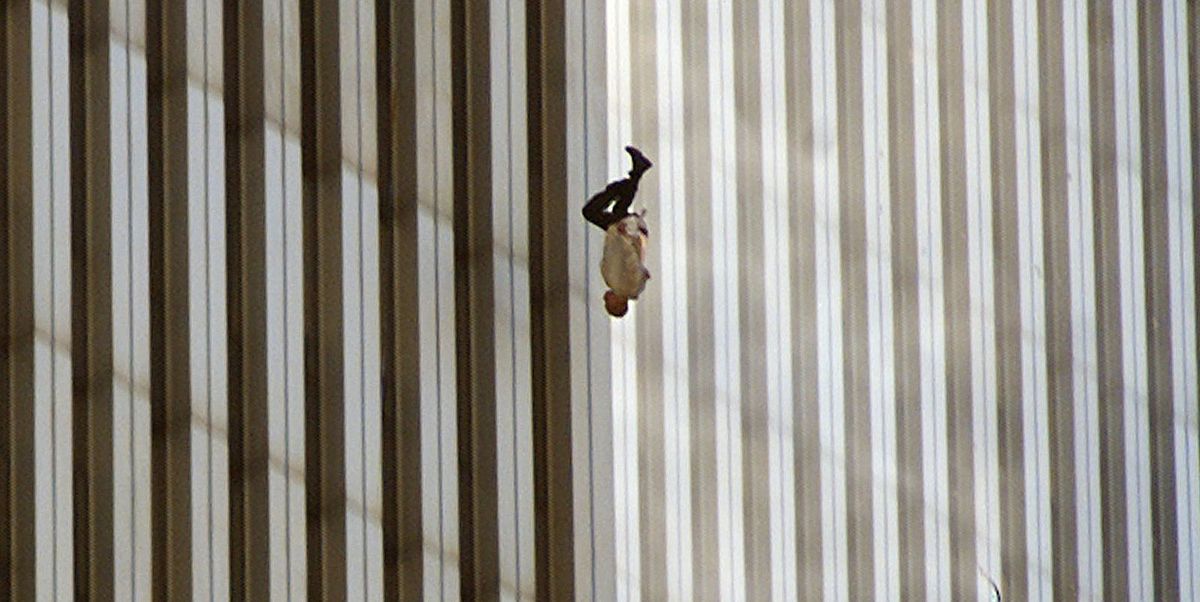
**The photograph and the photographer.** Drew was shooting a maternity fashion show in Bryant Park when the first plane hit. He took the subway downtown, alone in the car, and photographed falling people through a 200mm lens while a police officer and an emergency technician beside him called out "There goes another." He recognised the frame instantly on his laptop — verticality and symmetry — and filed it. It ran on page seven of the *Times* the next morning, and in hundreds of papers worldwide. The man was not identified.
Junod establishes Drew's history in one devastating paragraph: at twenty-one he stood behind Robert Kennedy when Kennedy was shot, and photographed him dying while Ethel Kennedy begged the photographers — begged *him* — to stop. He has kept the jacket. He has never averted his eye.
**The suppression.** In most American newspapers the photograph ran once and never again. Papers were accused of exploitation, of stripping a man of dignity, of pornography. CNN moved from live broadcast, to blurring, to not showing at all. A 9/11 documentary kept the sound of impacts but edited out how often they occurred. Images of the falling migrated to shock sites, where looking carries shame by association.
**The numbers, and the word.** The *Times* counted only what its reporters could see in footage: fifty. *USA Today*, using eyewitness accounts and forensic evidence, put it at two hundred or more — which would make it roughly one in six of the North Tower dead. The Medical Examiner's Office rejects the verb entirely.
**The first identification, and its cost.** Peter Cheney enhanced the image, reasoned to a dark-skinned man with a goatee in a food-service tunic, found a missing poster matching that description, and took the print to the family of Norberto Hernandez. A brother and a sister said yes. Then Cheney went to the funeral and showed the photograph to the eldest daughter, who told him it was not her father and had him removed.
The consequences were permanent. The family divided between those who had said it might be him and those who knew it was not. Norberto's widow Eulogia and their daughters moved out of the neighbourhood after sixteen-year-old Tatiana began seeing visions of her father and hearing what people were saying. Strangers wrote poems about Norberto jumping. People called offering money. Others wrote online that he had gone to hell for it.
Eulogia had dressed him that morning and could list what he wore. Shown the twelve-frame sequence on her own front porch, she looked, handed it back, and said the man was not her husband.
**The orange shirt.** In the full sequence the fall tears the white jacket away and reveals a bright-orange shirt beneath. It is the one hard fact the outtakes yield, and Junod uses it as an eliminator: Windows on the World kitchen staff wore checked or white; Forte Food's male employees were kitchen workers; nobody would have worn orange under the serving coat. Candidate after candidate is ruled out — Sean Singh, Wilder Gomez, Charlie Mauro, Junior Jimenez — on clothing, build, or circumstance.
**The woman in Connecticut.** She lost both sons, who worked back-to-back at Cantor Fitzgerald. She stopped reading the news, then saw a year-end photograph of people at the edge of the broken building and recognised the posture of one of them. She demanded the photographer enlarge it. Both her sons were in it. Her answer to whether she was right to look is the counterweight to the Hernandez family's answer, and Junod sets the two beside each other without adjudicating.
**Jonathan Briley.** Windows on the World, forty-three, six foot five, a preacher's son whose father demanded of God to be told where he was — and whose body was found, intact, the next day. His brother Timothy, a police officer, identified him by his black high-tops and kept one. His sister Gwendolyn knew he had asthma. And Timothy knew Jonathan wore an orange T-shirt constantly enough to tease him about it.
It is not proof, and the piece does not claim it is. Jonathan's clothes were unrecognisable except the shoes; his wife never saw what he left in that morning.
### 🗒️ Notes
- **The thesis, stated in the second sentence of the piece.**
> [!quote]
> In the United States, people have taken pains to banish it from the record of September 11, 2001.
- **The photographer's principle**, established through his own history with the Kennedy assassination.
> [!quote]
> It is not up to him to reject the images that fill his frame, because one never knows when history is made until one makes it.
- **The Medical Examiner's Office on the word itself.** The most compressed statement in the piece of what is at stake in describing these deaths.
> [!quote]
> We don't like to say they jumped. They didn't jump. Nobody jumped. They were forced out, or blown out.
- **The distinction the argument turns on.** Not that the images are worse, but that Americans were asked to decide on the dead's behalf.
> [!quote]
> What distinguishes the pictures of the jumpers from the pictures that have come before is that we—we Americans—are being asked to discriminate on their behalf.
- **And the conclusion drawn from it**, which is the moral centre of the essay.
> [!quote]
> we have somehow taken it upon ourselves to deem their deaths unworthy of witness—because we have somehow deemed the act of witness, in this one regard, unworthy of us.
- **The turn against his own opening.** Having spent a page on the photograph's composition, Junod dismantles it.
> [!quote]
> Photographs lie. Even great photographs. Especially great photographs.
- **What the outtakes show instead.**
> [!quote]
> He fell like everyone else, like all the other jumpers—trying to hold on to the life he was leaving, which is to say that he fell desperately, inelegantly.
- **The family's reasoning, reported in their own logic rather than assessed.** Note the construction: not that he *couldn't* have, but that he *wouldn't* have.
> [!quote]
> But he couldn't have jumped out a window, his family knows, because he wouldn't have jumped out a window: not Papi.
- **Eulogia Hernandez's request**, at the close of the scene on her porch.
> [!quote]
> Please clear my husband's name.
- **The evidentiary spine**, and the only hard fact the sequence yields.
> [!quote]
> Whoever the Falling Man may be, he was wearing a bright-orange shirt under his white top.
- **The counterweight.** The mother in Connecticut, answering the question the piece is really asking.
> [!quote]
> I could never have made the choice not to know.
- **The piece interrogating its own method, out loud.** Junod asks this about the calls he would have to make, and does not resolve it.
> [!quote]
> But should those calls be made? Should those questions be asked?
- **Timothy Briley's teasing**, which is the detail that makes the Briley possibility land and also the reason it can never be more than a possibility.
> [!quote]
> When are you gonna get rid of that orange T-shirt, Slim?
- **The final line**, which refuses the identification the structure has been building toward and redirects it.
> [!quote]
> That we have known who the Falling Man is all along.
## 📚 References
Listed in the in-page References section. The piece's evidence is reported rather than cited, and the reporting is unusually legible: photographers and reporters are named, competing estimates are attributed to the outlets that produced them along with their differing methods, and the one institutional refusal — the Medical Examiner's Office on the word "jumped" — is quoted directly.
Two observations:
- **The two estimates are given with their methods, not just their numbers.** The *Times* counted what reporters could see in footage; *USA Today* used eyewitness accounts and forensic evidence. Junod notes the *Times* figure is "admittedly conservative" and does not choose between them.
- **The identification chain is shown, not summarised.** Cheney's reasoning — enhancement, skin tone, goatee, tunic, Windows on the World, missing poster — is laid out step by step, which is what lets a reader see where it went wrong.
## 🗣️ Paraphrase
*The image.* A man falls, vertical, bisecting the towers, apparently composed. He is fifteen seconds past 9:41 a.m., accelerating, upside down. In the frame he is frozen; outside it he drops until he disappears.
*The photographer.* Richard Drew of the AP was shooting a maternity fashion show when the first plane hit. He took an empty subway downtown, photographed falling people through a long lens between a police officer and a paramedic, and was engulfed when the South Tower came down. At his office he saw the frame immediately and filed it. It ran on page seven of the *Times* and around the world. The man was not named.
*The falling.* They began after the first plane and continued until the tower fell, from all four sides, for over ninety minutes, from Marsh & McLennan, Cantor Fitzgerald, Windows on the World. Roughly ten seconds down. Those falling were silent; the people watching screamed.
*The refusal.* American papers ran the picture once. Editors were accused of exploitation. CNN went from live, to blurred, to nothing. A documentary kept the sound of impacts but not their frequency. The images ended up on shock sites.
*The numbers.* Fifty by the *Times*' conservative count; at least two hundred by *USA Today*'s. Possibly one in six of the North Tower dead. The Medical Examiner's Office objects to the verb.
*The first identification.* Peter Cheney enhanced the photo, reasoned to a Latino food-service worker with a goatee, matched a missing poster, and got confirmation from a brother and sister. He brought the print to the funeral and showed it to the eldest daughter, who told him it was not her father and had him removed. The family has been divided ever since; the widow and daughters moved away.
*The orange shirt.* The full sequence shows the jacket tearing loose and an orange shirt underneath. Kitchen staff wore checked or white. The detail eliminates candidate after candidate.
*Connecticut.* A mother who lost both sons recognised one of them in a year-end photograph of people at the building's edge, had it enlarged, and found both. Asked whether she was right to look, she said she could never have chosen not to know.
*Jonathan Briley.* Windows on the World, forty-three, six foot five, light-skinned, goateed. His father demanded of God to know where he was; the FBI called the next day and the body was intact. His brother identified him by his black high-tops and kept one. His brother also remembers an orange T-shirt he wore constantly.
*The ending.* He might be. The only certainty is the one we started with: a photograph was taken, went everywhere, and vanished. The picture is the man's cenotaph, and it asks one acknowledgment — that we have known who he is all along.
## 📰 Newsletter
**The photograph America agreed not to look at**
Twenty-five years on, and after spending today reading three other pieces about this anniversary, the one that should be read first is [Tom Junod's 2003 Esquire feature](https://www.esquire.com/news-politics/a48031/the-falling-man-tom-junod/). It is about Richard Drew's photograph of a man falling from the North Tower, and it is not really about the photograph at all.
Junod's argument, and it is an argument:
> we have somehow taken it upon ourselves to deem their deaths unworthy of witness—because we have somehow deemed the act of witness, in this one regard, unworthy of us.
He builds it by comparison. We showed the camps. We showed Robert Kennedy dying — Drew took those pictures too, at twenty-one, with Kennedy's blood on his jacket and Ethel Kennedy begging him to stop. We showed the girl running from the napalm. These deaths, uniquely, we agreed to avert our eyes from, and Junod's point is that the decision was made *for* the dead, by people who had not been asked.
**But the piece is honest about what looking costs**, and that is why it lasts. A Toronto reporter named Peter Cheney did the detective work first — enhanced the image, reasoned his way to a food-service worker with a goatee, matched a missing poster, got a yes from a brother and sister. Then he took the print to the funeral and showed it to the man's eldest daughter.
Her answer is in the piece. The family has never been the same. The widow and daughters left the neighbourhood after their sixteen-year-old began seeing her father in the house. Strangers wrote poems. Strangers wrote that he had gone to hell for it.
He was not the man in the photograph. The full twelve-frame sequence — which Cheney did not have — shows the jacket tearing away to reveal **a bright orange shirt**, and Norberto Hernandez did not own one.
**Junod asks the question about himself**, which is the thing I keep returning to:
> But should those calls be made? Should those questions be asked?
He does not answer it. He sets two families beside each other instead. One believes the photograph slanders a man who was trying to come home. The other is a mother in Connecticut who lost both sons, found them in a year-end photograph of people at the building's edge, and had it enlarged so she could be sure:
> I could never have made the choice not to know.
Both are right. That is the piece.
**One craft note.** Junod opens with a page of gorgeous writing about the photograph's composition — the verticality, the symmetry, the man as an arrow — and then turns around and destroys it: *"Photographs lie. Even great photographs. Especially great photographs."* In the outtakes he falls like everyone else, desperately and inelegantly. An essay willing to demolish its own best paragraph is doing something most essays never risk.
*Pairs with the two other 9/11 pieces I read today — Shawn Hooper's 336 words from Ottawa, and Anil Dash's 25th annual New York essay. Three entirely different answers to how you write about this, and the Junod is the one about whether you should look at all.*
## ✅ Action Items
> This template's action framework assumes a source with organizational implications. A 2003
> magazine feature about the dead has almost none, and manufacturing them would be the padding
> the "not applicable" instruction exists to prevent. The items below are the ones that are real.
#### DevRel
- Not applicable to this source.
#### OSPO
- Not applicable to this source.
#### Community
- If community archives or anniversary programming touch 9/11, the piece is the reference on the ethics of which images to show and who gets to decide.
- The Hernandez outcome is the cautionary case for any identification effort conducted on the public record: a wrong attribution followed the family for years and was not retractable.
#### WordPress
- **Accessibility** — the one transferable professional item: an image that *is* the subject of a piece carries an alt-text obligation of a different order from a decorative one, and this article is the extreme case. See the Accessibility Assessment.
- **All other teams** — not applicable to this source.
#### The WPOCC
- Not applicable to this source.
### FAIR
- Not applicable to this source.
## 🧪 Hypotheses
> Framed as questions the piece raises, not claims it makes. Junod advances no testable thesis
> about the man's identity and explicitly declines to.
1. **The orange shirt is the only eliminating fact, and it eliminates more than it identifies.** The piece uses it to rule out every named candidate and cannot use it to rule one in. Testable only against the full sequence and employment records, which is what Junod did.
2. **The suppression was a decision about the viewers, not the dead.** Every rationale quoted — dignity, privacy, families — is offered by people who were not the families. Testable against what the families actually said, which the piece partly supplies and which cuts both ways.
3. **Identification attempts harm families in proportion to their publicity, not their accuracy.** Cheney's was wrong and public; Junod's is careful and public. Testable against the Hernandez and Briley families' subsequent experience.
4. **The taboo has weakened over twenty-five years.** Christy Ferer's Auschwitz comparison — "they can show that now" — predicts it. Testable against current anniversary coverage, including today's.
5. **The final line is deliberately ambiguous and is usually misread as naming Briley.** Testable against how the piece is cited.
### 📊 Methodology
- **Source type.** Longform magazine journalism, roughly 7,300 words, first published in *Esquire* in September 2003 and republished online (the captured page carries a 2021-09-09 date, which is the republication, not the original). Reader recorded the author as the domain; the byline in the text is Tom Junod, with additional reporting by Andrew Chaikivsky.
- **Evidence base.** Named interviews (Drew, Fischl, the Hernandez family, the Briley family, an unnamed Connecticut mother, Christy Ferer, Walter Isaacson quoted), two attributed published estimates with their differing methods, a quoted institutional position, and the twelve-frame photographic sequence itself.
- **What it establishes.** That the photograph was taken and suppressed as described; that Cheney's identification of Norberto Hernandez was made, published, and rejected by the immediate family; that the full sequence shows an orange shirt; that Jonathan Briley matches several criteria including a habitually worn orange T-shirt.
- **What it does not establish, and does not claim to.** The man's identity. Junod writes "might be" and stops. Reading the piece as identifying Briley is a misreading it takes care to forestall.
- **The inference chain's weakest links, named by the piece itself.** Jonathan Briley's clothes were unrecognisable on recovery except the shoes; his wife never saw what he wore that morning; and the orange shirt is corroborated by a brother's memory of habit, not by any record of that day.
- **A named limitation in the earlier attempt.** Cheney worked from a single enhanced frame. The orange shirt is visible only in the outtakes. The identification failed on evidence he did not have, which is a fact about access rather than about care — and it is also why the piece shows his method step by step.
- **Verification performed for this note.** All sixteen links extracted and checked; they are Esquire navigation and related-content promotion, with no citations, which is a property of a republished 2003 print feature rather than a sourcing defect. No "uncited" finding applies.
- **Positional note.** Junod is a participant in his own story — the man on the phone in the Connecticut scene, and the person who showed photographs to Eulogia Hernandez on her porch. He does not conceal this, and the piece's ethical question is asked about his own conduct as much as about Cheney's.
### ❓ Questions
- Was the identification ever settled after publication? The piece ends open by design; whether later reporting closed it is outside this source.
- What did the Briley family make of the piece once it ran? Junod reports their memories; he does not report their response to being written about.
- Would the Hernandez family's experience have differed if Cheney had held the story rather than attending the funeral with a print?
- Who, institutionally, decided the images were untransmittable — and was any family consulted before the networks stopped?
- Does the Medical Examiner's refusal of the word "jumped" reflect a forensic determination or a protective one? The piece quotes it without resolving which.
- What happened to Eric Fischl's *Tumbling Woman* after the exhibition was ended?
### 🔮 Future Research
- Read the piece alongside the 2006 documentary and the later Esquire podcast episode, both of which revisit the identification.
- Compare the *Times* and *USA Today* methodologies directly; the gap between 50 and 200 is a methodological question with a determinate answer.
- Trace how the taboo shifted across the anniversaries — the same question Anil Dash's linked 25-essay series answers from a different angle.
- Examine whether any 9/11 oral-history archive systematically collects accounts from families of those who fell, or whether the aversion Junod describes shaped the archives too.
### 💡 Implications
- **Practice.** For anyone doing identification work on the public record: publication is not retractable, and a wrong attribution attaches to a family permanently. Cheney's error is the case study.
- **Policy.** A decision to withhold images on behalf of families should involve families. The piece's strongest structural point is that nobody asked.
- **Security.** Not applicable to this source.
- **Education.** The best available teaching text on the ethics of witness, and unusual in that it argues a position while showing the strongest evidence against it — the Hernandez family's grief — at full strength.
- **Funding.** Not applicable to this source.
### 🧠 Learning Styles Assessment
#### 👀 Visual learners
Served in a way the piece is deliberately uneasy about. The photograph is the subject, and the essay's opening page is an extended act of looking on the reader's behalf — describing the image in detail so precisely that a reader who never sees it still has it. Junod then argues that the describing is not a substitute for the looking.
#### 🔊 Aural learners
Not served by the text; an Esquire Classic podcast episode on this piece is linked from the page.
#### 🗣️ Verbal learners
Exceptionally served. This is among the most carefully written pieces of American magazine journalism, and its effects are built at sentence level — the short declaratives after long ones, the repetitions, the refusal of a closing name.
#### 🧩 Kinesthetic learners
Not applicable to this source.
#### 🧠 Logical learners
Well served, and more than the subject might suggest. The identification runs as a genuine elimination argument with a stated decisive criterion, candidates ruled out one at a time on specified grounds, and an explicit refusal to overclaim the conclusion.
#### 🧑🤝🧑 Social learners
Well served. The piece is built from people — a photographer, a reporter, three families, a sculptor — and its method is putting their incompatible positions beside one another.
#### 🧘♀️ Solitary learners
Well served, and probably best read alone. It is long, slow, and asks something of the reader.
#### 🌿 Naturalistic learners
Not applicable to this source.
**Reading level estimate.** Roughly grade 12–14. The vocabulary is not specialised but the sentences are long and layered, the structure is associative rather than linear, and the piece assumes a reader who will sit with discomfort rather than skim. It is also emotionally demanding in a way a reading-level figure does not capture, and that is the real accessibility barrier.
### 📊 Accessibility Assessment
#### Screen reader semantics
Not fully assessable from the extract. The article body is long-form paragraph content with section breaks rather than headings — appropriate to the form, and it does mean a 7,300-word piece offers no navigable outline. For text this long, some structural landmarks would help without damaging the prose.
#### Keyboard navigation
The sixteen links are all navigation and related-content promotion rather than in-text citations, so the reading path is uninterrupted. Several anchor texts are decorative or auto-generated — one reads as a list of image tags ("Public speaking, Microphone, Spokesperson, Tie, Blazer, Lectern…"), which is a scraped alt-text string surfacing as link text and would be meaningless in a screen-reader link list.
#### Contrast and readability
Not assessable from extracted HTML. Recorded as **not evaluated**.
#### Text resizing and reflow
Not assessable from the captured content.
#### Media and captions
**This is the most consequential accessibility question in anything processed today, and it could not be resolved from the extraction.** The photograph is not an illustration of the article — it *is* the article's subject, and the opening page is a description of it. Whether the image carries alt text, and what that alt text says, is an editorial and ethical decision of real weight: a description must convey what the piece is about without becoming gratuitous, for a reader who cannot see it and is entitled to the same access to the argument.
Junod's own opening paragraph is, in effect, an extended alt text written by a master. Whether the page supplies anything comparable is unknown from here and worth checking on the rendered page.
#### Forms and interactions
The captured content includes an email-collection notice ("This content is created and maintained by a third party, and imported onto this page to help users provide their email addresses"), an embedded third-party component not evaluated here.
#### Standards reference
Against WCAG 2.2 AA: **SC 1.1.1 Non-text Content** is the criterion that matters and is **undetermined** from extraction — see above. **SC 2.4.4 Link Purpose** is weakened by the scraped-alt-text link string. **SC 2.4.6 Headings and Labels** is a quality observation for a piece of this length. SC 1.4.3, 1.4.4, 2.4.7 **not evaluated** without the rendered page.
### 🌍 DEIB Assessment
#### Cultural breadth
American, and conscious of it. The piece's central claim is explicitly about a national decision — "we Americans" — and it notes that the rest of the world saw footage the United States did not. That framing is the argument rather than a limitation of it.
#### Inclusive language
Careful, and the care is doing analytical work. Junod handles the word "jumpers" as contested, quotes the Medical Examiner's rejection of it, and notes the term was applied "as though they represented a new lemminglike class." Race is discussed because identification turned on it, and the descriptions are reported as the observations of the people making them — Cheney's reasoning, Eulogia Hernandez's "the man in this picture is a black man" — rather than asserted by the author.
#### Neurodiversity support
Demanding. Long associative structure, no headings, no summary, and sustained emotional weight with no relief points. A reader who needs to know what a piece is going to ask of them before starting will not get that here.
#### Representation
The strongest DEIB feature and the reason the piece endures. Three families are given room on their own terms and are allowed to disagree with each other and with the author. The Hernandez family's rejection of the photograph is presented at full force, in Spanish and English, without being corrected or contextualised into something more convenient for the essay's argument. The Connecticut mother's opposite conclusion is given equal standing. Junod is arguing for looking, and he hands the strongest case against it to the people who hold it.
Worth naming: the piece is largely about working-class food-service staff — pastry chefs, kitchen workers, audiovisual staff — who are ordinarily invisible in coverage of the towers. The identification chain runs through employment records at Windows on the World and Forte Food, and the effect is a portrait of who was actually at the top of that building.
#### Psychological safety
Handled with unusual care for material this hard. There is no gratuitous description of impact; the one clinical sentence about what happened on landing is immediately followed by "in body though not, one prays, in soul." The families' dignity is protected in the writing even where their words are raw. The piece gives no warning at its start, which is a 2003 convention rather than a choice, and a reader coming to it cold today should know what it contains.
### ✅ Logical Validity
> Applied to Junod's argument only. The families' statements are testimony about their own dead
> and are not assessed as reasoning.
#### Strong reasoning
- **The central argument is built on a comparison that does real work.** Holocaust photographs, the Kennedy assassination, the napalm girl, Father Mychal Judge — all shown, all accepted as witness. The question of what distinguishes these images is asked rather than assumed, and the answer offered is specific: that Americans were asked to decide on the dead's behalf.
- **The identification is a genuine elimination argument.** One decisive criterion, candidates ruled out individually on stated grounds, and the conclusion held at "might be."
- **The piece attacks its own best writing.** Having made the photograph beautiful, Junod says photographs lie, and shows the outtakes where the man falls inelegantly. That is an author removing his own strongest rhetorical asset because it is not true.
- **The strongest counter-evidence is given full weight.** The Hernandez family's experience is the best argument against Junod's thesis, and he reports it at length and without softening.
- **The method is interrogated explicitly.** "Should those calls be made?" is asked and left open.
#### Weaknesses and tensions
- **The argument and the method are in tension, and the piece knows it without resolving it.** Junod argues that we should look; his reporting required showing photographs of a falling man to his possible widow on her front porch. The Cheney scene is included as the cautionary version, and Junod's own version is gentler and the same kind of act. Naming it is not the same as answering it.
- **The elimination is sound and the positive identification is not, and the structure invites conflation.** Ruling out Hernandez on the orange shirt is strong. Ruling *in* Briley rests on a brother's memory of a habit, against clothes that could not be identified on recovery. Junod is explicit — "might be" — and the essay's build makes it easy to read a conclusion that was not offered.
- **"We Americans" flattens a decision made by a small number of editors.** The piece attributes to a public a choice made by networks, editors, and standards executives, some of whom are named as having made it. The rhetorical force of the collective is real; the accuracy is loose.
- **One claim rests on an interested source.** The Medical Examiner's Office rejects the word "jumped," and the piece quotes it as a position without establishing whether it is a forensic finding or a protective convention. Either is defensible; they are different things.
#### Tone of voice
Elevated, deliberate, and controlled throughout, with the writer's presence acknowledged and never centred. The piece risks lyricism on a subject where lyricism could easily become obscene, and it earns it by repeatedly puncturing itself — the beautiful opening undone by "photographs lie," the elegant fall corrected to the desperate one. The closing lines shift register to something close to liturgy, which will strike some readers as the piece's finest moment and others as a step past what the reporting supports.
### 🛡️ DARVO Analysis
**Not applicable to this source, and the framework should not be forced onto it.**
DARVO describes a defensive pattern — deny, attack, reverse victim and offender — deployed by someone facing an accusation of causing harm. This piece contains no such actor. It is reported journalism about a photograph, a death, and grief.
There is a surface temptation to read the Hernandez family's rejection of the photograph through this lens, because the elements are superficially present: a denial, anger directed at a reporter, a family positioning itself as wronged. **That reading would be wrong and this note rejects it explicitly.** The family were not accused of anything and were not defending against an allegation of harm. They were correcting a false public claim about their dead — and, on the evidence the piece assembles, they were correct. Their anger at a reporter who brought a photograph of a falling body to a funeral is not a rhetorical manoeuvre. It is a proportionate human response, and treating it as a pattern to be diagnosed would be both analytically empty and a failure of ordinary decency.
Recorded for structural consistency across the vault, with the finding that the framework does not apply and the reason it must not be stretched to fit.
## 🎯 Conclusion
**Bottom line.** The definitive piece on the ethics of looking at 9/11, and its subject is not the photograph but the decision to look away from it. Junod argues that a country which agreed not to witness these deaths made a judgment about the dead — one nobody asked the dead or their families to authorise.
**What makes it durable** is that it holds its own argument to account. It shows what looking cost the Hernandez family, in full, as the strongest case against itself. It asks whether its own method is defensible and leaves the question open. And it dismantles its most beautiful paragraph on the grounds that the photograph, however composed, lies about how the man actually fell.
**On the identification: it does not make one.** The orange shirt eliminates; it does not confirm. Jonathan Briley "might be" the man, on a brother's memory of a habitually worn shirt against clothing that could not be identified when the body was recovered. The final line refuses the name and redirects the question, and the piece is regularly misread as having answered it.
**The two answers it sets side by side** are the thing to carry. A family who believes the photograph slanders a man who was trying to come home, and a mother who found both her sons in a photograph and said she could never have chosen not to know. Junod does not adjudicate between them, and the refusal is the essay's integrity rather than its evasion.
**Next steps.**
1. Read it whole and slowly; it does not survive skimming and it asks something of the reader.
2. If citing it, cite the uncertainty — "might be" — and not an identification.
3. Pair it with the day's other two anniversary pieces already in the vault; three different answers to how this gets written, and this is the one about whether to look.
## 🔄 Refactor Appendix — The Falling Man
> Density: 2–5 Literature atoms (H3), 0–3 Permanent candidates (H4).
> Resonance filter: if you can't articulate in one line why a claim matters, drop it.
### 📚 Literature Atoms (H3)
#### [H1] The refusal was a judgment made on the dead's behalf
> [!quote]
> What distinguishes the pictures of the jumpers from the pictures that have come before is that we—we Americans—are being asked to discriminate on their behalf.
**Context & use**:
- The argument's hinge: not that the images are worse than the camps or the Kennedy assassination, but that someone decided for the dead.
- The "we Americans" flattens a choice made by a small number of named editors, which is the claim's rhetorical strength and its accuracy problem.
**Tags**: #xref
<!-- atomicity: 1 idea ✓ -->
#### [H2] A great photograph's composition can be a lie about the event
> [!quote]
> Photographs lie. Even great photographs. Especially great photographs.
**Context & use**:
- Junod demolishes his own opening page, then shows the outtakes in which the man falls desperately and inelegantly.
- The rare case of a writer removing his strongest rhetorical asset because it misrepresents what happened.
**Tags**: #xref #aphorisms
<!-- atomicity: 1 idea ✓ -->
#### [H3] The piece interrogates its own method out loud
> [!quote]
> But should those calls be made? Should those questions be asked?
**Context & use**:
- Asked about the calls Junod would have to make to families to ask what their dead wore that morning.
- Left unresolved, with the Cheney scene standing as the cautionary version of the same act.
**Tags**: #xref
<!-- atomicity: 1 idea ✓ -->
#### [H4] Two families, opposite conclusions, both given full weight
> [!quote]
> I could never have made the choice not to know.
**Context & use**:
- The Connecticut mother who found both her sons in a photograph, set against the Hernandez family's "not Papi."
- Junod declines to adjudicate, which is the essay's structural integrity rather than an evasion.
**Tags**: #xref
<!-- atomicity: 1 idea ✓ -->
#### [H5] One detail eliminates where it cannot identify
> [!quote]
> Whoever the Falling Man may be, he was wearing a bright-orange shirt under his white top.
**Context & use**:
- Visible only in the outtakes, which is the evidence Cheney did not have when he identified Norberto Hernandez.
- Rules candidates out cleanly and rules none in, which is why the piece ends on "might be."
**Tags**: #xref
<!-- atomicity: 1 idea ✓ -->
### 🧠 Permanent Candidates (H4)
#### [P1] Evidence That Eliminates Cannot Identify
**Claim** (one sentence, Courtney's voice): A discriminating detail can rule candidates out conclusively while ruling none in, because exclusion needs only a mismatch and inclusion needs everything else to match too — so an elimination argument that has removed every rival has still not established its survivor.
**Evidence pointer**: [[#H5]] — an orange shirt that eliminates every kitchen worker at two catering firms, and that supports the remaining candidate only through a brother's memory of a habit rather than any record of that morning.
**Scope & conditions**: Holds wherever the discriminating feature is necessary but not sufficient for identity. The structural trap is that a narrowing sequence *feels* like it converges — each elimination raises confidence in whoever is left, even though no positive evidence has been added. The remedy is to state what would still be needed to confirm, which Junod does by ending on "might be" and which most narrowing arguments omit. Applies to attribution, incident root-causing, and any diagnosis by exclusion; the failure mode is the last-suspect-standing conclusion.
**Links** (≥1 with annotation):
- [[3. Resources/Permanent Notes/A Contact Claim Needs a Named Transfer Not Just Proximity]] — the same gap between narrowing evidence and an established link.
- [[3. Resources/Permanent Notes/Evidence Scope and Vulnerability Scope Are Different Claims]] — the same distinction between what was demonstrated and what is asserted.
- [[3. Resources/Permanent Notes/Vividness Is Not Accuracy and Careful Testimony Marks the Difference]] — the companion caution about what a compelling account establishes.
<!-- atomicity: 1 idea ✓ -->
#### [P2] Deciding What Others Should Not See Is a Claim to Speak for Them
**Claim** (one sentence, Courtney's voice): Withholding material on behalf of the people it depicts, or their families, asserts an authority to speak for them that is rarely sought and rarely held — so the protective decision is itself an exercise of power over the people it claims to protect.
**Evidence pointer**: [[#H1]] [[#H4]] — a national withdrawal of images justified by respect for families, made by networks and editors; and two families who reached opposite conclusions about whether looking served them.
**Scope & conditions**: The protective instinct is genuine and the decision is sometimes right; the claim is about who makes it and on what standing. The tell is whether the affected parties were asked, and in this case the piece's evidence is that they were not and that they did not agree with each other. Extends past images to any withholding justified by someone else's welfare — content moderation, medical disclosure, redaction of victims' names, and organizational decisions about what staff can handle. Does not imply everything should be published; it implies the deciding party should name whose judgment it is exercising and on what authority.
**Links** (≥1 with annotation):
- [[3. Resources/Permanent Notes/Being Anticipated Beats Being Tolerated - Visible Inclusion Shifts the Burden]] — the same question of who decides what another person needs, from the accommodation side.
- [[3. Resources/Permanent Notes/Meaning About Suffering Belongs to the Sufferer]] — the closest existing claim: interpretation of a person's suffering is theirs to make, and this note extends it to the decision about what may be seen.
- [[3. Resources/Permanent Notes/Absence of Testimony Indicates Absence of Invitation]] — why the families' silence in the record cannot be read as consent to the decision made for them.
- [[3. Resources/Permanent Notes/Withholding a Dual-Use Method Withholds Its Verification Too]] — the same structure in a technical domain, where a protective non-disclosure also removes scrutiny.
<!-- atomicity: 1 idea ✓ -->
### ✏️ Fleeting Queue
- [F1] Did later reporting settle the identification? The piece ends open by design; the 2006 documentary and the Esquire Classic podcast both revisit it. #xref
- [F2] Compare the *New York Times* (50) and *USA Today* (at least 200) methodologies directly — the gap is a methodological question with a determinate answer, and both are stated in the piece. #articleseed
- [F3] Check whether the rendered Esquire page supplies alt text for the photograph, and what it says. For an image that *is* the subject, this is an editorial decision of real weight. #accessibility
- [F4] Do 9/11 oral-history archives systematically collect accounts from families of those who fell, or did the aversion Junod describes shape the archives too? #articleseed
- [F5] Three 9/11 pieces in the vault from today — Hooper (336 words, Ottawa, no argument), Dash (4,100 words, NYC, political thesis), Junod (7,300 words, the ethics of looking). Worth writing up as a study in how one anniversary gets written. #articleseed
### → Things 3 (max 2 actions)
- [ ] Read "The Falling Man" whole and unhurried, away from a screen; it does not survive skimming. #reading #things
- [ ] Check the alt text on the Esquire page's photograph — the access question for an image that is itself the subject. #accessibility #things
<!-- deep-read:sections end -->
📄 **Full text:** [[Full Document Contents/Articles/The Falling Man.md|The Falling Man by Tom Junod]]
## Highlights
- Photographs lie. Even great photographs. Especially great photographs. ([View Highlight](https://read.readwise.io/read/01m28zmnnns11vngrsehmnwaqg))
- Note: Junod demolishes his own opening page — the verticality, the symmetry, the man as arrow — and then shows the outtakes, where he falls desperately and inelegantly. A writer removing his strongest rhetorical asset because it misrepresents what happened.
- Tags: photojournalism, longform-journalism
- Whoever the Falling Man may be, he was wearing a bright-orange shirt under his white top. ([View Highlight](https://read.readwise.io/read/01m28zn4d332ehx5g5f6amqcmf))
- Note: The evidentiary spine — visible only in the twelve-frame sequence, which is the evidence Cheney did not have when he identified Norberto Hernandez from a single enhanced frame. It eliminates candidates cleanly and rules none in, which is why the piece ends on "might be."
- Tags: photojournalism, identification
- What distinguishes the pictures of the jumpers from the pictures that have come before is that we—we Americans—are being asked to discriminate on their behalf. ([View Highlight](https://read.readwise.io/read/01m28zmdsjtqxjzvyvt7t4szyg))
- Note: The argument's hinge. Not that these images are worse than the camps or the Kennedy assassination — that someone decided for the dead, and nobody asked them or their families. Note the "we Americans" flattens a choice made by a small number of named networks and editors: rhetorically strong, loose on accuracy.
- Tags: collective-memory, ethics-of-witness
- I could never have made the choice not to know. ([View Highlight](https://read.readwise.io/read/01m28znbw6c84nm98bex8yd5m2))
- Note: The mother in Connecticut who lost both sons, recognised one in a year-end photograph of people at the building's edge, and had it enlarged. Set against the Hernandez family's "not Papi." Junod places the two answers side by side and declines to adjudicate — that refusal is the essay's integrity, not its evasion.
- Tags: grief, ethics-of-witness
- But should those calls be made? Should those questions be asked? ([View Highlight](https://read.readwise.io/read/01m28zmx0p52jyva5kbaftecq7))
- Note: The piece interrogating its own method out loud — the calls Junod would have to make asking families what their dead wore that morning. He leaves it unresolved, with the Cheney-at-the-funeral scene standing as the cautionary version of the same act he is performing more gently.
- Tags: longform-journalism, ethics-of-witness