The Hidden Reason Your AI GTM Workflows Fail
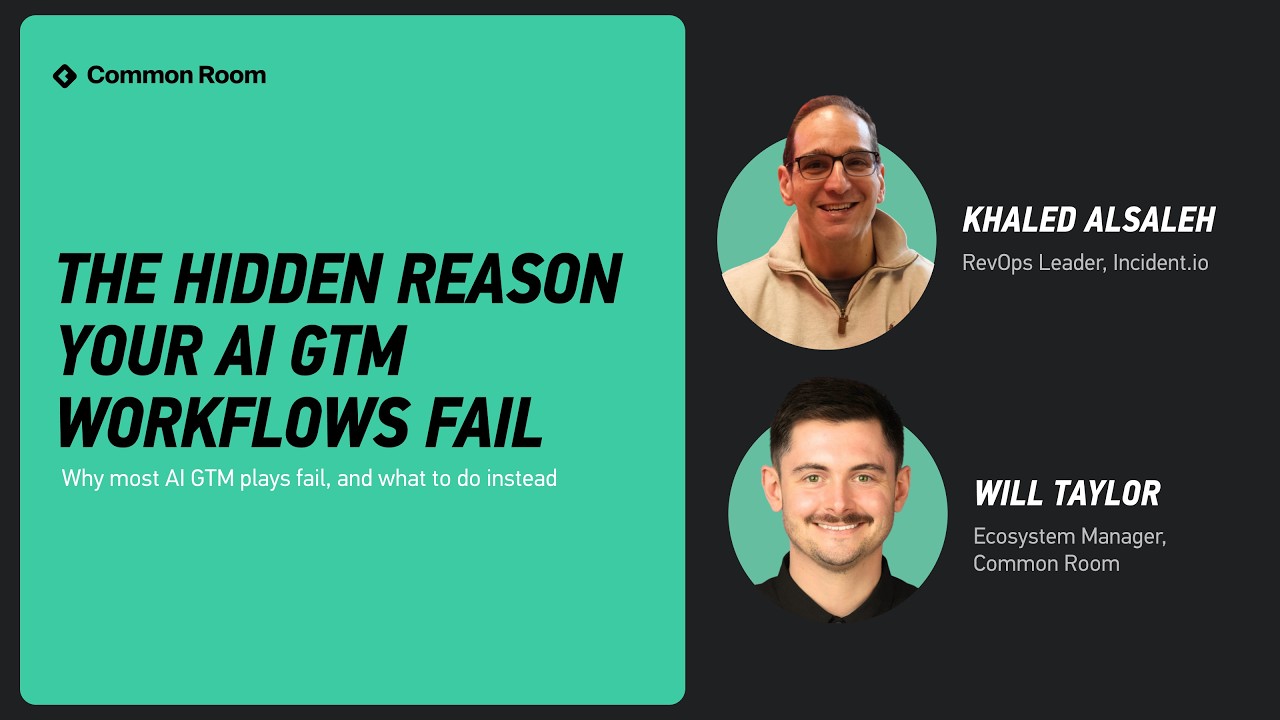
🔗 **Source:** [The Hidden Reason Your AI GTM Workflows Fail](https://www.youtube.com/watch?v=iDtQ3Ajf7lo)
> [!note]+ Document Notes
> tags: [ai-gtm-workflows, data-quality, revops-challenges, salesforce-management, duplicate-management, sales-team-morale]
> author: [MISSING]
> source: [MISSING]
> reference: [https://www.youtube.com/watch?v=iDtQ3Ajf7lo]
> date created: {{date:YYYY-MM-DD}} {{time:HH:mm}}
>
> # 🏷️ Title: The Hidden Reason Your AI GTM Workflows Fail
>
<!-- deep-read:sections start -->
## 🧭 Table of Contents
- [📝 Summary](#-summary)
- [📖 Main Content](#-main-content)
- [🗒️ Notes](#️-notes)
- [📚 References](#-references)
- [🗣️ Paraphrase](#️-paraphrase)
- [📰 Newsletter](#-newsletter)
- [✅ Action Items](#-action-items)
- [🧪 Hypotheses](#-hypotheses)
- [📊 Methodology](#-methodology)
- [❓ Questions](#-questions)
- [🔮 Future Research](#-future-research)
- [💡 Implications](#-implications)
- [🧠 Learning Styles Assessment](#-learning-styles-assessment)
- [📊 Accessibility Assessment](#-accessibility-assessment)
- [🌍 DEIB Assessment](#-deib-assessment)
- [✅ Logical Validity](#-logical-validity)
- [🛡️ DARVO Analysis](#-darvo-analysis)
- [🎯 Conclusion](#-conclusion)
## 📝 Summary
- **What happened**: Khaled from incident.io shared how poor data quality undermines AI-powered go-to-market workflows, turning efficiency gains into scaled problems.
- **Why it matters**: AI amplifies existing data issues - duplicate accounts, stale contacts, and routing errors multiply when automated at scale.
- **Key stakeholders**: RevOps teams, sales leadership, AI implementation teams, and sales reps dealing with data quality fallout.
- **Risks and tradeoffs**: Without clean foundational data, AI tools create customer experience issues, internal friction, and revenue impact through misrouted leads and compliance violations.
- **Bottom line**: Data cleanliness is the prerequisite for successful AI GTM implementation - solve the fundamentals before scaling with automation.
## 📖 Main Content
The core argument centers on data quality as the hidden foundation of successful AI go-to-market operations. While many organizations focus on implementing flashy AI tools and workflows, they overlook the critical prerequisite of clean, reliable data.
**The Scale Problem**: AI doesn't just automate good processes - it scales whatever exists. When data is messy (duplicates, stale contacts, incorrect routing), AI amplifies these problems exponentially. What once affected tens of interactions now impacts hundreds at machine speed.
**The Trust Crisis**: Poor data quality creates a morale and trust problem between RevOps and sales teams. When leads are misrouted or accounts are duplicated, sales reps lose confidence in the systems meant to support them, leading to "rogue" behavior and potential revenue impact.
**The Revenue Connection**: Data quality directly impacts revenue through customer experience degradation, sales team turnover, and reduced productivity. Misrouted demo bookings and compliance violations with do-not-call lists compound the problem.
### 🗒️ Notes
#### ⏱️ [00:03:12](https://www.youtube.com/watch?v=iDtQ3Ajf7lo&t=192) Problem Scale at incident.io
- Started with 28,000 accounts in Salesforce, scaled to 130,000 overnight via third-party data provider
- Created massive duplicate and data quality issues that existing processes couldn't handle
- Sales team scaled exponentially, making manual data management impossible
#### ⏱️ [00:08:45](https://www.youtube.com/watch?v=iDtQ3Ajf7lo&t=525) AI Amplification Effect
- Applied AI team automated workflows for efficiency gains
- Key insight: "with poor data, you do bad things a lot faster at scale"
- Human judgment previously caught errors; AI automation removes this safety net
#### ⏱️ [00:12:30](https://www.youtube.com/watch?v=iDtQ3Ajf7lo&t=750) Customer Experience Impact
- Inbound leads routed to wrong geographic territories
- Pre-booked demos requiring rescheduling due to territory mismatches
- Prospects selecting inconvenient times (7 PM UK Friday) due to incorrect geo-routing
#### ⏱️ [00:16:20](https://www.youtube.com/watch?v=iDtQ3Ajf7lo&t=980) Revenue Operations Trust
- Internal customer (sales team) trust eroded by system failures
- Reps spending time on Salesforce cleanup instead of selling
- Morale directly impacts revenue through turnover and performance
#### ⏱️ [00:22:15](https://www.youtube.com/watch?v=iDtQ3Ajf7lo&t=1335) Creative Sales Rep Solutions
- Top performers purchasing personal tools and data sources
- Security implications of unsanctioned tool usage
- RevOps learning from and legitimizing successful rep innovations
#### ⏱️ [00:28:40](https://www.youtube.com/watch?v=iDtQ3Ajf7lo&t=1720) Technical Solutions Attempted
- Homegrown Claude-based duplicate detection using LinkedIn URLs and fuzzy matching
- Headless browser validation for domain matching
- Automated low-risk merges with human review for high-risk cases
#### ⏱️ [00:34:50](https://www.youtube.com/watch?v=iDtQ3Ajf7lo&t=2090) Common Room Implementation
- Third-party credibility more trusted than internal tools
- 140,000 accounts processed, 3,700-19,000 unknown contacts matched
- Automated contact updating without full-time data cleanliness team
## 📚 References
- [incident.io](https://incident.io) - Series B incident management platform
- [Common Room Data Agent](https://commonroom.io) - Account and contact data enrichment platform
- Claude AI - Used for homegrown duplicate detection solutions
## 🗣️ Paraphrase
Organizations rushing to implement AI in their go-to-market operations often focus on the wrong end of the problem. While everyone talks about AI agents, workflows, and efficiency gains, the fundamental issue is data quality. When your CRM contains duplicate accounts, stale contact information, and poor routing logic, AI doesn't solve these problems - it accelerates them.
The real danger lies in AI's speed and scale. A human manually working through leads might catch obvious errors or routing mistakes. AI will process hundreds of records with the same flawed logic, creating customer experience issues and internal team friction at unprecedented scale.
The solution isn't more sophisticated AI tools, but rather investing in data cleanliness as a prerequisite. Organizations that get this right create a foundation where AI can actually deliver on its promise of improved efficiency and revenue generation.
## 📰 Newsletter
**The Hidden AI GTM Trap: Why Your Data Matters More Than Your Algorithms**
This week we're diving into something most AI discussions completely miss - the unglamorous but critical foundation of data quality. Khaled from incident.io shared how their series B company learned this lesson the hard way when scaling from 28K to 130K accounts overnight.
The key insight? AI doesn't fix bad processes; it scales them. When your CRM has duplicate accounts and stale contacts, AI-powered outbound doesn't become more efficient - it becomes more efficiently wrong. Misrouted demos, compliance violations, and frustrated sales teams multiply at machine speed.
**What's Working:**
- Third-party data validation tools (more trusted than homegrown solutions)
- Automated low-risk merges with human oversight for complex cases
- Learning from "creative" sales reps who've already solved these problems with personal tools
**The Revenue Connection:**
Poor data quality directly impacts team morale and trust. When sales reps lose confidence in their tools, they either leave or go rogue with unsanctioned solutions. Both hurt predictable revenue generation.
Before implementing that shiny new AI SDR or lead scoring algorithm, audit your data quality. Your future self (and your sales team) will thank you.
## ✅ Action Items
#### DevRel
- Document data quality requirements for AI tool evaluations and demos
- Create educational content around data hygiene best practices for developers
- Build example implementations showing proper data validation in AI workflows
#### Community
- Host data quality workshops for RevOps professionals implementing AI tools
- Create shared resources for duplicate detection and contact validation
- Facilitate peer learning between organizations facing similar scaling challenges
#### WordPress
- **Documentation**: Add data quality sections to AI integration guides and best practices
- **Community**: Share incident.io case study in RevOps and AI implementation forums
- **Training**: Develop curriculum modules on foundational data practices before AI implementation
## 🧪 Hypotheses
1. Organizations implementing AI GTM tools without prior data quality investment experience 3-5x higher failure rates
2. Sales team trust scores correlate directly with CRM data accuracy and lead routing success rates
3. Third-party data validation tools achieve higher adoption rates than homegrown solutions due to perceived credibility
4. Companies with dedicated data cleanliness processes scale AI implementations more successfully than those without
5. Manual data quality processes break down predictably at specific headcount/account volume thresholds
6. Revenue impact from data quality issues compounds exponentially when AI automation is introduced
### 📊 Methodology
- Longitudinal study tracking AI GTM implementation success rates against baseline data quality scores
- Survey RevOps professionals on tool adoption preferences (internal vs. third-party solutions)
- Correlation analysis between CRM health metrics and sales team satisfaction/turnover
- Case study analysis of companies at different scaling stages and their data management approaches
### ❓ Questions
- What specific data quality thresholds predict AI GTM success vs. failure?
- How do different industries vary in their tolerance for data quality issues?
- What's the ROI calculation for investing in data cleanliness before AI implementation?
- How do sales team behaviors change when they lose trust in system accuracy?
- What role should AI play in data quality improvement vs. being dependent on clean data?
### 🔮 Future Research
- Develop predictive models for when manual data processes will break down at scale
- Create industry-specific data quality benchmarks for AI readiness
- Study the psychological factors affecting tool adoption (internal vs. third-party credibility)
- Research optimal human-in-the-loop designs for AI-powered data management
### 💡 Implications
**Practice**: RevOps teams need data quality assessment frameworks before AI tool selection. Investment in foundational data infrastructure should precede automation initiatives.
**Policy**: Organizations should establish data quality standards and governance before scaling AI implementations. Clear ownership and accountability for data accuracy becomes critical.
**Security**: Unsanctioned tool usage by sales teams creates compliance and security risks that require proactive management and approved alternatives.
**Education**: AI implementation training should emphasize data quality prerequisites, not just tool functionality and features.
**Funding**: Investment priorities should shift toward data infrastructure and quality assurance before advanced AI capabilities.
### 🧠 Learning Styles Assessment
**Reading level**: Grade 12-14 (Flesch-Kincaid). Technical terminology balanced with concrete examples and clear explanations.
#### 👀 Visual learners
- **Present**: Process flow descriptions, before/after scenarios
- **Improve**: Add data flow diagrams showing clean vs. messy data paths through AI systems, dashboard screenshots showing duplicate detection
#### 🔊 Aural learners
- **Present**: Video transcript with conversational tone and concrete examples
- **Improve**: Audio summary highlighting key insights, podcast-style discussion format
#### 🗣️ Verbal learners
- **Present**: Clear definitions (duplicate accounts, routing logic), business impact explanations
- **Improve**: Glossary of RevOps terms, analogies comparing data quality to manufacturing quality control
#### 🧩 Kinesthetic learners
- **Present**: Step-by-step solution implementation stories
- **Improve**: Interactive data quality assessment checklist, hands-on duplicate detection exercises
#### 🧠 Logical learners
- **Present**: Cause-and-effect relationships (poor data → scaled problems), ROI connections
- **Improve**: Decision trees for data quality investment, quantified impact metrics, cost-benefit analysis frameworks
#### 🧑🤝🧑 Social learners
- **Present**: Team dynamics discussion, peer learning from sales rep innovations
- **Improve**: Case study discussion prompts, RevOps community sharing guidelines
#### 🧘♀️ Solitary learners
- **Present**: Individual reflection on organizational challenges
- **Improve**: Self-assessment questionnaire for data quality readiness, personal action planning worksheets
#### 🌿 Naturalistic learners
- **Present**: Organic growth metaphors (scaling challenges, system health)
- **Improve**: Ecosystem thinking about data flows, sustainability of manual vs. automated approaches
### 📊 Accessibility Assessment
#### Screen reader semantics
- **Present**: Clear heading hierarchy, descriptive transcript structure
- **Improve**: Add ARIA landmarks, enhance alt text for any future diagrams
#### Keyboard navigation
- **Present**: Text-based content with logical reading order
- **Improve**: Ensure any interactive elements are keyboard accessible
#### Contrast and readability
- **Present**: Plain text format with good information hierarchy
- **Improve**: Verify heading styles meet contrast requirements when published
#### Text resizing and reflow
- **Present**: Responsive text structure
- **Improve**: Test readability at 200% zoom levels
#### Media and captions
- **Present**: Full transcript provided for video content
- **Improve**: Add timestamp navigation, downloadable transcript option
### 🌍 DEIB Assessment
#### Cultural breadth
- **Present**: Business examples from multiple geographic regions (UK, US, Canada)
- **Improve**: Include examples from different business cultures and company sizes
#### Inclusive language
- **Present**: Gender-neutral language, defined technical terms
- **Improve**: Expand glossary, avoid idioms like "rogue reps"
#### Neurodiversity support
- **Present**: Clear section breaks, consistent structure
- **Improve**: Add summary bullets, visual breaks between concepts
#### Representation
- **Present**: Diverse professional roles and perspectives
- **Improve**: Include varying organization sizes and industries in examples
#### Psychological safety
- **Present**: Non-judgmental framing of common challenges
- **Improve**: Emphasize learning from mistakes, normalize data quality struggles
### ✅ Logical Validity
#### Strong reasoning
- **Causal reasoning** (00:08:45): "With poor data, you do bad things a lot faster at scale" - clearly explains how AI amplifies existing problems rather than solving them
- **Inductive evidence** (customer experience examples): Multiple specific instances of routing failures support broader claim about revenue impact
- **Analogical thinking** (creative sales reps): Comparing unsanctioned tool usage to recipe sharing effectively illustrates knowledge hoarding behavior
#### Fallacies
- **False dichotomy** around "rogue vs. creative" sales reps: Suggests only two categories when reality includes spectrum of behaviors and motivations
- **Survivorship bias** in success metrics: Focus on what worked may overlook failed approaches or negative cases not discussed
#### Tone of voice
- **Conversational and practical**: Uses first-person experience ("I tried"), specific numbers (28K to 130K accounts), and relatable challenges
- **Non-judgmental toward common problems**: Frames data quality issues as normal scaling challenges rather than failures
### 🛡️ DARVO Analysis
No significant DARVO patterns detected. The presentation acknowledges organizational responsibility for data quality issues and focuses on solutions rather than blame. The speaker takes ownership of challenges and credits team members for innovations.
## 🎯 Conclusion
The fundamental message is clear: data quality is the hidden prerequisite for successful AI go-to-market implementations. Organizations that rush to deploy AI tools without first establishing clean, reliable data foundations will scale their existing problems rather than solve them.
**Practical next steps for readers:**
1. Audit current CRM data quality before implementing new AI tools
2. Establish trust-building practices between RevOps and sales teams
3. Learn from creative sales rep solutions and legitimize successful innovations
4. Invest in third-party data validation tools when internal solutions lack credibility
5. Prioritize foundational data infrastructure over flashy AI features
The lesson from incident.io's journey is that the unsexy work of data cleanliness enables the exciting possibilities of AI automation. Skip the foundation at your own risk.
---
## Full Transcript
[00:05] All right, welcome everyone. I'm excited<br>[00:08] to dig into today's session. We're going<br>[00:11] to be looking at the hidden reason why<br>[00:14] your go to market fails even with<br>[00:17] leveraging AI in this modern age. We're<br>[00:20] all trying to figure it out. And that's<br>[00:22] all the serious stuff we'll be talking<br>[00:24] about. But right now, I'd love to hear<br>[00:26] where you're tuning in from. I'm over in<br>[00:28] Ontario, Canada. So, you might get some<br>[00:31] A's and O's as I as I talk. I try to<br>[00:33] hide it as best as I can, but uh I'm<br>[00:36] over in Ontario. It's beautiful out<br>[00:37] today. I've been really enjoying the sun<br>[00:40] and everything that we've been getting.<br>[00:41] Where are you tuning in from? Please<br>[00:42] drop it in the chat. And uh we'll get<br>[00:46] into the the topic in just a moment<br>[00:47] here. The one thing I want you to have<br>[00:49] in your mind is this is for you and we<br>[00:53] definitely want to put uh KED on stage<br>[00:55] and uh make them you know the spotlight<br>[00:58] of this conversation but also it's for<br>[01:00] you as the viewers. We really want to<br>[01:02] help you.<br>[01:04] Without further ado, we're going to be<br>[01:06] digging into uh again the hidden reason<br>[01:08] why AI can fail in go to market and<br>[01:12] today we're talking to Khaled comes from<br>[01:16] incident.io. college. I'd love to hear a<br>[01:18] brief intro from you. What do you do?<br>[01:20] What is incident.io do and uh yeah,<br>[01:23] where are you turning tuning in from?<br>[01:26] >> Um hey, well, thanks a lot for the<br>[01:28] intro. So, I am actually based in<br>[01:31] London, but I'm tuning in from uh San<br>[01:33] Francisco today. I'm here uh for the<br>[01:36] week. Uh Incident.io is a uh we're still<br>[01:41] a startup. We're a series B company and<br>[01:43] we help companies uh with their incident<br>[01:46] management. Um we are a fast growing uh<br>[01:51] company which is why I think this is<br>[01:53] quite an important topic uh that the<br>[01:55] cleanliness of data is quite an<br>[01:57] important topic. I joined incident about<br>[02:00] six months ago to uh pretty much set up<br>[02:03] uh the revops organization here. So, uh,<br>[02:06] I'm still a, uh, team of two, but still<br>[02:10] a small team for a company of our of our<br>[02:13] scale.<br>[02:14] >> And you're probably facing all of the<br>[02:16] the challenges that a small team uh,<br>[02:19] faces and having to do all the things<br>[02:21] uh, yourself as well. But like the topic<br>[02:24] is for today, you know, a lot of the<br>[02:26] conversation out there in the market is<br>[02:28] around the the different tools and<br>[02:29] agents and prompts and of course those<br>[02:32] fun workflows that you can see on on<br>[02:34] LinkedIn that someone replaced their<br>[02:36] team with. Whether or not that's true,<br>[02:38] uh, but the teams that are getting real<br>[02:40] value from AI usually have something<br>[02:43] more fundamental in place. Uh, which I<br>[02:45] think again is like a really good<br>[02:47] overlap into what instant.io does, which<br>[02:49] is the trustworthiness of your data. and<br>[02:52] of course trust in the data. So I would<br>[02:55] love to hear more about like the<br>[02:57] situation especially as you mentioned<br>[02:59] you know it's a small team series B<br>[03:01] company um there's probably a lot going<br>[03:03] on in the way of the data within the<br>[03:06] organization from a go to market<br>[03:08] perspective talk to me about like some<br>[03:10] of the the things that you are<br>[03:12] experiencing<br>[03:14] um as you're getting the revops function<br>[03:16] stood up and what were some of the<br>[03:18] things that you know your peers are<br>[03:20] facing uh dayto-day especially you know<br>[03:23] if there are those AI tools maybe<br>[03:24] they're creating more data and more<br>[03:26] noise but you tell me what was the the<br>[03:29] situation for you as you're getting<br>[03:31] things stood up.<br>[03:32] >> Sure. Uh it didn't start with AI for us.<br>[03:35] So uh I joined in December and we had<br>[03:37] about 28,000 accounts in Salesforce. Uh<br>[03:41] but our sales team had scaled<br>[03:43] exponentially over that period and uh<br>[03:47] what we needed to do in December for the<br>[03:49] start of the year is make sure that as<br>[03:51] the salespeople join they've got a ton<br>[03:53] of accounts that they can go after and<br>[03:55] that we're able to score and manage<br>[03:56] these accounts successfully. [gasps] Um,<br>[03:59] so I partnered with a a third party<br>[04:02] provider, got a set of accounts, and<br>[04:05] that created a ton of duplicates and a<br>[04:07] ton of uh slop in the system. We tried<br>[04:10] to manage it as much as we can at the<br>[04:12] time, but it's never easy when you go<br>[04:14] from 28,000 to 130,000 overnight. Um, so<br>[04:19] that's where the problem started. It<br>[04:20] didn't start with AI. And um over time,<br>[04:24] the problem that we saw occurring time<br>[04:27] and time again is we've got more sales<br>[04:29] reps. We've got a lot more BDRs. We've<br>[04:32] got a very active marketing channel. So<br>[04:35] we're getting a ton of inbound and a ton<br>[04:36] of outbound activity. And the outbound<br>[04:40] in many cases are working with poor<br>[04:43] data. So the contact data wasn't up to<br>[04:46] date. No one was maintaining it. It was<br>[04:48] it was there.<br>[04:49] uh we just got new data as and when we<br>[04:51] needed it and our inbound leads weren't<br>[04:55] being routed to the right person because<br>[04:57] the account data wasn't always uh as<br>[04:59] good as it can be and that was causing a<br>[05:02] ton of issues for us. Um more recently<br>[05:06] in the last three months we've also<br>[05:07] created an applied AI team and their<br>[05:09] role is or their job is to look at ways<br>[05:12] of applying AI internally. So they've<br>[05:14] done a tremendous job of automating a<br>[05:17] lot of the work. As you know with AI,<br>[05:19] everyone talks about increased<br>[05:20] efficiency and increased productivity.<br>[05:22] So you do things a lot faster, which<br>[05:25] also means that with poor data, you do<br>[05:28] bad things a lot faster uh at scale. And<br>[05:32] that was causing an issue for us. And uh<br>[05:35] I believe that's why uh we're here today<br>[05:37] to talk about how we solved it.<br>[05:39] >> Yeah. And I I think it's um it's often<br>[05:42] missed in the conversation because the<br>[05:44] flashy object is the the outcome or the<br>[05:48] output and it's like oh that that's<br>[05:49] great of course I want to get there and<br>[05:51] everyone you know on this session also<br>[05:53] wants to get to the outcome but if we're<br>[05:56] not being particular or careful then it<br>[05:59] can of course uh cause the problems that<br>[06:01] we'll be digging into and you know I was<br>[06:04] a seller myself in a past life and I can<br>[06:07] tell you as well the duplicate account<br>[06:09] thing. It's like uh it is a pain and<br>[06:12] also it's a pain from like an<br>[06:14] administrative standpoint and um no<br>[06:17] shade to any sellers that might be on<br>[06:19] the the session today but uh sellers we<br>[06:22] suck at updating records too and so<br>[06:25] doing any kind of admin submitting forms<br>[06:28] or even submitting requests to RevOps<br>[06:30] it's generally not the like revenue<br>[06:33] generating activity that we are focused<br>[06:35] on which is the activities uh like calls<br>[06:37] and emails and what have you. So even<br>[06:40] there I I I experienced friction in<br>[06:43] going about that problem. I'd be curious<br>[06:46] like te tell me more about um what were<br>[06:49] some of the specific areas that it<br>[06:51] impacted uh in terms of having the<br>[06:54] duplicate accounts and the call it the<br>[06:56] messy data that was convoluting the<br>[06:58] outbound and the inbounds like what what<br>[07:01] did it impact essentially like what<br>[07:04] areas was the outbounds like getting a<br>[07:06] lot of bounces and it was hurting the<br>[07:08] domain talk to me more about uh some of<br>[07:10] those functions<br>[07:11] >> was getting a lot of bounces uh it was<br>[07:14] mostly inbound that's being impacted and<br>[07:16] team morale. So with inbound it was<br>[07:20] leads being routed to the incorrect<br>[07:22] person and what you internally and we<br>[07:25] try to respond to leads very very<br>[07:27] quickly and what that means is you you<br>[07:30] get AEES talking to each other and<br>[07:32] saying look I'm going to move this<br>[07:34] because I got this lead but it appears<br>[07:36] to be a company based in the UK and not<br>[07:39] the US. uh and they pass it on to<br>[07:41] someone in the UK for demo requests uh<br>[07:45] that are pre- booked, that is an issue<br>[07:47] because uh the customer has already told<br>[07:50] us or the prospect has already told us<br>[07:52] who they like what time they're they're<br>[07:54] going to be available. They selected<br>[07:56] that time based on availability in the<br>[07:58] calendar and um they're now being asked<br>[08:02] to speak to someone else who may or may<br>[08:04] not be available at that point. more so<br>[08:07] if it's in the correct in the incorrect<br>[08:10] geo they might end up uh with you know<br>[08:13] selecting a time that's inconvenient<br>[08:15] from like uh I know 700 p.m. in the UK<br>[08:18] on a Friday evening because that's the<br>[08:21] only time that appeared when we thought<br>[08:23] they were uh in San Francisco. So that<br>[08:26] was from a customer experience that was<br>[08:28] poor and from a um from basically uh<br>[08:32] internally that was also causing some<br>[08:34] friction. When we think about<br>[08:37] territories what we want is and and you<br>[08:39] alluded to this, you want reps to be<br>[08:41] selling. You don't want them cleaning up<br>[08:43] Salesforce. You don't want them cleaning<br>[08:45] up or whatever CRM system. You don't<br>[08:46] want them managing any of that. And so<br>[08:49] what we tried to do is just make sure<br>[08:51] that uh you know it's it's as clean as<br>[08:54] possible in the initial draft, but we<br>[08:58] simply weren't there. And you end up<br>[09:00] with I wouldn't say infighting. I think<br>[09:02] we're small enough as a company and the<br>[09:04] culture is quite uh positive. So we<br>[09:07] trust by default. We try to do what's<br>[09:09] right by the customer and uh but it's<br>[09:12] still not a great experience internally<br>[09:14] for the reps and frankly they're my<br>[09:16] internal customer. So, I want to do what<br>[09:18] I can to help them.<br>[09:20] >> So, let's talk about um the whether it<br>[09:23] was directly to uh your organization or<br>[09:26] even kind of like what you're getting<br>[09:27] ahead of with the ability to be agile<br>[09:30] based on your team size. Uh what is the<br>[09:34] like implication of if you don't solve<br>[09:36] it, what then happens? again whether<br>[09:38] it's specific to uh what your team<br>[09:40] experienced or again what you you know<br>[09:43] have experienced in other organizations<br>[09:45] uh or what you know your peers are<br>[09:47] experiencing where like where does it<br>[09:48] then translate into uh as like an impact<br>[09:51] down the road even further uh I'm<br>[09:54] curious like you know if people are<br>[09:55] implementing an AISDR or creating these<br>[09:58] workflows and and what have you what is<br>[10:00] that future impact that makes them go oh<br>[10:03] wait<br>[10:04] >> yeah I mean it's it's what we<br>[10:06] experienced in the fast at scale.<br>[10:08] Essentially, we're going to be calling<br>[10:09] the wrong customer. We're going to be<br>[10:11] calling customers uh rather than<br>[10:13] prospects, and that'll upset them. We're<br>[10:15] going to be be calling people on the do<br>[10:18] not call list because we've got<br>[10:20] duplicate contacts and we we thought we<br>[10:22] can now call them uh when we shouldn't.<br>[10:24] And again, there's an implication there.<br>[10:27] Um so you see all the downstream<br>[10:29] problems are uh upstream issues uh<br>[10:32] downstream issues that uh are going to<br>[10:34] be caused um when we had the old school<br>[10:39] you know non AISDR are now going to be<br>[10:42] multiplied and you're going to be able<br>[10:45] to call you know hundreds of customers<br>[10:47] instead of tens uh in a certain day. I<br>[10:50] can also see that uh in the past what we<br>[10:53] had is uh at a previous company is we<br>[10:56] had a team that was responsible for<br>[10:58] cleaning up uh the data in the CRM and<br>[11:01] they couldn't keep up. Uh we had about 2<br>[11:04] million records. We didn't need 2<br>[11:05] million records. We got to two million<br>[11:07] records because we weren't cleaning them<br>[11:10] and we weren't managing them. The<br>[11:13] structure wasn't clear. Um, and that's,<br>[11:16] you know, that that's fantastic, uh, to<br>[11:19] to, you know, have that problem, but<br>[11:20] it's also a problem that we can solve.<br>[11:23] So, I could see these problems happening<br>[11:26] further down the line. Uh, and what I<br>[11:29] wanted to try and do is see if there's a<br>[11:30] way of kind of getting ahead of them uh,<br>[11:33] today rather than uh, in the future. The<br>[11:36] other thing is and we don't often talk<br>[11:38] about this is it's very difficult to<br>[11:40] understand the scale of the issue and<br>[11:43] what how big the problem you have. So uh<br>[11:47] you know uh anecdotally you hear that we<br>[11:49] have a ton of duplicates. Uh I can't<br>[11:52] prove if that's right or wrong and I<br>[11:55] know that people tend to there's a bias<br>[11:57] there that if a lead comes in and it's<br>[12:00] misouted people raise their voice. They<br>[12:03] don't talk about all the other ones that<br>[12:05] went straight through and went to the<br>[12:06] right person, etc. That's irrelevant.<br>[12:09] It's the one that you know got away<br>[12:11] essentially that you're going to have an<br>[12:13] issue with and it really does cause uh<br>[12:16] morale issues. Uh and it's unfair.<br>[12:20] >> Yeah. And I I want to dig into that<br>[12:22] because it's, you know, in the world<br>[12:23] before AI, it was there was a human in<br>[12:26] the loop literally doing the work. So,<br>[12:27] they had some level of judgment. They<br>[12:30] probably weren't only just crunching<br>[12:31] tasks. they were probably raising those,<br>[12:34] hey, this was the the bad data. Um, we<br>[12:37] need to fix it and then maybe they don't<br>[12:39] action it. AI may not have that specific<br>[12:42] filter to say, oh, I actually shouldn't<br>[12:44] do this. Instead, it's just going to do<br>[12:46] it. Um and so my my thought there you<br>[12:49] mentioned the morale piece because<br>[12:51] internal politics whether we like it or<br>[12:53] not is is a reality of all organizations<br>[12:57] and you can have the greatest culture uh<br>[13:00] in a team but you're still going to have<br>[13:02] that trust problem and that is going to<br>[13:05] impact the morale. So I'm curious like<br>[13:08] because again it's probably not as well<br>[13:11] talked about in terms of that<br>[13:13] partnership between revops and sales. Um<br>[13:17] what is the impact there? Like what is<br>[13:19] that downstream uh impact of like okay<br>[13:23] morale is lowered? So then what happens<br>[13:25] you know why why should you know our<br>[13:28] peers care or anyone in revops actually<br>[13:30] care about morale and trust especially<br>[13:32] when they're so focused on crunching<br>[13:35] those uh requests and building<br>[13:37] automations and really empowering the<br>[13:39] the revenue team. Um why is morale and<br>[13:42] trust important in your mind? What does<br>[13:44] it translate to?<br>[13:46] >> Yeah, it translates into revenue. If uh<br>[13:48] the sales team don't have faith in the<br>[13:52] company's ability to help them sell, to<br>[13:54] equip them with the right equipment to<br>[13:56] sell, uh they're either going to leave<br>[13:59] or uh they'll they'll stay and speak<br>[14:03] poorly of the company externally. You'll<br>[14:05] get bad uh glass door ratings or<br>[14:08] whatever. And uh it really is going to<br>[14:10] impact your ability to hire. Um, so<br>[14:14] fundamentally if we get this wrong and<br>[14:17] salespeople are unhappy, morale is low<br>[14:20] and they leave, we're not going to<br>[14:22] generate the revenue that we want to<br>[14:24] generate. And we are in a competitive<br>[14:26] space. We are growing quite quickly. And<br>[14:29] so we need to have very happy<br>[14:32] salespeople who believe in the company's<br>[14:34] ability uh or in the company and its<br>[14:36] ability to support their growth. So um<br>[14:39] that that's why I view this as very<br>[14:41] important because it will have a direct<br>[14:43] impact uh on uh on the company.<br>[14:47] >> Yeah. And it makes me think of um the<br>[14:50] like rogue sales reps too. I don't know<br>[14:53] like if you have an opinion on that or<br>[14:55] or what you're hearing from<br>[14:56] conversations in the market, but like it<br>[14:59] makes me think of if a rep needs to do<br>[15:02] everything they can to hit their number<br>[15:04] cuz that's their livelihood and how they<br>[15:06] get paid, then I'm hearing that some<br>[15:09] reps are kind of like paying out of<br>[15:11] pocket for their own uh you know lists<br>[15:13] that they're buying or other AI tools<br>[15:15] and obviously that's like now a security<br>[15:17] issue. uh what do you have an opinion on<br>[15:20] that or a view on that?<br>[15:22] >> So there's a lot of that uh and there's<br>[15:24] a lot of that today and what we tried to<br>[15:26] do is understand what they're doing with<br>[15:29] these tools and is there a better way<br>[15:31] for us to do it and uh I wouldn't it's<br>[15:35] not I wouldn't say they're they're the<br>[15:36] rogue reps. I'd say they're the most<br>[15:38] more creative and ambitious reps because<br>[15:41] what they tend to do is actually quite<br>[15:43] intelligent. uh you know if someone's<br>[15:45] willing to pay out of pocket to do their<br>[15:47] job better they really are committed and<br>[15:50] we should do whatever we can to support<br>[15:51] them and in many cases I'm learning uh<br>[15:54] new tips and tricks things that I<br>[15:57] wouldn't have thought of uh that uh we<br>[16:00] can implement so what I tried to do is<br>[16:02] understand what it is that they're doing<br>[16:04] with their tools uh why it is that<br>[16:06] they're buying them and is there a way<br>[16:08] uh to get a lot of benefit out of that<br>[16:11] uh across the board what What I've also<br>[16:13] noticed is in many cases the reps um<br>[16:16] some are very happy to share. Some it's<br>[16:19] kind of like when you share a good<br>[16:21] recipe, you won't share all the<br>[16:22] ingredients or you're gonna you won't<br>[16:24] give the exact ingredients. Uh I've<br>[16:27] noticed a couple of the of the more<br>[16:29] creative reps just kind of just give me<br>[16:31] enough to get me off their back, but<br>[16:35] they leave me kind of um you know<br>[16:37] wanting. Um and that's fine. like you<br>[16:40] know honestly you know they they don't<br>[16:42] want to give away all of their playbook<br>[16:43] and that's fine. So and as much as I can<br>[16:46] I try to understand what they're doing<br>[16:48] why they're doing it and how we can<br>[16:50] replicate it. Uh we've actually ended up<br>[16:53] purchasing quite a few tools uh at least<br>[16:56] two that I can think of. Uh because we<br>[16:59] noticed reps were using them. They were<br>[17:01] very happy with them. they talk to<br>[17:03] others about them and it's like you know<br>[17:05] what like you know<br>[17:07] clearly there's a market there<br>[17:09] internally so might as well go with that<br>[17:12] nice that uh I think that's a good<br>[17:14] testament to the fact that if you have<br>[17:17] that trust and the morale is where it<br>[17:20] needs to be then you'll create an<br>[17:22] environment where they're comfortable<br>[17:24] sharing that recipe or like you said<br>[17:26] just enough that they're like okay I<br>[17:28] know this is probably going to help me<br>[17:29] out in the end too so let me empower my<br>[17:32] team uh cuz they empower me back and I<br>[17:34] think that's a really good team dynamic<br>[17:37] that especially if there is a separation<br>[17:40] or one is seen as like a nuisance to the<br>[17:43] other there wouldn't be that alignment<br>[17:44] and there would be only more of the like<br>[17:46] you know uh I'll call it like creative<br>[17:49] actors uh that are not sharing uh<br>[17:51] because they wouldn't have that that<br>[17:52] trust. So that's a good testament there.<br>[17:55] You mentioned solutions. Let's talk<br>[17:57] about like how did you solve for the<br>[18:01] different uh areas of the duplicate<br>[18:04] accounts, the uh misaligned routing.<br>[18:07] What were some of the things that you<br>[18:08] were thinking about of like oh it<br>[18:11] wouldn't it be great if we just did this<br>[18:13] or if we had this? I'm curious what you<br>[18:15] tried um what worked and then also maybe<br>[18:18] even what didn't work uh as well so that<br>[18:20] you know anyone doesn't go and try it<br>[18:22] themselves as well. So yeah, what did<br>[18:24] you try first in terms of trying to<br>[18:26] solve or even diagnose the the problem<br>[18:28] that we're talking about here?<br>[18:30] >> So in a prior life, what we tried is<br>[18:32] purchasing an off-the-shelf tool um to<br>[18:36] look through all 2 million accounts and<br>[18:38] try to solve the duplicates there. There<br>[18:41] are a lot of things that it didn't do.<br>[18:43] So for example, it can't tell me if two<br>[18:46] websites that don't look the same<br>[18:48] actually lead to the same uh domain. uh<br>[18:52] there's there isn't account<br>[18:54] intelligence. It's literally just a uh<br>[18:57] fuzzy match. Um and so I didn't want to<br>[19:00] do that. Uh what I started with was a<br>[19:04] homegrown solution that used different<br>[19:07] matching uh techniques based on the data<br>[19:11] that we already had internally. So um<br>[19:14] one one of the better indicators was do<br>[19:17] two companies have the same LinkedIn<br>[19:19] URL? we were enriching that and I could<br>[19:22] tell uh whether they were a match or<br>[19:24] not. Um do two companies have the same<br>[19:28] name with a fuzzy match? Do they have<br>[19:31] the same I don't know zoom info ID?<br>[19:33] Whatever it might be is there a unique<br>[19:35] identifier that tells me that these two<br>[19:37] companies are the same. What that<br>[19:39] doesn't do? Uh and that worked okay. It<br>[19:42] was a homebuilt solution. I actually got<br>[19:45] it, you know, thanks to Claude. I got it<br>[19:47] actually looking into websites where I<br>[19:50] had a doubt that two companies might be<br>[19:52] the same and actually uh using a<br>[19:54] headless browser would tell me whether<br>[19:56] or not they were uh actually the same<br>[19:58] company. So it was a decent enough<br>[20:01] solution and to some degree it helped me<br>[20:04] one identify how many uh duplicates I<br>[20:07] have to um solve some of these issues<br>[20:11] live. What it didn't help me do is the<br>[20:14] contact uh data issue. Like contacts<br>[20:17] were still stale. Uh they were still uh<br>[20:20] you know uh frankly uh uh you know yeah<br>[20:25] there was no way for me to validate that<br>[20:27] and I didn't even try. So to be honest,<br>[20:30] up until the final solution that we<br>[20:33] tried, uh although now we're actually<br>[20:36] we've evolved a bit, um I didn't even<br>[20:39] think of addressing the contact issue.<br>[20:42] That was just something for later that I<br>[20:45] was going to deal with maybe someday.<br>[20:49] >> Nice. So the homegrown solution worked<br>[20:52] until it became like basically it sounds<br>[20:54] like too big of a a task to to take on<br>[20:56] yourself even if it were were to be<br>[20:59] important. And so I'm curious now like<br>[21:02] um<br>[21:03] why context why was that not addressed?<br>[21:07] Was it simply a volume problem or was it<br>[21:09] there was a certain amount of<br>[21:10] complexity? And then I'd love to dig<br>[21:12] into like what did solve that? Um and<br>[21:15] then we can get into like where where's<br>[21:18] the current state now? What's happening<br>[21:21] uh and and what have you. But yeah, what<br>[21:23] why contacts and what was that core<br>[21:26] challenge in terms of trying to do it<br>[21:28] yourself? Um and what you did instead.<br>[21:32] >> Contacts I didn't even attempt. So uh<br>[21:35] like for me contacts were such a massive<br>[21:38] issue uh that it wasn't something that I<br>[21:41] was going to solve. what we were doing<br>[21:43] is asking people to manually update the<br>[21:46] contacts if and when they noticed that<br>[21:48] something was off. Um it just isn't a<br>[21:53] very good or uh you know from a if we<br>[21:56] think of uh the team as our customers<br>[21:58] that's not a great uh customer<br>[22:01] experience. I noticed someone mentioned<br>[22:02] they use the native HubSpot duplicate<br>[22:05] management. So, we tried that with<br>[22:06] Salesforce as well and it helps um it<br>[22:10] helps when you create a new account uh<br>[22:12] for us uh because it tells you that you<br>[22:15] know there's a potential duplicate or<br>[22:16] you go to an account and it says you<br>[22:18] know this might be a duplicate to X uh<br>[22:20] but it wasn't as uh you know as scalable<br>[22:24] or as uh great at doing this as we'd<br>[22:27] hoped.<br>[22:29] >> Yeah, that's that's interesting. And<br>[22:30] Axel mentioned they're about to build<br>[22:33] something with Claud starting with<br>[22:35] merging leads, the contacts and family<br>[22:37] accounts. Um, sounds like they're going<br>[22:39] in the the reverse direction. Uh, any<br>[22:42] any advice there on like again accounts<br>[22:44] versus<br>[22:44] >> kind of what I did? Um, and it to be<br>[22:47] honest, it was all clauded and it works<br>[22:49] quite well. We've now got to a point<br>[22:52] where uh our CMO built a like a clawed<br>[22:58] uh code sort of routine that checks<br>[23:01] every new account and assesses uh<br>[23:04] whether or not it's a duplicate. It<br>[23:06] works great for accounts. Again, leads<br>[23:09] and contacts is where uh we haven't been<br>[23:12] able to do it. So, we've automated a lot<br>[23:14] of the merging for the low-risk accounts<br>[23:16] and it tags people to let them know with<br>[23:18] the higher risk account merges there<br>[23:21] might be an issue. Um, it it's only for<br>[23:25] um accounts, contacts and leads. Uh<br>[23:29] yeah, we we haven't attempted that<br>[23:31] through Claude or uh Clay or any of the<br>[23:34] other tools that we use.<br>[23:35] >> Yeah. So, um you're a common room<br>[23:38] customer. Uh you've leveraged data<br>[23:40] agent. I'm curious like what the impact<br>[23:43] of that was and where within this<br>[23:46] process it like kind of plugged in as as<br>[23:49] the solution. So I know and we're happy<br>[23:51] to share the story. Um we've written a<br>[23:53] story with instant.io. Uh some of the<br>[23:55] metrics are you know across 140,000<br>[23:59] accounts um 3700 to 19,000 unknown<br>[24:02] company contacts were matched with real<br>[24:04] accounts. talk to me about um yeah some<br>[24:07] of the the impacts there um and where in<br>[24:10] this puzzle it it fit in.<br>[24:12] >> Yeah. So what we ended up doing is as<br>[24:15] first of all the one big thing is when<br>[24:18] you build a tool internally everyone has<br>[24:21] an opinion about the you know how you<br>[24:24] should configure it and whether or not<br>[24:27] so let's say it tells me I've got<br>[24:30] right now it tells us we've got about<br>[24:32] 600 duplicate accounts out of 140,000.<br>[24:36] Uh do people trust that 600? They've got<br>[24:38] different views. They've seen 10<br>[24:40] accounts. they can show me 15 accounts<br>[24:42] that might be duplicates and you know<br>[24:44] it's my tool versus what they believe<br>[24:47] in. Uh so where common room came in is<br>[24:50] first of all it was a third party tool<br>[24:52] so it's not my view it's it's common<br>[24:55] room. Secondly their data particularly<br>[24:57] they've got this organization and<br>[25:00] account data um that actually provides<br>[25:03] quite a bit of insight. Uh, in fact,<br>[25:06] when I first used common room for the<br>[25:08] account merges, what I did is I looked<br>[25:11] at it, downloaded everything, put it<br>[25:12] into claude and got claw to look in<br>[25:15] Salesforce and compare the accounts<br>[25:18] manually. And it for the most part it<br>[25:20] was pretty uh pretty spot-on. There are<br>[25:22] some nuances. There might be two<br>[25:24] different countries uh and so there's a<br>[25:27] reason to have these duplicates etc. But<br>[25:29] broadly it was pretty pretty okay. um<br>[25:33] with contacts is where it's shown.<br>[25:35] That's where basically we had<br>[25:40] quite a few contacts that were<br>[25:42] duplicates um and people had moved on,<br>[25:46] moved to new roles, etc. Uh we were<br>[25:49] already using that data through common<br>[25:51] room to contact a lot of these people.<br>[25:54] But now I could actually make sure that<br>[25:55] my Salesforce data is up to date and<br>[25:57] that we're not working with stale data.<br>[26:00] And it's all automated.<br>[26:03] I sit there, review, you know, uh,<br>[26:06] review what Common Room tells me and<br>[26:08] click on a button and it does it for me.<br>[26:11] Uh, I don't have to worry too much about<br>[26:14] the accuracy of the data, the accuracy<br>[26:16] of the contacts, etc. I know common room<br>[26:19] gets uh, decent enough contact data.<br>[26:21] Definitely decent enough uh, data on<br>[26:25] where someone works, what their LinkedIn<br>[26:27] ID is, etc. So, uh, it's it's pretty<br>[26:30] it's pretty solid there.<br>[26:32] >> Uh, so it's been it's been great for us.<br>[26:34] And again, I'm a team of we're two now.<br>[26:38] But, um, you know, for me to do this,<br>[26:41] uh, I I don't want to do this as a<br>[26:43] full-time job. I don't want to hire<br>[26:45] someone to do this as a full-time job.<br>[26:47] So, the more I can automate, the better<br>[26:50] uh, the easier it is. Uh, the better it<br>[26:52] is for us.<br>[26:54] >> Yeah. And like you mentioned before<br>[26:56] there in previous organizations it's<br>[26:59] like a team the data data cleanliness<br>[27:03] team is is uh it's so important and<br>[27:06] again like because all of this data is<br>[27:08] being ingested by AI um it's it's so<br>[27:12] foundational and that's why people would<br>[27:14] hire full teams and you know your<br>[27:16] organization size didn't need it quite<br>[27:18] yet but um I'm curious now like what<br>[27:21] does this unlock in terms of like the<br>[27:23] either the trust and morale between the<br>[27:26] the teams and or like that next frontier<br>[27:29] of okay the data is good we can trust it<br>[27:32] a lot more<br>[27:34] like what can you work now work on and<br>[27:36] and be more trustworthy of the data for<br>[27:38] >> we're still evolving the data so we're<br>[27:40] still working on it [clears throat] the<br>[27:42] applied AI team is now helping me with<br>[27:44] this they've actually taken over and<br>[27:46] what we want to do is automate um the<br>[27:50] ability to detect and clean a lot of<br>[27:52] these accounts there are certain things<br>[27:54] that you simply can't get for one or<br>[27:56] from one or two data providers. So,<br>[27:58] they've built their own workflows uh to<br>[28:00] get that. Uh the most pressing was when<br>[28:04] a company uses a lot of different URLs<br>[28:07] um or multiple URLs for emails or uh<br>[28:11] different URLs because they've got<br>[28:13] different uh loc you know subsidiaries<br>[28:16] etc. So, they've managed to ingest all<br>[28:18] of that into Salesforce which should<br>[28:20] give us uh more trust in the data. The<br>[28:24] reason they're doing all of this is one<br>[28:26] of our key focus areas like as it is<br>[28:29] with any uh growing company is we we're<br>[28:32] still fortunate enough uh we have a very<br>[28:35] good marketing team. They've done an<br>[28:37] incredible job with maintaining our<br>[28:39] inbound lead flow. Uh but at some point<br>[28:41] that's going to run out. Uh you know<br>[28:43] I've seen this happen at other companies<br>[28:45] and it's inevitable. Uh so we we are<br>[28:48] very focused on our outbound engine. I<br>[28:51] think what this will do, it will allow<br>[28:53] us to experiment with different and<br>[28:55] creative ways of using AI to uh to drive<br>[28:59] demand. It will also allow us to uh uh<br>[29:04] yeah and and I think that's going to be<br>[29:05] the focus basically. How do we build<br>[29:07] pipeline at scale and how do we uh how<br>[29:10] do we make sure that we're uh able to<br>[29:13] continue to grow at the pace that we're<br>[29:14] growing today or even faster.<br>[29:17] and making that predictable revenue<br>[29:18] engine even more predictable cuz like<br>[29:21] that data layer is foundational uh and<br>[29:24] everything else scales on top of it and<br>[29:26] so um we're one minute or just under a<br>[29:30] minute or so um Alexa happy to answer<br>[29:34] your question Khaled thank you for your<br>[29:36] time and wisdom is there any like<br>[29:38] parting oneliner that you want to give<br>[29:40] to people like hey remember this um this<br>[29:42] is how you'll find success uh and then<br>[29:44] if we all have time then we can do some<br>[29:46] Q&A. But yeah, what is your your one<br>[29:48] parting thought for everyone?<br>[29:50] >> Uh, I'd say find the easiest path uh to<br>[29:54] unlock uh the end goal that you want. I<br>[29:56] think there's a lot of uh time spent, a<br>[29:59] lot of time that I spent on<br>[30:00] experimenting with Claude and other<br>[30:02] tools and it's fantastic. Uh but yeah,<br>[30:05] uh just keep it simple.<br>[30:09] >> Nice. Um and where can people find you?<br>[30:11] Um, if uh Alexa wants to chat more,<br>[30:15] LinkedIn or<br>[30:17] >> uh Yeah, absolutely. LinkedIn works very<br>[30:19] well. I tend to uh be on LinkedIn a lot.<br>[30:22] I'll share I don't know if it's okay for<br>[30:24] me to share my LinkedIn. Yeah.<br>[30:26] >> Uh for sure email.<br>[30:27] >> Yeah. Let me uh [snorts] I think I<br>[30:30] actually I got it up already. I'll pop<br>[30:32] it in the chat.<br>[30:33] >> That is fantastic.<br>[30:35] >> Yeah, there's your your LinkedIn. Uh<br>[30:37] Alexa, yes. uh specific examples of<br>[30:39] those experiments for the future. That<br>[30:42] is a great topic for another time. Uh<br>[30:44] maybe we'll bring Khaled back on, but<br>[30:46] we're at our time. Send over your<br>[30:48] questions. Uh you can send them to me,<br>[30:51] send them to Khaled on LinkedIn, Alexa,<br>[30:54] thank you for your attention and your<br>[30:56] time. Axel, Casey, everyone else, Peter.<br>[30:59] Um really appreciate you tuning in and<br>[31:01] of course Khaled for you sharing your<br>[31:03] wisdom and expertise. Uh, I hope<br>[31:05] everyone got the the answers they needed<br>[31:07] and it sounds like there's some more.<br>[31:09] So, we'll cover that on the next one.<br>[31:11] >> Thanks a lot all. Thank you, Will.<br>[31:13] >> Thank you.
<!-- deep-read:sections end -->
📄 **Full text:** ![[Full Document Contents/Articles/The Hidden Reason Your AI GTM Workflows Fail.md|The Hidden Reason Your AI GTM Workflows Fail by YouTube]]
## Highlights
- things stood up. >> Sure. Uh it didn't start with AI for us. So uh I joined in December and we had about 28,000 accounts in Salesforce. Uh but our sales team had scaled exponentially over that period and uh what we needed to do in December for the start of the year is make sure that as the salespeople join they've got a ton of accounts that they can go after and that we're able to score and manage these accounts successfully. [gasps] Um, so I partnered with a a third party ([View Highlight](https://read.readwise.io/read/01ktf41jzjqedpyn31yn49gngx))
- Tags: 👻 ai highlighted
- so I partnered with a a third party provider, got a set of accounts, and that created a ton of duplicates and a ton of uh slop in the system. We tried to manage it as much as we can at the time, but it's never easy when you go from 28,000 to 130,000 overnight. Um, so ([View Highlight](https://read.readwise.io/read/01kter57c8845hw2hawth6saaf))
- Note: The concrete trigger: a third-party data partnership ballooned the CRM from 28,000 to 130,000 accounts overnight — "a ton of duplicates and slop" that AI workflows then amplified.
- Tags: ai, data-quality, atom/literature/h2, gtm
- provider, got a set of accounts, and that created a ton of duplicates and a ton of uh slop in the system. We tried to manage it as much as we can at the time, but it's never easy when you go from 28,000 to 130,000 overnight. Um, so that's where the problem started. It didn't start with AI. And um over time, the problem that we saw occurring time and time again is we've got more sales reps. We've got a lot more BDRs. We've ([View Highlight](https://read.readwise.io/read/01ktf41jzz6bs7kt0caf6v7cr2))
- Tags: 👻 ai highlighted
- So you do things a lot faster, which also means that with poor data, you do bad things a lot faster uh at scale. And that was causing an issue for us. And uh I believe that's why uh we're here today ([View Highlight](https://read.readwise.io/read/01kter4yk13972wc2tawjkedt8))
- Note: The core AI-GTM failure mode: "with poor data, you do bad things a lot faster at scale" — AI amplifies data-quality problems rather than fixing them.
- Tags: atom/zettel/z1, data-quality, gtm, ai
- it's generally not the like revenue generating activity that we are focused on which is the activities uh like calls and emails and what have you. So even there I I I experienced friction in going about that problem. I'd be curious like te tell me more about um what were some of the specific areas that it impacted uh in terms of having the duplicate accounts and the call it the messy data that was convoluting the outbound and the inbounds like what what ([View Highlight](https://read.readwise.io/read/01ktf41k0svwghh9gyg3xq900j))
- Tags: 👻 ai highlighted
- through Claude or uh Clay or any of the other tools that we use. >> Yeah. So, um you're a common room customer. Uh you've leveraged data agent. I'm curious like what the impact of that was and where within this process it like kind of plugged in as as the solution. So I know and we're happy to share the story. Um we've written a story with instant.io. Uh some of the metrics are you know across 140,000 accounts um 3700 to 19,000 unknown ([View Highlight](https://read.readwise.io/read/01ktf41k6yd058bps8y32v49ky))
- Tags: 👻 ai highlighted
- company contacts were matched with real accounts. talk to me about um yeah some of the the impacts there um and where in this puzzle it it fit in. >> Yeah. So what we ended up doing is as first of all the one big thing is when you build a tool internally everyone has an opinion about the you know how you should configure it and whether or not so let's say it tells me I've got ([View Highlight](https://read.readwise.io/read/01ktf41kacg89ptg0p3rgg3a9q))
- Tags: 👻 ai highlighted
- right now it tells us we've got about 600 duplicate accounts out of 140,000. Uh do people trust that 600? They've got different views. They've seen 10 accounts. they can show me 15 accounts that might be duplicates and you know it's my tool versus what they believe in. Uh so where common room came in is first of all it was a third party tool so it's not my view it's it's common room. Secondly their data particularly they've got this organization and ([View Highlight](https://read.readwise.io/read/01ktf41kehvz6xjnkvv3qk97n2))
- Tags: 👻 ai highlighted