The Problem With Modern Dating Culture | Kelsey McGinnis | Ep 734
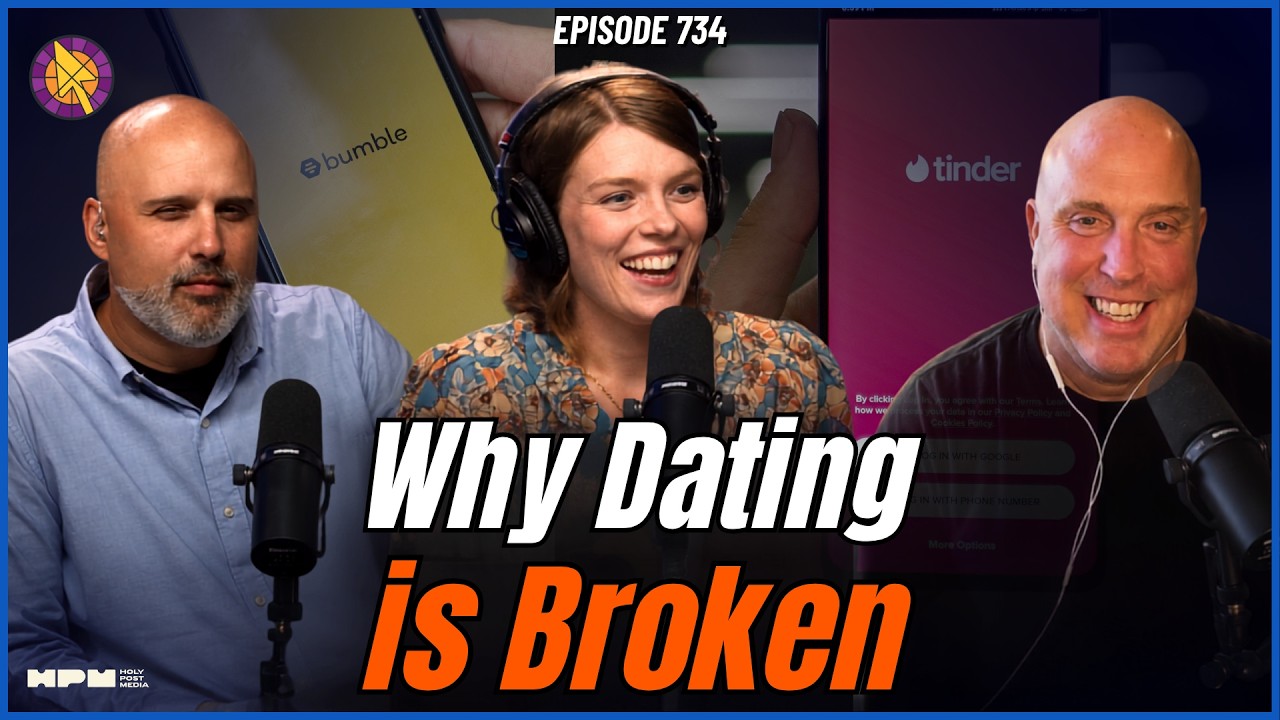
🔗 **Source:** [The Problem With Modern Dating Culture | Kelsey McGinnis | Ep 734](https://www.youtube.com/watch?v=xPqtwvyzLM8)
> [!note]+ Document Notes
> tags: [contemporary-christian-music, ai-and-intimacy, evangelical-culture, dating-culture, worship-theology, digital-formation]
> author: Holy Post Podcast — Caitlyn Schiess, Skye Jethani, Mike Erre, with Kelsey McGinnis
> source: Holy Post Podcast (Ep 734)
> reference: https://www.youtube.com/watch?v=xPqtwvyzLM8
> date created: 2026-08-22 10:40
>
> > [!info] Generated analysis — not the author's words. Sections below are machine-written
> > from the captured source. Only text inside `> [!quote]` blocks is verbatim from the author.
> > Do not quote or attribute any other line to the named author.
>
> # 🏷️ Title: The Problem With Modern Dating Culture | Kelsey McGinnis | Ep 734
>
<!-- deep-read:sections start -->
## 🧭 Table of Contents
- [📝 Summary](#-summary)
- [📖 Main Content](#-main-content)
- [🗒️ Notes](#️-notes)
- [📚 References](#-references)
- [🗣️ Paraphrase](#️-paraphrase)
- [📰 Newsletter](#-newsletter)
- [✅ Action Items](#-action-items)
- [🧪 Hypotheses](#-hypotheses)
- [📊 Methodology](#-methodology)
- [❓ Questions](#-questions)
- [🔮 Future Research](#-future-research)
- [💡 Implications](#-implications)
- [🧠 Learning Styles Assessment](#-learning-styles-assessment)
- [📊 Accessibility Assessment](#-accessibility-assessment)
- [🌍 DEIB Assessment](#-deib-assessment)
- [✅ Logical Validity](#-logical-validity)
- [🛡️ DARVO Analysis](#-darvo-analysis)
- [🎯 Conclusion](#-conclusion)
### 🔗 References
- [Episode video](https://www.youtube.com/watch?v=xPqtwvyzLM8) — Holy Post Ep 734
- Faith Hill, "Bumble Hands the First Move Back to Men" (The Atlantic) — the news hook
- Alice Lassman, "AI Will Affect Your Social Life. Yes, Yours." (New York Times)
- Christopher Jones, "American Evangelicals Long for the Embrace of the Machine God" (Mere Orthodoxy)
- Scott Galloway's work on male passivity (cited by Jethani, non-Christian source)
- The Pope's encyclical on AI (referenced repeatedly as the theological counterweight)
- Kelsey McGinnis — musicologist and Christianity Today music writer
> [!note] **The title is misleading.** It fuses two unrelated segments: the news discussion of
> dating apps, and the Kelsey McGinnis interview — which is about **contemporary Christian
> music**, not dating. McGinnis never discusses dating culture. Anyone citing this episode for
> "Kelsey McGinnis on dating" would be citing something that does not exist in it.
## 📝 Summary
- **What happened.** A four-part episode of the Holy Post, hosted by Caitlyn Schiess (standing in for Phil Vischer) with Skye Jethani and Mike Erre. Three news segments — Bumble abandoning its women-message-first policy, a NYT piece on AI quietly reshaping ordinary social life, and a Mere Orthodoxy essay on why American evangelicals are unusually AI-receptive — followed by Schiess's extended interview with musicologist Kelsey McGinnis on the current CCM resurgence (Forrest Frank, Brandon Lake), the ethics of the Christian music industry, and why congregational singing matters.
- **Why it matters.** The through-line the hosts never quite name explicitly: each segment is about **substituting a lower-friction synthetic good for a higher-friction embodied one** — dating apps for social communities, AI for relational counsel, parasocial Christian influencer content for congregational life. The Jethani "ROI" framing makes the mechanism explicit and generalizes well beyond this episode's religious context.
- **Key stakeholders.** Pastors and church leaders facing congregants who take relational advice from chatbots; parents of a cohort growing up "indigenous to AI"; Christian musicians and the CCM industry; anyone in the church-adjacent world deciding how to talk about AI.
- **Risks and tradeoffs.** The dating-apps segment is the weakest: two married middle-aged men who openly admit they've never used dating apps do most of the theorizing, with the one participant who actually used them (Schiess) frequently cut off. Several sweeping empirical claims — pornography as the primary driver of global male passivity, a "10,000 year" universal sexual contract — are asserted with no citation and are contestable. The McGinnis interview is markedly more careful and better sourced.
- **Bottom line.** Skip the dating segment for anything but its self-aware framing. The AI segments contain one genuinely portable idea (synthetic relationship as a rational-but-impoverishing value trade), and the McGinnis interview is the substantive half — a nuanced treatment of art, vocation, money, and why singing together is not replaceable.
## 📖 Main Content
- **Segment 1 — Bumble reverses course.** Bumble launched in 2014 letting only women send the first message, framed as a corrective to aggressive men. It has now dropped that rule. The stated reason: two-thirds of surveyed female users said they'd rather not have to initiate every interaction, and younger women reported both added pressure and frustration with men putting in little effort. Schiess, the only participant who used the apps, reports her bad experiences were rarely about male aggression — mostly about total passivity ("I've asked you 45 questions. You have not asked me a single question").
- **Jethani's structural critique of Bumble.** The sharpest analytic point in the segment: an app that forbids men from initiating *self-selects for men who don't want to initiate*, so the platform manufactures the passivity its female users then complain about. Whether or not the broader porn thesis holds, this design-incentive argument stands on its own.
- **Erre on masculinity formation.** His diagnosis is discipleship-shaped: the church offers no healthy, robust theology of masculinity, leaving "a Mr. Rogers view or an Andrew Tate view," and the vacuum is filled by Jordan Peterson and by Christian nationalist figures. He ties it to fathers who are present but not engaged.
- **Jethani's porn thesis, and the pushback.** He argues male passivity is global (not merely American or generational), citing Scott Galloway and Japan's fertility decline, and proposes pornography as a fundamental driver — sexual desire satiated without the social risk that historically motivated young men to develop social skill. Schiess pushes back, asking whether porn is symptom or root; Jethani concedes he'd want engaged fathers too but maintains the technology has independent force.
- **The status-inversion point (Schiess).** Underdiscussed but strong: the apps were designed on an assumption of male advantage in education, income, and power — which has partly inverted. More women hold degrees; many out-earn the men they match with; neither party has been given a relational model that survives the inversion. Women receive contradictory scripts (girl-boss self-sufficiency alongside models of masculine initiative and provision).
- **Segment 2 — "synthetic intimacy."** From Lassman's NYT piece: reliance on AI for emotional and relational life is more common than assumed, it is largely hidden (frequent AI use is treated as taboo), and it distorts intimacy even for people who never use it. Two-thirds of adolescents using chatbots reported seeking friendship or advice. Erre, who uses AI zero, frames the theological objection: the movement of the Bible is "from word to flesh," AI can handle data and information but not knowledge or wisdom, and he sees it substituting for community.
- **Jethani's ROI model.** The episode's most transferable idea: a human relationship might deliver ~98% of what you're designed to find fulfilling but demands enormous investment; AI might deliver 60–70% at ~10% of the cost. The trade is *rational on value terms and impoverishing on satisfaction terms* — which is precisely why it wins by default.
- **Schiess's counter — the collective-action frame.** She notes young people report they'd prefer everyone quit social media, suggesting the behavior isn't a revealed preference but a trap: people sense this isn't the life they want but can't unilaterally exit. She extends it to AI intimacy, reading the secrecy itself as evidence that users know they're settling.
- **Segment 3 — why evangelicals are AI-receptive.** Jones's three proposed reasons: **political** (technological progress read as positive and inevitable, coupled to pro-capitalism instincts); **theological** (a functional discounting of the body, plus a sin framework that sees only individual acts rather than systemic effects); **psychological** (a craving for certainty — "unprepared for the hard, careful work of separating truth from falsehood, evangelicals long for a computer to simply tell them what is true"). Data point cited: people attending church more than weekly report the highest confidence in AI of any group.
- **The hosts' amendments.** Jethani narrows the certainty claim to fundamentalism specifically, then argues modern American evangelicalism is above all *market-shaped* — and predicts the AI romance may end abruptly if AI is blamed for an economic collapse. He also predicts the Gospel Coalition will quietly reverse its no-AI-submissions policy. Erre self-implicates: he was trained to treat the Bible as a source of propositions rather than a wisdom document, and to see sin as private and individual — assumptions that make an arbitrating machine feel natural. Schiess raises the sharpest puzzle: why hasn't a subculture prone to conspiratorial and end-times readings turned on AI? Jethani's answer — "they're the elites we like" — with the Hobby Lobby barcode contrast as the illustration.
- **Segment 4 — the McGinnis interview on CCM.** McGinnis (musicologist; music writer for Christianity Today; third-generation church musician) defines CCM as popular-style music made by and for Christians — a niche broad enough to contain Christian hip-hop, with contemporary worship music as a subcategory. What's novel now is that this is **the first CCM generation native to social media**.
- **The Forrest Frank case.** Formerly of the successful duo Surfaces, Frank pivoted to explicitly Christian lo-fi/hip-hop pop and to Christian-influencer marketing, with unusual success — he and Brandon Lake charted on the Billboard Hot 100 simultaneously, driving a "Christian music is blowing up" narrative despite the niche holding under 5% market share. McGinnis notes the pattern is cyclical (Amy Grant in the '90s, Switchfoot in the 2000s), and that each generation frames itself as the first.
- **The Dove Awards controversy.** Frank announced he'd stop attending award shows — "this is music that is from Jesus and for Jesus. I've received my reward." The backlash had two prongs: he profits from that music anyway, and his own submission would have preceded the announcement. McGinnis's industry read is the more interesting one: to working Christian musicians it landed as *I don't need any of you* — which stung precisely because Frank, unlike Brandon Lake, arrived with a built-in secular audience and genuinely didn't need the Nashville CCM machine.
- **The vocation/Romanticism frame.** McGinnis's best analytic contribution: before the 19th century, church music was a *craft* and a vocation — Mozart wrote sacred music he didn't want to write — so questions about the artist's inner purity were largely beside the point. The Romantic conception of art as an outpouring of the artist's inner life is what makes contemporary audiences want to character-test worship songwriters, and what makes money in Christian music feel "icky."
- **The close — why singing together matters.** McGinnis on congregational singing as embodied, communal, and irreplaceable: physical (vocal cords, vibration, listening to the person beside you), emotionally capacious (lament, joy, praise, questioning), and near-unique as an art form made collectively and simultaneously. She calls the Bible "graciously vague" about what music should be, leaving a "human sandbox of sound." Schiess closes with her grandfather, who in late-stage Alzheimer's couldn't say his wife's name but could still sing the doxology.
### 🗒️ Notes
- The episode's real spine is **friction**. Dating apps removed the friction of social risk; AI removes the friction of relational vulnerability; influencer-driven Christian music removes the friction of belonging to a congregation. In each case the frictionless option is chosen, and in each case the participants suspect it is worse. Jethani's ROI framing is the general form.
- The Bumble self-selection argument deserves separating from the porn thesis it's bundled with. It's a clean incentive-design observation — a platform rule that filters for the very trait it was built to counteract — and requires no contested empirical claims.
- Erre's self-implication is the most intellectually honest moment in the news segments: rather than diagnosing other evangelicals, he traces his *own* formation (Bible as propositional truth-source, sin as private and individual) to the credulity toward AI he's critiquing. That is a materially stronger move than the essay's third-person psychologizing.
- Schiess is repeatedly the most rigorous voice and repeatedly interrupted. She raises the status-inversion point, the collective-action rebuttal, and the conspiracy-theory puzzle — three of the episode's four best ideas — and gets talked over on at least two of them. Worth noting for anyone assessing whose analysis to carry forward.
- McGinnis's craft-versus-Romantic-artist distinction reframes an argument that usually generates heat and little light. "Should Christian musicians make money" becomes tractable once you notice we're applying a 19th-century theory of artistic authenticity to a practice that was, for most of its history, a trade.
- The Frank episode is a good instance of a general pattern: someone who has already secured distribution outside an institution can defect from that institution's norms at little cost, and the defection reads as principle to outsiders and as contempt to insiders. Both readings can be accurate simultaneously.
## 📚 References
- [Holy Post Ep 734 (primary)](https://www.youtube.com/watch?v=xPqtwvyzLM8) — auto-captioned transcript; speaker attribution is inferred from context, not labelled.
- Faith Hill, The Atlantic — the Bumble reversal, including the two-thirds-of-female-users survey figure.
- Alice Lassman, New York Times — "AI Will Affect Your Social Life. Yes, Yours."; source of the synthetic-intimacy framing and the two-thirds-of-adolescents figure.
- Christopher Jones, Mere Orthodoxy — the political/theological/psychological taxonomy and the churchgoing-confidence-in-AI survey finding.
- Scott Galloway — cited for global male passivity; not read aloud, so the specific claims aren't verifiable from this episode.
- The Pope's encyclical on AI — invoked three times as the systemic-and-embodied counterweight evangelical frameworks lack; never quoted directly.
## 🗣️ Paraphrase
- Bumble built its whole identity on women making the first move, then dropped it because women got tired of doing all the work — and Jethani points out the rule guaranteed that outcome by attracting men who preferred not to initiate.
- The hosts argue young men are broadly passive, blaming some mix of absent discipleship, absent fathers, and pornography; Schiess adds the piece they underweight, which is that the educational and income assumptions the old dating script rested on have partly inverted, and nobody has been handed a replacement script.
- People are quietly taking their relational problems to chatbots, hiding it, and thereby changing intimacy even for people who never touch AI.
- Jethani's model for why: a real relationship gives you nearly everything you're built for at enormous cost; AI gives you most of the feeling at a fraction of the cost. As a value calculation it wins. As a life it doesn't.
- Evangelicals turn out to be among the most AI-trusting groups in America, which the hosts trace to market-shaped instincts, a thin theology of the body, a privatized account of sin, and an appetite for certainty that a machine appears to satisfy.
- McGinnis explains the current CCM boom as the first one native to social media, cyclical rather than unprecedented, and small in market terms despite the "Christian music is taking over" framing.
- The Forrest Frank award-show refusal read as integrity outside the industry and as *I don't need any of you* inside it — and he could afford to say it because he arrived with an audience the CCM machine didn't give him.
- Her deeper point: we only find money-in-worship-music icky because we inherited a Romantic idea that art expresses the artist's soul. Treated as a craft, as it was for centuries, the question mostly dissolves.
- She ends on congregational singing as something modern life has almost nowhere else — embodied, collective, and capable of holding grief and joy at once.
## 📰 Newsletter
- Not applicable to this source — this is a faith-and-culture podcast with no WordPress, open-source, or developer-tooling content. Nothing here fits a WordPress-focused newsletter without distortion.
## ✅ Action Items
#### DevRel
- Not applicable to this source — no developer relations, tooling, or technical-community content.
#### OSPO
- Not applicable to this source — no open-source governance, licensing, or software-inventory content.
#### Community
- Genuinely relevant in one narrow respect: the collective-action framing (people report preferring a world where everyone left the platform, yet can't unilaterally exit) is a real dynamic in *any* community where participation norms are set by tooling rather than choice. Applicable to community design well beyond the religious context.
#### WordPress
- Not applicable to this source — no WordPress content of any kind (Core, Core Performance, Core AI, Core Program Team, Mobile, Playground, Community, Training, Marketing, Support, Design, Documentation, Photos, TV, Polyglots, Accessibility, Meta, CLI, Hosting, Tide, Openverse, Themes, Plugins all N/A).
#### The WPOCC
- Not applicable to this source — no WP Open Community Collective content.
#### FAIR
- Not applicable to this source — no FAIR governance or federation content.
#### Personal / faith-and-culture (the actually relevant lane)
- The AI-and-formation material is directly usable for anyone thinking about how AI reshapes non-technical people's relational lives — a different question from AI's effect on knowledge work, and one with much less good writing about it.
- The Jones taxonomy (political / theological / psychological) is a reusable analytic frame for *any* subculture's disproportionate technology adoption, not just evangelicalism.
- The McGinnis vocation-versus-Romantic-artist distinction transfers cleanly to any argument about creative work and money.
## 🧪 Hypotheses
- H1: Dating platforms that restrict who may initiate contact self-select for users disinclined to initiate, producing measurably lower message-response and match-conversion rates over time than unrestricted platforms.
- H2: Frequency of AI use for emotional or relational advice correlates negatively with self-reported satisfaction in human relationships, even controlling for baseline loneliness.
- H3: Religious-service attendance frequency predicts confidence in AI systems — the episode cites this as an existing survey finding; the causal mechanism (certainty-seeking vs. market orientation vs. authority deference) is untested.
- H4: Christian musicians who establish audiences outside the CCM industry before entering it face lower reputational cost for defecting from industry norms than those whose audiences were built within it.
- H5: Congregational singing produces measurable social-bonding effects (synchrony, endorphin release) not produced by individually consumed worship music — testable and partly supported by existing music-cognition literature the episode doesn't cite.
### 📊 Methodology
- **What this source is:** an opinion-and-interview podcast. The news segments are three participants reacting to articles they have read, with no independent reporting. The interview is a subject-matter expert speaking within her documented specialty.
- **Evidence quality is uneven and the split is instructive.** McGinnis grounds claims in music history, industry reporting she has personally done, and explicit uncertainty flags ("I don't fully understand the process," "I don't know him, I've never talked to him," "I'm biased"). The news segments trade in unsourced universals — a "10,000 years of human civilization" sexual contract, porn as fundamental cause of a global phenomenon — offered with brief caveats ("this is going to sound really gendered") that acknowledge rather than address the problem.
- **Structural limitation on the dating segment:** the two participants doing most of the analysis state plainly they have never used dating apps and did not know what Bumble was before reading the article. The participant with direct experience is the least represented in airtime.
- **To test H1:** platform-level A/B or cross-platform comparison of initiation-restricted versus unrestricted matching, measuring first-message rates and conversion, controlling for user demographics.
### ❓ Questions
- Is the Bumble reversal actually evidence of male passivity, or evidence that the initiation-restriction was always a poor product-market fit? The hosts treat these as the same finding.
- What does Galloway's evidence actually show about causation versus correlation in global male passivity? It's invoked as authority without any of its substance.
- If churchgoers really do report the highest confidence in AI, does that survive controlling for age, region, education, and political affiliation — or is "evangelical" proxying for something else?
- Does McGinnis's Romantic-artist diagnosis predict that traditions with a stronger craft conception of church music (e.g. liturgical traditions with paid musicians) show less discomfort about money in worship music?
- What would a "robust theology of masculinity" actually contain? Erre names the vacuum precisely and offers nothing to fill it.
- Why did the episode title attribute the dating-culture topic to McGinnis, who never discusses it?
### 🔮 Future Research
- Empirical work on the collective-action hypothesis for AI intimacy specifically: do users report preferring a counterfactual world without the option, as they do for social media? That would distinguish a trap from a preference and has direct policy implications.
- A study of whether pre-Romantic craft framings of religious art measurably reduce audience demand for artist character-testing — McGinnis's hypothesis, stated but untested.
- Longitudinal tracking of the current CCM crossover against the Amy Grant and Switchfoot precedents, to test whether social-media-native distribution changes the cycle's shape or merely its speed.
### 💡 Implications
- **Practice (pastoral/community):** congregants are taking relational counsel from chatbots and concealing it. The concealment is the actionable part — it means the behavior won't surface in normal conversation and must be asked about directly.
- **Policy:** the certainty-seeking mechanism has a general form worth attending to — any group under high interpretive uncertainty is a candidate for outsourcing judgment to a system that presents as neutral. That's a risk profile, not a religious quirk.
- **Security:** not applicable to this source.
- **Education:** the ROI framing is a genuinely good teaching device for why lower-friction substitutes displace higher-value practices — applicable to reading, to learning, and to relationships alike.
- **Funding models:** McGinnis's craft-versus-inner-life distinction is directly relevant to how creative and open-source work gets compensated. The intuition that being paid contaminates sincere work rests on a specific and recent historical theory of authorship.
### 🧠 Learning Styles Assessment
- Reading level estimate: conversational, roughly Flesch-Kincaid grade 8–10. Assumes fluency with American evangelical subculture (purity culture, *I Kissed Dating Goodbye*, the Gospel Coalition, Dove Awards, CCM); a listener without that context will miss much of the shorthand.
#### 👀 Visual learners
- Present: minimal — a video recording of people talking, no graphics or visual aids.
- Improve: the three-part Jones taxonomy and the CCM generational cycle (Grant → Switchfoot → Frank) are both natural diagrams; neither is shown.
#### 🔊 Aural learners
- Present: strong — natively audio, with humor, interruption, and tonal shifts carrying real meaning that the transcript flattens.
- Improve: none needed.
#### 🗣️ Verbal learners
- Present: strong — definitions offered inline (CCM, musicologist), and McGinnis is a notably clear explainer.
- Improve: the auto-generated transcript has no speaker labels, making a four-voice conversation hard to follow in text.
#### 🧩 Kinesthetic learners
- Present: minimal — nothing to do or apply directly.
- Improve: the episode raises "how should I think about the music my church sings" without offering any concrete evaluative process.
#### 🧠 Logical learners
- Present: the Jones taxonomy is cleanly structured, and Jethani's ROI argument is genuinely a model with premises.
- Improve: the dating segment repeatedly conflates correlation and cause; a logical listener will find the porn thesis frustratingly unstructured.
#### 🧑🤝🧑 Social learners
- Present: strong — four-way conversation with real disagreement and pushback.
- Improve: the interruption pattern means one participant's arguments are systematically underdeveloped.
#### 🧘♀️ Solitary learners
- Present: self-contained for anyone with the subcultural context.
- Improve: the referenced articles are named but not linked in-episode.
#### 🌿 Naturalistic learners
- Not applicable to this source — no ecological or environmental dimension.
- Improve: not applicable.
### 📊 Accessibility Assessment
#### Screen reader semantics
- Present: YouTube's standard player and description; the transcript captured here is auto-generated captions, not a published transcript.
- Improve: no human-corrected transcript is offered, and speaker labels are absent — a significant gap for a four-person conversation.
#### Keyboard navigation
- Present: standard YouTube player, which is keyboard-operable.
- Improve: none specific to this episode.
#### Contrast and readability
- Present: not assessable from the transcript capture.
- Improve: check the live page.
#### Text resizing and reflow
- Present: standard YouTube responsive player.
- Improve: not assessable.
#### Media and captions
- Present: **auto-generated captions only.** Quality is visibly poor on proper nouns — "Sky Jatani" for Skye Jethani, "Mike Erie" for Mike Erre, "Kelsey McGinness" for McGinnis, "Whitney Wolfhurd" for Whitney Wolfe Herd, "Caleb" for K-LOVE, "Forest Frank" for Forrest Frank, "mal foration" for malformation. Any quotation drawn from these captions must be verified against the audio.
- Improve: human-corrected captions and a published transcript with speaker labels. For a podcast whose value is largely verbal argument, this is the single highest-impact accessibility fix available.
#### Forms and interactions
- Present: none beyond standard platform controls.
- Improve: not applicable.
#### Standards reference
- **WCAG 2.2 AA 1.2.2 (Captions, Prerecorded)** is only nominally met — auto-captions with systematic proper-noun errors are a weak substitute, and the guideline expects accuracy. **1.2.1** would be satisfied by a published transcript, which does not appear to exist. Speaker identification is the specific missing element.
### 🌍 DEIB Assessment
#### Cultural breadth
- Limited and US-centric by design. Japan appears as a single illustrative example of declining marriage rates, framed through a brief secondhand anecdote ("the problem is the men") that does substantial argumentative work on very thin sourcing.
- Improve: the global-phenomenon claim is central to the porn thesis and rests almost entirely on that one anecdote.
#### Inclusive language
- Present: generally careful; participants flag their own generalizations before making them.
- Improve: flagging a stereotype ("this is going to sound really gendered and stereotyped, but just go with me") acknowledges the issue without mitigating it. The 10,000-year "basic transaction" framing is presented as historical fact rather than as one contested model.
#### Neurodiversity support
- Present: clear segment structure with explicit transitions between topics.
- Improve: heavy crosstalk and frequent interruption make the audio demanding to follow; the unlabelled transcript compounds this.
#### Representation
- **The notable weakness.** A segment substantially about women's experience of dating apps is dominated by two men who have never used them, while the woman with direct experience is repeatedly interrupted — including mid-sentence during her most substantive point about educational and income inversion. The hosts are self-aware about the setup ("two married middle-aged men accompanying me") and joke about it, but self-awareness doesn't change the airtime distribution.
- Present positively: the McGinnis interview is a woman interviewing a woman about her area of expertise, with no interruption, and it is by a wide margin the best-argued part of the episode.
#### Psychological safety
- Present: warm and genuinely funny; disagreement is handled without hostility. Erre's willingness to implicate his own formation rather than diagnose others models good practice, as does McGinnis's repeated charity toward people she's critiquing.
- Improve: the interruption pattern is itself a safety issue — the participant with the most relevant lived experience gets the least uninterrupted space.
### ✅ Logical Validity
#### Strong reasoning
- **The Bumble self-selection argument is genuinely well-formed.** It identifies a mechanism (the rule filters the user pool), predicts the observed outcome (a population of passive men), and explains the reversal without needing any claim about men in general: "you've created the environment that you're fighting against." This survives independently of the surrounding speculation.
- **Jethani's ROI model is a real model.** It specifies inputs (investment cost), outputs (proportion of fulfillment), and a decision rule, and it explains why an option people acknowledge as inferior wins by default. It is falsifiable and generalizes.
- **McGinnis's Romantic-artist genealogy is the strongest single piece of reasoning in the episode.** She identifies a historical shift (craft → expression of inner life), shows what it explains (audience demand to character-test worship songwriters; the "ickiness" of money), and bounds it with counterexamples (Mozart writing sacred music he resented).
- **Erre's self-implication** is methodologically superior to the essay he's responding to: rather than psychologizing a group from outside, he traces the mechanism through his own formation.
#### Fallacies
- **Monocausal overreach on the porn thesis.** Global male passivity is a multi-causal phenomenon (economic precarity, housing costs, urbanization, delayed adulthood, changing education patterns — several of which Schiess gestures at). Elevating pornography to "one of the most fundamental pieces" is asserted, not argued, and the Japan example is invoked without addressing the extensive economic and labor-culture literature on Japanese fertility decline. **Fix:** state it as one contributing factor among several, or engage the alternative explanations directly.
- **Appeal to an invented historical universal.** The "for 10,000 years of human civilization, the basic contract has been…" framing presents one contested anthropological model as settled fact. Human societies have varied enormously in kinship structure, descent, property, and sexual norms. It's flagged as stereotyped but the flag doesn't repair the argument. **Fix:** drop the universality claim; the point about *recent* changes to a *specific* Western arrangement stands without it.
- **Generalizing from unrepresentative sampling.** Both hosts extrapolate from anecdote — "I don't know anybody who got married because some guy came up to them at a bar" — to conclusions about how dating worked generally. Their social circles are not a sample.
- **Prediction stated as insight.** Jethani's forecast that the Gospel Coalition will quietly reverse its AI policy ("I don't know any organization that's going to make that kind of position that will stick to it") is unfalsifiable as stated — no timeframe, and a quiet reversal would be hard to observe. Fine as a hunch; it's offered with more confidence than that.
- **Note the asymmetry:** essentially all of these occur in the news segments. The McGinnis interview is largely free of them, and where she's uncertain she says so.
#### Tone of voice
- Warm, jocular, self-deprecating, willing to disagree without rancor. The hosts joke about their own unsuitability for the dating topic, which is disarming but also functions to pre-empt the objection rather than answer it. The interview shifts register noticeably — slower, more careful, more evidence-bound.
### 🛡️ DARVO Analysis
- Not applicable to this source. DARVO (Deny / Attack / Reverse victim-offender) describes an accused party's response to accusation, and no participant here is defending against an accusation. The nearest adjacent dynamic is the Forrest Frank backlash discussion, but that is reported at third hand — McGinnis explicitly declines to characterize Frank's motives ("I do not know him, I've never talked to him. I'm sure he would say that was not the heart behind what he said"), which is the opposite of the attributional certainty DARVO analysis looks for.
## 🎯 Conclusion
- **Bottom line:** two episodes in one wrapper. The news segments circle a real and useful idea — that we keep trading high-friction embodied goods for low-friction synthetic ones, and that the trade is rational on value terms while being impoverishing in fact — but reach for sweeping causal claims the format can't support, and sideline the participant with the most direct knowledge. The McGinnis interview is the reason to spend time here: a careful, historically grounded account of why money and worship music feel incompatible (a Romantic inheritance, not a theological given), why the current CCM boom is cyclical rather than unprecedented, and why congregational singing does something no substitute reproduces.
- **Practical next steps:** (1) take the Bumble self-selection argument and Jethani's ROI model as the two portable ideas from the first half, and leave the porn thesis as unestablished; (2) if you work with people pastorally or in community management, note that AI-for-relational-advice is both common and deliberately concealed — it will not surface unless asked about; (3) read the Jones essay directly rather than through this summary, since the hosts substantially amend it; (4) treat McGinnis's craft-versus-inner-life distinction as the reusable idea, applicable well beyond church music to any argument about being paid for sincere work; (5) verify any quotation against the audio — the auto-captions misrender nearly every proper noun in the episode.
## 🔄 Refactor Appendix — Holy Post Ep 734
> Density: 2–5 Literature atoms (H3), 0–3 Permanent candidates (H4).
> Resonance filter applied — 4 atoms, 2 Permanent candidates.
### 📚 Literature Atoms (H3)
#### Synthetic relationship wins as value while losing as satisfaction
> [!quote] ID:rw_1
> It may not satisfy, but it's a better value. It's cheaper.
**Context & use**:
- Jethani's ROI model: a human relationship returns ~98% of designed fulfillment at enormous cost; AI returns 60–70% at ~10% of the cost.
- The episode's most portable idea, and the general form of every substitution it discusses. Applies well beyond religion or relationships.
**Tags**: #xref #aphorisms
<!-- atomicity: 1 idea ✓ -->
#### A generation will grow up indigenous to AI
> [!quote] ID:rw_2
> because there's a generation of young kids right now who are going to grow up indigenous to AI,
**Context & use**:
- Jethani's argument that current AI-use taboo is transitional, exactly as dating-app stigma was in the early 2000s.
- Useful framing for any "will this normalize" question — the taboo is evidence of novelty, not of durable resistance.
**Tags**: #xref
<!-- atomicity: 1 idea ✓ -->
#### The church offers only Mr. Rogers or Andrew Tate
> [!quote] ID:rw_3
> Uh I personally think that there is no robust theology of masculinity >> in the church that is actually healthy. And so you've got either
**Context & use**:
- Erre's diagnosis of the formation vacuum that Peterson-style and Christian-nationalist figures fill.
- He names the gap precisely and proposes nothing to fill it — the absence is itself the note-worthy part.
**Tags**: #xref #articleseed
<!-- atomicity: 1 idea ✓ -->
#### Scripture's vagueness about music is a feature
> [!quote] ID:rw_4
> And the Bible is so graciously vague about what music is supposed to be or supposed to sound like that we just get it just gets to be this
**Context & use**:
- McGinnis's closing frame: underdetermination as gift, producing a "human sandbox of sound" that can vary across times and cultures.
- A generous model for reading scriptural silence as permission rather than as a gap needing to be filled.
**Tags**: #xref #aphorisms
<!-- atomicity: 1 idea ✓ -->
### 🧠 Permanent Candidates (H4)
#### [P1] Frictionless substitutes win on value and lose on fulfillment
**Claim** (one sentence, Courtney's voice): When a cheaper substitute delivers most of the feeling of a demanding practice at a fraction of its cost, people will rationally choose it and be worse off, because the value calculation and the fulfillment it's proxying for come apart.
**Evidence pointer**: [[#rw_1]]
**Scope & conditions**: Holds where the substitute's cost advantage is large and its quality deficit is hard to perceive in the moment — AI companionship, algorithmic feeds over reading, parasocial content over community. Weakens where the deficit is immediately obvious, or where the demanding practice carries external accountability that makes defection costly.
**Links** (≥1 with annotation):
- [[AI & the Future of Knowledge Work MOC]] — because extends: the same substitution logic applied to relationships rather than to cognitive work
- [[Personal Knowledge Management MOC]] — because applies-in: the identical trade governs why frictionless capture displaces effortful synthesis
<!-- atomicity: 1 idea ✓ -->
#### [P2] Discomfort about paying artists is a Romantic inheritance, not a moral fact
**Claim** (one sentence, Courtney's voice): The sense that money contaminates sincere creative work comes from a 19th-century theory that art expresses the artist's inner life, and it dissolves when the same work is understood as a craft practised by a person with skills.
**Evidence pointer**: [[#rw_4]] — and McGinnis's Mozart example, where a resented commission produced canonical sacred music.
**Scope & conditions**: Holds wherever sincerity is treated as a precondition for the work's validity — worship music, open-source contribution, advocacy, ministry. Weakens where the work's value genuinely does depend on the maker's state (testimony, memoir, confession).
**Links** (≥1 with annotation):
- [[Open Source Governance MOC]] — because applies-in: the same intuition drives discomfort about paid open-source contribution
- [[Commons & Community Governance MOC]] — because contrasts on framing: commons work is defended as gift, which inherits the same purity assumption
<!-- atomicity: 1 idea ✓ -->
### ✏️ Fleeting Queue
- [F1] Read Christopher Jones's "American Evangelicals Long for the Embrace of the Machine God" (Mere Orthodoxy) directly — the hosts amend it substantially and the primary text is worth having. #xref
- [F2] The craft-versus-Romantic-artist distinction is a strong article seed applied to open-source contribution: why does being paid to maintain feel like it taints the maintaining? #articleseed
- [F3] Check whether the "churchgoers report highest confidence in AI" survey holds up under controls for age, education, and political affiliation — it's load-bearing for the whole third segment. #xref
- [F4] Look up the music-cognition literature on synchrony and group singing; McGinnis's embodiment claim is almost certainly supported empirically and she doesn't cite it. #xref
### → Things 3 (max 2 actions)
- [ ] Read the Mere Orthodoxy "machine God" essay and note where the hosts' amendments improve on it — reading queue #things
- [ ] Draft the craft-vs-Romantic-artist note applied to paid open-source work — writing #things
<!-- deep-read:sections end -->
📄 **Full text:** [[Full Document Contents/Articles/The Problem With Modern Dating Culture Kelsey McGinnis Ep 734.md|The Problem With Modern Dating Culture | Kelsey McGinnis | Ep 734 by Holy Post Podcast — Caitlyn Schiess, Skye Jethani, Mike Erre, with Kelsey McGinnis]]
## Highlights
- This is fine. >> Absolutely. This is very exciting. >> Yes. I'm here with Sky Jatani. >> Hi, Caitlyn. ([View Highlight](https://read.readwise.io/read/01m0p01mzc1kzfc6ns2x7dx9ka))
- Note: IGNORE — anchor-capability test artifact from processing, not a real highlight. Created only to verify highlights could anchor on this doc (word_count was None). No API delete path exists for Reader-native highlights, so this note is the cleanup. The real atom highlights follow.
- Tags: test-anchor-check
- >> Uh I personally think that there is no robust theology of masculinity >> in the church that is actually healthy. And so you've got either >> kind of a Mr. Rogers view or an Andrew Tate view. And um and neither one of those is really I think doing justice to ([View Highlight](https://read.readwise.io/read/01m0p0cnq4x0g0v2hw7spxddqe))
- Note: Erre names the formation vacuum that Peterson-style and Christian-nationalist figures fill — and proposes nothing to fill it. The absence is the noteworthy part.
- Tags: articleseed, evangelical-culture, atom/literature/h3
- because there's a generation of young kids right now who are going to grow up indigenous to AI, >> who are just going to think about it the way your generation thinks about dating apps. It's just normal. ([View Highlight](https://read.readwise.io/read/01m0p0c5fncdz9th2bv8vm5sb4))
- Note: Current AI-use taboo is transitional, exactly as dating-app stigma was in the early 2000s. Useful frame for any "will this normalize" question — taboo signals novelty, not durable resistance.
- Tags: digital-formation, atom/literature/h2
- relation and at some level you go, hey, you know what? The calculus works out >> and it's a better value. >> It may not satisfy, but it's a better value. It's cheaper. ([View Highlight](https://read.readwise.io/read/01m0p0bv9krpgqc276mr7wcbkc))
- Note: Jethani's ROI model — the episode's most portable idea. A human relationship returns ~98% of designed fulfillment at enormous cost; AI returns 60-70% at ~10% of the cost. Rational as value, impoverishing as life.
- Tags: ai-and-intimacy, aphorisms, atom/literature/h1
- in that way. >> It's such a gift. And the Bible is so graciously vague about what music is supposed to be or supposed to sound like that we just get it just gets to be this ([View Highlight](https://read.readwise.io/read/01m0p0d08sn2asq3fy2zj3vc81))
- Note: McGinnis's closing frame — scriptural underdetermination as gift, producing a "human sandbox of sound." A generous model for reading silence as permission rather than gap.
- Tags: worship-theology, atom/literature/h4, aphorisms