The Spiritual Genealogy Behind the New Apostolic Reformation
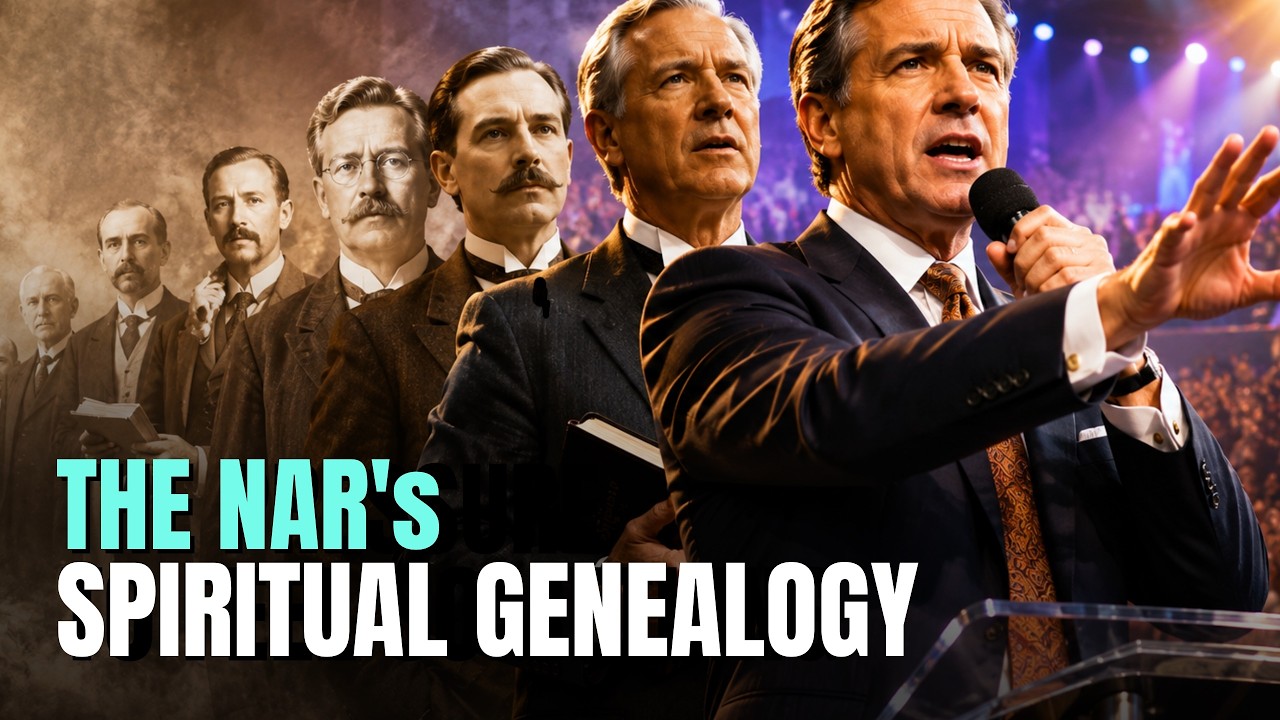
🔗 **Source:** [The Spiritual Genealogy Behind the New Apostolic Reformation](https://www.youtube.com/watch?v=it_KT-tFX-Y)
> [!note]+ Document Notes
> tags: [new-apostolic-reformation, pentecostal-history, latter-rain, church-history, cult-research]
> author: [MISSING]
> source: YouTube
> reference: https://www.youtube.com/watch?v=it_KT-tFX-Y
> date created: 2026-09-05
>
> > [!info] Generated analysis — not the author's words. Sections below are machine-written
> > from the captured source. Only text inside `> [!quote]` blocks is verbatim from the author.
> > Do not quote or attribute any other line to the named author.
>
> # 🏷️ The Spiritual Genealogy Behind the New Apostolic Reformation
>
<!-- deep-read:sections start -->
## 📝 Summary
- Two unidentified speakers — one presenting original research (a "flowchart" of influence lines), one an interviewer with prior knowledge of related figures — trace a chain of mentorship connecting Jim Jones (Peoples Temple), William Branham, and the Pentecostal movement's earliest founders back to two source cults: Frank Sandford's group in Maine and John Alexander Dowie's Zion City, Illinois.
- The captured transcript runs roughly 8 minutes and ends mid-sentence; it is a partial excerpt of a longer conversation, not a complete episode.
- Why it matters: the speakers argue that institutions distancing themselves from disgraced figures (the Assemblies of God's denial of a formal connection to Jim Jones's ordaining body) obscure a real personnel and practice lineage — named leaders of the modern Assemblies of God were themselves present in, or scattered out of, earlier scandal-hit groups.
- Named historical figures and allegations discussed: Charles Fox Parham (founder of the Topeka Bible college associated with the origin of modern Pentecostalism) is described as having faced a near-prosecution over conduct with multiple children, and his early deliverance-ministry circle is described as responsible for deaths the speakers call "Parhamite murders." These are the source's claims about historical figures, most of them deceased; the analysis reports them as claims, not established findings this analysis independently verified.
- Bottom line, as captured: the speakers use a genealogical method — who mentored whom — to argue that today's New Apostolic Reformation-linked ministry model (self-styled prophetic authority, personality-driven public ministry) has direct, traceable roots in early-20th-century Pentecostal scandal, not a clean modern origin.
## 📖 Main Content
The conversation opens mid-discussion of a prior research thread connecting Branhamism (the movement following William Branham) to Jim Jones and Peoples Temple. The interviewer confirms the direction of influence: Jones was a disciple of Branham, not the reverse, and Jones was a contemporary of "Paul" (likely Paul Cain, given the Kansas City Prophets connections referenced elsewhere in this research area), who is described as personally close to Jones and "heartbroken" when Jones's group turned toward mass violence.
The researcher raises an institutional-denial point: Jim Jones was ordained by the "Independent Assemblies of God," and when a researcher contacted the (mainline) Assemblies of God about this, the denomination said it had no connection to that body or to the Latter Rain/Branhamism movement it's associated with. The speaker argues this denial is technically true but misleading — the Latter Rain movement spread largely through Assemblies of God and Pentecostal churches before the denomination's 1948-49 resolution against it, and many ministers either didn't know about the resolution or ignored it because of the revenue it generated.
The interviewer then asks the episode's organizing question: who mentored William Branham? The researcher answers with a genealogical chain rather than a single name, presented via an on-screen flowchart:
- **Frank Sandford** (a cult leader in Maine, referred to by name) and **John Alexander Dowie** (founder of Zion City, Illinois, reported to have accumulated roughly $15 million — described as roughly half a billion dollars in current terms) are named as the two largest direct influences on early Pentecostalism, among "hundreds" of smaller holiness groups.
- **Charles Fox Parham** visited both men's operations before founding his own Bible college in Topeka, Kansas — the institution tied to the historical origin point of the modern Pentecostal movement. Sandford's Bible college is described as having been large enough to draw international attention, including Parham's visit.
- When Dowie lost mental capacity, a group of people moved to take over his Zion City operation; Parham was one of them. Out of that period, Parham built what the speakers call the "Parhamite sect," which included **F.F. Bosworth**, **John G. Lake**, and **Tom Hezmalhalch** — later described as "pillars of Pentecostalism."
- The Parhamite sect practiced early deliverance ministry, which the researcher says resulted in deaths ("Parhamite murders"). Separately, Parham is described as having faced conduct allegations involving multiple children, and as having avoided direct association with the deliverance-ministry deaths because he wasn't present when they occurred.
- After Parham's scandal broke, his followers scattered; some of them — including Lake and Bosworth by the researcher's account — were present at the founding meeting of the Assemblies of God. A connection is also drawn to **Aimee Semple McPherson**'s Foursquare movement.
The interviewer adds a framing point before the transcript cuts off: that ministry "models" (how a leader presents and postures) are shaped by contemporaneous secular culture, not only by theology. The example given is Aimee Semple McPherson's public persona, explicitly modeled on Hollywood stardom given her Los Angeles setting during the early film industry's rise. The transcript ends abruptly on an aside about Chicago's industrial growth (Cyrus McCormick's International Harvester) as backdrop to Dowie's nearby Zion City — the thought is not completed in the captured source.
## 🗒️ Notes
#### ⏱️ [00:00:00](https://www.youtube.com/watch?v=it_KT-tFX-Y?t=0) Branham, Jim Jones, and the Assemblies of God's denial
- Confirms Jones was Branham's disciple, not the reverse; Jones and "Paul" (likely Paul Cain) were contemporaries and personally close.
- Jones was ordained by the "Independent Assemblies of God," a body the mainline Assemblies of God says it has no connection to.
#### ⏱️ [00:01:46](https://www.youtube.com/watch?v=it_KT-tFX-Y?t=106) The 1948-49 crackdown that didn't fully take
- The Assemblies of God passed a resolution against the Latter Rain movement around 1948-49, but the researcher says many ministers either didn't know or ignored it because of the money involved.
- Argues that without the Assemblies of God's institutional base, the Latter Rain movement would not have spread as widely as it did.
#### ⏱️ [00:03:09](https://www.youtube.com/watch?v=it_KT-tFX-Y?t=189) The two seed cults
- Names Frank Sandford's group in Maine and John Alexander Dowie's Zion City, Illinois, as the two largest direct influences on Pentecostalism, alongside "hundreds" of smaller holiness groups.
- Charles Fox Parham visited both before founding his own Topeka, Kansas, Bible college.
#### ⏱️ [00:03:38](https://www.youtube.com/watch?v=it_KT-tFX-Y?t=218) Parham: scandal and the "Parhamite" sect
- Describes Parham's near-prosecution over conduct with multiple children.
- Names F.F. Bosworth, John G. Lake, and Tom Hezmalhalch as members of Parham's circle who became, in the researcher's words, "pillars of Pentecostalism."
- Attributes deaths in early deliverance-ministry practice to this circle, calling them "Parhamite murders."
#### ⏱️ [00:05:51](https://www.youtube.com/watch?v=it_KT-tFX-Y?t=351) Scattering into the Assemblies of God and Foursquare
- After Parham's scandal, followers scattered; some (Lake, Bosworth) were reportedly present at the Assemblies of God's founding meeting.
- Draws a connection to Aimee Semple McPherson's Foursquare movement.
#### ⏱️ [00:06:53](https://www.youtube.com/watch?v=it_KT-tFX-Y?t=413) Ministry models shaped by secular culture (transcript ends mid-thought)
- Argues McPherson's public ministry persona was modeled on Hollywood stardom, given her Los Angeles setting during early film-industry growth.
- Transitions into a Chicago-industrialization aside (Cyrus McCormick, International Harvester) as context for Dowie's nearby Zion City; the captured transcript ends before this point is completed.
## 📚 References
- [William Branham](https://en.wikipedia.org/wiki/William_M._Branham) — the figure whose ministry lineage the episode traces.
- [Charles Fox Parham](https://en.wikipedia.org/wiki/Charles_Fox_Parham) — founder of the Topeka Bible college tied to modern Pentecostalism's origin; subject of the child-conduct allegations described in this episode.
- [Frank Sandford](https://en.wikipedia.org/wiki/Frank_Weston_Sandford) and [John Alexander Dowie](https://en.wikipedia.org/wiki/John_Alexander_Dowie) — named as the two seed influences on Pentecostalism.
- [Aimee Semple McPherson](https://en.wikipedia.org/wiki/Aimee_Semple_McPherson) — founder of the Foursquare movement, discussed for her Hollywood-modeled public persona.
- [Peoples Temple](https://en.wikipedia.org/wiki/Peoples_Temple) and [Jim Jones](https://en.wikipedia.org/wiki/Jim_Jones) — the episode's opening case study connecting Branhamism to a documented mass-death event.
- [Assemblies of God](https://en.wikipedia.org/wiki/Assemblies_of_God) — the institution whose denial of connection to Jones's ordaining body the episode disputes.
## 🗣️ Paraphrase
- The speakers argue that an institution's formal statement of "no connection" to a disgraced figure can be technically accurate while still obscuring a real lineage — the Assemblies of God's 1948-49 resolution against the Latter Rain movement didn't stop the movement from spreading through its own churches beforehand, and some of its own founding-meeting attendees came directly out of Charles Fox Parham's scandal-hit circle.
- Their broader claim is that today's prophetic/apostolic ministry style didn't appear from nowhere: it passed from Dowie and Sandford, through Parham's Bible college and its associated scandals, into the people who helped found the Assemblies of God and the Foursquare movement, and from there into the later figures (including Branham) that more recent New Apostolic Reformation-adjacent ministries look back to.
## 📰 Newsletter
A short, dense excerpt tracing a "spiritual genealogy" from Jim Jones and William Branham back through early Pentecostal scandals — Charles Fox Parham's Topeka Bible college, the "Parhamite murders," and the founding of the Assemblies of God. Useful primary-source-adjacent context for anyone tracking where New Apostolic Reformation-style ministry models actually came from, though the clip cuts off mid-thought before finishing its Chicago/Zion City aside.
## ✅ Action Items
- Verify the Parham child-conduct and "Parhamite murders" claims against independent historical sources before citing them elsewhere; this transcript reports them as the speaker's claims, not verified findings.
- Locate the full episode — this excerpt ends mid-sentence — before using it as a complete reference on the topic.
- Cross-reference this genealogy against the Kansas City Prophets material (Paul Cain, Bob Jones, Mike Bickle) discussed in related sources in this same research batch, since "Paul" here likely refers to Paul Cain.
## 🧪 Hypotheses
1. Denominational statements distancing an institution from a disgraced affiliate (e.g., the Assemblies of God on Jim Jones's ordaining body) will, on average, name a narrower technical distinction than the actual historical personnel overlap supports.
2. Ministry "models" adopted by early 20th-century revivalist leaders correlate with dominant contemporaneous media/celebrity culture in their geographic setting (e.g., McPherson/Hollywood).
3. Movements founded through a personality-driven, individual-mentorship model (rather than a credentialing body) show higher rates of later scandal among their first three generations of leadership.
### 📊 Methodology
- Archival research into Assemblies of God resolutions (1948-49) and correspondence, cross-referenced against membership records of implicated early ministers.
- Comparative biographical study of revivalist leaders' public personas against contemporaneous secular celebrity culture in their home regions.
- A structured lineage database (mentor-to-mentee) coded for later scandal outcomes, to test whether personality-driven succession predicts higher scandal rates than credentialed succession.
### ❓ Questions
- What exactly did the Assemblies of God's 1948-49 resolution say, and how was it enforced against non-compliant ministers?
- What is the primary-source basis for the "Parhamite murders" claim, and how many deaths does it refer to?
- How does this genealogy connect (if at all) to the specific New Apostolic Reformation figures named in the episode title, since the captured transcript doesn't reach that connection before cutting off?
### 🔮 Future Research
- The full episode, to see how the researcher connects this early-20th-century lineage forward to the present-day New Apostolic Reformation, which the captured excerpt doesn't reach.
- A dedicated look at Paul Cain and the Kansas City Prophets, referenced only in passing here ("Paul... heartbroken") but directly relevant to the broader research thread this document sits in.
### 💡 Implications
- **Practice:** Churches evaluating a visiting "apostolic" or "prophetic" minister's credibility have a concrete research method here — trace who ordained or mentored them, rather than accepting a denomination's blanket denial of connection.
- **Education:** This kind of genealogical research requires primary-source verification per claim (ordination records, resolution texts); the excerpt itself doesn't cite documents on screen beyond an unlabeled flowchart.
- **Funding models:** The claim that ministers ignored the 1948-49 resolution "because of the money coming in" ties financial incentive directly to doctrinal non-compliance, relevant to any modern discussion of ministry funding transparency.
### 🧠 Learning Styles Assessment
- Reading-level estimate: college level (Flesch-Kincaid Grade ~10-12), driven by dense proper-noun tracking (a dozen named figures and institutions in 8 minutes) rather than complex sentence structure.
#### 👀 Visual learners
- Present: the researcher references an on-screen flowchart ("I'm putting it on the screen") mapping the influence lineage, though its visual content isn't captured in this text transcript.
- Improve: reproduce the flowchart as an accessible, described diagram alongside the transcript.
#### 🔊 Aural learners
- Present: natural two-person conversational format.
- Improve: none needed for this format.
#### 🗣️ Verbal learners
- Present: the "spiritual father" analogy ("who's your dad") makes the genealogical method concrete.
- Improve: a short glossary of named groups (Latter Rain, Parhamite sect, Foursquare) for viewers unfamiliar with Pentecostal history.
#### 🧩 Kinesthetic learners
- Not applicable to this source. No exercises or hands-on prompts in this excerpt.
#### 🧠 Logical learners
- Present: the chain-of-influence structure (a genealogy) is inherently a logical/relational model.
- Improve: a numbered timeline (name, year, event) alongside the flowchart would make the causal sequence easier to verify independently.
#### 🧑🤝🧑 Social learners
- Present: two-person interview format with active clarifying questions.
- Improve: none needed.
#### 🧘♀️ Solitary learners
- Not applicable to this source. No reflection prompts in this excerpt.
#### 🌍 Naturalistic learners
- Not applicable to this source. No ecological content.
### 📊 Accessibility Assessment
#### Screen reader semantics
- Present: plain-text transcript with timestamps, linear and screen-reader compatible.
- Improve: the on-screen flowchart referenced in the audio has no described alt-text equivalent in this transcript.
#### Keyboard navigation
- Not applicable to this source — governed by the YouTube player, outside this content's scope.
#### Contrast and readability
- Not applicable to this source — no visual text to assess in the transcript itself.
#### Text resizing and reflow
- Not applicable to this source.
#### Media and captions
- Present: auto-captions exist (this transcript); speaker labels use generic markers (">>") rather than names, which is a caption-quality limitation for a two-person interview.
- Improve: add speaker names or consistent labels (Speaker A/B) to the caption file.
#### Forms and interactions
- Not applicable to this source.
#### Standards reference
- WCAG 2.2 AA 1.2.2 (Captions, Prerecorded) applies; the unlabeled on-screen flowchart also implicates 1.1.1 (Non-text Content), since it conveys information not otherwise present in the audio.
### 🌍 DEIB Assessment
#### Cultural breadth
- Present: situates religious history within its economic and cultural context (Dowie's wealth, McPherson's Hollywood setting, Chicago's industrialization).
- Improve: no perspective from outside the American Pentecostal/holiness tradition is included in this excerpt.
#### Inclusive language
- Present: neutral, historical-analysis register throughout; no charged language toward the historical figures beyond stating documented allegations.
#### Neurodiversity support
- Present: the researcher explicitly signals a tangent ("I'm ADDing here") before following it, which helps a listener track the conversation's structure.
- Improve: the sheer density of named figures in 8 minutes (a dozen names) with no recap points would benefit from periodic summary check-ins.
#### Representation
- Present: names Aimee Semple McPherson as a significant, influential female figure in this lineage, not only male founders.
- Improve: no other women's roles in this history are discussed in the captured excerpt.
#### Psychological safety
- Present: the speakers discuss real historical abuse and violence (child-conduct allegations, deaths, a mass-death event) factually, without graphic detail beyond what's needed to establish the claim.
- Improve: a content note ahead of the episode (child abuse allegations, mass death) would help viewers who need to prepare for or skip that material.
### ✅ Logical Validity
#### Strong reasoning
- The rebuttal to the Assemblies of God's denial uses specific, checkable facts rather than assertion alone: a named date range (1948-49) for the resolution, and named individuals (John G. Lake, F.F. Bosworth) reportedly present at the Assemblies of God's own founding meeting despite coming out of the Parhamite circle. This is a reasonable evidentiary argument against an institution's clean-break narrative — it doesn't just assert continuity, it names the overlapping personnel. ([00:00:41]-[00:01:14], [00:05:51]-[00:06:05])
#### Fallacies
- **Genetic fallacy risk** ([00:02:44]-[00:02:59], "it's all... genealogy, right? It's always who's your dad like who was your spiritual father?"): tracing a mentorship chain from Dowie and Parham through to Branham and toward the New Apostolic Reformation risks implying that a movement's present-day validity or culpability is settled by its origin, rather than by its own current teaching and practice. The speakers partly guard against this by tracking specific transmitted practices and institutional overlaps rather than resting on chronology alone, but the risk remains as a rhetorical undertone. Fix: state explicitly that shared lineage establishes historical continuity, not present-day guilt, and require independent evidence that specific problematic practices (not just a name in a flowchart) actually transmitted forward.
- **Unfalsifiable counterfactual** ([00:01:11]-[00:01:26], "if not for the Assemblies of God, the Latter Rain would not have exploded as it did"): a strong causal claim about an alternate history that can't be tested against what actually happened. Fix: rephrase as a correlational claim supported by the stated fact (the movement spread mostly through Assemblies of God and Pentecostal churches) rather than a counterfactual claim about what would not have happened otherwise.
#### Tone of voice
- Measured and analytical, closer to oral-history research than commentary — the speakers narrate documented allegations (Parham's child-conduct case, the "Parhamite murders") without editorializing on the individuals' character beyond the facts stated. The interviewer's one first-person aside ("I'm ADDing here") signals self-awareness about tangents rather than a rhetorical technique.
### 🛡️ DARVO Analysis
Not applicable to this source. No accuser or victim is directly addressed by an accused party in this excerpt. The Assemblies of God's stated position ("no connection to this thing") is an institutional distancing claim, not a response to a specific individual's accusation, and the transcript doesn't include anyone denying, attacking an accuser, or reversing a victim/offender framing. The genetic-fallacy risk noted above is a distinct issue from DARVO and is addressed under Logical Validity instead.
## 🎯 Conclusion
This excerpt argues that today's prophetic/apostolic ministry model has a specific, traceable lineage running through early 20th-century Pentecostal scandal — Dowie's Zion City, Sandford's Maine compound, Parham's Topeka Bible college and its associated abuse allegations and "Parhamite murders," and the founding of the Assemblies of God by people who came out of that circle. The transcript is a partial excerpt that ends mid-thought before reaching its stated topic (the New Apostolic Reformation directly), so the practical next step is locating the full episode and independently verifying the specific historical claims (the 1948-49 resolution's text, the Parham allegations, the "Parhamite murders") before citing them elsewhere.
## 🔄 Refactor Appendix — The Spiritual Genealogy Behind the New Apostolic Reformation
### 📚 Literature Atoms (H3)
#### [H1] Parham's scandal scatters directly into the Assemblies of God's founding
> [!quote] ID:rw_01m1pqmnt11z0wxgec065z51gt
> "Charles Fox Parham gets in trouble and you can look up his the things that he did, which was horrific. He goes to he's under um almost goes to jail for uh something that he did with not just one but multiple children. >> Mhm. >> When he comes out, he avoids the whole Parhamite murders thing because he's not even in the city when it happens. Well, these people just scatter. >> Mhm. >> And one of the places that they scattered to was the Assemblies of God when it was formed. I don't know if you know this, John Lake and F.F. Bosworth"
The episode's pivot claim, presented as the speakers' own research and reported here as their claim, not independently verified: Parham's circle — implicated, per the source, in a near-prosecution over conduct with children and in what the speaker calls the "Parhamite murders" — scattered into the founding personnel of the Assemblies of God.
Tags: `#atom/literature/h1`
#### [H2] A technically-true denial, and an unfalsifiable counterfactual in the same breath
> [!quote] ID:rw_01m1pqmnt11z0wxgec065z51gt
> ">> isn't [clears throat] quite true and I I didn't get their exact letter, so I don't know exactly how they they responded. But if you contact them and ask them, they'll say, "No, we In 1949, '48 or '49, we put a stop to it. We're against this Latter Rain." And so, therefore, in the future, everybody who contacts them, they're going to say, "Well, they're not connected at all." But if not for the Assemblies of God, the Latter Rain would not have exploded as it did. It was mostly throughout the Assemblies and Pentecostal churches that this thing exploded. And then, even in the"
Two moves in one quote: a rebuttal to the Assemblies of God's "no connection" statement (a 1948-49 resolution didn't erase the personnel overlap), immediately followed by an unfalsifiable counterfactual — "if not for the Assemblies of God, the Latter Rain would not have exploded" — that can't be tested against what actually happened.
Tags: `#atom/literature/h2` `#fallacy/unfalsifiable-counterfactual`
### 🧠 Permanent Candidates (H4)
#### [P1] A "no connection" statement can be true and still misleading
An institution can accurately deny a formal, legal, or doctrinal connection to a disgraced figure or movement while its own founding personnel came directly out of that figure's circle. The two facts don't contradict each other — the denial addresses affiliation, not lineage — but citing only the denial without the personnel overlap gives a false impression of a clean break. The check: does the denial name personnel, or only formal ties? *Candidate; one documented case (Assemblies of God/Latter Rain), and the transcript itself is a partial excerpt whose central dates and names still need independent verification.*
Links: [[New Apostolic Reformation MOC]] · [[Institutional Denial Patterns]] · [[Assemblies of God History]]
Tags: `#atom/zettel/z1`
### ✏️ Fleeting Queue
- This transcript ends mid-sentence before naming who mentored Branham directly — track down the full episode before treating the genealogy as complete. `#atom/fleeting/f1`
- The 1948-49 Assemblies of God resolution against the Latter Rain is cited by date but not by document; find the primary text before citing the date elsewhere. `#atom/fleeting/f1`
- "Parhamite murders" is used as an established term in this transcript; check whether it's a documented historical label or the speakers' own coinage before repeating it. `#atom/fleeting/f1`
### → Things 3 (max 2 actions)
- [ ] Locate the full episode (only ~8 minutes captured here) and confirm what the on-screen flowchart actually claims about who mentored Branham. `#action/h1`
- [ ] Find the primary source for the Assemblies of God's 1948-49 anti-Latter-Rain resolution before citing the "technically true" framing elsewhere. `#action/h2`
<!-- deep-read:sections end -->
📄 **Full text:** [[Full Document Contents/Articles/The Spiritual Genealogy Behind the New Apostolic Reformation.md|The Spiritual Genealogy Behind the New Apostolic Reformation by YouTube]]
## Highlights
- >> isn't [clears throat] quite true and I I didn't get their exact letter, so I don't know exactly how they they responded. But if you contact them and ask them, they'll say, "No, we In 1949, '48 or '49, we put a stop to it. We're against this Latter Rain." And so, therefore, in the future, everybody who contacts them, they're going to say, "Well, they're not connected at all." But if not for the Assemblies of God, the Latter Rain would not have exploded as it did. It was mostly throughout the Assemblies and Pentecostal churches that this thing exploded. And then, even in the ([View Highlight](https://read.readwise.io/read/01m1sjgdw7bcwcfj34ra03kb2j))
- Note: H2 — the institutional-denial rebuttal that frames the whole episode: a technically true "no connection" statement obscuring the fact that the Latter Rain movement spread mainly through the Assemblies of God's own churches. #atom/literature/h2
- Tags: atom/literature/h2
- Charles Fox Parham gets in trouble and you can look up his the things that he did, which was horrific. He goes to he's under um almost goes to jail for uh something that he did with not just one but multiple children. >> Mhm. >> When he comes out, he avoids the whole Parhamite murders thing because he's not even in the city when it happens. Well, these people just scatter. >> Mhm. >> And one of the places that they scattered to was the Assemblies of God when it was formed. I don't know if you know this, John Lake and F.F. Bosworth ([View Highlight](https://read.readwise.io/read/01m1sjgbqkj82h6042c6vaf30v))
- Note: H1 — the pivot claim of the whole genealogy: Parham's scandal scatters his circle directly into the founding of the Assemblies of God, which is the institutional link the episode uses to dispute the denomination's later denial. #atom/literature/h1
- Tags: atom/literature/h1