These FREE Tools Feel Illegal for Researchers to Use
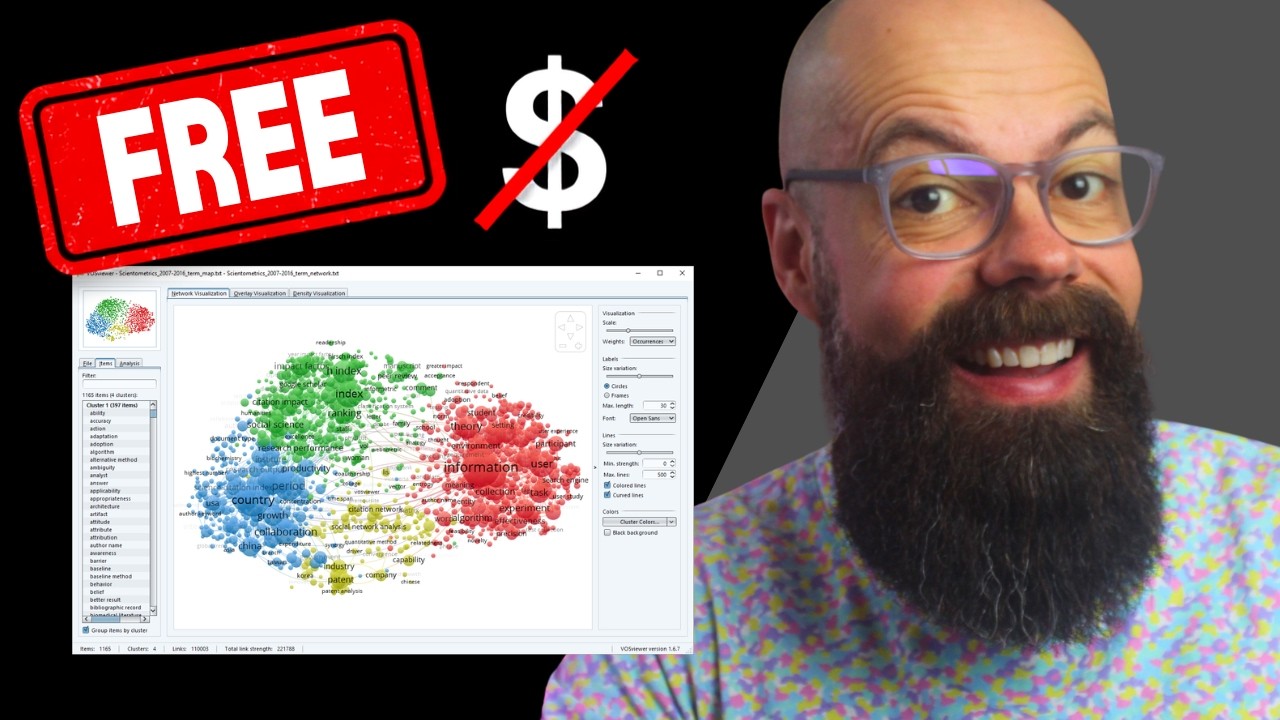
🔗 **Source:** [These FREE Tools Feel Illegal for Researchers to Use](https://www.youtube.com/watch?v=7PKZvNq4M-Q)
> [!note]+ Document Notes
> tags: [academic-research-tools, bibliometric-mapping, ai-research-assistants, open-source-software, literature-review, citation-analysis]
> author: Andy Stapleton
> source: Andy Stapleton (YouTube)
> reference: https://www.youtube.com/watch?v=7PKZvNq4M-Q
> date created: {{date:YYYY-MM-DD}} {{time:HH:mm}}
>
> # 🏷️ Title: These FREE Tools Feel Illegal for Researchers to Use
>
<!-- deep-read:sections start -->
## 🧭 Table of Contents
- [📝 Summary](#-summary)
- [📖 Main Content](#-main-content)
- [🗒️ Notes](#️-notes)
- [📚 References](#-references)
- [🗣️ Paraphrase](#️-paraphrase)
- [📰 Newsletter](#-newsletter)
- [✅ Action Items](#-action-items)
- [🧪 Hypotheses](#-hypotheses)
- [📊 Methodology](#-methodology)
- [❓ Questions](#-questions)
- [🔮 Future Research](#-future-research)
- [💡 Implications](#-implications)
- [🧠 Learning Styles Assessment](#-learning-styles-assessment)
- [📊 Accessibility Assessment](#-accessibility-assessment)
- [🌍 DEIB Assessment](#-deib-assessment)
- [✅ Logical Validity](#-logical-validity)
- [🛡️ DARVO Analysis](#-darvo-analysis)
- [🎯 Conclusion](#-conclusion)
## 📝 Summary
- Andy Stapleton (an academic-YouTube creator focused on grad school/research productivity) runs through five free/open-source research tools plus three "honorable mention" tools, positioning them as replacements for expensive commercial research software.
- Core chain demonstrated: OpenAlex (free scholarly database + free API key) feeds bibliographic data into VOSviewer (free desktop app) to generate bibliometric network maps — visualizing citation/co-authorship/keyword connections across a research field, spotting gaps and outlier concepts.
- Also covered: Asta (branded "Aster" in the video, at allenai.org via a.allen.ai) — a free AI research assistant from Allen Institute for AI that finds papers, drafts literature-review-style reports, and can analyze uploaded datasets; ResearchRabbit — free citation-network exploration tool (unlimited searches, 50 inputs, one project on the free tier); Global Research Space (globalresearchspace.com) — an interactive, zoomable semantic map of global research fields.
- Honorable mentions: Quarto (open-source scientific publishing system for websites/articles/books), jamovi and JASP (free open-source statistics packages, alternatives to SPSS).
- Why it matters: framed for cost-constrained researchers (grad students, academics) who can't afford or don't have institutional access to paid bibliometric/AI research tools (e.g., Scopus, Web of Science, paid literature-review AI products).
- Risks/tradeoffs: the presenter's own hands-on demo surfaces real friction (confusing "request URL" step in VOSviewer, uncertain output correctness — "not sure how functional it is" re: Global Research Space) and no rigorous evaluation of result quality/accuracy across tools; claims like "75 perfectly relevant papers" are quoted from the tool's own UI language, not independently verified by the presenter.
- Bottom line: a practical, tutorial-style roundup of free research-workflow tools with a live walkthrough of the OpenAlex→VOSviewer pipeline; useful as a starting toolkit list but not a rigorous comparative evaluation.
## 📖 Main Content
- The video is structured as a sequential tool tour, each introduced with the promise "free" and (for most) "open source," building against an implied contrast with paid research-software subscriptions (Scopus, Web of Science, paid AI literature tools) that the presenter never names directly but clearly references ("expensive," "a lot of other tools actually charge you money to do").
- **OpenAlex + VOSviewer (bibliometric mapping)**: OpenAlex is described as a free scholarly-metadata database (not the tool itself); VOSviewer is presented as the actual payoff — a desktop application (Mac/Windows/other) that ingests bibliographic data and renders a network visualization of a research field (nodes = papers/authors/keywords, edges = citation or co-occurrence links). Two data-import paths are demonstrated:
1. From Zotero: export the whole Zotero library as an RIS file (File → Export Library → RIS), then in VOSviewer choose Create → "map based on bibliographic data" → read from RIS/RefWorks → point at the exported file.
2. From OpenAlex directly (for those without an existing Zotero library): VOSviewer's "download data through API" option supports OpenAlex/Crossref; this requires generating a free OpenAlex API key (Account → Settings → API key → copy) and constructing a "request URL" by running a search on the OpenAlex website itself and copying the resulting URL/query string into VOSviewer.
- Once processed, VOSviewer renders the full network map — the presenter describes using it to "zoom in and find research gaps," discover unfamiliar adjacent concepts, and spot disconnected outlier papers.
- **Asta / "Aster" (allenai.org, referred to on-screen as a.allen.ai)**: A free AI research assistant from the Allen Institute for AI. Capabilities shown: semantic paper search, an "ask a scientific question" report-generation mode (literature-review-like), and a dataset-analysis mode (upload data, describe key columns, ask questions). Demo query "OPV devices" (organic photovoltaic devices) returns a UI message "Found 75 perfectly relevant papers" — the presenter treats this claim with visible skepticism/mockery ("perfectly relevant... I don't know why that sounds so bad") while still endorsing the tool overall. Results can be filtered/sorted and exported as citations into a reference manager (e.g., Zotero). Emphasized selling point: no pricing page, no signup requirement to access core features.
- **ResearchRabbit**: A citation-network exploration tool the presenter says he's covered before on the channel. Free tier: unlimited searches, 50 inputs, basic search settings, one project. Workflow: search a keyword/title, then explore "similar articles," "all the references," or "what has cited" a given paper to expand outward through a citation graph.
- **Global Research Space (globalresearchspace.com)**: An interactive, zoomable, semantically-organized map of global research fields/topics (e.g., "advanced material synthesis," "computational... functional composite materials," "stimuli," "actuators," "hydrogel," "electrochemistry," "perovskite solar cells," "quantum dot... nanocrystal optoelectronics"). Clicking into a node surfaces manuscript details, DOI, open-access PDF link where available, and a link out to OpenAlex. The presenter flags this one as possibly "a time sync" and admits uncertainty about "how functional it is," while still calling it "a really nice way for free" to explore adjacent research areas.
- **Honorable mentions** (each covered briefly, no live demo):
- Quarto — open-source scientific/technical publishing system for websites, blogs, dashboards, articles, presentations, books, and reports.
- jamovi — free, open-source statistics software with R integration, positioned as staying "always free and open."
- JASP — free, open-source statistics software, described as "friendly" and "intuitive."
- Throughout, the presenter's framing device is repeatedly noting the absence of a pricing page or paywall as the strongest evidence a tool is genuinely free ("there is no payment button... Brilliant").
### 🗒️ Notes
#### ⏱️ [00:00](https://www.youtube.com/watch?v=7PKZvNq4M-Q&t=0) Intro: free vs. paid research tools
- Opens by naming the pain point directly: it "seems like right now it's so expensive to use tools for research," then pivots to promise free/open-source alternatives.
- Sets up OpenAlex as the entry point but immediately reframes it as *not* the main tool — VOSviewer is.
#### ⏱️ [00:11](https://www.youtube.com/watch?v=7PKZvNq4M-Q&t=11) OpenAlex + VOSviewer bibliometric mapping
- Shows a fully rendered VOSviewer network map of his own research field as the payoff visual before explaining setup.
- Quote: "I can zoom in and find research gaps. I can find new concepts that I've never really heard of before."
- Two on-ramps demonstrated: (1) Zotero library → export RIS → VOSviewer "read from RIS/RefWorks"; (2) OpenAlex API key → build a request URL by copying the search-results URL from openalex.org → paste into VOSviewer's "download data through API" flow.
- Explicitly calls out the request-URL step as "a little bit confusing."
- Demo search term: "transparent electrodes."
#### ⏱️ [04:12](https://www.youtube.com/watch?v=7PKZvNq4M-Q&t=252) Asta: free AI research assistant
- Introduces the tool as "Aster" (spoken), on-screen as a.allen.ai (Allen Institute for AI's Asta).
- Highlights the missing pricing/terms page as proof of "no strings attached" freeness.
- Three modes shown: find papers, generate a report/literature-review-style answer to a scientific question, analyze an uploaded dataset.
- Demo query: "OPV devices" → tool responds "Found 75 perfectly relevant papers."
- Notes citation export into a reference manager (e.g., Zotero) and sortable results.
#### ⏱️ [06:13](https://www.youtube.com/watch?v=7PKZvNq4M-Q&t=373) ResearchRabbit: citation exploration
- Says this tool "will remain largely free" with paid upgrade optional but not necessary.
- Free-tier limits stated on screen/verbally: unlimited searches, 50 inputs, basic search settings, one project.
- Demo query: "OPVDes" (typo for OPV devices) still returns usable results.
- Core interaction pattern: pick an article, branch into "similar articles," "references," or "citing works."
#### ⏱️ [07:39](https://www.youtube.com/watch?v=7PKZvNq4M-Q&t=459) Global Research Space: interactive research map
- Describes it as "all of the research I think globally... in a single navigable map."
- Demo drills into "advanced material synthesis" → composite materials → hydrogel/electrochemistry, then semantically searches "OPV devices," which surfaces in an unexpected cluster near perovskite solar cells and quantum-dot/nanocrystal optoelectronics.
- Clicking a manuscript node surfaces DOI, open-access PDF (if available), and an OpenAlex link.
- Self-assessed caveat: "I'm not sure how functional it is."
#### ⏱️ [09:40](https://www.youtube.com/watch?v=7PKZvNq4M-Q&t=580) Honorable mentions
- Groups three tools quickly with no live demo, framed as adjacent-but-not-central to the bibliometrics/AI-search theme of the video.
#### ⏱️ [09:44](https://www.youtube.com/watch?v=7PKZvNq4M-Q&t=584) Quarto
- Open-source scientific/technical publishing system; lists supported outputs: websites, blogs, dashboards, articles, presentations, books, knowledge reports/repos.
#### ⏱️ [10:07](https://www.youtube.com/watch?v=7PKZvNq4M-Q&t=607) Jamovi
- Free, open-source statistics tool with R integration; framed as a commitment ("will always be free and open") rather than just a current price point.
#### ⏱️ [10:23](https://www.youtube.com/watch?v=7PKZvNq4M-Q&t=623) JASP
- Free, open-source statistics software; described in terms of usability ("friendly," "intuitive interplay") rather than feature depth.
## 📚 References
- [OpenAlex](https://openalex.org)
- [VOSviewer](https://www.vosviewer.com)
- [Asta / Allen Institute for AI](https://allenai.org) (on-screen as a.allen.ai)
- [ResearchRabbit](https://www.researchrabbitapp.com)
- [Global Research Space](https://globalresearchspace.com)
- [Quarto](https://quarto.org)
- [jamovi](https://www.jamovi.org)
- [JASP](https://jasp-stats.org)
- [Zotero](https://www.zotero.org)
## 🗣️ Paraphrase
- Research software doesn't have to cost money: a free scholarly database (OpenAlex) paired with a free desktop visualization tool (VOSviewer) can produce the same kind of bibliometric network maps that paid platforms charge for — showing how papers, authors, and concepts in a field connect, and where the empty spaces (research gaps) sit.
- Beyond mapping, a cluster of free AI-assisted tools (Asta for semantic paper search and report drafting, ResearchRabbit for citation-network branching, Global Research Space for a global topic map) now cover much of what researchers used to need paid subscriptions for, though their result quality hasn't been independently verified in the video and at least one tool's usefulness is openly uncertain even to the presenter.
## 📰 Newsletter
- Cash-strapped grad student or bootstrapping researcher? This roundup from Andy Stapleton is worth a watch. The headline trick: OpenAlex (free scholarly database) feeds into VOSviewer (free desktop app) to generate the kind of bibliometric network maps that paid tools like Scopus or Web of Science charge for — complete with a step-by-step for both a Zotero-library export and a direct OpenAlex-API route.
- Also on the list: Asta, a completely free AI research assistant from the Allen Institute for AI (paper search, report generation, dataset analysis, no paywall in sight); ResearchRabbit for citation-network exploration; and Global Research Space, an interactive map of global research topics.
- Rounding it out: Quarto for scientific publishing, plus jamovi and JASP as free, open, friendly alternatives to SPSS.
- Worth flagging for anyone evaluating these for serious use: none of the tools get a rigorous accuracy check in the video — treat "75 perfectly relevant papers" and similar UI claims as starting points, not verified results.
## ✅ Action Items
#### DevRel
- Not applicable to this source — video is aimed at individual researchers/students, not a developer-relations or platform team; no DevRel-shaped actions arise from the content.
#### OSPO
- Software Inventory: if any of these free/open-source tools (VOSviewer, Quarto, jamovi, JASP) get adopted into an org's research workflow, log them in whatever open-source-usage inventory exists, since several are academic-licensed rather than commercially supported.
- Community Engagement: none surfaced directly — the video doesn't discuss governance or funding models of the underlying open-source projects.
#### Community
- Not applicable to this source — no maintainer, contributor, or sponsor angle is discussed; the video is a tool-recommendation list, not an open-source community piece.
#### WordPress
- Not applicable to this source — content has no WordPress, plugin, or CMS relevance.
#### The WPCC
- Not applicable to this source — no funding, fellowship, or governance content present.
### FAIR
- Not applicable to this source — video doesn't touch license compliance, provenance, or funding-transparency topics; it's a straightforward tool-usage tutorial.
## 🧪 Hypotheses
- H1: Researchers using the OpenAlex→VOSviewer pipeline can produce bibliometric maps of comparable analytical value to those from paid tools (e.g., Scopus/Web of Science-based VOSviewer imports) for a given research field.
- H2: Asta's semantic paper search returns precision/recall on niche technical queries (e.g., "OPV devices") comparable to established academic search engines (Google Scholar, Semantic Scholar) despite being free.
- H3: ResearchRabbit's free tier (50 inputs, one project) is sufficient for a single literature-review project of typical grad-student scope (roughly 50-150 source papers).
- H4: Global Research Space's semantic clustering produces topic placements that domain experts would judge as sensible (e.g., OPV devices correctly adjacent to perovskite solar cells and optoelectronics clusters) more often than not.
- H5: Time invested learning the OpenAlex API key + request-URL workflow pays off compared to the Zotero-export route for researchers who don't already maintain a Zotero library.
### 📊 Methodology
- For H1: recruit researchers with existing paid-tool bibliometric maps of their own field; regenerate the same field's map via OpenAlex+VOSviewer; have blinded domain-expert raters compare gap-identification and cluster-coherence quality between the two maps.
- For H2: run a fixed set of niche technical queries through Asta and 2-3 comparator tools (Google Scholar, Semantic Scholar, a paid literature-AI tool); have subject-matter experts rate precision (relevance) and recall (coverage) blind to tool identity.
- For H3: track actual input/project usage across a sample of grad students completing a literature review, and measure how often the 50-input/one-project free-tier ceiling is hit.
- For H4: sample topic-placement decisions from Global Research Space across several fields and have domain experts rate placement sensibility on a Likert scale.
- For H5: time both onboarding paths (Zotero-export vs. OpenAlex-API) for first-time users and measure time-to-first-successful-map.
### ❓ Questions
- How does VOSviewer's OpenAlex-API import path handle rate limits or very large result sets (the video mentions results only "up to the 10 pages")?
- What is Asta's actual underlying search/ranking method, and does "perfectly relevant" reflect a real relevance score or just UI copy?
- Does Global Research Space's map update as new papers are indexed, or is it a static/point-in-time snapshot?
- What happens to a researcher's workflow once they exceed ResearchRabbit's free-tier limits mid-project?
- Are any of these tools' outputs (especially Asta's generated reports) suitable for direct citation, or do they require independent verification of every claim before use in a manuscript?
### 🔮 Future Research
- A head-to-head benchmark of free vs. paid bibliometric-mapping pipelines (OpenAlex+VOSviewer vs. Scopus/WoS+VOSviewer) across multiple research fields.
- Longitudinal tracking of whether free AI research assistants (Asta) maintain "no paywall" status over time, given many "free" AI tools introduce tiers as usage scales.
- Usability research on the OpenAlex API key + request-URL step specifically, since the presenter himself flags it as confusing — a likely drop-off point for less technical users.
### 💡 Implications
- Practice: lowers the cost barrier for literature reviews and bibliometric analysis, potentially most impactful for under-resourced institutions, independent researchers, and grad students without full library database access.
- Policy: strengthens the case for research funders/institutions to not assume paid-tool subscriptions are the only path to rigorous bibliometric work when justifying budget line items.
- Education: gives instructors a free toolset to teach bibliometrics and literature-review methodology without requiring paid institutional licenses.
- Security: minimal — these are read-oriented research tools, though uploading proprietary datasets to a third-party AI tool (Asta's data-analysis mode) carries a data-privacy consideration not addressed in the video.
- Funding models: several tools (ResearchRabbit, Asta) are free-to-use without disclosed monetization shown in the video; sustainability of "always free" claims (jamovi, JASP) is asserted, not evidenced.
### 🧠 Learning Styles Assessment
- Reading level estimate: video is spoken, conversational, informal register; approximate Flesch-Kincaid grade level of the transcript ~7-8 (short sentences, casual asides, minimal jargon beyond domain-specific tool/field names).
#### 👀 Visual learners
- Present: screen-recorded live demos of every tool's interface (VOSviewer network map, Asta's search results, ResearchRabbit's citation graph, Global Research Space's zoomable map).
- Improve: on-screen callout boxes or captions labeling each UI step (e.g., numbering the RIS-export sequence) would help viewers replicate the workflow without re-watching.
#### 🔊 Aural learners
- Present: full narrated walkthrough with the presenter's own reactions and asides serving as informal signal for "this step matters" or "this step is confusing."
- Improve: a spoken step-count recap ("that's step 3 of 5") at each tool transition would aid audio-only listeners following along without the screen.
#### 🗣️ Verbal learners
- Present: plain-language explanations of technical steps (e.g., explaining what an API key is functionally for before using it).
- Improve: a glossary moment defining "bibliometric," "RIS file," or "semantic search" the first time each term appears would help less experienced viewers.
#### 🧩 Kinesthetic learners
- Present: step-by-step, reproducible click-through sequences for the Zotero export and OpenAlex API workflows.
- Improve: a downloadable checklist or companion doc listing the exact click sequence would let viewers follow along hands-on without pausing/rewinding video.
#### 🧠 Logical learners
- Present: sequential cause-effect structure (export data → import into tool → get visualization); chapter timestamps in the description function as an implicit outline.
- Improve: a comparison table of the five main tools (cost, limits, best use case) would give logical learners a structured decision framework.
#### 🧑🤝🧑 Social learners
- Present: none — this is a solo-presenter tutorial with no discussion prompts, comments engagement, or collaborative framing within the content itself.
- Improve: inviting viewers to share their own VOSviewer maps or tool experiences in comments would add a social/community layer.
#### 🧘♀️ Solitary learners
- Present: content is well-suited to self-paced, individual follow-along use given the step-by-step demo format.
- Improve: a self-check ("did your map look like this?") moment after the VOSviewer demo would help solitary learners confirm they replicated the process correctly.
#### 🌿 Naturalistic learners
- Present: not applicable to this source — content has no ecological, sustainability, or environmental-systems framing.
- Improve: not applicable.
### 📊 Accessibility Assessment
#### Screen reader semantics
- Present: cannot be assessed from transcript alone — this is a YouTube video; on-platform accessibility (video title, description structure) is present but no ARIA/landmark data is available from a transcript-only source.
- Improve: ensure the video description's chapter list (already present with timestamps) is mirrored as YouTube's native chapter markers so screen-reader/keyboard users can jump sections via the player's chapter UI.
#### Keyboard navigation
- Not applicable to this source — keyboard navigation is a property of the YouTube player/website, not the video content itself.
#### Contrast and readability
- Not applicable to this source — visual contrast in on-screen UI elements (VOSviewer, Asta, etc.) cannot be assessed from a transcript; would require visual/frame analysis.
#### Text resizing and reflow
- Not applicable to this source — applies to web/app UI, not video content.
#### Media and captions
- Present: this analysis itself was produced from an auto-generated transcript, confirming captions/transcript data exists for the video.
- Improve: given the transcript shows clear ASR artifacts (e.g., "Aster" instead of "Asta," "a.allen.ai" instead of "aster.allen.ai" per the description, "jamovi stats open now" likely "jamovi, stats open and free," "delve deeper" auto-transcribed oddly), a human-reviewed caption pass would reduce transcription errors for hearing-impaired viewers.
#### Forms and interactions
- Not applicable to this source — no forms or interactive elements within the video itself.
#### Standards reference
- Given the caption-accuracy gaps identified above, this content would benefit from WCAG 2.2 AA criterion 1.2.2 (Captions, Prerecorded) — ensuring captions are accurate rather than merely present.
### 🌍 DEIB Assessment
#### Cultural breadth
- Present: tools mentioned are globally accessible (all web-based or free downloads), and Global Research Space is explicitly framed as covering research "globally."
- Improve: no discussion of language-access barriers (e.g., whether OpenAlex, Asta, or Global Research Space support non-English queries/interfaces) — worth flagging for non-English-speaking researchers.
#### Inclusive language
- Present: casual, informal language throughout ("easy peasy lemon squeezy," "bonk") with no exclusionary or jargon-gatekeeping tone.
- Improve: define acronyms on first use (OPV, RIS, API) for viewers newer to academic research infrastructure.
#### Neurodiversity support
- Present: consistent segment structure (introduce tool → explain cost model → live demo) provides predictable pacing.
- Improve: the presenter's own tangential asides (e.g., the drum-and-bass search example) could be trimmed or clearly flagged as an aside, since unpredictable topic shifts can be harder to follow for some neurodivergent viewers.
#### Representation
- Not applicable to this source — no people beyond the presenter appear or are discussed; no representation dimension to assess.
#### Psychological safety
- Present: tone is low-stakes and encouraging ("you don't have to sign up necessarily if you don't want to"), which lowers anxiety for viewers new to these tools.
- Improve: none needed — content poses no psychological-safety risk.
### ✅ Logical Validity
#### Strong reasoning
- The core causal claim — free scholarly data (OpenAlex) plus a free visualization tool (VOSviewer) can produce bibliometric maps without paid subscriptions — is supported by direct, reproducible demonstration (live screen recording of the actual workflow, from data export to rendered map), which is the strongest form of evidence a tutorial video can offer.
- The "no pricing page" heuristic used repeatedly (Asta, ResearchRabbit) is a reasonable, checkable proxy for "genuinely free," since the presenter shows the absence of a pricing/terms link on-screen rather than merely asserting it.
#### Fallacies
- Hasty generalization: labeling Asta's 75 results "perfectly relevant papers" without independent verification of relevance — the presenter notices and mocks this phrasing but doesn't correct it with his own relevance check, so the claim stands unchallenged in the video's evidentiary record. Fix: spot-check a handful of returned papers against the query manually before endorsing the count.
- Appeal to novelty/enthusiasm: repeated exclamations ("Love it," "Brilliant," "fantastic") function as evaluative shortcuts rather than argued conclusions — pleasant tone substitutes for a stated evaluation criterion in several spots (e.g., Global Research Space is called "really nice" in the same breath as "I'm not sure how functional it is," which is an internally tense combination of endorsement and uncertainty). Fix: separate the enthusiasm from the functional assessment explicitly ("it looks great, but I can't yet vouch for accuracy").
#### Tone of voice
- Casual, self-deprecating, enthusiastic ("I'm a champion" after spelling a word correctly), consistent with an academic-YouTube personality format aimed at grad students/early-career researchers rather than a formal review or benchmark.
### 🛡️ DARVO Analysis
- Not applicable to this source — DARVO (Deny, Attack, Reverse Victim/Offender) is a framework for analyzing responses to accusations of wrongdoing; this video is a neutral tool-recommendation tutorial with no accusation, conflict, or defensive rhetoric present.
## 🎯 Conclusion
- The video's bottom line holds up on its central, demonstrated claim: OpenAlex plus VOSviewer is a genuine, reproducible, free path to bibliometric network mapping that would otherwise require paid database access. The AI-assistant and mapping tools (Asta, ResearchRabbit, Global Research Space) are shown working and free-to-access, though their result quality isn't independently verified within the video itself.
- Practical next step for readers/viewers: treat this as a toolkit starting point — try the OpenAlex→VOSviewer pipeline first since it's the most rigorously demonstrated, then evaluate Asta/ResearchRabbit/Global Research Space against your own known literature (spot-check results against papers you already know are relevant) before relying on them for a formal literature review.
## 🔄 Refactor Appendix — These FREE Tools Feel Illegal for Researchers to Use
### 📚 Literature Atoms (H3)
#### OpenAlex plus VOSviewer replaces paid bibliometric mapping
> [!quote] ID:rw_7PKZvNq4M-Q_1
> "this is just a really great way to get a visual oversight of a research field and a group of papers for free."
**Context & use**:
- [00:11](https://www.youtube.com/watch?v=7PKZvNq4M-Q&t=11) — after demonstrating the rendered VOSviewer network map.
- Matters because it's the video's central, demonstrated claim: a specific free pipeline substitutes for paid bibliometric software.
**Tags**: #xref
**Highlight**: [view highlight](readwise://open?url=https://www.youtube.com/watch?v=7PKZvNq4M-Q)
<!-- atomicity: 1 idea ✓ -->
#### VOSviewer network maps surface research gaps and outliers
> [!quote] ID:rw_7PKZvNq4M-Q_2
> "I can zoom in and find research gaps."
**Context & use**:
- [00:11](https://www.youtube.com/watch?v=7PKZvNq4M-Q&t=11) — describing what the rendered map is used for.
- Matters as the practical payoff/use-case for the whole OpenAlex+VOSviewer workflow, not just data visualization for its own sake.
**Tags**: #xref
**Highlight**: [view highlight](readwise://open?url=https://www.youtube.com/watch?v=7PKZvNq4M-Q)
<!-- atomicity: 1 idea ✓ -->
#### Asta's "perfectly relevant" claim goes unverified
> [!quote] ID:rw_7PKZvNq4M-Q_3
> "Found 75 perfectly relevant papers."
**Context & use**:
- [04:12](https://www.youtube.com/watch?v=7PKZvNq4M-Q&t=252) — Asta's UI response to the "OPV devices" query.
- Matters as the clearest example in the video of an unverified quality claim treated with humor but not independently checked.
**Tags**: #xref
**Highlight**: [view highlight](readwise://open?url=https://www.youtube.com/watch?v=7PKZvNq4M-Q)
<!-- atomicity: 1 idea ✓ -->
### 🧠 Permanent Candidates (H4)
#### No-pricing-page is a checkable proxy for genuinely free tools
**Claim** (one sentence, Courtney's voice): When evaluating whether a tool is truly free, check for the absence of a pricing/terms page rather than trusting a marketing claim of "free."
**Evidence pointer**: [[#OpenAlex plus VOSviewer replaces paid bibliometric mapping]]
**Scope & conditions**: Holds for consumer/prosumer SaaS tools where pricing pages are standard; breaks down for tools with hidden enterprise tiers or usage-based backend costs not surfaced in the UI.
**Links** (≥1 with annotation):
- [[Free-tool evaluation heuristics]] — because extends
<!-- atomicity: 1 idea ✓ -->
### ✏️ Fleeting Queue
- [F1] Spot-check Asta's "perfectly relevant" claim against a known literature set before relying on it for a real review — https://www.youtube.com/watch?v=7PKZvNq4M-Q #xref
- [F2] Try the OpenAlex API key + VOSviewer request-URL workflow once to confirm the confusing step is actually navigable — https://www.youtube.com/watch?v=7PKZvNq4M-Q #xref
### → Things 3 (max 2 actions)
- [ ] Test OpenAlex-to-VOSviewer pipeline on one real research question — research tools #things
<!-- deep-read:sections end -->
📄 **Full text:** [[Full Document Contents/Articles/These FREE Tools Feel Illegal for Researchers to Use.md|These FREE Tools Feel Illegal for Researchers to Use by YouTube]]
## Highlights
- It seems like right now, it's so expensive to use tools for research. Well, that's not the case. I'm going to show you free and open source ways to maximize your research output and this is where it starts. So, the first thing is OpenAlex. Now, OpenAlex is a great place to search for papers, but that's not actually the tool, even though it is free. You can go there and use it. This is what I actually want to talk about today, which is VOSviewer. VOSviewer is super powerful and I'll show you how to use it with OpenAlex to get all of that ([View Highlight](https://read.readwise.io/read/01kxh9na3myy29wnsg4e7g6pms))
- Tags: atom/literature/h3
- delicious data in a visual format. This is what it actually ended up looking like after I played about with it for a while. You can see this is my research field and it's all of the connections, all of the things. Look how detailed it is. I can zoom in and find research gaps. I can find new concepts that I've never really heard of before. I can see how they're connected. I can see these outlines that aren't connected and this is just a really great way to get a visual oversight of a research field and a group of papers for free. So, how do ([View Highlight](https://read.readwise.io/read/01kxh9mzrnedhp6gtd1macbv8d))
- Tags: atom/literature/h1
- all of the stuff. Here are This is analyzing a request, looking for papers, searching for papers. It's going to use semantic searches to find stuff that OPV devices. And then yeah, we'll just wait for the output. >> [gasps] >> Found 75 perfectly relevant papers. All right, thanks very much. Show me the 75 perfectly relevant papers. Here they are. And you can see here you've got perfectly >> [laughter] >> perfectly relevant. I don't know why that sounds passive-aggressive. Like, "Well, that was perfectly relevant." ([View Highlight](https://read.readwise.io/read/01kxh9n4ww7vpzzt8egnrsj63g))
- Tags: atom/literature/h2