Unpacking Notemaking: Concept Modeling With Nick Milo
[[3. Resources/Readwise/Full Document Contents/Articles/Unpacking Notemaking Concept Modeling With Nick Milo|Full Document Contents]]
## Document Notes
---
tags: #ConceptModeling #NoteMaking #PKMSummit
- ConceptModeling
- NoteMaking
- PKMSummit
Author: Nick Milo
Source: YouTube Transcript
Reference: [Unpacking Notemaking: Concept Modeling with Nick Milo](https://www.youtube.com/watch?v=ztCup77A77A)
date created: 2024-09-15 18:30
---
# Title: Concept Modeling in Note-Making: An Overview with Nick Milo
## Table of Contents:
- [[#📝 Summary:]]
- [[#📖 Main Content:]]
- [[#🗒️ Notes:]]
- [[#📖 References:]]
- [[#🗣️ Paraphrase:]]
- [[#📰 Newsletter:]]
- [[#✅ Action Items:]]
- [[#🧪 Hypotheses:]]
- [[#📊 Methodology:]]
- [[#❓ Questions:]]
- [[#🔮 Future Research:]]
- [[#💡 Implications:]]
- [[#🧠 Learning Styles Assessment:]]
- [[#📊 Accessibility Assessment:]]
- [[#🌍 DEIB (Diversity, Equity, Inclusion, and Belonging) Assessment:]]
- [[#✅ Logical Validity:]]
- [[#🔍 SEO Evaluation:]]
- [[#🎯 Conclusion]]
## 📝 Summary:
In this conversation between Nick Milo and Jolt, they explore the importance of concept modeling as a tool for organizing thoughts and enhancing the process of note-making. Concept modeling allows for a visual representation of relationships between ideas, helping clarify definitions and generate insights. The goal is to transition from note-taking, a passive act, to note-making, an active process that generates value, insights, and intellectual assets.
## 📖 Main Content:
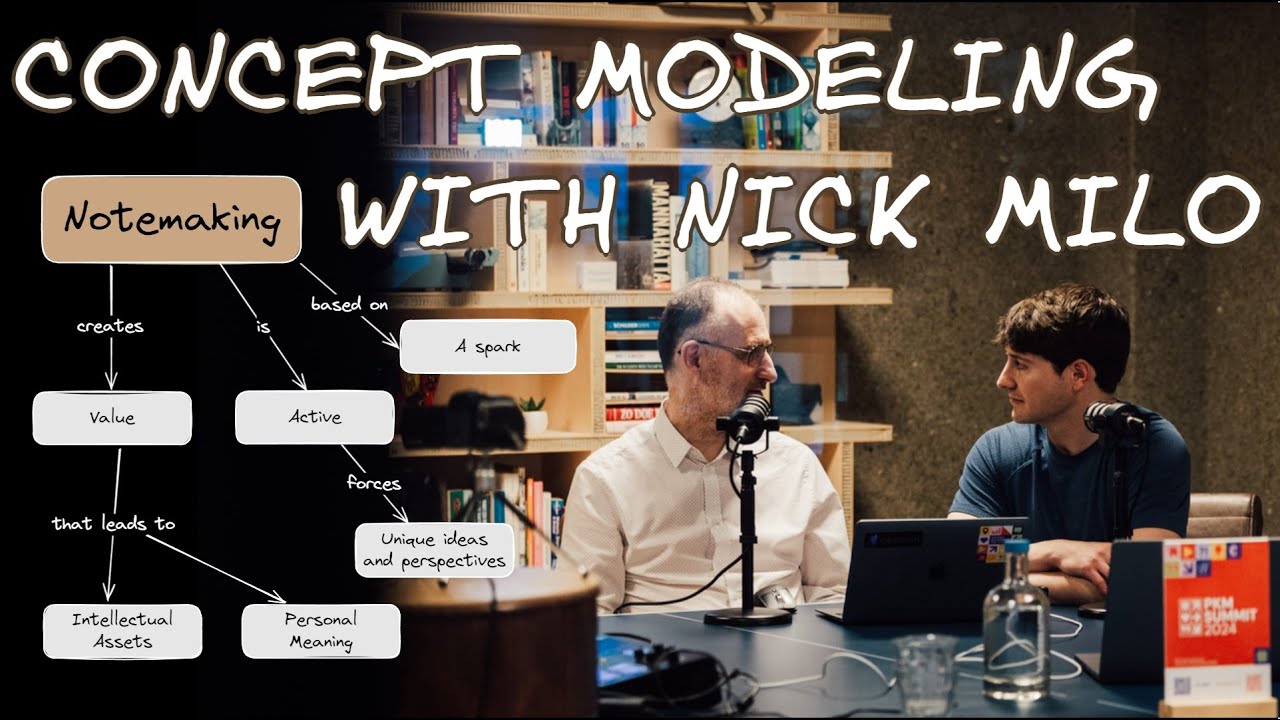
Nick Milo introduces the concept of **note-making** as an active process that leads to deeper intellectual engagement. Through **concept modeling**, users can visually map out ideas by connecting nouns (concepts) and verbs (relationships). This approach is useful for organizing thoughts, developing consistent vocabularies, and ultimately enhancing the clarity of writing and thinking.
- **Concept Modeling**: A visual tool used to clarify relationships between ideas.
- **Note-Making**: A process distinct from note-taking, characterized by active engagement with content.
- **Value Creation**: Note-making helps create intellectual assets, personal meaning, and unique perspectives.
### 🗒️ Notes:
- **Concept Modeling**:
- A diagram with shapes (nouns) and lines (verbs) connecting concepts.
- Helps define terms, organize thoughts, and clarify relationships.
- **Note-Making**:
- Active process, different from passive note-taking.
- Leads to the creation of intellectual assets.
- **Value Creation**:
- Generates new insights and perspectives.
- Builds personal meaning over time.
## 📖 References:
- Nick Milo, [Unpacking Notemaking: Concept Modeling with Nick Milo](https://www.youtube.com/watch?v=ztCup77A77A)
## 🗣️ Paraphrase:
1. Nick describes note-making as an active process, different from note-taking, where you create intellectual assets by engaging with the content. This generates value through insights and personal meaning, making notes more useful in the long term.
2. Jolt explains that **concept modeling** is a visual way of organizing ideas, helping clarify complex relationships between concepts. It's about creating diagrams that link terms and definitions, providing a clearer vocabulary for writing and thinking.
## 📰 Newsletter:
🚀 **Enhance Your Note-Making with Concept Modeling**
If you're looking to take your note-making skills to the next level, consider using **concept modeling**! In this method, you visually map out relationships between ideas, helping you clarify your thoughts and create intellectual assets. This approach, shared by Nick Milo at the PKM Summit, transitions you from passive note-taking to active note-making. Ready to organize your thoughts in a more meaningful way? Learn more about concept modeling [here](https://www.youtube.com/watch?v=ztCup77A77A). 🙌
## ✅ Action Items:
- Explore concept modeling as a tool to enhance the organization of ideas in note-making.
- Use Obsidian’s visual features to create diagrams that map relationships between terms.
- Apply this process to open-source advocacy, using visual thinking to outline project goals and community engagement strategies.
## 🧪 Hypotheses:
- Concept modeling will improve clarity and reduce ambiguity in complex projects by creating visual vocabularies.
- Note-making, as an active process, will generate deeper insights and intellectual assets that passive note-taking does not produce.
### 📊 Methodology:
- Use concept modeling software like Excalidraw to visually map the connections between terms and ideas.
- Evaluate the quality and depth of insights produced through concept modeling versus traditional note-taking.
### ❓ Questions:
- How does the active process of note-making change the way we engage with content?
- Can concept modeling improve collaboration by providing a shared visual vocabulary?
### 🔮 Future Research:
- Investigate how concept modeling can be applied in educational settings to enhance learning outcomes.
- Explore the use of visual tools like Obsidian in project management and team collaboration.
### 💡 Implications:
Concept modeling offers a powerful tool for clarifying complex ideas, creating intellectual assets, and fostering deep engagement. This approach could revolutionize how we organize and communicate ideas, both in individual learning and in collaborative work environments.
### 🧠 Learning Styles Assessment:
1. **Visual Learners (Spatial)**:
- **Present**: The use of diagrams and concept maps supports visual learning.
- **Improve**: Enhance with more detailed infographics or visual aids.
2. **Aural Learners (Auditory-Musical)**:
- **Improve**: Consider adding audio explanations or video content to complement the visual modeling.
3. **Verbal Learners (Linguistic)**:
- **Present**: The detailed explanations of terms and ideas appeal to verbal learners.
- **Improve**: Incorporate more examples and analogies to deepen understanding.
4. **Physical Learners (Kinesthetic)**:
- **Improve**: Suggest interactive exercises, such as building concept maps by hand.
5. **Logical Learners (Mathematical)**:
- **Present**: Concept modeling’s structured relationships appeal to logical learners.
- **Improve**: Add step-by-step problem-solving examples to engage this group further.
6. **Social Learners (Interpersonal)**:
- **Improve**: Encourage collaborative concept modeling sessions where teams build diagrams together.
7. **Solitary Learners (Intrapersonal)**:
- **Present**: The individual nature of note-making supports solitary learners.
- **Improve**: Add reflection prompts to deepen personal engagement with the material.
8. **Naturalistic Learners**:
- **Improve**: Introduce real-world applications or nature-based analogies to connect with naturalistic learners.
### 📊 Accessibility Assessment:
- **Screen Reader Compatibility**: Ensure that diagrams and text are accessible with proper alt-text descriptions.
- **Keyboard Navigation**: Enable keyboard shortcuts for all interactive elements in visual modeling software.
- **Contrast and Readability**: Use high-contrast color schemes in diagrams to ensure readability for those with visual impairments.
- **Text Resizing**: Ensure all text in diagrams is scalable without loss of quality.
### 🌍 DEIB (Diversity, Equity, Inclusion, and Belonging) Assessment:
- **Cultural Relevance**: Introduce diverse perspectives in concept modeling examples to ensure cultural inclusivity.
- **Inclusive Language**: Use gender-neutral and non-exclusionary terms throughout the material.
- **Neurodiversity Support**: Simplify complex diagrams and break them into smaller steps to support neurodiverse learners.
### ✅ Logical Validity:
- **Sound Reasoning**: The relationship between concept modeling and clarity of thought is well-supported by the arguments made.
- **Potential Fallacies**: No fallacies identified; the reasoning is consistent and logical throughout the discussion.
### 🔍 SEO Evaluation:
1. **Keywords**: “Concept Modeling,” “Note-Making,” “Visual Thinking” are integrated effectively.
2. **Meta Description**: In
> [!note]+ Document Notes
> tags: [ConceptModeling, NoteMaking, PKMSummit]
> - ConceptModeling
> - NoteMaking
> - PKMSummit
> Author: Nick Milo
> Source: YouTube Transcript
> Reference: [Unpacking Notemaking: Concept Modeling with Nick Milo](https://www.youtube.com/watch?v=ztCup77A77A)
> date created: 2024-09-15 18:30
>
> # Title: Concept Modeling in Note-Making: An Overview with Nick Milo
>
<!-- deep-read:sections start -->
## Table of Contents:
1. [📝 Summary](#-summary)
2. [📖 Main Content](#-main-content)
3. [🗒️ Notes](#-notes)
4. [📖 References](#-references)
5. [🗣️ Paraphrase](#-paraphrase)
6. [📰 Newsletter](#-newsletter)
7. [✅ Action Items](#-action-items)
8. [🧪 Hypotheses](#-hypotheses)
9. [📊 Methodology](#-methodology)
10. [❓ Questions](#-questions)
11. [🔮 Future Research](#-future-research)
12. [💡 Implications](#-implications)
13. [🧠 Learning Styles Assessment](#-learning-styles-assessment)
14. [📊 Accessibility Assessment](#-accessibility-assessment)
15. [🌍 DEIB Assessment](#-deib-assessment)
16. [✅ Logical Validity](#-logical-validity)
17. [🔍 SEO Evaluation](#-seo-evaluation)
18. [🎯 Conclusion](#-conclusion)
## 📝 Summary:
In this conversation between Nick Milo and Jolt, they explore the importance of concept modeling as a tool for organizing thoughts and enhancing the process of note-making. Concept modeling allows for a visual representation of relationships between ideas, helping clarify definitions and generate insights. The goal is to transition from note-taking, a passive act, to note-making, an active process that generates value, insights, and intellectual assets.
## 📖 Main Content:
Nick Milo introduces the concept of **note-making** as an active process that leads to deeper intellectual engagement. Through **concept modeling**, users can visually map out ideas by connecting nouns (concepts) and verbs (relationships). This approach is useful for organizing thoughts, developing consistent vocabularies, and ultimately enhancing the clarity of writing and thinking.
- **Concept Modeling**: A visual tool used to clarify relationships between ideas.
- **Note-Making**: A process distinct from note-taking, characterized by active engagement with content.
- **Value Creation**: Note-making helps create intellectual assets, personal meaning, and unique perspectives.
### 🗒️ Notes:
- **Concept Modeling**:
- A diagram with shapes (nouns) and lines (verbs) connecting concepts.
- Helps define terms, organize thoughts, and clarify relationships.
- **Note-Making**:
- Active process, different from passive note-taking.
- Leads to the creation of intellectual assets.
- **Value Creation**:
- Generates new insights and perspectives.
- Builds personal meaning over time.
## 📖 References:
- Nick Milo, [Unpacking Notemaking: Concept Modeling with Nick Milo](https://www.youtube.com/watch?v=ztCup77A77A)
## 🗣️ Paraphrase:
1. Nick describes note-making as an active process, different from note-taking, where you create intellectual assets by engaging with the content. This generates value through insights and personal meaning, making notes more useful in the long term.
2. Jolt explains that **concept modeling** is a visual way of organizing ideas, helping clarify complex relationships between concepts. It's about creating diagrams that link terms and definitions, providing a clearer vocabulary for writing and thinking.
## 📰 Newsletter:
🚀 **Enhance Your Note-Making with Concept Modeling**
If you're looking to take your note-making skills to the next level, consider using **concept modeling**! In this method, you visually map out relationships between ideas, helping you clarify your thoughts and create intellectual assets. This approach, shared by Nick Milo at the PKM Summit, transitions you from passive note-taking to active note-making. Ready to organize your thoughts in a more meaningful way? Learn more about concept modeling [here](https://www.youtube.com/watch?v=ztCup77A77A). 🙌
## ✅ Action Items:
- Explore concept modeling as a tool to enhance the organization of ideas in note-making.
- Use Obsidian’s visual features to create diagrams that map relationships between terms.
- Apply this process to open-source advocacy, using visual thinking to outline project goals and community engagement strategies.
## 🧪 Hypotheses:
- Concept modeling will improve clarity and reduce ambiguity in complex projects by creating visual vocabularies.
- Note-making, as an active process, will generate deeper insights and intellectual assets that passive note-taking does not produce.
### 📊 Methodology:
- Use concept modeling software like Excalidraw to visually map the connections between terms and ideas.
- Evaluate the quality and depth of insights produced through concept modeling versus traditional note-taking.
### ❓ Questions:
- How does the active process of note-making change the way we engage with content?
- Can concept modeling improve collaboration by providing a shared visual vocabulary?
### 🔮 Future Research:
- Investigate how concept modeling can be applied in educational settings to enhance learning outcomes.
- Explore the use of visual tools like Obsidian in project management and team collaboration.
### 💡 Implications:
Concept modeling offers a powerful tool for clarifying complex ideas, creating intellectual assets, and fostering deep engagement. This approach could revolutionize how we organize and communicate ideas, both in individual learning and in collaborative work environments.
### 🧠 Learning Styles Assessment:
1. **Visual Learners (Spatial)**:
- **Present**: The use of diagrams and concept maps supports visual learning.
- **Improve**: Enhance with more detailed infographics or visual aids.
2. **Aural Learners (Auditory-Musical)**:
- **Improve**: Consider adding audio explanations or video content to complement the visual modeling.
3. **Verbal Learners (Linguistic)**:
- **Present**: The detailed explanations of terms and ideas appeal to verbal learners.
- **Improve**: Incorporate more examples and analogies to deepen understanding.
4. **Physical Learners (Kinesthetic)**:
- **Improve**: Suggest interactive exercises, such as building concept maps by hand.
5. **Logical Learners (Mathematical)**:
- **Present**: Concept modeling’s structured relationships appeal to logical learners.
- **Improve**: Add step-by-step problem-solving examples to engage this group further.
6. **Social Learners (Interpersonal)**:
- **Improve**: Encourage collaborative concept modeling sessions where teams build diagrams together.
7. **Solitary Learners (Intrapersonal)**:
- **Present**: The individual nature of note-making supports solitary learners.
- **Improve**: Add reflection prompts to deepen personal engagement with the material.
8. **Naturalistic Learners**:
- **Improve**: Introduce real-world applications or nature-based analogies to connect with naturalistic learners.
### 📊 Accessibility Assessment:
- **Screen Reader Compatibility**: Ensure that diagrams and text are accessible with proper alt-text descriptions.
- **Keyboard Navigation**: Enable keyboard shortcuts for all interactive elements in visual modeling software.
- **Contrast and Readability**: Use high-contrast color schemes in diagrams to ensure readability for those with visual impairments.
- **Text Resizing**: Ensure all text in diagrams is scalable without loss of quality.
### 🌍 DEIB (Diversity, Equity, Inclusion, and Belonging) Assessment:
- **Cultural Relevance**: Introduce diverse perspectives in concept modeling examples to ensure cultural inclusivity.
- **Inclusive Language**: Use gender-neutral and non-exclusionary terms throughout the material.
- **Neurodiversity Support**: Simplify complex diagrams and break them into smaller steps to support neurodiverse learners.
### ✅ Logical Validity:
- **Sound Reasoning**: The relationship between concept modeling and clarity of thought is well-supported by the arguments made.
- **Potential Fallacies**: No fallacies identified; the reasoning is consistent and logical throughout the discussion.
### 🔍 SEO Evaluation:
1. **Keywords**: “Concept Modeling,” “Note-Making,” “Visual Thinking” are integrated effectively.
2. **Meta Description**: Include a concise description with target keywords for better visibility.
3. **Title Optimization**: The title could be improved by adding “How to Use Concept Modeling in Note-Making.”
4. **Headers**: H1, H2, and H3 headers are well-organized and appropriately structured.
## 🎯 Conclusion:
Concept modeling is a powerful tool for enhancing note-making by visually organizing relationships between ideas. This approach clarifies complex concepts, generates intellectual assets, and fosters deeper engagement with content. By integrating these techniques, individuals and teams can improve their ability to think critically and communicate effectively.
Short Summary for [Unpacking Notemaking: Concept Modeling with Nick Milo](https://www.youtube.com/watch?v=ztCup77A77A) by [Merlin](https://merlin.foyer.work/)
Concept Modeling for Clear and Consistent Vocabulary: A Practical Approach with Nick Milo
[00:04](https://www.youtube.com/watch?v=ztCup77A77A&t=4) Concept modeling helps in organizing vocabulary and creating a glossary
[02:06](https://www.youtube.com/watch?v=ztCup77A77A&t=126) Creating visual concept models for better understanding and organization.
[04:05](https://www.youtube.com/watch?v=ztCup77A77A&t=245) Creating active relationships in concept modeling
[06:17](https://www.youtube.com/watch?v=ztCup77A77A&t=377) Importance of externalizing thoughts through note-taking
[08:13](https://www.youtube.com/watch?v=ztCup77A77A&t=493) Note-making is based on spark and spatial organization
[10:07](https://www.youtube.com/watch?v=ztCup77A77A&t=607) Creating a note generates intellectual assets with long-term value.
[12:03](https://www.youtube.com/watch?v=ztCup77A77A&t=723) Note making generates insights and creates value.
[13:56](https://www.youtube.com/watch?v=ztCup77A77A&t=836) Encouraging active conversations and value creation
---------------------------------
Detailed Summary for [Unpacking Notemaking: Concept Modeling with Nick Milo](https://www.youtube.com/watch?v=ztCup77A77A) by [Merlin](https://merlin.foyer.work/)
Concept Modeling for Clear and Consistent Vocabulary: A Practical Approach with Nick Milo
[00:04](https://www.youtube.com/watch?v=ztCup77A77A&t=4) Concept modeling helps in organizing vocabulary and creating a glossary
- Concept modeling involves shapes with text representing concepts and lines connecting them
- It helps define terms, create a clear vocabulary, and clarify ideas on paper
[02:06](https://www.youtube.com/watch?v=ztCup77A77A&t=126) Creating visual concept models for better understanding and organization.
- Start by creating a new Excolo drawing with grid for better organization.
- Add key ideas in rectangles, create parking lot for related terms, and connect them for a comprehensive concept model.
[04:05](https://www.youtube.com/watch?v=ztCup77A77A&t=245) Creating active relationships in concept modeling
- By dragging and adding active below notemaking, you define the relationship with an arrow.
- Concept maps consist of interconnected statements forming short sentences explaining the concept.
[06:17](https://www.youtube.com/watch?v=ztCup77A77A&t=377) Importance of externalizing thoughts through note-taking
- Note-taking helps to capture important information and make it more tangible.
- Note-making can be based on various sources like sparks, ideas, book highlights, concepts, or purposes.
[08:13](https://www.youtube.com/watch?v=ztCup77A77A&t=493) Note-making is based on spark and spatial organization
- Spatial organization aids in remembering information spatially
- Spark represents energy and universality in note-making
[10:07](https://www.youtube.com/watch?v=ztCup77A77A&t=607) Creating a note generates intellectual assets with long-term value.
- Notes serve as intellectual capital that can be used in various ways, sometimes with unforeseen benefits.
- Value of a note may not be immediately clear, but is revealed over time and can inform future work, projects, and experiences.
[12:03](https://www.youtube.com/watch?v=ztCup77A77A&t=723) Note making generates insights and creates value.
- Note taking is simply collecting information without adding value, while note making involves creating new assets and insights.
- Concept modeling can lead to intellectual assets, personal meaning, and deeper understanding.
[13:56](https://www.youtube.com/watch?v=ztCup77A77A&t=836) Encouraging active conversations and value creation
- Emphasizes generating insights through active engagement
- Promotes unique ideas and perspectives for deeper understanding
<!-- deep-read:sections end -->
## Highlights
- PKM Summit ([View Highlight](https://read.readwise.io/read/01j7vjtmbbajm29aed0nbgwhen))