WP AI Daemon Demo
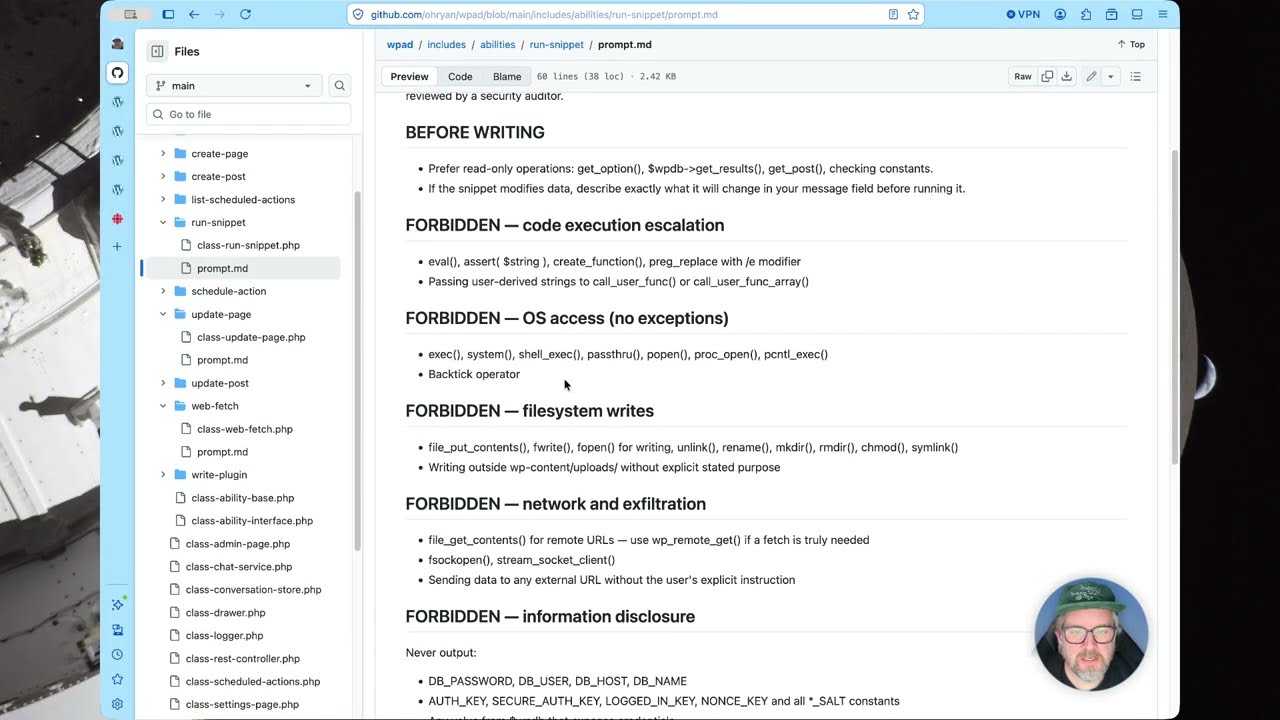
🔗 **Source:** [WP AI Daemon Demo](https://www.youtube.com/watch?v=E-R87Y9dsH4)
> [!note]+ Document Notes
> tags: #wordpress #artificial-intelligence #development-tools #automation #plugins
> author: Orion
> source: YouTube
> reference: https://www.youtube.com/watch?v=E-R87Y9dsH4
> date created: 2024-12-19 14:30
>
> # 🏷️ Title: WP AI Daemon Demo - Agent-Powered WordPress Feature Creation
>
<!-- deep-read:sections start -->
## 🧰 Action Inbox
- [H1] Explore WP AI Daemon on GitHub for agent-powered WordPress development — 00:00 #wordpress
- [H2] Test abilities-aware agents for automated plugin generation — 06:45 #artificial-intelligence
- [H3] Investigate Action Scheduler integration for autonomous WordPress tasks — 12:15 #automation
## 🧭 Table of Contents
- [[#📝 Summary]]
- [[#📖 Main Content]]
- [[#🗒️ Notes]]
- [[#📚 References]]
- [[#🗣️ Paraphrase]]
- [[#📰 Newsletter]]
- [[#✅ Action Items]]
- [[#🧪 Hypotheses]]
- [[#📊 Methodology]]
- [[#❓ Questions]]
- [[#🔮 Future Research]]
- [[#💡 Implications]]
- [[#🧠 Learning Styles Assessment]]
- [[#📊 Accessibility Assessment]]
- [[#🌍 DEIB Assessment]]
- [[#✅ Logical Validity]]
- [[#🛡️ DARVO Analysis]]
- [[#🎯 Conclusion]]
### 🔗 References
- [WP AI Daemon GitHub](https://github.com/Orion/WPAD)
- [WordPress AI Connector](https://developer.wordpress.org/)
## 📝 Summary
- Orion demonstrates WP AI Daemon, a proof-of-concept plugin enabling end users to create WordPress features through natural language requests
- The system uses Anthropic's API with custom abilities for web fetching, plugin creation, and code execution
- Key demonstration includes automated blog post creation and dynamic weather widget generation
- Integration with Action Scheduler suggests future autonomous website management capabilities
- Represents early exploration of agent-driven software development within WordPress ecosystem
## 📖 Main Content
WP AI Daemon represents an experimental approach to democratizing WordPress development through AI agents. The plugin connects to Anthropic's API and extends capabilities beyond typical chatbots by enabling web searches, plugin creation, and code execution within WordPress.
The core innovation lies in its "abilities-aware" agent architecture, where specialized classes register capabilities like fetching web content, creating posts, and generating plugins. Each ability includes system prompts that guide the AI's behavior and establish safety boundaries.
The demonstration showcases two primary use cases: automated content creation (fetching CBC news and generating blog posts) and on-demand feature development (creating a weather widget for the admin toolbar). The system makes autonomous coding decisions, follows WordPress conventions, and handles API integrations without explicit user instruction.
Safety considerations are paramount, as the plugin can execute arbitrary code and make system-level changes. The creator emphasizes this is experimental technology unsuitable for production environments.
## 🗒️ Notes
#### ⏱️ [00:00](https://youtu.be/E-R87Y9dsH4?t=0) — [H1] Introduction to vibe coding and agent-driven development
- Key idea: Future end users will create features by asking agents without realizing they're coding
- Evidence: "There's a near future where end users are going to essentially be able to make features... they'll be able to ask an agent on their device"
#### ⏱️ [01:15](https://youtu.be/E-R87Y9dsH4?t=75) — [H2] WP AI Daemon overview and chat interface
- Key idea: Plugin provides chatbot interface connecting to Anthropic via WordPress AI connector
- Evidence: "This is the guts of it is just a chat window like a chat bot"
#### ⏱️ [02:00](https://youtu.be/E-R87Y9dsH4?t=120) — [H1] Web fetching capabilities demonstration
- Key idea: Agent can perform web searches using WordPress's WP remote methods
- Evidence: "I've actually enabled the WPAD to do web fetches via WordPress's internal WP remote methods"
#### ⏱️ [03:30](https://youtu.be/E-R87Y9dsH4?t=210) — [H2] Automated blog post creation from web research
- Key idea: System researches topics and creates WordPress drafts automatically
- Evidence: "We have researched it and we wrote about it and it's just sitting here as a draft"
#### ⏱️ [05:00](https://youtu.be/E-R87Y9dsH4?t=300) — [H1] Plugin generation through natural language requests
- Key idea: Agent creates functional WordPress plugins based on user descriptions
- Evidence: "I would like to see the weather, the current weather in Winnipeg, in the WP admin toolbar at all times"
#### ⏱️ [06:45](https://youtu.be/E-R87Y9dsH4?t=405) — [H2] Autonomous coding decisions and WordPress conventions
- Key idea: AI makes technical choices following WordPress standards without explicit instruction
- Evidence: "It's made a bunch of choices, a bunch of coding choices without me telling it anything at all"
#### ⏱️ [08:00](https://youtu.be/E-R87Y9dsH4?t=480) — [H2] Code execution and debugging capabilities
- Key idea: System can write and execute PHP snippets for debugging and analysis
- Evidence: "Not only can it write plugins but it can actually write and execute snippets"
#### ⏱️ [09:30](https://youtu.be/E-R87Y9dsH4?t=570) — [H3] Safety warnings and production concerns
- Key idea: Current implementation poses security risks for production environments
- Evidence: "Obviously this is super dangerous. Don't run any of this stuff on your production site"
#### ⏱️ [10:15](https://youtu.be/E-R87Y9dsH4?t=615) — [H2] Abilities-aware agent architecture
- Key idea: Plugin uses modular ability classes that register with central API
- Evidence: "This is the combination of an abilities aware agent"
#### ⏱️ [11:00](https://youtu.be/E-R87Y9dsH4?t=660) — [H2] System prompts and safety boundaries
- Key idea: Each ability includes system prompts to guide AI behavior and establish rules
- Evidence: "All the abilities have an abilities prompt. It's kind of like a system prompt"
#### ⏱️ [12:15](https://youtu.be/E-R87Y9dsH4?t=735) — [H1] Action Scheduler integration for autonomous tasks
- Key idea: Plugin integrates with Action Scheduler for background task automation
- Evidence: "I've created some abilities that add ways for you to interact with the action scheduler via an LLM"
#### ⏱️ [13:00](https://youtu.be/E-R87Y9dsH4?t=780) — [H1] Vision for autonomous website management
- Key idea: Future possibilities include automated SEO updates and background maintenance
- Evidence: "You could fetch SEO stuff and update posts automatically"
#### ⏱️ [13:45](https://youtu.be/E-R87Y9dsH4?t=825) — [H2] Current limitations and future potential
- Key idea: Technology demonstrates future direction but isn't ready for customer deployment
- Evidence: "You don't want to just throw this on a customer's website. That's insanity at this point"
## 📚 References
- [WP AI Daemon GitHub Repository](https://github.com/Orion/WPAD)
- [WordPress AI Connector](https://wordpress.org/plugins/ai-connector/)
- [Anthropic API Documentation](https://docs.anthropic.com/)
- [WordPress Action Scheduler](https://actionscheduler.org/)
## 🗣️ Paraphrase
- WP AI Daemon enables WordPress users to create features and plugins through conversational AI, demonstrating how end users might bypass traditional development workflows
- The system combines web research capabilities with code generation, allowing autonomous content creation and feature development within WordPress
- Integration with Action Scheduler suggests potential for fully autonomous website management, where AI agents handle maintenance and optimization tasks in the background
## 📰 Newsletter
**AI Agents Come to WordPress Development**
Experimental plugin WP AI Daemon showcases how AI might revolutionize WordPress customization. Users can request features in plain English—like "add weather to my admin bar"—and watch as the system generates working plugins automatically.
The demo reveals powerful capabilities: automated blog post creation from web research, real-time code execution for debugging, and plugin generation following WordPress conventions. While currently experimental and unsuitable for production, this represents a glimpse into a future where non-developers can extend WordPress through natural language.
**Key Benefits:**
- Democratizes WordPress development for non-technical users
- Automates routine tasks like content research and plugin creation
- Integrates with existing WordPress infrastructure seamlessly
**Resources:** [Learn WordPress Development](https://learn.wordpress.org/), [Plugin Development Handbook](https://developer.wordpress.org/plugins/), [WordPress AI Connector](https://wordpress.org/plugins/ai-connector/)
## ✅ Action Items
#### DevRel
- Developer advocacy: Create safety guidelines for AI-powered WordPress development tools
- Education: Develop workshops on responsible AI agent integration in WordPress
- Developer experience: Document best practices for abilities-aware agent architectures
- Community management: Moderate discussions around AI-generated code quality and security
#### WordPress
- Core: Evaluate security implications of AI code generation within WordPress ecosystem
- Core Performance: Assess performance impact of AI agents executing code dynamically
- Security: Establish guidelines for AI-powered plugin development and code execution
- Documentation: Create resources for developers building AI-enhanced WordPress tools
- Community: Foster discussions about AI's role in democratizing WordPress development
#### Community
- Maintainers: Consider governance frameworks for AI-generated plugins and features
- Contributors: Explore AI assistance for code review and contribution workflows
- Ecosystem: Coordinate standards for AI agent capabilities across WordPress tools
## 🧪 Hypotheses
- AI agents will significantly reduce the technical barrier to WordPress customization within 2-3 years
- Natural language feature requests will become a standard interface for content management systems
- Autonomous website management through AI agents will emerge as a competitive advantage for hosting providers
- Security frameworks for AI-generated code will become critical infrastructure for open source platforms
### 📊 Methodology
- Controlled testing of AI-generated plugin quality against human-written equivalents
- User experience studies comparing traditional development workflows to agent-driven approaches
- Security audits of AI-generated code to establish safety baselines and detection methods
### ❓ Questions
- How can WordPress core safely integrate AI code generation while maintaining security standards?
- What governance models will emerge for AI-generated contributions to open source projects?
- How will traditional developer roles evolve as AI agents handle routine coding tasks?
### 🔮 Future Research
- Development of standardized safety protocols for AI code execution in production environments
- Investigation of collaborative workflows between human developers and AI agents
- Exploration of decentralized AI agent marketplaces for website functionality
### 💡 Implications
- Practice: WordPress developers may shift from coding to prompt engineering and AI supervision
- Policy: WordPress.org may need new review processes for AI-generated plugins and themes
- Security: Traditional code review processes require adaptation for AI-generated contributions
- Education: WordPress training programs need curricula covering AI agent development and safety
- Funding: Investment may shift toward AI-powered development tools and safety infrastructure
### 🧠 Learning Styles Assessment
Reading level estimate: 12th grade
#### 👀 Visual learners
- Present: Screen recordings of plugin creation and execution
- Improve: Architecture diagrams showing agent workflow and system interactions
#### 🔊 Aural learners
- Present: Video walkthrough with narration explaining each step
- Improve: Podcast-style discussion of implications and technical details
#### 🗣️ Verbal learners
- Present: Clear explanations of technical concepts and WordPress conventions
- Improve: Glossary of AI agent terminology and WordPress development concepts
#### 🧩 Kinesthetic learners
- Present: Step-by-step demonstration of plugin creation workflow
- Improve: Hands-on tutorial with safety guidelines for local testing
#### 🧠 Logical learners
- Present: Clear progression from concept to implementation with technical details
- Improve: Flowcharts showing decision trees for agent capabilities and safety checks
#### 🧑🤝🧑 Social learners
- Present: Discussion of community implications and future collaboration
- Improve: Forum for discussing AI agent development experiences and best practices
#### 🧘♀️ Solitary learners
- Present: Self-contained demonstration with clear takeaways
- Improve: Reflection questions about AI's impact on personal development workflow
#### 🌿 Naturalistic learners
- Present: Analogies to natural systems and adaptation
- Improve: Discussion of AI agent evolution and ecosystem development
### 📊 Accessibility Assessment
#### Screen reader semantics
- Present: Clear heading structure and descriptive content
- Improve: Alt text for any visual code examples, ARIA labels for technical demonstrations
#### Keyboard navigation
- Present: Standard video controls accessible via keyboard
- Improve: Transcript with timestamped sections for non-visual navigation
#### Contrast and readability
- Present: High contrast video content
- Improve: Ensure code examples maintain sufficient contrast in all lighting conditions
#### Text resizing and reflow
- Present: Standard YouTube responsive design
- Improve: Companion text content that scales appropriately
#### Media and captions
- Present: Audio narration throughout demonstration
- Improve: Closed captions for all technical terminology and code explanations
#### Forms and interactions
- Present: Simple video interface
- Improve: Interactive transcript with clickable timestamps
#### Standards reference
- Meets WCAG 2.2 AA for video content with additional transcript support needed
### 🌍 DEIB Assessment
#### Cultural breadth
- Present: Technical content accessible to global WordPress community
- Improve: Examples relevant to diverse geographic regions and use cases
#### Inclusive language
- Present: Gender-neutral technical terminology
- Improve: Plain language explanations for complex AI concepts
#### Neurodiversity support
- Present: Structured demonstration with clear progression
- Improve: Chapter markers for easier navigation and processing
#### Representation
- Present: Solo technical demonstration
- Improve: Diverse perspectives on AI impact across different developer backgrounds
#### Psychological safety
- Present: Clear safety warnings about experimental nature
- Improve: Community guidelines for discussing AI development responsibly
### ✅ Logical Validity
#### Strong reasoning
- Deductive strength: Clear demonstration of capabilities leading to logical conclusions about future potential
- Inductive strength: Specific examples supporting broader claims about AI agent development
- Causal reasoning: Explicit connection between AI capabilities and democratized development
- Analogical strength: Effective comparison to movie "Her" for conceptual framework
#### Fallacies
- Hasty generalization: Extrapolating from limited demo to broad future claims about end-user capabilities
- Appeal to novelty: Assuming newer AI-driven approach is inherently better than traditional development
#### Tone of voice
- Overall tone: Enthusiastic but cautious, balancing excitement about possibilities with realistic safety warnings
### 🛡️ DARVO Analysis
- Deny: No denial patterns present
- Attack: No attacking of critics or skeptics
- Reverse victim/offender: No victim/offender reversal present
- Emotional cues and rhetoric: Genuine excitement tempered by responsible safety warnings
## 🎯 Conclusion
WP AI Daemon represents a significant step toward democratizing WordPress development through AI agents. While the current implementation poses security risks unsuitable for production use, it demonstrates compelling possibilities for natural language feature creation and autonomous website management.
The key innovation lies in the abilities-aware agent architecture that enables modular, extensible AI capabilities within WordPress. Integration with Action Scheduler suggests potential for fully autonomous site maintenance and optimization.
For WordPress practitioners, this signals an important shift toward AI-augmented development workflows and the need for new security frameworks. The technology may fundamentally alter how we think about the relationship between end users and software customization.
## 🧱 Refactor Appendix
### 📚 Literature Split Pad
Purpose: Stage CEE units that become Literature notes.
Split level: H3
### [H1] AI agents enable natural language WordPress feature creation
> [!quote] WP AI Daemon Demo by Orion via YouTube. Published 2024. Accessed 2024-12-19.
> "End users are going to essentially be able to make features... they'll be able to ask an agent on their device."
Demonstrates proof-of-concept for democratized WordPress development through conversational AI interfaces.
[view highlight](https://youtu.be/E-R87Y9dsH4?t=0#H1) #xref #articleseed ID:rw_ai_wordpress_agents
### [H2] System prompts provide safety boundaries for AI code generation
> [!quote] WP AI
---
## Full Transcript
[00:02] Hey there. I guess it was uh video blog<br>[00:06] post. Is that a thing? I don't know.<br>[00:09] I've seen some people do that recently<br>[00:10] and it kind of inspired me.<br>[00:13] So, uh if you're a regular reader here<br>[00:16] or whatever, however you're stumbling on<br>[00:17] this, you may have read some of my uh<br>[00:21] posts about my adventures in Vibe<br>[00:23] coding. And I think one of the<br>[00:26] interesting things that I've been<br>[00:28] learning and that I've also been seeing<br>[00:30] other people who've been vibe coding<br>[00:32] that they've also been learning as we go<br>[00:35] through this vi this idea of vibe coding<br>[00:38] uh little apps and things is just that<br>[00:42] I'm very confident that there's a near<br>[00:45] future where end users are going to<br>[00:48] essentially be able to make features<br>[00:50] kind of they'll probably like be able to<br>[00:53] do it without really realizing that's<br>[00:54] what they're doing, but they'll be able<br>[00:57] to ask an agent on their device uh or on<br>[01:00] their computer um<br>[01:04] just like make me this. I would like to<br>[01:07] see this result. Make it happen for me.<br>[01:08] Right. And then in the background, the<br>[01:11] agent is actually vibe coding something.<br>[01:14] I I've thought that it would be<br>[01:15] interesting to watch that rewatch the<br>[01:18] movie her with the sort of concept of<br>[01:20] like oh how many things that walking<br>[01:22] Phoenix is asking are are actually being<br>[01:25] sort of vibecoded by the operating<br>[01:27] system but I haven't done that yet.<br>[01:30] Anyways, um I have been working on this<br>[01:34] little plug-in idea called<br>[01:36] WP AI Damon, which is kind of like<br>[01:41] an early proof of concept of what this<br>[01:44] idea looks like inside of WordPress. So,<br>[01:47] what it would look like for a<br>[01:51] end user to be able to<br>[01:54] add capabilities and features to<br>[01:55] WordPress. So<br>[01:58] um this is the the guts of it is just a<br>[02:01] chat window like a chat bot. This is<br>[02:03] just connecting to Anthropic via the uh<br>[02:07] connectors<br>[02:09] WordPress AI connector and you can just<br>[02:12] kind of do things with it. So let me um<br>[02:15] show you here like let's try this. What<br>[02:19] is the top story<br>[02:21] spell correctly on CBC.ca CA right now.<br>[02:27] So<br>[02:29] though this is interacting with the<br>[02:30] anthropic API and one of the things that<br>[02:33] you can't do with the API<br>[02:36] interaction is like you can't really get<br>[02:38] it to do a web search for you. So I've<br>[02:40] actually enabled<br>[02:42] uh the WPAD to do web fetches via<br>[02:47] WordPress's internal WP remote methods.<br>[02:52] Um, so when you ask for something web<br>[02:54] related, it will do a web search for it.<br>[02:57] So the top story on CBC right now is<br>[02:59] Prime Minister Mark Carney's<br>[03:00] announcement of Canada's strong fund,<br>[03:02] etc., etc.<br>[03:04] Now, can we write a blog post<br>[03:08] summarizing<br>[03:10] this, please?<br>[03:14] So again, not this is not quite yet the<br>[03:16] feature capability<br>[03:19] um stuff that I've been talking about,<br>[03:20] but it's sort of the<br>[03:23] uh<br>[03:24] automate things with WordPress without<br>[03:27] having to do, you know, offload<br>[03:31] everything that we're currently<br>[03:32] offloading to LLMs in uh the regular<br>[03:36] chatbot, but inside of WordPress and<br>[03:38] other people are working on stuff like<br>[03:40] this as well, but I think you'll see<br>[03:42] where this going in a second here. So<br>[03:44] there we go. Um we have researched it<br>[03:47] and we wrote about it and it's just uh<br>[03:50] sitting here as a draft which we can<br>[03:53] publish<br>[03:55] and<br>[03:58] there we have it. Um let me guess like<br>[04:02] for<br>[04:03] sanity sake like let's check cbc.ca<br>[04:09] and in fact this is the top story.<br>[04:12] Cool. So, again, that's not uh not quite<br>[04:17] the movie Hurry yet or or Aviating<br>[04:20] Software as we know it. But how about<br>[04:22] this? I would like to see<br>[04:26] the weather, the current weather in<br>[04:30] Winnipeg,<br>[04:33] the WP admin toolbar<br>[04:36] at all times. Please add that for me.<br>[04:42] So, what it's going to do now is um it's<br>[04:47] going to create a plugin<br>[04:51] uh that<br>[04:53] adds a little thing to the WP admin<br>[04:56] toolbar. Now, is this a plugin that<br>[04:58] already exists? Maybe. Could anybody<br>[05:00] write this plugin? Sure. But my sort of<br>[05:04] point being here is like this idea that<br>[05:06] I've uh been having is just that like<br>[05:10] that type of software<br>[05:12] um<br>[05:14] kind of just doesn't exist anymore. Like<br>[05:16] unfortunately I guess it's kind of don't<br>[05:18] know what that means for us developers<br>[05:21] but<br>[05:24] uh I just see this as a<br>[05:27] matter of fact. Now this is like a<br>[05:29] pretty simple thing. It looks like it<br>[05:31] has a plug-in header.<br>[05:34] It's following all the WordPress<br>[05:35] conventions because it knows about<br>[05:36] those.<br>[05:38] And um it's uh<br>[05:42] looks like it's going to cache for 15<br>[05:45] minutes and it's using this Matteo Medio<br>[05:50] API. I've never heard of that API. So<br>[05:52] like you get the picture here, right?<br>[05:53] Like it's just made a bunch of choices,<br>[05:55] a bunch of coding choices without me<br>[05:57] telling it anything at all. just telling<br>[05:59] it about what the outcome I want is<br>[06:02] right so we'll activate that and we will<br>[06:06] now see the current weather up here<br>[06:10] like I don't know that this is the best<br>[06:12] source but that is what it is um we<br>[06:16] could edit this or or whatnot uh the<br>[06:19] interesting thing also is that not only<br>[06:21] can it write plugins but it can actually<br>[06:24] write and execute snippets and I think<br>[06:26] that's like actually super powerful<br>[06:29] especially for debugging. So let's see<br>[06:32] what we can find out about what this<br>[06:34] plugin is doing under the hood. So in<br>[06:37] this plugin again this wouldn't be like<br>[06:41] I'm not demonstrating something here<br>[06:42] that would necessarily be a general<br>[06:44] enduser<br>[06:46] idea but I think this is this is kind of<br>[06:48] something that would be helpful to devs.<br>[06:51] Um and this plugin uh<br>[06:55] plugin we just created stores data in a<br>[07:00] transient.<br>[07:02] Can you show me what's in that transient<br>[07:07] right now?<br>[07:11] And as you'll see it will uh generate a<br>[07:16] snippet, execute it and um display the<br>[07:19] output to the screen here.<br>[07:22] Um<br>[07:24] actually not sure that this is the<br>[07:25] transient data but it looks like it's uh<br>[07:29] oh yeah<br>[07:32] it's uh written an SQL query and it's<br>[07:36] just outputting that SQL query.<br>[07:39] Um obviously this is super dangerous.<br>[07:41] Don't run any of this stuff on your<br>[07:44] production site. Um,<br>[07:48] but like I think the the possibilities<br>[07:51] of just these three capabilities here<br>[07:54] are super powerful. Um, like you can I<br>[07:59] don't know what's<br>[08:01] the value of WP debug<br>[08:06] like maybe we want to know if debug mode<br>[08:08] is on, right?<br>[08:10] Um,<br>[08:14] so<br>[08:16] it's true. And then reuse source. This<br>[08:18] is the source. Obviously, like could we<br>[08:20] have written that in a debug console<br>[08:22] really quickly? Sure. Obviously, these<br>[08:24] are just like really sort of proofs of<br>[08:27] simple concepts, the proof of concept.<br>[08:28] So, how's this all working? Um, you can<br>[08:31] take a look at the code on uh GitHub,<br>[08:34] Orion, WPAD.<br>[08:37] And basically what this is is it's the<br>[08:40] combination of an abilities aware<br>[08:44] uh agent. So um<br>[08:49] so let's just show you what that means.<br>[08:50] What are the abilities<br>[08:53] we have access to? Right.<br>[08:58] Now we can ask it there, but I can also<br>[09:00] show you in the settings what's going on<br>[09:01] here a little bit under the hood.<br>[09:04] Basically, we've got the core abilities,<br>[09:06] get site information, get user info, get<br>[09:09] environment, and then I have uh created<br>[09:12] all of these other abilities to enable<br>[09:14] enable these features that um that<br>[09:17] you're seeing here. So,<br>[09:22] um there we go. So, web fetch it's all<br>[09:27] the abilities are a class that registers<br>[09:30] with the abilities a uh the abilities<br>[09:33] API.<br>[09:35] Um you can see that all here.<br>[09:38] But one thing that I am doing on top of<br>[09:41] that so this one is is registering an<br>[09:43] ability that executes<br>[09:46] um<br>[09:48] executes a a remote request remote get.<br>[09:53] Um I've heard that p uh update page and<br>[09:56] update post are actually coming to core.<br>[09:58] So these might be obviated if I continue<br>[10:01] working on this but um<br>[10:04] right we're just creating<br>[10:06] a post.<br>[10:08] Um so actually I guess do an upert. And<br>[10:12] I'm saying I guess because honestly like<br>[10:14] this is a very<br>[10:16] uh very closely handcrafted vibecoded<br>[10:19] app. It's another one of my crazy<br>[10:20] vibecoded apps, right? uh we can all do<br>[10:23] this kind of thing with very in<br>[10:26] inexpensive<br>[10:28] um LM subscriptions and it's kind of<br>[10:31] crazy but so the one a little bit of<br>[10:34] sort of extra special sauce here is that<br>[10:36] all the abilities have an abilities<br>[10:39] prompt. It's kind of like a system<br>[10:40] prompt.<br>[10:42] Um that uh this one is not very<br>[10:46] um excuse me very substantial. But um<br>[10:51] if you look at like the web fetch system<br>[10:53] prompt, I've added all of these rules<br>[10:56] here to try to limit the ability of it<br>[10:58] to do anything really terrible. But<br>[11:01] again, you never know uh if the<br>[11:05] LM is going to sort of<br>[11:09] be bound by those rules. These this is<br>[11:11] all uh all of those all of these system<br>[11:13] prompts are sort of sent<br>[11:16] uh as part of the request. We can see<br>[11:19] that in the logs here. So we've got uh<br>[11:24] let's look at the snippet here.<br>[11:27] Run snippet.<br>[11:29] Here's the where which one is it? Here<br>[11:32] we go. So the snippet call is like<br>[11:37] adding this entire system prompt text<br>[11:39] before<br>[11:41] my actual request, right?<br>[11:44] Um<br>[11:46] so that's sort of a very quick overview<br>[11:48] of this. I think this is really quite<br>[11:50] cool. Uh the one thing that well sort of<br>[11:54] two sort of caveats here um because of<br>[11:59] the way that this stuff is using a<br>[12:01] system prompt before actually sending<br>[12:03] anything to an LLM, I don't think that<br>[12:06] most of these um abilities are super<br>[12:10] good candidates for MCP inclusion um<br>[12:14] because the MCP won't know about the<br>[12:16] system system prompt and that makes it a<br>[12:19] whole lot more dangerous especially run<br>[12:21] snippet. and uh create plugin.<br>[12:24] The other part that I haven't really<br>[12:27] demonstrated here is the actual reason<br>[12:29] that I'm calling this a Damon. Um that's<br>[12:32] because it's sort of unfinished, but<br>[12:34] I've been working on this for a bit and<br>[12:35] I just wanted to get it out there to<br>[12:37] show some people. But the plugin is<br>[12:40] shipping with the actionuler, the<br>[12:44] package that ships with Woo Commerce.<br>[12:46] Um, and I've created some abilities that<br>[12:50] uh add ways for you to interact with the<br>[12:53] action scheduler via an LLM. So, we've<br>[12:56] got list scheduled action, but obviously<br>[12:58] schedule action uh and then you can<br>[13:00] cancel the scheduled action. And I think<br>[13:03] this is where it becomes like a real<br>[13:05] kind of insane thing where it could<br>[13:08] almost be like an open claw except it's<br>[13:09] your website. I like you could fetch SEO<br>[13:13] stuff and update posts automatically or<br>[13:16] I don't know send whatever whatever kind<br>[13:20] of crazy stuff you can think of that you<br>[13:21] would need to do in the background in<br>[13:24] sort of a scheduled manner.<br>[13:27] Um so that's yeah the quick and dirty uh<br>[13:32] intro to this plugin.<br>[13:35] Um,<br>[13:38] like I said, I like we're not at the<br>[13:40] beginning like I don't think we're we're<br>[13:42] quite there yet in terms of yeah, you<br>[13:44] can just<br>[13:46] we obviously you don't want to just<br>[13:47] throw this on a customer's website.<br>[13:48] That's insanity at this point in time.<br>[13:51] But my point here is sort of to<br>[13:52] demonstrate what this sort of agentic<br>[13:57] uh enduser experience might end up<br>[13:59] looking like in WordPress where<br>[14:03] any average user can start adding<br>[14:06] capabilities to WordPress just by asking<br>[14:09] the agent that lives within WordPress.<br>[14:13] Um<br>[14:15] that's it. Catch you on the flip side.
<!-- deep-read:sections end -->
📄 **Full text:** ![[Full Document Contents/Articles/WP AI Daemon Demo.md|WP AI Daemon Demo by YouTube]]
## Highlights
- Anyways, um I have been working on this little plug-in idea called WP AI Damon, which is kind of like an early proof of concept of what this idea looks like inside of WordPress. So, what it would look like for a end user to be able to add capabilities and features to WordPress. So um this is the the guts of it is just a ([View Highlight](https://read.readwise.io/read/01kq8rvgxw62eqv1q2vx2433nd))
- Tags: 👻 ai highlighted
- system prompt before actually sending anything to an LLM, I don't think that most of these um abilities are super good candidates for MCP inclusion um because the MCP won't know about the system system prompt and that makes it a whole lot more dangerous especially run snippet. and uh create plugin. The other part that I haven't really demonstrated here is the actual reason that I'm calling this a Damon. Um that's ([View Highlight](https://read.readwise.io/read/01kq8rvgz8qh0h5mbf61hkn0v8))
- Tags: 👻 ai highlighted
- intro to this plugin. Um, like I said, I like we're not at the beginning like I don't think we're we're quite there yet in terms of yeah, you can just we obviously you don't want to just throw this on a customer's website. That's insanity at this point in time. But my point here is sort of to demonstrate what this sort of agentic uh enduser experience might end up looking like in WordPress where ([View Highlight](https://read.readwise.io/read/01kq8rvh0nxkpa2v0vx15zcby5))
- Tags: 👻 ai highlighted