WP Engine, Inc. V. Automatic Inc. Et Al., No. 3:24-Cv-06917
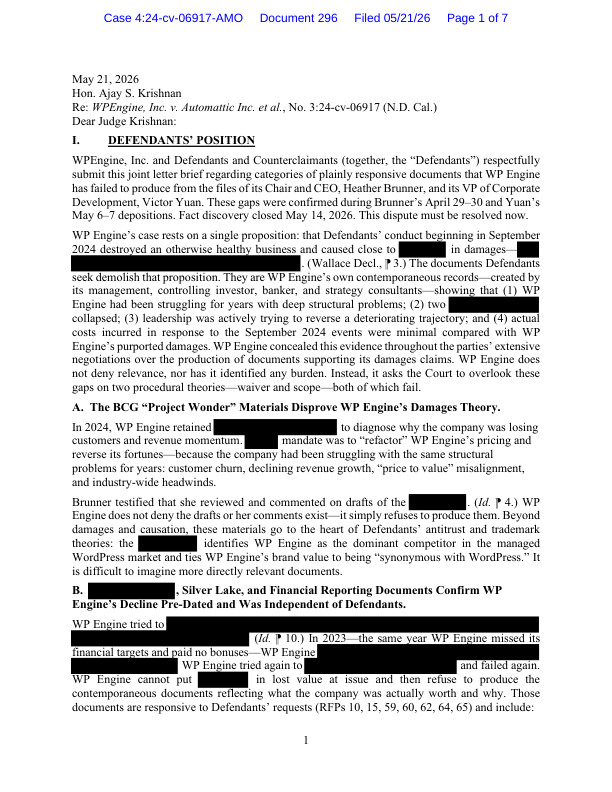
🔗 **Source:** [WP Engine, Inc. V. Automatic Inc. Et Al., No. 3:24-Cv-06917](https://storage.courtlistener.com/recap/gov.uscourts.cand.437474/gov.uscourts.cand.437474.296.0.pdf)
> [!note]+ Document Notes
> tags: [wp-engine-automattic, discovery-dispute, financial-discovery, deposition, damages-causation, silver-lake, bcg-consulting, wordpress-governance, trademark-antitrust]
> author: Joint Letter Brief (WP Engine & Defendants)
> source: CourtListener RECAP - N.D. Cal. 4:24-cv-06917-AMO
> filing_type: joint letter brief
> docket: 296.0
>
> # 🏷️ Post-Discovery Document Production Dispute: WP Engine's Financial Decline Evidence
> # 🧭 Table of Contents
> - [Summary](#📝-summary)
> - [Main Content](#📖-main-content)
> - [Governance Digest](#📰-governance-digest)
> - [Hypotheses](#🧪-hypotheses)
> - [Implications](#💡-implications)
> - [Conclusion](#🎯-conclusion)
>
> # 🔗 References
> **Dockets:** 296.0
> **Rules:** FRCP 1, FRCP 26, Civil L.R. 5-1(i)(3)
> **Parties:** WP Engine (Plaintiff), Automattic/Mullenweg (Defendants), Silver Lake (controlling investor)
> **Key Figures:** Judge Ajay S. Krishnan (Magistrate), Heather Brunner (WP Engine CEO), Victor Yuan (WP Engine VP Corporate Development)
>
> # 📝 Summary
> This joint letter brief reveals a bitter post-discovery fight over WP Engine's financial records that could determine the entire case outcome. With fact discovery closed May 14, 2026, Defendants demand production of documents they claim prove WP Engine was failing long before Automattic's September 2024 "nuclear war" campaign. The dispute centers on Boston Consulting Group's "Project Wonder" analysis, Silver Lake investor communications, and failed sale attempts that allegedly show WP Engine's $500+ million damages claim is fabricated. WP Engine argues Defendants waived these demands under their March 2026 discovery agreement. This battle over causation evidence directly impacts WordPress governance by testing whether Automattic's trademark control and plugin directory dominance can destroy competitors or whether market forces alone explain WP Engine's decline.
>
> # 📖 Main Content
<!-- deep-read:sections start -->
## 🗒️ Notes
**Core Dispute**: Whether WP Engine must produce financial documents showing pre-existing business problems versus Automattic-caused damages
**Key Missing Documents (Defendants' Claims)**:
- BCG "Project Wonder" study diagnosing customer churn and revenue decline
- Draft versions and Brunner's comments on BCG analysis
- Silver Lake communications about failed 2023-2024 sale attempts
- Monthly financial reports to Silver Lake (only 2 of 72 produced)
- Board deck drafts and investor feedback records
- Cost accounting for September 2024 incident response
**WP Engine's Defense Strategy**:
- Invoke March 2026 reciprocal discovery agreement as comprehensive limit
- Claim 630,000+ pages already produced, including 13,000 financial pages
- Assert waiver doctrine against late-stage demands
- Deny existence of missing substantive documents
**Procedural Timeline Issues**:
- Brunner deposition April 29-30, Yuan deposition May 6-7
- Discovery closed May 14, 2026
- Document gaps confirmed during depositions but not immediately escalated
- Defendants reserved recall rights during deposition
**Governance-Critical Evidence**:
- BCG study identifies WP Engine as "dominant competitor in managed WordPress market"
- Analysis shows WP Engine brand "synonymous with WordPress"
- Documents could prove/disprove antitrust market dominance claims
- Evidence of WordPress ecosystem competitive dynamics pre-conflict
# 📚 References
- Wallace Declaration (Defendants' supporting evidence)
- Jenkins Declaration (WP Engine's supporting evidence)
- Deposition transcripts (Brunner April 29-30, Yuan May 6-7)
- March 2026 reciprocal discovery agreement
- BCG "Project Wonder" materials
- Silver Lake investor communications and financial reports
# 🗣️ Paraphrase
**Defendants argue**: "WP Engine is hiding the smoking gun - their own documents prove the company was circling the drain for years before we did anything. They hired BCG to figure out why customers were fleeing, tried twice to sell the company and failed, and missed their financial targets. Now they want $500+ million from us for problems they created themselves. They can't cherry-pick which documents to show the court."
**WP Engine responds**: "This is a desperate attempt to relitigate settled discovery after they realized their defense strategy isn't working. We made a deal in March about what financial documents to exchange, both sides gave up some demands to avoid exactly this kind of motion practice, and we've already produced over 630,000 pages. They're trying to renege on their agreement and reopen closed discovery because they don't like what the evidence shows about their admitted 'nuclear war' against us."
# 📰 Governance Digest
The WordPress ecosystem's biggest corporate players are fighting over who gets to tell the story of WP Engine's decline. Automattic claims WP Engine was already failing due to customer churn and pricing problems before their September 2024 trademark restrictions began. WP Engine insists they were healthy until Automattic's "brick by brick" destruction campaign cut off their WordPress.org access. The missing puzzle pieces include a Boston Consulting Group study that allegedly shows WP Engine struggling with the same structural problems "for years" and communications with Silver Lake about failed attempts to sell the company. If Automattic can prove WP Engine was circling the drain independently, it undermines the entire premise that trademark and plugin directory control can be weaponized to destroy competitors - a question central to WordPress's open-source governance future.
# 🧪 Hypotheses
1. **Pre-existing decline theory**: BCG "Project Wonder" documents will show WP Engine had fundamental business model problems unrelated to Automattic's actions
2. **Market dominance paradox**: Evidence showing WP Engine as "synonymous with WordPress" will strengthen both antitrust claims and trademark confusion defenses
3. **Discovery gamesmanship**: The March 2026 agreement was intentionally ambiguous to allow later disputes over document scope
4. **Damages fabrication**: WP Engine's claimed $500+ million losses include problems predating September 2024 conflicts
5. **Investor knowledge**: Silver Lake communications will reveal sophisticated awareness of WP Engine's structural problems before Automattic's campaign
6. **WordPress ecosystem vulnerability**: The dispute will expose how trademark control enables market manipulation regardless of product quality
# 📊 Methodology
**Evidentiary Basis**: Joint letter brief supported by Wallace Declaration (Defendants) and Jenkins Declaration (WP Engine) claiming personal knowledge of document production disputes. **Procedural Posture**: Post-discovery motion practice before Magistrate Judge Krishnan with fact discovery closed May 14, 2026. **Key Evidence**: Deposition testimony from CEO Brunner and VP Yuan confirming existence of missing documents, plus production statistics and discovery agreement interpretation disputes.
# ❓ Questions
- Will the BCG "Project Wonder" study prove WP Engine's decline predates Automattic's actions?
- Can WP Engine's "synonymous with WordPress" branding survive trademark infringement analysis?
- Does the March 2026 discovery agreement create enforceable limits or interpretive wiggle room?
- How will courts balance open-source governance principles against traditional antitrust analysis?
- What remedies exist if WordPress Foundation trademark control enables market manipulation?
- Will Silver Lake's involvement expose private equity strategies in open-source ecosystems?
# 🔮 Future Research
**Litigation threads**: BCG study contents, Silver Lake investor communications, cost accounting for September 2024 impacts, WordPress Foundation governance structure analysis. **WordPress governance**: Trademark control mechanisms, plugin directory access policies, managed hosting market competition, relationship between commercial WordPress services and open-source project governance, private equity influence on WordPress ecosystem development.
# 💡 Implications
**Practice**: Discovery agreements require precise scope definition to avoid post-closure disputes. **Policy**: WordPress trademark ownership structure may need governance reforms to prevent market manipulation. **Security**: Centralized plugin directory control creates single points of failure for ecosystem security. **Education**: WordPress community needs transparency about trademark enforcement policies. **Funding**: Private equity involvement in WordPress hosting may create conflicts with open-source governance principles.
# 🧠 Learning Styles Assessment
**Visual**: Document production statistics, timeline graphics. **Aural**: Deposition transcript excerpts. **Verbal**: Legal argument structure and precedent analysis. **Kinesthetic**: Discovery process mechanics and motion practice. **Logical**: Causation analysis and damages calculation disputes. **Social**: Multi-party negotiation dynamics and ecosystem governance. **Solitary**: Individual document review and legal research. **Naturalistic**: WordPress ecosystem relationship patterns and market taxonomy. **Reading Level**: Graduate/Professional (complex legal terminology, procedural knowledge required).
# 📊 Accessibility Assessment
**Format**: Text-extractable PDF with standard legal document structure. **Headings**: Clear section divisions with Roman numeral organization. **Tables**: Minimal tabular content, mostly narrative legal argument. **WCAG 2.2 AA**: Standard legal document formatting without accessibility enhancements, but structurally navigable with assistive technology.
# 🌍 DEIB Assessment
**Cultural breadth**: Standard US federal court legal language without cultural context considerations. **Inclusive language**: Formal legal terminology, gender-neutral where applicable. **Neurodiversity support**: Dense legal text challenging for non-specialists, lacks plain-language summaries. **Representation**: Corporate legal teams from major firms, limited diversity visible in document. **Psychological safety**: Adversarial legal context by nature, no specific safety considerations evident.
# ✅ Logical Validity
**Strong reasoning**: Both sides present coherent arguments within discovery law framework. **Fallacies identified**:
- *False dilemma* (Defendants): Suggesting WP Engine must be either pre-damaged or Automattic-damaged, ignoring contribution analysis
- *Cherry-picking* (WP Engine): Claiming comprehensive production while potentially withholding unfavorable documents
- *Moving goalposts* (mutual): Both parties recharacterizing March 2026 agreement scope post-hoc
**Tone**: Professional but adversarial, appropriate for legal brief context.
# 🛡️ DARVO Analysis
**Defendants' approach**: *Reverse victim-offender* by claiming WP Engine's own mismanagement caused damages they attribute to Automattic's actions. **WP Engine's counter**: *Attack* Defendants' credibility by emphasizing "nuclear war" admissions and procedural bad faith. **Overall pattern**: Classic corporate litigation DARVO with both sides attempting victim-offender reversal depending on issue framing.
# 🎯 Conclusion
This document production fight will likely determine whether WP Engine can prove $500+ million in Automattic-caused damages or whether Defendants can establish pre-existing business decline. The BCG "Project Wonder" study and Silver Lake communications represent potential case-changing evidence about WordPress ecosystem market dynamics. Judge Krishnan's ruling on discovery scope will signal whether courts will allow deep financial archaeology in WordPress governance disputes. **Watch next**: Magistrate Judge's ruling on document production and any motions for discovery deadline extension.
# 🧱 Refactor Appendix
## 📚 Literature Atoms
> [!quote] Core Damages Theory
> "WP Engine's case rests on a single proposition: that Defendants' conduct beginning in September 2024 destroyed an otherwise healthy business and caused close to [REDACTED] in damages— [REDACTED]."
> [!quote] BCG Market Analysis
> "the [BCG study] identifies WP Engine as the dominant competitor in the managed WordPress market and ties WP Engine's brand value to being 'synonymous with WordPress.'"
> [!quote] Nuclear War Campaign
> "This case is about Defendants' admitted 'nuclear war' launched against WPE, with Defendants' stated goal of destroying WPE 'brick by brick,' for WPE's failure to capitulate to Defendants' extortionate monetary demands."
> [!quote] Discovery Agreement Dispute
> "Neither side reserved any rights to later seek additional categories of financial documents and both parties proceeded in accordance with the agreement."
## 🧠 Permanent Candidates
- WordPress trademark weaponization mechanics
- Managed WordPress hosting market competition dynamics
- Open-source project commercial control structures
- Discovery agreement interpretation in complex litigation
- Private equity influence on WordPress ecosystem governance
## ✏️ Fleeting Queue
- BCG consulting role in WordPress ecosystem analysis
- Silver Lake's WordPress strategy beyond WP Engine
- WordPress Foundation independence questions raised by antitrust claims
- Plugin directory access as essential facility for competition
- Relationship between "synonymous with WordPress" branding and trademark law
<!-- deep-read:sections end -->
📄 **Full text:** ![[Full Document Contents/Articles/WP Engine, Inc. V. Automatic Inc. Et Al., No. 324-Cv-06917.md|WP Engine, Inc. V. Automatic Inc. Et Al., No. 3:24-Cv-06917 by Jay S. Krishnan]]
## Highlights
- This case is about Defendants' admitted "nuclear war" launched against WPE, with Defendants' stated goal of destroying WPE "brick by brick," for WPE's failure to capitulate to Defendants' extortionate monetary demands. With no colorable basis to deny Defendants' reprehensible and intentional wrongdoing, Defendants instead attempt to manufacture an alternate causation narrative in order to shift attention away from their own misconduct. Specifically, Defendants urge that WPE was simply a poorly-run business that was doomed to fail anyway, such that Defendants' intentional efforts to destroy WPE should be excused. Defendants are wrong on all counts. ([View Highlight](https://read.readwise.io/read/01ksfvbrq8kt24dbrt8vv54rwm))
- Note: Docket 296: WPE's framing — "nuclear war," destroy "brick by brick"; Defendants' alternate-causation narrative.
- Tags: wp-engine-automattic, legal