WP Engine, Inc. V. Automattic Inc. Et Al.
🔗 **Source:** [WP Engine, Inc. V. Automattic Inc. Et Al.](https://storage.courtlistener.com/recap/gov.uscourts.cand.437474/gov.uscourts.cand.437474.294.0_1.pdf)
> [!note]+ Document Notes
> tags: [deposition-dispute, mullenweg-testimony, discovery-obstruction, wordpress-governance, rule-30b6, procedural-breach, audrey-capital, acf-plugin]
> author: WP Engine, Inc. and Automattic Inc. et al.
> source: CourtListener RECAP - N.D. Cal. 4:24-cv-06917-AMO
> filing_type: joint letter brief
> docket: 294.0_1
>
> # 🏷️ Mullenweg Deposition Battle: 21 Hours Still Not Enough for WordPress Governance Questions
>
> # 🧭 Table of Contents
> - Summary of deposition dispute over Matthew Mullenweg's 30(b)(6) testimony
> - WP Engine's position on inadequate preparation and obstructive behavior
> - Automattic's counter-argument about procedural breaches and excessive time
> - Governance implications for WordPress Foundation control and plugin directory oversight
> - Analysis of testimony gaps on organizational structure and "nuclear war" campaign
>
> # 🔗 References
> - **Docket**: 294.0_1 (Joint Statement on Mullenweg Deposition)
> - **FRCP**: Rule 30(b)(6) (Corporate designee depositions), Rule 30(d)(1) (7-hour presumptive limit), Rule 32(d)(3) (Waiver of objections)
> - **Cases**: ProDox, LLC v. Pro. Document Servs., Inc., 341 F.R.D. 679 (D. Nev. 2022); Borenstein v. Animal Found., 2024 WL 5683398 (D. Nev. Feb. 14, 2024)
> - **Local Rules**: Civil L.R. 5-1(i)(3) (E-filing signatures)
>
> # 📝 Summary
> WP Engine and Automattic clash over Matthew Mullenweg's 21-hour deposition spanning three days, where he testified as the Rule 30(b)(6) designee on 46 corporate knowledge topics. WP Engine demands 5 additional hours, claiming Mullenweg was unprepared on critical governance topics including WordPress Foundation control, the ACF plugin takeover, and his "nuclear war" campaign against WP Engine. Automattic counters that 21 hours exceeded all limits and WP Engine reneged on agreements while failing to raise objections during testimony. The dispute reveals deep tensions over WordPress ecosystem governance, with redacted testimony suggesting explosive admissions about organizational entanglement and anti-competitive conduct. The outcome will determine whether core governance questions about WordPress Foundation independence and plugin directory control receive adequate discovery scrutiny.
>
> # 📖 Main Content
>
<!-- deep-read:sections start -->
## 🗒️ Notes
**WP Engine's Core Arguments:**
- Mullenweg designated on 46 Rule 30(b)(6) topics but inadequately prepared on key areas including Topic 3 (organizational structure/control), Topic 20/Woo Topic 9 (anti-WPE campaign), and Topic 35/Woo Topic 15
- Extensive redacted testimony suggests damaging admissions about lack of preparation and knowledge gaps on fundamental governance questions
- Dilatory tactics included theatrical delays, non-responsive narratives, and arguing with questions rather than answering
- Critical topics left unexamined: October 2024 "Alignment Offer" to silence employees, ACF/SCF plugin confusion data, "maker/taker" rhetoric justification, and technical basis for "bastardized simulacra" accusations
**Automattic's Counter-Arguments:**
- 21 hours exceeded Rule 30's 7-hour presumptive limit by 3x, with three Quinn Emanuel attorneys asking 1300+ questions using 86 exhibits
- WP Engine reneged on agreed three-day limit and breached meet-and-confer protocols by filing without weekend discussion
- Preparation complaints are cherry-picked soundbites; Mullenweg used legitimate memory palace technique
- Many questioned areas fell outside noticed topic scope; 30(b)(6) witnesses need not answer every tangential question
- WP Engine waived objections by failing to raise them during deposition per Rule 32(d)(3)
**Governance-Critical Testimony Gaps:**
- Organizational structure and control relationships between Automattic, WordPress Foundation, and Mullenweg's personal entities (Audrey Capital/Audrey HC)
- WordPress Foundation's creation rationale and independence from Automattic control
- Decision-making process for ACF plugin takeover and SCF substitution
- "Nuclear war" campaign coordination and employee alignment enforcement
- Technical implementation knowledge underlying quality degradation claims
# 📚 References
- Federal Rules of Civil Procedure 30(b)(6), 30(d)(1), 32(d)(3)
- ProDox, LLC v. Professional Document Services (agreement enforcement precedent)
- Borenstein v. Animal Foundation (30(b)(6) preparation standards)
- New York Times and University of Chicago sources on memory palace techniques
# 🗣️ Paraphrase
WP Engine says Mullenweg wasn't ready for his big deposition despite being chosen to speak for the companies on 46 different topics. They claim he couldn't answer basic questions about how WordPress Foundation relates to Automattic, dodged questions about the campaign against WP Engine, and wasted time with long non-answers and arguments. WP Engine wants 5 more hours to actually get answers on the important stuff they couldn't cover because of his behavior.
Automattic fires back that 21 hours is already way more than the usual 7-hour limit, and WP Engine's lawyers got to ask over 1300 questions with tons of documents. They say WP Engine broke their agreement about the three-day limit and didn't complain about Mullenweg's answers during the actual deposition, so they can't complain now. They also argue many questions went beyond what the deposition was supposed to cover.
# 📰 Governance Digest
The WordPress drama continues with a classic "he said, she said" over whether Matt Mullenweg properly answered questions about who really controls what in the WordPress world. WP Engine claims Mullenweg stonewalled for 21 hours straight when asked about the WordPress Foundation's independence and the hostile takeover of their plugin. Automattic says 21 hours of grilling was plenty and WP Engine is just mad they didn't get the smoking gun admissions they wanted. The redacted parts of this filing probably contain the juiciest bits about organizational control and anti-competitive schemes, but we'll have to wait for the judge to decide if the WordPress community gets another round of Mullenweg under oath.
# 🧪 Hypotheses
1. **Testimony Redactions Contain Governance Admissions**: The extensive blackout boxes likely contain damaging testimony about WordPress Foundation's lack of independence from Automattic
2. **Plugin Directory Control is Central Issue**: ACF/SCF topics receiving inadequate testimony time suggests this represents core anti-competitive conduct
3. **Employee Silencing Program Documented**: The "Alignment Offer" represents systematic suppression of internal dissent about governance practices
4. **Personal Entity Entanglement Exposed**: Mullenweg's preparation failures on Topic 3 suggest deliberate obfuscation of Audrey Capital/HC relationships
5. **Technical Defamation Claims Lack Basis**: Inability to examine "bastardized simulacra" evidence suggests public attacks were unfounded
6. **Procedural Gamesmanship Reflects Weak Substantive Position**: Both sides' focus on process violations indicates underlying merits problems
# 📊 Methodology
This joint letter brief relies on transcript citations from Mullenweg's three-day deposition (Volumes I-III), email exchanges between counsel (Dore and Mack declarations), and procedural agreements. The extensive redactions limit analytical depth but preserve core procedural arguments. No personal knowledge declarations accompany this filing—parties rely on transcript record and correspondence for factual assertions.
# ❓ Questions
- What governance admissions are hidden in the redacted testimony about WordPress Foundation structure and control?
- Why was Mullenweg unprepared on basic organizational questions if he's the CEO and founder?
- What specific evidence exists about plugin directory manipulation and customer confusion between ACF and SCF?
- How does the "Alignment Offer" program relate to broader efforts to suppress employee criticism of governance practices?
- Will Judge Krishnan prioritize procedural compliance over substantive discovery needs in this governance-critical case?
- What technical evidence supports or refutes the "degraded product quality" accusations against WP Engine?
# 🔮 Future Research
**Litigation Threads**: Judge Krishnan's ruling on additional deposition time; potential designation of alternative 30(b)(6) witnesses; discovery sanctions for inadequate preparation; expert witness testimony on plugin confusion and technical implementation.
**WordPress Governance**: WordPress Foundation independence audit; plugin directory governance reforms; community input on trademark enforcement policies; transparency measures for Automattic-Foundation relationships; employee speech protections within the WordPress ecosystem.
# 💡 Implications
**Practice**: Corporate designees must thoroughly prepare for governance-related topics or face extended depositions and sanctions. Plugin developers should document their relationships with directory administrators to protect against arbitrary removal.
**Policy**: WordPress Foundation needs clearer independence safeguards and transparent governance structures. The community requires better mechanisms for challenging trademark and plugin directory decisions.
**Security**: Plugin takeover precedents create supply chain risks if directory administrators can arbitrarily substitute maintained plugins with alternatives under different control.
**Education**: Developers need training on corporate governance structures in open source ecosystems and legal protections for plugin intellectual property.
**Funding**: Governance litigation costs may drive consolidation in WordPress hosting market, reducing competition and innovation in the ecosystem.
# 🧠 Learning Styles Assessment
**Visual**: Organizational charts redacted but deposition structure clear; exhibits numbered (86 total) but content sealed
**Aural**: Testimony format accessible to audio learners; oral argument implications clear
**Verbal**: Legal terminology heavy but governance concepts explained; reading level: Graduate/Professional
**Kinesthetic**: Procedural steps clearly outlined; tactical decisions have concrete consequences
**Logical**: Clear cause-effect relationships between preparation failures and discovery disputes
**Social**: Multi-party dynamics and counsel interactions central to analysis
**Solitary**: Individual study supported by comprehensive citations and analysis framework
**Naturalistic**: Pattern recognition supported by comparison to similar discovery disputes
# 📊 Accessibility Assessment
**Structure**: Well-formatted with clear headers and citations; machine-readable text throughout
**WCAG 2.2 AA**: Meets contrast and structure requirements; no images or complex tables requiring alt-text
**Navigation**: Logical flow with clear section breaks; extensive cross-references support non-linear reading
**Limitations**: Heavy redaction limits content accessibility; legal jargon may require translation tools
# 🌍 DEIB Assessment
**Cultural Breadth**: US federal court procedures; limited international perspective on open source governance
**Inclusive Language**: Professional legal terminology throughout; no exclusionary language detected
**Neurodiversity Support**: Multiple information processing styles supported; clear structural organization aids comprehension
**Representation**: Limited diversity in legal counsel representation; open source community interests underrepresented in formal proceedings
**Psychological Safety**: Adversarial legal context inherently challenging; community members may feel excluded from governance discussions
# ✅ Logical Validity
**Strong Reasoning**: Both sides present coherent procedural and substantive arguments with supporting citations
**Fallacies Identified**:
- *Ad Hominem* (WP Engine): Attacking Mullenweg's memory technique rather than addressing substance - **Fix**: Focus on specific preparation failures with concrete examples
- *False Dichotomy* (Automattic): Suggesting only complete satisfaction or procedural breach options exist - **Fix**: Acknowledge middle ground of partial remedies
- *Red Herring* (Both): Emphasizing procedural disputes over substantive governance issues - **Fix**: Balance process concerns with underlying merits
**Tone**: Professional but adversarial; appropriate for discovery dispute context
# 🛡️ DARVO Analysis
**Present**: Automattic employs classic DARVO pattern by denying preparation failures (Deny), attacking WP Engine's procedural compliance (Attack), and positioning themselves as victims of procedural abuse rather than addressing substantive governance concerns (Reverse). WP Engine counters by maintaining focus on Mullenweg's inadequate preparation while defending their procedural position, though they also engage in some victim-reversal by claiming they were forced to agree to insufficient time.
# 🎯 Conclusion
This deposition dispute epitomizes the broader WordPress governance crisis, with 21 hours of testimony still insufficient to examine fundamental questions about Foundation independence, plugin directory control, and anti-competitive conduct. Judge Krishnan's ruling will determine whether the WordPress community gets transparency on these critical governance issues or whether procedural technicalities shield the ecosystem's power structures from scrutiny. **Watch for**: The court's decision on additional deposition time, potential sanctions for inadequate 30(b)(6) preparation, and whether alternative witnesses must be designated for governance topics where Mullenweg proved inadequately prepared.
# 🧱 Refactor Appendix
## 📚 Literature Atoms
> [!quote] WP Engine's Core Preparation Claim
> "Mullenweg demonstrated his lack of adequate preparation on several Rule 30(b)(6) Topics for which he was designated as the person most knowledgeable, including Automattic Topics 3, 20 (Woo Topic 9), and 35 (Woo Topic 15)."
> [!quote] Governance Structure Knowledge Gap
> "On Topic 3 addressing the organizational management and structure, ownership, and control of Automattic, WordPress Foundation (WPF), and Mullenweg's entities, [REDACTED]."
> [!quote] Anti-Competitive Campaign Evidence
> "On Topic 20 addressing Defendants' campaign to discourage business with WPE in Fall 2024, [REDACTED]."
> [!quote] Automattic's Time Limit Defense
> "Mr. Mullenweg appeared, was sworn, and answered the questions put to him. That is three times the seven hours that Rule 30 affords as a presumptive limit."
> [!quote] Procedural Breach Allegations
> "WP Engine is bound by the agreement its own counsel made. The parties expressly agreed that Mr. Mullenweg would sit for three full days, and that if WP Engine believed it needed more time it would meet and confer and brief the dispute by May 18."
## 🧠 Permanent Candidates
#### WordPress Foundation Independence Questions
The deposition revealed significant gaps in testimony about WordPress Foundation's relationship to Automattic, suggesting either deliberate obfuscation or genuine structural confusion.
#### Plugin Directory Governance Mechanisms
ACF/SCF plugin substitution represents broader questions about directory administrator powers and community recourse mechanisms.
#### Employee Alignment Programs
"Alignment Offer" concept suggests systematic approaches to managing internal dissent about governance practices.
#### Rule 30(b)(6) Preparation Standards
Corporate designees must balance comprehensive preparation with practical time limits, especially for governance-critical topics.
## ✏️ Fleeting Queue
- Memory palace technique controversy may reflect broader tensions about executive testimony styles in tech litigation
- Redaction patterns might indicate privilege assertions over attorney-client communications about governance strategy
- Quinn Emanuel's three-attorney approach suggests high-stakes nature of governance testimony
- Gibson Dunn's procedural focus may indicate confidence in substantive positions or desire to avoid merits discovery
<!-- deep-read:sections end -->
📄 **Full text:** ![[Full Document Contents/Articles/WP Engine, Inc. V. Automattic Inc. Et Al.-2.md|WP Engine, Inc. V. Automattic Inc. Et Al. by Ajay S. Krishnan, WP Engine, Inc.]]
## Highlights
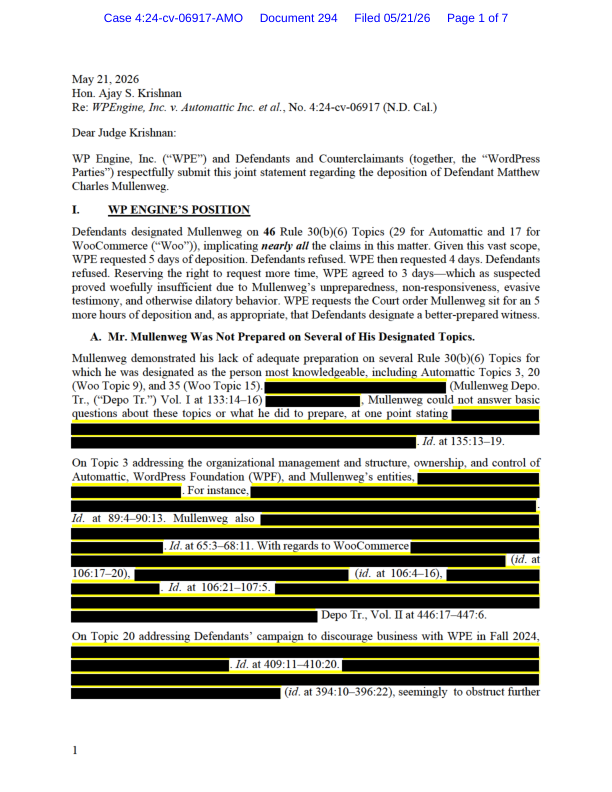
- Defendants designated Mullenweg on 46 Rule 30(b)(6) Topics (29 for Automattic and 17 for WooCommerce ("Woo")), implicating
*nearly all*
the claims in this matter. Given this vast scope, WPE requested 5 days of deposition. Defendants refused. WPE then requested 4 days. Defendants refused. Reserving the right to request more time, WPE agreed to 3 days—which as suspected proved woefully insufficient due to Mullenweg's unpreparedness, non-responsiveness, evasive testimony, and otherwise dilatory behavior. WPE requests the Court order Mullenweg sit for an 5 more hours of deposition and, as appropriate, that Defendants designate a better-prepared witness. ([View Highlight](https://read.readwise.io/read/01ksfvcq0mm7be6wxc6b9kfn65))
- Note: Docket 294: WPE seeks 5 more hours of Mullenweg deposition — alleges unpreparedness/evasiveness across 46 topics.
- Tags: wp-engine-automattic, legal