WP Engine, Inc. V. Automattic Inc. Et Al.
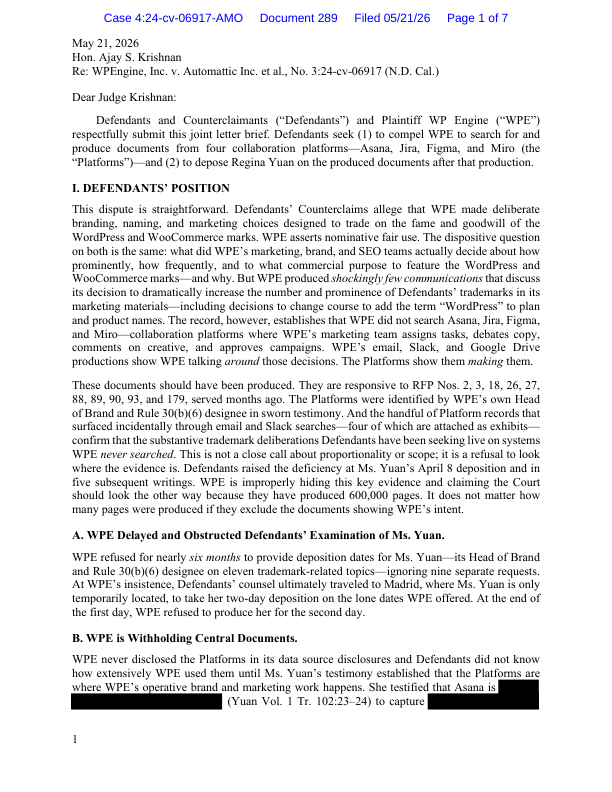
🔗 **Source:** [WP Engine, Inc. V. Automattic Inc. Et Al.](https://storage.courtlistener.com/recap/gov.uscourts.cand.437474/gov.uscourts.cand.437474.289.0.pdf)
> [!note]+ Document Notes
> tags: [wp-engine-automattic, discovery-dispute, trademark-litigation, deposition-conflict, platform-search, brand-marketing, document-production, nominative-fair-use, wordpress-governance]
> author: Joint Letter Brief (WP Engine & Defendants)
> source: CourtListener RECAP - N.D. Cal. 4:24-cv-06917-AMO
> filing_type: joint letter brief
> docket: 289.0
>
> # 🏷️ Discovery Battle Over Marketing Platform Documents and Deposition Rights
>
> # 🧭 Table of Contents
> - [Summary](#-summary)
> - [Main Content](#-main-content)
> - [References](#-references)
> - [Paraphrase](#-paraphrase)
> - [Governance Digest](#-governance-digest)
> - [Analysis Sections](#analysis-sections)
> - [Conclusion](#-conclusion)
> - [Refactor Appendix](#-refactor-appendix)
>
> # 🔗 References
> **Dockets:** 289.0 (this filing), 252, 238, 1 (complaint)
> **Rules:** FRCP 26(b)(2), Rule 30(b)(6), E-Discovery Guideline 1.03
> **Cases:** New Kids on the Block v. News America Publishing, Inc., 971 F.2d 302 (9th Cir. 1992); Brooks Sports, Inc. v. Anta (China) Co., Ltd., 2018 WL 7488924 (E.D.Va. 2018); Myung Ga, Inc. v. Myung Ga of MD, Inc., 2011 WL 3476828 (D. Md. 2011); Martin v. Monsanto Co., 2017 WL 5172205 (C.D. Cal. 2017)
> **Judge:** Magistrate Judge Ajay S. Krishnan (discovery matters)
>
> # 📝 Summary
>
> This joint letter brief presents a heated discovery dispute where Automattic/Mullenweg seek to compel WP Engine to search four collaboration platforms (Asana, Jira, Figma, Miro) for trademark-related marketing documents and allow a third deposition day for WP Engine's Head of Brand Regina Yuan. The fight centers on whether WP Engine's 600,000+ page document production adequately covers internal branding decisions about WordPress trademark usage—the core issue for both trademark infringement counterclaims and WP Engine's nominative fair use defense.
>
> **Key Stakeholders:** WP Engine's marketing/brand teams, Regina Yuan (Head of Brand), the WordPress trademark ecosystem, and the broader question of what internal deliberations matter for trademark disputes.
>
> **Risks/Tradeoffs:** Defendants risk appearing to conduct a fishing expedition while WP Engine risks concealing smoking-gun evidence of commercial trademark exploitation. The dispute reveals deep disagreement about whether trademark law focuses on internal intent or external appearance.
>
> **Bottom Line:** A discovery power struggle that could determine whether crucial evidence about WordPress trademark commercialization sees daylight—with major implications for how WordPress governance entities can police trademark usage.
>
> # 📖 Main Content
>
<!-- deep-read:sections start -->
## 🗒️ Notes
**The Core Dispute:**
- Defendants want WP Engine to search Asana, Jira, Figma, and Miro for documents responsive to 10 different RFPs (Nos. 2, 3, 18, 26, 27, 88, 89, 90, 93, 179)
- WP Engine argues its 600,000+ page production from email, Slack, and Google Drive is sufficient
- Fight triggered by Regina Yuan's deposition testimony revealing these platforms house key branding workflows
**Defendants' Position - "Look Where the Evidence Actually Is":**
- Yuan testified these platforms are where WP Engine's "operative brand and marketing work happens"
- Asana captures workflow decisions and approvals for branding/naming choices
- Figma houses the 2024 brand refresh approval workflow "at the heart of the counterclaims"
- Four incidental documents found in email notifications show substantive trademark deliberations on these platforms
- Example evidence includes discussions of increasing "search authority" and "commercial deployment" of WordPress marks
**WP Engine's Position - "Fishing Expedition After 600k Pages":**
- Comprehensive search already conducted across disclosed data sources and custodians
- Yuan testified that actual branding decisions were made through email/Slack, not the platforms
- Platforms are workflow tools (Asana), bug tracking (Jira), visual collaboration (Miro), and design (Figma)—not strategic decision repositories
- Legal standard focuses on public marketing materials, not internal decision-making process
- Defendants use same platforms but refuse to search them reciprocally
**The Yuan Deposition Saga:**
- WP Engine delayed providing deposition dates for 6 months despite 9 requests
- Defendants traveled to Madrid for deposition on WP Engine's limited dates
- WP Engine refused to produce Yuan for second day initially
- Defendants got partial second day on May 14 (discovery cutoff) with hard 11 AM stop
- Yuan designated as Rule 30(b)(6) witness on 11 trademark-related topics
**Legal Framework Clash:**
- Defendants: Nominative fair use requires using "only so much of the mark as is reasonably necessary"—internal intent about "how prominently, how frequently, and to what commercial purpose" matters
- WP Engine: New Kids three-factor test "turns exclusively on public marketing materials"—internal deliberations irrelevant
# 📚 References
- New Kids on the Block v. News America Publishing, Inc., 971 F.2d 302, 308 (9th Cir. 1992)
- Brooks Sports, Inc. v. Anta (China) Co., Ltd., 2018 WL 7488924 (E.D.Va. 2018)
- Federal Rules of Civil Procedure 26(b)(2), Rule 30(b)(6)
- N.D. Cal. E-Discovery Guideline 1.03
# 🗣️ Paraphrase
**Defendants' Story:** "WP Engine is hiding the smoking gun. They produced 600,000 pages but deliberately avoided searching the four platforms where their Head of Brand testified the actual marketing decisions happen. The few documents we found by accident show employees talking about boosting 'search authority' and 'commercial deployment' of our WordPress trademarks—exactly what we need to prove trademark infringement. WP Engine delayed Regina Yuan's deposition for six months, then tried to limit it when she revealed these platforms exist. They're playing games with discovery."
**WP Engine's Story:** "This is a desperate fishing expedition. We've produced 600,000 pages including thousands of emails, Slack messages, surveys, and brand presentations. Regina Yuan was deposed for two full days and answered everything about the 2024 rebrand. These platforms are just project management tools—the real decisions happened over email and Slack, which we produced. The legal test looks at public marketing, not internal brainstorming. Defendants use the same platforms but won't search them themselves. They're trying to relitigate discovery they could have requested months ago."
# 📰 Governance Digest
The WordPress trademark enforcers are demanding to peek behind WP Engine's marketing curtain, specifically into their project management and design collaboration tools. Automattic claims WP Engine is hiding evidence of deliberately exploiting WordPress trademarks for commercial gain, while WP Engine says they've already produced 600,000 pages and this is just a fishing expedition. The fight reveals a key question: when policing WordPress trademark usage, does internal corporate intent matter, or just what the public sees? It's like arguing whether we should judge a book by its cover or by the author's notes—except the book costs millions in legal fees and the notes might be on Figma.
# 🧪 Hypotheses
1. **Platform Specialization Hypothesis:** Marketing teams compartmentalize different types of decisions across specialized platforms, making comprehensive discovery require multi-platform searches
2. **Intent Materiality Hypothesis:** Internal deliberations about trademark prominence and commercial purpose are legally material to both infringement claims and nominative fair use defenses
3. **Discovery Timing Hypothesis:** Late-stage discovery disputes indicate earlier deficient meet-and-confer processes or strategic information withholding
4. **Reciprocal Burden Hypothesis:** Parties using identical collaboration platforms should bear symmetric discovery burdens
5. **Deposition Effectiveness Hypothesis:** Witness preparation and time limitations can effectively frustrate opposing counsel's examination strategy
6. **Trademark Governance Hypothesis:** WordPress trademark enforcement strategy depends on accessing internal corporate decision-making processes
# 📊 Methodology
**Evidentiary Basis:** Joint letter brief with competing declarations (Hogan Declaration for Defendants, Keohane Declaration for WP Engine) and deposition transcript excerpts from Regina Yuan's April 8 and May 14, 2026 depositions.
**Procedural Posture:** Post-discovery-cutoff motion practice before Magistrate Judge Krishnan, with fact discovery having closed May 14, 2026. Both parties cite personal knowledge through their respective counsel declarations and sworn deposition testimony.
**Document Foundation:** Four exhibits showing incidental platform documents (Asana workflow, Figma approval, Jira tracking, Miro collaboration) that defendants argue demonstrate substantive trademark deliberations on unsearched platforms.
# ❓ Questions
1. How will Judge Krishnan balance proportionality concerns against potential evidence gaps in trademark intent analysis?
2. What discovery reciprocity requirements will the court impose if compelling additional platform searches?
3. How does the Madrid deposition logistics dispute affect the court's assessment of good faith cooperation?
4. Will the court adopt defendants' "internal intent matters" or WP Engine's "public materials only" view of nominative fair use?
5. What sanctions risk does WP Engine face if the platforms contain significant responsive documents?
6. How might this discovery dispute pattern repeat in other WordPress trademark enforcement actions?
# 🔮 Future Research
**Litigation Threads:**
- Judge Krishnan's ruling on platform search scope and deposition extensions
- Impact of additional platform documents (if produced) on trademark infringement/fair use analysis
- Discovery sanctions motions if evidence withholding found
- Expert witness testimony on trademark usage patterns and commercial intent
**WordPress Governance Threads:**
- Development of WordPress Foundation trademark enforcement protocols
- Corporate compliance frameworks for WordPress ecosystem companies
- Internal governance documentation practices for trademark-sensitive decisions
- Community guidelines for commercial WordPress trademark usage
# 💡 Implications
**Practice:** WordPress ecosystem companies should implement comprehensive document retention covering all collaboration platforms, not just email/Slack, given trademark enforcement scrutiny.
**Policy:** WordPress Foundation trademark enforcement may increasingly focus on internal corporate decision-making processes rather than just external marketing appearances.
**Security:** Marketing and brand teams in WordPress companies face heightened legal exposure for internal communications about trademark strategy.
**Education:** WordPress community needs guidance on legally compliant trademark usage and documentation practices.
**Funding:** Discovery costs for trademark disputes may escalate significantly with multi-platform search requirements, affecting smaller WordPress businesses disproportionately.
# 🧠 Learning Styles Assessment
**Visual:** Document exhibits and platform interface references support visual learners
**Aural:** Legal argument structure follows oral advocacy patterns
**Verbal:** Heavy use of legal terminology and written argument analysis
**Kinesthetic:** Procedural discovery mechanics require hands-on legal process understanding
**Logical:** Step-by-step legal reasoning and rule application
**Social:** Joint brief format shows collaborative/adversarial legal interaction
**Solitary:** Complex legal analysis requires individual study and reflection
**Naturalistic:** Pattern recognition in legal precedent application and case categorization
**Reading Level:** Graduate/Professional (complex legal terminology, procedural rules, case citations)
# 📊 Accessibility Assessment
**Structure:** Well-formatted legal brief with clear headings and section organization
**Text Extraction:** Fully text-extractable court filing
**WCAG 2.2 AA:** Legal document format meets accessibility standards with clear hierarchy
**Artifacts:** Standard court filing formatting without problematic table/line artifacts
**Navigation:** Roman numeral sections and clear party position delineation aid comprehension
# 🌍 DEIB Assessment
**Cultural Breadth:** U.S. federal court system context; international business elements (Madrid deposition location)
**Inclusive Language:** Professional legal terminology without exclusionary language
**Neurodiversity Support:** Clear structure and logical organization support diverse cognitive processing
**Representation:** Corporate legal dispute between technology companies
**Psychological Safety:** Adversarial legal context inherently creates tension but follows professional norms
# ✅ Logical Validity
**Strong Reasoning:** Both parties present coherent arguments within their legal frameworks
**Fallacies:**
- *Defendants' Red Herring:* Focusing on document volume rather than platform comprehensiveness
- *WP Engine's False Dilemma:* Presenting choice as either "fishing expedition" or "comprehensive production" without middle ground
- *Both Parties' Ad Hominem:* Attacking opposing counsel's tactics rather than addressing substantive legal standards
**Tone:** Professional but combative legal advocacy appropriate for discovery dispute context
# 🛡️ DARVO Analysis
**Defendants' Framing:**
- **Deny:** WP Engine denies hiding relevant evidence
- **Attack:** Characterizes defendants as conducting fishing expedition
- **Reverse:** Positions defendants as the obstructionist party despite their own platform usage
**WP Engine's Framing:**
- **Deny:** Defendants deny making unreasonable discovery demands
- **Attack:** Characterizes WP Engine as deliberately withholding key evidence
- **Reverse:** Positions WP Engine as the transparent party despite delayed depositions
**Assessment:** Both parties employ DARVO tactics typical of adversarial discovery disputes, making substantive evaluation require careful attention to underlying facts rather than rhetorical framing.
# 🎯 Conclusion
This discovery battle crystallizes a fundamental tension in WordPress trademark enforcement: whether internal corporate deliberations about commercial trademark usage matter legally, or whether only external public-facing materials count. Judge Krishnan's ruling will significantly impact both this case's trajectory and future WordPress trademark disputes.
**Watch Next:** Judge Krishnan's order on platform searches and deposition scope, which could either validate WP Engine's targeted discovery approach or expose significant evidence gaps requiring expensive additional production. The ruling may establish precedent for WordPress ecosystem trademark enforcement discovery standards.
# 🧱 Refactor Appendix
## 📚 Literature Atoms
> [!quote] "The dispositive question on both is the same: what did WPE's marketing, brand, and SEO teams actually decide about how prominently, how frequently, and to what commercial purpose to feature the WordPress and WooCommerce marks—and why."
> [!quote] "WPE's email, Slack, and Google Drive productions show WPE talking around those decisions. The Platforms show them making them."
> [!quote] "Nominative fair use under New Kids on the Block v. News America Publishing, Inc., 971 F.2d 302, 308 (9th Cir. 1992) requires that 'only so much of the mark' be used 'as is reasonably necessary to identify the product.'"
> [!quote] "It does not matter how many pages were produced if they exclude the documents showing WPE's intent."
> [!quote] "All of the factors in the likelihood of confusion test go to publicly available facts, as the entire issue is whether the public is likely to be confused."
## 🧠 Permanent Candidates
#### Platform-Specific Discovery Protocols
Modern trademark litigation requires comprehensive search across specialized collaboration platforms, not just traditional email/document systems.
#### Intent vs. Appearance in Trademark Law
Core tension between internal corporate decision-making and external public presentation in trademark infringement analysis.
#### Discovery Timing and Strategic Withholding
Late-stage discovery disputes often indicate earlier procedural failures or strategic information management.
#### WordPress Trademark Enforcement Evolution
WordPress Foundation trademark protection increasingly scrutinizes internal corporate processes rather than just external marketing.
## ✏️ Fleeting Queue
- Connection between Madrid deposition location and international WordPress business operations
- Relationship between Rule 30(b)(6) designations and individual witness knowledge limitations
- Pattern of discovery disputes potentially indicating broader case management issues
- Implications for smaller WordPress businesses unable to afford multi-platform discovery costs
<!-- deep-read:sections end -->
📄 **Full text:** ![[Full Document Contents/Articles/WP Engine, Inc. V. Automattic Inc. Et Al.-3.md|WP Engine, Inc. V. Automattic Inc. Et Al. by Ajay S. Krishnan, WP Engine]]
## Highlights
- In all events, Defendants have had ample opportunity to fully explore WPE's decision making process. WPE has produced thousands of documents, including emails, Slack messages, surveys and raw survey data, and brand planning slide presentations, including in response to Defendants' demands following Ms. Yuan's first deposition.
*See*
Keohane Decl. ¶¶ 2, 5, 8. Defendants deposed Ms. Yuan for two days; they deposed WPE's CEO for two days; and they had the opportunity to depose WPE's Chief Marketing Officer, but chose to cancel her deposition.
*See id.*
¶ 7. Regarding the "2024 rebrand" that Defendants contend is "at the heart of the counterclaims" and is critical to their Motion, Ms. Yuan
*led*
the "rebrand" and testified fulsomely across two days about decision making relating to it, including answering hours of questions concerning internal presentations WPE produced concerning it. Her testimony confirms that the Platforms are
*unlikely*
to yield the type of unique, substantive strategic discussions or approvals Defendants claim they are seeking. ([View Highlight](https://read.readwise.io/read/01ksfvffpv9yps6ckxc10ggd2a))
- Note: Docket 289: WPE opposes added platform discovery — thousands of docs produced, Yuan deposed 2 days on the rebrand.
- Tags: wp-engine-automattic, legal