WPEng, Inc. V. Automattic Inc. Et Al., No. 4:24-Cv-06917
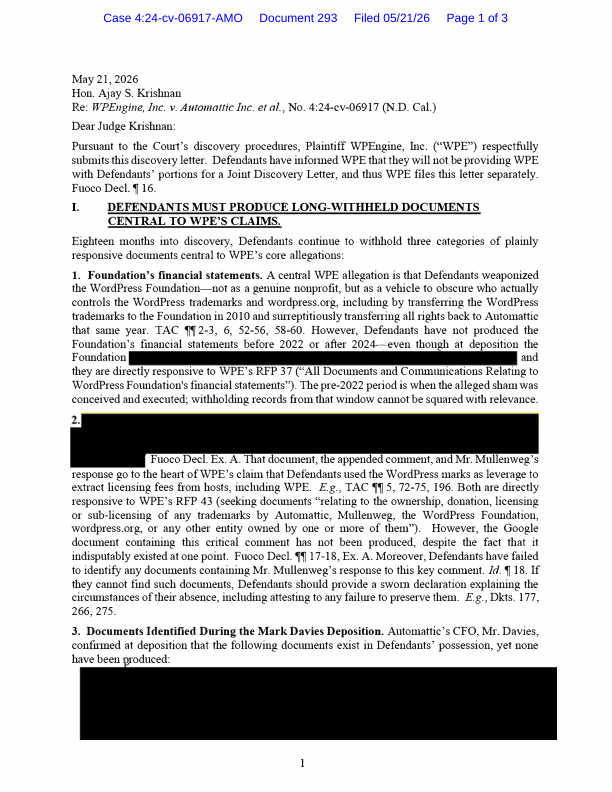
🔗 **Source:** [WPEng, Inc. V. Automattic Inc. Et Al., No. 4:24-Cv-06917](https://storage.courtlistener.com/recap/gov.uscourts.cand.437474/gov.uscourts.cand.437474.293.0.pdf)
> [!note]+ Document Notes
> tags: [wp-engine-automattic, discovery-dispute, wordpress-foundation, financial-discovery, trademark-control, wordpress-governance, document-production, deposition-follow-up]
> author: WP Engine, Inc.
> source: CourtListener RECAP - N.D. Cal. 4:24-cv-06917-AMO
> filing_type: discovery letter brief
> docket: 293.0
>
> # 🏷️ WP Engine's Discovery Letter Seeking Production of Foundation Financial Records and Mullenweg Response Documents
>
> # 🧭 Table of Contents
> - [References](#-references)
> - [Summary](#-summary)
> - [Main Content](#-main-content)
> - [Paraphrase](#-paraphrase)
> - [Governance Digest](#-governance-digest)
> - [Hypotheses](#-hypotheses)
> - [Methodology](#-methodology)
> - [Questions](#-questions)
> - [Future Research](#-future-research)
> - [Implications](#-implications)
> - [Learning Styles Assessment](#-learning-styles-assessment)
> - [Accessibility Assessment](#-accessibility-assessment)
> - [DEIB Assessment](#-deib-assessment)
> - [Logical Validity](#-logical-validity)
> - [DARVO Analysis](#-darvo-analysis)
> - [Conclusion](#-conclusion)
> - [Refactor Appendix](#-refactor-appendix)
>
> # 🔗 References
> **Dockets:** 177, 266, 275, 293.0
> **FRCP:** Rule 36(a)(6)
> **Discovery Requests:** RFP 37, RFP 43, RFP 264, RFP 168, RFP 44, RFP 317, RFA 45
> **Pleadings:** TAC ¶¶ 2-3, 6, 52-56, 58-60, 72-75, 196
> **Court:** N.D. Cal. No. 4:24-cv-06917-AMO (Mag. Judge Ajay S. Krishnan)
>
> # 📝 Summary
> WP Engine files a unilateral discovery letter after defendants refused to participate in a joint filing, seeking court intervention on three categories of withheld documents: WordPress Foundation financial statements (pre-2022/post-2024), critical Google document comments about trademark licensing leverage, and financial flow documents between Automattic/Foundation/Mullenweg identified during CFO Mark Davies' deposition. The filing also challenges Mullenweg's evasive responses to data production requests and requests for admission about Foundation tax filing disclosures. This matters because it targets the financial paper trail allegedly proving Automattic's surreptitious control over WordPress trademarks through the Foundation—the governance smoking gun WP Engine needs to prove its "sham nonprofit" theory. Bottom line: WP Engine is fighting for access to financial records that could expose whether the WordPress Foundation operates as Automattic's trademark shell or as a genuine independent nonprofit.
>
> # 📖 Main Content
>
<!-- deep-read:sections start -->
## 🗒️ Notes
**Missing Foundation Financial Records (Pre-2022/Post-2024)**
- WP Engine alleges WordPress Foundation serves as vehicle to obscure trademark control
- Defendants transferred WordPress trademarks to Foundation in 2010, then "surreptitiously transferred all rights back to Automattic that same year"
- Foundation has not produced financial statements before 2022 or after 2024
- Pre-2022 period is when alleged "sham was conceived and executed"
- Documents responsive to RFP 37 seeking Foundation financial statements
**Critical Google Document Comments**
- Contains comment about using WordPress marks as "leverage to extract licensing fees from hosts"
- Goes to heart of WP Engine's claims about trademark weaponization
- Google document existed but has not been produced despite being responsive to RFP 43
- Mullenweg's response to the comment also missing
- WP Engine demands sworn declaration explaining circumstances if documents destroyed
**CFO Davies Deposition Follow-Up**
- Automattic CFO Mark Davies confirmed existence of specific documents at deposition
- Documents relate to "financial flows among Automattic, the Foundation, and Mr. Mullenweg"
- Defendants promised production but failed to deliver despite fact discovery closing
- Responsive to RFP 264 (Automattic-Mullenweg transactions), RFP 168 (shared resources with Audrey HC), RFP 44 (trademark licensing)
**Mullenweg's WordPress Analytics Access (RFP 317)**
- Mullenweg's March 15, 2026 X.com post claimed "a few new [WordPress] sites being created every second"
- Statement demonstrates "continuous, real-time access to wordpress.org analytics"
- Contradicts defendants' claims that analytics don't exist or are unavailable
- Data relevant to WordPress market share and monopoly power evidence
**Foundation Tax Filing Disclosure (RFA 45)**
- Requests admission that Mullenweg didn't disclose exclusive license agreement in Foundation's California tax filings
- Goes to concealment of Automattic's trademark control
- Mullenweg's evasive response claims insufficient information despite founding the Foundation
- Tax filings are public records available online at rct.doj.ca.gov
# 📚 References
- WP Engine Third Amended Complaint
- Fuoco Declaration ¶¶ 16-19, Exhibits A-C
- Federal Rules of Civil Procedure Rule 36(a)(6)
- California Attorney General Registry of Charitable Trusts database
# 🗣️ Paraphrase
WP Engine tells the court that after 18 months of discovery, defendants are still hiding three types of crucial documents. First, the WordPress Foundation's old financial records (before 2022) and recent ones (after 2024) that would show whether it's really independent or just Automattic's puppet for controlling WordPress trademarks. Second, a Google document with comments about using WordPress trademarks to squeeze money out of web hosts—exactly what WP Engine says happened to them. Third, financial documents that Automattic's money guy confirmed exist but haven't been handed over yet. WP Engine also wants Mullenweg to produce data backing up his tweet about WordPress site creation rates, since he claims to have real-time access while saying other analytics don't exist. Finally, they want Mullenweg to give a straight yes-or-no answer about whether he disclosed Automattic's exclusive trademark license in the Foundation's public tax filings, instead of his current non-answer claiming he doesn't know about his own paperwork.
# 📰 Governance Digest
The WordPress Foundation's financial transparency is under legal microscope as WP Engine pushes for records that could reveal whether Automattic secretly controls WordPress trademarks through the nominally independent nonprofit. The missing financial statements from 2010-2022—when the alleged trademark shell game occurred—represent the potential smoking gun in governance terms. If WP Engine's theory proves correct, it would mean the WordPress community has been operating under false assumptions about who actually controls the project's core assets. The Foundation's legitimacy as an independent steward hangs in the balance, with implications for every WordPress contributor who believed they were supporting genuine open-source governance rather than corporate interests disguised as community infrastructure.
# 🧪 Hypotheses
1. **Financial Flow Hypothesis**: WordPress Foundation financial statements will show significant undisclosed transactions with Automattic inconsistent with independent nonprofit operation
2. **Trademark Shell Theory**: Pre-2022 Foundation records will reveal the 2010 trademark transfer and immediate license-back was structured to obscure rather than genuinely transfer control
3. **Analytics Access Contradiction**: Mullenweg's real-time WordPress analytics access demonstrates broader data control than defendants have disclosed in discovery
4. **Tax Filing Concealment**: Foundation's California tax filings omit disclosure of the exclusive trademark license agreement with Automattic
5. **Document Preservation Failure**: Missing Google documents and CFO-confirmed records indicate systematic discovery violations rather than innocent loss
6. **Governance Facade Hypothesis**: Financial flows between Automattic, Foundation, and Mullenweg's personal entities will show intermingled operations inconsistent with independent governance
# 📊 Methodology
Filing relies on the Fuoco Declaration establishing personal knowledge basis for document existence and defendants' production failures. Evidentiary foundation includes CFO Davies' deposition testimony confirming specific documents exist, Mullenweg's public X.com post demonstrating analytics access, and defendants' own prior statements promising document production. Procedural posture is post-fact-discovery motion practice under Federal Rules of Civil Procedure, with WP Engine forced into unilateral filing after defendants refused joint discovery letter participation. Declaration exhibits provide documentary support for claims about missing responsive materials.
# ❓ Questions
- Will defendants claim privilege over Foundation-Automattic financial flows, and how will the court balance corporate privilege against nonprofit transparency obligations?
- What sanctions might the court impose if document destruction is found, particularly for materials central to trademark control allegations?
- How will Mullenweg's public statements about WordPress analytics access affect his credibility regarding other claimed data limitations?
- Can the Foundation maintain tax-exempt status if financial records reveal undisclosed control arrangements with for-profit Automattic?
- What governance reforms might emerge if the Foundation's independence is legally disproven?
# 🔮 Future Research
**Litigation Threads**: Watch for defendants' response to discovery letter, potential sanctions motions, and court's ruling on document production scope. Monitor whether missing documents surface or require forensic recovery efforts.
**WordPress Governance**: Track Foundation board responses to financial transparency challenges, community discussions about governance reform, and potential impacts on contributor trust. Research similar open-source foundation structures for comparative governance analysis.
**Trademark Law Development**: Follow how courts handle trademark control disputes involving nominally independent foundations, particularly regarding tax-exempt entity obligations and public benefit standards.
# 💡 Implications
**Practice**: Legal practitioners should document foundation-corporate relationships meticulously, as informal control arrangements face increasing scrutiny. Open-source projects need clear governance documentation separating nonprofit and commercial interests.
**Policy**: Regulatory attention to tax-exempt entities serving commercial interests may increase, requiring stricter disclosure requirements for foundation-corporate relationships.
**Security**: Community trust in WordPress governance infrastructure depends on resolving questions about who actually controls core project assets and decision-making processes.
**Education**: WordPress contributors need better understanding of project governance structure, particularly the relationship between Foundation, Automattic, and wordpress.org operations.
**Funding**: Foundation fundraising credibility depends on demonstrating genuine independence from commercial interests, requiring transparent financial reporting and governance practices.
# 🧠 Learning Styles Assessment
**Visual**: Document production timeline and financial flow diagrams would aid comprehension
**Aural**: Complex legal arguments benefit from oral explanation of discovery procedure
**Verbal**: Extensive legal terminology requires glossary support for general audience
**Kinesthetic**: Abstract governance concepts need concrete examples and case studies
**Logical**: Strong sequential argument structure appeals to analytical learners
**Social**: Governance implications invite collaborative discussion and debate
**Solitary**: Dense legal content requires individual processing time and reflection
**Naturalistic**: Pattern recognition useful for identifying governance structure themes
**Reading Level**: College/graduate level due to legal terminology and complex procedural concepts
# 📊 Accessibility Assessment
Document appears text-extractable with clear structure and consistent formatting. Contains standard legal headings and numbered sections supporting screen reader navigation. No apparent table artifacts or line-number issues. Court filing format includes proper document identification and party information. Meets basic WCAG 2.2 AA standards for text accessibility, though legal terminology may present comprehension barriers for general audiences.
# 🌍 DEIB Assessment
**Cultural Breadth**: Limited to U.S. legal system context with minimal international perspective on open-source governance models
**Inclusive Language**: Professional legal language avoids exclusionary terminology, though technical jargon may limit accessibility
**Neurodiversity Support**: Dense legal text and complex procedural concepts may challenge readers with attention or processing differences
**Representation**: Corporate litigation context may not reflect diverse WordPress community stakeholder perspectives
**Psychological Safety**: Adversarial legal framing could discourage community members from engaging with governance questions
# ✅ Logical Validity
**Strong Reasoning**: Clear causal chain from document production failures to prejudice in proving trademark control claims. Logical progression from general allegations to specific discovery violations with supporting evidence.
**Fallacies**: None identified. Arguments follow standard discovery dispute format with appropriate legal citations and factual support.
**Tone**: Professional and assertive legal advocacy tone appropriate for discovery motion practice, though may appear aggressive to non-legal audiences familiar with collaborative open-source norms.
# 🛡️ DARVO Analysis
Not applicable—this is a discovery motion in ongoing litigation rather than a defensive response to abuse allegations. WP Engine maintains consistent position as plaintiff seeking document production without attempting to reverse victim-offender dynamics.
# 🎯 Conclusion
WP Engine's discovery letter targets the financial paper trail that could prove or disprove its central governance theory—that the WordPress Foundation serves as Automattic's trademark shell rather than genuine independent steward. The missing Foundation financial statements from 2010-2022 represent the potential smoking gun, covering the period when the alleged surreptitious trademark control arrangement was established. Success in obtaining these documents could fundamentally reshape understanding of WordPress governance, while failure might force WP Engine to prove its case through circumstantial evidence alone. Watch for the court's ruling on document production scope and any sanctions for discovery violations—the outcome will significantly impact both the litigation trajectory and broader questions about open-source project governance transparency.
# 🧱 Refactor Appendix
## 📚 Literature Atoms
> [!quote]
> "A central WPE allegation is that Defendants weaponized the WordPress Foundation-not as a genuine nonprofit, but as a vehicle to obscure who actually controls the WordPress trademarks and wordpress.org, including by transferring the WordPress trademarks to the Foundation in 2010 and surreptitiously transferring all rights back to Automattic that same year."
> [!quote]
> "The pre-2022 period is when the alleged sham was conceived and executed; withholding records from that window cannot be squared with relevance."
> [!quote]
> "Mr. Mullenweg's public statement is itself an admission of continuous, real-time access to wordpress.org analytics, which cannot be reconciled with Defendants' production of only limited categories of wordpress.org data or their claims that several categories of analytics do not exist or are unavailable."
> [!quote]
> "Mr. Mullenweg founded the Foundation and arranged the license-back to Automattic; whether the Foundation's tax filings disclose that license concerns his own paperwork."
### 🧠 Permanent Candidates
**WordPress Foundation Independence**: Central question whether Foundation operates as genuine nonprofit or corporate trademark shell
**Discovery Violation Patterns**: Systematic withholding of financial documents across multiple categories and time periods
**Trademark Control Mechanisms**: 2010 transfer-and-license-back structure as method for obscuring actual control
**Analytics Access Contradictions**: Mullenweg's public claims versus discovery responses about data availability
## ✏️ Fleeting Queue
- Connection between CFO Davies deposition and broader Automattic financial structure
- Significance of Audrey Capital/HC entities in trademark control scheme
- Public records availability versus claimed discovery burdens
- WordPress community implications of Foundation governance revelations
<!-- deep-read:sections end -->
📄 **Full text:** ![[Full Document Contents/Articles/WPEng, Inc. V. Automattic Inc. Et Al., No. 424-Cv-06917.md|WPEng, Inc. V. Automattic Inc. Et Al., No. 4:24-Cv-06917 by Ajay S. Krishnan]]
## Highlights
- RFA 45 asks Mr. Mullenweg to "[a]dmit that You did not disclose the exclusive license agreement between WordPress Foundation and Automattic in the WordPress Foundation's tax filings with the California government." This goes to the heart of WPE's allegation that Defendants concealed Automattic's exclusive control of the WordPress trademarks. E.g., TAC ¶ 53-54. Hours before the deadline for this motion, Mr. Mullenweg amended his response to state: "Mr. Mullenweg has made a reasonable inquiry and the information Mr. Mullenweg knows or can readily obtain is insufficient to enable Mr. Mullenweg to admit or deny this Request, and on that basis denies this Request." Fuoco Decl. ¶ 19, Ex. C. This response makes no sense. Mr. Mullenweg founded the Foundation and arranged the license-back to Automattic; whether the Foundation's tax filings disclose that license concerns his own paperwork. The filings are also public records, freely available online (see https://rct.doj.ca.gov/). A "reasonable inquiry" required no more than clicking through links to see whether he disclosed this crucial fact. WPE accordingly requests that the Court deem the response insufficient under Rule 36(a)(6) and order Mr. Mullenweg to "admit" or "deny" RFA 45. ([View Highlight](https://read.readwise.io/read/01ksfvdxd35cnnqd4m3kdb6gpk))
- Note: Docket 293: RFA 45 — alleged concealment of the Foundation→Automattic exclusive trademark license in CA tax filings.
- Tags: wp-engine-automattic, legal