WPEngine, Inc. V. Automattic Inc., Et Al.
🔗 **Source:** [WPEngine, Inc. V. Automattic Inc., Et Al.](https://readwise.io/reader/document_raw_content/449370033)
> [!note]+ Document Notes
> ```yaml
> tags: [WordPress, law, open-source]
> author: [MISSING]
> source: [MISSING]
> reference: [https://readwise.io/reader/document_raw_content/449370033]
> date created: 2026-04-29 00:00
>
> ---
>
> # 🏷️ Title: WPEngine, Inc. V. Automattic Inc., Et Al.
>
<!-- deep-read:sections start -->
## 🧭 Table of Contents
- [📝 Summary](#-summary)
- [📖 Main Content](#-main-content)
- [🗒️ Notes](#️-notes)
- [📚 References](#-references)
- [🗣️ Paraphrase](#️-paraphrase)
- [📰 Newsletter](#-newsletter)
- [✅ Action Items](#-action-items)
- [🧪 Hypotheses](#-hypotheses)
- [📊 Methodology](#-methodology)
- [❓ Questions](#-questions)
- [🔮 Future Research](#-future-research)
- [💡 Implications](#-implications)
- [🧠 Learning Styles Assessment](#-learning-styles-assessment)
- [📊 Accessibility Assessment](#-accessibility-assessment)
- [🌍 DEIB Assessment](#-deib-assessment)
- [✅ Logical Validity](#-logical-validity)
- [🛡️ DARVO Analysis](#-darvo-analysis)
- [🎯 Conclusion](#-conclusion)
### 🔗 References
- Include links cited in or relevant to the article.
## 📝 Summary
- What happened.
- Why it matters.
- Key stakeholders.
- Risks and tradeoffs.
- Bottom line.
## 📖 Main Content
- Explain the core arguments in plain language.
- Add sourced context and define terms.
- Note uncertainties or contested claims.
### 🗒️ Notes
Dense notes go here (no timestamps — this is a court PDF, not a transcript).
## 📚 References
- [WPEngine, Inc. v. Automattic Inc., et al.](https://readwise.io/reader/document_raw_content/449370033)
- Add docket, court filings, and official statements as needed.
## 🗣️ Paraphrase
- Paragraph A paraphrase.
- Paragraph B paraphrase.
## 📰 Newsletter
A new federal case, *WPEngine, Inc. v. Automattic Inc., et al.*, is raising high‑stakes questions about how WordPress businesses build on shared open‑source foundations. We’ll track the filings, surface plain‑language explainers, and point to resources on GPL, trademarks, and contributor rights so product teams and agencies can navigate risk while still shipping. Expect links to legal primers, community commentary, and any plugins or tools implicated as the case unfolds.
## ✅ Action Items
#### DevRel
- Coordinate clear messaging for developers about legal boundaries (GPL, APIs, trademarks) implicated by the case.
- Propose office hours or Q&A sessions with legal counsel for plugin/theme authors.
- Curate examples and templates for “compliant integration” patterns in docs and demos.
- Track developer sentiment and questions; route themes back to product and legal.
#### OSPO
- Review internal open‑source policies against issues raised by the complaint (licensing, attribution, trademarks, data use).
- Ensure license‑compliance scanning and approval flows cover patterns at issue in the case.
- Document guidance for contributing to and consuming from Automattic/WPEngine‑adjacent repos.
- Prepare executive brief on strategic risk and governance options.
#### Community
- Support maintainers with basic legal‑process explainers (what a civil case does/doesn’t mean).
- Encourage calm, policy‑focused discussion spaces; enforce codes of conduct.
- Gather anonymous input on how the dispute affects contributor willingness and trust.
- Share any neutral resources on GPL and commercial hosting/platforms.
#### WordPress
- Core: Watch for any direct claims touching core decision‑making or governance; keep discussion in public channels.
- Core Performance: Note if performance or infrastructure tradeoffs are used as legal arguments; document technical facts.
- Core AI: Flag any case elements involving data usage, training, or AI‑powered features around WordPress content.
- **Core Program Team:** Coordinate statements, FAQs, and event guidance to avoid speculation or harassment.
- Mobile: Ensure mobile integrations with proprietary services stay within licensing and branding norms raised here.
- Playground: Provide isolated repro environments if technical behaviors from the complaint need community review.
- Community: Update WordCamp and meetup guidance on discussing ongoing litigation responsibly.
- Training: Create neutral lessons on WordPress licensing, host/platform roles, and business models.
- Marketing: Avoid messaging that could be misconstrued in light of allegations; align with legal review.
- Support: Prepare macros for user questions about the case, pointing to official sources only.
- Design: If UI flows or branding are implicated, audit patterns used across ecosystem projects.
- Documentation: Clarify “what’s core vs. service vs. host” in DevHub/HelpHub.
- Photos: Review any logo/mark usage guidelines if trademarks are at issue.
- TV: Curate or commission talks explaining open‑source law basics (with disclaimers).
- Polyglots: Localize any official statements or FAQs about the dispute.
- Accessibility: Ensure all public statements and explainers are accessible and easy to read.
- Meta: Monitor .org infrastructure if requested for evidence discovery or clarification.
- CLI: Audit any commands that integrate directly with services named in the case; document boundaries.
- Hosting: Work on common “good citizen” standards between hosts, managed platforms, and upstream.
- Tide: Note implications for automated code assessment when commercial interests intersect.
- Openverse: Check how attribution, licenses, and platform integrations are communicated.
- Themes: Clarify guidance on theme–host/platform contracts and bundled services.
- Plugins: Highlight best practices for SaaS integrations, data handling, and naming/branding.
#### The WPOCC
- Consider whether to host neutral governance and licensing clinics for affected projects.
- Explore fellowships or stipends for maintainers whose work is dragged into legal disputes.
- Pilot transparent funding or mediation experiments that reduce incentives for litigation.
### FAIR
- Promote technical independence: clear separation of local WordPress stacks from proprietary hosting logic.
- Encourage public covenants about funding, governance, and non‑interference between host/platform and upstream project.
- Package reusable charters and operator agreements that define rights when commercial platforms build on WordPress.
## 🧪 Hypotheses
- High‑profile litigation between major WordPress companies will chill third‑party developer experimentation.
- Clearer, shared governance and licensing norms would reduce similar disputes.
- Public, neutral education about GPL and trademarks will improve ecosystem resilience.
- Business models relying on “platform lock‑in” are more likely to create legal conflicts in open‑source ecosystems.
### 📊 Methodology
- Survey WordPress developers and agencies before/after major case milestones about risk perception and willingness to ship new integrations.
- Compare incident rates of legal disputes in ecosystems with/without strong OSPO/governance norms.
- Analyze public code and docs of involved parties to classify integration patterns and licensing approaches.
### ❓ Questions
- Which specific legal theories (copyright, trademark, contract, trade secret) are central here?
- How might a ruling shape future WordPress‑as‑a‑service offerings?
- What responsibilities do large ecosystem players have toward upstream governance?
### 🔮 Future Research
- Comparative studies of disputes in other CMS and cloud ecosystems.
- Models for shared legal defense or mediation structures for open‑source maintainers.
- Impact of legal uncertainty on contribution volume and diversity.
### 💡 Implications
- Practice: Agencies and product teams may tighten review of platform dependencies and branding.
- Policy: WordPress‑adjacent organizations may formalize governance charters and contribution policies.
- Security: Discovery could surface infrastructure details needing hardening.
- Education: Stronger emphasis on licensing, contracts, and platform economics in WordPress training.
- Funding: Donors and sponsors may ask for clearer governance to de‑risk investments.
### 🧠 Learning Styles Assessment
- Reading level estimate: likely US college level (Flesch–Kincaid ≈ 12–14) due to legal language.
#### 👀 Visual learners
- Present: PDF layout, headings, maybe diagrams of parties/claims.
- Improve: Flowcharts of claims, timelines, and relationships between entities.
#### 🔊 Aural learners
- Present: None inherent.
- Improve: 2–5 minute audio summary and expert podcast episode.
#### 🗣️ Verbal learners
- Present: Precise legal definitions and argument structure.
- Improve: Plain‑language glossary and narrative case overview.
#### 🧩 Kinesthetic learners
- Present: None.
- Improve: Step‑by‑step exercises applying GPL/contract concepts to hypothetical plugins.
#### 🧠 Logical learners
- Present: Structured pleadings and cause‑of‑action breakdowns.
- Improve: Decision trees for “if you do X with WordPress, then legal risk Y.”
#### 🧑🤝🧑 Social learners
- Present: Community discussions around the case.
- Improve: Moderated study groups and Q&A sessions.
#### 🧘♀️ Solitary learners
- Present: Full text for deep reading.
- Improve: Reflection prompts and self‑check quizzes on key concepts.
#### 🌿 Naturalistic learners
- Present: Minimal connection.
- Improve: Analogies to ecosystems: hosts, niches, and symbiosis vs. predation.
### 📊 Accessibility Assessment
#### Screen reader semantics
- Present: Court PDFs often have basic text, but tagging is inconsistent.
- Improve: Ensure proper headings, landmarks, and descriptive titles.
#### Keyboard navigation
- Present: Standard PDF navigation.
- Improve: Tagged reading order and bookmarks for sections.
#### Contrast and readability
- Present: Black on white text; good contrast.
- Improve: Increase line spacing and allow user‑controlled themes.
#### Text resizing and reflow
- Present: Zoom; reflow may be limited.
- Improve: Provide HTML version with responsive layout and prefers‑reduced‑motion.
#### Media and captions
- Present: Text only.
- Improve: Offer audio with captions/transcript.
#### Forms and interactions
- Present: None.
- Improve: N/A.
#### Standards reference
- Map issues to WCAG 2.2 AA: 1.3.1, 1.4.3, 1.4.4, 2.4.1–2.4.6.
### 🌍 DEIB Assessment
#### Cultural breadth
- Present: US‑centric legal framing.
- Improve: Comparative notes for non‑US jurisdictions and translations.
#### Inclusive language
- Present: Formal legal terminology.
- Improve: Plain‑language companion summary; defined jargon.
#### Neurodiversity support
- Present: Rigid structure may help some readers.
- Improve: More headings, summaries, and consistent visual cues.
#### Representation
- Present: Focus on corporate entities.
- Improve: Case commentary that surfaces diverse community voices.
#### Psychological safety
- Present: Neutral but high‑stakes.
- Improve: Community guidelines and moderation around discussion of parties and individuals.
### ✅ Logical Validity
#### Strong reasoning
- Likely: Structured legal claims citing contracts, statutes, and facts; deductive where elements of a claim are listed and applied.
- Clarify by adding explicit element‑by‑element mappings and timelines.
#### Fallacies
- Watch for overgeneralizations about “the WordPress community” or motives; fix with precise claims and evidence.
#### Tone of voice
- Formal, adversarial, and technical, as is typical in federal civil litigation.
### 🛡️ DARVO Analysis
- Deny: Defendants may deny specific allegations or knowledge.
- Attack: Filings may question the other side’s credibility or characterization of facts.
- Reverse victim/offender: Each side may frame itself as protecting the ecosystem or users from the other’s conduct; look for rhetoric casting commercial strategies as “defensive” rather than exploitative.
## 🎯 Conclusion
*WPEngine, Inc. v. Automattic Inc., et al.* is poised to shape how large WordPress‑based businesses coexist on a shared open‑source foundation. For practitioners, the safest moves are to shore up licensing and governance practices, follow official statements rather than rumor, and use the case as a prompt to clarify how your own products relate—legally and technically—to WordPress, hosts, and managed platforms.
## 🧱 Refactor Appendix (append after 🎯 Conclusion)
### 📚 Literature Split Pad
- Purpose: Stage Konik CEE units that become per-source Literature notes.
- Split level: **H3**.
- Include verbatim quotes under 25 words and a [view highlight] link.
### [H1] 5–10-word present-tense claim
> [!quote] [WPEngine, Inc. V. Automattic Inc., Et Al.](https://readwise.io/reader/document_raw_content/449370033) by [[U.S. District Court]] via [[United States District Court]]. Published 2026-04-28. Accessed .
> “Short quote, verbatim, ≤25 words.”
Two lines: context and use. Cite data if relevant.
[view highlight](https://readwise.io/reader/document_raw_content/449370033#H1) #xref #articleseed ID:rw_[MISSING]
### [H2] 5–10-word present-tense claim
> [!quote] [WPEngine, Inc. V. Automattic Inc., Et Al.](https://readwise.io/reader/document_raw_content/449370033)
> “Short quote, verbatim, ≤25 words.”
Two lines: context and use.
[view highlight](https://readwise.io/reader/document_raw_content/449370033#H2) #xref ID:rw_[MISSING]
---
### 🔖 Atomic Split Pad (Zettel Candidates)
- Purpose: Promote reusable claims into Atomic notes.
- Split level: **H4**.
- Each item: one idea, present tense, specific, testable.
#### [Z1] 5–10-word present-tense claim
- Scope/condition in one line.
- Pointer to page/time or dataset.
- Links: [[Parent-Concept]] [[Related-Idea]]
#### [Z2] 5–10-word present-tense claim
- Scope/condition in one line.
- Pointer to page/time or dataset.
- Links: [[Parent-Concept]] [[Related-Idea]]
---
### ✏️ Fleeting Queue (Extract by Selection)
- Purpose: Capture quick actions or sparks for Fleeting notes.
- Extraction: **Select one line** → “Refactor: Extract selection to new note (content only).”
- Keep each line short and self-contained.
- [F1] Short action — context/https://readwise.io/reader/document_raw_content/449370033 #fleeting #inbox
- [F2] Short action — context/https://readwise.io/reader/document_raw_content/449370033 #fleeting #inbox
- [F3] Short action — context/https://readwise.io/reader/document_raw_content/449370033 #fleeting #inbox
---
<!-- deep-read:sections end -->
📄 **Full text:** ![[Full Document Contents/Articles/WPEngine, Inc. V. Automattic Inc., Et Al..md|WPEngine, Inc. V. Automattic Inc., Et Al. by U.S. District Court]]
## Highlights
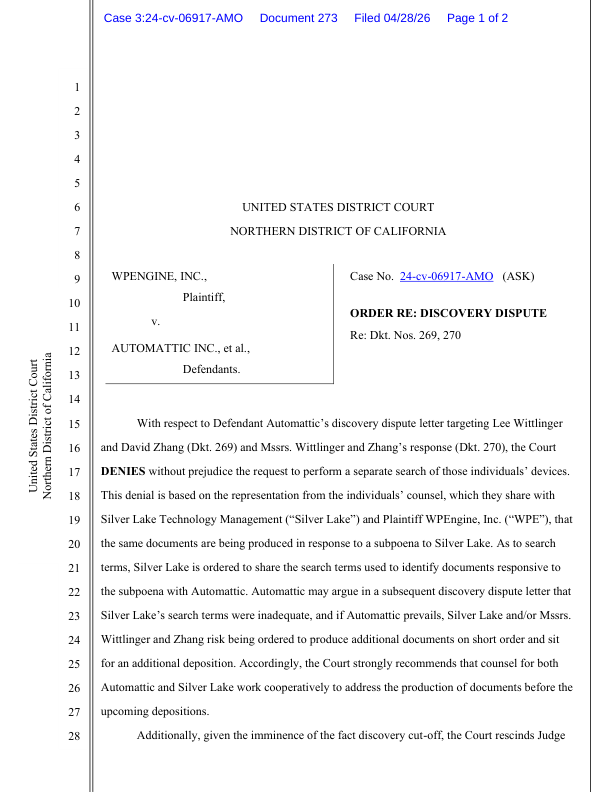
- the Court DENIES without prejudice the request to perform a separate search of those individuals’ devices.
This denial is based on the representation from the individuals’ counsel, which they share with Silver Lake Technology Management (“Silver Lake”) and Plaintiff WPEngine, Inc. (“WPE”), that the same documents are being produced in response to a subpoena to Silver Lake ([View Highlight](https://read.readwise.io/read/01kqcwp47bm2n21zsfkb30v8fe))