WPEngine, Inc. V. Automattic Inc. Et Al., No. 4:24-Cv-06917
🔗 **Source:** [WPEngine, Inc. V. Automattic Inc. Et Al., No. 4:24-Cv-06917](https://storage.courtlistener.com/recap/gov.uscourts.cand.437474/gov.uscourts.cand.437474.292.0.pdf)
> [!note]+ Document Notes
> tags: [wp-engine-automattic, discovery-dispute, interrogatory-limits, trademark-infringement, dilution-claims, wordpress-governance, laches-defense, damages-discovery]
> author: WP Engine (Quinn Emanuel)
> source: CourtListener RECAP - N.D. Cal. 4:24-cv-06917-AMO
> filing_type: motion
> docket: 292.0
>
> # 🏷️ WP Engine's Motion to Compel Four Critical Interrogatory Responses
>
> # 🧭 Table of Contents
> - [References](#-references)
> - [Summary](#-summary)
> - [Main Content](#-main-content)
> - [Paraphrase](#-paraphrase)
> - [Governance Digest](#-governance-digest)
> - [Hypotheses](#-hypotheses)
> - [Implications](#-implications)
>
> # 🔗 References
> **Dockets:** 238 (trademark claims), 233 (laches defenses), 292.0 (this filing)
> **Rules:** FRCP 33(a)(1), 26(b)(1)-(2)
> **Key Cases:** People Ctr. v. Deel (2025), SkyHawke Techs v. Deca Int'l (2019), NantWorks v. Niantic (2022)
> **Statutes:** 15 U.S.C. § 1125(c) (trademark dilution)
>
> # 📝 Summary
> WP Engine seeks court intervention to compel Automattic and co-defendants to answer four specific interrogatories after defendants engaged in "unreasonably parsimonious" counting of interrogatories, refusing to answer 8-13 questions by tallying "commas and semicolons." The four interrogatories target: (1) evidence of trademark fame for dilution claims, (2) actual confusion instances, (3) damages calculations, and (4) Mullenweg's awareness of WP Engine's trademark use (for laches defense). This reflects escalating discovery tensions in a case involving WordPress governance, trademark control, and Mullenweg's admitted "nuclear war" campaign against WP Engine.
>
> # 📖 Main Content
>
<!-- deep-read:sections start -->
## 🗒️ Notes
**Discovery Obstruction Pattern:**
- Defendants counted explanatory phrases as separate interrogatories
- Refused to answer 8-13 of WP Engine's 21-25 interrogatories
- Other defendants answered similar questions, but selectively refused these four
**Four Target Interrogatories:**
1. **Fame Evidence:** Factual bases for trademark dilution claims requiring proof of fame under 15 U.S.C. § 1125(c)
2. **Actual Confusion:** Specific instances where third parties confused WP Engine's use with defendants' marks
3. **Damages:** Itemized damages claims and factual bases for monetary relief
4. **Laches/Awareness:** Mullenweg's knowledge timeline of WP Engine's trademark use (decade+ delay claimed)
**Legal Standards Applied:**
- Rule 33(a)(1) limits don't prevent relevant, proportional discovery in complex cases
- Advisory Committee Notes favor allowing additional interrogatories when consistent with Rule 26(b)(2)
- Courts grant leave for "very relevant information" in trademark cases
**Case Complexity Factors:**
- 18 WP Engine claims + 7 counterclaims + 28 affirmative defenses
- Multiple legal theories: antitrust, CFAA, defamation, tortious interference
- Multiple trademark disputes: "WordPress," "WooCommerce," "Woo," design marks
- Each defendant claims some rights in contested marks
# 📚 References
- Fuoco Declaration ¶¶ 2-10 (supporting factual allegations)
- Federal Rule 33 Advisory Committee Notes (1993 Amendment)
- Protective Optics v. Panoptx (proportionality in complex trademark cases)
- EVO Brands v. Al Khalifa Group (trademark-specific interrogatory relief)
# 🗣️ Paraphrase
WP Engine tells the court that Automattic and its co-defendants are playing word games to avoid answering important questions during the discovery phase. Instead of providing straightforward responses, the defendants are counting every comma and semicolon to claim WP Engine asked too many questions under court rules limiting interrogatories to 25. WP Engine says this is ridiculous given the case's complexity and asks the judge to order responses to four specific questions about: how famous defendants think their trademarks are, whether anyone was actually confused by WP Engine's trademark use, what monetary damages they're seeking, and when Matt Mullenweg first knew about WP Engine's trademark use. WP Engine argues these questions are directly relevant to core legal issues and that other defendants already answered similar questions, making the refusal seem arbitrary and obstructionist.
# 📰 Governance Digest
The WordPress ecosystem's trademark disputes have reached peak procedural warfare, with Automattic literally counting commas to avoid answering basic questions about their governance claims. WP Engine wants to know: How famous do you think "WordPress" really is? Can you name anyone actually confused by our trademark use? What damages are you seeking for our alleged sins? And when exactly did Matt Mullenweg first notice we existed? The fact that defendants are word-lawyering their way out of these fundamental questions suggests either weak underlying claims or a strategy to make discovery as painful as possible. For the WordPress community, this procedural trench warfare delays any resolution of who actually controls the trademarks that define the ecosystem's identity.
# 🧪 Hypotheses
1. **Weak Fame Evidence:** Defendants' interrogatory evasion suggests limited evidence of WordPress trademark fame sufficient for federal dilution claims
2. **Minimal Actual Confusion:** Refusal to identify confusion instances indicates few or no documented cases of consumer confusion
3. **Uncertain Damages Theory:** Defendants lack concrete damages calculations or factual bases for monetary relief sought
4. **Laches Vulnerability:** Mullenweg's awareness timeline may undermine trademark claims through unreasonable delay
5. **Discovery Strategy:** Procedural obstruction aims to increase WP Engine's litigation costs and delay case resolution
6. **Selective Cooperation:** Inconsistent responses across defendants reveals coordinated but imperfect defense strategy
# 📊 Methodology
**Evidentiary Basis:** Fuoco Declaration providing personal knowledge of discovery conferences and defendants' specific refusals. **Procedural Posture:** Post-discovery closure motion (fact discovery closed May 14, 2026) seeking judicial intervention under FRCP 33 and 26. **Legal Foundation:** Federal trademark law requirements, established discovery precedents in complex IP litigation, and Advisory Committee guidance on interrogatory limits.
# ❓ Questions
- Why did some defendants answer virtually identical interrogatories while others refused?
- What specific evidence does Automattic possess regarding WordPress trademark fame?
- How will the court balance discovery limits against case complexity involving ecosystem governance?
- What timeline emerges for Mullenweg's awareness of WP Engine's trademark use?
- How do these discovery disputes affect the broader WordPress Foundation's independence claims?
# 🔮 Future Research
**Litigation Threads:** Court's ruling on interrogatory limits, substantive responses if compelled, expert witness disclosures on damages and confusion. **Governance Implications:** WordPress Foundation's actual independence from Automattic control, trademark ownership clarity, plugin directory governance structure, community impact of prolonged uncertainty.
# 💡 Implications
**Practice:** Discovery disputes signal aggressive litigation strategy potentially extending case timeline. **Policy:** WordPress trademark control remains unresolved, affecting ecosystem stability. **Security:** Continued uncertainty about legitimate WordPress services and authorized plugin distribution. **Education:** Community needs clarity on trademark usage rights and WordPress Foundation independence. **Funding:** Extended litigation costs may impact both parties' ecosystem investments and community support.
# 🧠 Learning Styles Assessment
**Visual:** Clean document structure, numbered sections, clear legal citations. **Aural:** Formal legal language suitable for oral argument. **Verbal:** Extensive written reasoning and case law analysis. **Kinesthetic:** Procedural motion requiring active judicial response. **Logical:** Systematic legal argument with rules-based reasoning. **Social:** Addresses community governance and stakeholder interests. **Solitary:** Individual party motion requiring independent analysis. **Naturalistic:** Pattern recognition in discovery obstruction tactics. **Reading Level:** Law school/professional (Grade 16+).
# 📊 Accessibility Assessment
**Structure:** Well-organized with clear headings and legal citations. **Format:** Text-extractable PDF with standard legal formatting. **Navigation:** Numbered sections and paragraph references enable easy location of specific arguments. **WCAG 2.2 AA:** Likely compliant for text-based legal document, though specific font sizes and contrast ratios not specified.
# 🌍 DEIB Assessment
**Cultural Breadth:** US-focused legal proceeding with global WordPress ecosystem implications. **Inclusive Language:** Standard legal terminology without apparent bias. **Neurodiversity Support:** Structured format with clear logical progression. **Representation:** Corporate legal dispute may not reflect diverse community voices. **Psychological Safety:** Adversarial legal context inherently creates tension for ecosystem participants.
# ✅ Logical Validity
**Strong Reasoning:** Systematic application of discovery rules to case-specific facts with supporting precedent. **Fallacies:** None identified - arguments follow established legal logic and proportionality principles. **Tone:** Professional advocacy appropriate for judicial audience, neither inflammatory nor evasive.
# 🛡️ DARVO Analysis
Not applicable to this filing - this is a procedural discovery motion focused on interrogatory compliance rather than substantive defenses involving victim/offender dynamics.
# 🎯 Conclusion
WP Engine's motion exposes defendants' discovery obstruction tactics while seeking answers to four fundamental questions about trademark fame, confusion, damages, and awareness timelines. The court's ruling will establish boundaries for discovery in this complex ecosystem governance dispute and may reveal the strength of underlying trademark claims. Watch for the court's proportionality analysis and any compelled responses that illuminate the factual foundations of WordPress trademark disputes.
# 🧱 Refactor Appendix
## 📚 Literature Atoms
> [!quote] Discovery Obstruction Tactics
> "Defendants have taken an unreasonably parsimonious approach to 'counting' interrogatories, tallying up commas and semicolons in interrogatories that provided explanations of topics as constituting separate interrogatories"
> [!quote] Case Complexity Justification
> "The case would be complex even without the counterclaims and declaratory judgment claims, as it also involves antitrust, the Computer Fraud and Abuse Act, defamation, and tortious interference claims"
> [!quote] Laches Defense Foundation
> "This seeks facts critical to WPE's laches defense and Mr. Mullenweg's delay, which WPE contends has gone on for over a decade"
### 🧠 Permanent Candidates
- **Interrogatory Counting Standards:** Courts focus on relevance and proportionality over semantic parsing
- **Complex Case Discovery:** Additional interrogatories permitted when case complexity justifies expanded discovery
- **Trademark Fame Requirements:** Dilution claims require factual proof of mark fame under federal law
- **Laches Defense Elements:** Awareness timeline and unreasonable delay central to trademark laches claims
## ✏️ Fleeting Queue
- Connection between discovery obstruction and weak underlying claims
- Selective cooperation patterns among co-defendants
- WordPress Foundation's response consistency with Automattic's positions
- Impact of discovery delays on community uncertainty resolution
<!-- deep-read:sections end -->
📄 **Full text:** ![[Full Document Contents/Articles/WPEngine, Inc. V. Automattic Inc. Et Al., No. 424-Cv-06917.md|WPEngine, Inc. V. Automattic Inc. Et Al., No. 4:24-Cv-06917 by WPEngine, Inc., Automattic Inc.]]
## Highlights
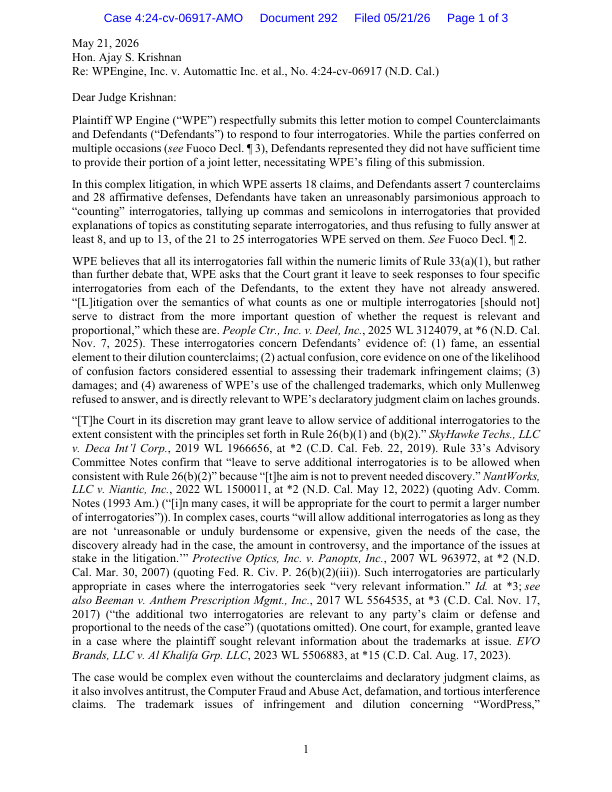
- WPE believes that all its interrogatories fall within the numeric limits of Rule 33(a)(1), but rather than further debate that, WPE asks that the Court grant it leave to seek responses to four specific interrogatories from each of the Defendants, to the extent they have not already answered. "[L]itigation over the semantics of what counts as one or multiple interrogatories [should not] serve to distract from the more important question of whether the request is relevant and proportional," which these are.
*People Ctr., Inc. v. Deel, Inc.*
, 2025 WL 3124079, at \*6 (N.D. Cal. Nov. 7, 2025). These interrogatories concern Defendants' evidence of: (1) fame, an essential element to their dilution counterclaims; (2) actual confusion, core evidence on one of the likelihood of confusion factors considered essential to assessing their trademark infringement claims; (3) damages; and (4) awareness of WPE's use of the challenged trademarks, which only Mullenweg refused to answer, and is directly relevant to WPE's declaratory judgment claim on laches grounds. ([View Highlight](https://read.readwise.io/read/01ksfvejtsbgkxr8k3kjxsqgtw))
- Note: Docket 292: WPE seeks leave for 4 interrogatories — fame, actual confusion, damages, trademark-use awareness.
- Tags: wp-engine-automattic, legal