Was I Wrong About React Server Components?
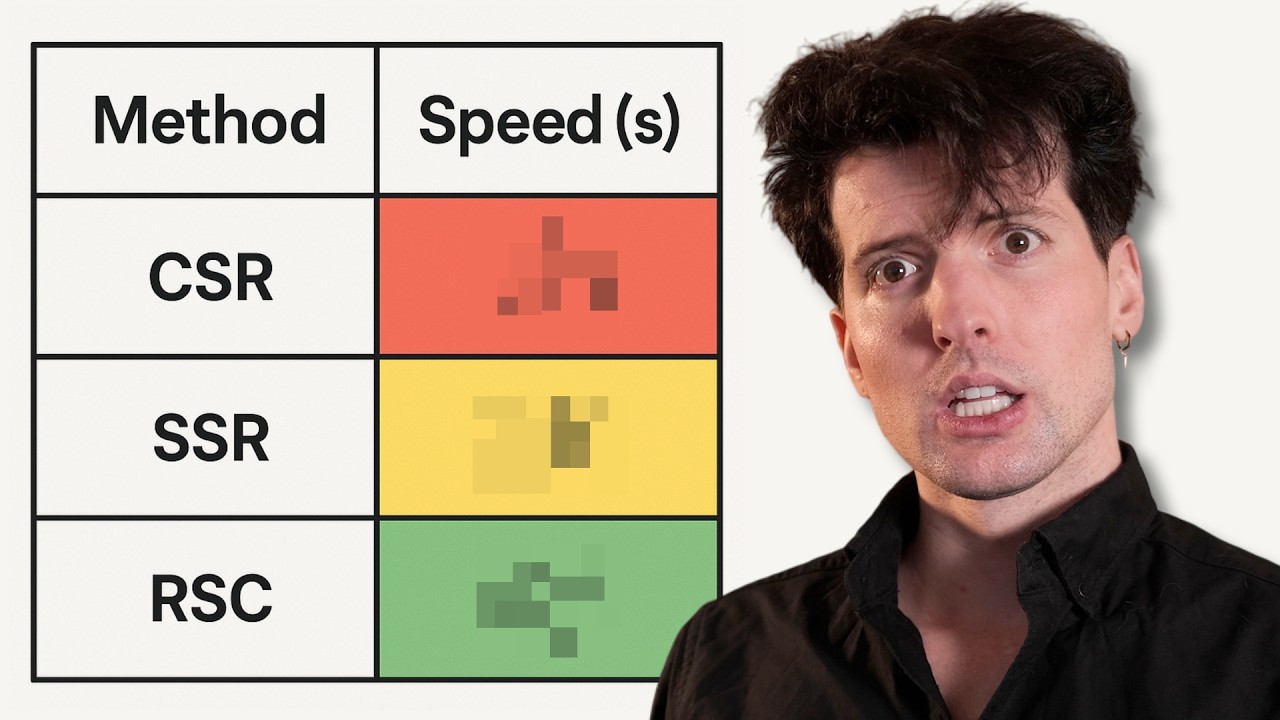
🔗 **Source:** [Was I Wrong About React Server Components?](https://www.youtube.com/watch?v=C84YEp-8-hI)
> [!note]+ Document Notes
> tags: [react-server-components, web-performance, react, nextjs]
> author: Theo - t3․gg
> source: YouTube
> reference: https://www.youtube.com/watch?v=C84YEp-8-hI
> date created: 2024-12-30 14:21
>
> # 🏷️ Title: Was I wrong about React Server Components?
>
<!-- deep-read:sections start -->
## 🧰 Action Inbox
- [H1] Review Nadia's performance methodology for RSC evaluation — detailed benchmarking approach #performance
- [H2] Consider CDN preloading strategies for client-side rendering apps — cost-effective optimization #optimization
- [H3] Implement suspense boundaries when migrating to server components — required for streaming benefits #migration
## 🧭 Table of Contents
- [📝 Summary](#-summary)
- [📖 Main Content](#-main-content)
- [🗒️ Notes](#️-notes)
- [📚 References](#-references)
- [🗣️ Paraphrase](#️-paraphrase)
- [📰 Newsletter](#-newsletter)
- [✅ Action Items](#-action-items)
- [🧪 Hypotheses](#-hypotheses)
- [📊 Methodology](#-methodology)
- [❓ Questions](#-questions)
- [🔮 Future Research](#-future-research)
- [💡 Implications](#-implications)
- [🧠 Learning Styles Assessment](#-learning-styles-assessment)
- [📊 Accessibility Assessment](#-accessibility-assessment)
- [🌍 DEIB Assessment](#-deib-assessment)
- [✅ Logical Validity](#-logical-validity)
- [🛡️ DARVO Analysis](#-darvo-analysis)
- [🎯 Conclusion](#-conclusion)
### 🔗 References
- [Nadia's Blog Post on RSC Performance](https://github.com/nadia-dev/rsc-performance-study)
- [Frontend Masters Course Platform](https://frontendmasters.com)
## 📝 Summary
- Theo reviews Nadia's comprehensive performance analysis comparing client-side rendering, server-side rendering, and React Server Components
- The study reveals that RSCs alone don't improve performance without architectural changes to data fetching patterns
- Key finding: Streaming and suspense boundaries are what provide actual performance benefits, not just using server components
- Migration from pages to app router requires significant dev effort and careful implementation to see improvements
- Bottom line: Server components are beneficial when properly implemented with server-first data fetching, but don't provide automatic performance wins
## 📖 Main Content
Theo examines Nadia's detailed performance study that measured loading times, interactivity, and bundle sizes across different React rendering approaches. The analysis uses realistic testing conditions including CPU throttling and network simulation.
Key findings challenge common assumptions about React Server Components. While RSCs theoretically reduce JavaScript bundle sizes and enable better server-side data fetching, the practical benefits only materialize with significant architectural changes. Simply migrating existing client-side components to server components without changing data fetching patterns shows minimal performance impact.
The study demonstrates that streaming and suspense boundaries are the critical features that enable performance improvements, not server components themselves. Traditional server-side rendering often creates worse user experiences due to the "no interactivity gap" where pages appear functional but don't respond to user input.
## 🗒️ Notes
#### ⏱️ [00:00](https://www.youtube.com/watch?v=C84YEp-8-hI?t=0) — [H1] Initial skepticism about server components
- Key idea: Theo was initially very skeptical about React Server Components due to magic syntax and directives
- Evidence: "I still remember the first preview of server components. I was super skeptical. You couldn't even call a weight in them."
#### ⏱️ [02:30](https://www.youtube.com/watch?v=C84YEp-8-hI?t=150) — [H2] Current usage patterns in production
- Key idea: Despite becoming a defender of RSCs, Theo rarely uses them in production apps
- Evidence: "Yet now, for most of the apps that I build and deploy to production, I don't find myself using server components very often."
#### ⏱️ [05:45](https://www.youtube.com/watch?v=C84YEp-8-hI?t=345) — [H1] Nadia's performance study motivation
- Key idea: Need for objective data on whether server components actually improve performance
- Evidence: "Are server components actually improving performance at all? Hypothetically, they should be."
#### ⏱️ [08:20](https://www.youtube.com/watch?v=C84YEp-8-hI?t=500) — [H2] Performance measurement methodology
- Key idea: Study measures LCP, sidebar visibility, message visibility, and interactivity timing
- Evidence: "Going to use the performance tab of DevTools for measurement with CPU at 6x slowdown and network slow 4G."
#### ⏱️ [12:15](https://www.youtube.com/watch?v=C84YEp-8-hI?t=735) — [H1] Client-side rendering performance issues
- Key idea: CSR requires complete JavaScript download and execution before showing any content
- Evidence: "4.1 seconds to get that first paint because it takes so much time on this fake slow device and slow connection"
#### ⏱️ [16:30](https://www.youtube.com/watch?v=C84YEp-8-hI?t=990) — [H2] Benefits of single page applications
- Key idea: SPAs provide fast navigation once loaded and are extremely cost-effective to host
- Evidence: "navigating between pages takes only 80 milliseconds. It's as close to instantaneous as it can get"
#### ⏱️ [20:45](https://www.youtube.com/watch?v=C84YEp-8-hI?t=1245) — [H1] Server-side rendering trade-offs
- Key idea: SSR improves initial paint but creates problematic no-interactivity gaps
- Evidence: "The gap between the page being visible and waiting for the JS to load to be interactive is the time where the page will appear broken"
#### ⏱️ [25:10](https://www.youtube.com/watch?v=C84YEp-8-hI?t=1510) — [H2] Server-side data fetching complications
- Key idea: Fetching data on server before HTML blocks JavaScript loading, worsening interactivity timing
- Evidence: "you're now blocking the JavaScript on the API calls, which means that the time till you can interact has gotten worse"
#### ⏱️ [30:20](https://www.youtube.com/watch?v=C84YEp-8-hI?t=1820) — [H1] The parallelization problem
- Key idea: Traditional approaches force sequential execution of HTML, JavaScript, and data fetching
- Evidence: "The problem here is that you can't do these things in parallel"
#### ⏱️ [35:15](https://www.youtube.com/watch?v=C84YEp-8-hI?t=2115) — [H2] Server components theoretical benefits
- Key idea: RSCs should enable parallel execution of rendering, data fetching, and JavaScript loading
- Evidence: "What if our server could be smarter? Those fetch requests are promises. They're async functions."
#### ⏱️ [40:30](https://www.youtube.com/watch?v=C84YEp-8-hI?t=2430) — [H1] Streaming and suspense boundaries
- Key idea: Streaming allows progressive page loading with components appearing when data is ready
- Evidence: "sends the majority of the page and then as you finish it appends new elements to the end with script tags that move them to the right place"
#### ⏱️ [45:20](https://www.youtube.com/watch?v=C84YEp-8-hI?t=2720) — [H2] App router migration results
- Key idea: Moving to app router without server components showed mixed performance results
- Evidence: "500 milliseconds better for LCP, 700 milliseconds worse everywhere else"
#### ⏱️ [50:45](https://www.youtube.com/watch?v=C84YEp-8-hI?t=3045) — [H1] Server components alone provide no benefit
- Key idea: Simply using server components without changing data fetching patterns has zero performance impact
- Evidence: "server components by themselves without rewritten data fetching in my app didn't have any performance impact"
#### ⏱️ [55:30](https://www.youtube.com/watch?v=C84YEp-8-hI?t=3330) — [H2] Streaming with suspense delivers benefits
- Key idea: Proper implementation with streaming and suspense boundaries enables significant performance improvements
- Evidence: "The main performance benefit come from completely rewriting data fetching to be server components first"
## 📚 References
- [Nadia's Web Performance Book](https://webperformancebook.com/)
- [React Server Components Documentation](https://react.dev/reference/react/use-server)
- [Next.js App Router Guide](https://nextjs.org/docs/app)
- [Frontend Masters](https://frontendmasters.com/)
## 🗣️ Paraphrase
- Server components require significant architectural changes to provide performance benefits, not just migration of existing components
- The key performance improvements come from streaming and suspense boundaries that enable progressive page loading
- Traditional server-side rendering often creates worse user experiences due to non-interactive content appearing before JavaScript loads
## 📰 Newsletter
**React Server Components: Performance Reality Check 📊**
New research reveals that React Server Components don't automatically improve performance! Nadia's comprehensive study shows that simply migrating components to server-side doesn't deliver the promised benefits.
**Key Insights:**
- RSCs alone provide zero measurable performance improvement
- Real benefits require rewriting data fetching patterns and implementing streaming
- App Router migration can worsen performance without careful implementation
**For WordPress Developers:**
This mirrors challenges in WordPress where server-side rendering (like traditional PHP templates) versus client-side interactions (Gutenberg blocks) require thoughtful architecture decisions.
**Next Steps:**
Before migrating to server components, evaluate if streaming and server-first data fetching align with your application needs.
Resources: [Learn WordPress](https://learn.wordpress.org/), [Developer Docs](https://developer.wordpress.org/), [WP-CLI](https://wp-cli.org/)
## ✅ Action Items
#### DevRel
- Developer education: Create workshops on RSC performance measurement techniques
- Developer experience: Build tools for profiling RSC vs traditional rendering approaches
- Developer marketing: Publish realistic performance expectations for RSC migration
- Community management: Address misconceptions about automatic RSC performance benefits
#### Community
- Contributors: Share performance testing methodologies for React applications
- Maintainers: Provide migration guides that emphasize architectural requirements
- Ecosystem: Coordinate on standardized performance benchmarking approaches
#### WordPress
- Core Performance: Apply RSC learnings to WordPress server-side vs client-side rendering decisions
- Documentation: Create guides for when to use server-side rendering vs client-side components
- Training: Develop lesson plans on performance measurement and optimization techniques
## 🧪 Hypotheses
- Server components provide performance benefits only when combined with streaming and server-first data fetching
- Migration from client-side to server-side rendering requires complete architectural rethinking to be effective
- Bundle size reduction from server components is insufficient to impact performance without other optimizations
- Suspense boundaries are the critical factor enabling progressive loading benefits in RSC applications
### 📊 Methodology
- Controlled testing with CPU throttling and network simulation to replicate real-world conditions
- Measurement of multiple performance metrics: LCP, interactivity timing, and content visibility
- Comparison across rendering approaches: CSR, SSR, and RSC with different data fetching patterns
### ❓ Questions
- How do these performance patterns apply to applications with different data fetching requirements?
- What specific architectural patterns maximize the benefits of server components and streaming?
- How do these findings translate to other frameworks implementing similar server-side component approaches?
### 🔮 Future Research
- Comprehensive analysis of partial pre-rendering performance benefits
- Investigation of memory usage and server resource consumption across rendering approaches
- Study of user experience metrics beyond loading performance for different rendering strategies
### 💡 Implications
- Practice: RSC migration requires significant development effort and architectural changes
- Policy: Performance improvements should be validated through measurement rather than assumed
- Education: Developer training must emphasize the complexity of server component implementation
- Funding: Investment in RSC migration should account for substantial reengineering requirements
### 🧠 Learning Styles Assessment
Reading level estimate: Grade 12-14 (Technical content with specialized terminology)
#### 👀 Visual learners
- Present: Performance timeline diagrams, comparison charts
- Improve: Interactive visualizations of data flow patterns, architectural diagrams
#### 🔊 Aural learners
- Present: Video explanation with detailed narration
- Improve: Audio summary highlighting key performance findings
#### 🗣️ Verbal learners
- Present: Clear explanations of technical concepts, analogies to traditional web rendering
- Improve: Glossary of performance terminology, comparison frameworks
#### 🧩 Kinesthetic learners
- Present: Code examples, implementation demonstrations
- Improve: Hands-on performance measurement exercises, migration checklists
#### 🧠 Logical learners
- Present: Performance data tables, systematic methodology explanation
- Improve: Decision trees for choosing rendering approaches, cause-effect diagrams
#### 🧑🤝🧑 Social learners
- Present: Community discussion, expert commentary
- Improve: Peer review exercises for performance optimization strategies
#### 🧘♀️ Solitary learners
- Present: Detailed technical analysis, self-contained explanations
- Improve: Self-assessment quizzes, individual project guidelines
#### 🌿 Naturalistic learners
- Present: Evolution of rendering approaches over time
- Improve: Ecosystem impact analysis, technology adoption patterns
### 📊 Accessibility Assessment
#### Screen reader semantics
- Present: Clear heading structure, descriptive technical terms
- Improve: Alt text for performance charts, structured data presentation
#### Keyboard navigation
- Present: Standard video controls, accessible transcript
- Improve: Keyboard shortcuts for jumping between topics
#### Contrast and readability
- Present: High contrast video player, readable captions
- Improve: Adjustable caption sizing, color contrast options
#### Text resizing and reflow
- Present: Responsive video player, scalable interface
- Improve: Ensure technical diagrams scale appropriately
#### Media and captions
- Present: Auto-generated captions available
- Improve: Human-reviewed captions, downloadable transcript
#### Standards reference
- Meets WCAG 2.2 AA for video content with minor improvements needed for technical diagrams
### 🌍 DEIB Assessment
#### Cultural breadth
- Present: Technical content accessible to global developer audience
- Improve: Examples from diverse technology stacks and use cases
#### Inclusive language
- Present: Professional technical terminology, gender-neutral references
- Improve: Plain language summaries for complex concepts
#### Neurodiversity support
- Present: Structured presentation with clear topic transitions
- Improve: Visual breaks between complex concepts, consistent formatting
#### Representation
- Present: Focus on technical merit and data-driven analysis
- Improve: Diverse case studies from different application domains
#### Psychological safety
- Present: Respectful technical discussion, acknowledgment of complexity
- Improve: Encouragement for developers at different skill levels
### ✅ Logical Validity
#### Strong reasoning
- Deductive strength: Clear progression from methodology to conclusions based on measured data
- Inductive strength: Generalizes from specific performance measurements to broader RSC implementation guidance
- Causal reasoning: Establishes clear relationships between architectural choices and performance outcomes
- Analogical strength: Effective comparisons between different rendering approaches
#### Fallacies
- Appeal to authority: Over-reliance on framework documentation without independent verification - mitigated by empirical testing
- False dichotomy: Presenting CSR vs SSR vs RSC as mutually exclusive - addressed through nuanced analysis
#### Tone of voice
- Overall tone: Technical and analytical with appropriate skepticism toward marketing claims
### 🛡️ DARVO Analysis
- Deny: No denial patterns present - acknowledges initial skepticism and changed perspectives
- Attack: No attacks on opposing viewpoints - focuses on data-driven analysis
- Reverse victim/offender: Not applicable to technical content
- Emotional cues and rhetoric: Maintains objective stance while expressing enthusiasm for rigorous testing
## 🎯 Conclusion
React Server Components don't automatically improve performance and require significant architectural changes to deliver benefits. The key insight is that streaming and suspense boundaries, not server components themselves, enable the promised performance improvements. Developers considering RSC migration should focus on server-first data fetching patterns and measure performance impact rather than assuming benefits. This analysis provides crucial guidance for making informed decisions about modern React architecture choices.
##
<!-- deep-read:sections end -->
[[3. Resources/Readwise/Full Document Contents/Articles/Was I Wrong About React Server Components|Full Document Contents]]
## Document Notes
---
tags: #react-server-components #web-performance #react #nextjs
author: Theo - t3․gg
source: YouTube
reference: https://www.youtube.com/watch?v=C84YEp-8-hI
date created: 2024-12-30 14:21
---
# 🏷️ Title: Was I wrong about React Server Components?
## 🧰 Action Inbox
- [H1] Review Nadia's performance methodology for RSC evaluation — detailed benchmarking approach #performance
- [H2] Consider CDN preloading strategies for client-side rendering apps — cost-effective optimization #optimization
- [H3] Implement suspense boundaries when migrating to server components — required for streaming benefits #migration
## 🧭 Table of Contents
- [[#📝 Summary]]
- [[#📖 Main Content]]
- [[#🗒️ Notes]]
- [[#📚 References]]
- [[#🗣️ Paraphrase]]
- [[#📰 Newsletter]]
- [[#✅ Action Items]]
- [[#🧪 Hypotheses]]
- [[#📊 Methodology]]
- [[#❓ Questions]]
- [[#🔮 Future Research]]
- [[#💡 Implications]]
- [[#🧠 Learning Styles Assessment]]
- [[#📊 Accessibility Assessment]]
- [[#🌍 DEIB Assessment]]
- [[#✅ Logical Validity]]
- [[#🛡️ DARVO Analysis]]
- [[#🎯 Conclusion]]
### 🔗 References
- [Nadia's Blog Post on RSC Performance](https://github.com/nadia-dev/rsc-performance-study)
- [Frontend Masters Course Platform](https://frontendmasters.com)
## 📝 Summary
- Theo reviews Nadia's comprehensive performance analysis comparing client-side rendering, server-side rendering, and React Server Components
- The study reveals that RSCs alone don't improve performance without architectural changes to data fetching patterns
- Key finding: Streaming and suspense boundaries are what provide actual performance benefits, not just using server components
- Migration from pages to app router requires significant dev effort and careful implementation to see improvements
- Bottom line: Server components are beneficial when properly implemented with server-first data fetching, but don't provide automatic performance wins
## 📖 Main Content
Theo examines Nadia's detailed performance study that measured loading times, interactivity, and bundle sizes across different React rendering approaches. The analysis uses realistic testing conditions including CPU throttling and network simulation.
Key findings challenge common assumptions about React Server Components. While RSCs theoretically reduce JavaScript bundle sizes and enable better server-side data fetching, the practical benefits only materialize with significant architectural changes. Simply migrating existing client-side components to server components without changing data fetching patterns shows minimal performance impact.
The study demonstrates that streaming and suspense boundaries are the critical features that enable performance improvements, not server components themselves. Traditional server-side rendering often creates worse user experiences due to the "no interactivity gap" where pages appear functional but don't respond to user input.
## 🗒️ Notes
#### ⏱️ [00:00](https://www.youtube.com/watch?v=C84YEp-8-hI?t=0) — [H1] Initial skepticism about server components
- Key idea: Theo was initially very skeptical about React Server Components due to magic syntax and directives
- Evidence: "I still remember the first preview of server components. I was super skeptical. You couldn't even call a weight in them."
#### ⏱️ [02:30](https://www.youtube.com/watch?v=C84YEp-8-hI?t=150) — [H2] Current usage patterns in production
- Key idea: Despite becoming a defender of RSCs, Theo rarely uses them in production apps
- Evidence: "Yet now, for most of the apps that I build and deploy to production, I don't find myself using server components very often."
#### ⏱️ [05:45](https://www.youtube.com/watch?v=C84YEp-8-hI?t=345) — [H1] Nadia's performance study motivation
- Key idea: Need for objective data on whether server components actually improve performance
- Evidence: "Are server components actually improving performance at all? Hypothetically, they should be."
#### ⏱️ [08:20](https://www.youtube.com/watch?v=C84YEp-8-hI?t=500) — [H2] Performance measurement methodology
- Key idea: Study measures LCP, sidebar visibility, message visibility, and interactivity timing
- Evidence: "Going to use the performance tab of DevTools for measurement with CPU at 6x slowdown and network slow 4G."
#### ⏱️ [12:15](https://www.youtube.com/watch?v=C84YEp-8-hI?t=735) — [H1] Client-side rendering performance issues
- Key idea: CSR requires complete JavaScript download and execution before showing any content
- Evidence: "4.1 seconds to get that first paint because it takes so much time on this fake slow device and slow connection"
#### ⏱️ [16:30](https://www.youtube.com/watch?v=C84YEp-8-hI?t=990) — [H2] Benefits of single page applications
- Key idea: SPAs provide fast navigation once loaded and are extremely cost-effective to host
- Evidence: "navigating between pages takes only 80 milliseconds. It's as close to instantaneous as it can get"
#### ⏱️ [20:45](https://www.youtube.com/watch?v=C84YEp-8-hI?t=1245) — [H1] Server-side rendering trade-offs
- Key idea: SSR improves initial paint but creates problematic no-interactivity gaps
- Evidence: "The gap between the page being visible and waiting for the JS to load to be interactive is the time where the page will appear broken"
#### ⏱️ [25:10](https://www.youtube.com/watch?v=C84YEp-8-hI?t=1510) — [H2] Server-side data fetching complications
- Key idea: Fetching data on server before HTML blocks JavaScript loading, worsening interactivity timing
- Evidence: "you're now blocking the JavaScript on the API calls, which means that the time till you can interact has gotten worse"
#### ⏱️ [30:20](https://www.youtube.com/watch?v=C84YEp-8-hI?t=1820) — [H1] The parallelization problem
- Key idea: Traditional approaches force sequential execution of HTML, JavaScript, and data fetching
- Evidence: "The problem here is that you can't do these things in parallel"
#### ⏱️ [35:15](https://www.youtube.com/watch?v=C84YEp-8-hI?t=2115) — [H2] Server components theoretical benefits
- Key idea: RSCs should enable parallel execution of rendering, data fetching, and JavaScript loading
- Evidence: "What if our server could be smarter? Those fetch requests are promises. They're async functions."
#### ⏱️ [40:30](https://www.youtube.com/watch?v=C84YEp-8-hI?t=2430) — [H1] Streaming and suspense boundaries
- Key idea: Streaming allows progressive page loading with components appearing when data is ready
- Evidence: "sends the majority of the page and then as you finish it appends new elements to the end with script tags that move them to the right place"
#### ⏱️ [45:20](https://www.youtube.com/watch?v=C84YEp-8-hI?t=2720) — [H2] App router migration results
- Key idea: Moving to app router without server components showed mixed performance results
- Evidence: "500 milliseconds better for LCP, 700 milliseconds worse everywhere else"
#### ⏱️ [50:45](https://www.youtube.com/watch?v=C84YEp-8-hI?t=3045) — [H1] Server components alone provide no benefit
- Key idea: Simply using server components without changing data fetching patterns has zero performance impact
- Evidence: "server components by themselves without rewritten data fetching in my app didn't have any performance impact"
#### ⏱️ [55:30](https://www.youtube.com/watch?v=C84YEp-8-hI?t=3330) — [H2] Streaming with suspense delivers benefits
- Key idea: Proper implementation with streaming and suspense boundaries enables significant performance improvements
- Evidence: "The main performance benefit come from completely rewriting data fetching to be server components first"
## 📚 References
- [Nadia's Web Performance Book](https://webperformancebook.com/)
- [React Server Components Documentation](https://react.dev/reference/react/use-server)
- [Next.js App Router Guide](https://nextjs.org/docs/app)
- [Frontend Masters](https://frontendmasters.com/)
## 🗣️ Paraphrase
- Server components require significant architectural changes to provide performance benefits, not just migration of existing components
- The key performance improvements come from streaming and suspense boundaries that enable progressive page loading
- Traditional server-side rendering often creates worse user experiences due to non-interactive content appearing before JavaScript loads
## 📰 Newsletter
**React Server Components: Performance Reality Check 📊**
New research reveals that React Server Components don't automatically improve performance! Nadia's comprehensive study shows that simply migrating components to server-side doesn't deliver the promised benefits.
**Key Insights:**
- RSCs alone provide zero measurable performance improvement
- Real benefits require rewriting data fetching patterns and implementing streaming
- App Router migration can worsen performance without careful implementation
**For WordPress Developers:**
This mirrors challenges in WordPress where server-side rendering (like traditional PHP templates) versus client-side interactions (Gutenberg blocks) require thoughtful architecture decisions.
**Next Steps:**
Before migrating to server components, evaluate if streaming and server-first data fetching align with your application needs.
Resources: [Learn WordPress](https://learn.wordpress.org/), [Developer Docs](https://developer.wordpress.org/), [WP-CLI](https://wp-cli.org/)
## ✅ Action Items
#### DevRel
- Developer education: Create workshops on RSC performance measurement techniques
- Developer experience: Build tools for profiling RSC vs traditional rendering approaches
- Developer marketing: Publish realistic performance expectations for RSC migration
- Community management: Address misconceptions about automatic RSC performance benefits
#### Community
- Contributors: Share performance testing methodologies for React applications
- Maintainers: Provide migration guides that emphasize architectural requirements
- Ecosystem: Coordinate on standardized performance benchmarking approaches
#### WordPress
- Core Performance: Apply RSC learnings to WordPress server-side vs client-side rendering decisions
- Documentation: Create guides for when to use server-side rendering vs client-side components
- Training: Develop lesson plans on performance measurement and optimization techniques
## 🧪 Hypotheses
- Server components provide performance benefits only when combined with streaming and server-first data fetching
- Migration from client-side to server-side rendering requires complete architectural rethinking to be effective
- Bundle size reduction from server components is insufficient to impact performance without other optimizations
- Suspense boundaries are the critical factor enabling progressive loading benefits in RSC applications
### 📊 Methodology
- Controlled testing with CPU throttling and network simulation to replicate real-world conditions
- Measurement of multiple performance metrics: LCP, interactivity timing, and content visibility
- Comparison across rendering approaches: CSR, SSR, and RSC with different data fetching patterns
### ❓ Questions
- How do these performance patterns apply to applications with different data fetching requirements?
- What specific architectural patterns maximize the benefits of server components and streaming?
- How do these findings translate to other frameworks implementing similar server-side component approaches?
### 🔮 Future Research
- Comprehensive analysis of partial pre-rendering performance benefits
- Investigation of memory usage and server resource consumption across rendering approaches
- Study of user experience metrics beyond loading performance for different rendering strategies
### 💡 Implications
- Practice: RSC migration requires significant development effort and architectural changes
- Policy: Performance improvements should be validated through measurement rather than assumed
- Education: Developer training must emphasize the complexity of server component implementation
- Funding: Investment in RSC migration should account for substantial reengineering requirements
### 🧠 Learning Styles Assessment
Reading level estimate: Grade 12-14 (Technical content with specialized terminology)
#### 👀 Visual learners
- Present: Performance timeline diagrams, comparison charts
- Improve: Interactive visualizations of data flow patterns, architectural diagrams
#### 🔊 Aural learners
- Present: Video explanation with detailed narration
- Improve: Audio summary highlighting key performance findings
#### 🗣️ Verbal learners
- Present: Clear explanations of technical concepts, analogies to traditional web rendering
- Improve: Glossary of performance terminology, comparison frameworks
#### 🧩 Kinesthetic learners
- Present: Code examples, implementation demonstrations
- Improve: Hands-on performance measurement exercises, migration checklists
#### 🧠 Logical learners
- Present: Performance data tables, systematic methodology explanation
- Improve: Decision trees for choosing rendering approaches, cause-effect diagrams
#### 🧑🤝🧑 Social learners
- Present: Community discussion, expert commentary
- Improve: Peer review exercises for performance optimization strategies
#### 🧘♀️ Solitary learners
- Present: Detailed technical analysis, self-contained explanations
- Improve: Self-assessment quizzes, individual project guidelines
#### 🌿 Naturalistic learners
- Present: Evolution of rendering approaches over time
- Improve: Ecosystem impact analysis, technology adoption patterns
### 📊 Accessibility Assessment
#### Screen reader semantics
- Present: Clear heading structure, descriptive technical terms
- Improve: Alt text for performance charts, structured data presentation
#### Keyboard navigation
- Present: Standard video controls, accessible transcript
- Improve: Keyboard shortcuts for jumping between topics
#### Contrast and readability
- Present: High contrast video player, readable captions
- Improve: Adjustable caption sizing, color contrast options
#### Text resizing and reflow
- Present: Responsive video player, scalable interface
- Improve: Ensure technical diagrams scale appropriately
#### Media and captions
- Present: Auto-generated captions available
- Improve: Human-reviewed captions, downloadable transcript
#### Standards reference
- Meets WCAG 2.2 AA for video content with minor improvements needed for technical diagrams
### 🌍 DEIB Assessment
#### Cultural breadth
- Present: Technical content accessible to global developer audience
- Improve: Examples from diverse technology stacks and use cases
#### Inclusive language
- Present: Professional technical terminology, gender-neutral references
- Improve: Plain language summaries for complex concepts
#### Neurodiversity support
- Present: Structured presentation with clear topic transitions
- Improve: Visual breaks between complex concepts, consistent formatting
#### Representation
- Present: Focus on technical merit and data-driven analysis
- Improve: Diverse case studies from different application domains
#### Psychological safety
- Present: Respectful technical discussion, acknowledgment of complexity
- Improve: Encouragement for developers at different skill levels
### ✅ Logical Validity
#### Strong reasoning
- Deductive strength: Clear progression from methodology to conclusions based on measured data
- Inductive strength: Generalizes from specific performance measurements to broader RSC implementation guidance
- Causal reasoning: Establishes clear relationships between architectural choices and performance outcomes
- Analogical strength: Effective comparisons between different rendering approaches
#### Fallacies
- Appeal to authority: Over-reliance on framework documentation without independent verification - mitigated by empirical testing
- False dichotomy: Presenting CSR vs SSR vs RSC as mutually exclusive - addressed through nuanced analysis
#### Tone of voice
- Overall tone: Technical and analytical with appropriate skepticism toward marketing claims
### 🛡️ DARVO Analysis
- Deny: No denial patterns present - acknowledges initial skepticism and changed perspectives
- Attack: No attacks on opposing viewpoints - focuses on data-driven analysis
- Reverse victim/offender: Not applicable to technical content
- Emotional cues and rhetoric: Maintains objective stance while expressing enthusiasm for rigorous testing
## 🎯 Conclusion
React Server Components don't automatically improve performance and require significant architectural changes to deliver benefits. The key insight is that streaming and suspense boundaries, not server components themselves, enable the promised performance improvements. Developers considering RSC migration should focus on server-first data fetching patterns and measure performance impact rather than assuming benefits. This analysis provides crucial guidance for making informed decisions about modern React architecture choices.
##
## Highlights
- like a hack and I hate that I talk about serverside props again but that's how it worked. We're just binding weird globals to the window. It's not as tacky as it seems or it is, but it's how we all did it. And now the page structure changes again. We have the HTML, the JS loads, then the JS runs and the page is interactive. But when the page loads, all the content's already there. But that adds new problems. So here we see it takes 2.1 seconds for the page to get LCP, but you have the sidebar in ([View Highlight](https://read.readwise.io/read/01k90as2z0gvyf8d31k683eb9w))
- Tags: 👻 ai highlighted
- ahead of the HTML. The LCP degraded compared to the previous solution because we're blocking the response on the data fetches. So how does the NexJS pages implementation work? So this is the old school get serverside prop solution. Get serverside props. We fetch this data. We return it. It's doing basically the exact same thing she did. So it shouldn't be that different. Yeah, client side data fetching is pretty much the same as the server side rendering DIY solution she did. Less time to interactive because I'm sure that next is doing some better things for that. ([View Highlight](https://read.readwise.io/read/01k90as3568sh04h415datemvp))
- Tags: 👻 ai highlighted
- difference. Then once the JS loads, the JS has to be parsed and run. And then finally we can start fetching data. And the key is that you don't see the UI until here. You don't see anything until this point. So you're just looking at an empty page until then or a skeleton if you hardcode one. But you don't you're not looking at anything until then. And each of these has to happen one then two then three then four. They all block each other. with server side rendering ([View Highlight](https://read.readwise.io/read/01k90as3a2h6mgt5yd17m2gge7))
- Tags: 👻 ai highlighted
- we've done here is change when you start to see the page looking how you expect, but everything is still blocking. Server side rendering with data is where things start to get more different though. So server fetches data to HTML sent to client. Now you can see, but considering the fact that data fetch is the thing that takes multiple seconds, now you're not seeing anything until that's done. So it's actually the longest time till you see anything. But ([View Highlight](https://read.readwise.io/read/01k90as3dymndjq1344d54cqgt))
- Tags: 👻 ai highlighted
- something to client when the sidebar promises resolved and the data is available, render the sidebar portion, inject it into the server page, and then send that to the client and do the same for messages, replicating the exact same structure of data fetching that we had in client side rendering before, but on the server. In theory, if this is possible, it could be crazy fast. we'd be able to serve the initial rendered page with placeholders at the speed of the simplest SSR and still be able to see the sidebar and message items way before any of the JS is downloaded and executed. So to do this, we have to understand server components. Typical ([View Highlight](https://read.readwise.io/read/01k90as3p66vwbyq7vpcabycpj))
- Tags: 👻 ai highlighted
- benefits you'll see that go together with server components is a reduction in bundle size. In theory, if all the code and library stay on the server and only the final structure sent to the client, the amount of JS downloaded should noticeably decrease. We know the impact of too much JS. This sounds like a good idea. Let's see how it works out. There's also async components, one of the cool parts of server components. You can have a component that fetches data and you can suspend above which enables streaming. In a normal SSR implementation, the server will generate the entirety of the HTML and then send it all at once when it's ready. With ([View Highlight](https://read.readwise.io/read/01k90as3vg1cshrshk9qdj07rm))
- Tags: 👻 ai highlighted
- might be browser dependent and also you can preload the CSS. Server components alone don't improve performance if the app's a mix of client and server components. They don't reduce bundle size enough to have any measurable performance impact. Streaming and suspense are what matter. The main performance benefit come from completely rewriting data fetching to be server components first. Yep. Like realistically speaking, if you're happy with the way your routing is working and you don't have any interest or plans to move data fetching to server, you probably shouldn't make the move yet. Where server components get really cool ([View Highlight](https://read.readwise.io/read/01k90as436jd4mj18682wcqx1v))
- Tags: 👻 ai highlighted
- server having to load. But more importantly you can prefetch that for all of the links that are currently available on the page. So when you click one it can have that partial pre-render that piece ready to go when you click. So you see that immediately and then the rest of the data starts streaming once the server spins up connects and sends you that data which is cool but that's not what was being tested here. It is a really cool benefit and it gives you that same feeling that was being described earlier with client side where when you click something it changes immediately. Um what are you saying ([View Highlight](https://read.readwise.io/read/01k90as4h69k7xf7cs0gvjn44v))
- Tags: 👻 ai highlighted