We Found Jesus’s Crucifixion Sign?
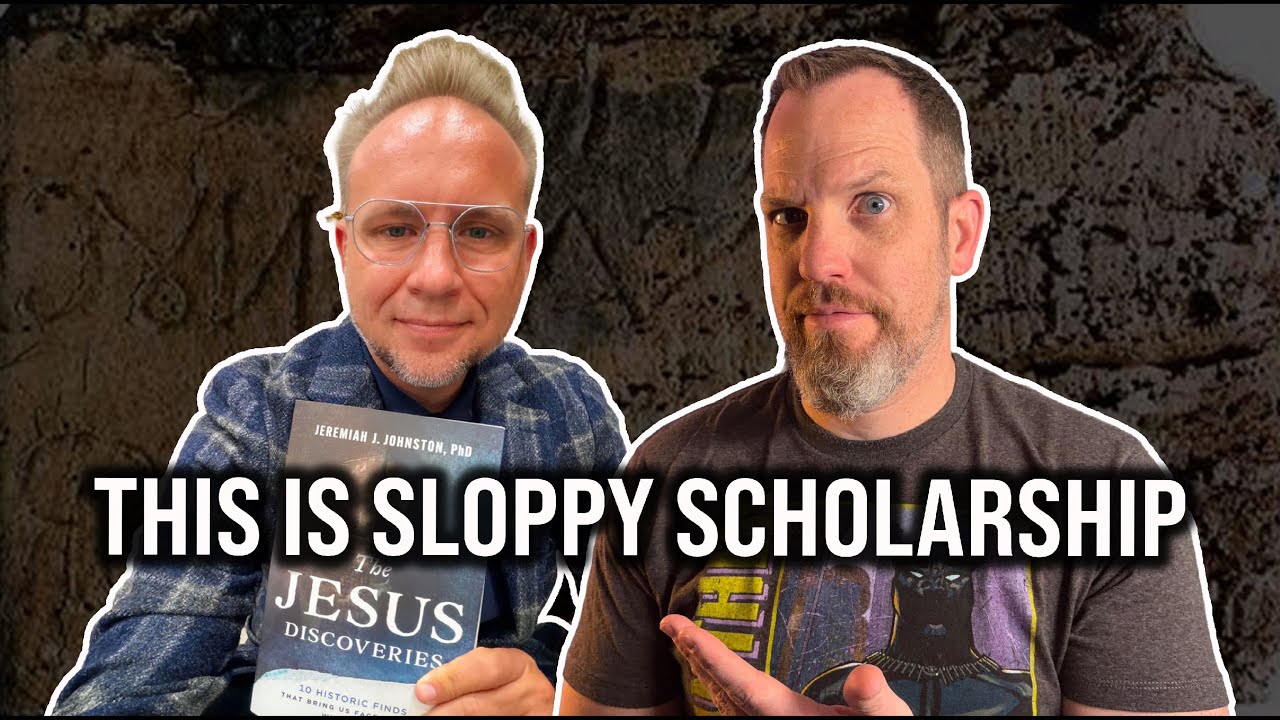
🔗 **Source:** [We Found Jesus’s Crucifixion Sign?](https://www.youtube.com/watch?v=bLcWxb-3CNY)
> [!note]+ Document Notes
> tags: [titulus-crucis, biblical-archaeology, relic-authentication, radiocarbon-dating, citation-verification]
> author: Dan McClellan
> source: Dan McClellan
> reference: https://www.youtube.com/watch?v=bLcWxb-3CNY
> date created: 2026-09-08
>
> > [!info] Generated analysis — not the author's words. Sections below are machine-written
> > from the captured source. Only text inside `> [!quote]` blocks is verbatim from the author.
> > Do not quote or attribute any other line to the named author.
>
> # 🏷️ Title: We found Jesus's crucifixion sign?
>
<!-- deep-read:sections start -->
## 🧭 Table of Contents
- [🔗 References (in-page)](#-references-in-page)
- [📝 Summary](#-summary)
- [📖 Main Content](#-main-content)
- [🗒️ Notes](#-notes)
- [📚 References](#-references)
- [🗣️ Paraphrase](#-paraphrase)
- [📰 Newsletter](#-newsletter)
- [✅ Action Items](#-action-items)
- [🧪 Hypotheses](#-hypotheses)
- [📊 Methodology](#-methodology)
- [❓ Questions](#-questions)
- [🔮 Future Research](#-future-research)
- [💡 Implications](#-implications)
- [🧠 Learning Styles Assessment](#-learning-styles-assessment)
- [📊 Accessibility Assessment](#-accessibility-assessment)
- [🌍 DEIB Assessment](#-deib-assessment)
- [✅ Logical Validity](#-logical-validity)
- [🛡️ DARVO Analysis](#-darvo-analysis)
- [🎯 Conclusion](#-conclusion)
- [🔄 Refactor Appendix](#-refactor-appendix--we-found-jesuss-crucifixion-sign)
### 🔗 References (in-page)
- [Radiocarbon dating segment](#️-000054-httpswwwyoutubecomwatchvblcwxb-3cnyt54s-facebook-post-and-first-image-review) — the C14 evidence
- [Craig Evans citation-check segment](#️-000828-httpswwwyoutubecomwatchvblcwxb-3cnyt508s-footnotes-3-and-8-trace-to-craig-evans) — the misattribution catch
- [Artist reproduction / vav segment](#️-001344-httpswwwyoutubecomwatchvblcwxb-3cnyt820s-the-hebrew-mem-ligature) — separate from Johnston critique
- [🎯 Conclusion](#-conclusion) — bottom line on the title claim
## 📝 Summary
- **What happened.** Dan McClellan reviews a viral Facebook post (account "Verified Bible") claiming archaeologists found the actual wooden sign hung over Jesus during the crucifixion — the Titulus Crucis, inscribed in Hebrew, Greek, and Latin. He shows the object in question was radiocarbon-dated in a 2002 journal article to roughly 900–1150 CE, centuries after the crucifixion, so it cannot be the 1st-century original. He then pivots to a #1 New York Times bestseller, Jeremiah J. Johnston's *The Jesus Discoveries*, and traces its chapter on the Titulus back to its own footnoted source (Craig Evans, *Jesus and the Manuscripts*) to check whether the citations hold up.
- **Why it matters.** This is a case study in checking a viral relic claim against the actual dating literature, and checking a bestselling popular book's footnotes against the scholar it cites, rather than trusting either at face value.
- **Key entities.** Facebook account "Verified Bible"; the Titulus Crucis fragment held at the Basilica di Santa Croce in Gerusalemme, Rome; the 2002 *Radiocarbon* journal article "14C dating of the Titulus Crucis"; Jeremiah J. Johnston and *The Jesus Discoveries* (10 Historic Finds That Bring Us Face to Face with Jesus); Craig Evans and *Jesus and the Manuscripts*; an unnamed artist who gave Johnston a reproduction of the titulus.
- **Risks and tradeoffs.** The video is strong where it quotes primary sources directly (the 2002 dating article, Evans' actual pages) and weaker where it reconstructs Johnston's drafting process from internal textual evidence alone — that section is explicitly framed as inference, not proof.
- **Bottom line.** No, the artifact in the Facebook post is not the sign from Jesus's crucifixion. It is a medieval object, independently dated on physical (radiocarbon) grounds well outside the 1st century.
## 📖 Main Content
The video's own audio has the presenter introduce himself at 0:06; the auto-generated transcript renders the name as "Dan Mlelen," which doesn't match any known Bible scholar. The phrase that follows immediately — "a scholar of the Bible and religion" — is the tagline Dan McClellan uses on his own channel, and the video's method (tracing a viral claim to its source, then tracing a book's footnote to its cited scholar) matches his known content. This note credits the video to Dan McClellan on that basis; the identification is inferred from context, not read literally off the transcript, and is flagged here rather than stated as certain.
The video makes two separate arguments, and it's worth keeping them apart the way the presenter does.
**Argument 1 — the Facebook post is demonstrably false.** The post claims archaeologists found the sign placed over Jesus's head, describes it as bearing part of "Jesus of Nazareth, King of the Jews," and says it preserves the same three languages John's gospel names. The presenter identifies the object as the Titulus Crucis fragment kept in Rome and cites a 2002 article in the journal *Radiocarbon*, "14C dating of the Titulus Crucis," which reports two independent AMS sample ranges: 996–1023 CE and 980–1146 CE. Wood that was alive around 1000 CE cannot carry an inscription older than the wood itself — a straightforward terminus post quem — so the object is a medieval artifact, roughly 800–1000 years old rather than roughly 2000. Whether it's a deliberate forgery or a devotional copy of something older isn't settled by the dating alone, but authenticity as the 1st-century original is ruled out by it.
**Argument 2 — a bestselling book mishandles its own citations on this same object.** Jeremiah J. Johnston's *The Jesus Discoveries: 10 Historic Finds That Bring Us Face to Face with Jesus* devotes a chapter to the Titulus. The presenter reads the chapter's own text acknowledging "no authentic or even plausibly authentic artifact has been discovered," then shows the chapter nonetheless discussing "the artifact" and "the reproduction" before it has introduced any discovery — a structural inconsistency he reads as evidence of a chapter written when the author still thought the relic might be genuine, then only partially revised after learning it's medieval. He traces two of the chapter's footnotes (3 and 8) to their cited source, Craig Evans's *Jesus and the Manuscripts*, and finds a mismatch: Johnston says the inscription was written in Aramaic, Greek, and Latin and cites Evans for it; Evans's own pages say Hebrew, Latin, and Greek four times and never say Aramaic, except once in a footnote referencing another publication's title. On dating, Evans's own stated range ("no earlier than the 12th century") is also, per the presenter, an oversimplification of the actual C14 window (10th–12th century), and Johnston repeats Evans's version rather than the primary article's.
**A separate, smaller point** concerns a modern reproduction of the titulus an artist gave Johnston as a gift, later posted to Instagram — not part of the book. The presenter flags two issues: the Greek lettering uses lowercase, breathing marks, accents, and word spacing, none of which existed in 1st-century Greek (written in capitals, unspaced); and the Hebrew includes an extra letter (a vav) before the word for "king" that has no basis in the parallel Greek text (which reads appositionally — "Jesus the Nazarene, [who is] also king of the Jews" — not as a four-word acrostic). The presenter explains the added vav lets the first letters of four words spell a form of the divine name, and calls that unsupported. He's explicit that he's never seen Johnston himself make this specific claim — the criticism targets the artist's choice, not the book.
### 🗒️ Notes
#### ⏱️ [00:00:00](https://www.youtube.com/watch?v=bLcWxb-3CNY&t=0s) Facebook post and first image review
- The "Verified Bible" Facebook post claims archaeologists found Jesus's actual crucifixion sign, describes it as the Titulus Crucis, carrying Hebrew, Greek, and Latin.
- At t=54s a clearer photo shows the Greek and Latin written backwards (mirror-reversed) except one Greek letter (zeta).
#### ⏱️ [00:01:26](https://www.youtube.com/watch?v=bLcWxb-3CNY&t=86s) Why it isn't the authentic titulus
- "Primarily, the fact that it was carbon dated to no more than about a thousand years ago."
- Cites the 2002 *Radiocarbon* journal article "14C dating of the titulus crucus" [sic; Titulus Crucis], quoting its conclusion that the method's control samples validated the calculated age.
#### ⏱️ [00:01:51](https://www.youtube.com/watch?v=bLcWxb-3CNY&t=111s) The two C14 ranges
- Two independent samples: 996–1023 CE and 980–1146 CE.
- Wood alive ~1000 years ago means the inscription cannot predate the wood's death by centuries — a medieval object either way.
#### ⏱️ [00:02:33](https://www.youtube.com/watch?v=bLcWxb-3CNY&t=153s) Verdict on the Facebook claim
- "So, the claim from that Facebook post is demonstrably false."
- Transition into the second half of the video: Jeremiah J. Johnston's book.
#### ⏱️ [00:02:40](https://www.youtube.com/watch?v=bLcWxb-3CNY&t=160s) Introducing *The Jesus Discoveries*
- Jeremiah J. Johnston's book, described as a #1 New York Times bestseller.
- Presenter notes he's critiqued Johnston's scholarship before, including "false claims on podcasts."
- The Titulus is chapter 6, "the King of the Jews inscription."
#### ⏱️ [00:03:12](https://www.youtube.com/watch?v=bLcWxb-3CNY&t=192s) The chapter's own admission
- The book itself states: "No authentic or even plausibly authentic artifact has been discovered."
- Presenter flags that the chapter proceeds to discuss an "artifact" and "reproduction" anyway.
#### ⏱️ [00:04:03](https://www.youtube.com/watch?v=bLcWxb-3CNY&t=243s) Gospel background — John 19
- The book covers what Matthew, Mark, and John 19:19–21 record about Pilate's inscription.
- Johnston's book states it was written in Aramaic, Latin, and Greek — a claim the video later disputes via footnote-checking.
#### ⏱️ [00:04:40](https://www.youtube.com/watch?v=bLcWxb-3CNY&t=280s) Aramaic vs. Hebrew substitution note
- Johnston's book itself notes some Bible translations substitute "Hebrew" for "Aramaic," though they're different languages — flagged by the presenter as relevant to the later citation problem.
#### ⏱️ [00:04:59](https://www.youtube.com/watch?v=bLcWxb-3CNY&t=299s) Reproduction image and reversed script
- The book shows an image with a caption noting reversed script on "the titulus reproduction."
- Presenter notes the chapter is discussing a reproduction of the medieval forgery before ever discussing that forgery's rediscovery.
#### ⏱️ [00:05:22](https://www.youtube.com/watch?v=bLcWxb-3CNY&t=322s) The book's image is printed upside down
- "not just reverse script. The image is upside down in the publication. Whoever approved these proofs, which would have been Jeremiah,"
- Presenter says the image must be flipped to read the Hebrew on top and the reversed Greek and Latin correctly.
#### ⏱️ [00:05:56](https://www.youtube.com/watch?v=bLcWxb-3CNY&t=356s) Johnston's explanation for reversed script
- Johnston attributes the mirrored letters to a transfer/impression process (like a seal or a shroud), preserving text in mirror form.
#### ⏱️ [00:06:21](https://www.youtube.com/watch?v=bLcWxb-3CNY&t=381s) "What artifact? We've not discussed any artifact whatsoever."
- Presenter's core structural critique: the chapter has, at this point, only discussed what the gospels say and a reproduction of a forgery — never the "discovery" the chapter is supposedly about.
#### ⏱️ [00:07:00](https://www.youtube.com/watch?v=bLcWxb-3CNY&t=420s) The Santa Croce fragment and its 1492 "rediscovery"
- Book: a wooden fragment in the Basilica di Santa Croce in Gerusalemme (Rome), "rediscovered" in 1492, bears a partial Latin inscription abbreviated "I NAZARINOS REX IUDAEORUM."
#### ⏱️ [00:07:21](https://www.youtube.com/watch?v=bLcWxb-3CNY&t=441s) The book's dating claim, corrected
- Book: carbon-14 testing "dates the relic to no earlier than the 12th century."
- Presenter: "This is not true. No earlier than the 10th century, no later than the 12th century" — per the C14 window itself.
#### ⏱️ [00:08:28](https://www.youtube.com/watch?v=bLcWxb-3CNY&t=508s) Footnotes 3 and 8 trace to Craig Evans
- Both footnotes point to two pages in Craig Evans's *Jesus and the Manuscripts*, the source for the language and paleography claims.
#### ⏱️ [00:09:01](https://www.youtube.com/watch?v=bLcWxb-3CNY&t=541s) What Evans actually says about the languages
- Evans identifies the three languages as Hebrew, Latin, and Greek — repeated across the two cited pages in that order and in the order Greek, Latin, Hebrew.
- The only appearance of "Aramaic" on those pages is inside a footnote citing another publication's title — not Evans's own claim.
#### ⏱️ [00:09:41](https://www.youtube.com/watch?v=bLcWxb-3CNY&t=581s) The misattribution, stated directly
- "And Craig Evans doesn't say that. Craig Evans four times says it was written in Hebrew, Greek, and Latin."
- Presenter's assessment: Johnston cites Evans for a claim Evans's own text refutes.
#### ⏱️ [00:10:28](https://www.youtube.com/watch?v=bLcWxb-3CNY&t=628s) Evans's own dating claim and its error
- Evans himself states the relic dates "no earlier than the 12th century" — which the presenter says is also wrong; the actual C14 window runs 10th–12th century.
- Johnston's chapter repeats Evans's version rather than the primary 2002 article's window.
#### ⏱️ [00:11:18](https://www.youtube.com/watch?v=bLcWxb-3CNY&t=681s) Presenter's reconstruction of how the chapter was written
- Explicitly framed as inference ("it seems to me"): Johnston likely began the chapter believing the relic authentic, later learned it's a demonstrated medieval forgery, and rearranged rather than rewrote the chapter, leaving inconsistent references intact.
#### ⏱️ [00:12:50](https://www.youtube.com/watch?v=bLcWxb-3CNY&t=770s) Summary verdict on Johnston
- "This is remarkably sloppy scholarship, but that's kind of what you get with Jeremiah J. Johnston."
#### ⏱️ [00:13:04](https://www.youtube.com/watch?v=bLcWxb-3CNY&t=784s) A separate note — the artist's gift, not the book
- Presenter explicitly separates this from criticism of Johnston: a photo Johnston posted to Instagram of a titulus reproduction an artist made and gave him.
#### ⏱️ [00:13:16](https://www.youtube.com/watch?v=bLcWxb-3CNY&t=796s) Greek lettering anachronisms in the reproduction
- The reproduction's Greek uses lowercase letters, breathing marks, accents, and spacing between words — none of which 1st-century Greek used (all-caps, unspaced).
#### ⏱️ [00:13:44](https://www.youtube.com/watch?v=bLcWxb-3CNY&t=824s) The Hebrew mem ligature
- A third descending stroke on the Hebrew letter mem indicates an inserted vav before the word "melek" (king) — "There's no vav plausibly in the rendering of the Hebrew."
#### ⏱️ [00:14:31](https://www.youtube.com/watch?v=bLcWxb-3CNY&t=871s) The tetragrammaton acrostic claim
- The inserted vav lets the first letters of four words spell a form of the divine name — presented by the presenter as unsupported and "used to jin up faith."
#### ⏱️ [00:14:49](https://www.youtube.com/watch?v=bLcWxb-3CNY&t=889s) Clarifying who made the claim
- "I've never seen Jeremiah make that claim. I'm not saying that Jeremiah is saying this, but the artist who made this for Jeremiah very clearly is throwing the vav in there."
#### ⏱️ [00:15:11](https://www.youtube.com/watch?v=bLcWxb-3CNY&t=911s) Closing line
- "No, we did not find the actual sign that was hung above Jesus's head. And take Jeremiah J. Johnston's scholarship with a grain of salt because it tends to be incredibly sloppy."
## 📚 References
- 2002 journal article, *Radiocarbon*, "14C dating of the Titulus Crucis" — cited in video for the two AMS sample ranges (996–1023 CE; 980–1146 CE). No URL captured from the video; verify directly against the journal before citing further.
- Craig Evans, *Jesus and the Manuscripts* — the book Johnston's footnotes 3 and 8 cite; two pages discussed on camera.
- Jeremiah J. Johnston, *The Jesus Discoveries: 10 Historic Finds That Bring Us Face to Face with Jesus* — the book under review, described in-video as a #1 New York Times bestseller.
- Basilica di Santa Croce in Gerusalemme, Rome — holder of the wooden fragment, "rediscovered" per the book in 1492.
- [We found Jesus's crucifixion sign? (video)](https://www.youtube.com/watch?v=bLcWxb-3CNY)
## 🗣️ Paraphrase
- A wooden fragment circulating on Facebook as "the actual sign placed over Jesus during his crucifixion" is the same Titulus Crucis relic that a 2002 radiocarbon study dated to roughly 1000 CE — meaning the wood itself didn't exist yet at the time of the crucifixion, so the object can't be the original. The presenter treats this as settled by the dating evidence, not by any manuscript or theological argument.
- The second half tracks a different failure mode: a popular, commercially successful book (Johnston's *The Jesus Discoveries*) cites a real scholar (Craig Evans) for a specific factual claim, and the scholar's actual text says something different. The presenter treats this as demonstrated, not inferred — he shows the cited pages directly — while keeping a separate, more speculative claim (his read on how and why the chapter was edited) explicitly labeled as his own inference.
## 📰 Newsletter
Not applicable to this source — biblical-archaeology relic critique with no WordPress, DevRel, or plugin content to summarize for a WordPress-focused newsletter.
## ✅ Action Items
#### DevRel
- Not applicable to this source — no developer community, product, or platform is discussed.
#### OSPO
- Not applicable to this source — no open-source project, license, or governance is discussed.
#### Community
- Not applicable to this source — no maintainer, contributor, or sponsor community is discussed.
#### WordPress
- Core, Core Performance, Core AI, Core Program Team, Mobile, Playground, Community, Training, Marketing, Support, Design, Documentation, Photos, TV, Polyglots, Accessibility, Meta, CLI, Hosting, Tide, Openverse, Themes, Plugins — not applicable to this source; the video is a biblical-scholarship citation critique unrelated to WordPress or its subteams.
#### The WPOCC
- Not applicable to this source — no fellowship, funding, or governance program is discussed.
#### FAIR
- Not applicable to this source — no plugin provenance, signing, or governance topic is discussed.
## 🧪 Hypotheses
- H1: The wooden object photographed in the "Verified Bible" Facebook post is the same physical fragment analyzed in the 2002 *Radiocarbon* study (the Santa Croce relic), not a different or newer object.
- H2: Johnston's chapter was drafted assuming the relic's authenticity and only partially revised after the author learned it was a demonstrated medieval forgery, leaving the structural inconsistencies the video points out.
- H3: The vav inserted before "melek" in the artist's reproduction is not attested in any published transcription of the actual Santa Croce fragment.
- H4: Craig Evans's stated dating range ("no earlier than the 12th century") is a simplified misstatement of the 2002 *Radiocarbon* article's actual two sample ranges, and Johnston's book repeats Evans's simplification rather than the primary source.
- H5: Viewers who see only the original Facebook post are more likely to believe the relic is authentic than viewers who also see this rebuttal.
### 📊 Methodology
This is the section that matters most for a relic-claim video, so it's worth being explicit about what methods the video actually uses versus asserts.
- **Radiocarbon (¹⁴C) dating.** The presenter relies entirely on a named, dated, peer-reviewed source — the 2002 *Radiocarbon* journal article — rather than performing or claiming any independent testing. He reports two calibrated ranges from two separate samples (996–1023 CE; 980–1146 CE) and applies straightforward terminus post quem logic: an inscription on wood cannot predate the wood's own life. This is the strongest evidence in the video because it's a physical, replicated, published measurement, not an interpretive judgment.
- **Citation-tracing / source-verification.** The video's second half is methodologically distinct: it isn't new physical evidence, it's a direct check of Johnston's footnotes against Evans's actual pages. The presenter names the book (*Jesus and the Manuscripts*), the footnote numbers (3 and 8), and quotes what those specific pages say. This is the video's central method and its most rigorous move — it doesn't ask the viewer to trust either author, it shows the primary text.
- **Paleography (letterform comparison).** Both Evans and Johnston invoke paleography — how consistent the lettering style is with a given era — to argue for or against authenticity. The video treats this as weaker evidence than C14 without saying so explicitly: paleographic judgments are comparative and stylistic, not an absolute date, and letterforms can be imitated by a later copyist. The video would be stronger if it stated this distinction directly rather than leaving it implicit in how much weight it gives each type of evidence.
- **Visual/orthographic analysis of the artist's reproduction.** For the Instagram photo specifically, the presenter applies epigraphic conventions (case, diacritics, word spacing for Greek; ligature and consonant analysis for Hebrew) to argue the artist's reproduction doesn't match 1st-century writing conventions. This is a different evidentiary category from the first two — it's about a modern artwork, not a claimed ancient relic, and the video is explicit about that distinction.
- **What's not shown.** No chain-of-custody discussion for the Santa Croce fragment, no discussion of the C14 method's error margins or lab identity beyond what's visible in the cited article's conclusion, and no exact quoted sentence from Evans on the dating claim (the language claim is quoted more precisely than the dating claim — an asymmetry worth naming, see Logical Validity below).
### ❓ Questions
- Has anyone cross-checked other chapters of *The Jesus Discoveries* against their cited sources, or is the Aramaic/Hebrew misattribution isolated to this chapter?
- What does the Basilica di Santa Croce or the Vatican say officially about the relic's status — authentic tradition, acknowledged medieval object, or no official position?
- Does the "Verified Bible" Facebook account have a pattern of circulating other archaeology claims without sourcing, or was this an isolated post?
- Has Johnston or his publisher responded to accuracy critiques of this book, and has any later printing corrected the Aramaic/dating claims?
- Is there a published epigraphic study of the artist's reproduction, or is the ligature/vav critique original to this video?
### 🔮 Future Research
- A full page-by-page fact-check of *The Jesus Discoveries*' ten chapters against their footnoted sources, given the book's bestseller reach.
- A study of how a corrected physical finding (a 2002 journal article) competes for reach against a viral social-media repost of the original, uncorrected claim, decades later.
- The genuinely contested scholarly question the video mentions but doesn't resolve: whether the Greek term behind "Hebrew" in John 19:20 (Hebraisti) should be read as Hebrew or Aramaic — a live debate, not settled by this video.
### 💡 Implications
- **Practice.** A #1 New York Times bestseller can misstate what its own cited source says, in a footnote a reader could check, and remain uncorrected in the edition reviewed here.
- **Education.** Readers without access to the underlying journal article or the cited book can't independently verify a footnote chain — an argument for open-access primary literature on relic dating.
- **Funding/publicity models.** A negative or clarifying finding published in a specialist journal (Radiocarbon, 2002) can be outpaced for decades by an uncorrected repost on a platform with far larger reach (Facebook, this year).
- **Security/trust.** The pattern here — primary science, then a popular book that simplifies or miscites it, then a social post that drops the sourcing entirely — is a repeatable misinformation supply chain worth naming generally, not just in this one case.
### 🧠 Learning Styles Assessment
- **Reading level estimate:** Flesch-Kincaid Grade Level, estimated 12–13 (upper high school to early college). The delivery is conversational and first-person, but the vocabulary (paleography, apposition, tetragrammaton, terminus-post-quem-style dating logic) and long, clause-stacked sentences push the estimate above the spoken-register norm; this is an estimate from vocabulary and sentence-structure density, not a computed score against the raw transcript text.
#### 👀 Visual learners
- **Present:** on-screen photos of the Facebook post, the journal article's conclusion (in a red box), and multiple book pages with highlighted passages.
- **Improve:** a side-by-side timeline graphic (crucifixion date vs. C14 range vs. 1492 "rediscovery" vs. book publication) would make the centuries-long gaps easier to hold in view than narration alone.
#### 🔊 Aural learners
- **Present:** the video is itself a narrated audio walkthrough of each source; no separate audio-only version needed to get the argument.
- **Improve:** a short audio-only recap of the two headline findings (relic date; citation mismatch) would help a listener who missed a visual-only moment (e.g., the upside-down image).
#### 🗣️ Verbal learners
- **Present:** the presenter defines technical terms in passing (appositional construction, ligature, terminus-type dating logic) as he uses them.
- **Improve:** a one-line glossary callout for "Titulus Crucis," "paleography," and "tetragrammaton" would help a viewer unfamiliar with all three before the density increases mid-video.
#### 🧩 Kinesthetic learners
- **Present:** the video models a repeatable, learnable task — pull the cited page, compare it word-for-word to the claim.
- **Improve:** a downloadable checklist ("how to check a footnote in a popular book") would let a viewer practice the same method on other claims.
#### 🧠 Logical learners
- **Present:** the terminus-post-quem dating logic and the footnote-by-footnote citation check are both clean, stated chains of reasoning.
- **Improve:** an explicit table (Claim → Cited source → What the source actually says → Verdict) would make the Evans mismatch easier to audit at a glance than following it in narration.
#### 🧑🤝🧑 Social learners
- **Present:** none — this is a solo, single-narrator video with no discussion, comments engagement, or collaborative element on screen.
- **Improve:** a linked community thread or comment-pinned Q&A addressing common objections (e.g., "but the fragment could be a copy of something older") would extend the video into a discussion space.
#### 🧘♀️ Solitary learners
- **Present:** the video works well as a self-paced, pause-and-check resource — every claim is tied to a nameable, look-up-able source.
- **Improve:** timestamped chapter markers in the YouTube description (matching the Notes section above) would let a solitary viewer jump straight to the segment they want to re-verify.
#### 🌿 Naturalistic learners
- **Present:** none directly — the content is textual/philological, not environmental.
- **Improve:** not a natural fit for this topic; no meaningful addition suggested.
### 📊 Accessibility Assessment
#### Screen reader semantics
- **Present:** the presenter narrates most on-screen text content aloud (post captions, book passages, red-boxed conclusions), so a non-visual listener gets most of the substance.
- **Improve:** footnote numbers and small print (e.g., "footnote 3," "footnote 8") are referenced by number without always reading the note text itself — WCAG 2.2 AA 1.1.1 (non-text content) would call for the video description or captions to spell out what each footnote says, not just its number.
#### Keyboard navigation
- **Present:** standard YouTube player keyboard controls apply; nothing in the video itself blocks them.
- **Improve:** not applicable beyond platform-level controls; no in-video interactive elements to assess.
#### Contrast and readability
- **Present:** book pages and the journal article's red-boxed conclusion are shown at readable resolution when described as "clearer" images.
- **Improve:** some screenshots (the first Facebook image, before the "clearer" one) are described by the presenter as hard to read — WCAG 1.4.5/1.4.9 (images of text) favors captioning the actual text rather than relying on a follow-up clearer image.
#### Text resizing and reflow
- **Present:** not directly testable from a transcript; standard YouTube player reflow applies.
- **Improve:** no video-specific issue identified.
#### Media and captions
- **Present:** the transcript itself is auto-generated by YouTube, so captions exist.
- **Improve:** the auto-captions visibly mangle proper nouns and foreign terms throughout ("titulus crucus" for Titulus Crucis, "radioarbon" for Radiocarbon, "Nazerite" for Nazarene, the presenter's own name) — WCAG 1.2.2 (captions, prerecorded) is met in that captions exist, but caption *accuracy* on proper nouns and technical terms undermines usefulness for a caption-dependent viewer trying to look up the same sources; a corrected caption track or pinned glossary would close this gap.
#### Forms and interactions
- **Present:** not applicable — no forms or interactive elements in the video.
- **Improve:** not applicable.
#### Standards reference
- Gaps identified above map to WCAG 2.2 AA 1.1.1 (non-text content), 1.2.2 (captions, prerecorded), and 1.4.5/1.4.9 (images of text).
### 🌍 DEIB Assessment
#### Cultural breadth
- Engages Christian, Jewish (Hebrew), and Greco-Roman source material, appropriate to the subject; no claims made outside that scope, so no gap to flag.
#### Inclusive language
- The presenter critiques specific claims and a specific author's scholarship, not believers or Christian readers generally; language stays on the evidence throughout, including in the closing line, which targets Johnston's scholarship rather than his readers.
#### Neurodiversity support
- The video moves briskly between a Facebook post, two book pages, a journal article, and a separate Instagram photo without on-screen recap markers — a viewer needing predictable chunked structure may need to pause and re-orient between segments (the Notes section above supplies that structure where the video doesn't).
#### Representation
- All named sources and the presenter are men (Johnston, Evans, McClellan); no representation diversity is present or discussed, which reflects the specific citation chain examined rather than a broader claim about the field.
#### Psychological safety
- The presenter is explicit and careful about scope: he separates criticism of the book's scholarship from criticism of the artist's reproduction, and separates both from any criticism of readers or believers. The closing line ("take Jeremiah J. Johnston's scholarship with a grain of salt") targets the author's rigor specifically, not faith itself.
### ✅ Logical Validity
#### Strong reasoning
- **Terminus post quem dating logic (0:01:26–0:02:05).** Wood radiocarbon-dated to ~1000 CE cannot bear an inscription from ~30 CE — this is sound archaeological reasoning, correctly and simply applied, and it's the load-bearing argument for the video's central claim.
- **Direct source-verification (0:09:01–0:09:47).** Rather than asserting Johnston misquotes Evans, the presenter locates the specific footnoted pages and quotes what they actually say (Hebrew, Latin, Greek — four times, no Aramaic except in a footnote citing another work's title). This is the video's strongest inductive move: it doesn't ask for trust, it shows the primary text.
- **Structural/internal-consistency critique (0:06:21–0:08:21).** Pointing out that the chapter references "the artifact" and "the reproduction" before ever discussing a rediscovery is a textual observation any reader can verify against the book itself, not a subjective impression.
#### Fallacies
- **Motive speculation outrunning direct evidence (0:11:18–0:12:45).** The presenter reconstructs, in some narrative detail, why and how Johnston likely wrote and revised the chapter ("I don't want to get rid of the chapter, so I'm just going to rearrange things a little bit"). He does flag this explicitly as inference ("it seems to me that what's going on here is..."), which is good disclosure practice, but the confidence of the narration (presented almost as internal monologue) outruns the textual evidence offered for it. **Fix:** keep the observation (the structural inconsistency is real and verifiable) but frame the *why* more conditionally — "one plausible explanation" rather than a reconstructed narrative — since the video has no direct evidence of Johnston's drafting process.
- **Confident, uncited theological claim (0:15:11–0:15:14).** The closing line states flatly that Jesus is "most definitely not" identified as Adonai in the New Testament. This is a different order of claim from the rest of the video: the vav/acrostic critique in this specific artifact is well-supported (the Greek text is appositional, and no vav appears in the rendering), but the broader claim — that the NT never identifies Jesus with the divine name/kyrios in any sense — is a genuinely debated question in New Testament Christology (divine-identity readings of texts like Philippians 2:9–11 or Romans 10:13 are argued seriously by scholars on more than one side). Stated this flatly and without citation, it reads as an implicit appeal to the presenter's own authority rather than an argued case, in a video that is otherwise careful to cite exactly what it relies on. **Fix:** either cite the specific scholarship being relied on, or narrow the claim to what this video actually demonstrates — that this artifact's specific vav-based acrostic has no support — without extending it to a flat verdict on the wider Christological debate.
- **Asymmetric rigor between the two Johnston critiques (throughout the citation-check segment).** The Aramaic/language claim is quoted precisely from Evans's pages; the "no earlier than the 12th century" dating claim attributed to Evans is paraphrased rather than quoted directly. Not a fallacy on its own, but worth naming as a methodological gap next to a video whose central strength is precision-quoting.
#### Tone of voice
Analytical and source-driven, with moments of open exasperation ("What on earth is going on here?" at 0:06:50) aimed at the material, not at people. The presenter is careful to separate the target of each criticism — the Facebook post, the book, the artist's reproduction — and explicitly declines to extend the vav critique to Johnston himself without evidence he made that specific claim (0:14:49).
### 🛡️ DARVO Analysis
- **Deny:** Not applicable to this source — no accused party appears in the video to deny anything; Johnston and Evans are discussed, not present or responding.
- **Attack:** Not applicable to this source — the video contains no instance of an accused party attacking the presenter's credibility; it's a one-directional critique with no on-camera response from Johnston or Evans.
- **Reverse victim/offender:** Not applicable to this source — no party in the video attempts to recast itself as the victim; DARVO describes a response pattern to confrontation, and no confrontation-response exchange occurs on screen.
## 🎯 Conclusion
The title's question gets a clear no. The object behind the viral Facebook post is the same Titulus Crucis fragment a 2002 *Radiocarbon* study dated to roughly 900–1150 CE across two independent samples — centuries after the crucifixion — making it a medieval object at best, not the 1st-century sign. Separately, the video shows a #1 bestseller's chapter on this same relic misciting its own footnoted source (Craig Evans) on which languages the inscription used, and repeating rather than correcting an apparent oversimplification in Evans's stated dating range. The video's most speculative claim — its reconstruction of how and why the chapter was drafted and revised — is explicitly flagged as the presenter's own inference rather than demonstrated fact, which is the right way to handle a claim that can't be checked against a primary source the way the dating and citation claims can. Practical next step: treat any "artifact discovered" claim that spreads through social media or a popular book with the same method the video applies — find the actual cited page or dataset before treating the citation as support.
## 🔄 Refactor Appendix — We found Jesus's crucifixion sign?
> Density: 2–5 Literature atoms (H3), 0–3 Permanent candidates (H4).
> Resonance filter applied: 4 Literature atoms, 2 Permanent candidates.
### 📚 Literature Atoms
### Titulus Crucis wood carbon-dates to roughly 1000 CE
> [!quote]
> Primarily, the fact that it was carbon dated to no more than about a thousand years ago.
**Context & use:**
- [00:01:26](https://www.youtube.com/watch?v=bLcWxb-3CNY&t=86s) — the central physical-evidence claim of the whole video.
- Grounds the "demonstrably false" verdict on the Facebook post; everything else in the video builds on this dating.
**Tags**: #xref
**Highlight**: [view segment](https://www.youtube.com/watch?v=bLcWxb-3CNY&t=86s)
<!-- atomicity: 1 idea ✓ -->
### Johnston misattributes an Aramaic claim to Craig Evans
> [!quote]
> And Craig Evans doesn't say that. Craig Evans four times says it was written in Hebrew, Greek, and Latin.
**Context & use:**
- [00:09:41](https://www.youtube.com/watch?v=bLcWxb-3CNY&t=581s) — the video's direct citation-check payoff.
- Demonstrates the video's core method: locate the cited page, quote it, compare.
**Tags**: #xref
**Highlight**: [view segment](https://www.youtube.com/watch?v=bLcWxb-3CNY&t=581s)
<!-- atomicity: 1 idea ✓ -->
### Book's titulus reproduction image prints upside down
> [!quote]
> not just reverse script. The image is upside down in the publication. Whoever approved these proofs, which would have been Jeremiah,
**Context & use:**
- [00:05:22](https://www.youtube.com/watch?v=bLcWxb-3CNY&t=322s) — a production/editorial error compounding the reversed-script confusion.
- Minor but concrete evidence of insufficient editorial review on the chapter in question.
**Tags**: #xref
**Highlight**: [view segment](https://www.youtube.com/watch?v=bLcWxb-3CNY&t=322s)
<!-- atomicity: 1 idea ✓ -->
### Artist's reproduction inserts an unsupported Hebrew vav
> [!quote]
> vav before the word melc. There's no vav plausibly in the rendering of the Hebrew.
**Context & use:**
- [00:13:44](https://www.youtube.com/watch?v=bLcWxb-3CNY&t=824s) — separate from the Johnston book critique; targets a gifted reproduction posted to Instagram.
- Basis for the video's rejection of the four-word tetragrammaton acrostic claim.
**Tags**: #xref
**Highlight**: [view segment](https://www.youtube.com/watch?v=bLcWxb-3CNY&t=824s)
<!-- atomicity: 1 idea ✓ -->
### 🧠 Permanent Candidates
#### Citation-checking beats citation-trusting
**Claim** (Courtney's voice): When a book cites a scholar for a specific factual claim, the only way to catch a misattribution is to read the scholar's actual page, not just confirm the footnote exists.
**Evidence pointer**: [[#Johnston misattributes an Aramaic claim to Craig Evans]]
**Scope & conditions**: Applies to any secondhand citation chain — not just biblical studies. Breaks down when the underlying cited source is itself inaccessible or paywalled, which is a separate access problem this video doesn't address.
**Links**:
- [[Primary source verification]] — because extends
- [[Media literacy]] — because applies-in fact-checking a viral claim
- [[Faith deconstruction context]] — because applies-in weighing relic and apologetics claims on evidence rather than authority
<!-- atomicity: 1 idea ✓ -->
#### Radiocarbon dating sets a floor, not a ceiling, for inscriptions on wood
**Claim** (Courtney's voice): A carbon date on wood tells you when the tree died, so any writing on that wood can't predate the wood's death, but it could postdate it by any amount.
**Evidence pointer**: [[#Titulus Crucis wood carbon-dates to roughly 1000 CE]]
**Scope & conditions**: Holds for wood and other organic media dated by ¹⁴C. It rules out "too old to be true" but doesn't by itself resolve forgery vs. a later copy made on genuinely old, reused wood — both remain possible under the same date range.
**Links**:
- [[Radiocarbon dating]] — because extends
- [[Relic authentication]] — because applies-in
<!-- atomicity: 1 idea ✓ -->
### ✏️ Fleeting Queue
- [F1] Check whether Johnston or his publisher issued any correction to the titulus chapter's Aramaic/dating claims — #xref
- [F2] Pull the actual Evans quote on the C14 dating window (paraphrased, not quoted directly, in this video) to check the video's own paraphrase is fair — #xref
### → Things 3 (max 2 actions)
- [ ] Read the two Craig Evans pages on the Titulus Crucis directly (Jesus and the Manuscripts) before citing this claim anywhere — source-verification #things
- [ ] Note Dan McClellan's channel as a citation-checking exemplar for future biblical-claims deep-reads — reference #things
<!-- deep-read:sections end -->
📄 **Full text:** [[Full Document Contents/Articles/We Found Jesus’s Crucifixion Sign.md|We Found Jesus’s Crucifixion Sign? by Dan McClellan]]
## Highlights
- write. So, Jeremiah said it was written in Aramaic, Greek, and Latin, and cited Craig Evans in support of that. And Craig Evans doesn't say that. Craig Evans four times says it was written in Hebrew, Greek, and Latin. And there's a debate about whether the Greek term Hebrew could refer to Aramaic or Hebrew. But Jeremiah is being incredibly sloppy by citing in support of a statement, a scholar who directly refutes that ([View Highlight](https://read.readwise.io/read/01m21eweqtmwmv8mt79e5q9pm1))
- Note: The transferable method, independent of the relic question: check whether a cited source actually says what it's cited for. Here the cited scholar states the opposite four times. Worth keeping as a worked example of citation-checking.
- Tags: citation-verification, atom/literature/h2, biblical-archaeology