What Evangelical Christians Get Wrong About Deconstruction
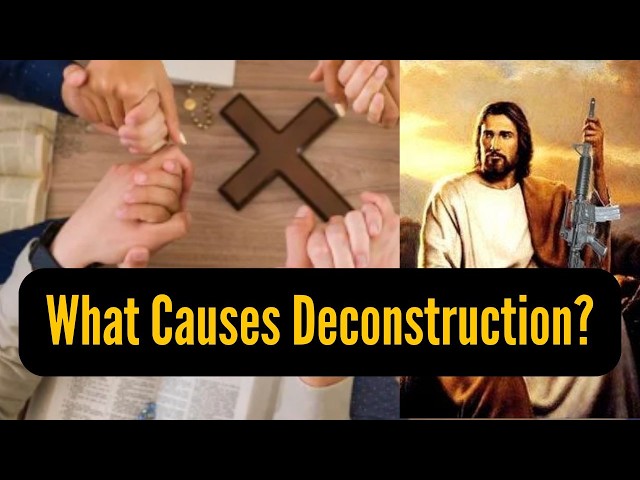
🔗 **Source:** [What Evangelical Christians Get Wrong About Deconstruction](https://www.youtube.com/watch?v=QEY_e53hDko)
> [!note]+ Document Notes
> tags: [deconstruction, evangelicalism, christian-nationalism, purity-culture, religious-trauma]
> author: April Ajoy
> source: April Ajoy (YouTube)
> reference: https://www.youtube.com/watch?v=QEY_e53hDko
> date created: 2026-09-28 09:00
>
> > [!info] Generated analysis — not the author's words. Sections below are machine-written
> > from the captured source. Only text inside `> [!quote]` blocks is verbatim from the author.
> > Do not quote or attribute any other line to the named author.
>
> > [!warning] Auto-caption artifacts. The reacted-to speaker's name renders as "Tara Lee Cobble"
> > and "Terry Lee Cobble"; her actual name (per the video's own metadata) is Tara-Leigh Cobble.
> > Her podcast is garbled as "the daily podcast called the daily recap" — its real name is
> > The Bible Recap. Her tour brand renders as "Israel Lux," likely IsraeLuxe. Book-recommendation
> > names are also mangled: "Kristen Dumé" for Kristin Kobes Du Mez (*Jesus and John Wayne*),
> > "Jamar Tisby" for Jemar Tisby (*The Color of Compromise*), and "Linda K. Klene" for Linda Kay
> > Klein (*Pure*). April's own book is captioned correctly once ("Star Spangled Jesus") and
> > garbled once ("Star Sminkle Jesus") — the real title is *Star-Spangled Jesus*. April's spouse
> > is named once as what the caption renders "be sure" and once as "Beecher"; neither is treated
> > here as a reliable spelling. Verify all proper nouns before quoting outside this file.
>
> # 🏷️ Title: What Evangelical Christians Get Wrong About Deconstruction
>
<!-- deep-read:sections start -->
## 🧭 Table of contents
- [📝 Summary](#-summary)
- [📖 Main content](#-main-content)
- [🗒️ Notes](#️-notes)
- [📚 References](#-references)
- [🗣️ Paraphrase](#️-paraphrase)
- [📰 Newsletter](#-newsletter)
- [✅ Action items](#-action-items)
- [🧪 Hypotheses](#-hypotheses)
- [📊 Methodology](#-methodology)
- [❓ Questions](#-questions)
- [🔮 Future research](#-future-research)
- [💡 Implications](#-implications)
- [🧠 Learning styles assessment](#-learning-styles-assessment)
- [📊 Accessibility assessment](#-accessibility-assessment)
- [🌍 DEIB assessment](#-deib-assessment)
- [✅ Logical validity](#-logical-validity)
- [🛡️ DARVO analysis](#-darvo-analysis)
- [🎯 Conclusion](#-conclusion)
### 🔗 References
- Source: https://www.youtube.com/watch?v=QEY_e53hDko (April Ajoy, 26:12, published 2026-09-23)
- Tara-Leigh Cobble — host of *The Bible Recap*; the reacted-to clips are hers, sourced from elsewhere, not a collaboration with this channel
- April Ajoy's book, *Star-Spangled Jesus*, referenced twice
- Books named as personally formative: *Love Wins* (Rob Bell), *Jesus and John Wayne* (Kristin Kobes Du Mez), *The Color of Compromise* (Jemar Tisby), *Pure* (Linda Kay Klein), *Come as You Are* (Emily Nagoski)
## 📝 Summary
- **What happened.** April Ajoy, a solo YouTube creator, reacts to two clips of Tara-Leigh Cobble (host of *The Bible Recap* podcast) discussing why people deconstruct their faith, then lays out April's own account of why April deconstructed and what the clips get wrong.
- **The claim.** Cobble's clips frame deconstruction as rooted in personal wounds and unmet expectations ("high anthropology"); April argues, from April's own experience and people April knows, that deconstruction is more often triggered by a real mismatch between what evangelicals teach and how evangelicals actually behave — April names white evangelical support for Donald Trump starting in 2016 as April's own catalyst.
- **Why it matters.** The video sits inside an active argument, on both sides of the aisle, about whether people who leave evangelicalism are reasoning their way out or fleeing pain — a framing dispute with real consequences for how churches respond to members who start asking questions.
- **Key stakeholders.** April Ajoy (creator, self-identified as raised Pentecostal, deconstructing since 2011); Tara-Leigh Cobble (subject of the reaction, not present to respond); an unnamed man in the second clip discussing demonic mind-reading; April's spouse, mentioned as coming out non-binary.
- **Risks and tradeoffs.** April generalizes from April's own social circle ("everybody that I know") to evangelicalism broadly; several numbers and historical claims are stated without citation; the tone toward Cobble is sometimes mocking, which cuts against April's own argument that dismissiveness is the problem.
- **Bottom line.** April's central claim — that hypocrisy, not just hurt, drives deconstruction — is argued from firsthand testimony rather than data, and the video is best read as one person's rebuttal essay, not a study.
## 📖 Main content
- **The two source clips.** April found Cobble's content through April's Instagram Reels algorithm, which April says April has trained to serve April's "cringiest weird evangelical stuff." April researched Cobble, found she hosts *The Bible Recap* and runs paid Holy Land tours (IsraeLuxe, per the caption's "Israel Lux"), then reacted to two separate short clips: one about why people deconstruct, one about demons and mind-reading.
- **Cobble's framing, as quoted in the video.** In the first clip Cobble says most people who deconstruct have "a deep wound" and are seeking comfort by rewriting their worldview instead of turning to God. She illustrates with her own past belief that Jeremiah 29:11 was a personal promise about a husband, and describes reading it in context as being about Israel's exile, not an individual.
- **April's central counter-claim.** April argues the opposite causal story: deconstruction starts with encountering "some experience or some truth, something real that did not match what evangelicals were teaching," not with unaddressed pain. April's own example is 2016 white evangelical support for Trump despite the Access Hollywood tape and the Stormy Daniels story, paired with being told April's father would be disappointed in April for not voting for him.
- **A firsthand account, clearly personal.** April describes April's spouse coming out as non-binary and a subsequent meeting with their pastor, who reportedly responded to their account of finding real peace with, "If I wanted to be happy, I would divorce my wife." April generalizes from this single account to a pattern April says April has also seen with other evangelical friends.
- **The "demonize the question" claim.** April argues evangelical culture tolerates doubt only conditionally — allowed as long as it doesn't change anyone's conclusions — and that the real gatekeeping happens at the first question that actually unsettles something, at which point (April's account) "everything unravels rather quickly."
- **The second clip: demons and mind-reading.** An unnamed man in this clip claims demons can read minds and describes this as advantageous because he can pray silently during sleep paralysis-like night terrors. Cobble recounts silently "casting out" a man on a New York City sidewalk who appeared to be in psychological distress, then hedges: "That could have been a coincidence." April contrasts this with what April was taught growing up Pentecostal — that demons could *not* read thoughts, only overhear speech — and argues the newer claim removes the "safe space" of unspoken thought entirely.
- **Christian nationalism as a throughline.** April argues the phrase "biblical truth," used by pastors to avoid explicitly endorsing a candidate, functions as a coded reference to a fixed bundle of positions (abortion, opposition to gay marriage and trans rights, gun rights, support for Israel) that maps onto one political party, and that this bundling is itself evidence there is no single "biblical truth."
- **Letting go of certainty.** April frames April's own multi-year deconstruction (self-reported starting in 2011, intensifying in 2016 and during the pandemic) as partly about releasing the need to have a settled position on every theological question, on the grounds that no one — including confident evangelical leaders — actually knows what happens after death.
- **Book and podcast recommendations.** April closes with a reading list April says helped April's own deconstruction: *Love Wins*, *Jesus and John Wayne*, April's own *Star-Spangled Jesus*, *The Color of Compromise*, *Pure*, and (non-religious) *Come as You Are*, plus early *The Liturgists* and Rob Bell's podcast.
- **An unresolved tension worth naming.** Cobble's own Jeremiah 29:11 anecdote is, structurally, a small act of exactly what April describes as deconstruction: re-examining an inherited reading of scripture and correcting it with context. The clip frames this as growth within faith rather than deconstruction, which is a labeling choice more than a factual disagreement — worth noting rather than resolving.
## 🗒️ Notes
#### ⏱️ [00:00:00](https://www.youtube.com/watch?v=QEY_e53hDko&t=0) Who Cobble is, and the IsraeLuxe tours
- April found the clips via April's Instagram algorithm; April frames this as reaction content, reacting first to a second video about deconstruction that April found more urgent to address than the first.
- April identifies Cobble as host of a daily podcast April recognizes from Apple's spirituality charts (per metadata: *The Bible Recap*).
- Cobble's website advertises luxury Israel tours ("Israel Lux" in the caption) described as offering deluxe accommodations and "life-changing devotionals" at biblical sites.
> [!quote]
> the tours range between 6,500 and $8,000 per person. That includes transportation, hotels, most meals, entry fees, and Bible teaching, but does not include your airfare to get there.
- April flags the pricing as sourced from Cobble's own website, not independently verified here, and calls pairing "luxury" language with religious pilgrimage "icky."
#### ⏱️ [00:04:19](https://www.youtube.com/watch?v=QEY_e53hDko&t=259) Clip one: "a deep wound"
> [!quote]
> Most of them have a deep wound. They have decided to not seek comfort in the one place it can be found, but to seek it in rewriting their worldview, rewriting who God is.
- This is Cobble's characterization of people who deconstruct, quoted directly from the reacted-to clip. It is an attributed claim, not established fact.
- Cobble ties this to "high anthropology" — the idea that a person believes they deserve more than they've been given.
- Her example: being taught she was promised "a great husband someday" and remaining single, which she now attributes to people's promises, not God's.
> [!quote]
> God didn't promise that to me. People did.
- Her Jeremiah 29:11 anecdote: she once treated the verse as a personal promise, then read it in context as addressed to Israelites facing 70 years of exile.
> [!quote]
> But it's written to a people group, not an individual person.
#### ⏱️ [00:06:31](https://www.youtube.com/watch?v=QEY_e53hDko&t=391) April's own account: a spouse coming out, and a pastor's response
- April introduces a firsthand story: April's spouse came out as non-binary, and the couple later met with their pastor to share the experience. (April refers to the book *Star-Spangled Jesus* for the longer version of April's own deconstruction story.)
- The pastor reportedly responded to their account of finding real peace by questioning whether life is about being happy.
> [!quote]
> If I wanted to be happy, I would divorce my wife.
- April says April has seen a similar dismissive pattern from other evangelical friends when April's spouse came out to them, generalizing from this one household's experience to a wider pattern April has personally observed.
#### ⏱️ [00:08:44](https://www.youtube.com/watch?v=QEY_e53hDko&t=524) April's rebuttal: hypocrisy, not wounds
> [!quote]
> most of the people that I know, actually everybody that I know that started deconstructing was because they came in contact with some experience or some truth, something real that did not match what evangelicals were teaching.
- This is April's own generalization from April's personal social circle, explicitly presented as such ("everybody that I know") rather than as a survey or study finding.
- April's named catalyst: white evangelical support for Trump starting in 2016, and being told April's late father would be disappointed in April for not voting for him.
> [!quote]
> "Well, God can use anybody." But if you asked, "Well, couldn't God also use Hillary Clinton?" Then they were like, "No, that's different."
> [!quote]
> I could not in good conscience stay in that group of people knowing how hateful that they were and how much they demonized the people that Jesus told us to love.
- April characterizes evangelical tolerance of doubt as conditional:
> [!quote]
> As long as you still land in the exact same place, as long as you still believe all the same things that everybody else does, that it's okay to ask questions.
- April's claim about what happens once a genuinely destabilizing question is asked:
> [!quote]
> you have to white knuckle your faith because you constantly carrying so much cognitive dissonance
> [!quote]
> I realized that white evangelicalism as a whole is just the roots are rotten.
- April's own description of the process as an "existential crisis":
> [!quote]
> deconstruction is not fun. I would call it an existential crisis.
- Closing theological objection to the clip's framing:
> [!quote]
> the evangelical worldview does not add up and does not match the existence of an allloving God.
#### ⏱️ [00:15:20](https://www.youtube.com/watch?v=QEY_e53hDko&t=920) Clip two: demons that read minds
- April sets up the contrast with April's own Pentecostal upbringing, where April was taught demons could influence thoughts but could not read them outright, only overhear speech.
> [!quote]
> not only could you not trust your own thoughts but that you know Satan could whisper and like demons could influence your thoughts.
- April reacts with disbelief to the clip's claim that demons can read minds, calling for scriptural support.
> [!quote]
> show me chapter and verse that says that Satan can't read your mind, that the demons can't read your mind.
- The unnamed man in the clip frames mind-reading demons as advantageous, since he can pray silently during episodes he describes as demonic attack.
> [!quote]
> He regularly in his line of work experiences demonic attack. Typically, he sleeps on his stomach and wakes up to his head being pressed into the pillow in a night terror situation where he can't speak.
> [!quote]
> I can still pray in my mind. I can still pray the name of Jesus in my mind, cast out demons in my mind, and it works.
- Cobble recounts her own anecdote of silently intervening with a stranger on a New York City sidewalk.
> [!quote]
> I was sitting at a cafe in New York City and there was a guy on the sidewalk who appeared to be manifesting some kind of demonic entity or entities. I just prayed silently, binding the enemy, speaking in the name of Jesus.
- Notably, Cobble hedges her own anecdote rather than presenting it as confirmed: "That could have been a coincidence." April's own aside:
> [!quote]
> TLC, mental exorcist.
- April's broader point: if demons can now read thoughts, the "safe space" April was taught existed (unspoken thought) disappears, and April argues this makes the belief system heavier to carry rather than reassuring.
#### ⏱️ [00:18:59](https://www.youtube.com/watch?v=QEY_e53hDko&t=1139) "Biblical truth" as a Christian nationalism dog whistle
- April argues pastors avoid direct endorsements by telling congregants to "vote for biblical truth," which April says functions as a coded reference to a specific political bundle.
> [!quote]
> that phrase biblical truth is a dog whistle for Christian nationalism.
- April lists the bundle as April has observed it: opposition to abortion (which April notes the Bible does not mention), opposition to gay marriage and trans rights, gun rights, and support for Israel.
> [!quote]
> There is no one party that holds a biblical truth because there is no one singular biblical truth.
- April's underlying claim: the Bible contains multiple, sometimes contradictory worldviews, which becomes visible "when you read it objectively," in April's account, during deconstruction.
#### ⏱️ [00:21:10](https://www.youtube.com/watch?v=QEY_e53hDko&t=1290) April's own timeline, and letting go of certainty
- Self-reported personal timeline, presented as autobiography rather than a general claim:
> [!quote]
> I really started deconstructing slowly in 2011. It really amped up in 2016 in the first Trump administration and then like accelerated in the pandemic.
- April describes an early felt need to immediately replace every discarded belief with a new firm position, and says releasing that need — rather than any specific doctrinal conclusion — was itself one of the more important steps.
- April invokes denomination count to argue no single theological position is mandatory:
> [!quote]
> there's over 45,000 Christian denominations.
- This figure is stated without a source in the video; it is a widely circulated number whose exact methodology is contested, and it is presented here as received wisdom rather than a cited statistic.
- April's closing epistemic claim, offered as April's own view rather than a proven fact:
> [!quote]
> Nobody knows what happens when we die.
#### ⏱️ [00:24:01](https://www.youtube.com/watch?v=QEY_e53hDko&t=1441) Recommended reading, podcasts, and close
- Book list, presented as personally formative rather than a comprehensive bibliography: *Love Wins* (Rob Bell, on hell and the afterlife), *Jesus and John Wayne* (Kristin Kobes Du Mez, garbled as "Kristen Dumé," on Christian nationalism), April's own *Star-Spangled Jesus*, *The Color of Compromise* (Jemar Tisby, garbled as "Jamar Tisby," on racism in white evangelicalism), *Pure* (Linda Kay Klein, garbled as "Linda K. Klene," on purity culture), and *Come as You Are* (Emily Nagoski, non-religious, on sexuality and body shame).
> [!quote]
> Love Wins by Rob Bell, especially on the topic of hell and the afterlife was really good for Christian nationalism.
- Podcasts named: early *The Liturgists* and Rob Bell's podcast, with the caveat that better resources likely exist now.
- April closes by inviting topic suggestions and a subscribe/like ask.
> [!quote]
> yeah, thank you for being here.
## 📚 References
The transcript itself contains no links; the following come from the video description or are primary sources for named entities.
- [The Bible Recap](https://www.thebiblerecap.com/) — Tara-Leigh Cobble's daily podcast, referenced (garbled) in the transcript
- *Love Wins* — Rob Bell
- *Jesus and John Wayne* — Kristin Kobes Du Mez (transcript: "Kristen Dumé")
- *Star-Spangled Jesus* — April Ajoy, the creator's own book (transcript: "Star Spangled Jesus" / "Star Sminkle Jesus")
- *The Color of Compromise* — Jemar Tisby (transcript: "Jamar Tisby")
- *Pure* — Linda Kay Klein (transcript: "Linda K. Klene")
- *Come as You Are* — Emily Nagoski
- *The Liturgists* (podcast, early episodes) and Rob Bell's podcast, both named as past listening rather than current recommendations
## 🗣️ Paraphrase
- **The setup.** April found Cobble's content through a feed April has deliberately trained to serve April's "cringiest weird evangelical stuff," looked her up, and decided to react to two clips.
- **Cobble's claim.** People who deconstruct usually have an unaddressed wound and are seeking comfort somewhere other than God; Cobble illustrates with her own past misuse of a Bible verse about a promised husband.
- **April's counter.** In April's own experience and among people April knows, deconstruction starts from witnessing a real mismatch — for April, the 2016 evangelical embrace of Trump — not from personal pain needing soothing.
- **The pastoral encounter.** When April and April's spouse shared that coming out non-binary brought real peace, their pastor reportedly responded by questioning whether happiness is even the point of life.
- **Doubt with conditions.** April argues evangelical culture permits doubt only as long as it doesn't change the answer, and that the real friction starts at the first question that actually does.
- **The demons clip.** A man claims demons reading minds is actually useful because he can pray silently; Cobble describes silently intervening with a stranger on a sidewalk, then hedges that it might have been coincidence. April contrasts this with being taught demons could only overhear, not read minds.
- **Christian nationalism.** "Vote for biblical truth" functions, in April's account, as code for a specific political bundle, which April argues is proof there's no single biblical position.
- **Letting go.** April's own multi-year deconstruction included releasing the need to hold a settled position on everything, on the argument that no one actually knows what happens after death.
- **The reading list.** Six books and two podcasts April says helped April, offered as personal recommendations rather than a systematic bibliography.
## 📰 Newsletter
**A creator's rebuttal essay to a popular Christian podcaster's framing of deconstruction — worth reading alongside, not instead of, the clips it responds to.**
April Ajoy spends 26 minutes making one argument: that Tara-Leigh Cobble's "deep wound" framing of deconstruction gets the causality backwards. April's version, from firsthand experience: people leave not because they're hurting and looking in the wrong place, but because they noticed the gap between what evangelicalism preaches and what it does — for April, the 2016 evangelical embrace of Donald Trump despite the Access Hollywood tape.
The most quietly interesting moment isn't the disagreement, it's the unremarked overlap: Cobble's own anecdote about re-reading Jeremiah 29:11 in context, after years of treating it as a personal promise, is structurally the same move April calls deconstruction. The video treats it as growth within faith rather than deconstruction — a labeling choice, not a factual one.
The second half covers a separate clip about demons reading minds, which April contrasts with April's own Pentecostal upbringing (demons could overhear, not read). Worth the caution: the clip's own speakers hedge their strongest anecdote ("that could have been a coincidence"), which is more epistemic humility than the framing gets credit for in April's reaction.
Numbers to sit with rather than repeat uncritically: the "45,000 Christian denominations" figure is stated with no source, and the IsraeLuxe tour pricing ($6,500–$8,000) comes from Cobble's own website via April, not independent verification.
## ✅ Action items
#### DevRel
- Developer advocacy: not applicable to this source.
- Education: no direct action; nearest relevance is the general lesson that framing a group's departure as individual pathology (rather than a response to observed inconsistency) forecloses learning from the departure — applicable to any community losing members, not just churches.
- Developer experience: not applicable to this source.
- Developer marketing: not applicable to this source.
- Community management: the "doubt is fine as long as the answer doesn't change" pattern April describes has a direct analog in any community that tolerates dissent only until it threatens consensus — worth naming explicitly in moderation norms.
- Internal/external/cross-project: not applicable to this source.
#### OSPO
- Policy & Governance: not applicable to this source.
- License Compliance: not applicable to this source.
- Security Management: not applicable to this source.
- Software Inventory: not applicable to this source.
- Developer Support: not applicable to this source.
- Community Engagement: not applicable to this source.
- Strategic Alignment: not applicable to this source.
#### Community
- Maintainers: not applicable to this source.
- Contributors: not applicable to this source.
- Sponsors: not applicable to this source.
- Ecosystem: not applicable to this source.
#### WordPress
- Core: not applicable to this source.
- Core Performance: not applicable to this source.
- Core AI: not applicable to this source.
- **Core Program Team:** not applicable to this source.
- Mobile: not applicable to this source.
- Playground: not applicable to this source.
- Community: the conditional-doubt pattern is a useful lens for any project reviewing why contributors quietly leave.
- Training: not applicable to this source.
- Marketing: not applicable to this source.
- Support: not applicable to this source.
- Design: not applicable to this source.
- Documentation: not applicable to this source.
- Photos: not applicable to this source.
- TV: not applicable to this source.
- Polyglots: not applicable to this source.
- Accessibility: not applicable to this source.
- Meta: not applicable to this source.
- CLI: not applicable to this source.
- Hosting: not applicable to this source.
- Tide: not applicable to this source.
- Openverse: not applicable to this source.
- Themes: not applicable to this source.
- Plugins: not applicable to this source.
#### The WPOCC
- Programs: not applicable to this source.
- Projects: not applicable to this source.
- Funding experiments: not applicable to this source.
### FAIR
- Technical independence: not applicable to this source.
- Policies and covenants: not applicable to this source.
- Productized governance artifacts: not applicable to this source.
## 🧪 Hypotheses
- People who deconstruct after witnessing an in-group's stated-values-versus-behavior gap (e.g., political hypocrisy) report a different subjective trigger than those who deconstruct after direct personal harm, even when both groups end up with similar theological conclusions.
- Framing a departing member's motives as psychological (a "wound") rather than reasoned (an observed inconsistency) reduces a listening audience's willingness to consider the departing member's substantive claims.
- Communities that describe "doubt" as acceptable only conditionally (as long as conclusions don't change) will show measurably higher rates of members concealing genuine uncertainty than communities without that framing.
- The claim that demons can read minds, versus only overhear speech, produces measurably higher anxiety in adherents than the overhear-only version, holding other beliefs constant.
- Self-reported deconstruction timelines cluster around identifiable political and public-health events (2016, 2020) more than around private personal crises, at least for people who name a specific catalyst.
## 📊 Methodology
- **Trigger-type study.** Survey a sample of people who identify as having deconstructed from evangelicalism, asking them to name their primary catalyst, then code responses into hypocrisy-witnessed versus personal-harm categories and compare with any available data on subsequent belief change.
- **Framing-effect experiment.** Present matched audiences with a "wound" framing versus a "hypocrisy" framing of the same deconstruction narrative and measure stated sympathy and willingness to engage with the departing person's specific claims.
- **Conditional-doubt survey.** Within congregations, measure self-reported comfort expressing doubt aloud versus privately, and test whether congregations with explicit "doubt is welcome" messaging show a gap between the two.
- **Belief-content anxiety comparison.** Within Pentecostal and charismatic samples, compare anxiety and rumination scores between adherents taught demons can read minds versus only overhear speech, controlling for general religiosity.
- **Timeline clustering.** Collect self-reported deconstruction start dates from public testimonies and test for clustering around 2016 and 2020 versus a null model of even distribution.
- **Data sources.** Would require new surveys; none of this video's claims are drawn from existing published data, and no such data is cited in the source.
- **Limits.** Every claim in the source is a single person's testimony or a characterization of another single person's short clip. Nothing here is measured; all of it is reported experience, and the two named clips are excerpted without their own full context.
## ❓ Questions
- What did the fuller Cobble clips say before and after the excerpted portions, and does context change the "deep wound" framing's fairness?
- Is April's claim that "everybody" April knows deconstructed over hypocrisy a description of April's actual social circle, or rhetorical emphasis? The video doesn't distinguish.
- Where does the 45,000-denomination figure actually come from, and does its counting methodology (which reportedly includes many autonomous congregations as separate "denominations") support the rhetorical point being made with it?
- Does the unnamed man's demons-read-minds claim have any basis Cobble or he cites beyond personal experience, and how does it square with Cobble's own hedge that her sidewalk intervention "could have been a coincidence"?
- Is "vote for biblical truth" actually used as consistently and specifically as April describes, or is this a generalization from a subset of pastors April has encountered?
- What would it look like for a church to treat a coming-out disclosure as April describes wanting — without needing to litigate whether life "is about happiness" at all?
- How does April's own generalization from personal testimony to "evangelicalism as a whole" avoid the same charge of overgeneralization April levels at Cobble?
## 🔮 Future research
- Comparative research on deconstruction triggers (institutional hypocrisy versus personal harm) is thin; most public accounts, including this one, are single testimonies rather than aggregated data.
- The psychological effect of belief content itself (demons-can/cannot-read-minds) on adherent anxiety appears understudied relative to the volume of testimony about it.
- The actual reach and consistency of "biblical truth" as coded political language across denominations and regions is an empirical question this video treats as settled from personal observation.
- Longitudinal tracking of self-reported deconstruction timelines against political and public-health events would test the clustering claim April makes about 2016 and 2020.
## 💡 Implications
- **Practice.** Pastoral responses to disclosures of identity or doubt that default to challenging the person's right to want happiness or certainty, rather than engaging their specific reasoning, are likely to be experienced as dismissive regardless of intent.
- **Policy.** Congregational leaders weighing how to discuss deconstruction publicly might separate "we disagree with this conclusion" from "this person is psychologically broken," since the second claim requires evidence the first does not.
- **Security.** Not a security topic in the technical sense, but the video's own recommended-reading pattern (personal testimony, no independent verification, statistics stated without source) is a reminder that faith-adjacent content consumed via algorithmic feeds — on either side of this argument — carries the same misinformation risks as any other algorithmically surfaced content.
- **Education.** Both clips model, without naming it, the difference between engaging an argument's substance and characterizing its source's motives; that distinction is teachable and neither speaker in this video fully honors it toward the other.
- **Funding.** Not applicable to this source; no funding, grants, or financial models are discussed beyond the stated cost of Cobble's tours.
## 🧠 Learning styles assessment
- Reading level estimate: Flesch-Kincaid, roughly grade 7-8 (Flesch Reading Ease in the mid-70s). Vocabulary is everyday and conversational; the difficulty comes from long, run-on spoken sentences and mid-thought digressions rather than vocabulary.
#### 👀 Visual learners
- Present: the reacted-to clips are shown on screen (implied by the ">>" speaker markers in the transcript), giving some visual anchor to the audio commentary.
- Improve: no on-screen citations for the 45,000-denomination figure or the tour pricing; a text overlay with sources would let visual learners check claims without pausing.
#### 🔊 Aural learners
- Present: strong. The entire video is spoken, conversational reaction content with clear vocal emphasis on key disagreements.
- Improve: no distinct audio cue marks the transition between April's voice and the excerpted clip audio; a sound sting would help listeners track whose claim is whose.
#### 🗣️ Verbal learners
- Present: April explains the reasoning at length rather than just asserting conclusions, and defines terms like "deconstruction" and "high anthropology" for viewers unfamiliar with them.
- Improve: some terms ("Bible roulette," "dog whistle") are used without definition for viewers outside evangelical or political-commentary contexts.
#### 🧩 Kinesthetic learners
- Present: minimal; this is a talking-head reaction video with no hands-on task.
- Improve: a companion worksheet ("name your own deconstruction catalyst, if any") would give this format a practical exercise it currently lacks.
#### 🧠 Logical learners
- Present: April's rebuttal to Cobble follows a clear premise-to-conclusion structure (observed hypocrisy, not private pain, as the actual trigger), supported by a specific dated example (2016).
- Improve: the causal claim is argued entirely from personal anecdote; no comparative data or counterexample is considered.
#### 🧑🤝🧑 Social learners
- Present: April explicitly invites viewer topic suggestions in the comments at the close.
- Improve: no discussion prompt or structured way for viewers to share their own deconstruction catalysts, despite the video's clear relevance to viewers going through the same process.
#### 🧘♀️ Solitary learners
- Present: adequate; the video is self-contained and followable without outside context, aside from not knowing the reacted-to clips' full length.
- Improve: 26 minutes with two distinct clip-reactions and no chapter markers means a viewer wanting only the demons segment has to scrub manually.
#### 🌿 Naturalistic learners
- Present: minimal.
- Improve: not a natural fit for this topic; no meaningful gap to flag.
## 📊 Accessibility assessment
#### Screen reader semantics
- Present: not evaluable for a video artifact.
- Improve: a description-box outline distinguishing the two reacted-to clips and April's own story would help anyone navigating by structure rather than watching linearly.
#### Keyboard navigation
- Present: inherits YouTube's player controls.
- Improve: no chapter markers across 26 minutes and at least four distinct sub-topics (Cobble's clips, April's own story, Christian nationalism, book recommendations); chapters are the most acute accessibility gap here.
#### Contrast and readability
- Present: not directly evaluable from the transcript; primarily a talking-head format with limited on-screen text.
- Improve: not applicable beyond standard caption legibility, addressed below.
#### Text resizing and reflow
- Present: not applicable to video content.
- Improve: not applicable.
#### Media and captions
- Present: auto-generated captions exist and are largely readable for common words.
- Improve: captions garble nearly every proper noun that matters for looking things up afterward — Cobble's name, her podcast's name, and four of six recommended-book authors. For a video whose value partly depends on tracking down the reading list, this materially reduces usefulness. WCAG 1.2.2 (Captions) is met only nominally.
#### Forms and interactions
- Present: not applicable to this source.
- Improve: not applicable.
#### Standards reference
- WCAG 2.2 AA notes: 1.2.2 Captions met nominally, with errors on nearly every proper noun (people, podcasts, books). 2.4.5 Multiple Ways unmet: no chapters, no timestamped description, no transcript link offered by the creator (Reader's own transcript is what made this analysis possible). 1.3.1 Info and Relationships not fully evaluable without visual access to on-screen clip framing.
## 🌍 DEIB assessment
#### Cultural breadth
- Present: the video is explicit about its specific subculture (white American evangelicalism, Pentecostalism) rather than presenting it as universal Christianity.
- Improve: the argument and its rebuttal both stay entirely within a US white evangelical frame; no perspective from evangelicals of color, non-US evangelical contexts, or non-Protestant Christian traditions is included.
#### Inclusive language
- Present: April refers to April's spouse's coming out as non-binary without editorializing on the disclosure itself, treating it as a fact of their shared life.
- Improve: some casual phrasing ("cringiest weird evangelical stuff") is dismissive toward Cobble's audience and could read as gatekeeping toward viewers still inside that audience who are watching this video.
#### Neurodiversity support
- Present: consistent first-person narration with a stable topic focus within each segment.
- Improve: long run-on sentences and frequent mid-thought digressions (a documented feature of unscripted reaction content) make the video harder to follow for viewers who benefit from more linear structure; no chapters compound this.
#### Representation
- Present: a non-binary person is referenced with evident care by their spouse, though not by name or in their own words; the video includes one creator's account of deconstructing from a Pentecostal background.
- Improve: the video is a single narrator's account throughout; no other deconstructed voices, and no space given to sincere evangelicals who might reasonably disagree with the causal claim on grounds other than the ones the video rebuts.
#### Psychological safety
- Present: April is candid about April's own distress during deconstruction ("crying and like laying on the floor balling"), which models vulnerability rather than certainty.
- Improve: the tone toward Cobble is frequently mocking (the "TLC, mental exorcist" aside, repeated characterizations of Cobble's content as "cringiest" and "weird"), which sits in tension with April's own critique of evangelical dismissiveness — a viewer sympathetic to Cobble is unlikely to feel safely engaged by this video's tone, even where its substantive argument has merit.
## ✅ Logical validity
#### Strong reasoning
- **The hypocrisy-as-catalyst argument (00:08:44).** April supports April's causal claim with a specific, checkable example (2016 evangelical support for Trump despite the Access Hollywood tape and the Stormy Daniels reporting) rather than an abstract assertion, and April distinguishes April's own experience from a universal claim by naming April's source ("people that I know").
- **The conditional-doubt argument (00:08:44-00:11:42).** April's claim that doubt is tolerated only until it changes an answer is reasoned from a described mechanism (cognitive dissonance accumulating until "you pull the string") rather than simply asserted as a rule.
- **Noticing the Jeremiah 29:11 anecdote's structure (00:04:19-00:05:46), unremarked in the video itself.** Cobble's own account of re-reading a verse in its historical context and revising a personal-promise interpretation is, structurally, the same move April elsewhere calls deconstruction. The video doesn't draw this connection, and this analysis flags it as a labeling difference rather than a factual disagreement between the two accounts.
#### Fallacies
- **Ad hominem via psychologizing (00:04:19).** *Location:* "Most of them have a deep wound... seeking comfort... in rewriting their worldview." *Weakness:* attributes deconstruction to unaddressed emotional need rather than engaging any specific claim a deconstructing person might be making. *Fix:* address the substantive claims (e.g., specific hypocrisy allegations) rather than the presumed motive behind raising them.
- **False dichotomy (00:04:19).** *Location:* the framing that people either "seek comfort in the one place it can be found" or "rewrite their worldview." *Weakness:* presents these as mutually exclusive when a revised worldview can itself be where someone finds comfort, as Cobble's own Jeremiah anecdote arguably demonstrates. *Fix:* allow for revised belief as itself a form of seeking, not automatically its opposite.
- **Hasty generalization from a small sample (00:08:44).** *Location:* "everybody that I know that started deconstructing was because they came in contact with some experience or some truth." *Weakness:* generalizes a causal pattern for an entire large-scale religious movement from April's own social circle. *Fix:* the claim is more defensible framed explicitly as "in my experience" throughout rather than implicitly extended to evangelicalism as a whole, which April does elsewhere in the video ("white evangelicalism as a whole is just the roots are rotten").
- **Appeal to an uncited statistic (00:21:54).** *Location:* "there's over 45,000 Christian denominations." *Weakness:* used to support a point (no single mandatory theological position) without stating where the number comes from; the figure is widely circulated but its counting methodology is disputed. *Fix:* name the source or state the point without leaning on a specific, unverified number.
- **Unfalsifiable personal anecdote presented as evidence, with a notable self-correction (00:16:44).** *Location:* Cobble's cafe intervention story. *Weakness:* a single unwitnessed personal account offered as illustrating a spiritual mechanism (silent exorcism). *Mitigation:* Cobble herself hedges — "That could have been a coincidence" — which is a genuine, if brief, epistemic caveat that keeps the claim from being fully unfalsifiable in its own framing.
#### Tone of voice
- Casual, sarcastic, and confessional — a solo creator narrating in real time, mixing personal vulnerability (crying during April's own deconstruction) with mockery of the reacted-to speaker's content and appearance of belief ("cringiest weird evangelical stuff," "TLC, mental exorcist"). The register shifts noticeably between the two modes: measured and specific when describing April's own experience, dismissive and joking when characterizing Cobble's. That contrast is itself worth noting, since the video's own thesis is that evangelical culture is too quick to dismiss people rather than engage them.
## 🛡️ DARVO analysis
- **Deny:** Not directly present as classic DARVO, but Cobble's clip can be read as a soft denial of institutional cause: framing deconstruction as personal-wound-driven implicitly denies that the institution's own behavior (the hypocrisy April describes) is the operative cause. This is April's characterization of a short excerpted clip lacking full context, not a verified claim about Cobble's full position.
- **Attack:** Not present in the excerpted material as an attack on named accusers. April's own commentary contains attacks on Cobble's content and audience in general terms ("cringiest weird evangelical stuff") rather than rebuttals of specific claims in places, which is worth naming as a tone issue even though it doesn't rise to DARVO's specific "attack the accuser" pattern.
- **Reverse victim/offender:** Not clearly present in either direction within the transcript. Neither speaker frames themselves as the victim of the other's accusations; this is better described as a framing dispute (motive versus mismatch) than a victim-offender reversal.
- **Assessment:** Full DARVO is not established by this transcript; the more accurate description is a motive-attribution dispute, where each side characterizes the other's stated reasons as suspect rather than engaging the substance. Retained per template requirement; the finding is a soft partial match on Deny only, not a clean case.
## 🎯 Conclusion
- **Bottom line.** April Ajoy argues, from April's own testimony, that people deconstruct because they witness a real mismatch between evangelical teaching and evangelical behavior, not primarily because of unaddressed personal pain — a direct rebuttal to Tara-Leigh Cobble's "deep wound" framing in the reacted-to clips.
- **The unremarked overlap worth keeping.** Cobble's own Jeremiah 29:11 story is structurally a small act of what April calls deconstruction; the video treats it as growth-within-faith instead, which is a framing choice rather than a factual dispute between the two accounts.
- **What to treat cautiously.** The 45,000-denomination figure and the IsraeLuxe tour pricing are both stated without independent verification in this analysis; treat both as reported rather than confirmed.
- **Practical next steps for readers.** If evaluating this video's central claim, look for aggregated accounts of deconstruction triggers beyond personal testimony (from either side of the argument) before treating either framing as settled. If drawing pastoral lessons, separate "we disagree with this person's conclusion" from "this person is psychologically motivated" — the second requires evidence the first does not.
## 🔄 Refactor Appendix — What Evangelical Christians Get Wrong About Deconstruction
> Density: 2–5 Literature atoms (H3), 0–3 Permanent candidates (H4).
> Defaults: 3 Literature, 1 Permanent. Resonance filter: if you can't
> articulate in one line why a claim matters, drop it.
>
> Konik claim-header rules: present tense, declarative, ≤10 words when
> possible, searchable, unique, mirrors annotation focus if present.
>
> Atomicity: one declarative sentence per atom. "and"/"also" → split.
>
> Tag pool: #bmf · #addendum · #xref · #articleseed · #storystem · #share · #aphorisms
### 📚 Literature Atoms (H3)
#### [H1] Evangelicalism's rot is systemic, not a few bad apples
> [!quote]
> I realized that white evangelicalism as a whole is just the roots are rotten.
**Context & use**:
- ~00:11:42, April's own conclusion after years of assuming individual church hurt was the whole story.
- Marks the shift from "some bad people" to "structural" critique, which is the hinge April's whole rebuttal to Cobble depends on.
**Tags**: #xref #articleseed
<!-- atomicity: 1 idea ✓ -->
#### [H2] Doubt is welcome only until it changes the answer
> [!quote]
> The reason they demonize asking questions, they don't want you to ask too many questions.
**Context & use**:
- ~00:10:57, describing how evangelical culture frames acceptable doubt.
- The mechanism claim (conditional tolerance, not open inquiry) is the sharpest, most transferable idea in the video — applies to any in-group managing dissent.
**Tags**: #xref #articleseed #aphorisms
<!-- atomicity: 1 idea ✓ -->
#### [H3] A claimed safeguard against demons collapses under its own logic
> [!quote]
> show me chapter and verse that says that Satan can't read your mind, that the demons can't read your mind.
**Context & use**:
- ~00:15:20, April challenging the premise of the second reacted-to clip.
- Illustrates how a belief system's internal comforts (unspoken thought as safe) can be revised without acknowledgment of the cost to the adherent.
**Tags**: #xref
<!-- atomicity: 1 idea ✓ -->
#### [H4] "Biblical truth" as spoken by pastors names a political bundle
> [!quote]
> that phrase biblical truth is a dog whistle for Christian nationalism.
**Context & use**:
- ~00:19:43, April's central claim about coded pulpit language.
- A specific, checkable claim (does the bundle map this consistently?) rather than a vague accusation — worth testing against a wider sample of sermons.
**Tags**: #xref #articleseed
<!-- atomicity: 1 idea ✓ -->
### 🧠 Permanent Candidates (H4)
#### [P1] Deconstruction usually starts with witnessed hypocrisy, not private pain
**Claim** (one sentence, Courtney's voice): When someone leaves a religious or political in-group after years inside it, the trigger is usually a witnessed gap between the group's stated values and its actual conduct, not an unaddressed personal wound needing comfort.
**Evidence pointer**: [[#H1]]
**Scope & conditions**: Holds for departures following a specific, nameable event (an endorsement, a policy, a cover-up) that the person can point to. Weakens for departures with no identifiable trigger, where wound-based explanations may fit better case by case.
**Links**:
- [[Doubt is welcome only until it changes the answer]] — because extends the same in-group control mechanism from belief-tolerance to departure-explanation
- [[Faith deconstruction context]] — because evidence-for Courtney's own NAR exit following the same pattern
- [[Christian nationalism codes its politics as theology]] — because applies-in the specific political expression April names
<!-- atomicity: 1 idea ✓ -->
#### [P2] Confident claims of certainty are often self-persuasion, not knowledge
**Claim** (one sentence, Courtney's voice): When a religious leader states unusual confidence about the unknowable, that confidence is more often the sound of someone convincing themselves than evidence they actually know.
**Evidence pointer**: [[#H2]] · "Nobody knows what happens when we die." (00:22:35)
**Scope & conditions**: Applies to claims about categorically unverifiable things (the afterlife, another person's inner spiritual state). Does not apply to confidence about verifiable claims, where certainty can be earned.
**Links**:
- [[Faith deconstruction context]] — because applies-in Courtney's own reassessment of NAR certainty claims
- [[A claimed safeguard against demons collapses under its own logic]] — because contrasts on certainty performed publicly versus doubt suppressed privately
<!-- atomicity: 1 idea ✓ -->
### ✏️ Fleeting Queue
- [F1] The Jeremiah 29:11 anecdote is structurally deconstruction that the video labels as growth-within-faith — worth its own short note on labeling versus substance in these debates #fleeting #inbox
- [F2] Check the actual sourcing and counting methodology behind the "45,000 Christian denominations" figure before repeating it anywhere #fleeting #inbox
- [F3] The conditional-doubt mechanism (tolerated until it changes the conclusion) maps onto more than religious contexts — worth a standalone note on in-group dissent management #fleeting #inbox
- [F4] Tone mismatch worth naming in future faith-content notes: mocking the source while arguing against dismissiveness undercuts the argument's own credibility #fleeting #inbox
### → Things 3 (max 2 actions)
- [ ] Draft the "deconstruction usually starts with witnessed hypocrisy, not private pain" permanent note — personal #things
- [ ] Verify the denomination-count figure's actual source before it shows up in any of Courtney's own writing #things
<!-- deep-read:sections end -->
📄 **Full text:** [[Full Document Contents/Articles/What Evangelical Christians Get Wrong About Deconstruction.md|What Evangelical Christians Get Wrong About Deconstruction by April Ajoy]]
## Highlights
- good conscience stay in that group of people knowing how hateful that they were and how much they demonized the people that Jesus told us to love. Like I couldn't in my good conscience stay there. I had to start asking questions. Like that was that was the starting point. And what they don't tell you when you're inside. The reason they demonize asking questions, they don't want you to ask too many questions. They they say, "Oh, yeah, you can have doubts. As long as you still land in the exact same ([View Highlight](https://read.readwise.io/read/01m3m5rchmq9symktbcswqta64))
- Note: [H2] Doubt is welcome only until it changes the answer
- Tags: atom/literature/h2
- genuine desire to follow Jesus better, to follow the red letters more closely. And have I been hurt by people in the church? Yes. But I believed when I started deconstructing that those were just a few bad apples and it was not the whole system. But the further I the more questions that I asked, I realized that white evangelicalism as a whole is just the roots are rotten. and I just could no longer be a part of that. Also, ([View Highlight](https://read.readwise.io/read/01m3m5ra129xvfc3gc3be50nae))
- Note: [H1] Evangelicalism's rot is systemic, not a few bad apples
- Tags: atom/literature/h1
- had to ask yourself, was that from God? Was that from me or was that a demon? You know, and honestly, if it was from me, I might as well be a demon cuz I'm so evil, you know. So, anyway, this was just wild to me because I've never I've never heard this even in my in my Pentecostal days. So, show me chapter and verse that says that Satan can't read your mind, that the demons can't read your mind. And I was like, well, he's not omnisient. And he's like, that's not omniscience. Just because you know something doesn't mean you know everything. But he said, "In my experience, demons being able to read ([View Highlight](https://read.readwise.io/read/01m3m5rf6tv2k32192284jv9d8))
- Note: [H3] A claimed safeguard against demons collapses under its own logic
- Tags: atom/literature/h3
- pastor admits they're a Christian nationalist or not, they a lot of times will push it. Um here's a fun fact. Uh if a pastor gets up and says, "We don't tell you who to vote for, but we want to tell you to vote for biblical truth." As long as you vote for biblical truth, um that phrase biblical truth is a dog whistle for Christian nationalism. And you can tell too because usually they will then list those biblical truths, which is abortion, which the Bible doesn't mention. Um usually gay marriage, trans issues, gun rights, ([View Highlight](https://read.readwise.io/read/01m3m5rhsr1t5kj1hn5bjax6qw))
- Note: [H4] "Biblical truth" as spoken by pastors names a political bundle
- Tags: atom/literature/h3