What Is a Whataboutism? | TeachThought
🔗 **Source:** [What Is a Whataboutism? | TeachThought](https://www.teachthought.com/critical-thinking-posts/what-is-a-whataboutism/)
> [!note]+ Document Notes
> tags: #critical-thinking #rhetoric #argumentation
> author: TeachThought
> source: TeachThought
> reference: https://www.teachthought.com/critical-thinking-posts/what-is-a-whataboutism/
> date created: 2024-12-19 14:30
>
> # 🏷️ Title: What Is A Whataboutism?
>
<!-- deep-read:sections start -->
## 🧰 Action Inbox
- [H1] Develop classroom protocols for identifying whataboutism in student discussions #critical-thinking
- [H2] Create comparison criteria worksheets to distinguish useful analogies from deflection #argumentation
- [H3] Practice response strategies for addressing whataboutism in debates #rhetoric
## 🧭 Table of Contents
- [[#📝 Summary]]
- [[#📖 Main Content]]
- [[#🗒️ Notes]]
- [[#📚 References]]
- [[#🗣️ Paraphrase]]
- [[#📰 Newsletter]]
- [[#✅ Action Items]]
- [[#🧪 Hypotheses]]
- [[#📊 Methodology]]
- [[#❓ Questions]]
- [[#🔮 Future Research]]
- [[#💡 Implications]]
- [[#🧠 Learning Styles Assessment]]
- [[#📊 Accessibility Assessment]]
- [[#🌍 DEIB Assessment]]
- [[#✅ Logical Validity]]
- [[#🛡️ DARVO Analysis]]
- [[#🎯 Conclusion]]
### 🔗 References
- [Merriam-Webster: Whataboutism](https://www.merriam-webster.com/dictionary/whataboutism)
- [TeachThought Critical Thinking Resources](https://www.teachthought.com/critical-thinking-posts/)
## 📝 Summary
- **What happened**: TeachThought published an educational guide defining whataboutism as a rhetorical deflection technique that avoids answering claims by shifting attention to different issues
- **Why it matters**: Whataboutism undermines critical thinking and accountability in discussions, making it essential for educators to help students recognize and respond to this common argumentative fallacy
- **Key stakeholders**: Teachers, students, debate coaches, and anyone engaged in evidence-based reasoning and argumentation
- **Risks and tradeoffs**: While some comparisons are legitimate and helpful for understanding, whataboutism replaces original questions rather than clarifying them
- **Bottom line**: Students need tools to distinguish between useful comparisons that advance discussion and deflection tactics that derail accountability and evidence-based reasoning
## 📖 Main Content
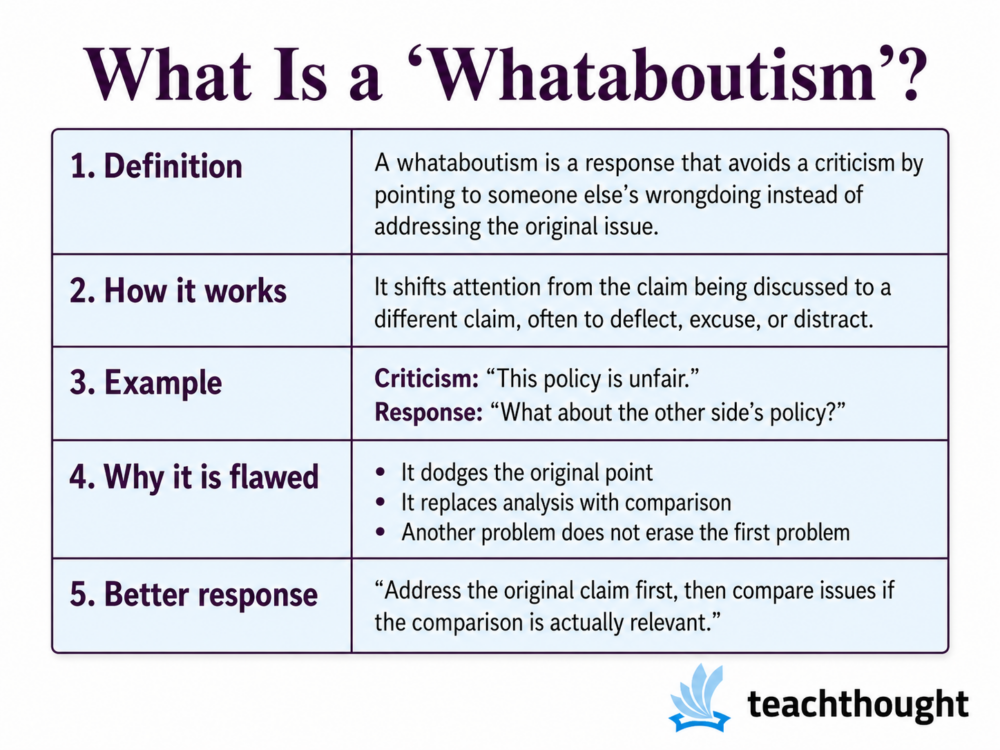
Whataboutism is a rhetorical strategy where someone avoids responding to criticism or questions by pointing to a different problem, typically starting with "What about this other thing?" This technique can sound like fairness while actually functioning as avoidance.
The article explains that whataboutism is closely related to several logical fallacies:
- **Tu quoque**: Responding to criticism by accusing the critic of hypocrisy
- **Red herring**: Distracting from the original issue with an irrelevant topic
- **False equivalence**: Treating different situations as equal when important distinctions exist
- **Deflection**: Avoiding direct engagement with evidence or claims
What makes whataboutism particularly challenging is that it often contains elements of truth. The comparison being made may identify real problems or genuine hypocrisy. However, a true comparison can still be irrelevant to the original question being discussed.
The key distinction is that useful comparisons help clarify the original issue, while whataboutism replaces the original issue with a different one entirely. This changes the fundamental question from "Is this claim accurate?" to "Did someone else do something similar or worse?"
## 🗒️ Notes
#### 📖 [Article] — [H1] Whataboutism Definition and Core Problem
- Key idea: Whataboutism avoids responding to criticism by shifting attention to different issues
- Evidence: "Whataboutism is a rhetorical move in which a person avoids responding to a criticism, claim, or question by pointing to a different problem"
#### 📖 [Article] — [H2] Relationship to Logical Fallacies
- Key idea: Whataboutism connects to tu quoque, red herring, false equivalence, and deflection tactics
- Evidence: "In that sense, whataboutism is closely related to logical fallacies such as tu quoque, red herring arguments, and false equivalence"
#### 📖 [Article] — [H3] Why Whataboutism Feels Persuasive
- Key idea: Whataboutism contains partial truths that make it difficult to identify in real-time discussions
- Evidence: "Whataboutism is tempting because it often contains a small piece of truth. The other issue may be real. The comparison may reveal hypocrisy"
#### 📖 [Article] — [H2] Practical Examples in Educational Settings
- Key idea: Common whataboutism patterns include deflecting group work accountability and source criticism
- Evidence: "'You did not contribute to the group project.' 'What about Jordan? He missed the first meeting.'"
#### 📖 [Article] — [H1] The Central Problem: Question Substitution
- Key idea: Whataboutism fundamentally changes the question being discussed rather than answering it
- Evidence: "The central problem with whataboutism is that it changes the question being discussed"
#### 📖 [Article] — [H2] Response Strategies for Educators
- Key idea: Four specific techniques help redirect conversations back to original claims
- Evidence: "Return to the original claim: 'That may be worth discussing, but does it answer the question we started with?'"
#### 📖 [Article] — [H3] Distinction Between Comparison and Deflection
- Key idea: Not all comparisons are whataboutism; the issue is whether comparisons clarify or replace original questions
- Evidence: "This does not mean that every comparison is a fallacy. Comparisons can clarify patterns, expose inconsistency"
#### 📖 [Article] — [H3] Impact on Accountability and Reasoning
- Key idea: Whataboutism makes discussion circular and accountability nearly impossible
- Evidence: "That shift can make discussion circular. It can also make accountability nearly impossible"
## 📚 References
- [Merriam-Webster: Whataboutism](https://www.merriam-webster.com/dictionary/whataboutism)
- [TeachThought Critical Thinking Posts](https://www.teachthought.com/critical-thinking-posts/)
- [TeachThought Logical Fallacies Master List](https://www.teachthought.com/critical-thinking/logical-fallacies-master-list/)
## 🗣️ Paraphrase
- Whataboutism is a deflection technique where people avoid answering direct questions by pointing to unrelated problems or issues affecting other people
- This rhetorical move feels persuasive because it often contains some truth, but it derails productive discussion by changing the subject instead of addressing evidence
- Educators need specific strategies to help students distinguish between helpful comparisons that clarify issues and deflection tactics that avoid accountability
## 📰 Newsletter
**Critical Thinking Alert: Teaching Students to Spot Whataboutism**
Ever notice how classroom discussions sometimes spiral when students deflect with "But what about...?" TeachThought's latest guide breaks down whataboutism—the rhetorical move that sounds like fairness but actually avoids accountability.
**Key insight**: Not all comparisons are created equal. While some help clarify patterns and expose inconsistencies, whataboutism replaces the original question entirely. Students need tools to distinguish between the two.
**Practical application**: Use the four-step response strategy—return to the original claim, separate issues, ask for relevance, and acknowledge without conceding. Perfect for Socratic seminars and debate prep.
**Classroom connection**: This connects beautifully with existing critical thinking frameworks and questioning strategies. Help students stay with questions long enough to examine them thoroughly.
Resources: [Critical Thinking Skills](https://www.teachthought.com/critical-thinking/), [Logical Fallacies Guide](https://www.teachthought.com/critical-thinking/logical-fallacies-master-list/), [Questioning Strategies](https://www.teachthought.com/pedagogy/questioning/)
## ✅ Action Items
#### DevRel
- Education: Develop workshop modules on argumentative fallacies for developer community discussions
- Developer experience: Create documentation style guides that address whataboutism in technical reviews
- Community management: Establish moderation guidelines for identifying and addressing deflection in forums
#### Community
- Contributors: Design onboarding materials that distinguish constructive criticism from deflection tactics
- Maintainers: Create issue templates that prevent whataboutism in bug reports and feature requests
- Sponsors: Develop transparent communication protocols that address concerns directly
#### WordPress
- Training: Develop lesson plans on constructive feedback and argumentation for community workshops
- Community: Create meetup discussion guides that model productive disagreement and evidence-based reasoning
- Support: Design escalation procedures that address deflection in support interactions
- Documentation: Update community guidelines to include examples of constructive vs. deflective responses
## 🧪 Hypotheses
- Students who learn to identify whataboutism will demonstrate improved performance in evidence-based reasoning tasks
- Classroom discussions with explicit anti-whataboutism protocols will show increased time spent on original questions versus tangential issues
- Teachers who model response strategies will see reduced instances of deflection in student debates
- Online communities with clear whataboutism guidelines will demonstrate higher rates of issue resolution
### 📊 Methodology
- Pre/post assessments measuring student ability to identify relevant vs. irrelevant comparisons in argumentative texts
- Discussion transcription analysis comparing time allocation between original questions and deflected topics
- Longitudinal study tracking debate quality metrics before and after whataboutism training
### ❓ Questions
- How do cultural communication styles interact with Western definitions of whataboutism and direct argumentation?
- What role does whataboutism play in legitimate social justice conversations about systemic inequities?
- How can educators balance teaching directness while honoring students' needs to contextualize issues?
### 🔮 Future Research
- Cross-cultural analysis of deflection patterns and argumentation norms across different educational contexts
- Neurocognitive research on why whataboutism feels persuasive and how to strengthen resistance to deflection
- Longitudinal studies on the relationship between whataboutism training and democratic participation skills
### 💡 Implications
- **Practice**: Teachers need explicit training on distinguishing legitimate comparisons from deflection tactics in real-time classroom discussions
- **Policy**: Educational standards should include specific competencies around recognizing and responding to argumentative fallacies
- **Security**: Online platforms may need algorithmic detection for deflection patterns in moderated discussions
- **Education**: Critical thinking curricula require practical exercises with authentic examples from student contexts
- **Funding**: Professional development resources should prioritize argumentation skills for educators across disciplines
### 🧠 Learning Styles Assessment
Reading level estimate: 10th grade (clear definitions with concrete examples)
#### 👀 Visual learners
- Present: Clear table comparing whataboutism to related fallacies, structured examples with consistent formatting
- Improve: Flowcharts showing decision trees for identifying deflection, infographics mapping response strategies
#### 🔊 Aural learners
- Present: No audio content currently available
- Improve: 3-4 minute podcast episode with audio examples of whataboutism in action, spoken response demonstrations
#### 🗣️ Verbal learners
- Present: Strong use of definitions, examples with dialogue, clear terminology comparisons
- Improve: Etymology of "whataboutism" term, metaphors connecting to familiar experiences
#### 🧩 Kinesthetic learners
- Present: Concrete examples students can practice with, specific response templates to try
- Improve: Role-playing scenarios, debate exercises with whataboutism challenges
#### 🧠 Logical learners
- Present: Clear categorization table, step-by-step response process, systematic problem identification
- Improve: Decision matrices for evaluating comparison relevance, logical frameworks for response selection
#### 🧑🤝🧑 Social learners
- Present: Examples situated in group contexts (classroom discussions, group projects)
- Improve: Peer review exercises for identifying deflection, collaborative response strategy development
#### 🧘♀️ Solitary learners
- Present: Self-reflection prompts embedded in examples, individual analysis opportunities
- Improve: Personal reflection questions about past experiences with deflection, self-assessment rubrics
#### 🌿 Naturalistic learners
- Present: Pattern recognition between different types of fallacies and deflection strategies
- Improve: Ecosystem metaphors for healthy vs. unhealthy discussion environments
### 📊 Accessibility Assessment
#### Screen reader semantics
- Present: Clear heading structure, table with proper headers for fallacy comparisons
- Improve: ARIA labels for example dialogues, structured lists for response strategies
#### Keyboard navigation
- Present: Standard web navigation, no interactive elements requiring mouse
- Improve: Skip links to main sections, keyboard shortcuts to example categories
#### Contrast and readability
- Present: High contrast text, clear visual hierarchy with headings
- Improve: Larger font size options, adjustable line spacing controls
#### Text resizing and reflow
- Present: Responsive layout accommodating zoom up to 200%
- Improve: Prevent table overflow at high zoom levels, maintain readability of example dialogues
#### Media and captions
- Present: Text-based content with no multimedia requiring captions
- Improve: Audio examples would need full transcripts, video demonstrations would need captions
#### Forms and interactions
- Present: No forms or complex interactions in current content
- Improve: If adding interactive exercises, ensure proper labeling and error handling
#### Standards reference
- Content meets WCAG 2.2 AA for text contrast and heading structure
### 🌍 DEIB Assessment
#### Cultural breadth
- Present: Examples focus on universal classroom and argumentation contexts
- Improve: Include examples from different cultural communication styles, international educational contexts
#### Inclusive language
- Present: Gender-neutral examples in most cases, accessible vocabulary with definitions
- Improve: More diverse names in examples, acknowledge cultural variations in direct communication norms
#### Neurodiversity support
- Present: Clear structure with consistent formatting, concrete examples rather than abstract concepts
- Improve: Content warnings for conflict scenarios, alternative framing for students who struggle with confrontation
#### Representation
- Present: Examples avoid identity-based stereotypes, focus on universal academic situations
- Improve: Include diverse perspectives on when comparison and context-setting are culturally appropriate
#### Psychological safety
- Present: Respectful tone, focuses on skill development rather than labeling people as manipulative
- Improve: Acknowledge legitimate needs to provide context, validate feelings behind deflection behaviors
### ✅ Logical Validity
#### Strong reasoning
- Deductive strength: Clear definition followed by categorization of related concepts (strong)
- Inductive strength: Multiple examples supporting general pattern identification (moderate)
- Causal reasoning: Explains how whataboutism leads to circular discussion (strong)
- Analogical strength: Effective comparison between useful and deflective comparisons (strong)
#### Fallacies
- False dichotomy: Presents whataboutism as simply good/bad without acknowledging cultural nuances in communication styles
- Hasty generalization: Limited examples mostly from academic contexts may not represent all deflection scenarios
#### Tone of voice
- Overall tone: Instructional and balanced, avoiding condescending language while maintaining clarity about problematic patterns
### 🛡️ DARVO Analysis
- Deny: Article acknowledges that comparisons raised in whataboutism may contain legitimate points
- Attack: No attacks on people who use whataboutism, focuses on the technique rather than character
- Reverse victim/offender: No evidence of victim/offender reversal in the content
- Emotional cues and rhetoric: Maintains neutral, educational tone without inflammatory language
## 🎯 Conclusion
Whataboutism represents a significant challenge in educational settings because it disguises avoidance as fairness. The key insight is that not all comparisons are problematic—the issue arises when comparisons replace rather than clarify the original question.
For educators, the practical next steps involve developing classroom protocols that help students distinguish between constructive comparisons and deflective tactics, while using specific response strategies to redirect conversations back to evidence and accountability.
This connects to broader implications about democratic participation and critical thinking skills that students need for civic engagement in an era of complex social and political discourse.
## 🧱 Refactor Appendix
### 📚 Literature Split Pad
Purpose: Stage CEE units that become Literature notes.
Split level: H3
### [H1] Whataboutism undermines accountability through question substitution
> [!quote] [What Is A Whataboutism?](https://www.teachthought.com/critical-thinking-posts/what-is-a-whataboutism/) by [[TeachThought]] via [[TeachThought]]. Published 2024. Accessed 2024-12-19.
> "The central problem with whataboutism is that it changes the question being discussed."
Essential distinction for educators teaching argumentation and evidence-based reasoning.
[view highlight](https://www.teachthought.com/critical-thinking-posts/what-is-a-whataboutism/#H1) #
<!-- deep-read:sections end -->
📄 **Full text:** ![[Full Document Contents/Articles/What Is a Whataboutism TeachThought.md|What Is a Whataboutism? | TeachThought by teachthought.com]]
## Highlights
- Whataboutism is a rhetorical deflection that avoids answering a claim by shifting attention to a different issue. Whataboutism weakens thinking when it uses comparison to avoid evidence, responsibility, or the original question. For students, the goal is not to stop asking *‘What about?’* but to ask it with precision: What does the comparison clarify, and what question still needs to be answered? ([View Highlight](https://read.readwise.io/read/01krbqb0rpq3p94rm24hmd5a2v))
- Tags: 👻 ai highlighted