What if Belonging Is About Much More Than Community?
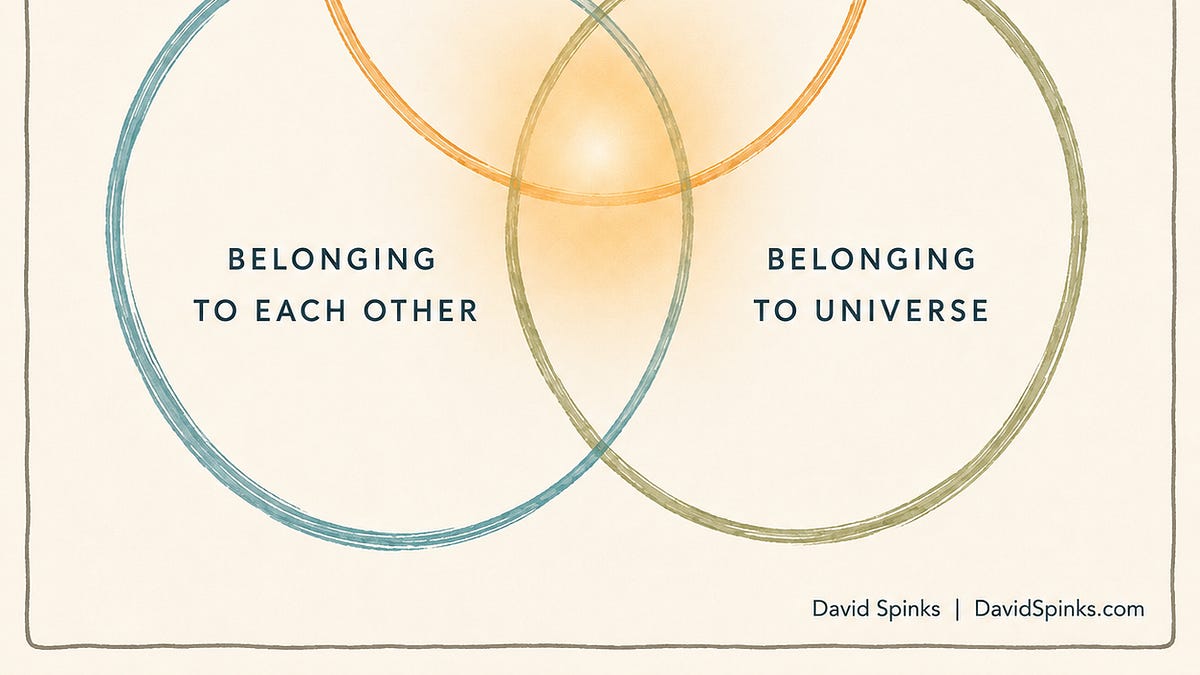
🔗 **Source:** [What if Belonging Is About Much More Than Community?](https://davidspinks.substack.com/p/the-three-fields-of-belonging)
> [!note]+ Document Notes
> tags: #belonging #community #spirituality
> author: David Spinks
> source: Substack
> reference: https://davidspinks.substack.com/p/the-three-fields-of-belonging
> date created: 2024-12-19 10:30
>
> # 🏷️ Title: What if belonging is about much more than community?
>
<!-- deep-read:sections start -->
## 🧰 Action Inbox
- [H1] Develop self-acceptance practices to build internal belonging — core framework #belonging
- [H2] Create spaces for unconditional relationship in community work — community design #community
- [H3] Explore spiritual practices for universal connection — holistic approach #spirituality
## 🧭 Table of Contents
- [[#📝 Summary]]
- [[#📖 Main Content]]
- [[#🗒️ Notes]]
- [[#📚 References]]
- [[#🗣️ Paraphrase]]
- [[#📰 Newsletter]]
- [[#✅ Action Items]]
- [[#🧪 Hypotheses]]
- [[#📊 Methodology]]
- [[#❓ Questions]]
- [[#🔮 Future Research]]
- [[#💡 Implications]]
- [[#🧠 Learning Styles Assessment]]
- [[#📊 Accessibility Assessment]]
- [[#🌍 DEIB Assessment]]
- [[#✅ Logical Validity]]
- [[#🛡️ DARVO Analysis]]
- [[#🎯 Conclusion]]
### 🔗 References
- [The Three Fields of Belonging](https://davidspinks.substack.com/p/the-three-fields-of-belonging)
- [Bowling Alone by Robert Putnam](https://bowlingalone.com/)
## 📝 Summary
- David Spinks proposes three interconnected fields of belonging beyond traditional community: belonging to self, belonging to each other, and belonging to universe/God
- Current approaches to solving loneliness focus only on social connection, missing critical internal and spiritual dimensions
- All three fields must work together - missing one leads to collapse of others
- True belonging requires self-acceptance, authentic community relationships, and connection to something greater
- Bottom line: Holistic belonging addresses existential loneliness that social connection alone cannot solve
## 📖 Main Content
Spinks challenges the conventional view of belonging as purely social, arguing that sustainable belonging requires three interconnected dimensions. The first field, belonging to self, involves developing internal acceptance and security without needing external validation. This requires turning inward to welcome and accept all parts of oneself, including those deemed "not enough" by inner critics.
The second field, belonging to each other, goes beyond casual social connection to what Daniel Thorson calls "unconditional relationship" - being accepted for differences rather than similarities. This involves showing up authentically in community and being loved even in darkness and vulnerability.
The third field, belonging to universe/oneness/God, addresses existential loneliness through connection to something greater than oneself. This "secure attachment to the universe" provides meaning, trust in unfolding, and recognition of universal interconnectedness.
Spinks emphasizes these fields are interconnected - spiritual belonging that abandons self-care or community care is misguided, just as social belonging without self-acceptance or spiritual grounding remains incomplete.
## 🗒️ Notes
#### 📖 [Article Start] — [H1] Three fields of belonging framework
- Key idea: Belonging extends beyond social connection to include self and universal dimensions
- Evidence: "There are at least three fields of belonging: Belonging to self, Belonging to each other, Belonging to universe/oneness/God"
#### 📖 [Self Section] — [H2] Internal belonging precedes external connection
- Key idea: Without self-acceptance, seeking belonging externally reinforces unworthiness
- Evidence: "I was trying to find belonging outside of myself when I didn't yet have it within"
#### 📖 [Community Section] — [H2] Authentic community requires unconditional relationship
- Key idea: True belonging means acceptance for differences, not assimilation through sameness
- Evidence: "Belonging isn't about being accepted for being the same as others. That's assimilation. Belonging is being accepted for your differences"
#### 📖 [Universal Section] — [H3] Spiritual belonging addresses existential loneliness
- Key idea: Connection to something greater provides meaning and trust beyond human relationships
- Evidence: "It's the loneliness of believing that you even have a separate self that needs to belong"
#### 📖 [Integration] — [H1] All three fields must work together
- Key idea: Spiritual practice without ethics toward self and others conflicts with life itself
- Evidence: "There's a reason that every major spiritual practice also holds a code of ethics, guiding us in how to treat each other and ourselves"
#### 📖 [Personal Journey] — [H2] Author's evolution through community building career
- Key idea: Professional community success didn't resolve personal loneliness until inner work began
- Evidence: "I built a community of tens of thousands of community builders and wrote a book about it. And yet, I was deeply alone"
#### 📖 [Recovery Context] — [H3] Unconditional relationship found in healing spaces
- Key idea: Recovery groups and healing circles model the quality of connection needed broadly
- Evidence: "Some still find it in recovery groups, healing circles, and religious spaces, but many don't have access to spaces or relationships like this anymore"
#### 📖 [Practical Application] — [H2] Bringing unconditional presence to all interactions
- Key idea: Quality of unconditional relationship can be practiced beyond formal healing spaces
- Evidence: "We don't have to be in a healing circle to hold each other in unconditional relationship, but those spaces are where we learn and experience this way of being together"
## 📚 References
- [David Spinks Substack](https://davidspinks.substack.com/)
- [Daniel Thorson's work on unconditional relationship](https://danielthorson.com/)
- [Bowling Alone research](https://bowlingalone.com/)
## 🗣️ Paraphrase
- Belonging has three essential dimensions: internal self-acceptance, authentic community connection, and spiritual/universal attachment that must work together rather than separately
- Social approaches to loneliness fail when people seek external validation to fill internal voids of self-worth and meaning that only inner work and spiritual practice can address
- True community connection requires spaces for unconditional relationship where people are accepted for their full authentic selves, including struggles and vulnerabilities, not just socially acceptable parts
## 📰 Newsletter
**Beyond Community: The Three Fields of Belonging**
Community builders often focus on bringing people together, but what if that's only one piece of the belonging puzzle? David Spinks, who built communities of tens of thousands, discovered that social connection alone couldn't solve his own deep loneliness.
His framework reveals three interconnected fields: belonging to self (internal acceptance), belonging to each other (unconditional relationship), and belonging to something greater (spiritual/universal connection). Each field supports the others - missing one causes the whole system to collapse.
For WordPress community leaders, this means creating spaces where people can show up authentically, be accepted for their differences, and find meaning in contributing to something larger than themselves.
**Practical applications:**
- Design community spaces that welcome vulnerability and authentic sharing
- Foster "unconditional relationship" quality in meetups and WordCamps
- Help contributors connect their work to larger purpose and values
- Model self-acceptance and spiritual grounding as community leaders
Resources: [Learn WordPress Community](https://learn.wordpress.org/), [WordCamp Central](https://central.wordcamp.org/), [WordPress Community Guidelines](https://make.wordpress.org/handbook/)
## ✅ Action Items
#### Community
- Maintainers: integrate belonging assessment into community health metrics
- Contributors: create onboarding that addresses all three belonging fields
- Sponsors: fund programs supporting holistic belonging, not just social connection
- Ecosystem: develop cross-community practices for unconditional relationship
#### WordPress
- Community: design WordCamp sessions on authentic community building
- Training: develop curriculum on sustainable community leadership including self-care
- Marketing: shift narratives from "join our community" to "belong fully here"
- Support: train moderators in holding unconditional relationship practices
#### DevRel
- Developer advocacy: model authentic vulnerability in conference speaking
- Education: create learning environments that welcome all skill levels unconditionally
- Developer experience: design onboarding that builds confidence and self-acceptance
- Community management: facilitate spaces for deeper connection beyond technical discussions
## 🧪 Hypotheses
- Communities focusing on all three belonging fields will have higher retention and deeper engagement than those focusing only on social connection
- Developer burnout correlates with missing spiritual/universal belonging field rather than just work-life balance issues
- Open source contributors who develop self-acceptance practices will show greater resilience during conflict and criticism
- Community spaces that explicitly welcome vulnerability will attract more authentic participation than achievement-focused spaces
### 📊 Methodology
- Longitudinal study tracking community member engagement across all three belonging dimensions using validated psychological scales
- Survey research comparing burnout rates between developers with and without spiritual practices or sense of universal purpose
- Ethnographic observation of community interactions in spaces with explicit vulnerability practices versus traditional technical-only forums
### ❓ Questions
- How can community platforms be designed to support spiritual/universal belonging alongside social features?
- What specific practices help community leaders develop sufficient self-belonging to hold space for others authentically?
- How do different cultural and religious backgrounds experience the "universal belonging" field in secular tech communities?
### 🔮 Future Research
- Cross-cultural validation of three fields model across different spiritual and cultural traditions in global open source communities
- Development of belonging assessment tools specific to online technical communities
- Investigation of how AI community tools might support or hinder authentic belonging experiences
### 💡 Implications
- Practice: Community managers need personal spiritual/self-acceptance practices to sustainably support others' belonging
- Policy: Community guidelines should address psychological safety and authentic expression, not just technical conduct
- Security: Holistic belonging may provide stronger resilience against bad-faith actors than purely behavioral moderation
- Education: Developer training should include emotional intelligence and self-acceptance alongside technical skills
- Funding: Community support grants should fund holistic belonging programs, not just social event coordination
### 🧠 Learning Styles Assessment
Reading level estimate: 10-12th grade
#### 👀 Visual learners
- Present: Clear section headers and three-field framework structure
- Improve: Diagram showing interconnection of three belonging fields, visual metaphors for each field
#### 🔊 Aural learners
- Present: Conversational, personal narrative tone throughout
- Improve: Audio version with reflective pauses, podcast discussion format
#### 🗣️ Verbal learners
- Present: Rich analogies, clear definitions, personal story examples
- Improve: Glossary of spiritual/psychological terms, more varied metaphors
#### 🧩 Kinesthetic learners
- Present: Reflection questions, call for reader responses and engagement
- Improve: Self-assessment exercises for each belonging field, practice prompts
#### 🧠 Logical learners
- Present: Clear three-part framework, cause-effect relationships between fields
- Improve: Decision tree for diagnosing belonging gaps, measurable indicators for each field
#### 🧑🤝🧑 Social learners
- Present: Community focus, invitation for reader comments and dialogue
- Improve: Discussion guides for community leaders, group reflection exercises
#### 🧘♀️ Solitary learners
- Present: Personal reflection emphasis, individual journey narrative
- Improve: Journaling prompts for each belonging field, self-guided exploration path
#### 🌿 Naturalistic learners
- Present: References to universal connection, oneness with nature
- Improve: More nature analogies, environmental metaphors for belonging ecosystem
### 📊 Accessibility Assessment
#### Screen reader semantics
- Present: Clear heading hierarchy, good paragraph structure
- Improve: More descriptive subheadings, summary of three fields in introduction
#### Keyboard navigation
- Present: Standard web article format with linear flow
- Improve: Skip links to each belonging field section, keyboard-accessible footnotes
#### Contrast and readability
- Present: Standard Substack formatting with good contrast
- Improve: Verify heading color contrast meets WCAG standards
#### Text resizing and reflow
- Present: Responsive design accommodates text scaling
- Improve: Test at 200% zoom for readability of inline links
#### Media and captions
- Present: Text-only article with no multimedia barriers
- Improve: Alt text for any embedded social media content
#### Forms and interactions
- Present: Simple subscription form with clear labels
- Improve: Error messaging for email validation, keyboard accessible
#### Standards reference
- Generally accessible text article meeting WCAG 2.2 AA standards
### 🌍 DEIB Assessment
#### Cultural breadth
- Present: References to multiple spiritual traditions (Buddhist, Christian, Jewish, Muslim)
- Improve: Examples of belonging from non-Western cultural contexts, indigenous perspectives
#### Inclusive language
- Present: Gender-neutral language, avoids ableist metaphors
- Improve: Acknowledgment of privilege in accessing spiritual practices, class considerations
#### Neurodiversity support
- Present: Clear structure, numbered fields, consistent formatting
- Improve: Content warnings for mental health topics, alternative frameworks for different cognitive styles
#### Representation
- Present: Personal vulnerability from privileged perspective
- Improve: Diverse voices and experiences of belonging, marginalized community examples
#### Psychological safety
- Present: Vulnerable self-disclosure, non-judgmental tone about spiritual diversity
- Improve: Explicit acknowledgment that spiritual language may trigger religious trauma
### ✅ Logical Validity
#### Strong reasoning
- Deductive strength: Strong logical progression from incomplete belonging through three-field solution to integration
- Inductive strength: Uses personal experience effectively but could benefit from broader evidence base
- Causal reasoning: Clear cause-effect relationships between self-acceptance and community connection
- Analogical strength: Effective analogies between attachment theory and spiritual belonging
#### Fallacies
- Anecdotal evidence: Relies heavily on personal experience without broader research validation - strengthen with psychological literature
- False trichotomy: May oversimplify belonging into exactly three fields when reality could be more complex - acknowledge other possible dimensions
#### Tone of voice
- Overall tone: Vulnerable, reflective, and invitational with authentic personal disclosure balanced by thoughtful framework presentation
### 🛡️ DARVO Analysis
- Deny: No denial patterns present - author takes responsibility for own belonging challenges
- Attack: No attacks on accusers - collaborative and invitational approach throughout
- Reverse victim/offender: No victim/offender dynamics - focuses on personal growth and systemic solutions
- Emotional cues and rhetoric: Authentic vulnerability used constructively, not manipulatively
## 🎯 Conclusion
- The three fields of belonging framework offers a more complete approach to addressing loneliness and building sustainable community than social connection alone
- Community leaders and platform designers should consider how their work supports belonging to self and universal meaning, not just interpersonal connection
- The integration of internal, social, and spiritual belonging may be essential for resilient open source communities and sustainable developer wellness
## 🧱 Refactor Appendix
### 📚 Literature Split Pad
Purpose: Stage CEE units that become Literature notes.
Split level: H3
### [H1] Belonging requires three interconnected fields
> [!quote] [What if belonging is about much more than community?](https://davidspinks.substack.com/p/the-three-fields-of-belonging) by [[David Spinks]] via [[Substack]]. Published 2024-05-12. Accessed 2024-12-19.
> "There are at least three fields of belonging: Belonging to self, Belonging to each other, Belonging to universe/oneness/God"
Framework for holistic community design beyond social connection.
[view highlight](https://davidspinks.substack.com/p/the-three-fields-of-belonging#H1) #xref #articleseed ID:rw_belonging_fields
### [H2] Self-acceptance precedes sustainable community belonging
> [!quote] [What if belonging is about much more than community?](https://davidspinks.substack.com/p/the-three-fields-of-belonging)
> "I was trying to find belonging outside of myself when I didn't yet have it within"
Internal work required for authentic external connection.
[view highlight](https://davidspinks.substack.com/p/the-three-fields-of-belonging#H2) #xref ID:rw_self_belonging
---
### 🔖 Atomic Split Pad (Zettel Candidates)
Purpose: Promote reusable claims into Atomic notes.
Split level: H4
#### [Z1] Unconditional relationship quality distinguishes belonging from assimilation
- Applicable to any community design context seeking authentic connection
- Referenced in community section discussion
- Links: [[Community Design]] [[Authentic Relationships]]
#### [Z2] Spiritual belonging addresses existential loneliness beyond social connection
- Universal across different spiritual and religious traditions
- Referenced in universe/oneness section
- Links: [[Existential Psychology]] [[Spiritual Community]]
---
### ✏️ Fleeting Queue
Purpose: Capture quick actions for Fleeting notes.
- [F1] Research Daniel Thorson's unconditional relationship work — community practices #fleeting #inbox
- [F2] Explore
<!-- deep-read:sections end -->
📄 **Full text:** ![[Full Document Contents/Articles/What if Belonging Is About Much More Than Community.md|What if Belonging Is About Much More Than Community? by davidspinks.substack.com]]
## Highlights
- We might call this form of loneliness “existential loneliness”. It’s the voice that asks, “What is the point of all of this? What is the meaning of life? How am I meant to show up in this life? Why do I suffer?” It’s the loneliness of feeling like you’re alone with these questions. It’s the loneliness of believing that you even have a separate self that needs to belong or that there’s anything other than the one universal community through which everything is inextricably connected. ([View Highlight](https://read.readwise.io/read/01kre58yyw9bq1p0sdw2qqnqj7))
- Tags: 👻 ai highlighted
- When I started to find a sense of belonging with that which is beyond, I found my sense of belonging to self and to others transformed yet again. It’s the safety net I can fall on when I’m struggling in the other fields of belonging — the moments where I feel disconnected from myself or others. I live with greater trust that all is unfolding exactly as it’s meant to, and that we are all inextricably and infinitely connected. ([View Highlight](https://read.readwise.io/read/01kre58yz93wmaha416fz3j4gh))
- Tags: 👻 ai highlighted