When AI Becomes What You Run
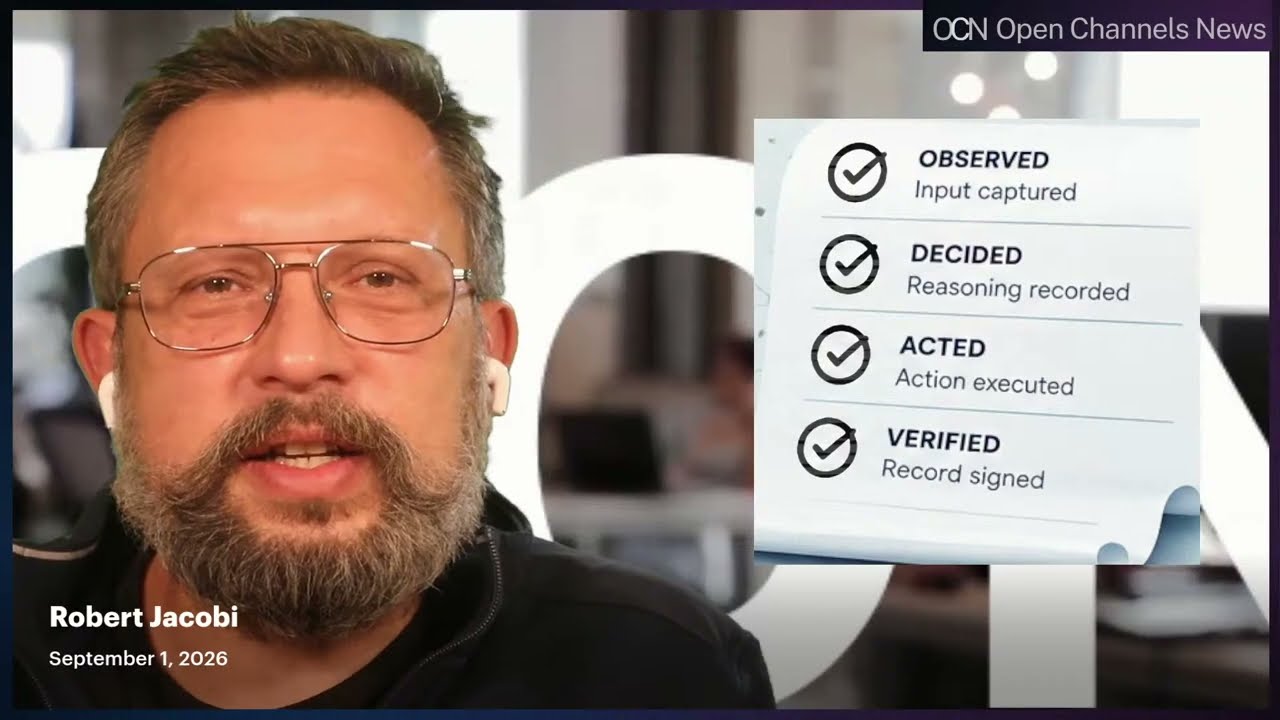
🔗 **Source:** [When AI Becomes What You Run](https://www.youtube.com/watch?v=o4lcSekNfRk)
> [!note]+ Document Notes
> tags: [open-channels-news, wordpress-news, open-weight-ai, ai-policy, agent-sprawl, ai-governance, ai-audit-trails, halo-record, open-source-ai, shadow-it, enterprise-ai, robert-jacobi, news-roundup]
> author: Open Channels News
> source: youtube.com
> reference: https://www.youtube.com/watch?v=o4lcSekNfRk
> date created: 2026-09-02 08:40
>
> > [!info] Generated analysis — not the author's words. Sections below are machine-written
> > from the captured source. Only text inside `> [!quote]` blocks is verbatim from the author.
> > Do not quote or attribute any other line to the named author.
>
> > [!warning] Short news broadcast, auto-captioned, sponsored
> > 7:46 video, ~1,400 transcript words, dated in-show September 1, 2026. Host is Robert Jacobi (ASR renders "Robert Jacobe"). Sponsors read in the open: Automattic ("Automatic"), InMotion Hosting ("Inotion Hosting"), and a third the captions render as "Omnisense" — most likely Omnisend; unverified. Other ASR artifacts: "Techraar"/"Techrator" = TechRadar; "Work Auto" = Workato; "Asians" = agents; "polycy" = policy; "help uh Net Security" = Help Net Security; "Halo Record" = halo-record. Source verification done for this note: (1) WordPress News, "WordPress Signs the Open Weights and American AI Leadership Letter," 2026-08-27, with a Mary Hubbard quote; (2) TechRadar Pro, "How to solve agent sprawl," by Derek Thompson of Workato; (3) Help Net Security, "Halo-record: Open-source audit trails for AI agents," 2026-08-31 — the show says "today," off by one day. The broadcast doesn't link its sources; none of the three is a WordPress-specific story except the first. Automattic sponsors a show that leads with a WordPress-project story — noted, not alleged to have shaped it.
>
> # 🏷️ Title: When AI Becomes What You Run
>
<!-- deep-read:sections start -->
## 🧭 Table of Contents
- [📝 Summary](#-summary)
- [📖 Main Content](#-main-content)
- [🗒️ Notes](#️-notes)
- [📚 References](#-references)
- [🗣️ Paraphrase](#️-paraphrase)
- [📰 Newsletter](#-newsletter)
- [✅ Action Items](#-action-items)
- [🧪 Hypotheses](#-hypotheses)
- [📊 Methodology](#-methodology)
- [❓ Questions](#-questions)
- [🔮 Future Research](#-future-research)
- [💡 Implications](#-implications)
- [🧠 Learning Styles Assessment](#-learning-styles-assessment)
- [📊 Accessibility Assessment](#-accessibility-assessment)
- [🌍 DEIB Assessment](#-deib-assessment)
- [✅ Logical Validity](#-logical-validity)
- [🛡️ DARVO Analysis](#-darvo-analysis)
- [🎯 Conclusion](#-conclusion)
### 🔗 References
- Source: https://www.youtube.com/watch?v=o4lcSekNfRk
- Story 1 (verified): https://wordpress.org/news/2026/08/open-weight/ — "WordPress Signs the Open Weights and American AI Leadership Letter," 2026-08-27
- Story 2 (verified): https://www.techradar.com/pro/how-to-solve-agent-sprawl — Derek Thompson (Workato), TechRadar Pro
- Story 3 (verified): https://www.helpnetsecurity.com/2026/08/31/halo-record-open-source-ai-agent-audit-trail/ — Help Net Security, 2026-08-31; project repo appears to be github.com/bkuan001/halo-record
- No links in the captured transcript; the video description wasn't captured.
## 📝 Summary
**What this is.** A single-host news broadcast from Open Channels News (OCN), host Robert Jacobi, dated September 1, 2026. Three stories stitched into one thesis: "If AI is going to be everywhere, how do we keep it open without losing control of it?" The framing device is the title — AI moving from "something you simply use" to "something you actually operate."
**Story 1 — WordPress signs the open-weights letter.** WordPress joined "more than 270 companies organizations" as a signatory to the Open Weights and American AI Leadership letter, asking US policymakers not to impose "premature restrictions" on open-weight models. Jacobi's gloss: open-weight models are ones "you can download, inspect, modify, and run on infrastructure you control," which is the open-source argument WordPress has made for twenty years, "extending that philosophy one layer deeper to the intelligence running alongside that software." He lists the letter's asks — compute access for startups and researchers, public datasets and evaluation tools, competition between open and closed models, and not treating distillation-style techniques "as theft." Verified against the WordPress News post of 2026-08-27; the asks match.
**Story 2 — Agent sprawl.** From TechRadar Pro, Derek Thompson of Workato: after server, cloud, and SaaS sprawl comes "agent sprawl" — "rapid uncoordinated deployment of AI agents across different departments, often using different models, different rules, different tools, and different security controls." Jacobi's line: "we have reinvented shadow IT, except now shadow IT can make decisions." The proposed fix is an orchestration layer. His own distinction: the goal isn't trusting every agent, it's trusting "the system governing those agents," and the security question shifts from "was this request malicious" to "what did this agent actually do?"
**Story 3 — halo-record.** From Help Net Security: an open-source project that creates "hash chain logs that the vendor running the AI can generate but cannot quietly reroute later without breaking verification," ingesting from OpenTelemetry, LangChain, MCP servers, and gateway logs. Jacobi's summary of the shift: agents don't follow predefined code paths, so "You don't just want the final answer. You want the receipts."
**The stitch.** Openness (WordPress) → proliferation (sprawl) → accountability (verifiable logs). Closing aphorism: "openness without visibility creates chaos. Control without openness creates dependency. The interesting infrastructure is going to live somewhere in between."
**Bottom line.** An accurate, well-sourced eight-minute roundup whose value is the editorial thread, not the reporting — all three stories are secondhand and correctly attributed once you correct the captions. The thread is a good one: it puts a WordPress policy signature in the context of what happens after the policy wins.
## 📖 Main Content
**The framing.** Jacobi opens with a category shift — AI as a thing you *run*, not a thing you *use*. That's the same shift WordPress users made when they moved from hosted platforms to self-hosting: you gain control and inherit operations. The three stories are chosen to walk that arc: the right to run (open weights), the mess of running many (sprawl), the duty to prove what ran (audit trails).
**Story 1 in detail.** The WordPress post (2026-08-27) is quoted-in-spirit rather than verbatim. Jacobi's paraphrase of the letter's asks is accurate: expanded compute access, public datasets and evaluation tools, preserving multiple kinds of models, and not treating common development practices "such as using one model's output to improve another" as theft. He adds the twenty-years framing himself; the WordPress post makes the same point ("For more than 20 years, WordPress has run on the idea that the people using a technology should be free to shape it"). What he leaves out: the post is signed by Executive Director Mary Hubbard, and WordPress is one signatory among 270+, not an organizer. He also doesn't say whether "WordPress" here means the Foundation, the project, or WordPress.org — the post itself is on wordpress.org/news and speaks as "WordPress."
**Story 2 in detail.** The sprawl lineage (server → cloud → SaaS → agent) is Thompson's; the "shadow IT that can make decisions" line and the "trust the system, not the agent" distinction read as Jacobi's own. The distinction is worth keeping: it reframes agent security as governance-layer design rather than per-agent vetting, which is the same move WordPress made when it stopped trying to vet every plugin's code and instead built capability checks, nonces, and a review process around them.
**Story 3 in detail.** Jacobi gets the mechanism right — hash-chained logs the operator can't silently rewrite — and the ingestion surfaces. The Help Net Security piece carries a nuance he skips: a chain the operator holds "cannot prove that every record was written" ("Delete the embarrassing Tuesday, re-seal the chain, and the file stays internally consistent"); closing that hole needs an external witness, and a hosted witness service is how the author (Kuan) intends to fund the project. So the "check it for yourself" promise is conditional on a third party. That's a material qualification for an eight-minute segment to drop.
**The closing bargain.** "Keep the models open. Keep the ecosystem innovative but make the actions accountable." It's a tidy triad, and it maps onto WordPress's own governance debates: the GPL keeps the code open, the plugin directory keeps the ecosystem innovative, and the current Core Security Initiative and the plugin-audit calls (both in this week's news) are the accountability layer catching up.
**What the broadcast doesn't do.** No links, no on-screen citations captured, no numbers beyond "270." No mention of who wrote the letter or who else signed. No critical voice on any of the three stories — this is a roundup, not analysis.
## 🗒️ Notes
- **Sponsor note.** Automattic sponsors the show and the lead story is a WordPress-project policy action. Nothing in the segment reads as promotional, and the story ran on WordPress News five days earlier, so the selection is defensible on news value alone. Still worth a line: an Automattic-sponsored outlet leading with a WordPress.org policy signature is the kind of adjacency Courtney's disclosure-practices reading (the VIP note from yesterday's batch) would flag.
- **Off-by-one on "today."** Help Net Security's halo-record piece is dated 2026-08-31; the broadcast (Sept 1) calls it "today." Minor.
- **The omitted halo-record caveat is the most useful fact in the source material.** A self-held hash chain proves no record was *altered*, not that none was *deleted*. The witness requirement — and the fact that the witness service is the funding model — turns "trust us" into "trust our witness," which is better but not the same as "check it yourself."
- **"Trust the system governing the agents, not each agent"** is the transferable idea for WordPress. It's how core already treats plugins. Applied to AI features in WordPress (Core AI team, AI Building Blocks), it argues for capability-scoped agent permissions and logged tool calls at the platform layer rather than per-plugin trust.
- **Overlap with this batch.** The Core Security Initiative and the Rank Math support-agent/plugin-audit stories (both saved in the same batch, from The Repository) are the WordPress-specific instances of Jacobi's stories 2 and 3 — an AI support agent deployed without adequate controls, and a project responding with process and audit. The broadcast doesn't cover either; the connection is this note's, not his.
- **ASR quality.** Roughly a dozen name-level miss-hearings in 1,400 words. Every proper noun needed checking; all checked out once corrected. Don't quote names from the captions.
- **Format.** One host, no guests, no interview. The "[snorts]" tags in the captions are the ASR labeling breaths; ignore.
## 📚 References
- Open Channels News (Robert Jacobi, host), *When AI Becomes What You Run*, YouTube, broadcast dated 2026-09-01, uploaded 2026-09-02, 7:46.
- WordPress, *WordPress Signs the Open Weights and American AI Leadership Letter*, wordpress.org/news, 2026-08-27 (statement attributed to Executive Director Mary Hubbard).
- Thompson, D. (Workato), *How to solve agent sprawl*, TechRadar Pro (date not captured).
- Help Net Security, *Halo-record: Open-source audit trails for AI agents*, 2026-08-31 (quotes project author Kuan; ~5,300 lines of Python, no runtime dependencies; cites AIUC-1 and the July Hugging Face intrusion — ~17,600 agent actions over five days).
- Cross-reference (same batch): The Repository on the Core Security Initiative and on Rank Math's support agent / Mullenweg's plugin-audit call — the WordPress-specific cases of the sprawl and accountability stories.
- Cross-reference (yesterday's batch): WordPress VIP, *AI Content Disclosure Practices* — sponsor-adjacency framing.
## 🗣️ Paraphrase
Here's the week in one line: AI stopped being a tool you pick up and became a thing you run, and running things comes with operations problems. First, WordPress put its name on a letter asking US policymakers to leave open-weight models alone — same argument as open source, one layer down: download it, inspect it, change it, run it where you want. Second, once anyone can spin up an agent, every department does, and you get agent sprawl — shadow IT that can take actions. The fix isn't trusting each agent; it's building a layer you can trust to govern them. Third, once agents act on your systems, "trust us" isn't an audit answer; halo-record is an open-source attempt to give you hash-chained receipts instead. Open models, many agents, verifiable actions — openness without visibility is chaos, control without openness is dependency, and the useful infrastructure lives in between.
## 📰 Newsletter
**Open Channels News stitches three AI stories into one WordPress-shaped argument.** Robert Jacobi's September 1 broadcast opens with WordPress signing the Open Weights and American AI Leadership letter (270+ signatories asking US policymakers not to restrict open-weight models — the WordPress News post ran August 27 with a Mary Hubbard statement), then follows the consequence chain: TechRadar Pro's "agent sprawl" (Derek Thompson, Workato — uncoordinated agents across departments, "shadow IT that can make decisions"), then halo-record, an open-source project covered by Help Net Security that hash-chains agent action logs so a vendor can't quietly rewrite them. Jacobi's throughline — "openness without visibility creates chaos, control without openness creates dependency" — is the best sentence in eight minutes. What he skips: Help Net Security notes a self-held chain can't prove records weren't deleted; you need an outside witness, and a hosted witness is the project's funding plan. The captions are rough (a dozen proper nouns mangled) but every story checks out. Sponsors: Automattic, InMotion Hosting, and a third the captions can't render. Worth eight minutes if you want the policy story placed in its operational context.
## ✅ Action Items
**DevRel**
- The "use → run" framing is a clean way to explain to WordPress builders why AI features bring hosting-style operational duties (logging, permissions, audit), not just UX. `#action/h3`
**OSPO**
- WordPress as a signatory to an AI-policy letter is a precedent: an open-source project taking a public position on model regulation. Track whether the Foundation or the project signs more of these, and who decides. `#action/h2`
**Community**
- Not applicable to this source.
**WordPress teams** (Core, Core Performance, Core AI, Core Program Team, Mobile, Playground, Community, Training, Marketing, Support, Design, Documentation, Photos, TV, Polyglots, Accessibility, Meta, CLI, Hosting, Tide, Openverse, Themes, Plugins)
- **Core AI:** "trust the governing layer, not each agent" argues for platform-level tool-call logging and capability-scoped agent permissions in the AI Building Blocks rather than per-plugin trust. halo-record's adapter list (OpenTelemetry, MCP servers, gateway logs) is a reference for what an audit surface looks like. `#action/h2`
- **Hosting:** agent sprawl is a hosting-account problem the moment AI plugins ship agents; hosts will be asked "what did this agent do" before core has an answer. `#action/h3`
- **Plugins:** the Rank Math support-agent story (same batch) is the directory's first sprawl-and-accountability case; this broadcast is the general frame for it. `#action/h3`
- **Marketing:** the open-weights signature got an 8-minute lead segment on an independent outlet; note the reach. `#action/h4`
- All other teams: not applicable to this source.
**The WPOCC**
- Not applicable to this source.
**FAIR**
- FAIR's decentralized-distribution argument and the open-weights letter's "run it on infrastructure you control" share a premise. Worth one line in any FAIR positioning that touches AI. `#action/h3`
**Personal (Courtney)**
- **halo-record is worth twenty minutes.** ~5,300 lines of Python, no runtime dependencies, MCP-server adapter. Your Claude Code sessions are exactly the "agent that reads, calls tools, changes records" case; a hash-chained action log is the receipt your own verify-delegated-work rule is asking for. Read the Help Net Security piece for the witness caveat before adopting. `#action/h2`
- **Pair this with the two Repository articles in this batch** (Core Security Initiative; Rank Math / plugin audits). Jacobi supplies the general frame; those supply the WordPress instances. One synthesis note, not three. `#action/h2`
- **Sponsor adjacency** — file the Automattic-sponsors-show-leading-with-WordPress.org-policy observation next to yesterday's VIP disclosure-practices note; it's a live example for the piece you've been circling on disclosure norms. `#action/h3`
## 🧪 Hypotheses
- **H-A:** WordPress's signature on the open-weights letter was a Foundation/Executive Director decision, not a community-governance decision; no Make blog discussion preceded it. *Testable: search make.wordpress.org for the letter before 2026-08-27.*
- **H-B:** The first "agent sprawl" incident in the WordPress ecosystem will be a plugin-shipped support or SEO agent acting without capability scoping — the Rank Math story is that incident or its precursor. *Testable against this batch's Repository article.*
- **H-C:** halo-record's format will be copied by at least one larger platform within a year, per the author's own prediction; the hosted-witness funding model will be the harder part. *Testable, slow.*
- **H-D:** Automattic sponsorship correlates with OCN leading on WordPress.org stories more often than news value alone predicts. *Testable by tallying OCN lead stories over a quarter against sponsor list; likely a small sample.*
### 📊 Methodology
A secondhand news roundup. Each story is a paraphrase of one published piece with no additional reporting. The editorial contribution is selection and sequencing. Evaluating it means checking each paraphrase against its source (done — all three accurate at the level of claim, one material omission in story 3) and judging whether the throughline is earned (it is — the three stories do form a cause-and-effect chain, though Jacobi asserts the chain rather than demonstrating it).
### ❓ Questions
- Who decided WordPress would sign the letter, and through what process? The post is signed by the Executive Director; the broadcast says "WordPress."
- What's the third sponsor? Captions say "Omnisense."
- Does the halo-record witness requirement appear in any WordPress AI-feature discussion yet, or is core still at "log it" without "prove it wasn't edited"?
- Thompson's TechRadar piece — what's its publication date, and does it cite any survey numbers on agent counts per enterprise? The broadcast gives none.
- Does OCN publish show notes with links? The captured transcript has none.
### 🔮 Future Research
- Read the WordPress News post and the Repository's Core Security Initiative piece together; check whether the security initiative mentions AI-agent behavior at all.
- Try halo-record against a Claude Code session's tool-call log (MCP adapter) as a proof of concept for the verify-delegated-work rule.
- Track OCN's next four broadcasts for source-link practice and sponsor/lead-story adjacency.
- Find the letter's organizer and full signatory list.
### 💡 Implications
**For WordPress governance.** A public policy signature by "WordPress" with no visible community process is a governance data point. Whether that's fine depends on who you think speaks for the project — the same question the plugin-audit and security-initiative stories raise this week from a different angle.
**For AI security thinking.** The shift Jacobi names — from "was this request malicious" to "what did this agent do" — moves the control point from input filtering to action logging. That's a different engineering discipline, and WordPress core has almost none of it yet for AI features.
**For open-source advocacy.** The open-weights argument borrows open-source's moral vocabulary (inspect, modify, run yourself). Story 2 and 3 are the reminder that the vocabulary came with an operations bill that open source spent two decades paying. Advocates who make the first argument should be ready for the second.
**For independent WordPress media.** An eight-minute, single-host, sponsor-read format that gets its facts right is a viable model. The gap is citations — no links means every viewer who wants to check has to do what this note did.
## 🧠 Learning Styles Assessment
**Auditory** — the primary mode. Single voice, conversational, clear signposting ("Our first story," "which brings us to our final story").
**Visual** — not assessable from captions; presumably a talking-head with graphics. No diagrams described.
**Read/write** — poorly served: no show notes or links captured; the auto-captions are the only text and they're unreliable on names.
**Kinesthetic** — none; there's nothing to do.
**Global** — well served: the throughline is stated up front ("Three stories, but really one question") and restated at the close.
**Sequential** — served by the explicit three-story structure.
**Overall:** a good listen for someone who wants the week's frame in eight minutes; a poor reference document.
## 📊 Accessibility Assessment
Assessment of the captured auto-captions only. Not a WCAG audit of the video or channel.
#### Alternative text and non-text content
Not assessable. The video's visual content (graphics, lower-thirds) isn't captured; whether names appear on screen — which would rescue the caption errors for sighted viewers — is unknown.
#### Keyboard navigation
YouTube player; not assessed.
#### Contrast and readability
Not assessable from captions.
#### Text resizing and reflow
Not applicable to video.
#### Media and captions
Auto-generated captions only, as far as the capture shows. Roughly a dozen proper-noun errors in ~1,400 words, plus "[snorts]" breath labels. A Deaf or hard-of-hearing viewer relying on these captions would get "Robert Jacobe," "Techraar," "Work Auto," and "Asians" for agents. That's a WCAG 1.2.2 (Captions, Prerecorded) quality failure — captions exist but don't convey the content accurately. Human-corrected captions or a published transcript would fix it.
#### Forms and interactions
None.
#### Standards reference
WCAG 2.2 AA, Success Criterion 1.2.2 Captions (Prerecorded) and 1.2.3 Audio Description or Media Alternative are the relevant criteria. Accurate captions are the one concrete fix this source needs.
## 🌍 DEIB Assessment
#### Cultural breadth
US policy story ("American AI Leadership," US policymakers) presented to a global WordPress audience without noting that the letter is US-specific. Enterprise-IT framing in story 2 assumes a corporate context.
#### Inclusive language
Neutral. "Businesses," "organizations," "the vendor," "customers." No gendered or loaded examples.
#### Neurodiversity support
Short, structured, signposted, single voice — good. Caption errors undercut it for anyone reading along.
#### Representation
Single host, no guests, all three sources are Western trade press or the WordPress project itself. Quoted or paraphrased people: Derek Thompson (Workato); the halo-record author isn't named on air.
#### Psychological safety
Not applicable; no interpersonal content.
## ✅ Logical Validity
**Claims and support.**
- *WordPress signed the letter; 270+ signatories; four listed asks* — verified against WordPress News, 2026-08-27. Accurate.
- *Agent sprawl is the next sprawl; orchestration is the proposed fix* — accurate paraphrase of the TechRadar piece.
- *halo-record produces hash-chained logs the operator can't silently rewrite* — accurate but incomplete: the source states a self-held chain can't prove records weren't deleted and needs an external witness. Omission changes the strength of "check it for yourself."
- *The three stories form one causal chain (openness → proliferation → accountability)* — an editorial claim, asserted not demonstrated. It's plausible; the stories weren't chosen at random. But nothing in story 2 or 3 references open weights, so the chain is the host's construction.
**Fallacies.** None. The closing triad ("openness without visibility creates chaos. Control without openness creates dependency") is an aphorism, not an argument — it's tidy and asserted.
**Internal consistency.** Consistent.
**Verdict.** Factually sound at the claim level on all three stories; one material omission; the unifying thesis is an editorial frame presented with more confidence than the evidence supports. Fine for a news roundup, which is what it is.
## 🛡️ DARVO Analysis
Not applicable to this source. No accusation, no reversal, no victim/offender dynamic. The nearest thing to a critical claim — "we have reinvented shadow IT, except now shadow IT can make decisions" — is aimed at a pattern, not a party.
## 🎯 Conclusion
An eight-minute roundup that gets three stories right and stitches them into a frame worth keeping: AI is now something you run, and running things means governance and receipts. The WordPress open-weights signature is placed where it belongs — as the start of a chain, not the end of a story. The one material gap is in the halo-record segment, where "check it for yourself" is offered without the source's own caveat that a self-held chain needs an outside witness. The captions are bad enough that no name should be trusted without checking; every name checked out. For Courtney the note's use is as the general frame for two WordPress-specific stories in the same batch (Core Security Initiative; Rank Math and plugin audits), and as a pointer to halo-record — a project whose adapter list includes MCP servers and whose purpose is the receipt her own verify-the-delegate rule keeps asking for.
## 🔄 Refactor Appendix — When AI Becomes What You Run
### 📚 Literature Atoms (H3)
#### [H1] WordPress extends the open-source inspect-modify-run argument to AI models
> [!quote] ID:rw_01m1h1fyvst5v0y7cc20sdgv31
> "The ability to inspect technology, change it, run it yourself, and build something new on top of it is a large part of what made open source software success successful in the first place. WordPress says the same principle should apply to AI."
The lead story's frame: open weights as open source one layer down. Verified against the 2026-08-27 WordPress News post.
Tags: `#atom/literature/h1`
#### [H2] Agent sprawl is shadow IT that can make decisions
> [!quote] ID:rw_01m1h1fyvst5v0y7cc20sdgv31
> "Sales builds one, marketing builds another, developers have three or four or 30, someone in finance has one nobody in IT knew existed. Congratulations, we have reinvented shadow IT, except now shadow IT can make decisions."
The line that makes the TechRadar story stick. Working agents are the problem — every department has a rational reason to deploy its own.
Tags: `#atom/literature/h2`
#### [H3] The security question shifts from "was the request malicious" to "what did the agent do"
> [!quote] ID:rw_01m1h1fyvst5v0y7cc20sdgv31
> "The goal isn't necessary to trust every individual agent. It's to create an environment where you can trust the system governing those agents. And that's a very different way of thinking about AI security."
Moves the control point from input filtering to governance-layer design and action logging. Same move WordPress made with plugins: capability checks and review process, not per-plugin code trust.
Tags: `#atom/literature/h3`
#### [H4] Openness without visibility is chaos; control without openness is dependency
> [!quote] ID:rw_01m1h1fyvst5v0y7cc20sdgv31
> "Keep the models open. Keep the e ecosystem innovative but make the actions accountable because openness without visibility creates chaos. Control without openness creates dependency. The interesting infrastructure is going to live somewhere in between."
The closing aphorism. Asserted, not argued — but it names the two failure modes cleanly.
Tags: `#atom/literature/h4`
### 🧠 Permanent Candidates (H4)
#### [P1] Govern the layer that runs agents, not each agent
Per-agent vetting doesn't scale once every team can deploy one; the tractable control point is a shared layer that scopes what agents can reach, logs what they did, and makes the log verifiable by someone other than the operator. This is how WordPress already treats plugins (capabilities, nonces, review) and how open source handled its own operations bill. The missing piece in most agent deployments — including WordPress's AI features so far — is the verifiable log, not the permission model. *Candidate; two sources in one broadcast (TechRadar, Help Net Security) plus the WordPress-plugin analogy, which is mine.*
Links: [[Verify Delegated Work Before Calling It Done]] · [[Maintainer Time Is the Scarce Security Resource]] · [[AI Tooling MOC]] · [[WordPress Security MOC]]
Tags: `#atom/zettel/z1`
### ✏️ Fleeting Queue
- halo-record: hash-chained agent logs, MCP-server adapter, ~5,300 lines of Python, no runtime deps. Caveat from the source: self-held chain can't prove deletions; needs a witness; hosted witness is the funding model. Try it on a Claude Code session log. `#atom/fleeting/f1`
- "AI as something you run, not something you use" — the self-hosting analogy for AI features in WordPress. `#atom/fleeting/f1`
- Who signs policy letters as "WordPress"? Executive Director statement, no visible Make discussion. Governance question, not an accusation. `#atom/fleeting/f1`
- Sponsor adjacency: Automattic-sponsored outlet leads with a WordPress.org policy story. File with the VIP disclosure-practices note. `#atom/fleeting/f1`
### → Things 3 (max 2 actions)
1. **Read the Help Net Security halo-record piece** and decide whether to try its MCP adapter against a Claude Code session log. `#action/h2`
2. **Write one synthesis note** pairing this broadcast's frame with the two Repository articles in this batch (Core Security Initiative; Rank Math / plugin audits). `#action/h2`
<!-- deep-read:sections end -->
📄 **Full text:** [[Full Document Contents/Articles/When AI Becomes What You Run.md|When AI Becomes What You Run by Open Channels News]]
## Highlights
- we begin with WordPress because this is really the starting point for everything else in today's broadcast. WordPress has signed the open weights and American AI leadership letter joining more than 270 companies organizations asking US polycy makers not to impose premature restrictions on openweight AI models. Openweight [snorts] models are models you can download, inspect, modify, and run on infrastructure you control. If that sounds familiar to anyone in open source, it should. WordPress makes ([View Highlight](https://read.readwise.io/read/01m1h2gpy4a4wv9re2y2tvbgym))
- Note: H1 — WordPress signs the Open Weights and American AI Leadership letter (270+ signatories); open weights framed as open source one layer down. Verified: wordpress.org/news 2026-08-27, Mary Hubbard statement. #atom/literature/h1
- Tags: atom/literature/h1
- departments, often using different models, different rules, different tools, and different security controls. Sales builds one, marketing builds another, developers have three or four or 30, someone in finance has one nobody in IT knew existed. Congratulations, we have reinvented shadow IT, except now shadow IT can make decisions. The individual agents may even work quite well. That's the problem. Every department has a perfectly rationable ([View Highlight](https://read.readwise.io/read/01m1h2h84559a6cjfhn3wte1js))
- Note: H2 — Agent sprawl = shadow IT that can make decisions; working agents are the problem because every department has a reason to deploy its own. Source: TechRadar Pro, Derek Thompson (Workato). #atom/literature/h2
- Tags: atom/literature/h2
- every individual agent. It's to create an environment where you can trust the system governing those agents. And that's a very different way of thinking about AI security. Because once an agent can read a database, call an API, change a record, generate code, of course, trigger other agents, the interesting security question is no longer simply was this request malicious. It becomes what did this agent actually do? What did this actually agent actually do? Which brings us to our final story ([View Highlight](https://read.readwise.io/read/01m1h2hshgmvjgr47rz9ea4mvd))
- Note: H3 — Trust the system governing the agents, not each agent; the security question moves from "was this request malicious" to "what did this agent actually do." Same move WordPress made with plugins (capabilities + review, not per-plugin code trust). #atom/literature/h3
- Tags: atom/literature/h3
- becomes a problem. And Halo record represents the next layer. When autonomous systems are acting across your infrastructure, you need more than access control. You need evidence. That may be the emerging bargain around open AI. Keep the models open. Keep the e ecosystem innovative but make the actions accountable because openness without visibility creates chaos. Control without openness creates dependency. The interesting infrastructure is going to live somewhere in between. And that's OCN for ([View Highlight](https://read.readwise.io/read/01m1h2ja4gdh1r78hp5vt041d0))
- Note: H4 — Closing bargain: keep models open, make actions accountable. "Openness without visibility creates chaos. Control without openness creates dependency." Asserted, not argued; names the two failure modes. Omits Help Net Security's caveat that a self-held hash chain needs an external witness. #atom/literature/h4
- Tags: atom/literature/h4