When American Evangelicalism Came to Costa Rica
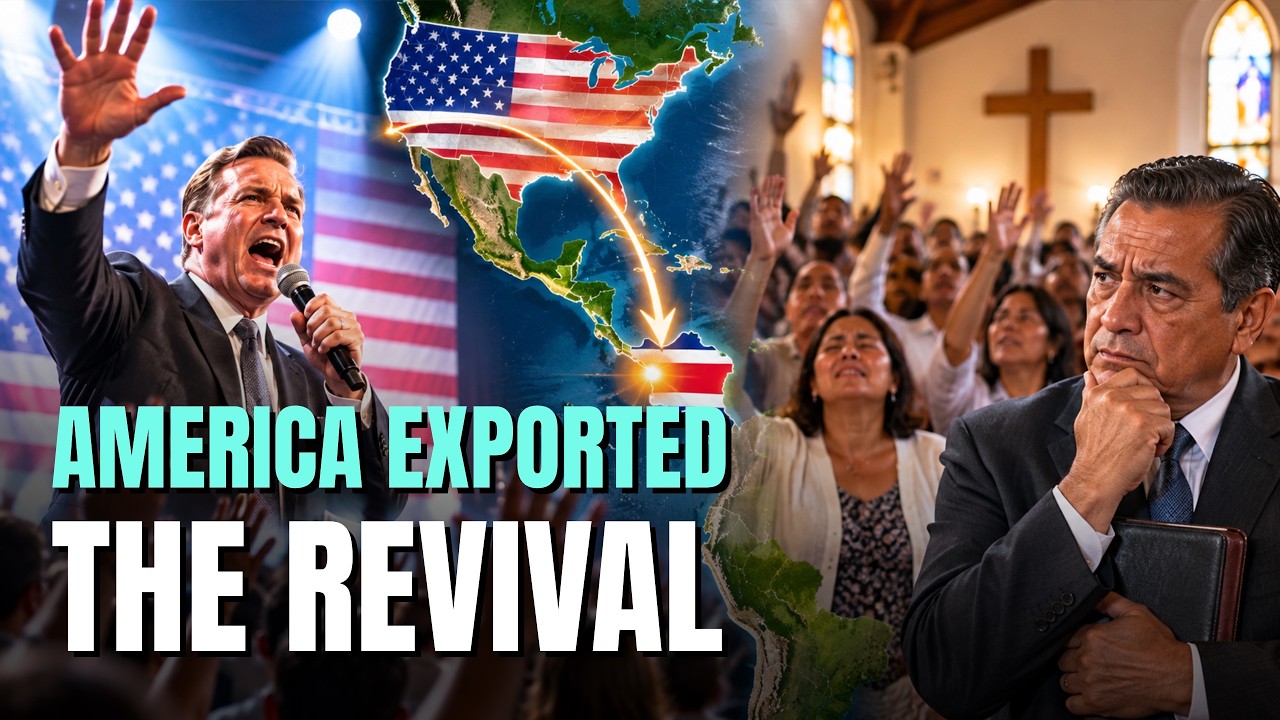
🔗 **Source:** [When American Evangelicalism Came to Costa Rica](https://www.youtube.com/watch?v=EpvTZCSWjMU)
> [!note]+ Document Notes
> tags: [costa-rica, evangelicalism, pentecostalism, new-apostolic-reformation, latin-american-christianity]
> author: John Collins
> source: Leaving the Message (YouTube)
> reference: https://www.youtube.com/watch?v=EpvTZCSWjMU
> date created: 2026-10-03 20:02
>
> > [!info] Generated analysis — not the author's words. Sections below are machine-written
> > from the captured source. Only text inside `> [!quote]` blocks is verbatim from the author.
> > Do not quote or attribute any other line to the named author.
>
> > [!warning] Auto-caption artifacts and format note. This 8:04 clip is an excerpt from a longer
> > two-person conversation. One speaker is the channel host (Leaving the Message is the channel tied
> > to william-branham.org and to the book "Weaponized Religion: From Christian Identity to the NAR,"
> > both linked in the description; the host speaks as a former Branhamite at 00:00:42). The second
> > speaker is a Costa Rica-based guest whom neither the transcript nor the description names; this
> > analysis calls them "the guest" and uses they/them. The author field names the channel host as
> > the publisher, not as the sole speaker. Likely caption garbles: "this track and" / "This track
> > and" (00:00:00, 00:05:43, 00:06:26) most likely renders "Strachan," the missionary family behind
> > the Latin America Mission, whose institutions match the radio station, Bible institute, hospital,
> > and Templo Bíblico the guest lists; "Kansas Prophets" is the Kansas City Prophets; "people to
> > moment" (00:00:00) is unrecoverable. The Miami pastor whose surname translates as "badly given"
> > (00:05:00) is not named; Guillermo Maldonado ("mal donado") of El Rey Jesús in Miami fits the
> > clue, but that identification is this analysis's inference. "Euclides Padilla" is kept as
> > captioned; the spelling is unverified. Quotes below preserve caption text exactly.
>
> # 🏷️ Title: When American Evangelicalism Came to Costa Rica
>
<!-- deep-read:sections start -->
## 🧭 Table of contents
- [📝 Summary](#-summary)
- [📖 Main content](#-main-content)
- [🗒️ Notes](#️-notes)
- [📚 References](#-references)
- [🗣️ Paraphrase](#️-paraphrase)
- [📰 Newsletter](#-newsletter)
- [✅ Action items](#-action-items)
- [🧪 Hypotheses](#-hypotheses)
- [📊 Methodology](#-methodology)
- [❓ Questions](#-questions)
- [🔮 Future research](#-future-research)
- [💡 Implications](#-implications)
- [🧠 Learning styles assessment](#-learning-styles-assessment)
- [📊 Accessibility assessment](#-accessibility-assessment)
- [🌍 DEIB assessment](#-deib-assessment)
- [✅ Logical validity](#-logical-validity)
- [🛡️ DARVO analysis](#️-darvo-analysis)
- [🎯 Conclusion](#-conclusion)
## 📝 Summary
- **What happened.** Leaving the Message, the channel run by a former follower of William Branham, published an 8 minute 4 second excerpt on 2026-10-03 in which the host and an unnamed Costa Rica-based guest trace how US Pentecostal and charismatic movements reached Costa Rica. The description splits it into 6 chapters, from "Different Forms of Evangelical Christianity" (00:00) to "How Christianity in Costa Rica Began to Change" (07:05).
- **The claim.** The host says an aggressive, in-your-face strain of US evangelicalism "merged with an agenda with the government" and targeted South America (00:02:48). The guest says Costa Rican Christianity's current shape was "imported directly from the United States" (00:03:31), naming the Azusa Street Revival, the New Apostolic Reformation (NAR), and the Kansas City Prophets as the exported movements (00:05:43), carried in through a missionary family that founded a radio station, a Bible institute, a hospital, and a role in Templo Bíblico (00:06:26).
- **Why it matters.** For a reader deconstructing out of the NAR, this is a short, first-person account of how the same apostolic and prophetic vocabulary she knows from the US arrived in a Central American country, plus a named local flashpoint: a pastor ("Euclides Padilla" in the captions) meeting "fierce opposition" from conservative pastors at Templo Bíblico over the "new move of the Holy Spirit" (00:07:10).
- **Key stakeholders.** The host (ex-Branhamite researcher); the guest (Costa Rican believer with friends "within many denominations," 00:03:31); the missionary family the captions render as "this track and"; pastor "Euclides Padilla"; Templo Bíblico's conservative pastors and members; the unnamed Miami megachurch pastor with "prophetic covering" (00:05:43); US government programs the host names, chiefly Operation Condor (00:02:48).
- **Risks and tradeoffs.** The clip compresses a century into 8 minutes and says so: "it's really hard to condense so much so many years of" history (00:07:10). The host's government-agenda claim is offered with "for whatever reason" and "you can find some weird stuff" (00:02:48) and no source. No dates appear anywhere. The guest's two key proper names are caption-garbled.
- **Bottom line.** A useful map of names and institutions to research, framed by two speakers' stated opinions ("in my opinion," 00:02:48). It isn't a sourced history, and it ends mid-thought at 00:07:53.
## 📖 Main content
- **Two kinds of evangelism (00:00:42 to 00:02:07).** The host says he never thought about the varieties of Protestantism until he left Branhamism, because the group's mindset was "us and everybody else." He describes a minister who boasted of opening conversations on buses and in taxis by asking strangers, "Did you know you're going to hell?" and who defined an evangelical church as one that is "in their face." The host says that at the time he called himself evangelical without knowing it meant this, and that he found the method offensive.
- **The other extreme (00:02:07).** The host contrasts confrontational evangelism with "peacefully converting" through exemplary living, then warns that this camp also has an extreme, "basically a works based religion." His framing is symmetrical: both approaches can go to extremes.
- **The government-agenda claim (00:02:48).** The host says that when the confrontational strain "exploded in the United States," it "merged with an agenda with the government" that targeted South America. He points to Operation Condor and "different government programs"; the guest adds "Even birth control at some point," and the host agrees. The host calls this wave "explosive" and "not from the good guys," and places it at "the more extreme side of the Pentecostal" (00:03:31). These are opinions; the host labels the good-guys judgment "in my opinion."
- **The guest's frame (00:03:31 to 00:05:00).** The guest agrees the movement was "imported directly from the United States," then states their own stance before going further: they have friends in many denominations, think you can learn "from everyone," and say anyone unwilling to challenge their own faith through study, prayer, and Scripture assumes they understand it entirely. They describe faith as a journey modeled on Abraham, Isaac, Jacob, and the patriarchs.
- **Costa Rica as a case study (00:05:00 to 00:05:43).** The guest calls Costa Rica "really really uh good case of study" and points to a large Miami church whose pastor's surname translates to "badly given," with "prophets" and "prophetic covering," which the guest describes as a discipleship structure behind much of modern evangelicalism. The pastor isn't named in the clip.
- **The imported movements (00:05:43 to 00:06:26).** The guest traces the earlier history to the missionary family the captions call "this track and" and to Euclides Padilla, and names the exported US movements: the Azusa Street Revival, the New Apostolic Reformation, and the Kansas City Prophets.
- **The institutions (00:06:26).** The missionary family "came here and open a radio station," then founded a Bible institute and a hospital, and had "a big part" in building Templo Bíblico. The guest is careful that they "were not the builders of the church." The guest's conclusion: Costa Rican Christianity's shape is "pretty much based on" them.
- **The Padilla flashpoint (00:07:10).** The guest says Padilla faced "fierce opposition" from Templo Bíblico's conservative pastors and members because of the "new move of the Holy Spirit," and that early Pentecostal Christians in Costa Rica were treated as heretics: "weird," "falling off," "speaking in tongues." The guest ties this to "the agenda" the host described.
- **Ending (00:07:53).** The clip cuts to music after the guest says the history is hard to condense. There's no conclusion or summary.
## 🗒️ Notes
#### ⏱️ [00:00:00](https://www.youtube.com/watch?v=EpvTZCSWjMU&t=0) Different forms of evangelical Christianity
- The guest opens mid-story, naming "this track and" (likely Strachan) and Euclides Padilla, "the first uh like major pastor" who marked a before-and-after "with the move of the Holy Spirit."
- The host says the shift in "agendas" is the big thing for him, and that he only saw Protestant variety after leaving Branhamism.
> [!quote] [00:00:42]
> we were in this mindset, it's us and everybody else and that's just how it was.
- The minister anecdote: confrontational evangelism on buses and taxis.
> [!quote] [00:00:42]
> Did you know you're going to hell?
- The host's response at 00:01:24: "you catch more flies with honey." He says he considered himself evangelical without knowing what the word meant.
> [!quote] [00:01:24]
> I considered myself evangelical, but I didn't know what that meant
- At 00:02:07 he describes the opposite camp, "peacefully converting," and says it can slide into "a works based religion."
#### ⏱️ [00:02:38](https://www.youtube.com/watch?v=EpvTZCSWjMU&t=158) American evangelical influence in South America
- The host's central claim: the confrontational strain "merged with an agenda with the government."
> [!quote] [00:02:48]
> Governmental agenda with the Evangelicals was a targeting South America for whatever reason
- Evidence offered: Operation Condor and "different government programs," with no detail on how either connects to missions. The guest adds "Even birth control at some point."
- The host calls it "an explosive wave" and says, "in my opinion it wasn't from the good guys."
#### ⏱️ [00:03:35](https://www.youtube.com/watch?v=EpvTZCSWjMU&t=215) A Costa Rican perspective on imported Christianity
- The host places the wave on "the more extreme side of the Pentecostal."
> [!quote] [00:03:31]
> this was imported directly from the United States.
- The guest states their stance first: friends in many denominations, learning "from everyone," testing faith through homework, prayer, and Scripture.
- At 00:04:16 the guest says no one can grasp God or the Bible in full, so faith is "a journey."
> [!quote] [00:04:16]
> So, what it means to me is that it's a journey of faith. I have to be learning constantly.
#### ⏱️ [00:05:11](https://www.youtube.com/watch?v=EpvTZCSWjMU&t=311) Costa Rica as a case study
> [!quote] [00:05:00]
> Costa Rica was really really uh good case of study.
- The guest asks whether the host knows a pastor whose name translates to "badly given," leading "pretty big uh church in" Miami (sentence spans 00:05:00 to 00:05:43).
- That church has "prophets," "offer covering like prophetic covering," which the guest calls "pretty much a disciple thing."
- The guest credits that model for much of "modern evangelicalism."
#### ⏱️ [00:06:05](https://www.youtube.com/watch?v=EpvTZCSWjMU&t=365) Revival movements and the NAR reach Costa Rica
- The guest traces the earlier wave to the missionary family and Euclides Padilla.
> [!quote] [00:05:43]
> the entire you know, Azusa Street Revival thing and the agenda and the New Apostolic Reformation and the Kansas Prophets
> [!quote] [00:06:26]
> all those things that were happening on United States were being imported to Costa Rica.
- Note the compression: Azusa Street (1906), the Kansas City Prophets (1980s), and the NAR (named by C. Peter Wagner in the 1990s) are decades apart, and the clip lists them as one stream.
#### ⏱️ [00:07:05](https://www.youtube.com/watch?v=EpvTZCSWjMU&t=425) How Christianity in Costa Rica began to change
- Institutions: a radio station, a Bible institute, a hospital, and "a big part" in Templo Bíblico (00:06:26).
> [!quote] [00:06:26]
> This track and came here and open a radio station.
- The flashpoint at Templo Bíblico:
> [!quote] [00:07:10]
> Euclides Padilla had a fierce opposition from the conservative pastors and and members of the church
- Early Pentecostals "were considered heretics," "weird," "speaking in tongues." The guest calls this "part of the agenda."
- The clip ends at 00:07:53 on music, mid-thought.
## 📚 References
The transcript itself contains no links; the following come from the video description or are primary sources for named entities. No URL beyond the description was fetched for this analysis.
- Weaponized Religion: From Christian Identity to the NAR (paperback): https://www.amazon.com/dp/1735160962
- Weaponized Religion (Kindle): https://www.amazon.com/dp/B0DCGGZX3K
- Channel website: https://william-branham.org
- Channel books page: https://william-branham.org/site/books
- Channel Patreon: https://www.patreon.com/branham
- Channel page: https://www.youtube.com/channel/UCBSpezVG15TVG-lOYMRXuyQ
- Facebook, TikTok, and Twitter links appear in the description; none are referenced in the conversation.
- Named entities to check against primary sources (none linked in the video):
- Latin America Mission and the Strachan family (Harry and Susan Strachan), the likely referent of "this track and."
- Templo Bíblico, San José, Costa Rica.
- Euclides Padilla (caption spelling, unverified).
- Azusa Street Revival (Los Angeles, 1906).
- Kansas City Prophets (Kansas City, 1980s).
- New Apostolic Reformation (term popularized by C. Peter Wagner).
- Operation Condor (US-backed coordination among Southern Cone governments, 1970s and 1980s).
- The unnamed Miami pastor; Guillermo Maldonado and El Rey Jesús is this analysis's inference, not the guest's statement.
## 🗣️ Paraphrase
- **The host's frame.** Leaving a closed sect (Branhamism) is what showed him Protestantism comes in many flavors. One flavor confronts strangers with hell; another tries to convert by example. Both can turn extreme.
- **The political claim.** The confrontational strain grew in the US, tied itself to a government agenda aimed at South America, and showed up alongside programs like Operation Condor. He gives no sources and calls the wave's motives bad in his own opinion.
- **The guest's frame.** Costa Rica's evangelical and Pentecostal shape came from the US. The guest stays open to learning from every denomination and treats faith as lifelong study.
- **The history.** A missionary family (likely the Strachans) built the radio station, Bible institute, and hospital that shaped Costa Rican Protestantism and helped found Templo Bíblico. Later, a pastor bringing Pentecostal practice, Euclides Padilla, met fierce opposition there. Revival, Kansas City Prophets, and NAR teaching came in from the US, and today a Miami church's "prophetic covering" model carries on the influence.
- **The ending.** The guest says it's too much history for one sitting, and the excerpt stops.
## 📰 Newsletter
**How the NAR got to Costa Rica, in 8 minutes**
Leaving the Message posted an 8-minute excerpt today in which the host, a former follower of William Branham, talks with an unnamed Costa Rican guest about how US evangelicalism reshaped Costa Rican Christianity.
The host starts with an anecdote: a minister who'd sit next to strangers on a bus and open with,
> "Did you know you're going to hell?"
That style, he argues, "merged with an agenda with the government" and targeted South America. He points to Operation Condor but doesn't explain the link, and he labels his judgment as opinion.
The guest supplies the Costa Rican side. Their summary:
> "this was imported directly from the United States."
The names are the useful part. A missionary family (the captions say "this track and," almost certainly the Strachans of the Latin America Mission) opened a radio station, a Bible institute, and a hospital, and helped build Templo Bíblico. Later, a pastor named Euclides Padilla brought Pentecostal practice to Templo Bíblico and hit "fierce opposition" from conservative pastors. Behind it, the guest says, came the Azusa Street Revival, the Kansas City Prophets, and the New Apostolic Reformation.
Read it as a lead list, not a history: no dates, no sources, and the clip ends mid-sentence. If you're tracing NAR influence outside the US, the Templo Bíblico conflict is the thread worth pulling.
## ✅ Action items
#### DevRel
- Developer advocacy: No direct action from this source; nearest relevance: the host's contrast between confrontational and lead-by-example persuasion (00:01:24, 00:02:07) maps onto evangelism-style versus example-style developer advocacy.
- Education: No direct action from this source; nearest relevance: the clip names 6 movements and institutions in 8 minutes without dates, a reminder that short explainers need a timeline.
- Developer experience: No direct action from this source.
- Developer marketing: No direct action from this source; nearest relevance: the "in their face" boast (00:01:24) is a counterexample for outreach tone.
- Community management: No direct action from this source; nearest relevance: the Templo Bíblico conflict (00:07:10) shows an established community labeling newcomers' practices as heresy.
- Internal/external/cross-project: No direct action from this source.
#### OSPO
- Policy & Governance: No direct action from this source; nearest relevance: "prophetic covering" (00:05:43) describes authority flowing from one leader, a governance pattern to recognize.
- License Compliance: No direct action from this source.
- Security Management: No direct action from this source.
- Software Inventory: No direct action from this source.
- Developer Support: No direct action from this source.
- Community Engagement: No direct action from this source.
- Strategic Alignment: No direct action from this source.
#### Community
- Maintainers: No direct action from this source.
- Contributors: No direct action from this source; nearest relevance: the guest's "you can learn pretty much from everyone" stance (00:03:31) is a workable norm for cross-project contribution.
- Sponsors: No direct action from this source; nearest relevance: the claim that outside funding and agendas shaped local institutions (00:02:48, 00:06:26) parallels sponsor influence on open-source projects.
- Ecosystem: No direct action from this source.
#### WordPress
- Core: No direct action from this source.
- Core Performance: No direct action from this source.
- Core AI: No direct action from this source.
- Core Program Team: No direct action from this source.
- Mobile: No direct action from this source.
- Playground: No direct action from this source.
- Community: No direct action from this source; nearest relevance: imported practices meeting local resistance (00:07:10) is the same shape as global programs landing in local meetups.
- Training: No direct action from this source.
- Marketing: No direct action from this source.
- Support: No direct action from this source.
- Design: No direct action from this source.
- Documentation: No direct action from this source.
- Photos: No direct action from this source.
- TV: No direct action from this source.
- Polyglots: No direct action from this source; nearest relevance: the guest translates a Spanish surname on air (00:05:00), and the captions garble two Spanish proper names, a live example of why translated and captioned media needs review.
- Accessibility: No direct action from this source; nearest relevance: auto-captions mangle "Strachan" and "Kansas City," see the accessibility section.
- Meta: No direct action from this source.
- CLI: No direct action from this source.
- Hosting: No direct action from this source.
- Tide: No direct action from this source.
- Openverse: No direct action from this source.
- Themes: No direct action from this source.
- Plugins: No direct action from this source.
#### The WPOCC
- Programs: No direct action from this source.
- Projects: No direct action from this source.
- Funding experiments: No direct action from this source; nearest relevance: the host's claim that a funder's agenda shaped what got built abroad (00:02:48) is a question any funding program should ask of itself.
### FAIR
- Technical independence: No direct action from this source; nearest relevance: "imported directly from the United States" (00:03:31) is the dependency pattern federation aims to avoid.
- Policies and covenants: No direct action from this source.
- Productized governance artifacts: No direct action from this source.
## 🧪 Hypotheses
- Costa Rican Protestant institutions founded by the Latin America Mission (radio, Bible institute, hospital, Templo Bíblico) predate the arrival of Pentecostal and charismatic practice there, and the earliest charismatic congregations formed partly from members who left those institutions.
- The conflict the guest describes at Templo Bíblico (00:07:10) appears in denominational or mission records as a documented dispute over speaking in tongues or Holy Spirit practice, with a datable year.
- NAR-style "apostolic" or "prophetic covering" structures in Costa Rican churches trace more often to Latin American hubs in Miami than to direct US-mainland NAR networks.
- Documented US government programs in Latin America (Operation Condor among them) show no direct funding link to evangelical missions in Costa Rica, and any government-evangelical overlap is better documented for other countries (Guatemala in the 1980s is a candidate).
- Costa Rican Christians who first met Pentecostal practice through a mainline Protestant church report the same "heretic" framing the guest describes, at higher rates than those who met it through an independent Pentecostal church.
## 📊 Methodology
- **Institutional timeline.** Build a dated timeline of Latin America Mission institutions in Costa Rica from mission archives and published histories, then place the first Pentecostal congregations and the Templo Bíblico dispute on it. Tests hypotheses 1 and 2.
- **Name verification.** Search Costa Rican church histories and Spanish-language press for "Euclides Padilla" and spelling variants to confirm identity, role, and dates. Prerequisite for hypothesis 2.
- **Network mapping.** Survey Costa Rican congregations that use "apostle," "prophet," or "covering" language and record which networks ordain or oversee their leaders. Tests hypothesis 3.
- **Archival check on government links.** Review declassified records and academic work on Operation Condor and US aid programs for any reference to Costa Rican missions. Tests hypothesis 4. Note Costa Rica wasn't a Condor member state, which this test should confirm or refute.
- **Oral history.** Structured interviews with older Costa Rican Pentecostals on how mainline churches described them. Tests hypothesis 5.
- **Limits.** The video gives no dates, no sources, and two garbled names. Every hypothesis starts from claims the clip asserts but doesn't document.
## ❓ Questions
- Who is "this track and"? If it's the Strachan family, which institutions did they found directly, and which radio station does the guest mean?
- Who is Euclides Padilla, when did the Templo Bíblico dispute happen, and did it end in a split?
- What specific evidence connects Operation Condor, a program run by Southern Cone governments, to evangelical work in Costa Rica or elsewhere in Central America?
- What does the guest mean by "Even birth control at some point" (00:02:48)? Which program, and what's the link to missions?
- Who is the Miami pastor whose name translates as "badly given," and how did that church's "prophetic covering" reach Costa Rican congregations?
- The guest calls the opposition to Padilla "part of the agenda." Whose agenda: the US government's, the missionaries', or the Pentecostal movement's?
- What comes before 00:00:00 and after 00:07:53 in the full conversation, and does it supply the sources this clip omits?
## 🔮 Future research
- A Spanish-language source pass on Costa Rican Protestant history to set dates for each institution and conflict the guest names.
- Matthew D. Taylor's work on the NAR and its international networks, read against the guest's Costa Rica account.
- Academic work on US evangelical missions and Cold War foreign policy in Central America, checking where documented overlap exists and where it doesn't.
- The full Leaving the Message episode this excerpt comes from, if published, to recover the missing context.
- The host's book "Weaponized Religion: From Christian Identity to the NAR," linked in the description, for the sourced version of the government-agenda argument.
## 💡 Implications
- **Practice.** For someone leaving an NAR context, the clip shows the same "apostle," "prophet," and "covering" language operating outside the US, a reminder that the structure travels independent of country.
- **Policy.** If the government-agenda claim holds up in sources, it bears on how foreign-funded religious institutions get disclosed; as stated in the clip, it's an unsourced claim.
- **Security.** No direct security implication; the closest is the guest's description of "prophetic covering" as a discipleship structure, which concentrates authority in one leader.
- **Education.** The clip is a reasonable 8-minute entry point that needs a timeline and spellings before anyone teaches from it.
- **Funding.** The guest's account of a missionary family funding radio, education, and health institutions shows how outside money set the long-term shape of a national church scene.
## 🧠 Learning styles assessment
- Reading level estimate: Flesch Reading Ease 74 (fairly easy) and Flesch-Kincaid Grade 7.4, computed on the 1,252-word transcript with a script-counted syllable estimate. Run-on spoken sentences make the grade an approximation.
#### 👀 Visual learners
- Present: the transcript gives no sign of on-screen maps, names, or dates; the format reads as two talking heads.
- Improve: on-screen spellings for "Strachan," "Euclides Padilla," and "Templo Bíblico" plus a one-line timeline would fix the clip's two largest gaps.
#### 🔊 Aural learners
- Present: conversational audio with clear turn-taking and laughter cues; the guest's accented English is easy to follow in the transcript.
- Improve: the guest's sentences restart often ("let let me uh let me first of all," 00:03:31), which costs listeners time.
#### 🗣️ Verbal learners
- Present: the guest defines "prophetic covering" as "pretty much a disciple thing" (00:05:43).
- Improve: NAR, Kansas City Prophets, and Azusa Street are named without definition.
#### 🧩 Kinesthetic learners
- Present: none; it's a listening format.
- Improve: a follow-up prompt such as "find when your own church adopted 'covering' language" would give viewers a task.
#### 🧠 Logical learners
- Present: the guest's causal chain (missionaries build institutions, institutions shape Costa Rican Christianity, US revival movements import later) is easy to follow.
- Improve: no dates, no numbers, and no sources; the government-agenda link is asserted with "for whatever reason."
#### 🧑🤝🧑 Social learners
- Present: two speakers with different vantage points (US ex-Branhamite, Costa Rican believer) model a cross-cultural conversation.
- Improve: no call for viewers to share their own country's version of the story.
#### 🧘♀️ Solitary learners
- Present: short and self-contained at 8:04, with chapters.
- Improve: it's an excerpt; solitary viewers can't tell what came before or after.
#### 🌿 Naturalistic learners
- Present: none.
- Improve: not applicable to this source's subject matter.
## 📊 Accessibility assessment
#### Screen reader semantics
- Present: the description gives a two-paragraph prose summary and a plain-text chapter list, which screen readers handle well.
- Improve: the description doesn't name the guest, so screen-reader users get no speaker identification.
#### Keyboard navigation
- Present: 6 chapters on an 8-minute video, navigable with YouTube's native keyboard controls.
- Improve: none needed for a clip this short.
#### Contrast and readability
- Present: not assessable from the transcript.
- Improve: if names appear on screen, check them against 1.4.3 Contrast (Minimum).
#### Text resizing and reflow
- Present: not applicable to the video itself; the description reflows normally.
- Improve: not applicable.
#### Media and captions
- Present: auto-generated captions, with ">>" speaker-change markers and sound cues ("[laughter]," "[clears throat]," "[music]").
- Improve: captions garble the two most important proper names ("this track and" for the likely Strachan, "Kansas Prophets" for Kansas City Prophets) and don't identify speakers by name; "people to moment" at 00:00:00 is unrecoverable. Corrected captions would fix this.
#### Forms and interactions
- Present: not applicable to the source video.
- Improve: not applicable.
#### Standards reference
- WCAG 2.2 AA notes: 1.2.2 Captions (Prerecorded) is met nominally, but proper-noun errors reduce accuracy on the clip's key facts. 2.4.6 Headings and Labels is met by the chapter titles. 2.4.5 Multiple Ways is partly met through chapters and the description summary. 3.1.2 Language of Parts applies to the Spanish terms ("Templo Bíblico") spoken inside English audio; captions don't mark them.
## 🌍 DEIB assessment
#### Cultural breadth
- Present: a Costa Rican speaker tells Costa Rica's story in their own words, which is the clip's main strength.
- Improve: the host's "South America" framing (00:02:48) applies to Costa Rica, which is in Central America; Operation Condor involved Southern Cone states. The geography blurs.
#### Inclusive language
- Present: the guest affirms learning "from everyone" across denominations (00:03:31); the host frames both evangelism styles as able to go extreme instead of singling one out.
- Improve: the host's private label for confrontational evangelists, withheld on air (00:01:24), still signals contempt.
#### Neurodiversity support
- Present: short runtime and chapters help sustained attention.
- Improve: the guest's restarts and the dense name list at 00:05:43 make it hard to track who did what.
#### Representation
- Present: a Latin American voice carries most of the history segment.
- Improve: the guest isn't named in the transcript or description, which leaves the Costa Rican perspective uncredited.
#### Psychological safety
- Present: the guest's stance that faith means constant learning (00:04:16) makes room for doubt.
- Improve: no harm in the clip; for viewers from Pentecostal backgrounds, the "considered heretics" history (00:07:10) is presented neutrally, without endorsing the label.
## ✅ Logical validity
#### Strong reasoning
- **Institutional causation (00:06:26).** The guest argues from mechanism: a group that founds the radio station, the Bible institute, the hospital, and helps build the main church shapes how a country's Christianity looks. That's a coherent and testable claim.
- **Symmetry check (00:02:07).** The host doesn't cast one evangelism style as good and the other as bad; he says both "go off into extremes," which keeps his critique from being one-sided.
- **Stated bias (00:03:31).** The guest discloses their ecumenical stance before making historical claims, so viewers can weigh it.
#### Fallacies
- **Unsupported causal claim (00:02:48).** *Quote:* "Governmental agenda with the Evangelicals was a targeting South America for whatever reason." *Weakness:* "for whatever reason" concedes there's no stated mechanism, and Operation Condor is cited without showing any tie to missions. *Fix:* name the program, the year, and the document that links it to evangelical work.
- **Guilt by proximity (00:02:48).** *Quote:* "you can find some weird stuff especially if you look at you know Operation Condor." *Weakness:* placing missions next to a repressive intelligence program implies a link without stating one. *Fix:* separate the two claims and source each.
- **Compression into a single cause (00:05:43).** *Quote:* "the entire you know, Azusa Street Revival thing and the agenda and the New Apostolic Reformation." *Weakness:* lists movements roughly 80 years apart as one imported "agenda." *Fix:* give each movement a date and a carrier into Costa Rica.
- **Ambiguous referent (00:07:10).** "That's part Again, as you said, part of the agenda." It's unclear which agenda the opposition to Padilla belongs to, so the claim can't be evaluated.
#### Tone of voice
- Relaxed and conversational, with laughter at 00:01:24, 00:02:48, 00:04:16, and 00:05:00. The host is critical and a little sardonic about confrontational evangelism; the guest is measured and ecumenical, opening with a disclosure of their own stance. Neither speaker uses hostile language toward Costa Rican believers, and both mark key judgments as opinion.
## 🛡️ DARVO analysis
Not applicable to this source. The clip is a historical conversation, not a response to an accusation, so no speaker denies, attacks, or reverses roles in reply to a charge.
- **Deny:** None. No speaker responds to an accusation or denies wrongdoing.
- **Attack:** None directed at a critic. The host criticizes a minister's evangelism method (00:01:24) and withholds an insult on air, but that's commentary, not a counterattack.
- **Reverse victim-offender:** None in the speakers' own conduct. The nearest pattern is reported: the guest says early Costa Rican Pentecostals "were considered heretics" by the established church (00:07:10), a description of how an incumbent group framed newcomers, not a DARVO move by anyone in the video.
## 🎯 Conclusion
- **Bottom line.** In 8 minutes, the host and a Costa Rican guest argue that Costa Rican evangelicalism was shaped by US imports: a missionary family's institutions first, then Pentecostal, Kansas City Prophets, and NAR teaching, and now Miami-based "prophetic covering." The institutional story is specific and checkable; the government-agenda story isn't sourced in the clip.
- **What to take seriously.** The Templo Bíblico dispute over "the new move of the Holy Spirit" (00:07:10) and the institution list (00:06:26) are concrete leads.
- **What to flag before repeating.** The Operation Condor and birth-control links (00:02:48), the identity of "this track and," the spelling of Euclides Padilla, and the unnamed Miami pastor all need sources before reuse.
- **Next step.** Pin the Strachan identification and the Padilla dates, then read the host's book for the sourced version of the government argument.
## 🔄 Refactor Appendix — When American Evangelicalism Came to Costa Rica
> Density: 2-5 Literature atoms (H3), 0-3 Permanent candidates (H4).
> Defaults: 3 Literature, 1 Permanent. Resonance filter: if you can't
> articulate in one line why a claim matters, drop it.
### 📚 Literature Split Pad
#### [H1] Costa Rica's charismatic Christianity was imported from the US
> [!quote] [00:03:31]
> this was imported directly from the United States.
**Context & use**:
- ~00:03:31, the guest's thesis, agreeing with the host's claim that the "explosive wave" came from the extreme side of US Pentecostalism.
- Anchor for tracing NAR language outside the US; pair with the movement list at 00:05:43 and the institution list at 00:06:26.
**Tags**: #xref #articleseed
<!-- atomicity: 1 idea ✓ -->
#### [H2] He called himself evangelical without knowing what it meant
> [!quote] [00:01:24]
> I considered myself evangelical, but I didn't know what that meant
**Context & use**:
- ~00:01:24, the host recalling the minister who opened conversations with "Did you know you're going to hell?"
- A clean statement of how a group label gets adopted before its practices are examined, which is a common step in deconstruction stories.
**Tags**: #xref #aphorisms
<!-- atomicity: 1 idea ✓ -->
#### [H3] Costa Rica's early Pentecostals were treated as heretics
> [!quote] [00:07:10]
> early Christians in Costa Rica were considered heretics
**Context & use**:
- ~00:07:10, the guest describing how established Templo Bíblico pastors viewed the first Pentecostals and Euclides Padilla.
- Shows the same movement that later became dominant once sat on the outside; useful when comparing incumbent and newcomer framing.
**Tags**: #xref #articleseed
<!-- atomicity: 1 idea ✓ -->
### 🧠 Atomic Split Pad
#### [P1] Religious authority structures travel through institutions, not borders
**Claim** (one sentence, Courtney's voice): Apostolic and prophetic covering doesn't stay in the country that invented it; it moves through the radio stations, Bible institutes, and megachurch networks that train the next set of leaders.
**Evidence pointer**: [[#H1]]
**Scope & conditions**: Holds where outside groups fund or found the training institutions; weaker where local churches develop their own leadership pipelines first. The clip supports the shape of this claim, not its dates.
**Links**:
- [[Alarm fatigue before adding alarms]] — because contrasts on how an established system treats a new signal as noise
- [[Self-selection is what makes an audience worth measuring]] — because applies-in deciding which converts an imported movement actually reaches
<!-- atomicity: 1 idea ✓ -->
### ✏️ Fleeting Queue
- [F1] Confirm "this track and" = Strachan family / Latin America Mission, and list which Costa Rican institutions they founded #fleeting #inbox
- [F2] Find dates and a correct spelling for Euclides Padilla and the Templo Bíblico dispute #fleeting #inbox
- [F3] Check whether "Weaponized Religion" sources the Operation Condor and evangelical-missions link #fleeting #inbox
### → Things 3 (max 2 actions)
- [ ] Look up the Strachan family and Templo Bíblico history to date the Padilla dispute — Costa Rica NAR thread #things
- [ ] Check "Weaponized Religion" for the source behind the Operation Condor claim — before citing this clip #things
<!-- deep-read:sections end -->
📄 **Full text:** [[Full Document Contents/Articles/When American Evangelicalism Came to Costa Rica.md|When American Evangelicalism Came to Costa Rica by John Collins]]
## Highlights
- [00:01:24] >> Oh, yeah. >> start his introduction like this and I'm sitting here thinking, "That's You know, you catch more flies with honey. That's not how you do this, man." But [laughter] it would and he browed he proudly boasted, "We are an evangel- evangelical church. If you're not in their face, if you're not converting them, that's how his mindset was." And I stopped and thought about it. I At that point in time, I considered myself evangelical, but I didn't know what that meant and I did not know that it meant that you must be like this and um I have I have a word for people like this now which I can't use on the program but >> [laughter] >> it's not it's not a good way to be to people. I'll just say it like that. There's There's There's ways that you [00:02:07] can treat people with respect and >> Yeah. >> And so you've got camps that are like that and there's like I said there's different levels they go off into extremism etc. And then on the other side of the aisle you have people that are peacefully converting. We're going to live our lives in such a good way that you want to live your life like us >> Yeah. >> living our life the the Christian saintly way and [snorts] that goes off into extremes. You've got camps where they you know that's basically a works based religion. So you can go extremes on both sides of the aisle. What I found out was when Evangelical Christianity exploded in the United States with the [clears throat] flavor of the minister which I mentioned >> [laughter] ([View Highlight](https://read.readwise.io/read/01m423pewq585s63qmptzyff21))
- Note: [H2] He called himself evangelical without knowing what it meant
- Tags: atom/literature/h2
- [00:02:48] >> all through the United States and they merged with an agenda with the government. >> Yeah. >> Governmental agenda with the Evangelicals was a targeting South America for whatever reason and you can find some weird stuff especially if you look at you know Operation Condor and different government programs that were going to South America, right? >> Even birth control at some point. >> Absolutely. So you had the you had these agendas and that's whenever it really came in and it was like this I I know you talked about the different waves of um Protestant Christianity coming in. Well this one was an explosive wave and it wasn't from in my opinion it wasn't from the good guys. This would be the [00:03:31] more extreme side of the Pentecostal of the Protestantism. >> [clears throat] >> I believe that's so and that's that's one of the reason that I say always that this was imported directly from the United States. And [clears throat] uh let let me uh let me first of all be very open with this. I have friends within many denominations. And I think that that's a perfectly doable thing. Because you can learn pretty much from everyone. If you're not agreeing with challenging your faith and going and you know, just go do the homework and do it by yourself and and prayer and reading the scripture. If ([View Highlight](https://read.readwise.io/read/01m423pbtemgse7wj0c106fk97))
- Note: [H1] Costa Rica's charismatic Christianity was imported from the US
- Tags: atom/literature/h1
- [00:07:10] it's pretty much based on on them. And then to give to give you an example, Euclides Padilla had a fierce opposition from the conservative pastors and and members of the church when we came when when he came to to Templo Bíblico because of the new new move of the Holy Spirit. And to give you a perspective on that, early Christians in Costa Rica were considered heretics and and they were like this they're weird and they're falling off and they're speaking in tongues, and they're not We don't want to have anything to do with that. Now, that's part Again, as you said, part of the agenda. And it's really hard to condense so much so many years of of [00:07:53] history. >> [music] ([View Highlight](https://read.readwise.io/read/01m423pht8pchsb4t4k995ce7f))
- Note: [H3] Costa Rica's early Pentecostals were treated as heretics
- Tags: atom/literature/h3