Why Aren’t More Christians Resistant to AI?
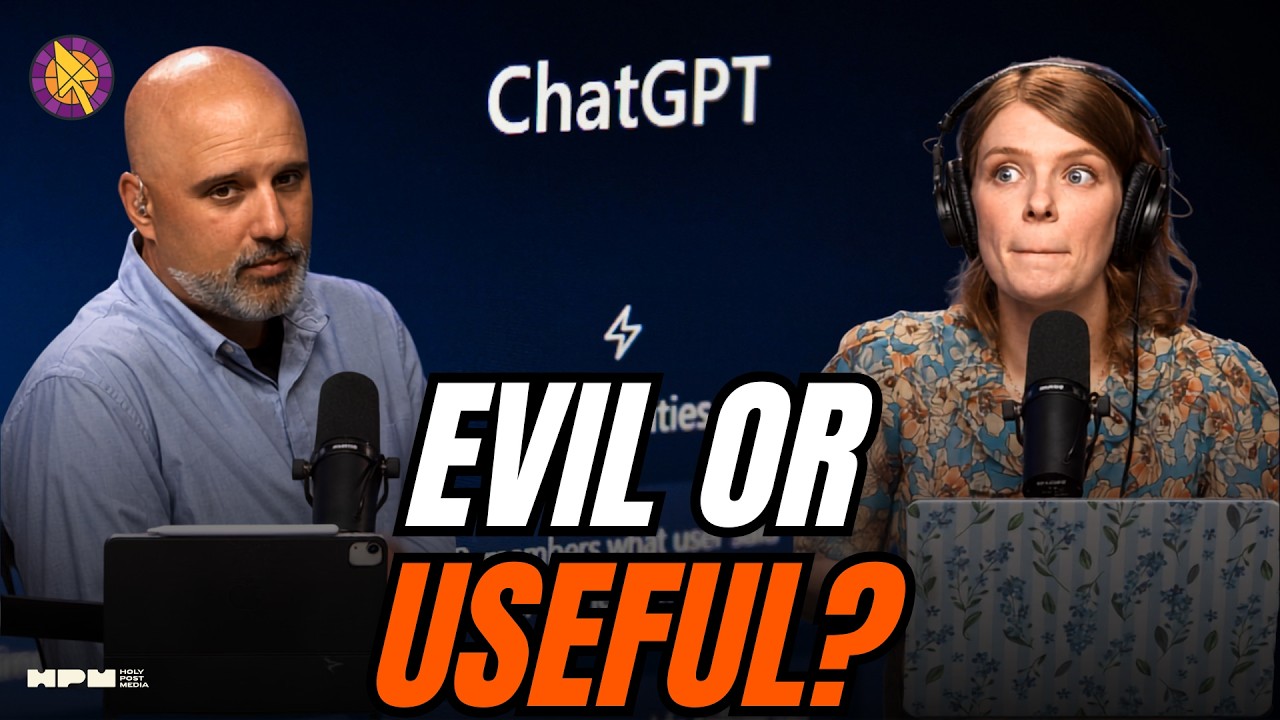
🔗 **Source:** [Why Aren’t More Christians Resistant to AI?](https://www.youtube.com/watch?v=cI9Cp1vkeOk)
> [!note]+ Document Notes
> tags: [theology-and-technology, evangelicalism, epistemic-certainty, ai-ethics, embodiment]
> author: [MISSING]
> source: YouTube
> reference: https://www.youtube.com/watch?v=cI9Cp1vkeOk
> date created: 2026-08-22 11:20
>
> > [!info] Generated analysis — not the author's words. Sections below are machine-written
> > from the captured source. Only text inside `> [!quote]` blocks is verbatim from the author.
> > Do not quote or attribute any other line to the named author.
>
> # 🏷️ Title: Why Aren't More Christians Resistant to AI?
>
<!-- deep-read:sections start -->
## 🧭 Table of Contents
- [📝 Summary](#-summary)
- [📖 Main Content](#-main-content)
- [🗒️ Notes](#️-notes)
- [📚 References](#-references)
- [🗣️ Paraphrase](#️-paraphrase)
- [📰 Newsletter](#-newsletter)
- [✅ Action Items](#-action-items)
- [🧪 Hypotheses](#-hypotheses)
- [📊 Methodology](#-methodology)
- [❓ Questions](#-questions)
- [🔮 Future Research](#-future-research)
- [💡 Implications](#-implications)
- [🧠 Learning Styles Assessment](#-learning-styles-assessment)
- [📊 Accessibility Assessment](#-accessibility-assessment)
- [🌍 DEIB Assessment](#-deib-assessment)
- [✅ Logical Validity](#-logical-validity)
- [🛡️ DARVO Analysis](#-darvo-analysis)
- [🎯 Conclusion](#-conclusion)
### 🔗 References
- [Mere Orthodoxy](https://mereorthodoxy.com/) — publisher of the discussed article, "American evangelicals long for the embrace of the machine God" by Christopher Jones
- [Antiqua et Nova — Vatican note on artificial intelligence and human intelligence](https://www.vatican.va/roman_curia/congregations/cfaith/documents/rc_ddf_doc_20250128_antiqua-et-nova_en.html)
> [!note] Speaker attribution
> Participants are referred to in the transcript by first name only — "Sky," "Mike," and
> "Caitlin" as rendered by auto-captions, which are unreliable for names. This analysis
> follows the transcript's usage without asserting full identities.
## 📝 Summary
- **What happened.** Three hosts discuss a survey finding that Christians are more likely than others to say they trust AI with major decisions, then work through an article by Christopher Jones in *Mere Orthodoxy* proposing three explanations — political, theological, and psychological — for why American evangelicals in particular have embraced AI rather than resisted it.
- **Why it matters.** The discussion identifies something broader than a religious curiosity: a specific epistemology — that truth is objective, accessible through correct procedure, and retrievable if you assemble the right inputs — which maps almost exactly onto how people relate to a language model. The group argues that a tradition trained in that epistemology is unusually primed to accept an oracle. That mechanism is not confined to any religion.
- **Key stakeholders.** Religious communities forming positions on AI; anyone studying how epistemic training shapes technology adoption; church leaders fielding questions their congregations expect to have single answers; and, more broadly, anyone who has noticed that the demand for "just tell me the right answer" predates chatbots by centuries.
- **Risks and tradeoffs.** The unnamed survey is never sourced, defined, or sized, yet it motivates the entire conversation. Sweeping claims are made about an enormous and internally diverse population on the basis of one article and personal anecdote. The hosts are describing a tradition they belong to and are candid about that, which is both the discussion's chief strength and the source of its selection bias.
- **Bottom line.** The central insight — that the desire for a certainty machine is old, and AI is merely the newest candidate to fill the role — is genuinely sharp and generalizes well past its religious setting. The empirical support offered for it is thin, and the participants say so about themselves more readily than about their evidence.
## 📖 Main Content
**The puzzle.** The conversation opens with an apparent paradox. A survey — unnamed, unsourced — reportedly found Christians more likely than others to trust AI with major decisions. One host argues this is backwards on the tradition's own terms: *"we are the ones that believe our God became incarnate. We are the ones who care so much about community and accountability and deep relationships."* The argument is that a theology built on embodiment, on presence, and on communal accountability supplies unusually strong grounds for skepticism toward a disembodied, individual, community-substituting technology. That the tradition with the best resources for resisting appears to be resisting least is the puzzle the rest of the episode addresses.
A second host immediately narrows the scope, noting the Pope's encyclical covers "deep historical theological Christian reasons why AI is problematic," but that much of it "doesn't transfer over to American Evangelicalism." This distinction — global Christian tradition versus American evangelicalism specifically — is the discussion's most important qualifier and is maintained fairly consistently thereafter.
**The three proposed reasons.** The hosts work through Jones's argument:
*Political.* Evangelicals are described as more supportive of capitalism and as carrying a competitive-adaptation logic — companies rejecting technological advances fall behind, so adoption is both inescapable and advantageous. The technology is framed as something you go along with because everyone else is.
*Theological.* The host offers her own reading rather than simply relaying the article's. Two strands: first, "a sense that the body doesn't matter very much," which she carefully labels *"not a Christian belief but can be an evangelical temptation"* — a precise distinction between a tradition's doctrine and a subculture's drift, and a gnostic tendency that historic Christianity explicitly rejected. Second, an individualist rather than systemic moral frame: if sin is located in private choices, then "my individual choice to stick something into ChatGPT is not going to have these massive ramifications so it's fine." Environmental cost, labour displacement, and data provenance all become invisible under that frame.
*Psychological.* Presented as the strongest of the three. The quoted argument: *"unprepared for the hard careful work of separating truth from falsehood, evangelicals long for a computer to simply tell them what is true."* The supporting context is interpretive overload — many denominations, many readings of scripture, competing online preachers and podcasts — producing a demand for something apparently unbiased that will simply adjudicate.
**Where the hosts push back and refine.** One host quibbles usefully: the craving for certainty is *"historically true of fundamentalists"* more than evangelicals, though he concedes that contemporary usage of "evangelical" has become "more or less synonymous with fundamentalism," which is why the claim lands anyway. This is a genuine analytic refinement rather than a defensive move.
He then advances a stronger thesis, flagged as risky — *"this is going to get me in trouble"* — that modern American evangelicalism "more than anything else is shaped by the market." On that reading, the capitalism link, the technological optimism, and the AI embrace are "all of a piece." He adds a falsifiable prediction: the enthusiasm could prove short-lived if AI comes to be blamed for economic damage, since an identity shaped by the market would turn against a technology that harmed it.
**The conspiracy puzzle.** Another host raises a second paradox: the same subculture has a documented "bent towards a conspiratorial way of thinking" and watches for end-times signs, so why has AI not been cast as apocalyptic? *"What separates this from like a global cabal of elites running the world?"* The answer offered — *"it's because they're our elites"* — is the episode's sharpest line and its least evidenced. It reframes the apparent inconsistency as coalitional rather than doctrinal: the objection was never to concentrated power, but to power held by the wrong people. The Hobby Lobby anecdote follows, contrasting a retailer that reportedly avoids barcodes with the same subculture's comfort with AI — *"which seems way more diabolical than barcodes."*
**The epistemology underneath.** The third host supplies what is, analytically, the most valuable contribution. He describes his own formation: taught that objective truth exists independent of belief, so *"the issue isn't is truth objective. It's always how can I access objective truth?"* Trained to treat the Bible as *"a source of information... a source of propositions... a source of truth statements"* rather than *"a wisdom document... a discerning document."* And trained to see sin as private and individual rather than communal and systemic.
His conclusion is that the desire for certainty is not a standalone psychological quirk but the surface of *"a whole bunch of baked-in assumptions about how the Bible works, how God works, and how truth works."* Once truth is objective, propositional, and accessible by correct procedure, an arbitration device is not a compromise of the framework — it is the framework's natural completion.
Two anecdotes illustrate. A man asked whether the emerging church was "good or bad," was told "yes, of course, it's both," and was furious: *"Just tell me if I can trust it or not."* And listeners regularly ask which commentary series produces the hosts' interpretations, wanting *"the one series that if I pick up any book in that series about any book of the Bible, it will tell me the correct answer"* — followed by the parallel question about the right Bible translation. The hosts name the underlying model directly: get the right translation, the right commentary, *"you put in the right pieces of the equation, you pop it in the right equation, there you go, you get the right answer."*
That is a description of a function. It is also, without anyone saying so, a description of prompting a language model — assemble correct inputs, receive authoritative output, treat the process as neutral. The discussion stops just short of drawing the equivalence explicitly, which is a missed opportunity, because it is the strongest version of their own argument.
**The self-aware close.** The episode ends with a joke — *"make us to the algorithm gods and like and subscribe"* — acknowledging that the hosts are themselves petitioning an opaque algorithmic authority for favour. It is brief, but it prevents the whole discussion from reading as though the speakers stand outside the dynamic they describe.
**Uncertainties.** The survey is never identified, so its sampling, its definition of "Christian," its question wording, and its effect size are all unknown; a finding about self-reported trust in a survey is weak evidence about behavior. All three explanations are proposed, none tested. Every empirical illustration is anecdotal. And "evangelical" covers an enormous, ethnically and theologically diverse population — the discussion is plainly about a specific white American conservative slice, which it names only intermittently.
## 🗒️ Notes
#### ⏱️ [00:00](https://www.youtube.com/watch?v=cI9Cp1vkeOk?t=0) The paradox
- A survey (unnamed) reportedly found Christians more likely than others to trust AI with major decisions.
- Argument that Christians have strong grounds to resist: belief in an incarnate God, and commitments to community, accountability, and deep relationships.
- The puzzle is that the tradition best equipped to resist appears least resistant.
#### ⏱️ [00:32](https://www.youtube.com/watch?v=cI9Cp1vkeOk?t=20) Scoping to American evangelicalism
- Notes the Pope's encyclical sets out historical theological reasons AI is problematic.
- Argues much of that reasoning "doesn't transfer over to American Evangelicalism."
- Introduces the article: Christopher Jones, "American evangelicals long for the embrace of the machine God," in *Mere Orthodoxy*.
- Article proposes three reasons evangelicals may be among the most AI-receptive demographics.
#### ⏱️ [00:32](https://www.youtube.com/watch?v=cI9Cp1vkeOk?t=45) Reason one — political
- Evangelicals described as more supportive of capitalism.
- Accompanying logic: companies that reject technological advances fall behind.
- Adoption framed as inescapable and advantageous — go along with what others use.
#### ⏱️ [01:05](https://www.youtube.com/watch?v=cI9Cp1vkeOk?t=65) Reason two — theological
- First strand: "a sense that the body doesn't matter very much," explicitly labeled not a Christian belief but an evangelical temptation.
- Second strand: attention to individual choices rather than systemic factors.
- Consequence: "my individual choice to stick something into ChatGPT is not going to have these massive ramifications so it's fine."
#### ⏱️ [01:39](https://www.youtube.com/watch?v=cI9Cp1vkeOk?t=99) Reason three — psychological
- Presented as the host's favourite and probably the biggest factor.
- Quoted: "unprepared for the hard careful work of separating truth from falsehood, evangelicals long for a computer to simply tell them what is true."
- Context of interpretive overload: many denominations, many biblical interpretations, many internet preachers and podcasts.
- The appeal is apparent objectivity — "a computer is unbiased, it'll just tell you what it is."
#### ⏱️ [02:13](https://www.youtube.com/watch?v=cI9Cp1vkeOk?t=133) Fundamentalism versus evangelicalism
- Agreement that all three explanations are broadly accurate.
- Quibble: the desire for certainty is historically characteristic of fundamentalists more than evangelicals.
- Concession: contemporary usage of "evangelical" is "more or less synonymous with fundamentalism," so the overlap makes the claim work.
#### ⏱️ [02:45](https://www.youtube.com/watch?v=cI9Cp1vkeOk?t=165) The market thesis
- Flagged as controversial: "this is going to get me in trouble."
- Claim that modern American evangelicalism "more than anything else is shaped by the market."
- The capitalism–evangelicalism–AI link is therefore "all of a piece."
- **Prediction:** the enthusiasm may not persist if AI is blamed for market collapse; notes "a lot of evidence that things are falling apart."
#### ⏱️ [03:23](https://www.youtube.com/watch?v=cI9Cp1vkeOk?t=203) The conspiracy paradox
- Observes the church can have "a bent towards a conspiratorial way of thinking" and looks for end-times signs.
- Finds it surprising AI has not been treated as "the conspiracy of the beginning of the end."
- "What separates this from like a global cabal of elites running the world?"
- Answer offered: "it's because they're our elites" — elites the group is aligned with politically.
#### ⏱️ [03:56](https://www.youtube.com/watch?v=cI9Cp1vkeOk?t=245) The Hobby Lobby contrast
- Anecdote about a retailer reportedly not using barcodes, requiring manual entry.
- The contrast drawn: the same religious subculture that avoids barcodes is enthusiastic about AI, "which seems way more diabolical than barcodes."
#### ⏱️ [04:28](https://www.youtube.com/watch?v=cI9Cp1vkeOk?t=270) Formation for credulity
- "The way the faith has come to me through my evangelical tribe sets me up for a credulity of this that other groups don't have."
- Taught objective truth exists independent of belief — "gravity is gravity even if you don't buy it."
- **The reframe:** "the issue isn't is truth objective. It's always how can I access objective truth?"
#### ⏱️ [05:02](https://www.youtube.com/watch?v=cI9Cp1vkeOk?t=302) The Bible as a source of propositions
- Trained to see the Bible as "a source of information... a source of propositions... a source of truth statements."
- Explicitly not "a wisdom document," not "a discerning document."
- Trained to see sin as private and individual, not communal and systemic — contrasted with the encyclical's systemic attention.
#### ⏱️ [05:39](https://www.youtube.com/watch?v=cI9Cp1vkeOk?t=339) Certainty as a symptom, not a cause
- Behind the quest for certainty sit "baked-in assumptions about how the Bible works, how God works, and how truth works."
- Those assumptions produce the conclusion: "I need something to help arbitrate."
- **Emerging church anecdote:** asked whether it was good or bad, answered "yes, of course... it's both," and the questioner was furious — "Just tell me if I can trust it or not."
- Described as first encountering "that unwillingness to sit in mystery, nuance, tension."
#### ⏱️ [06:19](https://www.youtube.com/watch?v=cI9Cp1vkeOk?t=379) Nuance coded as ideological
- Comfort with mystery, nuance, and tension are characterized within the subculture as "liberal feelings."
- Certainty and objective-truth feelings are "the real Christian feelings we ought to be having."
- Implication: epistemic humility is not merely difficult but coded as ideologically suspect.
#### ⏱️ [06:52](https://www.youtube.com/watch?v=cI9Cp1vkeOk?t=412) The listener questions
- Listeners hearing unfamiliar interpretations ask which commentary series produced them.
- Not "maybe there are different interpretations" but "what is the commentary series that you are using."
- The want stated plainly: "the one series that if I pick up any book in that series about any book of the Bible, it will tell me the correct answer."
- Parallel question: "What's the right Bible translation?"
#### ⏱️ [07:20](https://www.youtube.com/watch?v=cI9Cp1vkeOk?t=440) The equation model — and the self-aware close
- The assumed model: right translation plus right commentary — "you put in the right pieces of the equation, you pop it in the right equation, there you go, you get the right answer."
- Closing joke: "make us to the algorithm gods and like and subscribe to this video... It's the only way they will honor us on YouTube."
- The irony is left implicit but is clearly intentional.
## 📚 References
- [Mere Orthodoxy](https://mereorthodoxy.com/)
- [Antiqua et Nova — Note on the relationship between artificial intelligence and human intelligence](https://www.vatican.va/roman_curia/congregations/cfaith/documents/rc_ddf_doc_20250128_antiqua-et-nova_en.html)
- [Pew Research Center — religion and technology attitudes](https://www.pewresearch.org/religion/)
- [Barna Group — research on American faith and culture](https://www.barna.com/research/)
## 🗣️ Paraphrase
- **The puzzle.** A survey reportedly shows Christians trusting AI with major decisions more than others do, which is surprising because belief in an incarnate God and commitments to community and accountability supply strong reasons to resist a disembodied technology.
- **Scope.** The Pope's encyclical lays out historic theological objections, but much of that reasoning does not carry over into American evangelicalism specifically.
- **Political explanation.** Evangelical support for capitalism carries a competitive logic: those who reject new technology fall behind, so adoption seems both inevitable and advantageous.
- **Theological explanation.** A drift toward treating the body as unimportant — a temptation rather than a doctrine — combined with locating sin in individual choices rather than systems, makes a single person's use of a chatbot seem consequence-free.
- **Psychological explanation.** Faced with competing denominations, interpretations, and online voices, and unequipped for the difficult work of sorting truth from falsehood, people want a machine that appears unbiased to simply declare what is true.
- **A refinement.** The certainty craving belongs historically to fundamentalism rather than evangelicalism, but the terms have merged in common usage, so the point stands.
- **A stronger claim.** Modern American evangelicalism is shaped principally by the market, making its capitalism, its technological optimism, and its AI enthusiasm a single phenomenon — one that could reverse if AI is blamed for economic collapse.
- **A second puzzle.** A subculture inclined toward conspiracy and end-times reading has not treated AI as apocalyptic, apparently because the powerful people behind it are politically aligned with the group.
- **The underlying epistemology.** Formation taught that objective truth exists, that the question is only how to access it, that the Bible supplies propositions rather than wisdom, and that sin is private — assumptions that together make an arbitration device feel necessary rather than suspect.
- **Illustrations.** A questioner enraged by being told something was both good and bad; listeners asking which single commentary series or Bible translation yields correct answers.
- **The model.** Correct inputs placed into a correct procedure produce the correct output.
- **The close.** A joke about appeasing the algorithm gods, acknowledging the hosts' own position inside the dynamic they are describing.
## 📰 Newsletter
**"What's the right commentary series?" is a prompt. It just took a few centuries to find its machine.**
This one is a discussion among three Christian hosts about a survey finding that Christians trust AI with big decisions *more* than other people do — which, as one of them points out, is strange coming from a tradition whose central claim is that God took on a body, and which talks constantly about community, accountability, and being physically present to one another. If any group has the theological equipment to be suspicious of a disembodied answer machine, it should be this one.
They work through an article proposing three explanations — political, theological, psychological — and the third is where it gets interesting for anyone, religious or not. The quoted line: **"unprepared for the hard careful work of separating truth from falsehood, evangelicals long for a computer to simply tell them what is true."**
But the best contribution comes later, when one host describes his own formation and does something more precise than the article does. He was taught that objective truth exists, so **"the issue isn't is truth objective. It's always how can I access objective truth?"** He was taught the Bible is a source of propositions and truth statements — explicitly *not* a wisdom document, not a discerning document. Put those together and the craving for certainty stops looking like a personality trait and starts looking like a **conclusion**. If truth is objective, propositional, and reachable by correct procedure, then wanting a device to run the procedure isn't a failure of faith. It's the system working as designed.
Then the detail that made me stop. Listeners who hear an unfamiliar interpretation don't ask "are there other readings?" They ask which commentary series the hosts used — wanting, in their words, "the one series that if I pick up any book in that series about any book of the Bible, it will tell me the correct answer." And then: what's the right translation? The hosts name the model outright: get the right translation, the right commentary, **"you put in the right pieces of the equation, you pop it in the right equation, there you go, you get the right answer."**
That is a description of a function call. Nobody in the episode says "and that is exactly how people prompt ChatGPT," which is a shame, because it's the strongest version of their own argument. The demand for an oracle is *old*. LLMs didn't create it. They just finally shipped something that behaves like one — fluent, confident, apparently neutral, and always willing to give you a single answer.
Worth the salt: the survey is never named or sourced, and it's carrying the whole conversation. Every piece of evidence after that is an anecdote. And "evangelical" covers an enormous, diverse population that the discussion is clearly not all talking about. To their credit, the hosts are describing their own tradition and say so repeatedly — **"sets me up for a credulity of this that other groups don't have"** — which is a different and more honest thing than critiquing someone else's.
They close by joking about appeasing "the algorithm gods" so YouTube will favour them. Nobody in this story is standing outside it.
## ✅ Action Items
#### DevRel
- Developer advocacy: the "right inputs produce the right answer" mental model is exactly how many newcomers approach prompting; name it explicitly when teaching, because it sets the wrong expectation.
- Education: teach that model outputs are probabilistic and contestable, since learners arriving with a procedural-certainty epistemology will systematically over-trust them.
- Developer experience: interfaces that present a single confident answer reinforce oracle expectations; surfacing alternatives and uncertainty is a design responsibility.
- Developer marketing: avoid framing AI tools as arbiters of correctness; it sells to precisely the expectation that produces the worst outcomes.
- Community management: communities under interpretive overload will demand authoritative answers; anticipate that pressure rather than being surprised by it.
- Internal/external/cross-project: not applicable to this source.
#### OSPO
- Policy & Governance: the individual-versus-systemic framing applies directly to AI policy — organizations that evaluate AI use only per-decision will miss aggregate environmental, labour, and data-provenance effects.
- License Compliance: not applicable to this source.
- Security Management: over-trust in confident machine output is a real risk factor for social engineering and for accepting unverified technical claims.
- Software Inventory: not applicable to this source.
- Developer Support: not applicable to this source.
- Community Engagement: not applicable to this source.
- Strategic Alignment: not applicable to this source.
#### Community
- Maintainers: questions of the form "just tell me if this is good or bad" recur in technical communities too; a documented "it depends, and here is on what" response is more useful than a verdict.
- Contributors: not applicable to this source.
- Sponsors: not applicable to this source.
- Ecosystem: not applicable to this source.
#### WordPress
- Core: not applicable to this source.
- Core Performance: not applicable to this source.
- Core AI: directly relevant — user trust in AI features is shaped by pre-existing epistemic expectations, not only by output quality. Guardrails should assume some users will treat output as authoritative regardless of hedging.
- **Core Program Team:** not applicable to this source.
- Mobile: not applicable to this source.
- Playground: not applicable to this source.
- Community: not applicable to this source.
- Training: strong material for teaching evaluative literacy — the difference between "what is the right answer" and "what are the tradeoffs" is the core skill AI tooling makes more urgent.
- Marketing: not applicable to this source.
- Support: users asking for the single correct configuration are exhibiting the same pattern; documentation that gives conditions rather than verdicts serves them better long-term.
- Design: single-answer interfaces encode an epistemology; consider whether surfacing plurality is appropriate for the domain.
- Documentation: prefer "it depends on X, Y, Z" structures over prescriptive single answers where the truth genuinely is conditional.
- Photos: not applicable to this source.
- TV: not applicable to this source.
- Polyglots: this discussion is specifically about American religious culture and does not generalize across locales; treat the finding as culturally situated.
- Accessibility: not applicable to this source.
- Meta: not applicable to this source.
- CLI: not applicable to this source.
- Hosting: not applicable to this source.
- Tide: not applicable to this source.
- Openverse: not applicable to this source.
- Themes: not applicable to this source.
- Plugins: not applicable to this source.
#### The WPOCC
- Programs: not applicable to this source.
- Projects: not applicable to this source.
- Funding experiments: not applicable to this source.
### FAIR
- Technical independence: the individual-versus-systemic point supports FAIR's framing — evaluating a technology only by personal use obscures the concentration of infrastructure it depends on.
- Policies and covenants: not applicable to this source.
- Productized governance artifacts: not applicable to this source.
## 🧪 Hypotheses
1. Individuals holding a propositional, procedure-accessible view of truth report higher trust in AI-generated answers than individuals holding an interpretive or wisdom-oriented view, controlling for age, education, and technology familiarity.
2. Comfort with ambiguity predicts appropriate calibration of trust in AI outputs better than technical understanding of how such systems work.
3. Communities with high interpretive plurality but low tolerance for that plurality generate more demand for authoritative arbitration devices than communities with either low plurality or high tolerance.
4. Religious AI enthusiasm tracks political coalition alignment with technology-industry leadership more closely than it tracks any theological variable, as the "they're our elites" claim implies.
5. Framing moral responsibility individually rather than systemically predicts underestimation of aggregate harms from AI use, such as environmental and labour effects.
### 📊 Methodology
- **H1:** survey instrument measuring epistemic style (propositional versus interpretive) alongside AI trust measures; regression controlling for demographics; ideally paired with a behavioral trust task rather than self-report alone.
- **H2:** administer an established ambiguity-tolerance scale plus an AI-literacy assessment; test both against calibration measured by whether participants correctly reject incorrect model outputs.
- **H3:** comparative community study across religious and secular groups, coding plurality and tolerance independently, with demand for authority measured through question-asking behavior in forums.
- **H4:** longitudinal tracking of religious-cohort AI attitudes against political-alignment measures and against theological-position measures; test which predicts change better, using shifts in industry political posture as natural experiments.
- **H5:** vignette experiment varying individual versus systemic framing of an AI use case; measure estimated aggregate harm.
### ❓ Questions
- What survey is being referenced, what was its sample, and how did it define "Christian" and "trust with major decisions"?
- Does the finding survive controls for age, region, education, and political affiliation, or is religion a proxy for one of those?
- Is the pattern specific to American evangelicalism, as the hosts scope it, or does it appear in other high-certainty traditions and in secular ideological communities?
- Does self-reported trust in a survey correspond to actual reliance in consequential decisions?
- Is the "they're our elites" explanation testable, and what evidence would distinguish it from a theological explanation?
- Would a Christian tradition that emphasizes embodiment and communal discernment show measurably more AI resistance, as the opening argument predicts?
### 🔮 Future Research
- Whether the oracle-seeking pattern identified here appears wherever an epistemology treats truth as procedurally accessible, including in technical and scientific subcultures that would not recognize themselves in this description.
- Comparative study of AI attitudes across religious traditions with differing views of embodiment, authority, and interpretation.
- Whether AI adoption reshapes religious epistemology over time, or whether existing epistemology simply selects for adoption.
- The "unwillingness to sit in mystery, nuance, tension" as a measurable disposition and its relationship to automation trust generally.
- How coalition alignment mediates technology attitudes independent of stated principle — a question well beyond religion.
### 💡 Implications
- **Practice.** Anyone teaching AI use should surface the "correct inputs produce correct output" model explicitly and correct it, because learners holding it will over-trust fluent answers regardless of disclaimers.
- **Policy.** Individualist framings of AI ethics systematically undercount aggregate harms; governance frameworks need explicitly systemic evaluation criteria.
- **Security.** Populations disposed to accept confident authoritative output are more exposed to manipulation via that channel, which is a genuine threat-model consideration.
- **Education.** The most transferable skill implied here is tolerating unresolved questions long enough to evaluate them — which is difficult, teachable, and rarely taught directly.
- **Funding models.** Not applicable to this source.
### 🧠 Learning Styles Assessment
- **Reading level estimate.** Flesch-Kincaid Grade Level ≈ 9; Flesch Reading Ease ≈ 60. Conversational and interrupted in structure, but carrying specialist vocabulary (encyclical, evangelicalism, fundamentalism, systemic) largely without definition.
#### 👀 Visual learners
- Present: minimal — this is a talking-heads conversation with no diagrams or on-screen structure.
- Improve: a simple three-column graphic for the political, theological, and psychological explanations would anchor a discussion that otherwise circles back on itself repeatedly.
#### 🔊 Aural learners
- Present: excellent. Multi-voice conversation with genuine disagreement, interruption, and laughter; the format's natural home.
- Improve: nothing substantive; this is the strongest modality here.
#### 🗣️ Verbal learners
- Present: strong. Several compact, memorable formulations — "it's because they're our elites," "the issue isn't is truth objective, it's how can I access objective truth."
- Improve: define "encyclical," "evangelical," and "fundamentalist" for listeners outside the tradition; the fundamentalism/evangelicalism distinction is load-bearing and assumed.
#### 🧩 Kinesthetic learners
- Present: none; purely discursive.
- Improve: a reflective exercise — examine your own "right inputs, right answer" assumptions in a domain you know well — would make the central insight actionable.
#### 🧠 Logical learners
- Present: reasonable structure in the three-part taxonomy, and one genuinely good analytic move in reframing certainty as a symptom of prior assumptions rather than a cause.
- Improve: no evidence is tested; the motivating survey is unsourced; conclusions about a vast population rest on anecdote. A logical listener will find the framework interesting and the support absent.
#### 🧑🤝🧑 Social learners
- Present: excellent. Three participants actively disagreeing, refining each other's claims, and building a position collaboratively — including one explicit "let me quibble with that."
- Improve: no voices from outside the hosts' shared tradition; a participant who disagreed with the premise would strengthen the discussion considerably.
#### 🧘♀️ Solitary learners
- Present: self-contained and reflective in tone; the self-implicating passages invite personal application.
- Improve: the conversational structure means the argument is scattered; a written summary would help solitary processing.
#### 🌿 Naturalistic learners
- Present: none.
- Improve: the embodiment thread is the natural opening — AI's material footprint in energy and water is a concrete systemic cost that would connect the theological argument about bodies to a physical reality, and it goes unmentioned.
### 📊 Accessibility Assessment
#### Screen reader semantics
- Present: not applicable to the video medium itself.
- Improve: not applicable to this source.
#### Keyboard navigation
- Present: not applicable — no interface demonstrated.
- Improve: not applicable to this source.
#### Contrast and readability
- Present: standard talking-heads video presentation.
- Improve: not assessable from the transcript; no on-screen text carries argumentative weight, which is itself good.
#### Text resizing and reflow
- Present: not applicable.
- Improve: not applicable to this source.
#### Media and captions
- Present: auto-generated captions only. These handle overlapping speech poorly and mis-render names and terms — participant names appear inconsistently, and the article and author references are exactly the kind of proper noun auto-captions corrupt.
- Improve: human-reviewed captions and a published transcript with speaker labels. Multi-speaker conversation with frequent interruption is the hardest case for automatic captioning and the one where review matters most. Maps to WCAG 2.2 **1.2.2 Captions (Prerecorded) (A)**.
#### Forms and interactions
- Present: not applicable — no forms.
- Improve: not applicable to this source.
#### Standards reference
- Primary gap: **1.2.2 Captions (Prerecorded)** — heavily overlapping three-way speech with named references, served by auto-captions alone. Secondary: absence of speaker-labeled transcript, which affects comprehension for anyone relying on text.
### 🌍 DEIB Assessment
#### Cultural breadth
- Present: limited by design, and the hosts partly acknowledge this by scoping to American evangelicalism specifically rather than to Christianity broadly.
- Improve: "evangelical" globally includes enormous Black, Latino, African, and Asian populations whose politics, theology, and technology attitudes differ substantially from the group actually under discussion. The conversation is about a particular white American conservative subculture and names that only intermittently, which risks attributing to a worldwide movement the characteristics of one slice of it.
#### Inclusive language
- Present: generally respectful; criticism is directed at ideas and formation rather than at people, and the speakers include themselves in the critique.
- Improve: "AI-pilled" imports internet-political slang that carries dismissive connotation; the laughter following it edges toward mockery of the group being described, which sits awkwardly against the otherwise generous tone.
#### Neurodiversity support
- Present: the conversational format is engaging but structurally unpredictable — frequent interruption, overlapping speech, and topic loops.
- Improve: clearer signposting between the three explanations would help; as delivered, the taxonomy is stated once and then discussed non-linearly.
#### Representation
- Present: mixed-gender panel with genuinely distributed contribution; the woman host introduces the article, supplies the theological analysis, and raises the second paradox rather than moderating.
- Improve: all participants share a tradition and broadly a critical stance toward it. No participant defends the position being analyzed, so the strongest counterarguments to the hosts' thesis never get voiced by someone who holds them.
#### Psychological safety
- Present: notably good, and the discussion's strongest DEIB feature. The critique is self-directed throughout — "the way the faith has come to me through my evangelical tribe sets me up for a credulity," "this is going to get me in trouble." One host explicitly separates a tradition's doctrine from a subculture's temptation rather than condemning the tradition. That framing lets a listener who holds these views examine them without being positioned as the enemy.
- Improve: the "our elites" and Hobby Lobby passages shift briefly toward mockery, which could close down exactly the listener the discussion most needs to reach.
### ✅ Logical Validity
#### Strong reasoning
- **Argument from the tradition's own commitments, [00:00].** Reasoning that incarnational theology and commitments to community and accountability *should* generate resistance to a disembodied technology is a strong internal-consistency argument. It sets up the puzzle properly by establishing that the observed behavior conflicts with the group's stated principles rather than with the speaker's preferences.
- **Analytic refinement, [02:13].** Distinguishing fundamentalism's historical certainty-craving from evangelicalism, then conceding that contemporary usage has merged them so the claim survives, is careful reasoning that improves a claim rather than defending or discarding it.
- **The reframe, [04:28].** *"The issue isn't is truth objective. It's always how can I access objective truth?"* relocates the disagreement from metaphysics to epistemology, which is both more precise and more explanatory — it identifies the actual mechanism producing oracle-seeking.
- **Symptom versus cause, [05:39].** Arguing that the quest for certainty sits on top of prior assumptions about scripture, God, and truth is the discussion's best move. It explains why exhorting people to embrace nuance fails: the demand is downstream of a coherent framework, not a standalone attitude.
- **Falsifiable prediction, [03:23].** The claim that evangelical AI enthusiasm may reverse if AI is blamed for economic damage is a genuine, checkable prediction that follows from the market thesis rather than restating it.
- **Distinguishing doctrine from drift, [01:05].** Labelling body-devaluation "not a Christian belief but can be an evangelical temptation" avoids attributing to a whole tradition what is claimed about a tendency within it.
#### Fallacies
- **Unsourced motivating evidence, [00:00].** *"A survey found that Christians were more likely than others to say they trust AI with major decisions"* carries the entire conversation and is never identified — no source, sample, question wording, effect size, or controls. Self-reported trust is also weak evidence about behavior. **Fix:** name the survey and state its limits; without that, the puzzle may not exist.
- **Hasty generalization, throughout.** Claims about tens of millions of people rest on one article and personal anecdote. **Fix:** scope claims to "the subculture we were formed in," which is what the speakers actually have standing to describe and which they sometimes do say.
- **Unfalsifiable motive attribution, [03:56].** *"It's because they're our elites"* is witty and possibly right, but no evidence distinguishes it from theological or demographic explanations, and it attributes motive to a group from outside their self-understanding. **Fix:** present as a hypothesis and name what would test it.
- **Anecdote as evidence, [03:56] and [05:39].** The Hobby Lobby barcode contrast and the emerging-church questioner are memorable but are single cases used to characterize a population. The barcode comparison is also not like-for-like — declining a specific technology on specific grounds is not obviously inconsistent with accepting a different one. **Fix:** present as illustration, not support.
- **Weak-man risk, [06:52].** The listener demanding one authoritative commentary series is a real type, but selecting the least sophisticated instance of a position and treating it as representative understates the tradition's serious interpretive scholarship. **Fix:** acknowledge the rigorous hermeneutical work within the same tradition.
- **Speculation stated as near-observation, [03:23].** *"Right now there's a lot of evidence that things are falling apart"* asserts a contested macroeconomic claim without support, inside an argument that depends on it. **Fix:** cite or hedge.
#### Tone of voice
- Conversational, self-critical, and warm, with genuine intellectual disagreement conducted without hostility — one host opens a challenge with "let me just quibble with the last one for a second" and the others accept the refinement. The dominant register is insiders examining their own formation, and the repeated self-implication ("sets me up for a credulity," "this is going to get me in trouble") keeps the critique from reading as contempt. That posture slips twice, at the "our elites" line and the Hobby Lobby comparison, where the tone shifts to shared amusement at the group being described. The closing joke about the "algorithm gods" is a deliberate act of self-inclusion that partly repairs this — the hosts place themselves inside the dynamic rather than above it.
### 🛡️ DARVO Analysis
- **Deny:** Not present, and notably so. The discussion is structured around acknowledging an uncomfortable finding about the speakers' own group rather than minimizing or explaining it away. No participant disputes the premise or deflects responsibility; one goes further, volunteering that his own formation "sets me up for a credulity of this that other groups don't have."
- **Attack:** Largely absent in the DARVO sense, since there is no accuser whose credibility is being undermined. The critical energy is directed inward at the speakers' own tradition. Two passages — "it's because they're our elites" and the Hobby Lobby barcode contrast — approach mockery of a subgroup, but this is in-group criticism rather than an attack on a party making an accusation, which is what the DARVO pattern requires.
- **Reverse victim/offender:** Not present. No one is recast as a victim. The speakers consistently position themselves and their tradition as responsible for the disposition being examined, and explicitly decline the available move of blaming technology companies for exploiting believers.
- **Assessment:** DARVO is not applicable to this source. The rhetorical posture is close to the opposite of the pattern — self-implicating critique from inside a tradition, with responsibility accepted rather than deflected. The legitimate criticisms here concern evidentiary weakness (an unsourced survey, generalization from anecdote) and occasional in-group mockery, not defensive reframing. Where the speakers name a group they disagree with, they do so about beliefs they say they were themselves formed in, which is the structural inverse of victim-offender reversal.
## 🎯 Conclusion
- **Bottom line.** The discussion identifies a mechanism worth more attention than the religious framing might suggest: an epistemology holding that truth is objective, propositional, and reachable through correct procedure produces a standing demand for an arbitration device, and a fluent, confident, apparently neutral machine is the best candidate that demand has ever had. The listener asking which commentary series yields correct answers and the user expecting the right prompt to yield the right answer are running the same program. The taxonomy of political, theological, and psychological causes is useful; the empirical support is one unsourced survey and a set of anecdotes about a population far larger and more varied than the one actually being described.
- **Next steps for readers.** Locate and evaluate the underlying survey before treating the premise as established. Notice where the "right inputs, right answer" model operates in your own domain — it is not confined to religious contexts, and technical communities hold it about documentation and configuration as firmly as anyone holds it about scripture. If you teach AI use, address that expectation directly rather than relying on disclaimers. And take the hosts' framing seriously: the demand for certainty is downstream of assumptions about how truth works, so arguing for nuance without addressing those assumptions will not move anyone.
## 🔄 Refactor Appendix — Why Aren't More Christians Resistant to AI?
> Density: 2–5 Literature atoms (H3), 0–3 Permanent candidates (H4).
> Defaults: 3 Literature, 1 Permanent. Resonance filter applied.
### 📚 Literature Atoms (H3)
#### [H1] Certainty-seeking is a conclusion drawn from prior assumptions
> [!quote] ID:rw_1
> sitting behind the quest for certainty are a whole bunch of baked-in assumptions about how the Bible works, how God works, and how truth works
**Context & use**:
- [05:39], reframing the article's psychological explanation.
- The discussion's best analytic move. Explains why urging people toward nuance fails: the demand for certainty is coherent given its premises, so the premises are what must be addressed.
**Tags**: #xref #articleseed
<!-- atomicity: 1 idea ✓ -->
#### [H2] The contested question is access to truth, not its objectivity
> [!quote] ID:rw_2
> the issue isn't is of truth truth objective. It's always how can I access objective truth?
**Context & use**:
- [04:28]–[05:02], describing his own formation. Auto-caption stutter preserved verbatim.
- Relocates the argument from metaphysics to epistemology, which is where the actual disagreement lives. Directly transferable to debates about AI reliability, where the dispute is rarely about whether facts exist.
**Tags**: #xref #aphorisms
<!-- atomicity: 1 idea ✓ -->
#### [H3] The wanted object is a procedure that guarantees the right answer
> [!quote] ID:rw_3
> I want the one series that if I pick up any book in that series about any book of the Bible, it will tell me the correct answer.
**Context & use**:
- [06:52]–[07:20], the recurring listener question.
- The most concrete evidence in the episode, and the clearest bridge to how people relate to language models: the desire is not for information but for a guaranteed procedure. Predates chatbots entirely.
**Tags**: #xref #share
<!-- atomicity: 1 idea ✓ -->
#### [H4] Embodiment theology supplies unused grounds for AI resistance
> [!quote] ID:rw_4
> we are the ones that believe our God became incarnate. We are the ones who care so much about community and accountability and deep relationships
**Context & use**:
- [00:00], establishing the puzzle.
- Sets up the internal-consistency argument that makes the whole discussion work: the observed behavior conflicts with the group's own stated commitments, not merely with the speaker's preferences.
**Tags**: #xref
<!-- atomicity: 1 idea ✓ -->
### 🧠 Permanent Candidates (H4)
#### [P1] The demand for an oracle precedes any technology capable of being one
**Claim** (one sentence, Courtney's voice): People who already believe that correct inputs run through a correct procedure yield the correct answer will adopt any system that behaves like that procedure, which means an AI tool is not creating their over-trust but finally satisfying a demand they held long before it existed.
**Evidence pointer**: [[#H3]]
**Scope & conditions**: Holds wherever a community treats truth as propositional and procedurally accessible — religious interpretation, legal formalism, and notably technical cultures that expect one correct configuration or one right framework. Breaks down in communities that already treat judgment as irreducible, where a confident single answer reads as a warning sign rather than a service.
**Links** (≥1 with annotation):
- [[Epistemic humility]] — because contrasts on tolerance for unresolved questions
- [[AI over-trust]] — because extends
- [[A finding is a claim until something runs]] — because contrasts on procedure versus verification
<!-- atomicity: 1 idea ✓ -->
#### [P2] Arguing for nuance fails when certainty is downstream of a framework
**Claim** (one sentence, Courtney's voice): Telling someone to sit with ambiguity does not work when their demand for a single answer follows logically from what they believe about how truth is structured, so the productive move is to surface those structural assumptions rather than to advocate for comfort with mystery.
**Evidence pointer**: [[#H1]]
**Scope & conditions**: Holds where certainty-seeking is systematic and principled rather than situational — formed worldviews, professional orthodoxies, strongly held methodologies. Does not apply where someone wants a quick answer merely from time pressure or low stakes, in which case the framework is not engaged at all and directness is the right response.
**Links** (≥1 with annotation):
- [[Changing minds]] — because extends
- [[Teaching evaluative literacy]] — because applies-in curriculum design
- [[Diagnose context before escalating]] — because extends
<!-- atomicity: 1 idea ✓ -->
### ✏️ Fleeting Queue
- [F1] Identify the survey behind "Christians more likely to trust AI with major decisions" — unsourced and carrying the whole argument. — https://www.youtube.com/watch?v=cI9Cp1vkeOk #fleeting #inbox
- [F2] Read Christopher Jones, "American evangelicals long for the embrace of the machine God," Mere Orthodoxy. #fleeting #inbox
- [F3] Article idea: "What's the right commentary series?" is a prompt — oracle-seeking long predates LLMs, and technical communities do it about frameworks and configs. #articleseed #fleeting #inbox
- [F4] Read Antiqua et Nova on AI — cited here as attending to systemic rather than individual moral factors. #xref #fleeting #inbox
### → Things 3 (max 2 actions)
- [ ] Track down the survey on Christian trust in AI and check its sampling and question wording — research #things
- [ ] Draft the oracle-seeking-predates-the-oracle post connecting interpretive certainty to prompting — writing queue #things
<!-- deep-read:sections end -->
📄 **Full text:** [[Full Document Contents/Articles/Why Aren’t More Christians Resistant to AI.md|Why Aren’t More Christians Resistant to AI? by YouTube]]
## Highlights
- exists. Whether or not you like it, believe in it, gravity is gravity even if you don't buy it. So, the the issue isn't is of truth truth objective. It's always how can I access objective truth? I've also been trained to believe the Bible is a source of information. It's a source of propositions. It's a source of truth statements. It's a source It's not a It's not a wisdom document. It's not a discerning document. And per something you also said, I've been trained to see sin as something that only happens privately and individually. Not to pay attention to communal and ([View Highlight](https://read.readwise.io/read/01m0n21spxw51psj8r1ay424xr))
- Note: H2 — The contested question is access to truth, not its objectivity. Relocates the argument from metaphysics to epistemology, where the real disagreement lives. Also names the propositions-not-wisdom framing and the individual-not-systemic view of sin — the two assumptions that make an arbitration device feel necessary.
- Tags: theology-and-technology, atom/literature/h2, epistemic-certainty
- systemic um issues, which is what the Pope's encyclical does. >> Yeah. >> Um is it pays attention to those sorts of things. So, so I actually think sitting behind the quest for certainty are a whole bunch of baked-in assumptions about how the Bible works, how God works, and how truth works that set us up to actually think, "Yeah, this is I need something to help arbitrate." I remember years ago, Sky, we there were there the conversation about the emerging church was dominating. And ([View Highlight](https://read.readwise.io/read/01m0n218rmczbejhpnv0zjya98))
- Note: H1 — Certainty-seeking is a conclusion drawn from prior assumptions, not a standalone psychological quirk. The discussion's best analytic move: it explains why urging people toward nuance fails, since the demand for certainty is coherent given its premises. Seeds P2.
- Tags: atom/literature/h1, epistemic-certainty
- story or that verse." And instead of going like, "Oh, maybe there's a bunch of different interpretations. Maybe there's different ways of viewing this. Maybe I can learn from diverse sources." I get asked the question all the time, "What is the commentary series that you are using that gets you to these interpretations?" And I'm always like, "Well, I read a lot of commentaries. I've read a lot of book You know, I don't know what to tell you." And they're like, "No, no, no. I want the one series that if I pick up any book in that series about any book of the Bible, it will tell me the correct answer." And I'm always like, "Well, how about this one? What's the right Bible ([View Highlight](https://read.readwise.io/read/01m0n22djdecw4f88ee3bzj18t))
- Note: H3 — The wanted object is a procedure that guarantees the right answer, not information. The clearest bridge to how people relate to language models, and it predates chatbots entirely: "the one series that... will tell me the correct answer" is structurally a prompt. Seeds P1.
- Tags: atom/literature/h3, ai-ethics