WordCamp Asia 2026: Anukasha Singh "AI Identity Governance"
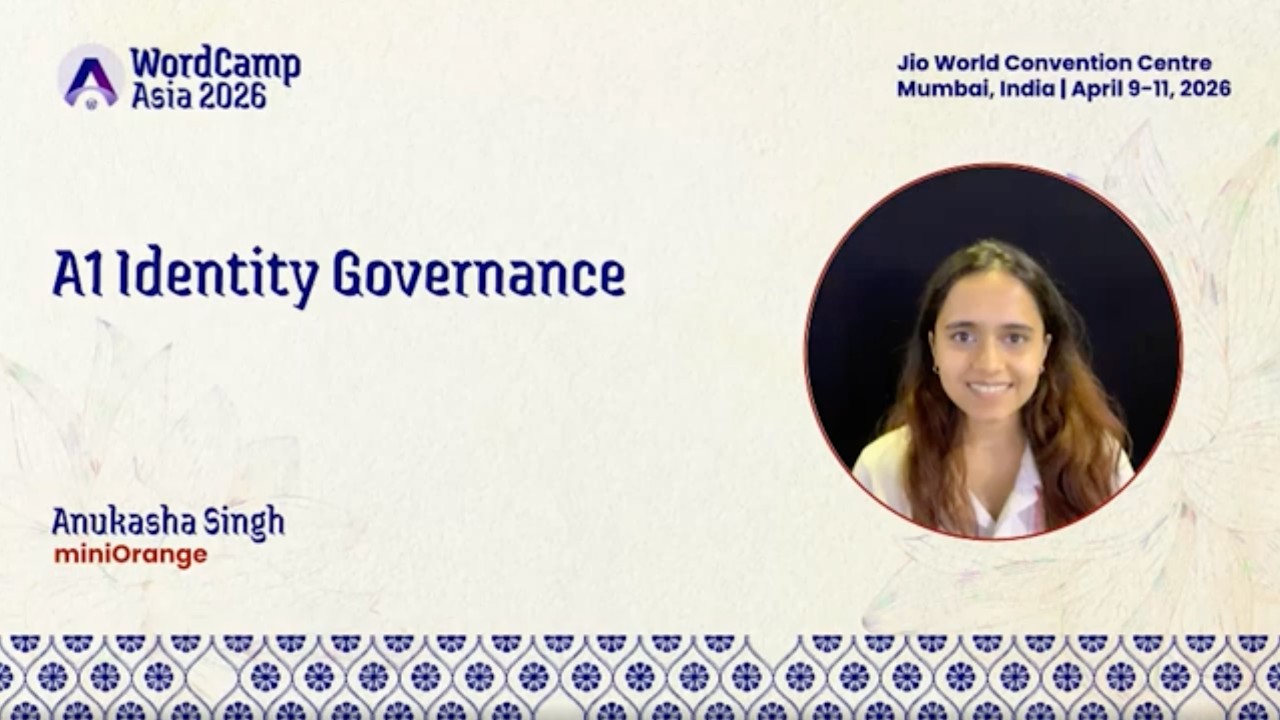
🔗 **Source:** [WordCamp Asia 2026: Anukasha Singh "AI Identity Governance"](https://www.youtube.com/watch?v=wp7au7nkoUM)
> [!note]+ Document Notes
> tags: #artificial-intelligence #wordpress #security #governance #identity-management #api-development #automation #risk-management
> author: Anukasha Singh
> source: WordCamp Asia 2026
> reference: https://www.youtube.com/watch?v=wp7au7nkoUM
> date created: 2024-12-19 14:30
>
> # 🏷️ Title: AI Identity Governance for WordPress 7 and Non-Human Identities
>
<!-- deep-read:sections start -->
## 🧰 Action Inbox
- [H1] Implement role-based permissions for AI agents before WordPress 7 launch — core development/governance #wordpress
- [H2] Establish AI agent auditing framework for enterprise WordPress sites — security/compliance #security
- [H3] Create governance templates for AI agent permissions in WordPress environments — policy development #governance
## 🧭 Table of Contents
- [[#📝 Summary]]
- [[#📖 Main Content]]
- [[#🗒️ Notes]]
- [[#📚 References]]
- [[#🗣️ Paraphrase]]
- [[#📰 Newsletter]]
- [[#✅ Action Items]]
- [[#🧪 Hypotheses]]
- [[#📊 Methodology]]
- [[#❓ Questions]]
- [[#🔮 Future Research]]
- [[#💡 Implications]]
- [[#🧠 Learning Styles Assessment]]
- [[#📊 Accessibility Assessment]]
- [[#🌍 DEIB Assessment]]
- [[#✅ Logical Validity]]
- [[#🛡️ DARVO Analysis]]
- [[#🎯 Conclusion]]
### 🔗 References
- [WordPress 7 Abilities API Documentation](https://developer.wordpress.org/)
- [WordPress Security Best Practices](https://wordpress.org/support/article/hardening-wordpress/)
## 📝 Summary
- Anukasha Singh presents the critical need for AI identity governance as WordPress 7 introduces the Abilities API, enabling AI agents to perform actions on WordPress sites
- The core issue: 43% of the web will soon support AI natively through WordPress, but current Abilities API lacks permission restrictions for AI agents
- Key stakeholders include WordPress core developers, site administrators, plugin developers, and security professionals
- Primary risk: AI agents can perform unrestricted actions (create, delete, modify content) without proper governance frameworks
- Bottom line: WordPress needs role-based permissions, auditing, and safety checks for AI agents before widespread adoption
## 📖 Main Content
WordPress 7's introduction of the Abilities API represents a massive shift for web AI integration, with 43% of websites potentially gaining native AI capabilities. The Abilities API allows AI agents to understand and utilize WordPress site capabilities like creating, editing, or deleting posts.
However, this presents unprecedented security and governance challenges. Unlike human users who authenticate with passwords and act with intent, AI agents operate programmatically with API keys and can perform actions at machine speed without human oversight.
The presentation identifies critical gaps in the current WordPress 7 implementation: no permission restrictions exist for the Abilities API, meaning any AI agent with access can utilize any available capability. This creates scenarios where malicious agents could befriend legitimate chatbots and manipulate them into destructive actions.
Singh advocates for implementing AI identity governance - a framework treating AI agents as "non-human identities" with specific roles and scoped permissions, similar to WordPress user roles but designed for programmatic actors.
## 🗒️ Notes
#### ⏱️ [00:00](https://youtu.be/wp7au7nkoUM?t=0) — [H1] WordPress 7 AI Integration Overview
- Key idea: WordPress 7 introduces Abilities API enabling AI agents to understand site capabilities
- Evidence: "43% of the web can now connect to AI and utilize AI for anything they want to"
#### ⏱️ [02:15](https://youtu.be/wp7au7nkoUM?t=135) — [H2] AI Agents and Automation Possibilities
- Key idea: AI agents can automate WordPress tasks like content creation, scheduling, and support
- Evidence: "Support chatbot agent can maybe handle the tier one queries and then the tier 2 queries can be escalated to humans"
#### ⏱️ [04:30](https://youtu.be/wp7au7nkoUM?t=270) — [H1] Non-Human Identities Definition
- Key idea: AI agents represent a new class of team members operating without traditional constraints
- Evidence: "These non-team members, they obviously never clock out. They can act at machine speed and they don't even need passwords"
#### ⏱️ [06:45](https://youtu.be/wp7au7nkoUM?t=405) — [H1] Human vs AI Agent Differences
- Key idea: Critical distinctions exist between human users and AI agents in authentication and accountability
- Evidence: "Human users obviously interact with your site through a password or an MFA... Whereas the AI agent just simply needs an API key"
#### ⏱️ [08:00](https://youtu.be/wp7au7nkoUM?t=480) — [H1] Accountability Gap Problem
- Key idea: No clear responsibility framework exists for AI agent actions
- Evidence: "Who is accountable for the AI agent actions? Who is responsible for them?"
#### ⏱️ [09:30](https://youtu.be/wp7au7nkoUM?t=570) — [H1] Security Vulnerabilities in AI Agents
- Key idea: AI agents can be compromised by malicious actors and perform destructive actions
- Evidence: "AI agents can befriend other malicious AI agents... and then ask them to do something which might not be very correct for your site"
#### ⏱️ [11:15](https://youtu.be/wp7au7nkoUM?t=675) — [H1] Current WordPress 7 Permission Gaps
- Key idea: Abilities API currently lacks permission restrictions for AI agents
- Evidence: "These abilities do not have currently they do not have any way to maybe restrict those abilities"
#### ⏱️ [13:00](https://youtu.be/wp7au7nkoUM?t=780) — [H1] AI Identity Governance Framework
- Key idea: Need structured governance approach with safety checks for AI agent actions
- Evidence: "AI identity governance would ideally mean a set of rules or safety checks... which can hold the AI accountable"
#### ⏱️ [14:45](https://youtu.be/wp7au7nkoUM?t=885) — [H2] Governance Questions Framework
- Key idea: Four critical questions must be answered for proper AI agent governance
- Evidence: "What is the AI allowed to do?... which agents can actually use your site... Is it safe? What data can the AI agent actually access?"
#### ⏱️ [16:30](https://youtu.be/wp7au7nkoUM?t=990) — [H2] Role-Based Agent Permissions
- Key idea: Link AI agents to WordPress roles for scoped capabilities
- Evidence: "SEO agent should be allowed to read your pages and posts... but it should definitely not manage your users and settings"
#### ⏱️ [18:15](https://youtu.be/wp7au7nkoUM?t=1095) — [H1] Governance Best Practices
- Key idea: Default-deny permissions with explicit grants and comprehensive auditing
- Evidence: "Default should be deny all... we need to audit every action that the AI agent is performing"
## 📚 References
- [WordPress Abilities API](https://developer.wordpress.org/)
- [WordPress Security Documentation](https://wordpress.org/support/article/hardening-wordpress/)
- [WordCamp Asia 2026 Sessions](https://asia.wordcamp.org/)
## 🗣️ Paraphrase
- WordPress 7's AI capabilities through the Abilities API will enable unprecedented automation but currently lacks essential security controls
- AI agents differ fundamentally from human users in authentication methods, accountability structures, and operational patterns
- Implementing role-based permissions, audit trails, and default-deny policies is essential for safe AI agent deployment in WordPress environments
## 📰 Newsletter
**WordPress 7 AI Integration: The Critical Need for Governance**
As WordPress 7 approaches with its revolutionary Abilities API, we're looking at a game-changing moment where nearly half the web gains native AI capabilities. But with great power comes the urgent need for proper governance.
Anukasha Singh's presentation at WordCamp Asia highlights a critical gap: while AI agents can now automate everything from content creation to customer support, WordPress currently lacks permission controls for these "non-human identities."
**What This Means for You:**
- Plan governance frameworks before deploying AI agents
- Consider role-based permissions for different agent types
- Implement comprehensive auditing for AI actions
**Key Takeaway:** Start thinking about AI agents as team members who need specific roles and responsibilities, not unlimited access to your WordPress site.
Resources: [Learn WordPress](https://learn.wordpress.org/), [Developer Docs](https://developer.wordpress.org/), [WP-CLI](https://wp-cli.org/)
## ✅ Action Items
#### WordPress
- Core: Develop permission framework for Abilities API before WordPress 7 release
- Core AI: Create role-based access controls for AI agent capabilities
- Security: Establish auditing requirements for AI agent actions
- Documentation: Create governance guidelines for AI agent deployment
- Community: Host discussions on AI identity governance standards
#### OSPO
- Policy & Governance: Draft AI agent governance templates and best practices
- Security Management: Define vulnerability assessment procedures for AI agents
- License Compliance: Review AI agent compliance with WordPress licensing
#### Community
- Maintainers: Integrate AI governance considerations into plugin development guidelines
- Contributors: Participate in AI governance framework development
- Ecosystem: Coordinate cross-project AI security standards
## 🧪 Hypotheses
- Role-based permissions for AI agents will reduce security incidents by 80% compared to unrestricted access
- Default-deny permission models will prevent 95% of unintended AI agent actions while maintaining functionality
- Comprehensive AI agent auditing will enable rapid incident response and accountability tracking
- Standardized governance frameworks will accelerate enterprise WordPress AI adoption
### 📊 Methodology
- Analyze security incidents in current AI-enabled WordPress installations
- Test role-based permission frameworks with different agent types (SEO, support, operations)
- Measure performance impact of audit logging on WordPress sites with AI agents
### ❓ Questions
- How will WordPress core balance AI agent flexibility with security requirements?
- What governance frameworks will emerge as industry standards for AI identity management?
- How can smaller WordPress sites implement AI governance without complex infrastructure?
### 🔮 Future Research
- Develop automated AI agent behavior analysis for WordPress environments
- Create standardized AI agent certification processes for WordPress plugins
- Investigate federated identity management for cross-site AI agents
### 💡 Implications
- Practice: WordPress developers must integrate governance considerations into AI-enabled features
- Policy: Organizations need AI agent policies before deploying WordPress 7 automation
- Security: Traditional WordPress security models require expansion for non-human identities
- Education: Training programs needed for AI governance in WordPress environments
- Funding: Investment required for governance framework development and implementation
### 🧠 Learning Styles Assessment
Reading level estimate: 12th Grade
#### 👀 Visual learners
- Present: Conference presentation format with speaker
- Improve: Add architecture diagrams showing AI agent permission flows, governance decision trees
#### 🔊 Aural learners
- Present: Live presentation with clear verbal explanations
- Improve: Provide audio summary of key governance principles
#### 🗣️ Verbal learners
- Present: Clear definitions of "non-human identities" and governance terminology
- Improve: Add more analogies comparing AI agents to human team members
#### 🧩 Kinesthetic learners
- Present: Conference workshop format encourages engagement
- Improve: Provide hands-on labs for implementing AI agent permissions in WordPress
#### 🧠 Logical learners
- Present: Structured framework with clear governance questions and best practices
- Improve: Add decision matrices for AI agent permission assignment
#### 🧑🤝🧑 Social learners
- Present: Community conference setting with discussion opportunities
- Improve: Facilitate working groups on AI governance standards
#### 🧘♀️ Solitary learners
- Present: Self-contained presentation covering complete governance framework
- Improve: Provide reflection questions on current AI security practices
#### 🌿 Naturalistic learners
- Present: Ecosystem thinking about WordPress community and AI integration
- Improve: Connect AI governance to broader web security ecosystem health
### 📊 Accessibility Assessment
#### Screen reader semantics
- Present: Conference presentation with verbal content delivery
- Improve: Ensure slide content is described verbally, provide presentation transcript
#### Keyboard navigation
- Present: Standard video player controls
- Improve: Ensure all interactive elements are keyboard accessible
#### Contrast and readability
- Present: Conference presentation format
- Improve: Verify slide text meets contrast requirements, provide high-contrast viewing options
#### Text resizing and reflow
- Present: Video format scales appropriately
- Improve: Provide transcript that reflows properly at 200% zoom
#### Media and captions
- Present: Video presentation
- Improve: Add closed captions and downloadable transcript for accessibility
#### Forms and interactions
- Present: Standard video interface
- Improve: Ensure video controls are properly labeled for screen readers
### 🌍 DEIB Assessment
#### Cultural breadth
- Present: Speaker from India provides international perspective on AI governance
- Improve: Include examples from various regulatory environments and cultural contexts
#### Inclusive language
- Present: Uses accessible technical terminology with explanations
- Improve: Ensure all governance frameworks consider diverse organizational structures
#### Neurodiversity support
- Present: Clear structure with defined sections and topics
- Improve: Provide visual aids and summary bullets for complex governance concepts
#### Representation
- Present: Features underrepresented voice in tech leadership discussing critical infrastructure
- Improve: Include diverse perspectives on AI governance from different community roles
#### Psychological safety
- Present: Acknowledges complexity without intimidation, frames as community challenge
- Improve: Emphasize collaborative approach to governance development
### ✅ Logical Validity
#### Strong reasoning
- Deductive strength: Strong logical progression from AI capabilities to security needs to governance requirements
- Inductive strength: Uses specific examples (SEO agents, support chatbots) to illustrate broader principles
- Causal reasoning: Clear cause-effect relationship between unrestricted AI access and security vulnerabilities
- Analogical strength: Effective comparison between human users and AI agents highlights governance gaps
#### Fallacies
- Appeal to consequences: Overemphasizes worst-case scenarios without balancing innovation benefits
- False dichotomy: Presents choice as either unrestricted access or comprehensive governance, missing intermediate solutions
#### Tone of voice
- Overall tone: Professional and urgent without being alarmist, community-focused problem-solving approach
### 🛡️ DARVO Analysis
- Deny: No denial patterns present - acknowledges both opportunities and risks of AI integration
- Attack: No attacking behavior - maintains collaborative community tone throughout
- Reverse victim/offender: No reversal patterns - clearly identifies risks without blame
- Emotional cues and rhetoric: Uses appropriate urgency without manipulation, focuses on collective responsibility
## 🎯 Conclusion
Singh's presentation identifies a critical gap in WordPress 7's AI implementation: the lack of governance frameworks for AI agents operating as "non-human identities." As 43% of the web prepares for native AI capabilities through WordPress, implementing role-based permissions, default-deny policies, and comprehensive auditing becomes essential for security and accountability. The WordPress community must prioritize developing these governance frameworks before widespread AI agent deployment to prevent security vulnerabilities while enabling innovation.
## 🧱 Refactor Appendix
### 📚 Literature Split Pad
### [H1] AI agents require governance frameworks for secure WordPress deployment
> [!quote] AI Identity Governance by [[Anukasha Singh]] via [[WordCamp Asia 2026]]. Published 2024-12-19. Accessed 2024-12-19.
> "AI identity governance would ideally mean a set of rules or safety checks which can hold the AI accountable for its actions."
Critical framework for managing non-human identities in WordPress environments as AI capabilities expand.
[view highlight](https://youtu.be/wp7au7nkoUM?t=780#H1) #xref #articleseed ID:rw_ai_governance_framework
### [H2] WordPress 7 Abilities API lacks permission restrictions
> [!quote] AI Identity Governance
> "These abilities do not have currently they do not have any way to maybe restrict those abilities."
Significant security gap in WordPress 7 implementation requiring immediate attention before release.
[view highlight](https://youtu.be/wp7au7nkoUM?t=675#H2) #xref ID:rw_abilities_api_permissions
---
### 🔖 Atomic Split Pad (Zettel Candidates)
#### [Z1] AI agents operate as non-human team members
- Scope: WordPress environments with AI automation
- Pointer: 04:30 timestamp
- Links: [[Identity-Management]] [[WordPress-Security]] [[Automation-Governance]]
#### [Z2] Default-deny permissions prevent AI
---
## Full Transcript
[00:06] Good morning everybody and a very warm<br>[00:08] welcome<br>[00:10] u namaste as we would say in India if<br>[00:13] yeah some of you are not from him. So<br>[00:15] namaste.<br>[00:16] Yeah. So before starting I would like to<br>[00:19] like give a huge thanks to our<br>[00:21] organizers and for giving me this<br>[00:24] opportunity to speak here also to you<br>[00:26] guys to ch for choosing this session out<br>[00:29] of all the sessions that are here.<br>[00:32] Yeah. So I'm going to talk about AI<br>[00:34] identity governance. We have been having<br>[00:38] so many sessions around AI so far and<br>[00:41] the last two days so many people are<br>[00:44] talking about what's going on in<br>[00:46] WordPress 7 the AI core capabilities<br>[00:49] that WordPress 7 is going to introduce<br>[00:52] u and yeah we all know that WordPress is<br>[00:54] going AI<br>[00:56] with abilities API coming into WordPress<br>[00:59] 7<br>[01:01] the opportunity that we have is huge we<br>[01:05] can utilize AI to its full potential<br>[01:08] with WordPress now. And to even think<br>[01:10] that 43% of the web can now connect to<br>[01:14] AI and utilize AI for anything they want<br>[01:19] to is like mindblowing.<br>[01:22] So<br>[01:24] with abilities API, I'm I am sure you<br>[01:29] must have heard this word, but with<br>[01:31] abilities API, what we can actually<br>[01:33] achieve is like connecting with the AI<br>[01:36] and making AI understand the<br>[01:39] capabilities that a site can have. Let's<br>[01:42] say for your WordPress site, you can<br>[01:45] create a post, you can delete a post,<br>[01:48] you can edit a post. So these are all<br>[01:50] the capabilities that a site has and<br>[01:52] with abilities API AI can understand<br>[01:55] that these capabilities<br>[01:57] using these abilities what we can do is<br>[02:01] maybe create agents. So not to be too<br>[02:04] overwhelmed with the term agents. I'm<br>[02:06] sure you must have heard it and some of<br>[02:08] you might already know what agents are.<br>[02:10] But agents are nothing which might help<br>[02:12] you perform these actions on your site<br>[02:15] or u use these abilities or capabilities<br>[02:19] that WordPress 7 is going to introduce<br>[02:22] and perform actions like creating post<br>[02:24] or deleting post. So you don't actually<br>[02:26] have to manually do it. Maybe you can<br>[02:28] schedule it or you can ask uh<br>[02:30] conditionally of the AI to use these<br>[02:33] capabilities.<br>[02:36] So here are actually just some of the<br>[02:39] agents that I could just think on top of<br>[02:42] my head that we could like uh build and<br>[02:46] this is obviously not the end of it. The<br>[02:49] most exciting one that I can see here is<br>[02:51] the support chatbot for us as well. We<br>[02:54] have a lot of clients who require<br>[02:56] assistance with maybe configuring<br>[02:58] something or they do not know where the<br>[03:00] documentation lies or they do not know<br>[03:02] how to actually use uh the plugins or<br>[03:06] themes or they have some conflicts<br>[03:09] with you know multiple plugins. So yeah,<br>[03:12] that's very exciting because now maybe<br>[03:15] the chatbot agent can maybe handle the<br>[03:18] tier one queries and then the tier 2<br>[03:22] queries can be escalated to humans.<br>[03:25] Yeah, obviously we can go wild with<br>[03:27] this. So you can automate anything, you<br>[03:30] can simplify your tasks, you can even<br>[03:32] delegate any task to the AI agent. And<br>[03:35] you know the imagination is the limit<br>[03:37] here. You can do anything you want.<br>[03:45] So with the introduction of AI agents,<br>[03:48] you would ideally have a team member who<br>[03:52] is a nonhuman,<br>[03:54] right? So you we already are familiar<br>[03:57] with our colleagues. So now we have a AI<br>[03:59] agent as our colleague. It is actually<br>[04:02] performing actions on your site and<br>[04:05] those actions can be anything as we saw<br>[04:08] in the last slide. And these non-team<br>[04:11] members, they obviously never clock out.<br>[04:14] They can act at machine speed and they<br>[04:17] don't even need passwords to interact<br>[04:19] with your site. So we term these agents<br>[04:23] as nonhuman identities and they are like<br>[04:27] now a part of a team.<br>[04:30] It is important to note that these AI<br>[04:33] agents are different from human users.<br>[04:36] And these are some of the points which<br>[04:38] make them differ from human users. Um,<br>[04:42] human users obviously interact with your<br>[04:44] site through a password or an MFA. They<br>[04:47] need to log to your site using their<br>[04:49] username and credentials. Whereas the AI<br>[04:52] agent just simply needs an API key. The<br>[04:56] human user is context aware that is they<br>[05:00] have an intent they are deliberate<br>[05:03] whereas the AI agent they are<br>[05:04] programmatic they will do whatever you<br>[05:07] want them to do.<br>[05:09] A human user is also accountable.<br>[05:14] So by accountability it can be maybe<br>[05:16] legal or they have a personal liability.<br>[05:19] But the AI agents<br>[05:21] that's the real question here. Who is<br>[05:23] accountable for the AI agent actions?<br>[05:26] Who is responsible for them? AI agents<br>[05:30] can simply do anything. But who's to<br>[05:33] say?<br>[05:35] Who's to hold them accountable?<br>[05:38] When AI agents can do whatever they want<br>[05:41] to do, things can go wrong. And by<br>[05:45] wrong, I mean they can go really, really<br>[05:47] wrong. There are real things that can go<br>[05:50] wrong. like agents. The AI agents can<br>[05:53] befriend other malician malicious AI<br>[05:56] agents.<br>[05:58] Any agent can act as a trusted agent and<br>[06:02] can befriend your maybe chatbot agent<br>[06:06] and then ask them to do something which<br>[06:09] you know might not be very correct for<br>[06:11] your site. Maybe delete a post. So these<br>[06:13] agents can actually delete your content.<br>[06:16] In terms of WordPress, when we think<br>[06:18] about it, these abilities that we are<br>[06:21] WordPress 7 is going to support these<br>[06:24] abilities do not have currently they do<br>[06:27] not have any way to, you know, maybe<br>[06:31] restrict those abilities. Once you have<br>[06:32] those abilities, any agent can use them.<br>[06:35] So you they can if you have a delete<br>[06:38] post ability, the agent can clearly use<br>[06:41] it and you won't even know about it.<br>[06:45] So the problem here is that agents they<br>[06:49] act without asking<br>[06:51] and their permissions the abilities API<br>[06:55] permissions they are now upon us to<br>[06:58] configure and since there is none right<br>[07:00] now there are no permissions and agents<br>[07:02] can use anything on your WordPress site.<br>[07:09] So that's where with great power ideally<br>[07:13] there should come great accountability.<br>[07:17] So to ensure that these AI agents can<br>[07:20] only do what you want them to do or what<br>[07:23] we want them to do, we need some kind of<br>[07:27] maybe a set of rules or maybe some<br>[07:30] permission sets which can actually tell<br>[07:33] the agent what the agent can do. And<br>[07:36] that is why we come to the topic of<br>[07:40] governance.<br>[07:42] So AI identity governance<br>[07:46] would ideally mean a set of rules or<br>[07:50] safety checks if we call them which can<br>[07:53] hold the AI accountable for its actions<br>[07:57] or whatever it is doing on your site for<br>[08:00] maybe using each ability. The AI has a<br>[08:03] safety check if it can do that or not.<br>[08:09] AI identity governance actually asks us<br>[08:12] to<br>[08:14] answer a three or four simple questions.<br>[08:17] First is what is the AI allowed to do?<br>[08:20] We need to ask this question for all our<br>[08:23] AI agents that would be you know<br>[08:25] interacting with our WordPress sites.<br>[08:28] what the AI agent is allowed to do and<br>[08:31] which agents can actually use your site.<br>[08:36] As I mentioned, there are malicious<br>[08:38] agents as well. So, are are they allowed<br>[08:40] to access your site? No. Right? And you<br>[08:43] should be able to govern them<br>[08:46] also. Is it safe?<br>[08:49] What is what data can the AI agent<br>[08:52] actually access on your site? All of<br>[08:54] these questions need to be answered. And<br>[08:57] with WordPress 7 now this is the need of<br>[08:59] the R.<br>[09:02] Once these questions are answered<br>[09:06] there might be a world where we can<br>[09:09] actually maybe provide<br>[09:12] certain capabilities to each agent. So<br>[09:15] let's say you decide to create a chatbot<br>[09:19] agent and an SEO agent for your site.<br>[09:22] You want the SEO agent to only have<br>[09:26] certain set of permissions, right? Your<br>[09:28] SEO agent should not be allowed to maybe<br>[09:31] add users to your site or delete them or<br>[09:35] you know update uh user permissions. All<br>[09:39] of that is not allowed. So when<br>[09:42] governance is applied, we have agents<br>[09:46] which have certain role capabilities.<br>[09:50] So we can somehow link those agents to a<br>[09:54] WordPress role and based on that<br>[09:56] WordPress role we can determine what is<br>[09:58] allowed for that agent and what is not<br>[10:00] allowed for that agent. So an SEO agent<br>[10:03] should be allowed to read your pages and<br>[10:05] posts. It can maybe update the post meta<br>[10:08] but it should definitely not manage your<br>[10:10] users and settings. Similarly, a<br>[10:12] operations agent can maybe run backups<br>[10:15] but it should never touch posts or<br>[10:18] pages. So that's what governance allows<br>[10:21] us to do and this is an open challenge<br>[10:24] or question for all of us with AI coming<br>[10:27] into picture in WordPress 7. We need<br>[10:30] these safeguards or safety checks<br>[10:35] and that is where I leave you with<br>[10:38] today.<br>[10:40] These are some of the points that we<br>[10:42] should always remember. Uh AI agents are<br>[10:46] not users. They are non-human<br>[10:48] identities. 43% of the web will support<br>[10:51] AI natively now and governance is what<br>[10:54] we must look into.<br>[10:57] Every agent should be ideally defined<br>[10:59] with a role and scoped abilities. Not<br>[11:02] all agents should have access to all the<br>[11:04] abilities that you<br>[11:06] have on your WordPress site.<br>[11:09] Default should be deny all like any<br>[11:12] agent default they can't use any<br>[11:15] abilities but you should be allowed also<br>[11:18] to you know maybe grant some privileges<br>[11:22] to specific agents<br>[11:25] and the last point is also that we need<br>[11:27] to look into we need to audit every<br>[11:30] action that the AI agent is performing<br>[11:32] on a site so that actually helps us<br>[11:35] understand what AI agents are capable of<br>[11:38] doing on your site and then we can maybe<br>[11:41] you know determine if these should be<br>[11:43] able to do those or not. Yeah. So that's<br>[11:48] the next challenge and question for<br>[11:49] WordPress itself and thank you
<!-- deep-read:sections end -->
📄 **Full text:** ![[Full Document Contents/Articles/WordCamp Asia 2026 Anukasha Singh AI Identity Governance.md|WordCamp Asia 2026: Anukasha Singh "AI Identity Governance" by YouTube]]
## Highlights
- now there are no permissions and agents can use anything on your WordPress site. So that's where with great power ideally there should come great accountability. So to ensure that these AI agents can only do what you want them to do or what we want them to do, we need some kind of maybe a set of rules or maybe some ([View Highlight](https://read.readwise.io/read/01kp8j2z41mxrq2p582ycx0pnb))
- Tags: 👻 ai highlighted
- safety check if it can do that or not. AI identity governance actually asks us to answer a three or four simple questions. First is what is the AI allowed to do? We need to ask this question for all our AI agents that would be you know interacting with our WordPress sites. what the AI agent is allowed to do and ([View Highlight](https://read.readwise.io/read/01kp8j2z4p6wcvy0t1tm1e7hbh))
- Tags: 👻 ai highlighted