WordCamp Asia 2026: James LePage "WordPress and AI"
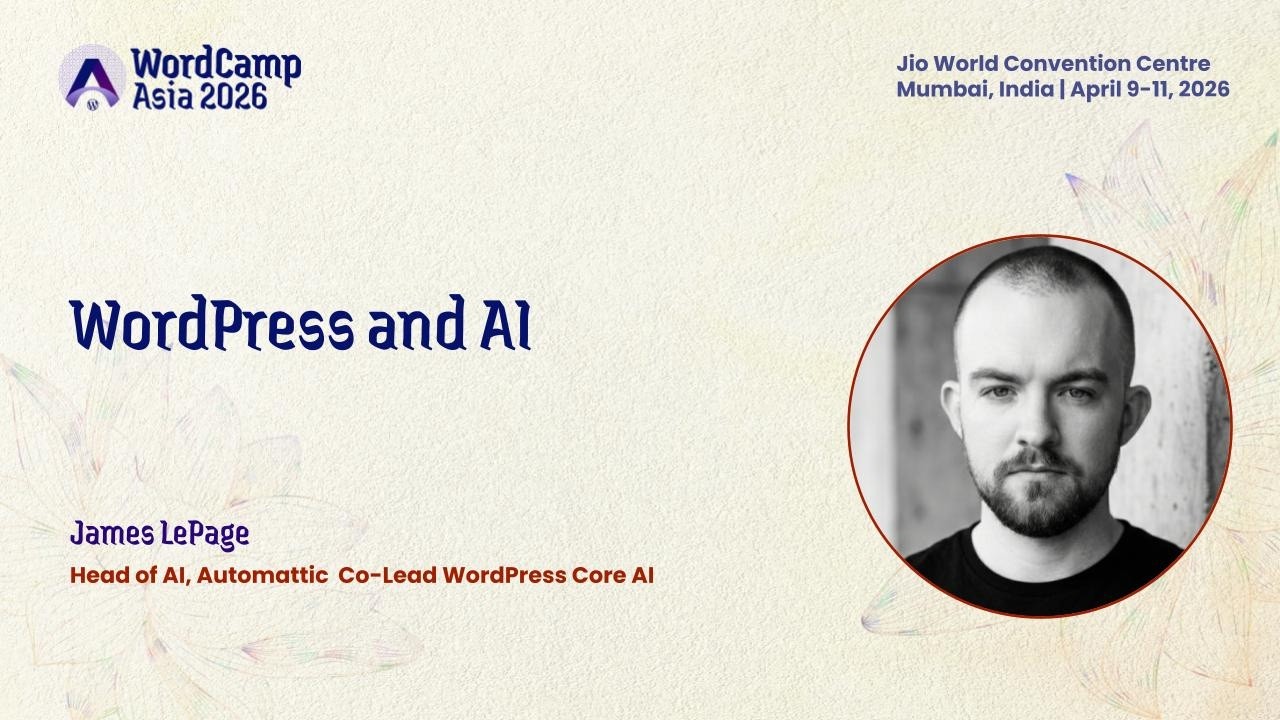
🔗 **Source:** [WordCamp Asia 2026: James LePage "WordPress and AI](https://www.youtube.com/watch?v=-mFbUueL0NE)
> [!note]+ Document Notes
> tags: #wordpress #artificial-intelligence #content-management #web-evolution #open-protocols
> author: James LePage
> source: WordCamp Asia 2026
> reference: https://www.youtube.com/watch?v=-mFbUueL0NE
> date created: 2024-12-19 10:30
>
> # 🏷️ Title: WordPress and AI: Building the Open Agentic Web
>
<!-- deep-read:sections start -->
## 🧰 Action Inbox
- [H1] Test WordPress 7.0 beta with AI building blocks — available now #wordpress #ai
- [H2] Install and explore the AI plugin for WordPress — core canonical plugin #development
- [H3] Implement MCP adapter to expose WordPress capabilities — enables agent interaction #integration
## 🧭 Table of Contents
- [[#📝 Summary]]
- [[#📖 Main Content]]
- [[#🗒️ Notes]]
- [[#📚 References]]
- [[#🗣️ Paraphrase]]
- [[#📰 Newsletter]]
- [[#✅ Action Items]]
- [[#🧪 Hypotheses]]
- [[#📊 Methodology]]
- [[#❓ Questions]]
- [[#🔮 Future Research]]
- [[#💡 Implications]]
- [[#🧠 Learning Styles Assessment]]
- [[#📊 Accessibility Assessment]]
- [[#🌍 DEIB Assessment]]
- [[#✅ Logical Validity]]
- [[#🛡️ DARVO Analysis]]
- [[#🎯 Conclusion]]
### 🔗 References
- [WordPress AI Documentation](https://make.wordpress.org/ai)
- [Model Context Protocol](https://modelcontextprotocol.io)
## 📝 Summary
- WordPress is evolving from a CMS to an agentic platform with four core AI building blocks shipping in version 7.0
- The web's consumption model is shifting from humans directly reading content to AI agents synthesizing and acting on information
- WordPress's 43% market share positions it uniquely to shape whether the AI-enabled internet remains open or becomes a closed walled garden
- Core AI team has built infrastructure (Abilities API, WP AI Client, MCP Adapter, AI Plugin) to enable native AI integration while maintaining open web principles
- The future "agentic web" will feature agent-to-agent communication where websites have AI delegates representing their owners
## 📖 Main Content
James LePage, WordPress Core AI co-lead and Head of AI at Automattic, presents a comprehensive vision for WordPress's role in the AI-enabled internet. He argues that while AI is changing how content is consumed (from direct human reading to AI synthesis), the underlying web structure remains the same beautiful interconnected graph of human knowledge and creativity.
The presentation centers on WordPress 7.0's four AI building blocks: the Abilities API (allowing sites to publish machine-readable capability lists), the WP AI Client (universal AI provider interface), the MCP Adapter (enabling external agent access), and the AI Plugin (tying everything together). These components transform WordPress from a traditional CMS into an "agentic platform" where AI agents can operate alongside humans using the same permissions and governance structures.
LePage envisions a future where websites have AI "delegates" that represent their owners in agent-to-agent interactions, maintaining the open web's decentralized nature while enabling sophisticated AI capabilities. This contrasts with closed proprietary systems that would create walled gardens.
## 🗒️ Notes
#### ⏱️ [00:00](https://youtu.be/-mFbUueL0NE?t=0) — [H1] Introduction and speaker background
- Key idea: James LePage introduces himself as WordPress Core AI co-lead presenting from Charlotte, NC
- Evidence: "I'm the core AI co-lead for the WordPress project. I'm also the head of AI at Automatic"
#### ⏱️ [03:45](https://youtu.be/-mFbUueL0NE?t=225) — [H2] The web as a living graph of entities
- Key idea: The internet is a beautiful interconnected graph of websites representing human knowledge and creativity
- Evidence: "The web isn't just a collection of pages, but instead it's a living graph of entities... shaped and crafted by people and humans"
#### ⏱️ [06:30](https://youtu.be/-mFbUueL0NE?t=390) — [H1] Shifting consumption models from human to AI
- Key idea: AI is fundamentally changing how content is discovered, read, and acted upon online
- Evidence: "Yesterday, a human would visit a site... Today now we see AI beginning to sit between the human and the web"
#### ⏱️ [09:15](https://youtu.be/-mFbUueL0NE?t=555) — [H2] The emergence of autonomous AI agents
- Key idea: Future agents will traverse the web independently to achieve user goals without direct human intervention
- Evidence: "The user begins to delegate goals to an agent... that agent begins traversing this open web"
#### ⏱️ [11:00](https://youtu.be/-mFbUueL0NE?t=660) — [H1] Content is king in the AI era
- Key idea: AI makes human-created content more valuable, not less, because models need fresh information
- Evidence: "Content in this AI era that we find ourselves hurtling towards still is king... humans are still reporting the news"
#### ⏱️ [15:30](https://youtu.be/-mFbUueL0NE?t=930) — [H2] Open vs closed AI future frameworks
- Key idea: The internet's future depends on whether AI development follows open protocols or proprietary closed systems
- Evidence: "Open versus closed when it comes to this AI enabled internet... open protocols... versus proprietary layers"
#### ⏱️ [18:45](https://youtu.be/-mFbUueL0NE?t=1125) — [H1] WordPress's strategic positioning with 43% market share
- Key idea: WordPress controls nearly half the web, giving it unique power to shape AI's impact on the internet
- Evidence: "43% of the web running on WordPress... The largest open-source publishing platform on the planet"
#### ⏱️ [22:00](https://youtu.be/-mFbUueL0NE?t=1320) — [H1] WordPress 7.0's four AI building blocks overview
- Key idea: WordPress ships with complete AI infrastructure enabling native agent integration
- Evidence: "AI building blocks for WordPress... gets delivered in its entirety with WordPress 7.0"
#### ⏱️ [24:15](https://youtu.be/-mFbUueL0NE?t=1455) — [H2] Abilities API - machine-readable capabilities
- Key idea: Websites can publish standardized lists of their functions for AI consumption
- Evidence: "The abilities API allows you to tell any AI what your website is capable of... machine readable list of everything it can do"
#### ⏱️ [26:30](https://youtu.be/-mFbUueL0NE?t=1590) — [H2] WP AI Client - universal provider interface
- Key idea: WordPress can connect to any AI provider without vendor lock-in
- Evidence: "WP AI client now allows WordPress to interact with any AI provider... swappable and pluggable"
#### ⏱️ [28:45](https://youtu.be/-mFbUueL0NE?t=1725) — [H2] MCP Adapter - external agent access
- Key idea: Model Context Protocol enables outside agents to interact with WordPress capabilities
- Evidence: "MCP adapter... allows third party clients to talk to software... meet users where they want to use AI"
#### ⏱️ [32:00](https://youtu.be/-mFbUueL0NE?t=1920) — [H3] Ecosystem adoption of AI building blocks
- Key idea: WordPress community is rapidly building on the new AI infrastructure
- Evidence: "Across the ecosystem, we're seeing the adoption of these building blocks really, really rapidly"
#### ⏱️ [35:30](https://youtu.be/-mFbUueL0NE?t=2130) — [H1] WordPress evolution to agentic platform
- Key idea: WordPress transforms from CMS to platform where AI agents operate with same permissions as humans
- Evidence: "We start moving from a CMS to an agentic platform... agents can operate on directly"
#### ⏱️ [39:45](https://youtu.be/-mFbUueL0NE?t=2385) — [H2] Collaborative editing with humans and agents
- Key idea: WordPress 7.0's collaborative editing feature enables humans and AI to work together in real-time
- Evidence: "Some of those collaborators aren't going to be human... agents can now work alongside you in the editor"
#### ⏱️ [43:00](https://youtu.be/-mFbUueL0NE?t=2580) — [H1] The agentic web and changing representation
- Key idea: Agent-to-agent communication will require websites to have AI delegates representing their owners
- Evidence: "Maybe with all these agents interacting with my site, I want an agent on my site to represent me to them"
#### ⏱️ [47:15](https://youtu.be/-mFbUueL0NE?t=2835) — [H1] Democratizing digital representation
- Key idea: WordPress must make AI representation accessible to all, not just those with technical resources
- Evidence: "WordPress made it possible for anybody to publish on the web... The same thing needs to happen for digital representation"
## 📚 References
- [WordPress AI Building Blocks Documentation](https://make.wordpress.org/ai)
- [Model Context Protocol (Linux Foundation)](https://modelcontextprotocol.io)
- [WordPress 7.0 Beta Testing](https://wordpress.org/download/beta/)
- [WordPress AI Plugin](https://wordpress.org/plugins/ai/)
## 🗣️ Paraphrase
- WordPress is positioning itself as the foundation for an open AI-enabled internet by building native agent capabilities into its core platform
- The shift from human-direct to AI-mediated content consumption requires new infrastructure for websites to communicate their capabilities to autonomous agents
- WordPress's massive market share gives it unique responsibility and opportunity to ensure the AI-powered web remains decentralized rather than controlled by proprietary platforms
## 📰 Newsletter
**WordPress Becomes AI-Ready with 7.0 Building Blocks**
WordPress 7.0 ships with game-changing AI infrastructure that transforms every WordPress site into an "agentic platform." The four core building blocks—Abilities API, WP AI Client, MCP Adapter, and AI Plugin—enable your sites to communicate directly with AI agents while maintaining full control and openness.
This isn't just about adding chatbots to your site. It's about preparing for a future where AI agents traverse the web on behalf of users, making decisions and taking actions. With WordPress powering 43% of the internet, these capabilities could determine whether the AI-enabled web remains open and decentralized.
**Try it now:** Install the WordPress 7.0 beta or experiment in WP Playground to see how AI agents can interact with your content and capabilities.
Resources: [Learn WordPress](https://learn.wordpress.org/), [AI Documentation](https://make.wordpress.org/ai), [MCP Protocol](https://modelcontextprotocol.io)
## ✅ Action Items
#### WordPress
- Core AI: Finalize WordPress 7.0 AI building blocks release and documentation
- Core: Integrate collaborative editing with agent workflows and permissions
- AI Plugin: Expand capabilities and improve developer experience
- Documentation: Create comprehensive guides for implementing AI building blocks
- Community: Evangelize open AI protocols vs proprietary alternatives
#### The WPCC
- Programs: Fund AI accessibility research and implementation grants
- Projects: Support community plugins adopting AI building blocks
- Funding: Sponsor open AI protocol development and standards work
#### OSPO
- Policy & Governance: Develop guidelines for ethical AI agent interaction
- Community Engagement: Participate in Model Context Protocol development
- Strategic Alignment: Align AI capabilities with open web principles
#### DevRel
- Developer advocacy: Create tutorials and demos for AI building blocks
- Education: Design workshops on agentic platform development
- Developer experience: Improve AI APIs and debugging tools
- Community management: Facilitate discussions on AI ethics and implementation
## 🧪 Hypotheses
- WordPress sites implementing AI building blocks will see increased engagement from AI agents and improved discoverability
- The Model Context Protocol will become a standard for website-agent communication across the broader web
- Sites with AI delegates will maintain better representation in agent-mediated interactions than passive sites
- Open AI protocols will outcompete closed proprietary systems when implemented at WordPress's scale
### 📊 Methodology
- Survey WordPress users adopting AI building blocks for measurable engagement metrics
- Track MCP adoption rates across different website platforms and CMSes
- A/B test sites with and without AI delegates for representation quality in agent interactions
### ❓ Questions
- How will WordPress ensure AI building blocks remain accessible to non-technical users and small site owners?
- What governance mechanisms will prevent malicious agents from abusing WordPress's open AI protocols?
- How will the economics of AI agent interactions affect traditional web monetization models?
### 🔮 Future Research
- Develop standards for agent-to-agent negotiation protocols beyond basic capability discovery
- Investigate privacy-preserving methods for AI agents to interact with sensitive site data
- Explore federated learning approaches for WordPress sites to collaboratively improve AI capabilities
### 💡 Implications
- Practice: WordPress developers need to learn AI building blocks APIs and agent interaction patterns
- Policy: Web standards bodies must consider AI agent access in future protocol development
- Security: New attack vectors emerge from AI agents with website interaction capabilities
- Education: WordPress training must incorporate AI platform concepts alongside traditional CMS skills
- Funding: Hosting providers should budget for AI compute resources as table stakes
### 🧠 Learning Styles Assessment
Reading level estimate: Grade 12
#### 👀 Visual learners
- Present: Web graph visualization, building blocks diagrams
- Improve: Agent interaction flowcharts, architecture diagrams, API relationship maps
#### 🔊 Aural learners
- Present: Video presentation with clear narration
- Improve: Podcast version, audio summaries of technical concepts
#### 🗣️ Verbal learners
- Present: Clear definitions of agents, MCP, abilities API
- Improve: Analogies comparing agent interactions to human behaviors
#### 🧩 Kinesthetic learners
- Present: QR codes for immediate exploration, beta testing encouragement
- Improve: Step-by-step implementation guides, sandbox environments
#### 🧠 Logical learners
- Present: Building blocks hierarchy, systematic API progression
- Improve: Decision trees for AI implementation, performance metrics
#### 🧑🤝🧑 Social learners
- Present: Community adoption examples, collaborative editing features
- Improve: Discussion forums for AI implementation, peer review processes
#### 🧘♀️ Solitary learners
- Present: Blog references for self-study, technical documentation links
- Improve: Self-assessment checklists, independent project templates
#### 🌿 Naturalistic learners
- Present: Web ecosystem metaphors, organic growth analogies
- Improve: Environmental impact considerations, sustainable AI practices
### 📊 Accessibility Assessment
#### Screen reader semantics
- Present: Clear heading structure, descriptive slide content
- Improve: Alt text for technical diagrams, ARIA labels for complex charts
#### Keyboard navigation
- Present: Standard video player controls
- Improve: Keyboard shortcuts for slide navigation, focus management
#### Contrast and readability
- Present: High contrast slides, large text
- Improve: Color-blind friendly palette, text alternatives to color coding
#### Text resizing and reflow
- Present: Scalable slide content
- Improve: Responsive layout testing, mobile accessibility
#### Media and captions
- Present: Full transcript provided
- Improve: Synchronized captions, audio descriptions for visual elements
#### Standards reference
- Meets WCAG 2.2 AA for text contrast and keyboard accessibility
### 🌍 DEIB Assessment
#### Cultural breadth
- Present: Global WordPress community context, international WordCamp setting
- Improve: Examples from diverse geographic regions, localization considerations
#### Inclusive language
- Present: Clear technical terms, defined jargon
- Improve: Plain language alternatives, cultural context awareness
#### Neurodiversity support
- Present: Structured presentation, clear sections
- Improve: Summary slides, reduced cognitive load techniques
#### Representation
- Present: Focus on democratizing technology access
- Improve: Diverse use case examples, varying technical skill levels
#### Psychological safety
- Present: Encouraging experimentation, acknowledging limitations
- Improve: Explicit welcome for questions, mistake normalization
### ✅ Logical Validity
#### Strong reasoning
- Deductive strength: Clear progression from web structure to AI requirements to WordPress solutions
- Inductive strength: Multiple examples supporting WordPress ecosystem adoption claims
- Causal reasoning: Well-established link between market share and influence on web standards
- Analogical strength: Effective comparison of current
---
## Full Transcript
[00:05] Hello, Word Camp. How are y'all? Thank<br>[00:08] you so much for having me. I really<br>[00:10] appreciate it and I'm excited to jump<br>[00:12] into this presentation on AI and<br>[00:14] WordPress. I'm also super bummed I can't<br>[00:17] be there in person. I was planning on<br>[00:19] it. I have some family stuff. So, I'm<br>[00:20] giving you this presentation live and<br>[00:22] direct from Charlotte, North Carolina in<br>[00:24] the United States. I'm drinking coffee.<br>[00:26] It's the middle of the night. It's early<br>[00:28] for y'all. Everybody's drinking coffee.<br>[00:30] My goal today is to talk about AI and<br>[00:33] WordPress and speak towards the things<br>[00:36] that have happened in the project and<br>[00:38] what we're building and what we're<br>[00:39] doing, what's coming in the near future,<br>[00:42] but also zoom out a little bit and think<br>[00:44] about the position and place that<br>[00:46] WordPress plays in this internet in this<br>[00:49] AI era. So, it's an interesting<br>[00:52] presentation. It's one where it's kind<br>[00:54] of taken a life of its own as I've put<br>[00:56] it together. So, I'm really excited to<br>[00:58] present to y'all. Hopefully, there will<br>[01:00] be time for questions at the end. I<br>[01:02] think one of my favorite things about<br>[01:03] Word Camps and something that I'm<br>[01:05] definitely already feeling the FOMO<br>[01:07] looking at the video feeds is that in<br>[01:10] person question answer time, the ideas<br>[01:13] shared, the code looked at. Um, so while<br>[01:17] I won't have that opportunity in person<br>[01:19] myself, uh, there are many folks from<br>[01:21] the core AI f focuses and functions here<br>[01:25] and I really invite you to use the<br>[01:27] in-person time to the best of your<br>[01:29] advantage. So the obligatory slide, who<br>[01:32] I am, my name is James Leage. Um, I<br>[01:35] actually had a way better introduction<br>[01:38] from uh, our opening presenters than I<br>[01:41] even think I can give myself. So thank<br>[01:43] you for that. That's awesome. But my<br>[01:45] name is James Leage. I'm the core AI<br>[01:47] co-lead for the WordPress project. I'm<br>[01:49] also the head of AI at Automatic. Um, to<br>[01:53] quickly restate my background, I got my<br>[01:54] start in WordPress building websites as<br>[01:57] a freelancer, eventually grew into<br>[01:59] running an agency, sold the agency, ran<br>[02:03] a startup in fintech for a little bit,<br>[02:05] and then founded a company called WP<br>[02:07] Aai. And WP AAI, as the name suggests,<br>[02:11] did AI for WordPress. Um, some of y'all<br>[02:14] may remember the CodeWP and the AgentWP<br>[02:17] products. I really love those near and<br>[02:20] dear to my heart. Uh, we were acquired<br>[02:22] into Automatic and this is where I find<br>[02:25] myself. You can find me online at j.cv.<br>[02:28] That's my personal blog. Uh, I have a<br>[02:31] lot of writing on this blog that cover a<br>[02:33] lot of the topics that we'll speak about<br>[02:35] today. You can also find me on X or<br>[02:38] Twitter and LinkedIn at JamesW leage.<br>[02:41] So, that's who I am. And before we<br>[02:44] really get into the WordPress stuff,<br>[02:45] before we get into the AI stuff, I I<br>[02:47] want to take a step back and take a look<br>[02:49] at what WordPress actually works within,<br>[02:52] what it occupies, which is the web. And<br>[02:55] to me, the web isn't just a collection<br>[02:58] of pages, but instead it's a living<br>[03:00] graph of entities. And it's really<br>[03:03] beautiful. This collection of entities,<br>[03:06] these individual websites represent<br>[03:08] people and businesses and places and<br>[03:10] concepts and ideas. And each of these is<br>[03:14] connected through links. They have<br>[03:16] citations. They have content that's<br>[03:18] similar to other websites. They have<br>[03:19] trust signals. So we have this beautiful<br>[03:22] internet of interconnected pieces of the<br>[03:26] web. These individual sites typically<br>[03:28] contain content that's been shaped and<br>[03:30] crafted by people and humans behind it.<br>[03:33] And it forms a genuinely beautiful<br>[03:36] collection of human knowledge, of human<br>[03:39] ideas, ingenuity. This is a visual<br>[03:42] representation of that actual graph of<br>[03:44] the web. And if you look it up, I I<br>[03:46] actually forget what the study is, but<br>[03:48] you you can get to these images and you<br>[03:50] can see the evolution of the web over<br>[03:52] time and the growth and the scaling of<br>[03:55] these really really incredibly connected<br>[03:59] nodes. Each little dot in this<br>[04:01] representation being a website. Websites<br>[04:03] connected through the links through the<br>[04:05] semantic similarity. Each color in this<br>[04:09] graph representing a specific category<br>[04:11] of site. This is what the internet is.<br>[04:14] And again to me it's a beautiful<br>[04:16] representation of people and humanity<br>[04:19] all pushing their hearts and their souls<br>[04:21] and their ideas into a digital space.<br>[04:25] And this structure of the web, this<br>[04:27] interconnected collection of entities<br>[04:29] has been very stable for 30 plus years.<br>[04:33] And what's changing right now because of<br>[04:35] this AI stuff isn't that structure, but<br>[04:38] instead it's everything else. It's<br>[04:40] everything around that structure. And<br>[04:42] one of the big changes that I'm seeing<br>[04:43] today is the shifting consumption model.<br>[04:47] Now we have AI consuming content. AI<br>[04:50] didn't exist in the way that it does<br>[04:52] even 3, four years ago. users are<br>[04:54] reading less. Publishers are changing<br>[04:57] the way they're capturing value. And<br>[04:59] when I say consumption model, it maybe<br>[05:01] sounds like a a big scary concept, but<br>[05:04] it's really just the discovery and the<br>[05:06] reading and the understanding and the<br>[05:08] traversing of the web and the content<br>[05:11] within. And that consumption model is<br>[05:13] changing because of AI. So yesterday,<br>[05:16] and I say this in absolute terms, but<br>[05:18] it's not absolute. This is still<br>[05:19] happening. I still do this all the time<br>[05:21] today. Yesterday, a human would visit a<br>[05:24] site. They'd go and read the content.<br>[05:25] They'd click the links. They'd go<br>[05:27] through the rabbit holes. They'd get<br>[05:28] distracted by an Amazon product and then<br>[05:31] buy it as I did today. Uh, and we go and<br>[05:34] synthesize the answer or we go and take<br>[05:36] the action or we go and achieve the goal<br>[05:39] uh on our own accord. And this has been<br>[05:42] really the way the web has worked for a<br>[05:43] long time. We search on Google, we end<br>[05:46] up on the site. We see the URL on the<br>[05:48] billboard, we end up on the site. We<br>[05:49] click through, we come to our own<br>[05:51] conclusions. And today now we see AI<br>[05:54] beginning to sit between the human and<br>[05:56] the web. And we see this with many of<br>[05:58] these AI tools. We see this also with<br>[06:00] the traditional ways we've interacted<br>[06:02] with the internet. Google introducing AI<br>[06:05] overviews. Something that synthesizes<br>[06:08] answers from dozens or hundreds of<br>[06:10] sources to give you a quick tidbit of<br>[06:13] information that may answer your<br>[06:15] question, may help you achieve your goal<br>[06:17] a bit quicker. a chat GBT pulling web<br>[06:21] searches down to site sources to give<br>[06:23] you answers or research reports or<br>[06:25] recommendations. But right now, the user<br>[06:28] is still deciding. They're still acting.<br>[06:30] They're the ones being given this<br>[06:33] synthesis of that web. Tomorrow, things<br>[06:37] change even more. The user begins to<br>[06:39] delegate goals to an agent. And that<br>[06:42] agent instead of the person begins<br>[06:44] traversing this open web, walking<br>[06:46] through those connected lines on the<br>[06:48] entities, comparing and acting, creating<br>[06:51] a recommendation, fulfilling an action.<br>[06:54] And the user chooses to be a part of the<br>[06:56] outcome, but maybe they don't need to<br>[06:58] be. And I think it's also worth defining<br>[07:00] what an actual agent is. An agent to me<br>[07:03] is something that is an AI based system<br>[07:06] that uses LLMs that has agency. Agency<br>[07:10] meaning they can go and do things<br>[07:12] themselves. They get the goal, they have<br>[07:14] a collection of tools, they walk through<br>[07:16] the internet to go and achieve that<br>[07:18] outcome. And this all represents that<br>[07:21] shifting changing consumption model. Now<br>[07:24] instead of taking half a day to do<br>[07:26] research on one specific thing, I can go<br>[07:29] spin up multiple agents. I can use<br>[07:31] OpenClaw. I can use cloud code. I can<br>[07:33] use chat GBT to go and do things for me,<br>[07:37] which means I'm much more enabled, much<br>[07:39] more efficient, and I can do a lot more<br>[07:41] at once. It's a very interesting shift.<br>[07:45] And that shift points to a term that has<br>[07:48] probably been mentioned at word camps<br>[07:50] time and time again. Content is king.<br>[07:53] And content in this AI era that we find<br>[07:55] ourselves hurtling towards still is<br>[07:58] king. Content is king again. And the<br>[08:01] reason is AI needs content to run well.<br>[08:04] The models are already trained. They<br>[08:07] already exist. But what they need is<br>[08:09] information about the world, deep<br>[08:11] expertise on specific topics, creation<br>[08:14] and novel outcomes that these models<br>[08:17] can't do. So right now, humans are still<br>[08:20] reporting the news. We don't have flying<br>[08:21] robots from OpenAI going and<br>[08:23] interviewing us as to how great Word<br>[08:26] Camp Asia really is this year. The<br>[08:28] humans are saying it's great this year.<br>[08:31] The people are writing the posts. We're<br>[08:33] creating the things that are making AI<br>[08:36] useful. Which means that to me, AI,<br>[08:40] generative AI, LLMs, agents, they're not<br>[08:44] going to replace the open web if we have<br>[08:46] anything to say about it. But instead,<br>[08:48] it makes this open web, this beautiful<br>[08:50] graph that I showed you on slide four,<br>[08:53] way more valuable. the people on the<br>[08:55] platforms that are creating and creating<br>[08:58] and publishing. This is going to matter<br>[09:00] a lot more in this AI mediated internet,<br>[09:03] not less. And to me, the act of writing<br>[09:06] and publishing on a personal level is<br>[09:09] more important now than it's been in<br>[09:10] years. As soon as I saw how the internet<br>[09:13] was evolving, these answers, these<br>[09:15] retrieval systems, these chat bots that<br>[09:18] would draw on sources, I began blogging<br>[09:21] a lot more about me, myself, my<br>[09:23] businesses because I knew that I wanted<br>[09:25] to control my representation, control<br>[09:27] the way I was positioned and placed on<br>[09:30] the internet. This has always been<br>[09:32] something, but it's much more important<br>[09:35] in this AI enabled era.<br>[09:38] But the way the publisher captures value<br>[09:41] is shifting. That content model is<br>[09:43] shifting and it's impacting the economic<br>[09:46] model that publishers big and small, me<br>[09:49] on my blog, huge media conglomerates,<br>[09:51] enterprises, e-commerce stores, commerce<br>[09:55] stores. It's changing the way we capture<br>[09:58] value. Now AI is synthesizing the<br>[10:01] content without always sending visitors<br>[10:03] to the source. And we're seeing<br>[10:04] responses already on the open internet<br>[10:07] like RSL, really simple licensing, a<br>[10:09] standard to monetize and protect<br>[10:12] content. We're seeing Cloudflare block<br>[10:13] AI crawlers by default. That model is<br>[10:16] changing.<br>[10:18] And it poses an interesting question to<br>[10:20] me. Who shapes how the content is<br>[10:23] accessed and how it's synthesized and<br>[10:25] how it's represented in this era that we<br>[10:28] find ourselves rapidly pointing towards?<br>[10:31] And if we want to go higher level, a big<br>[10:34] question becomes, what does this future<br>[10:36] look like? Is this future open or is the<br>[10:38] future closed? And I'm sure this is<br>[10:40] another question that we've also asked<br>[10:42] at camps time and time again. To me,<br>[10:46] open versus closed when it comes to this<br>[10:48] AI enabled internet, this AI era is an<br>[10:52] interesting question. The closed<br>[10:54] approach means that we have proprietary<br>[10:56] layers. They all work together. Content<br>[10:58] becomes material for interfaces. It's a<br>[11:00] walled garden. It's a garden. It's very<br>[11:03] pretty, but you're within it. You don't<br>[11:05] have an understanding as to how it<br>[11:08] works. And the agents that operate<br>[11:10] within these systems, these closed<br>[11:11] systems, don't publish their protocols.<br>[11:14] They don't publish the way they work. We<br>[11:16] don't really understand how to best<br>[11:18] interact with them. And that closed<br>[11:20] walled garden is something I would like<br>[11:22] to avoid in this AI internet. But I<br>[11:26] think it's also something that we've<br>[11:27] always wanted to at least have an answer<br>[11:29] to, which is a big reason why I love<br>[11:32] WordPress in general. And that open<br>[11:34] future, that open approach brings the<br>[11:38] source code to light. It has open<br>[11:40] protocols. It has open data. Your site<br>[11:43] can expose what it is and what it does<br>[11:45] through these standards like MCP. And<br>[11:47] I'll talk a lot more about that<br>[11:48] momentarily. You can choose your AI<br>[11:51] models. You can have your infrastructure<br>[11:52] and the web that beautiful graph<br>[11:55] representation of the web remains this<br>[11:57] decentralized network where you're<br>[11:59] maintaining the control on how you're<br>[12:01] represented. You're owning your content.<br>[12:04] You're being able to move it around. You<br>[12:06] have the benefit that WordPress offers.<br>[12:09] And this isn't something that's<br>[12:10] theoretical. This is something that's<br>[12:12] happening right now. And I absolutely<br>[12:14] see it as an individual working on my<br>[12:17] own personal blog walking through the<br>[12:19] internet. But I definitely see this in<br>[12:21] automatic and in the statistics on our<br>[12:24] users and in the way the internet itself<br>[12:26] is shaping up in the steering groups and<br>[12:28] the committees and all of the different<br>[12:31] things going on online today. This stuff<br>[12:34] is happening now and the outcome of this<br>[12:37] closed verse open how this internet<br>[12:39] actually looks in five years. It really<br>[12:41] to me depends on what gets built and<br>[12:44] who's actually building it. And that's<br>[12:46] when we get to our favorite number. And<br>[12:48] I know this number shifts and changes a<br>[12:50] little bit. This is actually my favorite<br>[12:51] number. So 43% of the web running on<br>[12:54] WordPress.<br>[12:56] That means that WordPress plays a very<br>[12:58] important role in what this future<br>[13:00] internet looks like. The largest<br>[13:04] open-source publishing platform on the<br>[13:07] planet. And I'll actually put a a cross<br>[13:08] through a strike through and just say<br>[13:10] the largest publishing platform on the<br>[13:12] planet. And this is the largest<br>[13:14] publishing platform that has two<br>[13:16] interesting things. especially in this<br>[13:19] AI era, distribution and content. And<br>[13:22] this is really important for WordPress,<br>[13:24] but this is important really for any<br>[13:25] product, any piece of software now that<br>[13:28] these generative AI LLM based things are<br>[13:32] walking around. Distribution is really<br>[13:35] hard to do. Having placement across the<br>[13:38] entirety of the internet is very<br>[13:40] difficult. new things pop up<br>[13:42] consistently, but they don't have the<br>[13:44] positioning that WordPress has, and they<br>[13:47] also don't have the content. WordPress<br>[13:49] is by definition a content management<br>[13:51] system. It's something that manages the<br>[13:53] stuff that a language model must<br>[13:56] interact with to be powerful. So these<br>[13:59] are two assets that we have as the<br>[14:00] WordPress project. And the third is that<br>[14:03] we have always been the open web's<br>[14:05] foundation. And now this role is more<br>[14:08] and more important.<br>[14:11] And so this was something that I think<br>[14:13] the WordPress project itself began to<br>[14:16] understand as we began to understand<br>[14:19] what LLMs were and how they would work<br>[14:21] and how they would interface with the<br>[14:24] software and what the limitations were<br>[14:26] and what we would expect things to<br>[14:27] happen, how we would expect things to<br>[14:29] shape up in the future. And the project<br>[14:32] was deeply tracking LLMs basically since<br>[14:35] they came out. And we watched and we<br>[14:38] waited for the maturity of an LLM, the<br>[14:40] maturity of the AI industry itself and<br>[14:43] then began building. We started building<br>[14:46] for this interesting change in the<br>[14:49] consumption models, this interesting<br>[14:50] change in the way we interact with<br>[14:52] software. And the first thing we started<br>[14:55] doing on the AI side of things,<br>[14:57] something that gets delivered in its<br>[14:58] entirety with WordPress 7.0, we call AI<br>[15:02] building blocks for WordPress. and<br>[15:04] you'll see a couple QR codes in the<br>[15:06] lower corner of the screen. These are<br>[15:08] things you can scan to get a lot more<br>[15:10] information about it. I wanted to do<br>[15:12] this presentation in a way where we<br>[15:14] spoke about these core foundational<br>[15:16] pieces, but also spoke about the impact<br>[15:19] that they have now that they really do<br>[15:20] exist in WordPress. If you've seen State<br>[15:23] of the Word, if you've seen some of the<br>[15:24] previous Word Camp US presentations, we<br>[15:27] go into a lot more detail about these<br>[15:29] building blocks. But if you scan that QR<br>[15:31] code, it will give you a really good<br>[15:33] overview of these blocks. You can also<br>[15:36] keep up to date with all of the AI stuff<br>[15:38] at make.wordpress.org/ai.<br>[15:41] And so these are the building blocks<br>[15:43] that we need to create to bring AI to<br>[15:46] WordPress. And now today with the<br>[15:49] WordPress 7.0 beta with the upcoming<br>[15:52] release and in WordPress 6.9, WordPress<br>[15:55] can do three things that it couldn't do<br>[15:57] before. The first thing, the first<br>[16:00] building block for AI, we call the<br>[16:02] abilities API. And this is in WordPress<br>[16:05] right now as of 6.9. The abilities API<br>[16:08] allows you to tell any AI what your<br>[16:11] website is capable of. Your site can<br>[16:14] publish a machine readable list of<br>[16:15] everything it can do. And that machine<br>[16:18] readable list says if you give me this<br>[16:20] in, I'll go do this out. And by the way,<br>[16:22] here are my permissions and here's<br>[16:25] exactly how I work. So an ability could<br>[16:28] look like updating content, managing<br>[16:30] users, interlinking pages. And when<br>[16:33] presented as a total list of what the<br>[16:36] website can do to AI, that AI can use it<br>[16:39] to interact with software. You can think<br>[16:42] of this as a tool set and your website<br>[16:45] itself being a toolbox.<br>[16:47] Abilities are really fun to me because<br>[16:49] you can also add additional abilities<br>[16:52] with the installation of WordPress<br>[16:54] plugins. Maybe I have a great learning<br>[16:56] management plugin and it has a lot of<br>[16:58] capabilities that I want AI to be able<br>[17:00] to interact with. If that learning<br>[17:02] management plug-in bundles abilities and<br>[17:04] I have an agent that uses these<br>[17:06] abilities or these individual tools, you<br>[17:08] could almost imagine the installation of<br>[17:11] this plugin on my WordPress website<br>[17:13] dumping seven new tools into that<br>[17:16] toolbox that now AI can use. And I have<br>[17:18] to mention also abilities is a very cool<br>[17:21] API. Even if AI didn't exist, it would<br>[17:24] be really fun. But to me, I'm a bit<br>[17:25] biased and a bit focused on AI. So<br>[17:28] abilities API for AI is extremely<br>[17:30] powerful and it's that kind of<br>[17:32] cornerstone thing that you need to bring<br>[17:34] AI to WordPress. The second thing is<br>[17:37] common core as of WordPress 7.0<br>[17:40] something that exists something that's<br>[17:41] being tested and has been tested for<br>[17:43] some time. But the WPAI client now<br>[17:46] allows WordPress to interact with any AI<br>[17:49] provider. A provider is a company like<br>[17:52] OpenAI or Google and they give access to<br>[17:56] state-of-the-art AI models. These models<br>[17:59] you can prompt to go do things. These<br>[18:02] models you can give access to tools.<br>[18:04] Tools being abilities in the context of<br>[18:06] WordPress. And this is something that is<br>[18:09] swappable and pluggable. It's a<br>[18:11] universal way to interact with AI. It<br>[18:13] doesn't lock you into a provider. And<br>[18:15] you can choose, hey, I want to use a<br>[18:17] model from my desktop, locally hosted,<br>[18:19] completely private. Or you can say, I<br>[18:21] want to use the best and greatest model<br>[18:22] from Google.<br>[18:24] You can choose anything you want, which<br>[18:27] I think is the biggest point of this WP<br>[18:30] AI client. And what's interesting when<br>[18:32] you take these two things together, the<br>[18:34] abilities API and the WPAI client, you<br>[18:37] end up with a toolkit to build native<br>[18:40] first class endtoend agents and AI<br>[18:43] features into WordPress as a developer.<br>[18:46] And now that things like Cloud Code<br>[18:49] exist and now that these projects are<br>[18:51] extremely well documented, you can kind<br>[18:53] of try your hand even if you don't<br>[18:55] consider yourself a developer. And<br>[18:57] that's really exciting and interesting<br>[18:59] to me. The third building block is<br>[19:01] almost more important than the first<br>[19:03] two, but it's actually dependent on the<br>[19:05] first two. So I put it third. This third<br>[19:08] building block is the MCP adapter. And<br>[19:11] first I'll mention the concept of<br>[19:12] adapter. So we have a list of abilities<br>[19:15] of what can happen on a WordPress site.<br>[19:18] These abilities can be used by AI and<br>[19:20] people alike, but AI to go do something<br>[19:22] on WordPress. But this is within<br>[19:25] WordPress. Outside of WordPress, we have<br>[19:27] a bunch of clients, things like chat<br>[19:30] GBT, Claude Code. These clients need to<br>[19:33] interface with the tools that software<br>[19:36] has to offer. And the way they interface<br>[19:38] in a primary function is MCP. MCP is<br>[19:42] model context protocol. It's an open<br>[19:44] protocol. It's now under the Linux<br>[19:47] Foundation, which is really exciting.<br>[19:49] And it allows third party clients to<br>[19:52] talk to software. So it allows us to say<br>[19:54] we have agents that can be built within<br>[19:57] WordPress, but we can also make<br>[19:58] WordPress extremely accessible to agents<br>[20:01] outside of it. We can meet users where<br>[20:04] they want to use AI. And this third<br>[20:07] building block gives that holistic<br>[20:09] coverage of AI within WordPress, AI on<br>[20:12] the front end, AI on the back end, AI<br>[20:14] everywhere.<br>[20:16] These blocks make WordPress enabled for<br>[20:19] an agentic era. Without them, we<br>[20:21] couldn't build for AI. With them, we<br>[20:24] can. And all of them ship with WordPress<br>[20:26] 7.0. All of them are open source. All of<br>[20:29] them are readily available. They're also<br>[20:31] not forced. You can opt in, you can opt<br>[20:33] out, but they're available regardless of<br>[20:36] your host, regardless of your provider<br>[20:38] or your budget. And this to me is<br>[20:40] extremely exciting because now with<br>[20:42] WordPress 7.0, we have a CMS that is<br>[20:45] ready for what the future of the<br>[20:47] internet is. And if you if you skin<br>[20:51] scanned the first QR code and are<br>[20:53] reading this building blocks article,<br>[20:55] you'll be like, James, hey, where's the<br>[20:56] fourth? This is the fourth. The fourth<br>[20:59] building block is the AI plug-in for<br>[21:01] WordPress. This is something that ties<br>[21:03] all three of the other blocks together<br>[21:05] and says, here's what they can actually<br>[21:08] do. here are the capabilities that we<br>[21:10] can offer you as a user of WordPress, as<br>[21:12] somebody who wants to generate images,<br>[21:15] get editor assistance, generate content,<br>[21:18] all built on these cornerstone building<br>[21:20] blocks. So, it's a great reference to<br>[21:22] the code and how everything works, but<br>[21:24] it's also just like awesome to install<br>[21:26] on your WordPress website and get AI<br>[21:29] features. So, this is a plugin that is a<br>[21:32] core canonical plugin, an official<br>[21:34] plugin of the project, and it's<br>[21:36] available for everybody, and it's an<br>[21:38] awesome project. It's consistently like<br>[21:40] every week releasing new versions. I<br>[21:42] think I went on my email maybe like 10<br>[21:45] minutes before this, and I saw that<br>[21:46] there's a 0.7.0 release out or coming<br>[21:49] out. So, consistently improving every<br>[21:52] day. And for the developers, now that<br>[21:55] these things exist within WordPress 7.0,<br>[21:58] know you can use these APIs directly.<br>[22:00] You can register abilities in your<br>[22:02] plugins or for your clients. You can<br>[22:04] query AI through the WPAI client. You<br>[22:07] can expose all of this to third party<br>[22:09] agents through MCP. And you begin<br>[22:12] building your WordPress websites, the<br>[22:14] existing stuff that you maintain<br>[22:16] yourself or you maintain for your<br>[22:17] clients or your people<br>[22:19] towards this agentic era. you begin<br>[22:22] truly enabling your people or yourself<br>[22:25] to be a player in this world. And across<br>[22:29] the ecosystem, we're seeing the adoption<br>[22:31] of these building blocks really, really<br>[22:34] rapidly. So, I put this slide together<br>[22:36] and I wanted to find some logos. So, I<br>[22:38] started doing research and I already<br>[22:41] know of ACF. I think that was a really<br>[22:43] fun announcement where they announced<br>[22:45] that they support abilities and<br>[22:46] Elementor doing really fun stuff with AI<br>[22:48] and WS form using all three of the<br>[22:50] blocks. But I also started finding<br>[22:53] community contributed provider plugins<br>[22:55] that work with that WP AI client and<br>[22:57] allow me to query things from Mistl<br>[23:02] openish<br>[23:04] AI provider in Europe, open router Olama<br>[23:08] and the list kept growing and growing<br>[23:10] and growing and growing. So, it's not<br>[23:11] just core, it's everywhere in WordPress<br>[23:14] that's now using these blocks because<br>[23:15] they're mature and available. And as I<br>[23:18] put this slide together, I decided to<br>[23:20] write a blog post. So, my blog j.cv/blog<br>[23:24] has a post that says the AI ecosystem or<br>[23:27] the ecosystem around AI and WordPress or<br>[23:29] something like this. And that post got<br>[23:31] so long and so overwhelming and had<br>[23:33] hundreds of links. It just got me so<br>[23:35] excited to see the actual use of these<br>[23:38] building blocks in the real world.<br>[23:40] Something where people are really<br>[23:42] deriving value and building really<br>[23:45] impressive things. This stuff is<br>[23:46] shipping now and it's consistently<br>[23:48] covered in TechCrunch and Endgadget and<br>[23:50] CMS Wire. We have real products both<br>[23:54] within the WordPress project itself, but<br>[23:56] almost more exciting within the<br>[23:58] community. We have real users using<br>[24:00] these things and legitimate capabilities<br>[24:03] being built into WordPress as we speak.<br>[24:06] Even in the contributor day yesterday, I<br>[24:08] saw some really fun stuff shaping up in<br>[24:10] core AI. And this starts us down the<br>[24:13] path, the path to the future. We start<br>[24:16] moving from a CMS to an agentic<br>[24:19] platform. And this is something that's<br>[24:21] more personal to me as opposed to AI is<br>[24:24] decreeing that this is becoming a gentic<br>[24:26] platform. But it's something where when<br>[24:28] we manage content and we place AI around<br>[24:31] it or near it, we're able to build<br>[24:34] towards a future-facing agentic<br>[24:36] platform. So WordPress isn't becoming<br>[24:39] this AI powered CMS. It's not becoming<br>[24:41] something that is sparkle buttons<br>[24:43] everywhere and AI everywhere and 14<br>[24:46] little clippies trying to joust for your<br>[24:48] attention. But it is becoming a platform<br>[24:51] that agents can operate on directly.<br>[24:54] They can access it through MCP. They can<br>[24:56] access it through the REST API through<br>[24:58] the WP CLI by directly using abilities<br>[25:00] both server side and client side. And<br>[25:04] this platform is the same old WordPress<br>[25:06] that we know and love. It has the same<br>[25:09] permissions baked in the capabilities,<br>[25:11] the user roles. It has the same<br>[25:12] governance as the project. It's open. We<br>[25:15] can see all of the code. There's no back<br>[25:17] doors. the automation and the agents<br>[25:20] respects the same rules holistically as<br>[25:23] people have for 20 years with WordPress.<br>[25:26] And this becomes the only agentic<br>[25:28] platform that has that deep distribution<br>[25:30] that 43% of the internet that's already<br>[25:33] that cornerstone which means it opens a<br>[25:36] door to a really exciting future for<br>[25:38] WordPress and AI.<br>[25:41] And I want to take a step back before I<br>[25:43] talk about that future because there's a<br>[25:45] lot more in WordPress and WordPress 7.0.<br>[25:48] than AI. And obviously I will talk about<br>[25:50] AI, but I do want to shout out one of<br>[25:52] the other flagship cornerstone features<br>[25:55] of this impending release, collaborative<br>[25:58] editing. This is something that's really<br>[25:59] exciting to me. I'm sure there's going<br>[26:01] to be a lot of demonstrations and<br>[26:03] chatter and discussion around it during<br>[26:05] the Word Camp Asia inerson sessions. But<br>[26:09] collaborative editing to me is really<br>[26:11] interesting because it was designed kind<br>[26:13] of before we saw all of this AI stuff<br>[26:16] shape up. It was designed for humans to<br>[26:18] work together in a document. And it's<br>[26:20] really fun. It's really awesome to play<br>[26:22] with and explore with people that you<br>[26:24] work with, but also yourself. I had like<br>[26:26] 18 different windows open and I was<br>[26:29] bouncing between all of them. It was<br>[26:31] awesome. You have your blocks that sync.<br>[26:33] You have your paragraphs that sync. It's<br>[26:35] really impressive. But now with AI, some<br>[26:38] of those collaborators aren't going to<br>[26:40] be human. And what's interesting to me<br>[26:42] is that we can use the same<br>[26:44] infrastructure that we've built for<br>[26:46] people for agents. We have the same<br>[26:48] permissions. The agents can now work<br>[26:50] alongside you in the editor. We have<br>[26:52] content guidelines that can steer them.<br>[26:54] We have abilities that can be chained<br>[26:56] together into workflows. And all of this<br>[26:58] to say, we're building these building<br>[27:00] blocks for WordPress. They're shipping<br>[27:02] into WordPress 7.0. There are additional<br>[27:05] features in WordPress 7.0. There's more<br>[27:07] work to do in AI with the AI plug-in,<br>[27:10] but there's also more work to do in<br>[27:12] general. As the WordPress platform moves<br>[27:15] into this agentic era, we have options<br>[27:18] to go and explore and build and continue<br>[27:20] to push the future of what this platform<br>[27:23] truly can be and truly can do. So, to<br>[27:25] me, one of those options is<br>[27:26] collaborative editing. Collaborative<br>[27:28] editing with both people and agents. But<br>[27:30] that's just one example of many exciting<br>[27:34] future states of WordPress.<br>[27:36] And that future state starts pointing<br>[27:39] towards the future state of the web<br>[27:41] which I am calling the agentic web. And<br>[27:43] you'll see the agentic web mentioned in<br>[27:46] many marketing documents all over the<br>[27:48] place. I keep seeing it pop up. But to<br>[27:50] me the agentic web is simply the<br>[27:52] internet that exists that beautiful<br>[27:53] graph with a new player on the board.<br>[27:56] Instead of only people now we have<br>[27:58] agents. Those agents being these LLM<br>[28:00] derived systems that have agency that<br>[28:02] can do things for you. we start moving<br>[28:06] from questions to goals and we start<br>[28:08] moving from synthesis to action. That<br>[28:09] changing consumption model that I spoke<br>[28:12] about. But the agents that are changing<br>[28:14] this consumption model are already using<br>[28:17] the same infrastructure that the web has<br>[28:18] that the web shifts with that the web<br>[28:20] has had for 30 years. We're not<br>[28:22] rearchitecting the internet in service<br>[28:24] of these agents. These things operate<br>[28:27] browsers. And a great example of these<br>[28:29] things operating browsers is uh claude<br>[28:32] in chrome the chatgbt computer use the<br>[28:36] perplexity computer they click they use<br>[28:40] the area labels they use the internet<br>[28:42] that already exists on the other hand<br>[28:44] other agents are accessing websites or<br>[28:47] these entities on that beautiful graph<br>[28:49] programmatically and they're accessing<br>[28:51] this through MCP which we talked about<br>[28:53] as a core building block but they're<br>[28:55] also accessing this through traditional<br>[28:57] means of software interaction and we're<br>[29:00] seeing a resurgence of CLI commands for<br>[29:02] local agents to use and the WP CLI being<br>[29:05] perfectly positioned for agents to<br>[29:07] interact with. We're seeing the REST API<br>[29:10] and application passwords get used more<br>[29:12] and more and more. I'm also seeing a new<br>[29:15] generation of browsers, specifically one<br>[29:17] coming from Google, but I see a few of<br>[29:19] these where they actually consume<br>[29:21] content from the site and they create<br>[29:23] ondemand interfaces, but it's all using<br>[29:25] the same stuff. It's all using the same<br>[29:27] web that's always existed. But that also<br>[29:30] means representation begins to shift.<br>[29:33] Representation, the reason why I even<br>[29:36] started blogging. The reason reason why<br>[29:38] I started increasing my outcome output<br>[29:40] of blogging. When a human visits your<br>[29:43] site, you control the experience. If you<br>[29:45] go to my blog, you'll see an about me<br>[29:48] that I've crafted very specifically to<br>[29:50] explain what I do and who I am. You'll<br>[29:52] see my personal experience, my<br>[29:54] professional experience. the albums that<br>[29:56] I like listening to. You'll get a sense<br>[29:58] for who I am because I've designed my<br>[30:01] site. I have set the layout, the flow,<br>[30:04] the messaging, the way the pages link<br>[30:06] together. So, I control that experience<br>[30:08] and everybody controls their own<br>[30:10] experience on the web. Today, I think<br>[30:12] we're back. I think this presentation<br>[30:14] was so good that my agent sabotaged me<br>[30:18] because I was going to share all of its<br>[30:20] secrets. So, we'll jump right back into<br>[30:23] where we left off. Actually, we'll go<br>[30:25] back one more slide. So, to me, when an<br>[30:29] agent visits your site, the experience<br>[30:31] that you've crafted yourself, you've put<br>[30:34] together this beautiful flow of<br>[30:36] information, you've created images, that<br>[30:39] experience begins to change. The agent<br>[30:42] interacts with your content differently.<br>[30:44] And that introduces an interesting<br>[30:46] concept to me, which is maybe with all<br>[30:49] these agents interacting with my site, I<br>[30:52] want an agent on my site to represent me<br>[30:55] to them.<br>[30:57] And this is a concept that I've been<br>[30:59] calling the site delegate. This is<br>[31:00] something that I've blogged about a lot,<br>[31:02] which is a site delegate. A delegate<br>[31:06] being something that represents you,<br>[31:08] something that understands your content<br>[31:09] and your capabilities and who you are<br>[31:11] and what your personality is. This is<br>[31:14] something that can start interacting<br>[31:15] with these visiting agents on your<br>[31:17] behalf. And instead of these visiting<br>[31:19] agents simply getting the content and<br>[31:21] leaving the site, they begin to interact<br>[31:25] to ask questions to go deeper. And your<br>[31:28] delegate begins to answer these things<br>[31:30] to negotiate on your behalf. So the web<br>[31:33] begins to evolve from a collection of<br>[31:35] documents to a network of interacting<br>[31:38] agents. That visiting agent represents<br>[31:40] the user and the site agent represents<br>[31:43] the entity and they communicate, they<br>[31:45] exchange information, they come to<br>[31:47] outcomes and you have more control over<br>[31:49] how you're represented in this agentic<br>[31:52] internet. And because it's all WordPress<br>[31:54] and because these four building blocks<br>[31:56] that I tuned back into and heard y'all<br>[31:59] winning on that quiz, all of those<br>[32:01] building blocks result in this being a<br>[32:05] possibility, this being open content<br>[32:09] that you own protocols that we all know<br>[32:12] and love like MCP existing under the<br>[32:15] Linux Foundation, agent to agent as an<br>[32:18] open standard. Nobody's locked into the<br>[32:20] ecosystem. Everybody's able to control<br>[32:22] their representation and we still<br>[32:25] maintain that beautiful decentralized<br>[32:27] web of information.<br>[32:29] And to me, I call this democratizing<br>[32:32] representation. I see this as almost the<br>[32:35] fourth step of WordPress. What needs to<br>[32:37] happen in the future? 20 years ago,<br>[32:40] WordPress made it possible for anybody<br>[32:42] to publish on the web. You didn't need a<br>[32:44] developer. You needed five minutes to<br>[32:45] install the thing and you started<br>[32:47] publishing. uh you had something to say<br>[32:50] and you said it. And if you look at my<br>[32:52] first blog about amateur radios, I was<br>[32:55] saying stuff about amateur radios and it<br>[32:57] was something that I wanted to do. I was<br>[32:59] enabled by WordPress to do that. The<br>[33:02] publishing was democratist.<br>[33:05] But now the same thing needs to happen<br>[33:07] for the digital representation. And I<br>[33:09] think that this has always been the case<br>[33:11] on the web. What's the best way to<br>[33:12] represent yourself? in a pre-AII era has<br>[33:15] been creating beautiful pages, working<br>[33:18] through the content flows, ensuring that<br>[33:20] you understand how a user walks through<br>[33:23] your site. But now with agents entering<br>[33:27] the chessboard, being a new player on<br>[33:29] the map, we need to do the same for<br>[33:32] digital representation.<br>[33:34] And without accessible tooling, the<br>[33:36] benefits of this agentic web, which is<br>[33:39] happening, they'll concentrate to those<br>[33:41] who have the resources to build for it.<br>[33:42] they'll end up in those very prettyl<br>[33:44] looking but messy closed walled gardens.<br>[33:49] But WordPress is the solution to this.<br>[33:51] WordPress can change that. We have the<br>[33:54] building blocks. We're building towards<br>[33:56] this interesting future where agents<br>[33:58] interact on the web, where our websites<br>[34:01] have MCP servers, where we have agent to<br>[34:03] agent, where we're able to interact<br>[34:05] locally through the WP CLI. It's all<br>[34:08] there for WordPress to use. So our local<br>[34:12] plumbers, our journalists, our tiny to<br>[34:15] huge WooCommerce stores, the portfolio<br>[34:17] websites, the J.CVS, blogs, everybody<br>[34:21] gets access to the same stuff, the same<br>[34:23] protocols, the same interoperability,<br>[34:27] the ability to look at the actual source<br>[34:29] code itself. They have the ability to<br>[34:31] shape their representation.<br>[34:34] So what you can do today is very, very<br>[34:37] related to those building blocks. You<br>[34:38] can register abilities in your plugins.<br>[34:40] If you're a developer, you can do the<br>[34:42] same if you're an agency. You can expose<br>[34:44] the functionality of your site through<br>[34:46] MCP. You can use MCP plus Claude or<br>[34:50] ChatgBT or Copilot to go and maintain,<br>[34:53] manage, extend, learn more about your<br>[34:54] WordPress sites. Client sites, your<br>[34:57] sites become these programmable<br>[34:59] interfaces. And this is the next era of<br>[35:02] WordPress. This is where everything is<br>[35:04] headed. and you can participate right<br>[35:05] now because it's in WordPress 6.9 and<br>[35:08] it's coming to WordPress 7.0<br>[35:11] for the creators and the publishers.<br>[35:13] Things are shifting, things are<br>[35:14] changing. But I think the best course of<br>[35:17] action is to keep creating, to keep<br>[35:20] presenting who you are and why you do<br>[35:22] it. You being the entity, you being the<br>[35:25] person, but you being the business or<br>[35:27] the e-commerce stop. Structure your<br>[35:30] content intentionally. Make sure that<br>[35:33] you're putting your best foot out there.<br>[35:35] The quality of the representation right<br>[35:37] now and into the future as we move<br>[35:40] towards this agentto agent model that<br>[35:42] may exist really depends on the quality<br>[35:45] of the content. Content is again it<br>[35:47] would kind of come back to the SEO world<br>[35:49] of write good stuff, link that stuff,<br>[35:52] make it well structured, you'll do just<br>[35:54] fine. And for the freelancers and the<br>[35:56] site builders, go and play with 7.0. Go<br>[35:59] and update to, well, I wouldn't<br>[36:01] recommend this on a production site, but<br>[36:03] go and update to WordPress 7.0 when it<br>[36:05] comes out. Go and experiment with the<br>[36:07] beta using WP Playground. You'll see<br>[36:09] that the AI just works. There's API keys<br>[36:13] that get set up in the central<br>[36:15] connectors plugin. If a host sets it up<br>[36:17] for you, it's just there. There's no<br>[36:20] plug-in hunting. And now a website is<br>[36:23] enabled by AI. And for the hosts, go and<br>[36:27] take a look at this WP AI client. You<br>[36:29] have the ability to bundle AI credits<br>[36:31] into your plans because of this unified<br>[36:34] approach. And what that means is if<br>[36:36] every host offered a small amount of<br>[36:38] free AI credits to their users, which is<br>[36:42] extremely possible with this WP AI<br>[36:44] client, everybody who ever uses<br>[36:47] WordPress gets access to AI out of the<br>[36:50] box. And imagine how powerful that could<br>[36:52] be for those creating, for those using<br>[36:54] AI in novel ways through their plugins.<br>[36:57] That would be an incredible world that<br>[36:59] we live and operate in. So right now<br>[37:02] today, you can update to 7.0, the beta.<br>[37:05] You could play around with it in WP<br>[37:07] Playground. You can go to<br>[37:09] makewordpress.orgai<br>[37:10] to understand more about what we're<br>[37:12] actually doing dayto-day in that core AI<br>[37:15] group. You can go to the core AI Slack<br>[37:17] and marvel at the really fun stuff that<br>[37:20] happened yesterday at the contributor's<br>[37:22] day. You can install the AI plugin. You<br>[37:24] can also tear it down and take a look at<br>[37:26] the code because it's a really great<br>[37:27] representation of how these things work<br>[37:29] together. You can point Claude at your<br>[37:32] site and say, "Tell me about myself.<br>[37:34] Help me interlink things. Am I missing<br>[37:36] images? Should I put alt text here? I've<br>[37:39] been using Claude and the MCP stuff.<br>[37:41] It's incredible." And just see what<br>[37:43] happens. Explore. Be in the<br>[37:45] conversation. Be in the arena.<br>[37:47] Understand what this agentic web truly<br>[37:50] could look like because you're actually<br>[37:51] a participant in the early stages of it.<br>[37:55] To me, it's always been empowerment over<br>[37:57] replacement. I want people to be<br>[38:00] empowered to create their best work<br>[38:03] instead of replaced with AI. So, we're<br>[38:05] not adding the sparkle buttons all over<br>[38:07] WordPress. If you want it, there are<br>[38:08] many plugins that will add it. But,<br>[38:10] we're building the tools that make<br>[38:11] everybody more effective at creating.<br>[38:13] And we're building the foundations that<br>[38:14] enable just that.<br>[38:17] The website concept that's not changing.<br>[38:19] The the reason for being digital, the<br>[38:22] reason for being online isn't changing.<br>[38:25] But the people on that board are the<br>[38:27] things on that board are. We now have<br>[38:29] both humans and agents. However, the<br>[38:31] people that build on and for and within<br>[38:34] WordPress, they are more important than<br>[38:36] ever. That open web is worth building<br>[38:39] for. That beautiful graph that I come<br>[38:41] back to is truly beautiful to me and<br>[38:44] WordPress is how we've always built for<br>[38:45] this web. It's our goal and core AI<br>[38:48] absolutely but within WordPress in<br>[38:50] general for this to be the way that we<br>[38:52] do it far into the future as well. So<br>[38:54] let's build that open agendic web. Let's<br>[38:57] do it together. Thank you very much for<br>[39:00] dealing with my interruptions and I<br>[39:03] really appreciate y'all taking the time<br>[39:05] to go and watch this presentation even<br>[39:07] though I was digital. I just want to<br>[39:09] mention that my favorite parts of word<br>[39:11] camps are the hallway tracks. They're<br>[39:13] the things where when I walk off this<br>[39:16] stage, I get stopped by people and have<br>[39:18] these crazy unique conversations and<br>[39:20] these ideas. And as I mentioned in the<br>[39:22] opener, I am bummed out that I can't be<br>[39:25] doing that here. But I do invite you to<br>[39:27] have these conversations. Think about<br>[39:29] what the future of the web looks like.<br>[39:30] Think about how WordPress plays a part<br>[39:32] in it. explore the building blocks, but<br>[39:34] explore the future of the CMS as you<br>[39:37] walk around in person today and tomorrow<br>[39:39] and really enjoy what looks to be a<br>[39:41] great word camp Asia. So, thank you very<br>[39:44] much. You can find me and you can ask me<br>[39:46] these questions at jamesw leage<br>[39:49] specifically on X. Feel free to DM me.<br>[39:51] You can read more about a lot of this<br>[39:53] thinking on j.cv.<br>[39:55] And I don't know if we have time for<br>[39:57] questions, but if we do, I'm happy to<br>[39:58] answer them. If not, enjoy your word<br>[40:01] camp.
<!-- deep-read:sections end -->
📄 **Full text:** ![[Full Document Contents/Articles/WordCamp Asia 2026 James LePage WordPress and AI|WordCamp Asia 2026: James LePage "WordPress and AI", YouTube]]
## Highlights
- lot of writing on this blog that cover a lot of the topics that we'll speak about today. You can also find me on X or Twitter and LinkedIn at JamesW leage. So, that's who I am. And before we really get into the WordPress stuff, before we get into the AI stuff, I I want to take a step back and take a look at what WordPress actually works within, what it occupies, which is the web. And to me, the web isn't just a collection of pages, but instead it's a living ([View Highlight](https://read.readwise.io/read/01knwwcbnq6gdh3sawjge2pz97))
- Tags: 👻 ai highlighted
- WordPress in general. And that open future, that open approach brings the source code to light. It has open protocols. It has open data. Your site can expose what it is and what it does through these standards like MCP. And I'll talk a lot more about that momentarily. You can choose your AI models. You can have your infrastructure and the web that beautiful graph representation of the web remains this decentralized network where you're maintaining the control on how you're ([View Highlight](https://read.readwise.io/read/01knwwcbppnmk967phyc4jbyjx))
- Tags: 👻 ai highlighted
- users, interlinking pages. And when presented as a total list of what the website can do to AI, that AI can use it to interact with software. You can think of this as a tool set and your website itself being a toolbox. Abilities are really fun to me because you can also add additional abilities with the installation of WordPress plugins. Maybe I have a great learning management plugin and it has a lot of capabilities that I want AI to be able ([View Highlight](https://read.readwise.io/read/01knwwcbrb1cbbsdd1k4gxjyxk))
- Tags: 👻 ai highlighted
- outside of it. We can meet users where they want to use AI. And this third building block gives that holistic coverage of AI within WordPress, AI on the front end, AI on the back end, AI everywhere. These blocks make WordPress enabled for an agentic era. Without them, we couldn't build for AI. With them, we can. And all of them ship with WordPress 7.0. All of them are open source. All of them are readily available. They're also ([View Highlight](https://read.readwise.io/read/01knwwcbvysam5a460jv1e9px1))
- Tags: 👻 ai highlighted
- You can register abilities in your plugins or for your clients. You can query AI through the WPAI client. You can expose all of this to third party agents through MCP. And you begin building your WordPress websites, the existing stuff that you maintain yourself or you maintain for your clients or your people towards this agentic era. you begin truly enabling your people or yourself to be a player in this world. And across the ecosystem, we're seeing the adoption ([View Highlight](https://read.readwise.io/read/01knwwcbxkabw6dnstjxyk04qy))
- Tags: 👻 ai highlighted
- these things and legitimate capabilities being built into WordPress as we speak. Even in the contributor day yesterday, I saw some really fun stuff shaping up in core AI. And this starts us down the path, the path to the future. We start moving from a CMS to an agentic platform. And this is something that's more personal to me as opposed to AI is decreeing that this is becoming a gentic platform. But it's something where when we manage content and we place AI around ([View Highlight](https://read.readwise.io/read/01knwwcc2nsnyd67tzyj4mz4zc))
- Tags: 👻 ai highlighted
- it or near it, we're able to build towards a future-facing agentic platform. So WordPress isn't becoming this AI powered CMS. It's not becoming something that is sparkle buttons everywhere and AI everywhere and 14 little clippies trying to joust for your attention. But it is becoming a platform that agents can operate on directly. They can access it through MCP. They can access it through the REST API through the WP CLI by directly using abilities ([View Highlight](https://read.readwise.io/read/01knwwcc7zhvs979qjpewh048w))
- Tags: 👻 ai highlighted
- digital representation. And without accessible tooling, the benefits of this agentic web, which is happening, they'll concentrate to those who have the resources to build for it. they'll end up in those very prettyl looking but messy closed walled gardens. But WordPress is the solution to this. WordPress can change that. We have the building blocks. We're building towards this interesting future where agents interact on the web, where our websites ([View Highlight](https://read.readwise.io/read/01knwwccfs5ggys989f7qhabkq))
- Tags: 👻 ai highlighted