WordPress MCP
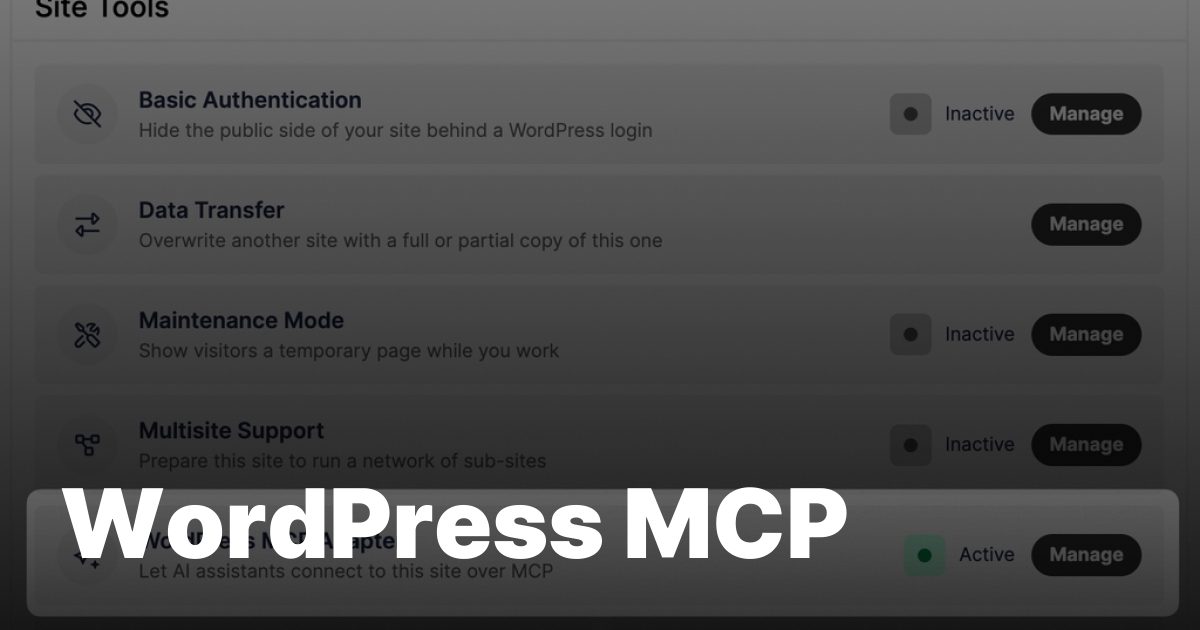
🔗 **Source:** [WordPress MCP](https://chriscoyier.net/2026/10/05/wordpress-mcp/)
> [!note]+ Document Notes
> tags: [wordpress, mcp, ai-agents, pressable, claude-code, content-workflow]
> author: Chris Coyier
> source: chriscoyier.net
> reference: https://chriscoyier.net/2026/10/05/wordpress-mcp/
> date created: 2026-10-05 14:11
>
> > [!info] Generated analysis — not the author's words. Sections below are machine-written
> > from the captured source. Only text inside `> [!quote]` blocks is verbatim from the author.
> > Do not quote or attribute any other line to the named author.
>
> # 🏷️ Title: WordPress MCP
>
<!-- deep-read:sections start -->
## 🧭 Table of contents
- [📝 Summary](#-summary)
- [📖 Main content](#-main-content)
- [🗒️ Notes](#️-notes)
- [📚 References](#-references)
- [🗣️ Paraphrase](#️-paraphrase)
- [📰 Newsletter](#-newsletter)
- [✅ Action items](#-action-items)
- [🧪 Hypotheses](#-hypotheses)
- [📊 Methodology](#-methodology)
- [❓ Questions](#-questions)
- [🔮 Future research](#-future-research)
- [💡 Implications](#-implications)
- [🧠 Learning styles assessment](#-learning-styles-assessment)
- [📊 Accessibility assessment](#-accessibility-assessment)
- [🌍 DEIB assessment](#-deib-assessment)
- [✅ Logical validity](#-logical-validity)
- [🛡️ DARVO analysis](#️-darvo-analysis)
- [🎯 Conclusion](#-conclusion)
- [🔄 Refactor appendix](#-refactor-appendix--wordpress-mcp)
## 📝 Summary
This is a descriptive reading of a short personal blog post. Chris Coyier published "WordPress MCP" on chriscoyier.net on 2026-10-05. The captured text runs 15 paragraphs and 321 words. It is first-person opinion and experience, not reporting or documentation.
- **What happened.** The author says all their WordPress sites are still on Pressable, lists five things they like about the host (¶2-¶6), and highlights a "one-clicker" setting (¶7). With that setting on, the author says they can authenticate an agent such as Claude Code that supports MCPs and connect it (¶8). The author then describes asking the agent to draft a blog post and to review this post for anything odd about elephants (¶9-¶11).
- **The claim.** The author's position is that light, rote automation of blog editing is worth having: Title Case headers, formatting that matches a style guide (¶12). They suggest pairing the connection with a SKILL.md file that holds the style guide and guardrails (¶13). They say they have no interest in automating AI slop writing (¶14).
- **Author's own experience versus general claims.** Nearly every sentence is the author's own experience or preference: "I think they do a good job," "the things I specifically like," "I appreciated," "I think I'm more likely to use this." The only broad statements are the list of what a host should do ("everything you'd expect a WordPress host to do," ¶1) and the framing of the author's own history as "one billion blog posts" (¶15), which reads as hyperbole.
- **Commercial relationship.** The post praises one named host and a feature of that host. The captured text contains no disclosure of a sponsorship, partnership, affiliate link, or free service. The absence of a disclosure in the captured text doesn't show whether a relationship exists. The author's other roles are outside the source and this analysis asserts none. The post does say the author is a Pressable customer in the present tense ("I've still got all my WordPress sites on Pressable").
- **Why it matters.** It is a concrete first-person account of the workflow: toggle a host setting, authenticate an agent, give it a narrow editing job, and constrain it with a skill file.
- **Key stakeholders.** The author, Pressable, Claude Code (named as an example agent), Jetpack and WordPress.com (named as a presumed reason the setup works), and anyone who edits blog posts for a living.
- **Risks and tradeoffs.** The post does not say what the setting does technically, what permissions the agent receives, or how the author limits what the agent can touch beyond the proposed skill rules. The author's own caveat is that the skill would say "only ever touch draft blog posts" (¶13).
- **Bottom line.** A satisfied-customer note that treats agent access as a way to automate small editing chores. It reports one working try (the elephants check, ¶11) and gives no measurements.
## 📖 Main content
**Why the author stays on Pressable (¶1-¶6).** The post opens with the author's current state: every WordPress site is still on Pressable, and the author is happy. The author lists what they specifically like: fast, good customer support that includes free movement of sites; deploying from a GitHub repo as "a first-class citizen"; "perfectly good" DNS management; no need for extra security, performance, or update plugins; and behavior that goes "with-the-grain" of the WordPress ecosystem. All six are the author's judgments, with no numbers (no response times, no prices, no uptime figures).
**The one-click setting (¶7-¶8).** The author singles out "this little one-clicker" under the last point. The captured text ends the sentence with a colon and shows no content after it, so the setting itself, its name, and its location are not in the capture. The next paragraph says that "with that on," and "presumably because I also use Jetpack and thus WordPress.com," the author can authenticate an agent that supports MCPs and connect it. The word "presumably" marks the cause as the author's guess. This analysis does not verify what the setting does technically.
**The workflow as the post gives it (¶8-¶11).** The post describes four steps, listed under Methodology as the author's own sequence. First, the setting is on. Second, the author authenticates an MCP-capable agent such as Claude Code and connects it. Third, the author tells the agent to make a draft blog post about something they're thinking about, so they don't forget it. Fourth, as a joke on being "meta," the author has the agent read this blog post and check that nothing weird is said about elephants. The author reports the agent "easily caught" them (¶11). The post doesn't say what the elephant slip was.
**Where the author expects value (¶12-¶15).** The author expects to use it for "very rote tasks": Title Case headers and formatting that matches a style guide. They propose a SKILL.md file as "home-base" for that style guide, with example rules in quotation marks: only touch draft posts, label code blocks by language, self-host images, and check that links look correct and are valid. The author states a strong preference against AI-written prose ("I friggin' hate AI slop writing") and says the interest is limited to "intelligent automation of certain rote tasks," drawn from long experience authoring and editing posts.
## 🗒️ Notes
#### 📄 ¶1-¶6 Why Pressable
- The author keeps all WordPress sites on Pressable and says "they do a good job" (¶1).
- Five likes follow: support that is fast and includes free site movement (¶2), GitHub deploys (¶3), DNS management (¶4), no extra security, performance, or update plugins (¶5), and fit with the WordPress ecosystem (¶6).
- All six statements are preference or experience. None carries a number or a source.
#### 📄 ¶7-¶8 The one-click setting and agent connection
- ¶7 introduces the "little one-clicker" under the ecosystem-fit point. Nothing follows the colon in the capture.
- ¶8 says that with it on, the author can authenticate an agent like Claude Code that supports MCPs.
- "Presumably because I also use Jetpack and thus WordPress.com" is the author's own hedge, not an established cause.
#### 📄 ¶9-¶11 First uses
- The author can tell the agent to make a draft blog post "so I won't forget about it" (¶9).
- ¶10 has the agent review this very post for weird statements about elephants.
- ¶11: "it easily caught me." One reported success, no detail on what was caught.
#### 📄 ¶12-¶13 Rote tasks and a SKILL.md
- ¶12 expects use on rote tasks: Title Case headers, formatting matched to a style guide.
- ¶13 proposes a SKILL.md as home-base for the style guide, with four sample rules: only touch draft posts, label code blocks, self-host images, check links.
- The "only ever touch draft blog posts" rule is a stated guardrail.
#### 📄 ¶14-¶15 Limits on what to automate
- ¶14 says the author hates AI slop writing and wants no automation around it.
- ¶15 frames the interest as automating rote tasks for someone who has "authored and edited one billion blog posts," which reads as a joke, not a count.
## 📚 References
The link list for this article has 1 entry, and this analysis checked it before making any sourcing statement.
**Article**
- [WordPress MCP](https://chriscoyier.net/2026/10/05/wordpress-mcp/), Chris Coyier, chriscoyier.net, 2026-10-05.
**Linked in the captured markup**
- "Pressable" -> https://pressable.com/. This analysis doesn't describe the linked page. It records only the anchor text and the URL.
**Claims with no link in the captured markup.** The post names Claude Code, Jetpack, WordPress.com, GitHub, MCP, and SKILL.md without links in the list. The one-click setting in ¶7 has no link in the captured markup, and the text after the colon is empty in the capture. The claims about support speed, free site movement, DNS, GitHub deploys, and the lack of extra plugins have no link in the captured markup to the host's documentation or terms.
**Disclosure check.** No sponsorship, affiliate, or partnership statement appears in the captured text. This analysis states only that none appears in the capture. The captured text does not cover the page footer, sidebar, or about page, so it can't speak to disclosures placed there.
## 🗣️ Paraphrase
Chris Coyier says they still host all their WordPress sites on Pressable and like the host: fast support (including free site moves), GitHub deploys, decent DNS, no need for extra security, performance, or update plugins, and a general fit with WordPress. They point to a one-click setting that, once on, lets them authenticate an MCP-capable agent such as Claude Code and connect it to the site. They guess it works because they also use Jetpack and WordPress.com.
Coyier gives two examples. They can tell the agent to draft a post so an idea doesn't get lost, and they had it read this very post to check for odd statements about elephants, which it caught. They expect most use to be rote editing, such as Title Case headers and style-guide formatting, guided by a SKILL.md file with rules like touching only draft posts, labeling code blocks, self-hosting images, and checking links. They state they hate AI slop writing and won't automate writing, only certain repetitive chores.
## 📰 Newsletter
**One host setting, one agent, small chores.** Chris Coyier writes that the author keeps all the WordPress sites on Pressable and likes it for fast support, GitHub deploys, DNS, and not needing extra security or performance plugins. A one-click setting on the account lets Coyier authenticate an MCP-capable agent such as Claude Code and connect it. They guess it works because they also use Jetpack and WordPress.com.
The examples are small. They had the agent draft a post so an idea wouldn't get lost, and had it read the post itself for weird claims about elephants. They expect the real value in rote edits like Title Case headers and style-guide formatting, with a SKILL.md that holds the rules: only touch drafts, label code blocks, self-host images, check links. They say they hate AI slop writing and aren't automating that. The post is Coyier's own account of one host and one workflow, and the captured text shows no sponsorship disclosure. Read the original: [chriscoyier.net](https://chriscoyier.net/2026/10/05/wordpress-mcp/).
## ✅ Action items
These items concern the reader's own documentation and community practices. They don't assess any host or tool.
#### DevRel
- Developer advocacy: if you cite this post, cite it as one author's experience on one host, not as evidence of how MCP connections work.
- Education: write a short tutorial on connecting an MCP-capable agent to a WordPress site, using the host's or WordPress's own documentation as the authority.
- Developer experience: document which actions an agent connection can take, and how to scope it to drafts only, as the author proposes for a SKILL.md.
- Developer marketing: if a host promotes a one-click agent setting, say what it enables and link the docs, since the post's own capture shows only a colon where the setting should appear.
- Community management: when sharing the post, note that the captured text contains no sponsorship disclosure either way.
- Internal/external: no direct action from this source.
#### OSPO
- Policy and governance: write a short policy for agent access to a content site: draft-only by default, human review before publish.
- License compliance: no direct action from this source.
- Security management: inventory which agents hold credentials to which sites, and who can revoke them.
- Software inventory: list agent connections and skill files as assets with an owner.
- Developer support: prepare an answer to "how do I limit what an agent can edit."
- Community engagement: no direct action from this source.
- Strategic alignment: no direct action from this source.
#### Community
- Maintainers: if you maintain a plugin that exposes site actions to agents, document the permission model in the readme.
- Contributors: no direct action from this source; nearest relevance is the sample style-guide rules in ¶13.
- Sponsors: where a post praises a sponsor's product, add a one-line disclosure.
- Ecosystem: no direct action from this source.
#### WordPress
- Core: no direct action from this source.
- Core Performance: no direct action from this source.
- Core AI: nearest relevance is how agents authenticate to a site and what scopes they get.
- Core Program Team: no direct action from this source.
- Mobile: none.
- Playground: none.
- Community: none directly.
- Training: a lesson on drafting a style-guide file for automated editing checks would fit.
- Marketing: none.
- Support: keep a short answer for "can an agent publish for me, or only draft."
- Design: none.
- Documentation: document agent connections in the handbook, including draft-only workflows.
- Photos: none.
- TV: none.
- Polyglots: none.
- Accessibility: if an agent checks headings or alt text, define the rules in a skill file and review the output.
- Meta: none.
- CLI: none.
- Hosting: no direct action from this source; the post is one customer's view of one host.
- Tide: none.
- Openverse: none.
- Themes: none.
- Plugins: none directly.
#### The WPOCC
- Programs: no direct action from this source.
- Projects: no direct action from this source.
- Funding experiments: none.
### FAIR
- Technical independence: no direct action from this source.
- Policies and covenants: no direct action from this source.
- Productized governance artifacts: no direct action from this source.
## 🧪 Hypotheses
1. A style-guide skill file with explicit rules (draft-only, label code blocks, self-host images, validate links) reduces formatting corrections per post compared with prompting the agent ad hoc.
2. An agent connected to a site and limited to draft posts produces no unintended publishes over 100 sessions.
3. Rote checks like Title Case headers are done by an agent with higher accuracy than the author's manual pass on a set of 50 posts.
4. Readers can't distinguish posts where an agent handled only formatting from posts with no agent involvement.
5. The one-click setting enables the connection on sites without Jetpack or WordPress.com, contrary to the author's presumption.
## 📊 Methodology
- **H1.** Take 20 posts. Edit 10 with a skill file loaded and 10 with a plain prompt of the same tasks. Count remaining formatting errors per post against the style guide.
- **H2.** Connect an agent with draft-only instructions and run 100 editing sessions over test content. Log every state change on the site and count publishes.
- **H3.** Seed 50 posts with known header-case errors. Compare an agent's catch rate and false changes to a human editor's on the same set.
- **H4.** Show readers pairs of posts, one edited by a person and one with agent formatting checks, and ask which has had automated help. Report the share who guess right.
- **H5.** On a test site without Jetpack and WordPress.com connections, try the same authentication flow and record whether it succeeds, using the host's documentation as the reference.
- **The author's own sequence, as the post gives it.**
1. Turn on the one-click setting (¶7-¶8).
2. Authenticate an MCP-capable agent such as Claude Code and connect it (¶8).
3. Tell the agent to make a draft blog post about something the author is thinking about (¶9).
4. Ask the agent to read the post being written and check it for weird statements about elephants (¶10-¶11).
5. For later use: put style-guide rules in a SKILL.md and keep the agent to rote tasks (¶12-¶13).
## ❓ Questions
- What does the one-click setting enable, and what is its name in the host's dashboard? The capture shows only a colon after "this little one-clicker."
- What permissions does the connected agent receive, and can the author scope them to drafts?
- Does the connection depend on Jetpack or WordPress.com, as the author presumes?
- What was the elephant slip the agent caught, and how many edits did it suggest?
- Does the author have a commercial relationship with the host? The captured text shows no disclosure either way.
- How often do style-guide rules in a skill file get ignored by the agent?
- What happens to the connection when the author revokes the authentication?
- Would the same flow work for another MCP-capable agent, or only for Claude Code?
## 🔮 Future research
- **Agent scoping on content sites.** Compare permission models for agent access across WordPress hosts and the WordPress project's own options.
- **Skill files as style guides.** Study which style-guide rules agents follow reliably and which they drift from.
- **Disclosure in customer-voice posts.** Check how often a personal post praising a vendor product states any relationship, using the capture of the page as the unit.
- **Rote versus generative tasks.** Measure error rates on mechanical editing tasks versus drafting tasks.
- **Draft-only workflows.** Compare incident rates between agent connections limited to drafts and those allowed to publish.
## 💡 Implications
- **Practice.** The post's own pattern is to keep agents on mechanical editing, with a written rule set in a skill file and draft-only scope. Anyone adopting it should test the scope before trusting it.
- **Policy.** A post praising a host's feature should state any commercial relationship near the praise. This capture shows none.
- **Security.** An authenticated agent holds a credential to a live site. The author names the rule "only ever touch draft blog posts" as a guardrail, and the post doesn't say how it is enforced.
- **Education.** The post is a compact example of separating tasks that suit automation (header case, label checks) from tasks the author declines to automate (writing).
- **Funding.** The post gives no prices or costs, so nothing here supports a cost comparison.
## 🧠 Learning styles assessment
- **Reading level estimate.** Flesch-Kincaid Grade Level of about 6 and Flesch Reading Ease of about 70, from a simple syllable heuristic on the 321-word capture. Short sentences and everyday vocabulary keep it low. Terms like "MCP," "SKILL.md," and "Title Case" assume a reader who already works with agents and CMS editing.
#### 👀 Visual learners
- Present: the capture shows no image. ¶7 ends with a colon after "this little one-clicker," which suggests an image or embed that the capture doesn't contain.
- Improve: show the setting and the connected agent in a screenshot with a text description.
#### 🔊 Aural learners
- Present: no audio is referenced in the captured text.
- Improve: a short spoken walkthrough of the workflow would serve listeners.
#### 🗣️ Verbal learners
- Present: short paragraphs and a plain list (¶2-¶6) make the text easy to follow.
- Improve: define MCP and SKILL.md in one clause each for newcomers.
#### 🧩 Kinesthetic learners
- Present: the author gives a concrete try (the elephants check) that a reader can repeat.
- Improve: list the exact steps to enable the setting and connect an agent.
#### 🧠 Logical learners
- Present: the post states sample rules in ¶13 that read as testable conditions.
- Improve: say what the agent changed in the elephants check, so the claim can be assessed.
#### 🧑🤝🧑 Social learners
- Present: first-person voice with jokes invites the reader into the author's thinking.
- Improve: no discussion prompt appears in the captured text.
#### 🧘♀️ Solitary learners
- Present: self-contained; a reader needs no earlier post.
- Improve: link the setting's documentation so a reader can follow alone.
#### 🌿 Naturalistic learners
- Present: none; the topic is tools and workflow. The elephants line is a joke, not nature content.
- Improve: not applicable.
## 📊 Accessibility assessment
Judged from the captured text and link list only. Rendered contrast, focus order, and image alt text are unknowable from this capture.
#### Screen reader semantics
- Present: the capture contains no heading text, so heading structure can't be judged. The list of likes (¶2-¶6) is shown as separate short lines and may be a real list element.
- Improve: confirm the likes are a list element and the page has a heading for the post title (WCAG 2.2 AA 1.3.1 Info and Relationships, 2.4.6 Headings and Labels).
#### Keyboard navigation
- Present: one link in the list, an ordinary anchor as far as the capture shows.
- Improve: not verifiable from text. Check 2.1.1 Keyboard and 2.4.7 Focus Visible on the rendered page.
#### Contrast and readability
- Present: unknowable from the capture. Paragraphs are short, and sentences are plain.
- Improve: verify 1.4.3 Contrast (Minimum) on body text and the link color.
#### Text resizing and reflow
- Present: text-only content should reflow, and the capture shows no fixed-size media.
- Improve: verify 1.4.4 Resize Text and 1.4.10 Reflow at 320 CSS px and 200% zoom.
#### Media and captions
- No media referenced in the captured text. ¶7 ends with a colon after "this little one-clicker," so an image, screenshot, or embed may follow that the capture lacks. If one exists, it needs alt text or a text equivalent (1.1.1 Non-text Content). The capture doesn't mention captions or transcripts.
#### Forms and interactions
- Present: no form appears in the captured text.
- Improve: if a comment form or newsletter signup exists on the page, check 3.3.2 Labels or Instructions.
#### Standards reference
- Likely gaps to verify against WCAG 2.2 AA: **1.1.1** for whatever follows the colon in ¶7, **2.4.4** Link Purpose for the one anchor ("Pressable," which names its destination in its own text), and **1.3.1** for the list. Everything else needs the rendered page.
## 🌍 DEIB assessment
#### Cultural breadth
- Present: the post covers one author's setup. Idioms and jokes ("one billion blog posts," elephants) assume a reader fluent in English humor.
- Improve: no international context appears. This is a gap in scope, not an error.
#### Inclusive language
- Present: no exclusionary terms appear. "I friggin' hate AI slop writing" is a strong, informal statement of preference.
- Improve: none needed beyond keeping informal intensifiers out of documentation.
#### Neurodiversity support
- Present: short paragraphs and a plain list aid scanning.
- Improve: a numbered list of the connection steps would reduce the load of inferring order from prose.
#### Representation
- Present: the post names only the author and products. No other person appears, and the captured text uses no gendered pronouns for the author, so none are used here.
- Improve: not applicable.
#### Psychological safety
- Present: the post states opinions as the author's own and doesn't criticize any named person.
- Improve: the hostility toward AI slop writing is aimed at a category of text, not at people.
## ✅ Logical validity
This is opinion and experience writing, a personal blog post, not an argument with premises and a thesis. Its claims are mostly "I like" and "I expect."
#### Strong reasoning
- **Marked hedging, ¶8.** "Presumably because I also use Jetpack and thus WordPress.com" labels a cause as a guess.
- **Scoped intent, ¶12 and ¶14.** The author limits expected use to "very rote tasks" and rules out automating writing, which keeps the claim narrow.
- **Guardrail proposal, ¶13.** The sample rules ("only ever touch draft blog posts") name the failure the author wants to prevent.
- **Preference framing, ¶1-¶6.** Each host claim begins with the author's own liking ("The things I specifically like are").
#### Fallacies
No formal fallacies found. What I checked: whether the likes in ¶2-¶6 are presented as general fact, whether the elephants test supports the broader claim, and whether any causal claim is stated as established. Points about framing:
- **Single-try support, ¶10-¶11.** "And it easily caught me!" rests on one example with no detail. It supports "it worked once," not "it works reliably." *Fix:* report how many items it caught and missed.
- **Host praise without evidence, ¶2-¶6.** "Customer support is good/fast" carries no number or source. It is the author's experience. *Fix:* add response times or a comparison.
- **Unstated relationship, whole post.** The captured text gives no disclosure of any relationship with the host. This is not a fallacy, and the capture can't show whether a relationship exists. *Fix:* if one exists, state it near the praise.
- **Hyperbole, ¶15.** "One billion blog posts" is a joke, not a figure, and should not be read as a count.
#### Tone of voice
- Casual, first-person, and jokey, with strong personal opinion on AI slop. Short paragraphs and exclamation marks ("I think they do a good job!"). Outlet viewpoint: the post favors small, supervised automation and the host it uses. The sourcing question the text supports is the absence of a disclosure line in the capture.
## 🛡️ DARVO analysis
Not applicable to this source. DARVO (Deny, Attack, Reverse Victim and Offender) describes a response pattern to accusation. This post responds to no accusation.
- **Deny.** None. The post makes no denial.
- **Attack.** None aimed at a person. The post criticizes AI slop writing as a category of text (¶14).
- **Reverse victim and offender.** None.
## 🎯 Conclusion
Chris Coyier's short post says they keep their WordPress sites on Pressable for six stated reasons, and that a one-click setting lets them authenticate an MCP-capable agent such as Claude Code and connect it. Coyier reports one test (an elephants check on this post that the agent caught) and expects to use agents mainly for rote chores, guided by a SKILL.md file with draft-only and formatting rules. Coyier rules out automating writing.
What the post doesn't establish: what the setting does, what permissions the agent gets, whether the connection depends on Jetpack or WordPress.com, how reliable the agent is beyond one try, and whether any commercial relationship exists. The captured text carries no disclosure, and that absence is all this analysis can say.
**Next steps for readers:** find the host's documentation for the setting, scope any agent connection to drafts, and test a skill file on a handful of posts before relying on it.
## 🔄 Refactor Appendix — WordPress MCP
> Density: 2–5 Literature atoms (H3 pad), 0–3 Permanent candidates (H4 pad).
> Emitted: 5 Literature, 2 Permanent. Resonance filter applied: the list of host
> likes was dropped as vendor-specific preference that will date quickly.
>
> Konik claim-header rules: present tense, declarative, ≤10 words, searchable, unique.
>
> Atomicity: one declarative sentence per atom. "and"/"also" → split.
>
> Tag pool: #bmf · #addendum · #xref · #articleseed · #storystem · #share · #aphorisms
### 📚 Literature Split Pad
#### [H1] The author reports being happy with their host
> [!quote] [¶1]
> I’ve still got all my WordPress sites on Pressable and happily so; I think they do a good job!
**Context & use**:
- ¶1, the opening statement of the author's own experience. It is a personal judgment with no figures.
- Pair with the Pressable link in the link list when citing the post.
**Tags**: #xref
<!-- atomicity: 1 idea ✓ -->
#### [H2] An MCP-capable agent connects once the setting is on
> [!quote] [¶8]
> I can auth an agent like Claude Code that supports MCPs and get it connected.
**Context & use**:
- ¶8, the central workflow claim. The cause ("presumably because I also use Jetpack and thus WordPress.com") is the author's guess.
- Not verified here. The post doesn't describe what the setting does technically.
**Tags**: #xref #articleseed
<!-- atomicity: 1 idea ✓ -->
#### [H3] The author expects agents to handle rote tasks
> [!quote] [¶12]
> I think I’m more likely to use this for very rote tasks like making sure my headers are Title Case,
**Context & use**:
- ¶12, a statement of expected use, not a measured result.
- The scope is mechanical formatting that matches a style guide.
**Tags**: #xref #share
<!-- atomicity: 1 idea ✓ -->
#### [H4] A SKILL.md file can hold the style guide
> [!quote] [¶13]
> I think it pairs nicely with having a “SKILL.md” file for it, which can be home-base for a style guide like that.
**Context & use**:
- ¶13, the proposal to keep style rules and guardrails in a skill file. The sample rules include "only ever touch draft blog posts."
- A suggestion, not a tested setup.
**Tags**: #xref #articleseed
<!-- atomicity: 1 idea ✓ -->
#### [H5] The author draws a line at AI-written prose
> [!quote] [¶14]
> I friggin’ hate AI slop writing, so please know I have no interest in automating anything around that.
**Context & use**:
- ¶14, the stated boundary on what the author will automate.
- It separates rote editing from generated writing.
**Tags**: #xref #aphorisms
<!-- atomicity: 1 idea ✓ -->
### 🧠 Atomic Split Pad
#### [P1] Give an agent rote chores and a written rule set
**Claim** (one sentence, Courtney's voice): An agent connected to a content site earns its access on mechanical editing chores, held to a written skill file that limits it to drafts.
**Evidence pointer**: [[#H3]] · [[#H4]]
**Scope & conditions**: Holds for formatting and link checks where a rule can be stated and checked. Weakens for judgment-heavy edits. The post reports one try (¶11), so treat the value as the author's expectation until tested.
**Links**:
- [[Agent permissions on content sites]] — because extends
- [[Skill files as style guides]] — because applies-in editorial workflows
- [[Automation versus generated writing]] — because contrasts on where the author draws the line
<!-- atomicity: 1 idea ✓ -->
#### [P2] Check for a disclosure before trusting vendor praise
**Claim** (one sentence, Courtney's voice): When a personal post praises one vendor's feature, I look for a stated relationship near the praise, and I note when the captured text shows none.
**Evidence pointer**: [[#H1]] · [[#H2]]
**Scope & conditions**: Holds when the post names one vendor and a product feature. The absence of a disclosure in a capture doesn't show whether a relationship exists, since the capture may omit footers and sidebars.
**Links**:
- [[Sponsor disclosure in coverage]] — because extends
- [[Customer-voice posts]] — because applies-in vendor praise
- [[Headline attribution]] — because contrasts on who is speaking
<!-- atomicity: 1 idea ✓ -->
### ✏️ Fleeting Queue
- [F1] Find the host's documentation for the one-click agent setting and read what it grants — https://chriscoyier.net/2026/10/05/wordpress-mcp/ #fleeting #inbox
- [F2] Draft a SKILL.md with four rules: drafts only, label code blocks, self-host images, validate links #fleeting #inbox
- [F3] Open question: does the connection depend on Jetpack or WordPress.com, as the author presumes? #fleeting #inbox
- [F4] Article seed: "Agents for rote editing, not for prose," using the ¶14 boundary #fleeting #inbox #articleseed
- [F5] Note the absence of a disclosure line in the capture as a check to run on vendor-praise posts #fleeting #inbox
### → Things 3 (max 2 actions)
- [ ] Find and read the host's documentation for the one-click MCP setting and note the permissions it grants — research, 20 min #things
- [ ] Draft a draft-only SKILL.md style guide and test it on five posts — editorial workflow #things
<!-- deep-read:sections end -->
📄 **Full text:** [[Full Document Contents/Articles/WordPress MCP.md|WordPress MCP by Chris Coyier]]
## Highlights
- I’ve still got all my WordPress sites on Pressable and happily so; I think they do a good job! They do everything you’d expect a WordPress host to do. The things I specifically like are: ([View Highlight](https://read.readwise.io/read/01m46me2fpjhzcj9x6k3w76z80))
- Note: [H1] The author reports being happy with their host
- Tags: atom/literature/h1
- With that on (and presumably because I also use Jetpack and thus WordPress.com?), I can auth an agent like Claude Code that supports MCPs and get it connected. ([View Highlight](https://read.readwise.io/read/01m46me4n5hfdh0c0bz3gskrzh))
- Note: [H2] An MCP-capable agent connects once the setting is on
- Tags: atom/literature/h2
- I think I’m more likely to use this for very rote tasks like making sure my headers are Title Case, and things are formatted like I want them to be, matching a style guide. ([View Highlight](https://read.readwise.io/read/01m46me6w4vzea01wfsayfs1xy))
- Note: [H3] The author expects agents to handle rote tasks
- Tags: atom/literature/h3
- I think it pairs nicely with having a “SKILL.md” file for it, which can be home-base for a style guide like that. The skill could have stuff in it like “only ever touch draft blog posts”, “make sure blocks of code are labelled for what type of code they are”, “make sure images are self-hosted”, “make sure anything I’m linking to looks correct and the link is valid”. ([View Highlight](https://read.readwise.io/read/01m46me90t0v6wv3d4xc66rzbk))
- Note: [H4] A SKILL.md file can hold the style guide
- Tags: atom/literature/h3
- I friggin’ hate AI slop writing, so please know I have no interest in automating anything around that. ([View Highlight](https://read.readwise.io/read/01m46meb4hg0qx8yjjeg8bkajs))
- Note: [H5] The author draws a line at AI-written prose
- Tags: atom/literature/h3